AN EVALUATION OF A GENERAL MODEL FOR INDIVIDUALIZING INSTRUCTION
BY
ALBERT EMILE BOULET
A THESIS SUBMITTED TO THE FACULTY OF EDUCATION OF THE UNIVERSITY OF LONDON FOR THE DEGREE
OF DOCTOR OF PHILOSOPHY INSTITUTE OF EDUCATION
DEPARTMENT OF CHILD DEVELOPMENT AND EDUCATIONAL PSYCHOLOGY
ABSTRACT
The purpose of this study was to develop, implement and assess the effectiveness of a general model for individualizing instruction in terms of its effects on:
(i) students' academic achievement (ii) students' attitudes towards a subject (iii) teachers' attitudes towards students
The need to develop a general model for individualizing instruction was deduced from an analysis of current models and procedures of individua-lization. The model is aimed at understanding individualized teaching and at
the same time catering to individualized learning. Its purpose is to provide teachers with the opportunity to exercise their particular strengths in teaching and a chance to compensate in some way for their individual weaknesses and this without being prejudicial to the individual learner.
The approach selected to achieve this purpose was to provide teachers with a flexible guide allowing them to design and administer individualized learning programmes according to their individual requirements, and above all according to the particular situations in which they are placed.
Four major instruments were used to collect data for the study: a Mathematics achievement test developed by the Montreal Catholic School Commission; the Subject Perception Test Developed by the author; the Minnesota Teacher Attitude Inventory developed by Cook, Leed and Callis (1951); and the Teaching Strategies Inventory also developed by the author.
The major findings of the study indicate that:
(i) The Mathematics academic achievement of students who have been involved in individualized learning programmes designed according to the new general model proposed in this study is higher than that of students involved in more traditional programmes.
(ii) The students who have been involved in individualized lear- ning programmes designed according to the new general model have more positive attitudes towards Mathematics than the students involved in more
traditional programmes.
(iii) The teachers who have been involved in individualized lear- ning programmes designed according to the new general model have more positive attitudes towards students than the teachers involved in more
TABLE OF CONTENTS
PAGE
List of Tables 10
Acknowledgements 13
Introduction 14
Chapter 1: A Classification and Analysis of Procedures for Individu-
alizing Instruction. 20
1.1 Procedures Centred on Organizational Patterns 21
1.1.1 Team Teaching 22
1.1.2 Non-Grading in Instruction 24
1.2 Procedures Centred on Curriculum Development 26
1.2.1 Teacher-Prepared Material 28
1.2.2 Commercially-Prepared Material 30
1.3 Procedures Centred on the Instructional Process 33
1.3.1 Independent Study 33
1.3.2 Mastery Learning 35
1.4 Procedures Centred on Educational Facilities 38
1.4.1 Programmed Instruction 38
1.4.2 Computer-Assisted Instruction 41
1.5 Student-Centred Procedures 42
1.5.1 Open Education 43
1.5.2 Open Space
46
1.6 Summary and Conclusions 48
Chapter 2: Evidence of Effects of Procedures for Individualizing Instruction
50 2.1 Procedures Centred on Organizational Patterns 51 2.1.1 Team Teaching
51
2.1.2 Non-Grading in Instruction 53
2.2 Procedures Centred on Curriculum Development 54
2.2.1 Teacher-Prepared Material 54
2.2.2 Commercially-Prepared Material 55
2.3 Procedures Centred on the Instructional Process 56
2.3.1 Independent Study 57
2.3.2 Mastery Learning 57
2.4 Procedures Centred on Educational Facilities 58
2.4.1 Programmed Instruction 59
2.5 Student-Centred Procedures 2.5.1 Open Education
2.5.2 Open Space
2.6 Summary and Conclusions Chapter 3: The Pilot Study
PAGE 61 61 64 65 67 3.1 The Pilot General Model for Individualizing Instruction 68 3.1.1 Main Competences Required of a Teacher in the Design and
Administration of an Individualized Learning Programme 70
3.1.1.1 General Abilities 70
3.1.1.2 Specific Domains of Knowledge 70
3.1.2 Three Steps for the Design of an Individualized Learning
Programme 71
3.1.2.1 Diagnosis of Students' Individual Differences 71
3.1.2.2 Curriculum Design 72
3.1.2.3 Instructional Design 72
3.1.3 Six Steps for the Administration of an Individualized
Programme 73
3.1.3.1 Placement of Each Student Along the Learning Continuum 74 3.1.3.2 Selection of Individual Programmes 74 3.1.3.3 Selection of Individual Learning Activities 74
3.1.3.4 Guidance of Each Student 74
3.1.3.5 Assessment of Performance Achieved by Each Student 74
3.1.3.6 Record-Keeping 74
3.1.4 Necessary Components for an Effective Individualized
Learning Programme 74
3.1.4.1 Individualized Pacing 74
3.1.4.2 Individual Instructional Objectives 75
3.1.4.3 Variety of Learning Paths 75
3.1.4.4 Individual Student Evaluation 75
3.1.4.5 Teacher and Student Involvement 75
3.2 The Pilot Experiment 75
3.2.1 Hypotheses and Dependent Variables 76
3.2.1.1 Effects on Students' Academic Achievement 76 3.2.1.2 Effects on Students' Attitudes towards a Subject 77 3.2.1.3 Effects on Teachers' Attitudes towards Students 78
3.2.1.4 Summary 79
3.2.2 Research Design 79
PAGE 3.2.4 Implementation of the Pilot General Model 84 3.2.5 Experimental Procedure and Data Collection 85
3.2.6 Instruments 86
3.2.6.1 The Standardized Achievement Tests 86
3.2.6.2 The Subject Perception Test 89
3.2.6.3 The Minnesota Teacher Attitude Inventory 91
3.2.7 Plan of the Statistical Analysis 92
3.2.8 Description and Analysis of Results 93
3.2.8.1 Effects on Students' Academic Achievement 93 3.2.8.2 Effects on Students' Attitudes towards a Subject 96 3.2.8.3 Effects on Teachers' Attitudes towards Students 99
3.3 Summary and Conclusions 101
3.3.1 Main Findings and Conclusions 101
3.3.2 Main Limitations and Weaknesses 102
Chapter 4: The New General Model for Individualizing Instruction 105
4.1 Theoretical Foundations 106
4.1.1 An Analysis of Current Models 106
4.1.2 Purpose of the General Model 109
4.1.3 The General Model: Assumptions 111
4.2 Conceptual Framework of the Model 113
4.2.1 Creation and Maintenance of a Favourable Climate for
Individualization 117
4.2.2 A Statement of the Philosophy of the Educational
Programme 118
4.2.3 The Identification of Students' Individual Differences 118
4.2.4 The Organization of the Curriculum 119
4.2.5 The Organization of Instruction 119
4.2.6 The Students' Evaluation 120
4.3 Practical Application of the New Model for Individualizing
Instruction 121
4.3.1 Stage One: Creation and Maintenance of a Favourable
Climate for Individualization 121
4.3.1.1 Necessary Conditions for a Climate Favourable to
Individualization 123
4.3.1.2 Basic Attitudes for Individualization 124 4.3.2 Stage Two: A Statement of the Philosophy of the
Educational Programme 126
PAGE 4.3.3 Stage Three: Identification of Student's Individual
Differences
4.3.3.1 A Classification of Student's Individual Differences
4.3.3.2 A Variety of Techniques for Identifying Individual Differences among Students
4.3.4 Stage Four: Organization of the Curriculum 4.3.4.1 Major Orientation for Curriculum Organization 4.3.4.2 Criteria for the Selection of Content
4.3.4.3 A Variety of Procedures for Organizing Content 4.3.5 Stage Five: Organization of Instruction
4.3.5.1 General Guidelines for the Selection of Teaching Methods 4.3.5.2 A Variety of Teaching Methods
4.3.5.3 General Guidelines for the Selection of Instructional Materials
4.3.5.4 A Variety of Instructional Materials
4.3.5.5 General Guidelines for the Selection of Instructional Media 4.3.5.6 A Variety of Instructional Media
4.3.5.7 General Guidelines about the Organization of the Classroom 4.3.6 Stage Six: Organization of Students' Evaluation
4.3.6.1 General Guidelines for the Organization of Students' Evalua- tion
4.3.6.2 Two Types of Students' Evaluation
4.3.6.3 Specific Guidelines for the Selection and/or Development of Evaluation Techniques and Instruments
Chapter 5: The Experiment
5.1 Hypotheses and Dependent Variables
5.1.1 Effects on Students' Academic Achievement 5.1.2 Effects on Students' Attitudes towards a Subject 5.1.3 Effects on Teachers' Attitudes towards Students 5.1.4 Summary of the Three Research Hypotheses 5.1.5 Independent Variables
5.2 Research Design 5.3 Samples
5.4 Implementation of the New General Model 5.5 Experimental Procedure and Data Collection 5.6 Instruments
5.6.1 The Mathematics Achievement Test 5.6.2 The Subject Perception Test
5.6.3 The Minnesota Teacher Attitude Inventory
PAGE
5.6.4 The Teaching Strategies Inventory 178
5.6.4.1 Reliability of the Teaching Strategies Inventory 179 5.6.4.2 Summary of the Answers of the Teachers in the Experimen-
tal Group on the Teaching Strategies Inventory 179 5.6.4.3 Differences in Teaching Strategies between the Teachers in
the Experimental and Control Groups 184
5.7 Plan of the Statistical Analysis 184
5.7.1 Hypothesis I 185
5.7.2 Hypothesis II 185
5.7.3 Hypothesis III 187
Chapter 6: Presentation and Analysis of Results 188 6.1 Effects on Students' Academic Achievement 189 6.1.1 Analysis of Results for Hypothesis I 189 6.1.2 "Post Hoc" Analyses of Results for Hypothesis I 191
6.1.3 Hypothesis I: Summary 196
6.2 Effects on Students' Attitudes towards a Subject 197 6.2.1 Analysis of Results for Hypothesis II 198 6.2.2 "Post Hoc" Analyses of Results for Hypothesis II 199
6.2.3 Hypothesis II: Summary 204
6.3 Effects on Teachers' Attitudes towards Students 204 6.3.1 Analysis of Results for Hypothesis III 206 6.3.2 "Post Hoc" Analysis of Results for Hypothesis III 208
6.3.3 Hypothesis III: Summary 208
Chapter 7: Summary and Conclusions 209
7.1 Summary 210
7.1.1 Objects of the Study 210
7.1.2 A Classification and Analysis of Procedures for
Individualizing Instruction 210
7.1.3 Evidence of Effects of Procedures for Individualizing
Instruction 211
7.1.4 The Pilot Study 212
7.1.4.1 The Pilot General Model for Individualizing Instruction 212
7.1.4.2 The Pilot Experiment 212
7.1.5 The New General Model for Individualizing Instruction 217
7.1.5.1 Theoretical Foundations 217
7.1.5.2 Conceptual Framework of the Model 218
7.1.5.3 Practical Application of the New Model 219
7.1.6.1 Hypotheses 7.1.6.2 Research Design 7.1.6.3 Samples
7.1.6.4 Implementation of the New General Model 7.1.6.5 Experimental Procedure and Data Collection 7.1.6.6 Instruments
7.1.6.7 Analysis of Data 7.1.6.8 The Findings 7.2 Conclusions
7.2.1 Limitations of the Study
7.2.2 Suggestions for Further Research References Appendix A: PAGE 219 220 220 220 221 221 222 222 224 226 227 229 Appendix G: Appendix H: Appendix I:
Summary of the Mathematics and French Programmes for the Fourth, Fifth and Six Grades. 243 The Achievement (French and Mathematics) Tests for the Fourth, Fifth and Sixth Grades.
The Subject Perception Test
The Minnesota Teacher Attitude Inventory The Teaching Strategies Inventory
Raw Scores Obtained by the Students in the Experi-mental Group on the Subject Perception Test and on the Mathematics Achievement Test (Pretest and Posttest) 356 Raw Scores Obtained by the Students in the Control Group on the Subject Perception Test and on the Mathe- matics Achievement Test (Pretest and Posttest) 359 Raw Scores Obtained by the Teachers in the
Experimen-tal and Control Groups on the Minnesota Teacher Atti- tude Inventory (Pretest and Posttest) 362
Multiple Classification Analyses 364
LIST OF TABLES TABLE
3.1 The Pilot General Model for Individualizing Instruction 3.2 Basic Non-Equivalent Control Group Design
3.3 Distribution of Teachers in Schools According to Grade 3.4 Distribution of the Sample for the Pilot Experiment 3.5 Correlations for Parallel Test Reliability
3.6 Means and Standard Deviations of the Achievement Tests (French and Mathematics) Scores Obtained by the Students in the
Experimental and Control Groups 94
3.7 One-Way Analysis of Covariance for the Students in the Experimental and Control Groups for the Achievement (French
and Mathematics) Tests 95
3.8 Mean Differences in Two Groups of Pre-Post Test Scores (French
and Mathematics Achievement Tests) 96
3.9 Means and Standard Deviations of the Numerical Values Assigned to the Subject (French and Mathematics) Perception Test by the Students in the Experimental and Control Groups 97 3.10 One-Way Analysis of Covariance for the Students in the
Experimental and Control Groups for the Subject (French and
Mathematics) Perception Test 98
3.11 Changes in Means of Subject Perception Test 99 3.12 Means and Standard Deviations of the Minnesota Teacher
Attitude Inventory Scores Obtained by the Teachers in the
Experimental and Control Groups 100
3.13 One-Way Analysis of Covariance for the Teachers in the Experimental and Control Groups for the Minnesota Teacher
Attitude Inventory 100
4.1 Teaching Models in Hierarchy of Emphasis on Social Forces in
Learning 107
4.2 Summary Flow Chart of the Functioning of the General Model as
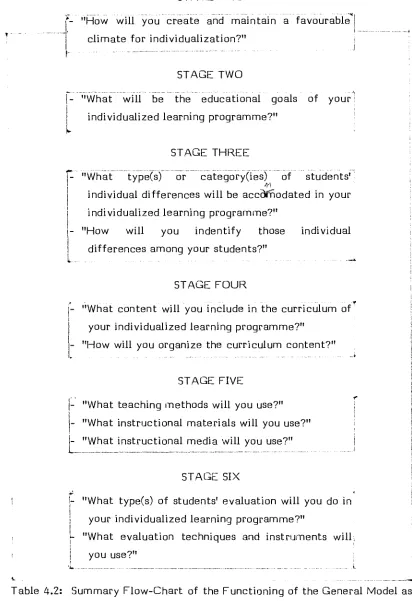
a Decision Making Process 122
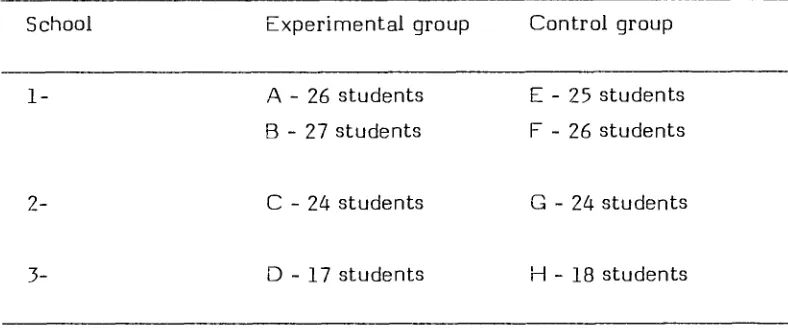
5.1 Distribution of the Sample for the Final Experiment 171 5.2 Agreement between the Answers of the Teachers in the
Experimental Group on the Teaching Strategies Inventory at First Observation Time (June, 1976) and the Answers of the Same Teachers on the Same Test at Second Observation Time
(November, 1978) 180
5.3 Mann-Whitney U Test of Differences between the Scores of the Teachers in the Experimental and Control Groups on the Teaching Strategies Inventory (second observation time) 185
PAGE 6.1 Means and Standard Deviations of the Mathematics Achievement
Test Scores Obtained by the Students in the Experimental and
Control Groups 190
6.2 Two-Way Analysis of Covariance for the Students in the Experimental and Control Groups on the Mathematics
Achievement Test 191
6.3 Means and Standard Deviations of the Mathematics Achievement Test Scores Obtained by the "Weak" Students and the "Strong" Students in the Experimental and Control Groups 192 6.4 One-Way Analysis of Covariance for the "Weak" Students in the
Experimental Group and the "Weak" Students in the Control Group on the Mathematics Achievement Test 193 6.5 One-Way Analysis of Covariance for the "Strong" Students in the
Experimental Group and the "Strong" Students in the Control Group on the Mathematics Achievement Test 194 6.6 One-Way Analysis of Covariance for the "Weak" Students and the
"Strong" Students in the Experimental Group on the Mathematics
Achievement Test 195
6.7 One-Way Analysis of Covariance for the "Weak" Students and the "Strong" Students in the Control Group on the Mathematics
Achievement Test 196
6.8 Means and Standard Deviations of the Numerical Values Assigned by the Students in the Experimental and Control Groups on the
Subject Perception Test 197
6.9 Two-Way Analysis of Covariance for the Students in the Experimental and Control Groups on the Subject Perception Test 198 6.10 Means and Standard Deviations of the Numerical Values Assigned
by the "Weak" Students and the "Strong" Students in the Experimental and Control Groups on the Subject Perception Test 200 6.11 One-Way Analysis of Covariance for the "Weak" Students in the
Experimental Group and the "Weak" Students in the Control
Group on the Subject Perception Test 201
6.12 One-Way Analysis of Covariance for the "Strong" Students in the Experimental Group and the "Strong" Students in the Control
Group on the Subject Perception Test 202
6.13 One-Way Analysis of Covariance for the "Weak" Students and the "Strong" Students in the Experimental Group on the Subject
Perception Test 203
6.14 One-Way Analysis of Covariance for the "Weak" Students and the "Strong" Students in the Control Group on the Subject Perception
Test 203
6.15 Means and Standard Deviations of the Minnesota Teacher Attitude Inventory Scores Obtained by the Teachers in the
PAGE
6.16 Mann-Whitney U Test of Differences between the Pretest scoresof the Teachers in the Experimental and Control Groups on the
Minnesota Teacher Attitude Inventory. 205
6.17 Mann-Whitney U Test of Differences between the Pretest-Posttest Gain Scores of the Teachers in the Experimental and Control Groups on the Minnesota Teacher Attitude Inventory 207 6.18 Covariance Analysis of the Minnesota Teacher Attitude
ACKNOWLEDGEMENTS
A number of persons have contributed to the present study. The author wishes here to express his sincere gratitude to those who have helped directly.
He wishes to express particular gratitude to Mrs D.M. Penfold and Dr F.J. Taylor, his supervisors, who have given the necessary guidance and encouragement to accomplish the study.
He is also very much indebted to Dr R.E. Tremblay whose friendship as well as his work has been a constant source of inspiration.
Special thanks are due to Dr G. Claxton who kindly replaced Dr F.J. Taylor during his leave of absence in Nigeria.
The study would not have been possible without the cooperation of the students and teachers in District Number Thirteen, Moncton, New Brunswick, Canada. This cooperation was achieved with the help of Mr Y. Ouellette, superintendent of School District Thirteen. The author is most grateful for their help.
Mr R. Chodos and Ms M. MacLeod-Boulet edited the manuscript and Mrs Ginette Sanchez typed it. For their masterly work the writer is most grateful.
Financially, the study was made possible by the University du Québec a Rimouski and a Hull.
The main object of this study is to develop and test a general model for individualizing instruction.
1. Definition of the Problem.
The most important single variable in the learning process is the individual learner. The most important single principle in psychology is that no two individual learners are identical. These statements are hardly new discoveries, but they do point up what many educators perceive as one of today's most challenging problems: the individualization of instruction.
There is, indeed, a wide range of individual differences among students. Students differ among themselves physically, intellectually, socially and emotionally. They differ, sometimes widely, in their interests and attitudes, their values and their goals, their talents and needs. They differ in their backgrounds and in the varieties of previous experiences they have accumulated.
In addition to these rather obvious differences, students differ in another way which, for the purposes of the present study, might be considered the most significant of all: they differ in their learning styles. That is, they differ in their modes of acquiring, retaining and applying knowledge. They differ in the ways they respond to particular methods of instruction.
The truth of these observations is evident in the classroom where some students learn more easily through reading, others through listening, and others through doing things. Some prefer to work under pressure, others prefer a more leisurely pace. Some need constant direction, others do better in a more informal classroom. In fact, as reported by Riessman (1972), each student has a distinctive style of learning, as individual as his personality.
The individualization of instruction is not a new theme in educa-tion. Looking back to the pre-Christian era, one finds that Plato and Socrates recognized the existence of human variabilities in the education process. During the early middle ages, Charlemagne and Rabelais paid particular attention to individual differences. During the Renaissance in Italy and the Reformation in England, it was recognized that different students had different interests and students were encouraged to do anything for which they had natural inclination.
The movement toward individualization was strongly influenced during the eighteenth century by Rousseau who criticized the teachers of his day for destroying special individuality in the classroom and by Pestalozzi who forcefully expressed his belief in individuality.
During the first half of the twentieth century, the educational system has benefited from the philosophical and practical contributions'of a large number of educators, notably Montessori, Dewey, Froebel, Ferriere, Reddie, Dottrens, Frenet, Lubienska, Wasburne, Kilpatrick and Parkhurst.
Since 1959, the movement toward individualization has further intensified and Piaget, Bruner, Skinner, Bloom, and many others have made major contributions to it.
In the last two decades in particular, most educators have made at least some attempt to recognize and provide for individual differences among students. Consequently, a large number of models have been developed for the purpose of individualizing or helping to individualize instruction.
A further analysis will also show that each of these procedures has its uses as well as its limitations. Just as there is no one best way of teaching in general, neither is there any one best way of individualizing learning.
The most common and most important limitation of these proce-dures for individualizing learning is that they are often not applicable by the average teacher in the average school. While all the procedures pursue the same goal which is to individualize learning, they have been developed to be used under very specific and predetermined conditions. Therefore the majority of the proposed procedures for individualizing learning cannot be adapted to every situation (teachers, students, schools). Consequently, only a minority of teachers can benefit from any one procedure on any one occasion.
On the basis of the foregoing, one may deduce an urgent need for a general model aimed at understanding individualized teaching and at the same time catering to individualized learning. The main purpose of such a model would be to provide teachers with the opportunity to exercise their particular strengths in teaching and a chance to compensate in some way for their individual weaknesses and this, without being prejudicial to the individual learner.
The approach to a model of individualization of instruction pro-posed in this study, is to provide teachers with a flexible guide allowing them to design and administer individualized learning programmes according to their individual requirements and above all according to the particular situations in which they are placed.
2. Major Trends of the Present Study
of generally accepted synthesis at this level, these procedures are classified under five major categories: those centred on organizational patterns; those centred on curriculum development; those centred on the instructional process; those centred on educational facilities; and those student-centred. Next, a description and critical analysis of the major procedures
represen-tative of each category is made. The rationale for doing this is that the relevance of a new general model for individualizing instruction could be better understood within the perspective of existing procedures.
A review of the effects in terms of educational outcomes of the major procedures for individualizing instruction is also presented. This is done in order to make observations that could help in the design of a meaningful assessment of the effectiveness of a new model for individuali-zing instruction.
This is followed by a descriptive analysis of a pilot study made in an effort to justify the theoretical and practical elements proposed in the new model for individualizing instruction, and in an effort to perfect the experimental plan used to test the new general model.
The new general model for individualizing instruction is then intro-duced and shown to emphasize flexibility by means of alternatives which allow each teacher to design and administer his own programme of individualized learning according to his individual requirements and above all according to the particular situations in which he is placed.
The conceptual framework of the general model is then presented, followed by the translation of this framework into operational elements.
The empirical part of the study is an assessment of the effec-tiveness of the general model in terms of its effects on students' academic achievement, students' attitudes towards a subject and teachers' attitudes towards students.
tal classrooms applied the general model while the teachers in four control classrooms delivered regular instruction. The basic research design used for the study is the "non-equivalent control group design" proposed by Campbell and Stanley (1966) in which the tests are given twice, once at the beginning of the experiment (pretests) and once at the end of the experiment (posttests).
The findings are presented in three sections, the results of testing hypothesis I (the effects of the general model on students' academic achievement); the results of testing hypothesis II (the effects of the general model on students' attitudes towards a subject); the results of testing hypothesis III (the effects of the general model on teachers' attitudes towards students).
In the final chapter a summary of the study and general conclusions are presented.
CHAPTER 1
A CLASSIFICATION AND ANALYSIS OF PROCEDURES
The interest raised by individualized instruction, particularly in the last two decades, has led educators to develop and implement a large number of procedures for individualizing instruction or at least providing for differences among students in a manner that might facilitate individualiza-tion. Most procedures have the same general orientation, that is toward the individual instead of the group or class. However, the implementation of that general orientation takes different forms in practice.
In the following pages a descriptive and critical review of the main procedures for individualizing instruction is made in an effort to make observations about possible future developments. In order to introduce some synthesis into this endeavour, the procedures which are being reviewed in this chapter are classified in five major categories: those centred on organizational patterns; those centred on curriculum development; those centred on the instructional process; those centred on educational facili-ties; and those student-centred.
It must he noted here that while reviewing the literature on individualized instruction, the author was seeking procedures implemented for the purpose of individualizing teaching (aimed at fitting the teaching method to the teacher) as well as procedures directed toward individualizing learning (aimed at fitting the teaching to the learner). The rationale for doing this is that both teaching and learning are considered basic com-ponents of the instructional process.
1.1 Procedures Centred on Organizational Patterns.
Some methods of individualizing instruction concentrate on re-arranging the organizational or structural features of a school. Such programmes are fundamentally organizational, although they obviously have their roots in the curriculum and may greatly influence curriculum develop-ment within the school.
1.1.1 Team Teaching.
Team teaching as a method and specific team programmes have dominated the education literature for the past several years. The first experimental projects were launched in the United States in 1956 by the National Association of Secondary School Principals, which established the Commission on Curriculum Planning and Development. Other major contri-butions to the progress of team teaching were provided by the Commftee on Staff Utilization, Harvard University and Claremont College of California.
All these projects were instigated to devise new approaches to the critical problems confronting the schools: the continuing curriculum explo-sion, the population boom and the acute shortage of teaching personnel.
The main objectives of team teaching programmes have been sum-marized by Singer (1964), Fraenkel and Gross (1967) and York (1971), They are:
a) More intelligent use of the teacher's specialized talents, interests, training, time and energy.
b) Differentiated instruction more closely associated with and effectively geared to individual student abilities and learning styles.
c) More freedom for teachers to prepare lessons, develop curri- cula, read, be creative and keep abreast of new developments during school hours.
According to Singer (1964) and Hanslovski, Moyer and Wagner (1969), there are two typical models of team teaching. The first of these takes three distinct forms: the single-discipline team usually consists of two or three teachers from the same department who jointly instruct a group of students. In an inter-disciplinary team the teachers offer instruc-tion in different disciplines to a shared group of students in classes of flexible size, arranging the timetable to suit the students. In a school-within-school team, teachers from all disciplines are responsible for the instruction of the same group of students, usually for two to four years, with due flexibility in class size and schedule.
The second typical model for team teaching, as proposed by Bair and Woodward (1964), Lobb and Delbert (1964), Shaplin and Odds (1964), Chamberlain (1969) and Warwick (1971) consists of the hierarchical and the co-operative type. The former usually entails a set of hierarchies based on ability, responsibility and specialized training, with proportionate rewards and prestige. In the latter, teachers work together voluntarily as a team without any hierarchy and any member may have to assume the role of leader when a situation arises requiring his particular abilities.
Of course teaching teams can be organized in many ways, but if they are to succeed, the members must be compatible and willing to expend sufficient energy to meet the demands of individualized instruction. Fur-thermore, all team members must work towards true co-operation. In relation to this point Engman's (1973) research revealed that the most frequent causes of failure in team teaching are personality clashes and a lack of planning time.
Team teaching is an organizational scheme which was not primarily intended as a means of individualizing instruction. The practice of having several teachers working together as a team can, nevertheless, be a useful instrument for individualization. If nothing else, team teaching can increase the probability that a given student will encounter, at least for a while, a teacher whose style of teaching matches his style of learning.
student interaction and for instructional flexibility.
The major limitation of team teaching is encountered in its implementation. There may be problems with respect to organizational restructuring and available funds, time and personnel.
1.1.2 Non-Grading in Instruction.
In the search for better ways to organize schools, a first experi-mental non-graded school was initiated in 1934 at Western Springs, Illinois under the heading of the Flexible Progress Plan. Since then, as reported by Goodlad (1955), Slater (1955), Austin (1958), Goodlad and Anderson (1958), Dean (1960), The National Education Association Research Devision (1961), and Alexander (1968), countless experimental projects have been launched all over America. Today the non-graded movement pervades the educa-tional scene from the nursery schools through the secondary schools.
Programmes in most traditional schools are based on the assumption that all students should be subjected to the same content, at the same time and at the same rate simply because they are in the same grade and are approximately the same chronological age. The focus is on the content to be covered. In a non-graded programme, there is instead an acceptance of the notion that there is no such thing as an entire class of students at one level of learning. The focus is on the individual needs of each student and his quest for self-discovery.
Hillson (1971) suggests several basic tenets drawn from the litera-ture which may serve to clarify the philosophy behind non-graded education. These tenets are summarized as follows:
a) In every group of learners there are wide differences in quality, desire and intent.
c) Every student in the elementary and secondary schools should be judged by the best that he can do.
d) No student should be judged by the median performance of a non-select group.
e) No student should be judged solely on the basis of his chronological age.
f) No student should be judged on a grade standard that is clearly indefensible and that cannot be defined in realistic terms related to the research on child growth and development.
Simply, non-grading in instruction can be defined as an organiza-tional and administrative rather than an instrucorganiza-tional device which does away with conventional age-grouping in favour of grouping according to the individual student's needs. A non-graded school is one in which grades are replaced by levels that a student accomplishes at his own speed; promotion and non-promotion are eliminated.
Because of the very decentralized nature and self-determination of most educational systems, there is no one "model" non-graded school. Various plans of non-grading exist. Tewksbury (1967) suggests three different ways of implementing a nongraded programme. They are:
a) To provide multilevel instruction in a self-contained, hetero- geneous classroom.
b) To assign students to self-contained classes according to performance levels.
c) To regroup a large aggregate of children from time to time to form classes that work at different levels under different teachers.
selection and that a standardized curriculum sequence is required for all students.
Non-grading in instruction is not just a simplistic method of teaching, nor should it be just an administrative or organizational reshuf-fling. Ideally, non-grading in instruction should create a framework in which better methods can be used and in which fluidity and flexibility allow exploitation of various activities that further learning.
Like team teaching, non-grading in instruction does not attack the problem of individual differences in the most direct way possible. There is yet no direct evidence that simply placing a student in a non-graded school is a guarantee that he will learn anything of consequence or that his particular educational needs will be met, neither does the practice of having him skip a grade or repeat a grade, or that of grouping him with others of like ability.
Although non-graded programmes provide experiences appropriate to each student, it seems that most of them have so far achieved individualization in only one respect: students proceed through the same material in pretty much the same way, but they do so at their own individual rate. In this respect, it is important to note the verdict of Wilt (1971) and McLoughlin (1972) who both disagree with the idea that the instructional problems posed by individual differences are to be solved only by tailoring groups accordingly.
As with team teaching, the major limitation of non-grading in instruction is its implementation. There may be problems with respect to the complex administrative and organizational restructuring, and the availa-ble funds, time, space and personnel.
1.2 Procedures Centred on Curriculum Development.
It has long been one of the goals of education to transform the traditional curriculum into appropriate learning activities in order to meet the needs and interests of the students. From 1920 to 1950, child study and the ideas of Dewey (1913) were a strong influence on the refinement of educational procedures. Childhood was recognized as a period distinct from later development, with concerns, interests and developmental needs not necessarily related to preparation for adult life. This led to a search for content relevant to the student's needs, and to the development of plans, like the "project method", in which topics of interest to students became the centre of organization of learning experiences. After 1950, reactions to this "progressive" approach suggested that learning had become too incidental; much content was omitted or lacked logical sequence. Participation of academic scholars tended to move curriculum into subject areas again, although active participation of learners and direct experiences were still seen as appropriate learning strategies. Less emphasis was given to interests and problems as primary determinants of content. At the same time, another trend with important curricular implications was the "Open Education" approach supported by the ideas of Bruner (1966) and Piaget (1969) who claimed that it is essential to plan all areas of curriculum in terms of child growth and development. Proponents of this approach pointed out that each child learns best when enablebto learn at the pace, and in the sequence, that meet his unique needs.
Since 1965 the major trend has been toward matching individual student needs with appropriate learning activities. The focus is on the individual student and his continuous progress. The emphasis is on goal setting or instructional objectives. The major characteristics of this "continuous progress" aproach are the planning of curriculum in terms of the individual student's needs, interests, and capacities, and the careful and individual evaluation of his progress to stimulate and assist his continuing evolution.
This curriculum is made up of personalized units of instruction which allow the individual student to progress in each subject at his own pace, according to his background, interests and abilities. There is very little emphasis on competition.
There are two main requisites for a continuous progress programme: first the curriculum must allow students to work through the content in logical order without interruption by artificial barriers, and second the curriculum must allow each student to work through the content at his own pace, according to his abilities, interests and individual characteristics.
Many attempts have been made to design a continuous progress curriculum, perhaps the most notable being the use of individualized learning materials, known as "Learning Packages", which according to Bishop (1971) comprise two types of material: teacher-prepared material developed within a specific school programme, and commercially-prepared material developed outside a school programme and more general in format.
1.2.1 Teacher-Prepared Material.
Several independently developed sets of material are representa-tive of this procedure, namely Individual Study Units (Lewis, 1971), Learning Activity Packages (Kapfer and Kapfer, 1972), Booklets for individual Pro-gress (Wilkins and Frase, 1972), and UNIPAC (Ringis, 1971). Despite the variation in names, these learning guides are all similar in design and intended use.
Typically, these learning guides consist of one or more objectives stated in behavioural or performance terms, a set of learning activities for achieving the objectives, and criterion-referenced tests for measuring entry behaviour, student progress, and terminal achievement.
Sciences. McNeil and Smith (1968) define it as a broadly-based set of materials providing each student with alternatives of how, what, when and where to learn along with a wide range of learning resources. In fact, its primary function is to guide the student through a highly-structured programme of learning material.
Like most learning packages, the Lapp comprises the following:
a) Unit's title (topic to be studied),
b) Unit's purpose (reason for studying the topic),
c) Objectives (intended learning outcomes),
d) Performance measures (pre-evaluation, self-evaluation, post-evaluation),
e) Learning activities (material and methods for achieving the objectives),
f) Enrichment activities (learning opportunities beyond the ob-jectives).
the package, the student can proceed to another LAP, taking the unit test to establish a grade and get a unit credit, if he wishes.
In such a complex programme of individualized instruction, the teacher's function is very different from that in a traditional programme, as Flynn and Chadwick (1970) showed in a survey conducted in the Nova public school's complex in Fort Lauderdale, Florida. In fact, the LAP tends to reduce the teacher's direct control over the subject matter acquired in class. In short, the teacher's role becomes more exploratory than didactic or dominant.
Most learning packages contribute directly to the solution of the problem posed by individual differences. Indeed, the use of the "multi's" approach (multi media, mode, content and activity experiences) allows each individual student to work at his own pace and in ways that are unique to him.
One of the obvious limitations of the learning packages is the requirement of an appropriate environment (laboratories and educational facilities) for its implementation. There may be problems as regards available funds and time and the size of the class.
1.2.2 Commercially-Prepared Material.
For the present study, the IPI system provides a good example of an attempt to develop commercially-prepared material. Scanlon (1970) defines it as an instructional system based on a set of behavioural objectives correlated with diagnostic instruments, curriculum material and teaching techniques.
The IPI system aims to improve learning in general on the basis of five major objectives. These objectives are: to enable each student to work at his own pace through units of study in a learning sequence; to develop a demonstrable degree of capability in each student; to develop initiative and direction; to develop a capacity for problem-solving; to encourage self-evaluation and motivation for learning.
The IPI system usually entails the following:
a) Specification of educational objectives,
b) Organization of relevant methods and material,
c) Evaluation of each student's current competence in a given subject and evaluation of his achievement in terms of the educational objectives, by means of placement tests, pretests, postests and curriculum embedded tests.
d) Daily evaluation and guidance of each individual student.
e) Frequent monitoring of progress for the benefit of student and teacher alike.
f) Continuous evaluation and improvement of curriculum and instructional procedures.
objectives in the unit and the work required to reach each objective. IF the test results show the teacher that the student knows most of the material and only needs rapid revision to master the objectives, the prescription is arranged accordingly. But if it seems the student needs a better conceptual framework within which to attain the objectives, the teacher may assign a more comprehensive prescription to the student. Also, as the student proceeds through a lesson, he undergoes curriculum-embedded tests to check his progress. Once he has mastered this step, he proceeds to the next step mapped out for him. On completion of a unit, the student takes a posttest and proceeds to the next unit if a satisfactory score is attained. If not, the student does further work to reinforce weak points and takes the posttest again.
According to Lindvall and Bolvin (1970), IPI teachers do very little lecturing to the entire class*. They spend most of their time administering tests, diagnosing individual needs, preparing prescriptions, evaluating stu-dents' progress, helping individuals on a one-to one basis or instructing small groups of students experiencing the same particular difficulties. In short, the IPI system requires the teacher to know the student better and guide his education more closely than the traditional system.
As is the case for most of the attempts reviewed so far, the major limitation of the majority of the commercially-prepared individualized learning units is encountered in their implementation. A common limitation is the requirement of an investment of resources in the neighbourhood of $10 per student annually for the IPI and !GE systems and of $100 per student annually for project PLAN. In addition, the IPI system requires a heavy investment in students' cognitive skill development, especially for special education and slow learners; on the other hand, the IGE system requires a willingness to restructure the school organization completely, and a com-mitment to a three-year staff development programme; and finally, project PLAN requires a staff commitment for a few weeks of in-service training in
the PLAN system.
1.3 Procedures Centred on the Instructional Process.
Two techniques for individualizing instruction that concentrate on the instructional process are independent study and mastery learning.
1.3.1 Independent Study.
Independent study is essentially a variation of differentiated as-signments which teachers have been giving for years and of student-teacher contracts which have long been used at the college level and more recently at the high school level.
becomes more involved in the purposes of his study and work and more aware of its value and relevance.
Although effective independent study strategies have been deve-loped only recently, the idea of using independent study as a teaching strategy is quite old. In the 1920s there were at least two major attempts to produce independent, self-directed learning. One was the Stanford Plan developed and initiated by Robinson (1937) at Stanford University in 1925. Since 1960, use of independent study strategies has spread throughout North America and whole school systems remodelled their school plants and reorganized instructional formats to accomodate independent study situa- tions for students. Among some of the most recent and important programmes of independent study at the elementary, secondary and college level are the Kahala Elementary School Programme in Honolulu, Hawaii (National School Public Relations, 1971); the Claremont High School Programme in California (Bishop and Wiley, 1968); and the University of Chicago Project (Congreve, 1965).
Not surprisingly, there is no one "model" of independent study. Nevertheless, according to Patrick (1965) and Hoover (1974), at the elemen-tary level, an independent study programme may embody three distinct phases or levels of independence. The first phase is essentially teacher-directed or teacher-oriented, in preparation for the subsequent progression toward independence. This phase is particulary helpful for students with specific learning difficulties and uses a combination of teaching aids and individual tutoring.
The second phase of the independent study programme is also partly teacher-oriented, but assignments are left open-ended, with no limit on what students may do, thus enabling them to work at their own pace according to their ability. Students are given guidance in planning the constructive use of their unscheduled time but they decide themselves on the actual timing of their studies.
Naturally, as suggested by Patrick (1965) and Lonnon and Bodine (1971), in an independent study programme the teacher's role changes from that of a taskmaster to that of counselor, guide and friend. Independent study in some form can be used at any level from kindergarten through graduate school. It can be used either regularly or just occasionally, and with or without any special material, space and facilities.
Independent study is probably one of the most direct ways of individualizing instruction. When used in its absolute form, independent study provides each individual student with maximum freedom to choose what, how and when to learn; if not used in its purest form, a modified programme of independent study will, at the very least, foster the development of responsibility, initiative and self-direction.
However, as is the case for the majority of procedures for individualizing instruction reviewed so far in this study, there may be problems when implementing an independent study programme. One of them is the requirement of a low student-teacher ratio for adequate planning, counselling and supervision. Independent study can also be expensive if used on a comprehensive basis in a school, mainly because the strategy may require adjustment in the use of space, personnel and material.
1.3.2 Mastery Learning.
Mastery learning is one of the plans proposed by educators who believe in behaviourist psychology. Essentially, mastery learning is an instructional strategy designed to bring all or almost all students to a specified level of mastery.
The plan itself is not new. According to Block (1971), as early as the 1920s, there were at least two major attempts to produce mastery in students' learning. One was the Winnetka Plan of Carleton Washburne and his associates (1922); the other was an approach developed by Henry C. Morrison (1926) at the University of Chicago's laboratory school. During the 1930s, the idea of mastery learning disappeared, mostly as a result of the lack of technology required to sustain a successful strategy. It did not resurface until the late 1950s and early 1960s, this time as a corollary of programmed instruction. Programmed instruction worked very well for some students, but it was not effective for all or even almost all students. Furthermore, programmed instruction did not produce a useful mastery learning model. It was only in 1963 that Carroll (1963) produced what is recognized today as the first useful conceptual model of mastery learning. Carroll's model was based on the assumption that most learning tasks in a school curriculum can be mastered by all students if each student is given the time he needs. He viewed the time needed by a student to learn a school task as a function of the complexity of the task, the aptitudes and prior learning of the student, his ability to understand instruction, his perseverance in mastering the task, and the quality of the instruction. In fact, Carroll proposed that the quality of instruction depends on such elements as how clearly the learning tasks are defined; how well the materials are sequenced and graded; and how effectively tests are used to provide encouragement, praise and cognitive feedback. Then, Bloom (1968) incorporated these elements into his personal approach and transformed Carroll's model into an effective working model for mastery learning.
Nowadays, there are many versions of mastery learning in existen-ce. However there are two basic strategies from which most approaches to mastery derive. These approaches are Bloom's learning for mastery strategy and Keller's (1968) personalized system of instruction.
Although they differ in these specific ways, Bloom's and Keller's strategies also share a set of common features which are considered essential to any mastery learning strategies. These essential features have been described by Block (1974) and can be summarized as follows:
a) The belief that most students can master what they are taught.
b) The importance of defining mastery and mastery standards.
c) The specification of detailed instructional objectives.
d) The organization of content into small sequences of learning units.
e) The design and use of original instructional forms and modes.
f) The importance of giving students all the time and help they need to learn.
g) The development and use of specific feedback-correction procedures.
h) The belief that each student should be graded on what he has learned in absolute terms rather than how well he has learned relative to his classmates.
When implementing a mastery learning strategy, there may be problems as regards available time and the provision for alternative learning correctives and alternative learning material. One could also question the presumption that all that is to be learned can be identified with a performance criterion, as well as express doubts about the possibility of extending the mastery learning strategy beyond the cognitive domain to the psychomotor and affective domains.
1.4 Procedures Centred on Educational Facilities.
Some methods of individualizing instruction concentrate on the design and utilization of educational facilities.
Since 1950, the many attempts to refine the school curriculum, instructional process and organizational pattern have led to the realization that it is difficult for teachers to engage in individualized instruction or tutor individual students without proper facilities. From this realization came the important concept of educational technology.
Duane (.1973) declares educational technology essential for indivi-dualized instruction. Visual aids, closed-circuit television, films, tapes, records, and other mechanical and electronic facilities are important here. Even more significant, however, are programmed instruction and the more specialized computer assisted instruction, in which the technological impact on education in general and on individualized instruction in particular has reached its highest point.
1.4.1 Programmed Instruction.
The originator of programmed instruction is generaly considered to be Sidney Pressey (1932), the inventor of the teaching machine. This early teaching machine offered the student problems together with multiple choice questions. It caused little excitement in educational circles. The man most responsible for the excitement that later surrounded programmed learning and furthered its development was B.F. Skinner (1954). A major modification of programmed material was later introduced by N.A. Crowder (1961, 1963).
Generally, programmed instruction entails a self-tutoring serial process which the individual student undergoes at his own pace. Programmes are available to teach concepts, facts and skills in such subjects as chemistry, logic, grammar, vocabulary, punctuation, spelling, mathematics and science. There is however no programme for developing such things as values, attitudes, creative writing skills, and the ability to organize ideas and examine them critically.
In programmed instruction, the material to be learned (content) is usually broken down into a small number of units, each typically consisting of a small amount of information, followed by or sometimes incorporating a question which the learner is required to answer, usually in not more than a few words.
A basic assumption underlying the organization of content into programmed learning units is that most human behaviour is learned and that learning of any behaviour rests upon the learning of a sequence of less complex component behaviours. Therefore, according to Skinner (1954), by breaking down a complex behaviour into a sequence of component beha-viours, it is possible to learn the most complex skills. The effectiveness of organizing content into programmed learning units depends on the nature of the content itself; for some materials or contents it may result in decreased continuity, and where such continuity is necessary learning could suffer. On the other hand, with some types of content where continuity is not necessary it may facilitate learning.
In the linear programme advocated by Skinner (1958), the learner proceeds through a sequence of small units of instruction. After each unit, the learner is required to answer a question. If the answer is incorrect his error is immediately corrected so that misunderstandings are not propa-gated. Thus, the material to be learned is broken down into very small units, each one requiring an active response on the part of the learner, and after each response the learner immediately learns whether he is correct or not.
The main advantage of the linear programme is that each student can proceed at his own pace. The main disadvantage is that each student has to proceed through identical sequences of units, progressing in very small steps which can cause frustration and boredom.
In the branched programme advocated by Crowder (1960), the learner also proceeds through a sequence of units and also has to answer a question at the end of each unit. The main difference between linear programmes and branched programmes is that in the latter the basic sequence of units generally proceeds in larger steps than is common with linear programmes, and if the learner makes an error he proceeds to a subsequence of the programme which customarily reviews in more detail the material on which he erred.
The advantages of the branched programme are that each student can proceed at his own pace and that students do not necessarily proceed through exactly the same sequence of units. Thus, the branched programme can be adapted to the needs of a wider range of students.
The major contribution of programmed instruction to individua-lizing instruction is that it provides for letting students progress at their own individual rates. Another prominent feature of programmed instruction is that it is largely self-instructional.
specifications and student characteristics. Teachers must have available a large inventory of instructional materials and media from which to make prescriptions. To implement such a system requires major efforts and investments.
1.4.2 Computer-Assisted Instruction.
Programmed instruction is a teaching medium which in some important but clearly restricted ways can be adapted to the needs of individual students. Some of the restrictions can be overcome with the use of computer-assisted instruction (CAI).
Since the early 1960s, large sums of money have been spent on research in order to develop an effective computer-assisted instruction system.
Basically a CAI system includes a computing centre together with a number of student terminals. Typically the learner interacts with the computer programme by means of a typewriter keyboard and/or a video-screen that reacts to a light pen. The machine in turn communicates with the learner via audio and/or video systems.
A CAI system can be put to several uses: one of the most common involves solving computational and logical problems; a second use involves drill and practice; a third application involves using the computer as a source of information. A fourth application involves the use of computers for simulation and for games; finally, a CAI system can be used for tutorial instruction.
process and change the role of teachers, who instead of being generalists responsible for the total process become professional specialists responsible for devising instructional programmes for individual students.
Computer-assisted instruction is not widely used in education, particularly as an instructional system. However it seems appropriate to mention that in some instructional systems where the computer serves a management function, it improves quality and saves teacher time in the most crucial areas of individualization (Cooley and Glaser, 1969; Dagnon and Spuck, 1977).
In theory, CAI has enormous potential and there is a wide range of ways in which teaching by computer can be flexible and adaptive to the particular needs of the learner. According to Stolurow (1968), of all the instructional media, the computer is the only one that communicates on a completely individualized basis.
That computers are not more widely used as instructional systems is due partly to the expense of preparing individualized instructional materials (programmes), and partly to the prohibitive cost of the computers themselves. Furthermore, the implementation of a computer-assisted instruction system may cause various practical problems.
1.5 Student-Centred Procedures.
The final approach to the individualization of instruction reviewed in the present study is more free and unstructured than any of the procedures presented so far. It concentrates on the individual student and its fundamental characteristic is informality.
1.5.1 Open Education.
Open education is an example of an approach to individualized instruction which has been implemented in many British primary schools, and many schools in America are experimenting with the idea.
Whatever its label, be it informal education, open classroom, or free school, open education entails a special approach to the learning process. Advocates of open education argue, for example, that learning is a personal matter that is different for different children. They also recognize that children learn over varying periods of time, in repeated encounters with concrete material and experiences and in exchanges of different points of view.
The whole idea of open education has many historical roots. In fact, many of the attitudes that are basic to its formulations are consistent with the rhetoric that fills the literature of education. Thus, many ideas supporting the open education system are found in the philosophical and psychological writing of Jean-Jacques Rousseau, Johann Pestalozzi, Maria Montessori, Friederich Froebel, and John Dewey, as well as in the more contemporary works of Piaget (1969), Bruner (1966), Holt (1967), Kohl (1970), and Featherstone (1971).
In English primary schools, the movement toward more informal styles of teaching and learning took place over a forty-year period. The changes first appeared in the nursery and infant schools following publica-tion of the Hadow Report (1933), and studies of Susan and Nathan Isaacs (1930) on child development. The successful experiment in the infant schools, as well as publication of the Plowden Report (1967), an extensive study on children and their primary schools, fostered changes in the junior schools, and in the 1960s informal practices became more common.
According to Walter and Miriam Schneir (1971), the essence of open education is an enriched, carefully planned environment which fosters the natural instinct for learning. Students teach themselves, learning from each other, from books, and from encounters with the world about them. Silberman (1973) also stresses the fact that open education sets great store by youth and puts considerable emphasis on the quality of the school experience as an experience in itself, not merely as a preparation for subsequent study and later life. Classrooms must therefore be congenial, for the experience of youth should not be sacrificed to a race to reach adulthood.
Because teachers and students are at many different stages in their development and have different levels of experience and different personal interests, open education classrooms tend to develop their unique qualities. Space and material as well as the school community environment also make a difference. Still, there tend to be many common attributes.
In an open education classroom, students no longer sit in rows facing the blackboard; they work in groups or individually although occasionally a whole class has a formal lesson before the blackboard. It is common to see a variety of learning activities going on at the same time. Some children may be reading, others acting out a play, working at math, or
painting. The mobility of children is apparent.
The classroom is typically decentralized into a variety of learning areas each representing a subject or a domain of activity. Commercial and homemade material of considerable range and diversity are found in abundance. Along with the use of common material, open education teachers place stress on the outside environment, which they view as too rich to be ignored. It serves as an excellent base for children to gain significant skills in observing, recording and interpreting what goes on in the world.
work at their own pace on a topic of their choice from the range of subjects carefully planned by the teacher. There are generally no examinations or report cards as such. Rather, parents receive detailed histories reporting what each student has accomplished. Indeed, one of the teacher's major tasks is record keeping. This is important because children are at so many different levels and working on so many diverse topics. Planning and provisioning would be less constructive without a careful record-keeping system. The teachers attempt to write something each day about each child. And the children also maintain a variety of records. They record their activities for the day and place some of their writing, math, and other projects into files for the teacher to review.
Teachers play a far more active and creative role in open educa-tion than in the tradieduca-tional educaeduca-tional setting. Barth (1973) considers it most important for teachers to do everything in their power to keep each student fully occupied in his particular daily activity for as long as possible, in as active and exploratory a way as possible. In this catalytic role teachers must do the following:
a) Respect chidren as individuals.
b) Organize the classroom to extend the range or possibilities children can explore.
c) Select and provide appropriate material.
d) Enhance children's self-expression.
e) Provide direct instruction when appropriate.
f) Encourage children's activity and exploration.
g) Encourage responsibility and independence.
year. By the end of the academic year, the balance has usually shifted even more toward child direction.
Open education holds considerable promise as a vehicle for indivi-dualization. Indeed, in the open education curriculum the emphasis is on each student's interests and needs. Furthermore, the open education system allows students to have different speeds and styles of learning. It is also evident that open education classrooms offer maximum freedom for the student's selection of learning experiences. In short, open education implies an "atmosphere" different from that generally found in the traditional classroom. This new atmosphere is characterized by students making decisions; selecting, at least partially, their own objectives; resolving conflicts; experiencing freedom to direct themselves; and most important, being responsible for their activities.
There are however some difficulties ahead for those who wish to implement an open education system. First, one must be fully aware that an open education system cannot survive in an environment that does not support openness, individuality, participation and trust. As such, it implies that teachers, as well as parents and administrators, are willing to "let go" of children and allow them freedom to explore, to initiate, and occasionnally to be wrong. Open education also demands careful preparation and restructuring as well an environment where support services (physical and intellectual) are available. This may cause some practical problems.
1.5.2 Open Space.
The main assumption underlying the open space concept is that young children need to move about and interact with people and the environment. As such, open space schools are designed to extend the learning environment and to use it more effectively.
A feature of many open space schools is the arrangement of classrooms in pods around a library and large multipurpose area. Within each pod there are classrooms which open directly into a large work centre that contains instructional media appropriate to the designated levels of instruction. Such an arrangement makes it possible to take advantage of various patterns of organization and grouping.
The major difference between open space schools and traditional schools is that in the latter, space is divided into rooms that are assigned on a permanent basis without much flexibility in use. Open space is flexible and, given proper furniture and equipment, the use of the space can change almost instantly. Students and teachers may move from a large group activity to small-group or individual study, and learning activities can flow from one place to another.
As a vehicle for individualization, the open space concept provides tremendous opportunities for students to work independently. As such, when properly planned and utilized, open space schools may foster the develop-ment of responsibility and self-direction.
1.6 Summary and Conclusions.
A large number of procedures have been developed and implemen-ted particularly in the last two decades, for the purpose of individualizing or helping to individualize instruction. Those procedures have been analysed and classified under five major categories: those centred on organizational patterns; those centred on curriculum development; those centred on the instructional process; those centred on educational facilities; and those student-centred.
While they are all oriented towards the individual, each set of procedures concentrates on a different aspect of the educational system. The procedures centred on organizational patterns, namely team teaching and non-grading in instruction, concentrate on rearranging the organiza-tional or structural features of a school. The procedures centred on curriculum development, namely the project method and the continuous progress approach, concentrate on the utilization of systematic, formalized programmes of individualization. The procedures centred on the instructional process, namely independent study and mastery learning, concentrate on rearranging the traditional instructional strategies. The procedures centred on educational facilities, namely programmed instruction and computer-assisted instruction, concentrate on the design and use of relevant educational facilities. The student-centred procedures, namely open education and open space, concentrate on the individual student and are characterized by informality.
Having studied the state-of-the-art in individualized instruction, one realizes that all the procedures for individualizing instruction are directed toward fitting the teaching to the learner (individualized learning) and none is directed toward fitting the teaching method to the teacher (individualized teaching).