On the universality of the
J
=
0
fixed pole contribution in DVCS
D. Müller1,aand K. Semenov-Tian-Shansky2,b
1Theoretical Physics Division, Rudjer Boškovi´c Institute, HR-10002 Zagreb, Croatia 2Petersburg Nuclear Physics Institute, Gatchina, 188300, St.Petersburg, Russia
Abstract.S. Brodsky, F.J. Llanes-Estrada and A. Szczepaniak formulated theJ=0 fixed pole universality hypothesis for (deeply) virtual Compton scattering. We show that in the Bjorken limit this hypothesis is equivalent to the validity of the inverse moment sum rule for theD-term form factor. However, any supplementaryD-term added to a generalized parton distribution (GPD) results in an additional J = 0 fixed pole contribution that violates universality. Unfortunately, one can not provide any reliable theoretical argument excluding the existence of such supplementaryD-term. Moreover, the violation ofJ=0 fixed pole universality was revealed in field theoretical GPD models. Therefore,J =0 fixed pole universality hypothesis remains just an external assumption and probably will never be proven theoretically.
1 Introduction
Studies of Compton scattering offa nucleonγ(∗)(q1)+N(p1)→ γ(∗)(q2)+N(p2) with both photons
being real (q2 1 = q
2
2 = 0) or with one (q
2 1 = −Q
2 1,q
2
2 = 0) or two (q
2 1 = −Q
2 1,q
2 2 = −Q
2 2) virtual
space-like photons allow to probe nucleon structure in low and high energy regimes. The customary theoretical framework which helps to address Compton scattering in high energy regime is the Regge theory. Assuming the existence of the leading Regge trajectoryα(t) (t≡(p2−p1)2), the high energy
leading asymptotic behavior∼ sα(t) of the amplitude originates from a moving pole in the plane of
complex cross-channel angular momentumJ. Besides these common moving poles (and/or cuts) there
also might exist so-calledfixed polesingularities (seee.g.Chapter I of Ref. [1]), that do not slide with
the change oftand can not be revealed by means of the analytic continuation inJ. AJ =J0 fixed
pole singularity may arise from a cross channel exchange with a non-Reggeized (elementary) particle of spinJ0in the cross channel (or from a contact interaction term). It appears then as the Kronecker-δ
singularity in the complexJ-plane.
The discussion on the manifestation of the J = 0 fixed pole singularity in Compton scattering,
which results in constant contribution in high-energy asymptotic limit, lasts since the late sixties (see the pioneering paper [2] and Ref. [3] as well as references therein). S. Brodsky, F. Close and J. Gunion identified this contribution at the diagrammatic level. They argue it originates from “seagull” diagrams corresponding to local two photon interaction. More recently, in [4] S. Brodsky, F. J. Llanes-Estrada
and A. Szczepaniak emphasized that suchJ=0 fixed pole contribution in virtual Compton scattering
is universal (i.e. independent of photon virtualities) and can be expressed by the inverse moment of
the correspondingt-dependent parton distribution function (PDF).
On the other hand, theJ=0 fixed pole contribution in deeply virtual Compton scattering (DVCS)
is closely related with the D-term form factor, which arises as the subtraction constant for deeply
virtual Compton scattering amplitude within the partonic picture. The D-term [5] was originally
introduced to complement the polynomiality condition for GPDs within the double distribution (DD) representation. Later it was realized that it could be implemented as an inherent part of GPD both within the modified DD representation and within the representations based on conformal partial wave (PW) expansion of GPDs.
Below, following Refs. [6, 7], we review the relation between the J =0 fixed pole contribution
and theD-term form factor. We tie together the J-analytic properties of cross channel SO(3) PWs
and those of GPD conformal moments in the conformal spin j. We show that theJ =0 fixed pole
universality hypothesis generally remains unproven and only can be accepted as external principle for building up phenomenological GPD models.
2 Dispersive approach for Compton amplitude
We focus on the Compton form-factor (CFF)H(ν≡s−4u,t|Q2
1,Q22) occurring in the parametrization of
the transverse non-flip photon helicity amplitude of Compton scattering. This CFF has even signature
(P= +1;C= +1) and is the analogue of the usual Dirac electromagnetic form factor. In the forward
kinematics the imaginary part ofHcorresponds to the deep inelastic structure functionF1.
A fixed-tdispersion relation for the CFFH can be obtained adopting usual assumptions on the
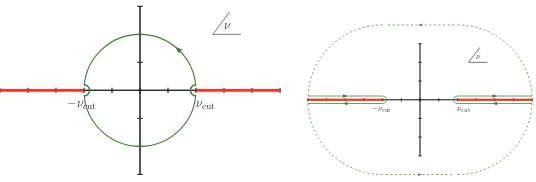
analytic properties of CFFs. Neglecting the Born term (which is irrelevant in the Bjorken limit) we consider the deformed integration contour surrounding cuts on the real axis starting at the pion
production thresholdνcut =
Q2 1+Q
2
2+t+(M+2mπ) 2−M2
4M (see Fig. 1). Assuming thatH vanishes at infinity
(lim|ν|→∞H(ν,t|Q2 1,Q
2
2)=0), we obtain the unsubtracted DR in the standard form,
H(ν,t|Q21,Q22)=1
π ∞
νcut
dν2ν
ImH(ν,t|Q2 1,Q
2 2)
ν2−ν2−i . (1)
OnceHdoes not vanish at infinity one still can formally consider the unsubtracted DR by specifying
a regularization procedure both for the divergent integral along the real axis and (either divergent) contributions from large semicircles of the contour on right panel of Fig. 1. A possible choice is the
analytic regularization (seee.g. Ref. [8]). The dispersive integral is replaced by the loop integral in
the complex plane that includes the pointν=∞, denoted as (∞). The unsubtracted DR for CFFH
then reads
H(ν,t|Q21,Q22)=H∞(t|Q21,Q22)+1
π (∞)
νcut
dν2ν
ImH(ν,t|Q2 1,Q22)
ν2−ν2−i , (2)
where the constantH∞, arises from the analytic regularization atν = ∞. Within the Regge–pole
expansion of the amplitude it is interpreted as theJ=0 fixed pole contribution.
An alternative form of DR employed within the deeply virtual (d.v.) regime involves one
subtrac-tion at the unphysical pointν=0:
H(ν,t|Q21,Q22)d=.v.H0(t|Q21,Q22)+1
π ∞
νcut
dν ν
2ν2ImH(ν,t|Q2 1,Q22)
ν2−ν2−i . (3)
Generally, the subtraction constantH0(t|Q2 1,Q
2
2) represents an unknown quantity. However, in the
−νcut νcut
ν
−νcut νcut ν
Figure 1.Left panel: Initial integration contour in the complexνplane to express the CFF through the Cauchy integral. Right panel: Deformation of the integration contour in eq. (1).
from the absorptive part of the amplitude. Relying on the operator product expansion one can check
that for equal photon virtualitiesQ2
1 = Q 2 2 = Q
2 (DIS kinematics) due to the current conservation
the subtraction constant vanishes to the leading twist accuracy. Within the kinematics of DVCS the subtraction constant in (3) corresponds to theD-term form factorH0(t|Q2
1=Q 2,Q2
2=0) d.v.
= 4D(t). The dispersion relations (2) and (3) are supposed to represent the same function. Therefore, the
J =0 fixed pole contributionH∞ could be related to the subtraction constantH0. Plugging in the
algebraic decomposition 2ν
ν2−ν2−i =ν1 2ν 2
ν2−ν2−i+ν2 of the Cauchy kernel into (2) and comparing it with
(3), we read offthe sum rule
H∞(t|Q21,Q 2
2)=H0(t|Q 2 1,Q
2 2)−
2
π (∞)
νcut
dν
ν ImH(ν,t|Q21,Q 2 2),
expressing the J = 0 fixed pole contribution through the subtraction constant and the analytically
regularized inverse moment of the absorptive part of the amplitude.
In the deeply virtual kinematics regime the convenient kinematical variable are the Bjorken-like
variableξ= Q2
(p1+p2)·21(q1+q2), whereQ
2 =−(q1+q2)2
4 ; and the photon asymmetry parameter
1ϑ=q21−q22
q2 1+q22 +
O(t/Q2). Note that fort =0ϑ=0 one recovers the usual DIS kinematics, whileϑ=1 corresponds
to the DVCS set up.
Within these scaling variables the analytically regularized DR (2) and the subtracted one (3) read as follows:
H(ξ,t|ϑ)= 1
π 1
(0)
dξ ξ
2ξ2ImH(ξ,t|ϑ)
ξ2−ξ2−i +H∞(t|ϑ); (4)
H(ξ,t|ϑ)= 1
π 1
0
dξ2ξ
ImH(ξ,t|ϑ)
ξ2−ξ2−i +H0(t|ϑ). (5)
Here, the lower integration limit,ξ=0, corresponds toν=∞and the upper integration limitξcut =
Q2
2Mνcut, has been set toξcut=1 in the (generalized) Bjorken limit. The equivalence of the two DRs (4), (5) is ensured by the sum rule (4), which now reads
H∞(t|ϑ)=H0(t|ϑ)−2π
1
(0)
dξ
ξ ImH(ξ,t|ϑ). (6)
Within these notations, theJ=0 fixed pole universality hypothesis of [4] reads:
H∞(t|ϑ)=−π2
1
(0)
dξ
ξ ImH(ξ,t|ϑ=0). (7)
3 Fixed pole contribution in GPD framework
In this section we address the issue of the subtraction constant for the dispersive representation of CFF within the partonic picture. We would now like to point out the origin of additional fixed pole
contributionΔH∞, which violates the universality conjecture within the GPD framework.
Within the collinear factorization approach to the leading order (LO) accuracy, the CFFH(ξ,t|ϑ)
arises from the elementary amplitude
H(ξ,t|ϑ)LO=
1
0
dx 2x ξ2−x2−iH
(+)(x, η=ϑξ,t), (8)
whereH(+)(x, η,t) ≡ H(x, η,t)−H(−x, η,t) stands for the antisymmetric charge even quark GPD
combination. Note that for all allowed values of|ϑ| ≤1 the imaginary part of the CFF is given by the
GPD in the outer regionξ≥η.
Inserting the imaginary part of (8) into the sum rule (6) allows to express theJ = 0 fixed pole
contributionH∞(t|ϑ) to the LO accuracy by the GPD in the outer region:
H∞(t|ϑ)LO= H0(t|ϑ)−2
1
(0)
dx x H
(+)(x, ϑx,t). (9)
By plugging the imaginary part of (8) into the subtracted DR (5) and equating it with the LO convo-lution formula (8) for the CFF, one can work out the GPD sum rule [13, 14]:
H0(t|ϑ)≡4D(t|ϑ)LO=
1
0
dx 2x x2−ξ2
H(+)(x, ϑx,t)−H(+)(x, ϑξ,t) (10)
for theD-term form factor, which corresponds to the subtraction constantH0. It seems that by
for-mally taking the high energy limitξ→ 0 one can provides a regular proof for theJ =0 fixed pole
universality conjecture (7). We argue that one has to be prudent while performing this limiting pro-cedure and separate the integration region in (9) into centralx∈[0;θξ] and outerx∈[θξ; 1] regions.
Omitting the contribution from the central region means ignoring possible separateD-term addenda
to GPD. As an illustration, we considered the specific form of a DD representation for GPD:
H(+)(x, η)=
1
0
dy
1−y
−1+y
dz(1−ax)δ(x−y−zη)− {x→ −x}h(y,z), (11)
whereh(y,z) is DD, symmetric inzand antisymmetric iny. The casea=0 corresponds to the usual
DD representation (without aD-term). Fora0 GPD (11) includes an inherentD-term part and the
polynomiality condition is respected in its complete form. The GPD sum rule (10) is also respected
and theJ=0 fixed pole universality conjecture (7) is valid.
However, adding a supplementary separateD-term contribution
H(+)(x, η)→H(+)(x, η)+θ(|x| ≤ |η|)df.p.(x/|η|) (12)
leads to breakdown of theJ=0 fixed pole universality conjecture by theJ=0 fixed pole contribution
4Df.p.(t|ϑ)=1 0dx
2xϑ2
1−ϑ2x2df.p.(x,t):
H∞(t|ϑ)LO= −2
1
0
dx x q
(+)(x,t)+4Df.p.(t|ϑ)
ΔH∞(t|ϑ)
A particular example of a field theoretical GPD model with a separate D-term contribution is provided by the calculation [9] of pion GPDs in the non-local chiral quark model [10]. In this model the universality conjecture (7) is not valid due to a supplementaryD-termdf.p.(x,t) contribution, which
has to be added to make GPD satisfy the soft pion theorem [11] fixing pion GPDs in the limitη→1.
Another example is given by the photon GPDH1, calculated to one-loop accuracy in [12], where a
direct calculation of the CFF in theξ→0 limit disproves the conjecture (7).
We conclude that the validity of theJ = 0 fixed pole universality conjecture corresponds to the
internal duality principle for GPDs, relating GPDs in the inner and outer support regions (see Ref. [13] for a detailed discussion).
It is extremely convenient to address this property within the approach [15] based on operator product expansion over the conformal basis. In this case there turns to be two kinds of analytical properties relevant for GPDs and associated CFFs:
• analyticity of CFFs in the cross channel angular momentumJ;
• analyticity of GPD Gegenbauer/Mellin moments in the variable j, labeling the conformal spinj+2
of twist-2 quark conformal basis operators2Oaj =Γ2(3jΓ/2)(3Γ/2(1++j)j)(i
↔
∂+)jψλ¯ aγ+C3j/2 ↔
D+
↔
∂+
ψ.
In order to show explicitly the J-analytic properties we employ the Froissart-Gribov projection
[16] of the cross channel SO(3) PWs of the CFF:aJ(t|ϑ) ≡ 12 1
−1d(cosθt)PJ(cosθt)H (+)(cosθ
t,t|ϑ),
where (neglecting the threshold corrections) the cosine of thet-channel scattering angle reads: cosθt=
−1/(ϑξ)+O(1/Q2).
ForJ>0 PWs the Froissart-Gribov projection provides to the LO accuracy
aJ>0(t|ϑ) LO
= 2
1
0
dxQJ(1/x) x2 H
(+)(x, ϑx,t), (14)
whereQJ(1/x) denote the Legendre functions of the second kind. ForJ=0 one obtains
aJ=0(t|ϑ) LO
= 2
1
0
dx
Q0(1/x)
x2 −
1
x
H(+)(x, ϑx,t)+4D(t|ϑ). (15)
Indeed, as clearly seen from Eqs. (14) and (15), one can not recoveraJ=0(t|ϑ) by means of the
ana-lytic continuation ofaJ>0(t|ϑ) toJ=0. Therefore, analyticity in the cross channel angular momentum
Jis affected by the presence of aJ=0 fixed pole contribution
afJ.=p.0(t|ϑ)≡ H∞(t|ϑ)LO= 4D(t|ϑ)−2
1
(0)
dx x H
(+)(x, ϑx,t). (16)
Within the conformal operator product expansion approach the analytic properties in the conformal
spin jof the Gegenbauer moments of GPDs play the crucial role. In particular, the presence of a
J =0 fixed pole contribution (16) to the CFFH is a direct consequence of absence of non-singular
conformal operators with the Lorentz spin J ≡ j+1 = 0. Such a j = −1 contribution has to be
subtracted from theJ =0 PW (see the 1/xmoment in the integrand of Eq. (15)). The analogous
cancelation appears also in the framework of dual parametrization of GPDs [6]. Moreover, assuming
maximal analyticity in the conformal spin j(which corresponds to absence of the j=−1 fixed pole
singularities manifest as the Kroneckerδj,−1terms or singular operator contributions in the momentum
2Here the covariant derivative↔Dand the total derivative↔∂are contracted with the light-cone vectorn,C32
fraction representation) leads to the validity of the internal duality principle for GPDs (see [13]). This
corresponds the implementation ofJ=0 fixed pole universality hypothesis with a definiteJ=0 fixed
pole contribution given by the inverse moment sum rule
H∞(t|ϑ)LO= −2
1
(0)
dx x H
(+)(x,0,t). (17)
It is worth emphasizing that the inverse moment of PDF (17) can not be extracted form the sum rule
(10) forD-term form factor as it simply cancels out. This sum rule is only potentially sensitive to
possible non-universal contribution intoH∞(t|ϑ).
Conclusions
TheJ=0 fixed pole universality hypothesis remains an attractive theoretical assumption for building
up consistent GPD models intended for description of Compton scattering in deeply virtual regime. However, at the moment this hypothesis lacks theoretical proof. Phenomenological verification of this conjecture from the GPD sum rule (9) is in principle possible but is biased by the necessity of extrapolation of experimental results into high energy asymptotic regime and therefore will hardly be considered as decisive.
References
[1] V. de Alfaro, S. Fubini, G. Furlan, C. Rossetti, Currents in Hadron Physics (North-Holland,
Amsterdam, 1973).
[2] M. J. Creutz, S. D. Drell and E. A. Paschos, Phys. Rev.178, 2300 (1969).
[3] S. J. Brodsky, F. E. Close and J. F. Gunion, Phys. Rev. D5, 1384 (1972); Phys. Rev. D6, 177
(1972).
[4] S. J. Brodsky, F. J. Llanes-Estrada and A. P. Szczepaniak, Phys.Rev. D79, 033012 (2009).
[5] M. V. Polyakov and C. Weiss, Phys. Rev. D60, 114017 (1999).
[6] D. Müller, M. V. Polyakov and K. M. Semenov-Tian-Shansky, JHEP1503, 052 (2015).
[7] D. Müller and K. M. Semenov-Tian-Shansky, Phys. Rev. D92, 074025 (2015).
[8] I. M. Gelfand and G. E. Shilov,Generalized Functions Vol. I(Academic Press, New York, 1964).
[9] K. M. Semenov-Tian-Shansky, Eur. Phys. J. A36, 303 (2008).
[10] M. Praszalowicz and A. Rostworowski, Acta Phys.Polon. B34, 2699 (2003).
[11] P. Pobylitsa, M. V. Polyakov and M. Strikman, Phys.Rev.Lett.87, 022001 (2001).
[12] S. Friot, B. Pire and L. Szymanowski, Phys. Lett. B645, 153 (2007).
[13] K. Kumeriˇcki, D. Müller and K. Passek-Kumeriˇcki, Eur. Phys. J. C58, 193 (2008).
[14] I. V. Anikin and O. V. Teryaev, Phys. Rev. D76, 056007 (2007).
[15] K. Kumeriˇcki, D. Müller and K. Passek-Kumeriˇcki, Nucl. Phys. B794, 244 (2008).
[16] V. N. Gribov, Zh. Eksp. Teor. Fiz.41, 667 (1961) [transl. Sov. Phys. JETP 14, 478 (1962)];