Information Communication Technology (ICT) Facilities Availability and Usage in Rivers State Public and Private Primary Schools
Asodike, Juliana (Department of Educational Management Faculty of Education University of Port Harcourt, Choba, PMB 5323, Port Harcourt, Nigeria)
Jaja, Atuwokiki Sam (Department of Educational Management Faculty of Education University of Port Harcourt, Choba, PMB 5323, Port Harcourt, Nigera)
918 Author(s)
Asodike, Juliana Department of Educational Management Faculty of Education University of Port Harcourt, Choba, PMB 5323, Port Harcourt, Nigeria
E-mail:[email protected]
Jaja, Atuwokiki Sam Department of Educational Management Faculty of Education University of Port Harcourt, Choba, PMB 5323, Port Harcourt, Nigera.
E-mail: [email protected]
Information Communication Technology (ICT) Facilities Availability and Usage in Rivers State Public and Private Primary Schools
Abstract
This study examined the use of ICT facilities in Nigerian primary schools and its implications in enhancing the future of the Nigerian child. The study was conducted through survey drawn from 700 primary schools in Rivers State, Nigeria. It comprised 430 public and 270 private primary schools in the State. A 28-item self-constructed instrument with a reliability coefficient of .92 tagged „Primary School ICT Use Survey‟ was used for data collection. The results showed that primary schools in Rivers State generally have poor access to computers as indicated by approximately 25% of respondents. Primary schools in the State provide pupils with access to ICTs in various forms, except e-mail and internet because most of these schools are not connected (mean 4.00). Problems of funding, lack of teachers‟ expertise in using ICT and poor power supply were indicated as factors inhibiting primary schools use of ICTs during lessons. Based on the findings, it was recommended that funding should be increased for the procurement of sufficient ICT facilities, teachers and pupils should be trained to enable them play active role in the use of ICT facilities in teaching and learning. The study recommended further that emphasis be laid on the importance and use of ICTs in the educational development of children in this information age.
Keywords: Information Communication Technology, Public School, Private School, Rivers State Introduction
Information Communication Technology encapsulates all the uses of analogue and digital technology to help individuals use information efficiently. It includes products or technology such as; personal computers, laptops, television, digital radios, internet, software programmes, hardware, and so on. These devices when working together either collectively or individually is referred to as ICTs. However, there is a constant evolution in the concepts, methods, applications, tools and devices related to ICTs. As such there is no universal definition of ICT.
Yusuf and Yusuf (2009) stated that ICTs are a combination of the potentials of computers, telecommunication and electronic media using digital technology. Curtin (2002) refers to ICT
as activities that are facilitated by electronic means, the capturing, storage, processing, transmission and display of information. Similarly Nnabuo and Asodike (2008) stated that ICT use modern day technological devices mostly computers and relevant software packages to store and retrieve information directly or remotely through scientific media, like the internet, needed in institutions of learning and other organizations.
919 efficient and faster way. In recognition of this
transformative role ICT is playing in this era commonly referred to as the “information age”, the National Policy on Education (2004) has emphasized on the integration of ICT in the school system, through government provision of adequate infrastructure and training.
ICTs are beginning to stretch the frontiers of education and constantly creating new boundaries every day. One of such new and innovative uses of ICTs in Nigerian educational institution is the internet. The use of the internet in transmitting, retrieving manipulating and storing information in digital format has changed the way assignments, school work, projects, theses and dissertations are done in Nigerian schools. Students and teachers are regularly seen browsing the internet for information related to topics of their interest. This opportunity is however available only to those who ICT literate and compliant are. Laptops, personal computers (PCs), smart phones, android phones, digital devices such as digital cameras, digital video discs (DVDs), can now be seen in virtually most families in urban centers. It is in view of this tremendous growth in the use of ICTs within the last decade in Nigeria homes and the world in general that many people are wondering what the roles of ICTs are in the transformation of the society and its impact on the educational development of the next generation.
In order for any society to embrace ICTs in its socio-economic institutions, the right environment has to be established. However, the rate of ICT development and use in Nigeria has been at a snail‟s pace. The country was ranked 61st out of 70 countries globally by the Economist Intelligence Unit in e-readiness (Digital economy ranking, 2010). “E-readiness (electronic “E-readiness) is a measure of the degree to which a country, nation or economy may be ready, willing or prepared to obtain benefits which arise from information and communication technologies (ICTs)” (DADA, 2006, p.1) E-readiness also refers to as the extent to which a nations market is conducive to internet based facilities. The factors considered in ranking the country
includes; the nation‟s information technology infrastructure, government initiatives towards ICTs, the impact of the internet on commercial activities, the level of educational awareness about ICTs among others. These are positive environment needed to embrace ICT but are not satisfactory available in Nigeria.
India, Japan and Taiwan are reporting benefits from developing their ICT environment. Indian‟s information technology sector is estimated to have grown by 19 percent in the FY2011, clocking revenue of almost 76 billion US dollars (Indian Brand Equity Foundation, 2011). Japan and Taiwan are some of the world‟s largest producers of microchips; software and hardware used in ICT devices all over the world and make billions of dollars annually from this. These accomplishments in these countries would not be possible without implementing the use of ICTs in the education system from the primary education level.
The Nigerian government should realize that creating conducive environment for ICTs to thrive at all sectors of the Nigeria society is a matter of necessity since, it is capable of transforming the socio-economic condition of the country positively through improved revenue generation. Also educational institutions at the primary, secondary and higher levels are being left behind by their counterparts in developed countries of the world in terms of ICT application. Nigeria as the „giant of Africa‟ has to take her rightful place in the international community as a leading provider of Information Communication Technologies innovations.
920 positively to ICT use and the inclusion of ICT
related activities during lesson. The significance of ICT in classroom and it environs is very visible as students are involved in activities that they are interested in and this makes them to demonstrate a longer attentions span.
The use of multi-media resources available through ICTs ensures improved visualization and manipulating of complex models, three dimensional images, and movement to enhance understanding of scientific ideas. This is particularly interesting for students in the classroom because it makes it a lot easier for them to comprehend science lessons with greater ease and accuracy. ICTs widen the variety of materials that can be used in teaching and learning to include text, still and moving images and sound, thereby increasing the diversity of ways that the material can be used for the whole class and individual learning. This means that a teacher can expand the scope of his lesson preparation and presentation to meet the needs of students with different learning styles. ICTs also allow teachers with different teaching styles to modify materials the way they are used in different and effective ways.
Akukwe (2003), stresses ICTs can improve the quality of data available to students in schools. Information obtained from the internet can be more up to date, and data obtained from loggers can include more current and more accurate knowledge as earlier indicated. This means that students and the general public can rely on ICTs as a reliable means to get correct data promptly and speedily. Computers also can allow several activities to be formed quickly and accurately so that more student time can be spent on thinking about the scientific data that has been created. These benefits of ICTs listed above makes it imperative for educational institutions in the country to incorporate them into the system. Expanding internet access in schools is necessary if our children are to gain access to a wider array of world issues. Indeed making ICT facilities available and assessable to children will keep the child at par with his foreign counterparts in terms of exposure to
recent educational technologies that facilitate development.
Absence of ICTs in Primary Education There is no doubt that lack of computers and access to the internet in developing countries like Nigeria, reinforces inequalities and prevents cross-cultural learning in schools and educational institutions. Without accessible ICTs such as internet access, particularly in the primary school system, the benefit of ICT as specified above will elude our children. They will not be capable of participating fully in what is becoming the primary means for accessing information around the world. This is because they will lack the necessary skills and capabilities of using ICTs to gather necessary information.
As innovative approaches to teaching and learning in this computer age are on the increase, many primary school teachers still lack the competence to use ICT facilities for teaching. This however, could be as a result of lack of computer training in our educational institutions particularly teacher training institutions. This situation is unhealthy and against what is obtainable in the US where students and teachers in educational institutions have almost unlimited access to computers with many connected to the internet (Ely, 2002.).
921 is progressive. This is because their lack of use
in schools weakens the student‟s attentions span, reduces their enthusiasm, and creates a vacuum in their understanding of some concepts. The use of ICTs should lead to an evolution of a new pedagogy in the classes and it should invigorate teaching, by making it more effective, engaging, and enthusiastic in today‟s increasingly and technologically oriented world.
Purpose of the Study
The availability and accessibility to ICTs in schools is the first approach in the use of computers and internet. Without these devices physically present, it is impossible to speak of them being used by students. For teachers to use ICT for classroom instruction they must also acquire some basic knowledge in ICT usage, have good access to computers, internet and software packages. These collections invariably determine the nature and extent of their use of in teaching. Unfortunately, ICT facilities are grossly lacking in most Nigerian schools and these inadequacies impede the use of ICT by teachers in the classroom.
The purpose of this study is to determine the availability of ICT facilities, access, and to determine the factors inhibiting adequate use of ICT resources in public and private primary schools in Rivers State, Nigeria and the extent to which these resources are put in place to help primary schools create better learning environments for all pupils are highlighted.
Research Questions
What ICT facilities are available for teaching and learning in Rivers State primary schools? What is the frequency of ICTs use in Rivers State primary schools?
What are the factors inhibiting the use of ICT facilities in Rivers State primary schools? What is the perception of the teacher on the usefulness of ICTs in teaching and learning?
Methodology
This study adopted a descriptive survey method, to allow the researcher have a clear description of how ICTs are being used in Nigerian primary schools. The population of
the study comprised all public and private primary schools in Rivers State where the study was conducted. Seven hundred primary schools were selected which consisted of 430 public primary schools and 270 private primary schools and a census of one head-teacher, one teacher and one student from each of these schools were taken. These gave a total of 2100 respondents which were selected using the simple random sampling techniques.
A questionnaire tagged “Primary School ICT Use Survey” with a reliability index of 0.80 was used for the study. The instrument was administered on the head-teachers, teachers and pupils with the help of four research assistants. All the 2100 respondents were given copies of the questionnaire in their respective schools. One thousand eight hundred and sixty-nine (1869) representing 89% were valid for the analysis. The data collected from the study were analyzed using frequency count, percentages and mean scores with a criterion mean of 2.5. The results obtained are represented in the tables 1-5 following.
Discussion of Findings
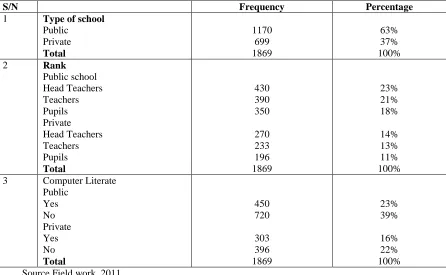
The study revealed that there are still teachers in the schools that have not had any training on the computer operation and application. In table 1, majority of respondents in both public and private primary schools in Rivers State stated that they are not computer literate. This could be attributed to the fact that teachers are rarely trained on ICT usage and have seldom access to computers as indicated on table 3 item 14. JISC (2004) in their study on developing maturity in learning technology revealed that the most significant barriers identified are linked to staff attitude and training staff in the use of ICT, access and ICT skill in general. Moreover (Marshall, Elgort & Mitchell, 2003) reported similarly that staff continues to identify a lack of training in the use of ICT facilities as a barrier to the use of technology in most schools.
922 and email facilities were lacking in the public
and private primary schools visited. This confirms the findings of Mumtaz (2000) who stated that very little use of the internet and e-mail facilities are put in primary schools. These probably suggest that some stakeholders regard providing internet connectivity in primary schools as costly, unessential, and perhaps expensive to maintain facilities.
Recently, however, the Rivers State governor has invested billions of naira into new model primary schools with internet and e-mail facilities (pictures 1&2). Because this effort is on a limited scale, it impacts on the overall ICT facilities available in public primary schools in the State are not positive as revealed on table 1. The provision of internet connectivity should be seen as a necessity because it ensures the availability of information that can be accessed by the teachers/pupils to facilitate knowledge delivery and sharing in the classroom.
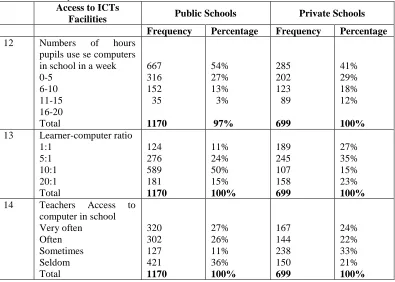
The study also revealed that a considerable number of public and private primary schools use ICT between 0- 5 hours per week, with 10:1 learner-computer ratio and teachers not often making use of ICT facilities in the schools (table 3). This is an indication that the use of ICTs in the primary school is still relatively low. This substantiates the findings by (Nnabuo & Asodike, 2008) that there is a lack of ICT facilities, poor access to the internet and use of ICTs in developing countries like Nigeria. It also confirms the assertion that availability usually determines accessibility. If the ICTs are available, it improves accessibility and their use in schools. ICT facilities have the capacity to improve teaching and learning at the primary level of education and set the foundation for children to be comfortable at using them at subsequent levels of their education.
The results revealed further that primary schools lack of internet connectivity, lack of funds to purchase ICT facilities and the absence of stable power supply are the most prominent factors inhibiting the use and availability of ICTs in primary schools in Rivers State (table 4). Orji (2007) stated the importance of regular electricity supply for
ICT use, saying that some countries are still living in the dark ages where electricity supply is inadequate. This is the situation in Nigeria where stable power supply is a major challenge facing the use of ICTs in primary schools in Rivers State.
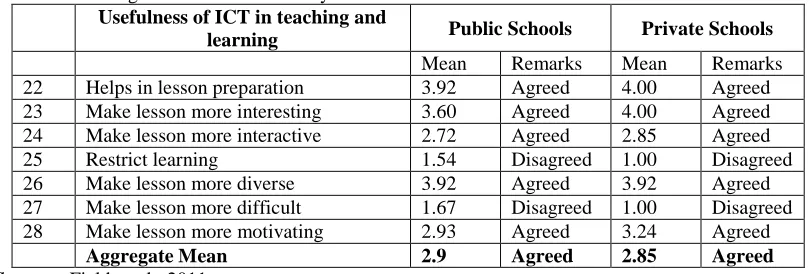
Finally, the study revealed that the use of ICT facilities in teaching and learning helps improve lesson preparation, make lessons more interactive and interesting (table 5). This is due to the fact that they require the active participation of teachers and students in their utilization. Other factors such as making the lessons more interesting, easier, more fun for them and their pupils, more diverse, more motivating for the pupils and more enjoyable among others were all highly rated. Additionally, it should be noted that in Technology Acceptance Model (TAM) by (Davis, Bagozzi, & Warshaw, 1989), one of the basic themes examined in terms of the usefulness of ICT in teaching and learning is ease of use. This according to Davis usually influence people acceptance to use a particular technology (ICT) for classroom instruction.
Conclusion
923 The study has shown that ICT facilities have
positive impact on teaching and learning at the primary school level in Rivers State. Head teachers, teachers and pupils now perceive their usefulness and attest to their relevance in the society and the education of young minds. Nevertheless, the fact remains that it is not every primary school in the country today can use ICT facilities to deliver their lessons. There is need for the implementation of an ICT policy in primary schools in Rivers State.
Recommendations
Based on the findings of the study the following suggestions are made:
Federal, State and Local Governments, proprietors and custodians of primary schools should put up efforts at providing ICT facilities in the primary schools. The ministries of education and local government education authorities in the various states should provide computers, internet and other ICT infrastructure in all the government owned primary schools so as to encourage the availability and use of them.
Primary school pupils should be regularly taught using ICT facilities to facilitate their learning and make them ICT literate. This will improve on the quality of education delivery
and prepare them on the uses of ICT at subsequent levels of education.
Teacher training and professional development oriented policies should support ICT-related teaching models that encourage both students and teachers to play an active role in teaching/learning activities. Emphasis must be placed on the pedagogy behind the use of ICTs for teaching/learning. Teachers need to adopt, develop and support a pedagogic culture that develops supportive practices for students‟ and encourages own theories in teaching/learning activities.
The use of ICTs should be linked to the development of life-long learning and professional practices that enable teachers and students to keep in touch with ICT development, new knowledge and research on teaching/learning in primary schools in Nigeria.
It is believed that if these recommendations are strictly adhered to the problem of under utilization of ICTs in the country will be resolved and the benefits associated ICT use will materialize.
1. Outside view of the Model Primary
School Rumupkokwu.
2. Computer laboratory of the
924 Tables 1-5
Table 1: Profile of Respondents
Source Field work, 2011
Table 1 shows the profile of respondents to the questionnaire titled “Primary School ICT Use Survey”. From the 1869 valid collected results 63% were public primary school respondents, while 37% were public primary school respondents.
Research Question 1: What ICT facilities are available in Rivers State primary schools?
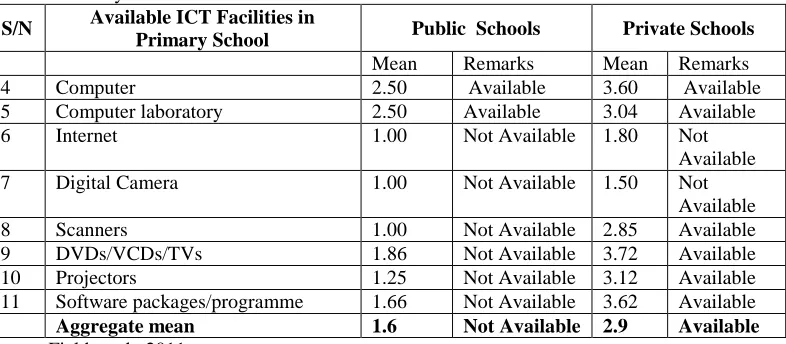
Table 2 shows that majority of public primary schools in Rivers State do not have access to ICT facilities such as internet, digital cameras, scanners, DVDs/VCDs/TVs, projectors and software packages/programme as indicated by low mean score of respondents in the study. While computers and computer laboratories are considered available in public primary schools (2.50 mean). On the contrary, most private primary schools agreed that ICT facilities ranging from computers, computer laboratories, DVDs/VCDs/TVs, Software packages/programme and projectors are available in these schools. The most available ICT facility in private primary schools is DVD/VCD/TV as indicated by a mean of 3.72. The results generally shows that while majority of public primary schools do not
have access to ICT facilities (mean < 2.5), their private primary school counterparts do have ICT facilities available in their schools (aggregate mean> 2.5)
Research Question 2: What is the frequency of ICT facilities usage in Rivers State primary schools?
Table 3 shows that majority of public primary school students spend between 0 – 5 hours using computers for teaching and learning, as indicated by 667 (54%) respondents. Also 41% of respondents in private primary schools in Rivers State show that computers are used between 0 – 5 hours a week by students. Furthermore, the student to computer ratio in public primary schools is 10:1 and this is stated by 50% of the respondents, while the ratio in private primary schools is 5:1 as indicated by 35% of respondents. Teachers‟ in
S/N Frequency Percentage
1 Type of school Public
Private Total
1170 699 1869
63% 37% 100%
2 Rank
Public school Head Teachers Teachers Pupils Private Head Teachers Teachers Pupils Total
430 390 350
270 233 196 1869
23% 21% 18%
14% 13% 11% 100% 3 Computer Literate
Public Yes No Private Yes No Total
450 720
303 396 1869
23% 39%
925 public primary schools rarely have access to
computers as indicated by 421 (36%) respondents, while in private primary schools teachers indicated that they sometimes have access to computers as shown by 238 respondents.
Research Question 3: What are the factors inhibiting the affective use of ICT facilities in Rivers State primary school?
Table 4 shows that the most challenging factor inhibiting the use of ICTs in public primary schools is the lack of internet connectivity as indicated by a mean of 4.00. While in private
primary schools the most challenging factor is the availability of adequate infrastructure as shown by a mean of 2.56. Lack of technical support staff is the least challenging factor hindering the use of ICTs in public and private primary schools in Rivers State with a mean of 3.24 and 2.21.
Research Question 4: What is the perception on the usefulness of ICTs in teaching and learning by respondents?
Table 2: Mean Scores of Respondents Assessment of availability of ICT Facilities in Rivers State Primary Schools
S/N Available ICT Facilities in
Primary School Public Schools Private Schools
Mean Remarks Mean Remarks
4 Computer 2.50 Available 3.60 Available
5 Computer laboratory 2.50 Available 3.04 Available
6 Internet 1.00 Not Available 1.80 Not
Available
7 Digital Camera 1.00 Not Available 1.50 Not
Available
8 Scanners 1.00 Not Available 2.85 Available
9 DVDs/VCDs/TVs 1.86 Not Available 3.72 Available
10 Projectors 1.25 Not Available 3.12 Available
11 Software packages/programme 1.66 Not Available 3.62 Available
Aggregate mean 1.6 Not Available 2.9 Available
926 Table 3: Frequency and Percentage Scores of Respondents Access to Available ICTs Facilities In
Rivers State Primary Schools Access to ICTs
Facilities Public Schools Private Schools
Frequency Percentage Frequency Percentage 12 Numbers of hours
pupils use se computers in school in a week 0-5
6-10 11-15 16-20 Total
667 316 152 35
1170
54% 27% 13% 3%
97%
285 202 123 89
699
41% 29% 18% 12%
100% 13 Learner-computer ratio
1:1 5:1 10:1 20:1 Total
124 276 589 181 1170
11% 24% 50% 15% 100%
189 245 107 158 699
27% 35% 15% 23% 100% 14 Teachers Access to
computer in school Very often
Often Sometimes Seldom Total
320 302 127 421 1170
27% 26% 11% 36% 100%
167 144 238 150 699
24% 22% 33% 21% 100% Source: Field work, 2011
Table 4: Mean Scores of Respondents Analysis of Factors Affecting the Use of Available of ICT Facilities in Rivers State Primary Schools
Public Schools Private Schools Mean Remarks Mean Remarks 15 Teachers not adequately trained 3.67 Agreed 2.36 Disagreed 16 High learner-computer ratio 3.50 Agreed 2.46 Disagreed 17 Inadequate infrastructural provision 3.30 Agreed 2.56 Agreed 18 Lack of constant electricity supply 3.67 Agreed 2.51 Agreed
19 Internet connectivity 4.00 Agreed 2.50 Agreed
20 Lack of fund to purchase other ancillary facilities
3.83 Agreed 2.45 Disagreed
21 Lack of technical support staff 3.24 Agreed 2.21 Disagreed
Aggregate Mean 3.6 Agreed 2.43 Disagreed
927 Table 5: Mean Scores Analysis of Respondents Perception of Usefulness of ICT in Teaching and
Learning in Rivers State Primary Schools Usefulness of ICT in teaching and
learning Public Schools Private Schools
Mean Remarks Mean Remarks 22 Helps in lesson preparation 3.92 Agreed 4.00 Agreed 23 Make lesson more interesting 3.60 Agreed 4.00 Agreed 24 Make lesson more interactive 2.72 Agreed 2.85 Agreed
25 Restrict learning 1.54 Disagreed 1.00 Disagreed
26 Make lesson more diverse 3.92 Agreed 3.92 Agreed
27 Make lesson more difficult 1.67 Disagreed 1.00 Disagreed 28 Make lesson more motivating 2.93 Agreed 3.24 Agreed
Aggregate Mean 2.9 Agreed 2.85 Agreed
Source: Field work: 2011
The result on table 5 shows a positive correlation in the responses of public and private primary schools on the usefulness of ICTs in teaching and learning. Majority of respondents in both public and private primary schools agree that ICTs help in lesson preparation as indicated by a mean of 3.92 and 4.0 respectively. Similarly, a mean of 3.60 shows public schools and 4.0 from private schools agree that using ICTs makes lessons more interesting. Furthermore, the results
show that few respondents disagree that using ICT restricts learning or makes learning more difficult, this is indicated with a mean of 1.54 and 1.00. The result in table 4 generally reveals the usefulness of ICTs in teaching/learning and its contribution to improving students‟ performance as perceived by respondents in both public and private primary schools in Rivers State (aggregate mean > 2.5).
References
Akukwe, A. C. (2003) Computer Studies an Introduction Owerri: Colon Concepts Ltd. Curtin, R. (2002) “Promoting youth employment through Information and Communication Technology (ICT): best practice example in Asia and the Pacific”. www.ybiz.com
Dada, D. (2006) “E-Readiness for developing countries: moving the focus from the environment to the users” The Electronic Journal on Information Systems in Developing Countries. Vol. 27, No. 6, pp. 1-14.
Davis, F.D., Bagozzi, R.P., and Warshaw, P.R. (1989) “User acceptance of computer technology: a comparison of two theoretical models” Management Science Vol. 35, No.8, pp. 982-1003.
Digital economy ranking (2010) Beyond e -readiness. A Report from the Economist Intelligence Unit written in co-operation with The IBM Institute for Business Values
Ely, D. P. (2002) “Computer Access and Use Trends in Education Technology. New York clearing house on information and technology
e-learning Network of Nigeria” (2006) e- learning workshop.
Federal Government of Nigeria/United Nations Education Social Cultural Organization/United Nation Development Program (2003) A decade of basic education data in Nigeria (1988-1998).
Federal Ministry Education (FME, 1988) Report on national policy on computer education. Lagos. FME
Federal Republic of Nigeria (2004) “National policy on education”. Lagos: NERDC Press
Gbenga, A. (2004) “Computer application and use of ICT for teaching and learning”. Unpublished manuscript for ETF/NCCE Cooperative on capacity building for lecturers in Colleges of Education.
India Brand Equity Foundation (IBEF). (2011) Information Technology http://wwwibef.org/industry/imformationtechn ology.aspx
928 Mumtaz, S. (2000) “Using ICT in schools: A
review of the literature on learning, teaching and software evaluation”. Coventry Centre for New Technology Research in Education. University of Warwick.
Nnabuo, P.O.M., and Asodike, J. D. (2008) “The future of the Nigerian child in science and technical education: Information and Communication Technology (ICT) perspective.” African Journal of Educational Research and Development Vol. 3, No.1, pp. 32 – 39.