Caching Location Data in Mobile Networking
Shyhtsun F. Wu
Computer Science Department
Columbia University
New York, NY 10027
[email protected]
Charles Perkins
Mobile Systems Design
IBM T. J. Watson Research Center
Yorktown Heights, NY 10598
[email protected]
Pravin Bhagwat
yComputer Science Department
University of Maryland
College Park, MD 20742
[email protected]
Abstract
EachLocation Directory (LD)provides the infor-mation to locate the forwarding address of aMobile Host (MH) in a mobile networking system. The LD should be updated when the MH moves from one access zone to another access zone. If an Inter-net Access Point (IAP)(or base station) could cache some useful LD information entries, then, after re-ceiving a packet from an MH in its access zone, the IAP could check its cached LD and make an optimal routing decision. With the LD distributed over the Internet Access Points, we avoid Dogleg Routing
because we no longer need to forward the packet to theMobile Router (MR)where a master copy of the LD is located. In this paper, we investigate how the LD data structure is used, updated, and distributed among Mobile Routers, Internet Access Points, and Mobile Hosts. Furthermore, we present our LD de-sign and implementation in the mobile IP network.
Wu is supported by an IBM Fellowship.
y
Bhagwat is supported by an IBM Fellowship.
1 Introduction
Recently, the problem of providing continuous network connectivity to mobile computers has re-ceived considerable attention [8, 9, 2, 1, 4, 6, 7, 3]. One key issue in achieving high performance mo-bile networking is to provide optimal routing with dynamic location directory (LD) information. Un-der the assumption that mobile hosts in a mobile networking system move randomly and frequently, it is critical to have an efficient scheme to distribute the dynamic LD information over routers, access points, and mobile hosts.
In this paper, we present a scheme to effi-ciently distribute location directory information. Our scheme works with both of the most commonly used mobile redirection schemes, loose source rout-ing (LSR) and encapsulation (ENC) (see [4]). In the next section, we give some background information about the mobile networking system. Then, we dis-cuss why it is important to distribute location di-rectory information over the IAPs (internet access points). Finally, our scheme as well as its imple-mentation is presented.
2
Background
geograph-ical area covered by an access zone is a function of the medium used for wireless communication. The range of infrared access zones is typically limited to about 20 feet, while that of radio frequency zones could be significantly larger.
Within one campus or administrative domain there could be multiple (sub)networks reserved for
mobile hosts. Each (sub)network has a router
which is referred to as Mobile Router (MR). Un-like other routers, an MR is not required to have an interface corresponding to the wireless (sub)net it serves. If an MR has a wireless interface then it can also function as an IAP. The association be-tween an MH and its current IAP is kept in the location directory (LD), which is maintained at the MR.
A mobile host retains its address regardless of which IAP’s access zone it is in. It can start ses-sions with other hosts (both mobile and stationary) and move into other IAP’s access zones without dis-rupting any active sessions. The movement of a mobile host is completely transparent to the run-ning applications, except possibly for a momentary pause which may occur while the access zone switch takes place. An MH can reside in the zone of only one IAP at any given time. Even if zones of two IAPs spatially overlap, an MH routes its outgoing packets through only one of them. An IAP can have multiple MHs in its access zone. We use the term
Correspondent Host (CH) to refer to the host com-municating with an MH.
3
Replicating the Location Directory
(LD)
We assume that the location directory (LD) in-formation of a mobile host, MHdst is kept in only
one mobile router, MRfoo. That is, no other mobile
router can have the LD information about MHdst.
When MHdstmoves into a new access zone (step 1 in
Figure 1), IAPdst, it sends MRfooa special message
containing the new location information through IAPdst(steps 2 and 3). After receiving this special
message, MRfooupdates the location directory and
assigns a new sequence number to this entry (step 4). Therefore, later packets (steps 7 and 8) desti-nated for MHdst would be forwarded to IAPdstby
MRfoo(steps 8 and 9).
We have another mobile host MHsr c, attached to
IAPsr c, which would like to talk to MHdst. And,
MRfoo might not have location information for
MHsr c; MHsr c belongs to MRbar, and MRfoo
ad-vertises reachability for the subnet of MHsr c. The
packets from MHsr c to MHdst would always pass
through MRfoo(steps 1 and 2 in Figure 2) because
only MRfoo has location information for MHdst.
Even if IAPsr c and IAPdst are very close to each
other, the packets still need to take a sub-optimal route to access MHdst. This is the DogLeg
Rout-ing(orTriangle Routing) problem mentioned in [5]. The solution is to let IAPsr c cache the location
in-formation about MHdst(step 6) so that the packets
follow an optimal route from MHsr cto MHdst(steps
7, 8, 9, and 10 in Figure 2).
4
Distributing the LD Information
In the previous section, we suggested that dis-tributing LD information can improve the mobile routing performance. In this section, we consider how to efficiently distribute the location directory information over the Internet Access Points. Our first design goal for distributing LD information to IAPs is that the LD entries should not be dis-tributed to a IAP unless the IAP would almost defi-nitely use these entries. Our second goal is to avoid or to minimize the extra processing overhead on ev-ery incoming packet.
4.1 Protocol
4.1.1 Location Directory Information Update Message (LUM)
ALocation directory information Update Message (LUM)is a location update entry for a mobile host. It contains four fields: the address of the Mobile Host (Destination), the forwarding address for this Mobile Host (Gateway), a unique sequence number incremented by the Mobile Host (MHdst), and a
spe-cial flag to identify the source of this LUM. We use this special flag (SF) to identify whether the LUM message is for IAPsr cor IAPdst.
4.1.2 Mobile Router (MR)
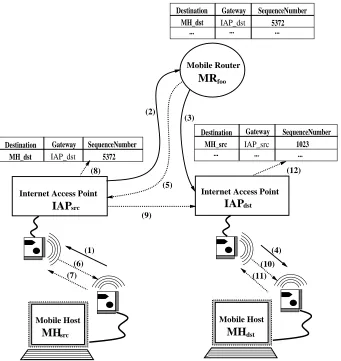
1. If the received packet is destined to this MR (step 2 in Figure 3), then pass it to the upper layer. Otherwise, go to the next statement.
2. Check whether the destination is a mobile host belonging to this MR. (This is done by checking the route flag in the MH’s route en-try.) If yes, it means that the source, MHsr c, of
the packet does not know the current location of the destination MH (MHdst).
3. Forward the packet (step 3 in Figure 3).
4. Send a LUM to MHsr c, the CH of MHdst(step
5 in Figure 3), about MHdst.
4.1.3 Internet Access Point
1. Receive a LUM from a MH in its access zone (steps 7 and 11 in Figure 3). Or, snoop a LUM from MR to the MH.
2. Check if a corresponding location cache ex-ists (step 8 and 12). If so, we compare the sequence numbers to decide whether we will update this entry. (This is only necessary if we snoop packets here.)
3. If the LUM entry is updated and the SF flag in the LUM message is on, then we turn off that SF and send the LUM to MHdst(step 9
in Figure 3). This is done so that IAPdstwill
Mobile Router
MR
fooMobile Router
MR
barsrc dst
MH
dstMH
srcMobile Host Mobile Host
Destination Gateway SequenceNumber
MH_dst 5372
... ... ...
(1)
(2) (3) (4)
(5)
(6) (7)
(8)
(9)
(10) Destination Gateway SequenceNumber
MH_src 1023
... ... ...
Normal Packet
Location Directory Information Message
IAP_src
IAP
IAP_dstIAP
Internet Access Point Internet Access Point
Figure 1: Mobile Networking without Distributing LD Information over IAP’s
4.1.4 Mobile Host
1. Receive an LUM from either the MR (steps 5 and 6 in Figure 3) or IAP of its correspondent host (steps 9 and 10 in Figure 3).
2. Check whether the LUM entry exists, If yes, we compare the sequence numbers to decide whether we will update this entry.
3. Send the same LUM to its current IAP (steps 7 and 11 in Figure 3).
4.2
Example
When MRfoo needs to forward a packet from
MHsr cto IAPdst, it knows that IAPsr cdoes not know
where IAPdst is. If this were not true, then this
packet would never have arrived at MRfoo. Then,
MRfooshould distribute the location information to
IAPsr csince this forwarding information is useful
for IAPsr c. Furthermore, in a lot of applications,
the communication is bi-directional, and therefore, MRfooshould also inform the IAPdstabout the
cur-rent location of MHsr c. However, only MRbar has
the location information about MHsr cand MRfooin
this case will not know whether MHsr cis a mobile
host or a stationary host. So, on one hand, MRfoo
can not send a message to IAPsr c because the
ad-dress of IAPsr c is unknown. On the other hand,
MRfoo can not inform IAPdstabout the current
lo-cation of MHsr cfor the same reason.
Our solution is the following: MRfoodistributes
the location information about MHdst directly to
MHsr c. And, since MHsr chas the knowledge about
IAPsr c, it forwards the information to its current
IAPsr c. Then, after knowing the relationship
Mobile Router
MR
foosrc dst
MH
dstMH
srcMobile Host Mobile Host
Destination Gateway SequenceNumber
MH_dst 5372
... ... ...
(1)
(2) (3)
(4)
(5) (6)
(7) (8)
(9)
(10) Destination Gateway SequenceNumber
MH_dst IAP_dst 5372
IAP
Internet Access Point
IAP_dst
IAP
Internet Access Point
Figure 2: Distributing Location Directory Information over IAP’s
the location information about MHsr c to MHdst.
And, again, MHdst would forward this
informa-tion to IAPdst. After receiving this message from
MHdst, IAPdst would NOT send another LUM to
MHsr c because the SF flag is off and therefore it
knows IAPsr chas already received the LUM from
MRfoo. Finally, as depicted in Figure 3, both IAPsr c
and IAPdst have enough information to route the
packets between MHsr c and MHdst without
pass-ing through any mobile router.
MHsr c may receive LUMs for MHdst, not only
from MRfoo, but also from IAPdst. Before the
IAPdstreceives the LUM from IAPsr c, MHdstsends
a packet back to MHsr c. This packet arrives at
MRbar, and similarly, MRbarsends MHdsta LD
mes-sage, which is then forwarded to IAPdst. At this
point, IAPdst does not know whether IAPsr c has
received the LD message from MRfoo, and
there-fore, sends a LD message to MHsr c. MHsr c can
determine which message is the most recent one as long as each message contains a sequence num-ber generated by MRfoo (originally from the time
stamp information sent by MHdstwhen MHdstlast
detected an access zone switch.)
5
Mobility of Cached Location
Direc-tory Information
One important issue in mobile computing is to provide continuous network service for hosts as they move around. In our example, both MHsr cand
MHdstcan move into new access zones. Therefore,
the distributed location directory information on IAPsr cand IAPdstmight need to be updated.
Fur-thermore, the new IAPs (i.e.,IAPnew sr c
and IAPnew dst
) for both mobile hosts (i.e., MHsr cand MHdst) also
need the location directory information for optimal mobile routing.
Whenever MHdst receives an LUM, it will keep
it in an LD table. Then, when MHdstmoves to
an-other access zone IAPnew dst
, it can send its cached LD information entries with sequence numbers to the IAPnew
dst
. So, immediately, the connections from MHdst to other correspondent hosts (CHs) would
Mobile Router
MR
foosrc dst
MH
dstMH
srcMobile Host Mobile Host
Destination Gateway SequenceNumber
MH_dst 5372
... ... ...
(1)
(2)
(3)
(4) (5)
(6) (7)
(8)
(9)
(10) Destination Gateway SequenceNumber
MH_dst 5372
Destination Gateway SequenceNumber
MH_src 1023
...
... ...
(11)
(12)
IAP_dst
IAP_src
IAP
Internet Access Point Internet Access Point
IAP
IAP_dst
Figure 3: An Example of Distributing Location Directory Information
another mobile host MHanother in IAPdst tries to
communicate with MHsr cbefore MHdstdoes. And,
the LD entry for MHsr c was built before MHdst
used it. Then, a sub-optimal route would be fol-lowed. In this case, the connection between MHsr c
and MHdstwould pass through neither MRfoo nor
MRbar. Thus, MHdst would not have the LD
en-try in its local LD copy. After moving to a new access zone, MHdst might need to go over the LD
distributing process again to get the optimal route. This results from our policy of tagging each location cache entry with just one MH, not multiple MHs, even when the cache entry is used by multiple MHs.
Another problem is that, after the movement of MHdst, the LD information kept by both MHsr cand
IAPsr c is invalid. The first packet will still go to
IAPdst. Then, the packet will be forward to MRfoo
and the whole LD distributing process starts again. In the case that IAPdst is down, we can
invali-date the cached LD entry upon receiving an ICMP host/network unreachable message for IAPdst. We
call this alazyinvalidating approach.
An alternative approach is toeagerlyinvalidate the LD entries on all the IAP’s having an MHdst
LD entry immediately after MHdstmoves to a new
access zone. This approach taken by [8, 9] has two major shortcomings:
1. The new updated entries might not be used before the next entry update. Thus, we waste some network bandwidth.
2. It is expensive to track which internet access points have an entry for MHdst. In our
im-plementation, it requires one extra route ta-ble lookup and possibly the manipulation of a linked list data structure for EACH incoming encapsulated or loose source routed IP packet.
Thus, to avoid unnecessary and extra processing, we do not take this eager approach.
6
Implementation and Evaluation
make the LD distribution scheme work, we only needed to modify the AIX kernel on the mobile router. We use the same kernel as described in [1] with an extension to support both LSR and encap-sulation for IAP and MH. We built three user level processes:
mh serv
,iap serv
, andmr serv
for mo-bile host, internet access point, and momo-bile router respectively, to distribute the LD information. All user processes communicate with each other via UDP sockets. Furthermore, the cached LD entries with sequence numbers are kept in the user pro-cesses. And, the first two columns of each entry (i.e.,omitting sequence numbers) are replicated into the kernel routing table.
For better performance, we made another modi-fication for the IAP kernel. We introduce a snoop-ing mechanism in the kernel of IAP to grab the LD messages for all the MHs in its access zone. By doing this, IAP can immediately have the LD in-formation without waiting for the round-trip UDP message from one of its MHs. Although this means that IAP kernel has to check every incoming packet, the checking is very efficient. And, only on the IAP kernel, it requires two extra comparisons: the UDP protocol number and the
mh serv
special port num-ber in theip forward
function. Thus, the IAP can immediately send another LUM to the IAP of the corresponding mobile host.If IAP does not have the snooping capability, the LD information will still arrive but with some extra delay. On the other hand, if MH can not handle the LUMs correctly, the snooping mechanism would still be able to install the LD entries for optimal mobile routing. However, in this case, when this MH moves, it will not be able to provide the LD entries for the new IAP. Finally, if both MH and IAP do not work as we expect, then packets from the MH would still arrive at the correct destinations through some sub-optimal routes.
7
Remarks
We present an efficient way to cache the location data information among all the components in a mobile networking system. The scheme is simple and few changes need to be made to the kernel. The required network bandwidth is small because only useful location directory information will be sent. Furthermore, our scheme avoids extra processing overhead for each packet.
The problem in general can be treated as a cache coherence control problem. However, we ob-served the required consistency in distributed LD is much weaker than the consistency criteria in a distributed shared memory system. It would be in-teresting to know the LD consistency criteria in a formal way, and thus we can compare and analyze different LD distributing schemes, e.g., [2, 8, 9]. Furthermore, we need to investigate the relation-ship between the network performance and the con-sistency criteria.
References
[1] Pravin Bhagwat and Charles Perkins. A Mo-bile Networking System based on Internet
Pro-tocol (IP). In Usenix Symposium on Mobile
and Location-Independent Computing, August 1993.
[2] John Ioannidis, Dan Duchamp, and Gerald Q. Maguire Jr. IP-based Protocols for Mobile Internetworking. InProceedings of ACM SIG-COMM, pages 235–245, 1991.
[3] David B. Johnson. Transparent Internet Rout-ing for IP Mobile Hosts. Internet draft, July 1993.
[4] Andrew Myles and David Skellern. Comparing Four IP Based Mobile Host Protocols. InJoint European Networking Conference, May 1993.
[5] Charles Perkins. Providing Continuous Net-work Access to Mobile Hosts Using TCP/IP. In
Joint European Networking Conference, May 1993.
[6] Charles Perkins and Yakov Rekhter. Short-cut Routing for Mobile Hosts. Internet draft, July 1992.
[7] Charles Perkins and Yakov Rekhter.
Sup-port for Mobility with Connectionless Network
Layer Protocols. Internet draft, November
1992.
[8] Fumio Teraoka, Yasuhiko Yokote, and Mario Tokoro. A Network Architecture Providing Host Migration Transparency. InProceeding of ACM SIGCOMM, Sept 1991.
[9] Hiromi Wada, Takashi Yozawa, Tatsuya