Open Peer Review
Discuss this article
(0)
Comments
DATA NOTE
The ICR639 CPG NGS validation series: A resource to assess
analytical sensitivity of cancer predisposition gene testing
[version 1; referees: 2 approved]
Shazia Mahamdallie
,
Elise Ruark
, Esty Holt
,
Emma Poyastro-Pearson
, Anthony Renwick , Ann Strydom
, Sheila Seal
,
Nazneen Rahman
1-3
Division of Genetics & Epidemiology, The Institute of Cancer Research, London, SM2 5NG, UK TGLclinical, The Institute of Cancer Research, London, SM2 5NG, UK
Cancer Genetics Unit, Royal Marsden NHS Foundation Trust, London, SM2 5PT, UK
Abstract
The analytical sensitivity of a next generation sequencing (NGS) test reflects the ability of the test to detect real sequence variation. The evaluation of analytical sensitivity relies on the availability of gold-standard, validated, benchmarking datasets. For NGS analysis the availability of suitable datasets has been limited. Most laboratories undertake small scale evaluations using in-house data, and/or rely on in silico generated datasets to evaluate the performance of NGS variant detection pipelines.
Cancer predisposition genes (CPGs), such as BRCA1 and BRCA2, are amongst the most widely tested genes in clinical practice today. Hundreds of providers across the world are now offering CPG testing using NGS methods. Validating and comparing the analytical sensitivity of CPG tests has proved difficult, due to the absence of comprehensive, orthogonally validated, benchmarking datasets of CPG pathogenic variants.
To address this we present the ICR639 CPG NGS validation series. This dataset comprises data from 639 individuals. Each individual has sequencing data generated using the TruSight Cancer Panel (TSCP), a targeted NGS assay for the analysis of CPGs, together with orthogonally generated data showing the presence of at least one CPG pathogenic variant per individual. The set consists of 645 pathogenic variants in total. There is strong
representation of the most challenging types of variants to detect, with 339 indels, including 16 complex indels and 24 with length greater than five base pairs and 74 exon copy number variations (CNVs) including 23 single exon CNVs. The series includes pathogenic variants in 31 CPGs, including 502 pathogenic variants in BRCA1 or BRCA2, making this an important
comprehensive validation dataset for providers of BRCA1 and BRCA2 NGS testing. We have deposited the TSCP FASTQ files of the ICR639 series in the European Genome-phenome Archive (EGA) under accession number
. EGAD00001004134
1,2
1,2
1
1,2
1
1,2
1,2
1-3
1 2 3
Referee Status:
Invited Referees
version 1 published 12 Jun 2018
1 2
report report
, Catalan Institute of
Conxi Lázaro
Oncology (ICO), Bellvitge Institute for
Biomedical Research (IDIBELL), Spain
, Bellvitge Institute
Lídia Feliubadaló
for Biomedical Research (IDIBELL), Spain
1
, IRCCS Istituto Tumori
Rosamaria Pinto
"Giovanni Paolo II", Italy
2
12 Jun 2018, :68 (
First published: 3
)
https://doi.org/10.12688/wellcomeopenres.14594.1
12 Jun 2018, :68 (
Latest published: 3
)
Keywords
next generation sequencing, cancer predisposition gene, BRCA1 and BRCA2, analytical sensitivity, genetic testing, validation, variant benchmarking
This article is included in the Transforming Genetic
gateway.
Medicine Initiative (TGMI)
Nazneen Rahman ( )
Corresponding author: [email protected]
: Conceptualization, Data Curation, Methodology, Validation, Writing – Original Draft Preparation; :
Author roles: Mahamdallie S Ruark E
Conceptualization, Formal Analysis, Methodology, Writing – Review & Editing; Holt E: Data Curation; Poyastro-Pearson E: Validation; Renwick
: Investigation, Validation; : Data Curation, Project Administration; : Investigation, Methodology, Supervision; :
A Strydom A Seal S Rahman N
Conceptualization, Supervision, Writing – Review & Editing
NR is a Non-Executive Director of AstraZeneca. No other authors disclosed any competing interests.
Competing interests:
The work was supported by the Wellcome Trust [200990].
Grant information:
The funders had no role in study design, data collection and analysis, decision to publish, or preparation of the manuscript.
© 2018 Mahamdallie S . This is an open access article distributed under the terms of the ,
Copyright: et al Creative Commons Attribution Licence
which permits unrestricted use, distribution, and reproduction in any medium, provided the original work is properly cited.
Mahamdallie S, Ruark E, Holt E
How to cite this article: et al.The ICR639 CPG NGS validation series: A resource to assess analytical
Wellcome Open Research 2018, :68 (
sensitivity of cancer predisposition gene testing [version 1; referees: 2 approved] 3
)
https://doi.org/10.12688/wellcomeopenres.14594.1
12 Jun 2018, :68 ( )
Introduction
For a clinical test based on next generation sequencing (NGS) to be approved for use, its performance with respect to accuracy, analytical sensitivity, analytical specificity and precision, must be evaluated1–4. Analytical sensitivity refers to the ability of a sequencing test to detect real sequence variation. The evalua-tion of analytical sensitivity therefore relies on the availability of gold-standard, validated, benchmarking datasets. For NGS analysis the availability of suitable datasets has been limited. Most laboratories undertake small scale evaluations, using in-house data that seldom comprehensively covers the spectra of variant types the test must detect5,6. Many laboratories also rely on in silico generated datasets to evaluate the performance of NGS variant detection pipelines. Whilst of value, in silico data cannot completely replace experimental data generated from biological samples that have been orthogonally validated7.
Cancer predisposition genes (CPGs), such as BRCA1 and BRCA2, are amongst the most widely tested genes in clinical practice6,8–10. Hundreds of providers across the world are now offering CPG testing using NGS methods, either through panel, exome, or whole genome testing9. Increasingly, the analysis of the data is processed separately to the generation of data and the clinical reporting of results, sometimes through outsourcing data analysis to a separate provider. This makes assessments and comparisons of analytical sensitivity even more challenging.
We have conducted CPG testing in research and clinical settings for over a decade, identifying many hundreds of pathogenic variants. We have generated extensive sequence-based data on thousands of samples using a variety of technologies including NGS methods, PCR amplification with Sanger sequencing, stand-ard Multiplex Ligation-dependent Probe Amplification (MLPA), MLPA by NGS and Conformation Sensitive Gel Electrophoresis (CSGE). To validate the analytical sensitivity of our ISO 15189 accredited CPG NGS clinical testing pipeline, we used data from 639 individuals known to have pathogenic variants in CPGs through testing by other methods. This validation resource has proved invaluable for ensuring optimal analytical sensitivity during the initial and ongoing development of our NGS pipelines.
To assist those without access to extensive validated datasets we have put together the ICR639 CPG NGS validation series, which we present here.
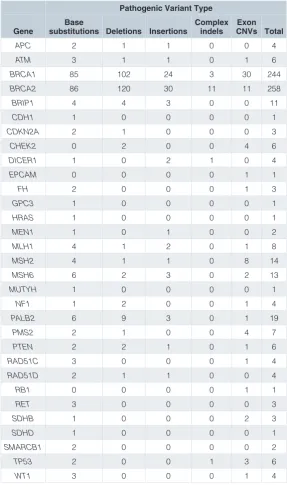
The ICR639 CPG NGS validation series comprises data from 639 individuals. Each individual has sequencing data gener-ated using the TruSight Cancer Panel (TSCP), a targeted NGS assay for the analysis of CPGs11, together with orthogonally generated data showing the presence of at least one CPG patho-genic variant per individual. The set consists of 645 pathopatho-genic variants in total. There is strong representation of the most chal-lenging types of variants, with 339 indels, including 16 complex indels and 24 with length greater than five base pairs and 74 exon copy number variations (CNVs) including 23 single exon CNVs (Table 1). The series includes pathogenic variants in 31 CPGs. There are 502 pathogenic variants in BRCA1 or BRCA2, making this an important comprehensive validation dataset for providers of BRCA1 and BRCA2 NGS testing. The vast majority of variants
occur in extremely high-quality sequencing data, fulfilling a Quality Sequencing Minimum (QSM) of C50_B10(85)_M20(95)12. As such, it is anticipated that any accredited test provider will be able to detect these variants.
The dataset size and comprehensive representation of variant types that can be detected by targeted sequencing, makes the ICR639 CPG NGS validation series a valuable benchmarking resource for providers of CPG testing by NGS. The dataset may also be of value to laboratories analysing other genes, and those performing exome or genome testing which will encompass CPGs. The ICR639 CPG NGS validation series was constructed as part of the Transforming Genetic Medicine Initiative (TGMI, www.thetgmi.org) a Wellcome funded initiative that is developing frameworks and resources to facilitate genetic medicine.
Methods
We used lymphocyte DNA from 639 individuals. The individuals were either recruited to our studies to discover and character-ise dcharacter-isease predisposition genes, which have been approved by the London Multicentre Research Ethics Committee (05/MRE02/17, MREC/01/2/044, MREC/01/2/18), or from the TGLclinical laboratory, an ISO 15189 accredited genetic testing laboratory. Written informed consent from patients tested through TGLclinical includes use of samples for quality-control and research.
We generated high-quality targeted NGS data for the ICR639 CPG NGS validation series using the TruSight Cancer Panel (TSCP) v2 (Supporting File 1). We prepared targeted DNA libraries from 50ng genomic DNA using the TSCP and TruSight Rapid Capture kit (Illumina, San Diego, CA, USA). We followed the manufacturer’s protocol with the exception of library enrich-ment pool complexity, which we performed in 48-plex. For every sample, we sequenced a final 10pM pooled library on a HiSeq 2500 platform set in Rapid-run mode following standard protocols: 96-plex pool per flow cell, HiSeq® Rapid SBS Kit v2, 101 bp paired-end dual index run, and onboard clustering using HiSeq® Rapid PE Cluster Kit v2. CASAVA v.1.8.2 was used to demultiplex and create FASTQ files per sample from the raw base call files.
To evaluate data quality, we mapped the sequencing reads to the human reference genome (GRCh37) using Stampy v.1.0.2013 with BWA v.0.7.5a14 for pre-mapping. We used CoverView v.1.1.015 to flag fragments containing the pathogenic variant, which did not fulfil a QSM12 of C50_B10(85)_M20(95) for all base substitutions and indels. All samples with an exon CNV pathogenic variant passed the default settings of DECoN v.1.0.016.
All 639 individuals also had orthogonally generated data available. These data were generated through either PCR ampli-fication with Sanger sequencing17, standard MLPA or MLPA by NGS11,18.
Table 1. Summary of pathogenic variant types by gene in the ICR639 CPG NGS validation series.
Pathogenic Variant Type
Gene substitutions Deletions InsertionsBase Complex indels CNVs TotalExon
APC 2 1 1 0 0 4
ATM 3 1 1 0 1 6
BRCA1 85 102 24 3 30 244
BRCA2 86 120 30 11 11 258
BRIP1 4 4 3 0 0 11
CDH1 1 0 0 0 0 1
CDKN2A 2 1 0 0 0 3
CHEK2 0 2 0 0 4 6
DICER1 1 0 2 1 0 4
EPCAM 0 0 0 0 1 1
FH 2 0 0 0 1 3
GPC3 1 0 0 0 0 1
HRAS 1 0 0 0 0 1
MEN1 1 0 1 0 0 2
MLH1 4 1 2 0 1 8
MSH2 4 1 1 0 8 14
MSH6 6 2 3 0 2 13
MUTYH 1 0 0 0 0 1
NF1 1 2 0 0 1 4
PALB2 6 9 3 0 1 19
PMS2 2 1 0 0 4 7
PTEN 2 2 1 0 1 6
RAD51C 3 0 0 0 1 4
RAD51D 2 1 1 0 0 4
RB1 0 0 0 0 1 1
RET 3 0 0 0 0 3
SDHB 1 0 0 0 2 3
SDHD 1 0 0 0 0 1
SMARCB1 2 0 0 0 0 2
TP53 2 0 0 1 3 6
WT1 3 0 0 0 1 4
at 1, the A of the ATG translation initiation codon. For WT1, c.1 is the A of the first in-frame AUG translation initiation codon and the KTS exon 9 sequence is included. We used Ensembl ENST transcripts from release 65 for exon CNV annotation as RefSeq mRNA transcripts do not specify intron/exon boundaries. All exon CNVs are described using the following notation “Exon X deletion/duplication” for single exon CNVs and “Exon X-Y deletion/duplication” for exon CNVs involving more than one exon, where X specifies the number of the first exon involved in the exon CNV with respect to the transcript, Y specifies the number
of the last exon involved in the exon CNV with respect to the transcript, and deletion or duplication is specified as appropriate. For all genes except BRCA1 exon numbering is consecutive from the first non-coding exon in the transcript. For BRCA1 we use the conventional clinical numbering system that does not include exon 4.
exon CNVs were validated by MLPA. We provide the most 5’ and most 3’ genomic coordinates of the exons involved in the exon CNV according to the exon numbering of the specified transcript. Of note, these are not the actual breakpoints; standardly neither MLPA nor targeted NGS data provides breakpoint sequence information for exon CNVs.
Dataset
The ICR639 CPG NGS validation series includes data from 639 individuals. Six individuals have two different pathogenic variants, so the dataset contains a total of 645 pathogenic CPG variants (Supporting File 2). The pathogenic variants occur in 31 different genes that are all proven disease-causing genes and are routinely tested in clinical practice6,8–10. The series includes 502 pathogenic variants in BRCA1 or BRCA2, which are the most commonly tested CPGs, and 43 pathogenic variants in the Lynch syndrome genes (MLH1, MSH2, MSH6, PMS2 and EPCAM).
All 645 pathogenic CPG variants are different and together they cover the variant types routinely detected and reported in clinical genetic testing (Table 1). There are 232 base substitu-tions, 323 insertions or delesubstitu-tions, 16 complex indels and 74 exon CNVs. Of note, the set include 24 insertions or deletions with length greater than five base pairs and 23 single exon CNVs, two challenging variant classes to detect in NGS data.
The ICR639 CPG NGS validation series comprises high qual-ity sequencing data. For 561 of the 571 base substitutions and indels (98%), the fragment containing the variant fulfilled a QSM of C50_B10(85)_M20(95)12. This represents a minimum quality requirement whereby 100% of bases in the fragment had at least 50x depth of coverage with a base quality score of ≥10 in at least 85% of reads and a mapping quality score of ≥20 in at least 95% of reads. For the remaining ten pathogenic variants, the fragment containing the variant did not meet the QSM requirement for either the base quality (n=5) or the mapping quality (n=5). All fragments fulfilled the coverage requirement. We include these variants to allow evaluation of variant detection performance in data with suboptimal base or mapping quality, as such data is commonly encountered in genetic testing. The sequencing data for all 74 exon CNVs fulfilled the minimum quality requirements of DECoN, a batch-based exon CNV calling tool16, namely a minimum correlation of 0.98 with other samples in its batch and a minimum median coverage metric of 100 across all exons in the target. The ICR639 CPG NGS validation series is thus a high- quality sequencing dataset and users are expected to detect all pathogenic variants in CPG(s) of relevance to their pipeline.
We have previously made freely available other datasets that groups may find useful in conjunction with the ICR639 CPG NGS validation series. For example, we generated TSCP data for the NIST-led Genome in a Bottle (GIAB) Consortium reference material (RM) 839815,20. We have also made available the ICR142 exome validation series17 and ICR96 exon CNV validation series11. These resources allow evaluation of both sensitivity and specificity, for small variants and exon CNVs respectively. Of note, 50 exon CNVs are included in both the ICR96 exon CNV validation series and the ICR639 CPG NGS validation series.
Data availability
We have deposited the TSCP FASTQ files for all 639 individuals in the European Genome-phenome archive (EGA). The acces-sion number is EGAS00001002993. Details of how to access the data is available at EGA or from www.icr.ac.uk/icr639.
The individual level genetic data on EGA is under managed access in line with general recommendations for use of patient information, the specific consent obtained for use of data from these samples and our institutional data access committee. The ICR-GSR data access application form should be completed and returned to [email protected]. Applications will only be accepted electronically. Access to the data will require the completion of a Data Access Agreement. Any queries regarding access procedures or completion of the forms should be sent to [email protected].
Supporting data files have been archived on Open Science Framework: http://doi.org/10.17605/OSF.IO/N2VWR21 under a CC0 1.0 Universal licence.
- Supporting File 1. TSCP targeted BED file. Targets of the Illumina TruSight Cancer Panel (TSCP) v2 in BED file format.
- Supporting File 2. Pathogenic variants in the ICR639 CPG NGS validation series. The ICR639 CPG NGS
validation series: a resource to assess analytical sensitivity of cancer predisposition gene testing
The description of the column headings are given below:
- SampleID – sample ID in the ICR639 CPG NGS validation
series
- AnnotationTranscript – the transcript used to annotate the
variant, either the RefSeq NM ID or the Ensembl v65 ENST ID
- Gene – HGNC symbol
- ReportedVariant – Base substitutions and indels are in
accordance with CSN v.1.0. Exon CNVs are described with notation “Exon X deletion/duplication” for single exon CNVs and “Exon X-Y deletion/duplication” for multi-exon CNVs, where X is the first exon and Y the last exon involved and deletion/duplication as appropriate
- VariantType – “bs”, “del”, “ins”, “complex”, or “exonCNV”
for base substitutions, deletions, insertions, complex indels, or exon CNV variants, respectively
- Zygosity – “heterozygous” a pathogenic variant that is
present on only one allele
- AdjacentVariant – annotation according to CSN v.1.0 if a
variant was detected adjacent to the reported variant, “.” if no adjacent variant was detected
- QSMFragmentResult – “PASS” if the fragment
“FLAG – MappingQuality” if at least one position in the fragment containing the variant did not fulfil M20(95), “.” if the variant was an exon CNV
- CHR – chromosome
- POS – the left-aligned position in GRCh37 coordinates, “.”
if the variant was an exon CNV
- REF – the reference allele in GRCh37, “.” if the variant was
an exon CNV
- ALT – the alternative allele, “.” if the variant was an exon
CNV
- 5PrimeExon37 – most 5’ genomic coordinate of most
5’ exon in GRCh37
- 3PrimeExon37 – most 3’ genomic coordinate of most
3’ exon in GRCh37
Researchers and authors that use the ICR639 CPG NGS validation series should reference this paper and should include the following acknowledgement: “This study makes use of the ICR639 CPG NGS validation series data generated by Professor
Nazneen Rahman’s team at The Institute of Cancer Research, London as part of the TGMI”.
Competing interests
NR is a Non-Executive Director of AstraZeneca. No other authors disclosed any competing interests.
Grant information
The work was supported by the Wellcome Trust [200990].
The funders had no role in study design, data collection and analysis, decision to publish, or preparation of the manuscript.
Acknowledgements
We are grateful to the TGLclinical team, the Rahman recruitment team and Anna Elliot, without whom the data would not have been available. We are grateful to MRC-Holland for providing the NGS-based MLPA data. We acknowledge support from the NIHR RM/ICR Specialist Biomedical Research Centre for Cancer. This work was undertaken as part of the Transforming Genetic Medicine Initiative (www.thetgmi.org).
References
1. Deans Z, Watson CM, Charlton R, et al.: Practice guidelines for Targeted Next Generation Sequencing Analysis and Interpretation. 2015.
Reference Source
2. Matthijs G, Souche E, Alders M, et al.: Guidelines for diagnostic next-generation sequencing. Eur J Hum Genet. 2016; 24(1): 2–5.
PubMed Abstract |Publisher Full Text |Free Full Text
3. Rehm HL: Disease-targeted sequencing: a cornerstone in the clinic. Nat Rev
Genet. 2013; 14(4): 295–300.
PubMed Abstract |Publisher Full Text |Free Full Text
4. Roy S, Coldren C, Karunamurthy A, et al.: Standards and Guidelines for Validating Next-Generation Sequencing Bioinformatics Pipelines: A Joint Recommendation of the Association for Molecular Pathology and the College of American Pathologists. J Mol Diagn. 2018; 20(1): 4–27.
PubMed Abstract |Publisher Full Text
5. Capone GL, Putignano AL, Trujillo Saavedra S, et al.: Evaluation of a Next-Generation Sequencing Assay for BRCA1 and BRCA2 Mutation Detection.
J Mol Diagn. 2018; 20(1): 87–94. PubMed Abstract |Publisher Full Text
6. Paulo P, Pinto P, Peixoto A, et al.: Validation of a Next-Generation Sequencing Pipeline for the Molecular Diagnosis of Multiple Inherited Cancer Predisposing Syndromes. J Mol Diagn. 2017; 19(4): 502–513.
PubMed Abstract |Publisher Full Text
7. Duncavage EJ, Abel HJ, Pfeifer JD: In Silico Proficiency Testing for Clinical Next-Generation Sequencing. J Mol Diagn. 2017; 19(1): 35–42. PubMed Abstract |Publisher Full Text
8. Rahman N: Realizing the promise of cancer predisposition genes. Nature. 2014; 505(7483): 302–8.
PubMed Abstract |Publisher Full Text |Free Full Text
9. Toland AE, Forman A, Couch FJ, et al.: Clinical testing of BRCA1 and BRCA2: a worldwide snapshot of technological practices. NPJ Genom Med. 2018; 3: 7. PubMed Abstract |Publisher Full Text |Free Full Text
10. Wallace AJ: New challenges for BRCA testing: a view from the diagnostic laboratory. Eur J Hum Genet. 2016; 24 Suppl 1: S10–8.
PubMed Abstract |Publisher Full Text |Free Full Text
11. Mahamdallie S, Ruark E, Yost S, et al.: The ICR96 exon CNV validation series: a resource for orthogonal assessment of exon CNV calling in NGS data [version 1; referees: 2 approved]. Wellcome Open Res. 2017; 2: 35.
PubMed Abstract |Publisher Full Text |Free Full Text
12. Mahamdallie S, Ruark E, Yost S, et al.: The Quality Sequencing Minimum (QSM): providing comprehensive, consistent, transparent next generation sequencing data quality assurance [version 1; referees: 1 approved, 1 approved with reservations]. Wellcome Open Res. 2018; 3: 37.
Publisher Full Text
13. Lunter G, Goodson M: Stampy: a statistical algorithm for sensitive and fast mapping of Illumina sequence reads. Genome Res. 2011; 21(6): 936–9. PubMed Abstract |Publisher Full Text |Free Full Text
14. Li H, Durbin R: Fast and accurate short read alignment with Burrows-Wheeler transform. Bioinformatics. 2009; 25(14): 1754–60.
PubMed Abstract |Publisher Full Text |Free Full Text
15. Münz M, Mahamdallie S, Yost S, et al.: CoverView: a sequence quality evaluation tool for next generation sequencing data [version 1; referees: 2 approved].
Wellcome Open Res. 2018; 3: 36. Publisher Full Text
16. Fowler A, Mahamdallie S, Ruark E, et al.: Accurate clinical detection of exon copy number variants in a targeted NGS panel using DECoN [version 1; referees: 2 approved]. Wellcome Open Res. 2016; 1: 20.
PubMed Abstract |Publisher Full Text |Free Full Text
17. Ruark E, Renwick A, Clarke M, et al.: The ICR142 NGS validation series: a resource for orthogonal assessment of NGS analysis [version 1; referees: 2 approved]. F1000Res. 2016; 5: 386.
PubMed Abstract |Publisher Full Text |Free Full Text
18. Benard-Slagter A, Zondervan I, de Groot K, et al.: Digital Multiplex Ligation-Dependent Probe Amplification for Detection of Key Copy Number Alterations in T- and B-Cell Lymphoblastic Leukemia. J Mol Diagn. 2017; 19(5): 659–672. PubMed Abstract |Publisher Full Text
19. Münz M, Ruark E, Renwick A, et al.: CSN and CAVA: variant annotation tools for rapid, robust next-generation sequencing analysis in the clinical setting.
Genome Med. 2015; 7: 76.
PubMed Abstract |Publisher Full Text |Free Full Text
20. Zook JM, Catoe D, McDaniel J, et al.: Extensive sequencing of seven human genomes to characterize benchmark reference materials. Sci Data. 2016; 3: 160025.
PubMed Abstract |Publisher Full Text |Free Full Text
21. Rahman N: “The ICR639 CPG NGS Validation Series.” Open Science
Framework. 2018.
Open Peer Review
Current Referee Status:
Version 1
03 August 2018 Referee Report
https://doi.org/10.21956/wellcomeopenres.15889.r33501
Rosamaria Pinto
Pharmacogenetics and Molecular Diagnostic Unit, IRCCS Istituto Tumori "Giovanni Paolo II", Bari, Italy
Rahman
et al
., in this study, analyzed cancer predisposition genes (CPGs) using NGS methods in
639 individuals and offering a new important dataset of CPG pathogenic variants for diagnostic
community.
The paper is well written and clear in its meaning and analysis. In my opinion the article can be accepted
for indexing.
Is the rationale for creating the dataset(s) clearly described?
Yes
Are the protocols appropriate and is the work technically sound?
Yes
Are sufficient details of methods and materials provided to allow replication by others?
Yes
Are the datasets clearly presented in a useable and accessible format?
Yes
No competing interests were disclosed.
Competing Interests:
I have read this submission. I believe that I have an appropriate level of expertise to confirm that
it is of an acceptable scientific standard.
02 July 2018 Referee Report
https://doi.org/10.21956/wellcomeopenres.15889.r33357
,
Conxi Lázaro
Lídia Feliubadaló
Hereditary Cancer Program, Catalan Institute of Oncology (ICO), Bellvitge Institute for Biomedical
Research (IDIBELL), Barcelona, Spain
Hereditary Cancer Program, Catalan Institute of Oncology (ICO), Bellvitge Institute for Biomedical
Research (IDIBELL), Barcelona, Spain
The manuscript is clearly written overall and the provided dataset will be a valuable tool for the
1 2
1