ADU-GYAMFI, KWAKU. Connections among Representations: The Nature of Students’ Coordinations on a Linear Function task. (Under the direction of Karen S. Norwood, Ed.D.)
This study focused on students’ translations between and coordinations among representations of linear function after having being explicitly taught functions via multiple representational approaches. The purpose of the study was to investigate the nature of connections performed among representations of linear function by students whose instructional experiences have been based on multiple representational
approaches. In class examinations and task based interviews were conducted with a purposefully chosen sample of students from the Intermediate Algebra through Multiple Representations course in order to elucidate patterns in students’ connections among representations of linear function.
Two types of translations and coordinations were elucidated from students work with the given representations of linear function, namely; procedural and foundational. In the case of translations, this study showed that students’ who performed procedural translations knew of procedures for working within both given source and specified target representations and for translating from the given source to the specified target
representations but lacked knowledge of the preservation of meaning requirement of the source representation under a translation. In the case of coordination, the study showed that students’ who performed procedural coordinations were restricted in their ability to relate specific representations of linear function and or to utilize specific constructs in
by
KWAKU ADU-GYAMFI
A dissertation submitted to the Graduate Faculty of North Carolina State University
in partial fulfillment of the requirements for the Degree of
Doctor of Philosophy
MATHEMATICS SCIENCE AND TECHNOLOGY EDUCATION
Raleigh, North Carolina 2007
APPROVED BY:
_________________________ __________________________ Dr. Ernest Stitzinger Dr. Karen Hollebrands
__________________________ _________________________ Dr Karen S. Norwood Dr Lee V. Stiff
DEDICATION
BIOGRAPHY
Kwaku Adu-Gyamfi was born to Dr and Mrs Adu-Gyamfi on May 7th, 1971 at
Mampong Ashanti (a town in Ghana). His secondary and undergraduate degree was earned in Ghana. Kwaku completed both his Ordinary level and Advanced level degree at Prempeh College in Kumasi (Ghana). He earned his Bachelor of Science degree and a Diploma in Education at the University of Cape Coast.
Kwaku entered the Masters program in Mathematics Education at North Carolina State University in the fall of 2000. He began the Ph.D. program in Mathematics
ACKNOWLEDGEMENTS
I wish to express thanks and gratitude to all those who helped in making my dissertation a success.
Special thanks to members of my immediate family for their ongoing support and help throughout this process, without them this dissertation would not have been a reality. I want to thank first and foremost my Dad Dr Adu-Gyamfi for his insights and his advice during the period of my dissertation. I want to thank also my mother Mercy for her encouragement, my brothers Baafour and Benji and my sister Nana for standing by me and giving me love and support during this period. Not forgetting my niece Kali who helped me in my analysis.
Special thanks to members of my Ph. D. committee for their
recommendations and advice which helped refine my work and made it more presentable. I want to thank first and foremost Dr Norwood (my advisor) for her encouragement, and guidance throughout the process. Thanks to Dr Stiff for his help and support throughout my career as a graduate student and in the dissertation process. I also want to thank Dr Hollebrands and Dr Stitzinger for their advice and valuable insights.
TABLE OF CONTENTS
LIST OF TABLES………. viii
LIST OF FIGURES………...……… ix
PART I: INTRODUCTION ………. 1
Definition of Key Terms ……….…... 3
Description of Dynagraph... 5
Problem Statement………... 6
Purpose of the Study and Research Question(s)………... 8
PART II: REVIEW OF LITERATURE……... 10
The Function Concept-Introduction………... 11
Students’ Difficulty with Functions ……….. 12
Connections among Function Representations ………….……… 14
Multiple Representations………... 16
Representations ………... 16
Multiple Representations: Definition and History ……… 17
Multiple Representations in Mathematics ……… 18
Issues Associated with Multiple Representations... 20
Connection among Representations ………... 21
Research on Multiple Representations ……….………. 23
Framework-Theoretical Foundation ……….………... 28
Framework ……… 30
PART III: METHODOLOGY... 34
Rationale……... 34
Pilot Study: Usefulness of Instruments... 35
The Researcher’s Role... 37
Main Study... 38
The Context: An Intermediate Algebra Course... 38
The Participants: Intermediate Algebra Students... 39
Data………... 41
Data Analysis……... 43
Ethical Issues ….………..………. 44
PART IV: CONNECTIONS AMONG REPRESENTATIONS: THE NATURE OF STUDENTS’ COORDINATIONS ON A LINEAR FUNCTION
TASK ………...……… 46
Introduction……… 47
Multiple Representations………... 49
Function………... 50
Methodology………... 52
The Context: An Intermediate Algebra Course………... 52
The Participants: Intermediate Algebra Students……….. 53
Data Sources……….. 54
Data Analysis………... 55
Results……… 56
Student by student analysis……….... 56
Task by Task Analysis………... 65
Discussion and Conclusion ………... 70
PART V: CONNECTIONS AMONG REPRESENTATIONS: THE NATURE OF STUDENTS’ CONNECTIONS BETWEEN STANDARD REPRESENTATIONS OF LINEAR FUNCTION………... 76
Introduction……… 77
Function………... 79
Multiple Representations……… 80
Methodology………... 81
The Context: An Intermediate Algebra Course ...………... 82
The Participants: Intermediate Algebra Students……… 82
Data Sources………... 83
Data Analysis………... 84
Results……… 85
Item by Item Analysis……… 85
Analysis of Results by Students………... 92
Discussion and Conclusion ………... 98
LIST OF REFERENCES………... 104
APPENDICES……… 112
Appendix A: Interview Protocol……… 113
Appendix B: Function Match Task……… 113
Appendix C: Student Work Sheet ………... 115
Appendix D: Coordination Chart ……….. 118
Appendix E: Rubric for Analyzing Students’ Coordination Chart……… 119
Appendix F: Test Instrument ……… 120
Appendix G: Translation Chart ………... 122
LIST OF TABLES PART I
TABLE 1 Components of a coordination.………... 4
PART III TABLE 1 Data sorted into categories based on research question……... 43
TABLE 2 Data analysis methods ………... 44
PART IV TABLE 1 Components of a coordination ………..……….. 48
TABLE 2 Summary description of participants………... 53
TABLE 3 Summary results for Task1………... 67
TABLE 4 Summary results for Task2……….………….………. 70
PART V TABLE 1 Summary description of participants………... 83
LIST OF FIGURES
PART I
FIGURE 1 Multiple representations of a given linear function……... 3
FIGURE 2 Example of a dynagraph ………... 6
FIGURE 3 Example of a dynagraph with a slope of 2……... 6
PART II FIGURE 1 Example of a symbolic representation of a linear function... 22
FIGURE 2 Example of a graphical representation of a liner function…... 22
FIGURE 3 Example of a tabular representation of a linear function ..…... 23
FIGURE 4 Graphical representation of the SOLO Taxonomy …... 32
PART IV FIGURE 1 Summary of John’s matches on the task……... 57
FIGURE 2 John’s coordination chart ... 58
FIGURE 3 Summary of Rita’s matches on the task...…... 59
FIGURE 4 Rita’s coordination chart ...…... 60
FIGURE 5 Summary of Jen’s matches on the task... 60
FIGURE 6 Jen’s coordination chart... 61
FIGURE 7 Summary of Ama’s matches on the task ... 61
FIGURE 8 Ama’s coordination chart ...…... 62
FIGURE 9 Summary of Shama’s matches on the task ………... 63
PART V
FIGURE 1 A sample student worksheet on item 1... 86
FIGURE 2 Ama’s worksheet on item 1……... 86
FIGURE 3 Jen’s worksheet on item 1... 87
FIGURE 4 A sample student worksheet on item 2 ... 87
FIGURE 5 A sample student worksheet on item 3... 88
FIGURE 6 A sample student worksheet on item 4……... 89
FIGURE 7 A sample student worksheet on item 5... 90
FIGURE 8 A sample student worksheet on item 6 ………... 91
FIGURE 9 Ama’s work sheet on item 6... 92
FIGURE 10 Ama’s translation chart……….……… 93
FIGURE 11 John’s translation chart ………….……….. ……… 94
FIGURE 12 Jen’s translation chart. ... 95
FIGURE 13 Rita’s translation chart ……….……… 96
Multiple representational approaches entail the explication of notions and ideas associated with mathematical concepts (such as functions) through more than one of its representations (table, graph, symbolic). For example, such an approach will explicate slope (m) as a single quantity signified in three different ways; a constant difference among y-values in the table, invariant angle of line in relation to the horizontal axis for the graph, and the coefficient of the x variable in the symbolic. Furthermore procedures such as figuring out rise over run (in the graph), finding the consistent difference among the “y” (f(x)) for every unit increase in the “x” (table) or identifying the coefficient of x (in the symbolic) are emphasized for establishing the abstract equivalency of this quantity in all three representations of the function.
Research that has permeated reform-oriented curricula over the past two decades suggests that utilizing multiple representational approaches to highlight connections among representations such as graph, table and the symbolic may help students develop strong conceptions of notions and ideas associated with mathematics concepts (Even, 1998; Porzio, 1998; Knuth, 2000a, 2000b; NCTM, 1989, 2000; Moseley & Brenner, 1997). Such a viewpoint seem to equate, or at least closely approximate, conceptual understanding with flexibility in making connections among representations (Hilbert & Carpenter, 1992; Janvier, 1987; Kaput, 1989; NCTM, 1989, 2000). While these
connections have being posited as a center piece of mathematical understanding
standard representations of the concept.
The concept of linear function is a major concept in first year algebra and represents the first formal example of function student’s most likely encounter. Knuth (2000a) contended that the study of linear functions sets the stage for more advanced work in school mathematics. Constructs of linear functions that seem of essence are “slope”, “y-intercept” (Moschkovich, 1996, 1998, 1999) and relation between dependent and independent variables. These ideas stem in part from the coordinated images of two independently varying linear quantities, “x” and “y” (Carlson, 1998, 2002), (where x and y co-vary) and a focus on the relations among these quantities. For example, the slope (m) is the invariant ratio between “y” and “x” increments; slope can thus be conceived as an invariant rate of change across co-variation. The “y-intercept”(c), could be described as the value of “y” when the coordinated value of ‘x” is zero.
These ideas are signified in the standard representations commonly used to represent the concept. A foundational conception of linear function has been linked to an ability to anticipate connections among these representations in given situations of the concept (Carlson, 1998). Consequently, this dissertation focuses on the nature of students’ connections among standard representations of linear function after having being explicitly taught functions via a multiple representational approach. This is done via through two different studies; the first focuses on students’ coordination among representations of linear function, the second focuses on students translations between representations of linear function.
Definition of Key Terms
in the previous and subsequent sections. This section serves the purpose of explicating those terms and phrases.
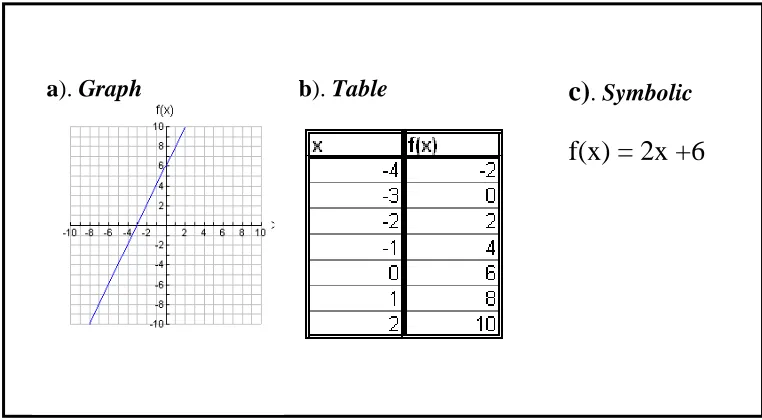
The term “multiple representations” as used in the study refers to external mathematical embodiments of ideas and concepts to provide the same information in more than one form (Ozgun-Koca, 1998). For example, in figure 1 (the case of the function, f(x) = 2x + 6), the term would refer to a combination of at least 2 standard representations (such as, the table, the graph, the symbolic) to provide the same
information (e.g. y-intercept = 6) in more than one form (e.g. where it crosses the vertical axis; the output (f(x)) corresponding to an input value (x) of 0; value of f(x) when x = 0 )
Figure 1. Multiple representations of a given linear function
a). Graph
b). Table
c).
Symbolicf(x) = 2x +6
(coefficient of x) of the function. This would entail not only being able to flexibly move from one representation to another (translation) but also to anticipate the invariance of constructs across the different representations (coordination).
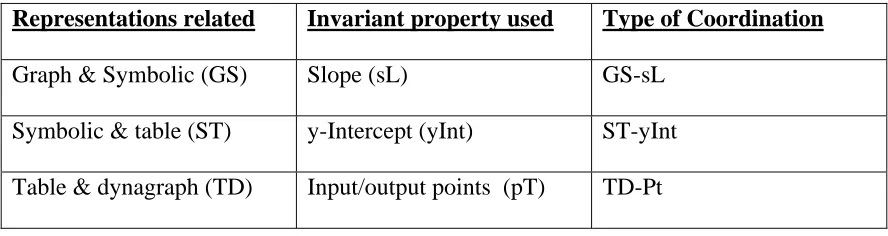
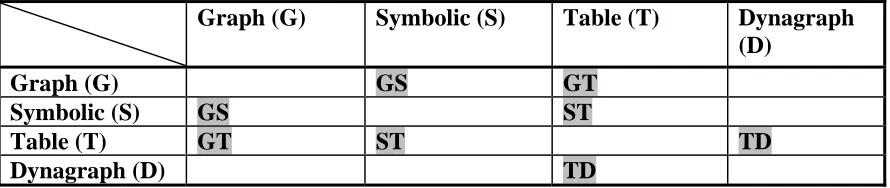
A “coordination” would be used in reference to the process involved in matching two equivalent representations together. In this study, a coordination would be specified by two components; the two representations being related or matched and the invariant property or construct used (Table 1).
Table 1. Components of a coordination
Representations related Invariant property used Type of Coordination Graph & Symbolic (GS) Slope (sL) GS-sL
Symbolic & table (ST) y-Intercept (yInt) ST-yInt Table & dynagraph (TD) Input/output points (pT) TD-Pt
For example, in a “GS-sL coordination”, the representations matched/related are graph & symbolic (GS) and the invariant property or construct used is slope. Similarly in an “ST-yInt coordination” the representations related are symbolic and table and the invariant property used is y-intercept. Being able to successfully perform a specified coordination will thus entail being able to correctly relate (match) the associated representations together via the specified invariant property or construct.
entail interpreting the meaning of the given source representation (e.g. Graph) and producing an equivalent target representation (e.g. Symbolic) with the same meaning. Being able to successfully perform a specified translation will thus entail success in mapping constructs of the specified source representation onto constructs of the specified target representation. In this light, performing a reversible translation (complementary translation) would entail translating from a given source representation to a specified target representation and vice versa; when position of source and target are switched.
The term “standard representations” will be used in reference to the three representations of functions commonly employed in a MATH101 course (i.e., symbolic, table, graph). These standard representations are employed because they are associated with linear functions in most mathematics texts. The term “non-standard
representations” on the other hand will be used in reference to representations of functions that are not likely to be encountered by students in a MATH101 course. A typical example of such a representation is a dynagraph (Goldenberg, et al., 1992).
Description of Dynagraph
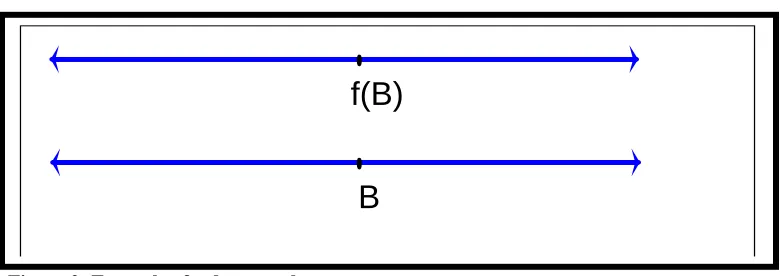
Figure 2: Example of a dynagraph
Configuring the magnitude and direction of movement of these two variables (domain and image) is used to determine the type of dynagraph represented. For example, if every movement in the domain is associated with twice as much corresponding
movement in the image variable (same direction as the domain), a linear function with slope 2 is represented (Figure 3).
Figure 3: Example of a dynagraph with a slope of 2
f(B)
B
Problem Statement
suggest that being able to connect among multiple representations is essential to a foundational conception of function (e.g. Brenner et al 1999; Hollar & Norwood, 1999; Keller & Hirsch, 1998; Knuth, 2000a; Knuth, 2000b; Rider, 2004).
In light of this, reform curricula have advocated for instructional approaches that help students make these connections. Even though multiple representational approaches have emerged as a leading candidate for helping students to make these connections, it is less clear if it is sufficient. Whether students in a course that employs these approaches to teach function concepts would necessarily be able to make these connections for standard representations of linear function and whether these connections once developed is a sufficient indicator of a foundational conception of linear function remains a contentious issue. More importantly it is less clear the nature of students’ connections after
experiencing such an approach to function instruction. This current state is problematic, because it does not clearly distinguish between a students’ connections as a case of conceptual understanding or of a desired procedural skill resulting from students work with these representations as ends in themselves (Dufour-Janvier et al. 1987).
For example, students may be able to determine zeros of given linear function and may correctly develop procedures for abstracting zeros for the table and even connect zeros to the x-intercept in a graph but may not really have the understanding to explain why two or more given linear functions are similar or different. Also students may develop invariant strategies for moving from one representation to another but may not understand the underlying theme behind a translation-an essential attribute in problem solving success and mathematical understanding. Thus focusing instruction on
conceptions may not have the desired impact on students; this is because they may lack the foundational conception required for meaningfully operating with the associated constructs of the concept.
This apparent gap in the literature in an era where these connections have
emerged as a center piece of mathematics instruction and function understanding is rather appalling. The argument is that unless teachers have a way of distinguishing between the essences of students’ connection when multiple representational approaches are
employed in instruction, they are going to be less likely to foster the type of foundational conception needed for students to successfully work with notions and ideas under-girding the function concept. Thus there is a need to further study the nature of students’
connections after going through a course that emphasize multiple representational approaches as a pathway to their understanding of associated mathematical concepts. To delineate students’ connections, the study necessitates engaging students in both standard and non-standard contexts of linear function. A research of this nature would add to the literature on both learning and teaching via multiple representations because it will inform the mathematics education community of the reasoning processes and connections students make when instruction focuses on multiple representational approaches.
Purpose of the Study and Research Question(s)
The study was guided by the questions below;
•
What is the nature of students’ coordination among representations oflinear function?
•
What is the nature of students’ translation among standard representationsREVIEW OF LITERATURE
The function concept has been distinguished as an essential component in mathematics (Selden & Selden, 1992). Although the concept remains one of the most prominent in a students’ mathematics education, studies indicate that many students emerge from freshman-college and developmental college courses with documented difficulties with the concept (Cooney & Wilson, 1993; Carlson, 1998, 2000; Thompson, 1994a). These difficulties have been blamed in part to a lack of foundational function conception-one that allows for meaningful interpretation and use of functions in different representations and settings (Hitt, 1998; Knuth, 2000).
The Function Concept Introduction
The function concept has been described as central to mathematics and to students’ success in mathematics (Selden & Selden, 1992). The importance of functions was brought to the fore front of the mathematics education and research community from as early as the 1920’s. At which time The National Committee on Mathematical
Requirements of the Mathematical Association of America recommended that functions be given a central focus in school mathematics (Cooney & Wilson, 1993). In the light of this, an understanding of the concept was deemed as necessary for any student hoping to comprehend mathematics at the college level (e.g. calculus and differential equations) (Carlson, 1998). Thus one of the goals of undergraduate mathematics was to develop in students a sense for function (Eisenberg, 1992).
Thompson, 1994; Carlson, 1998; 2002). This entailed being able to co-ordinate the images of two varying quantities and attend to the ways they change in relation to each other.
This study focuses on students connections among representations of linear function because this family represents the first formal example of function students’ encounter. Moreover linear function consists of the various aspects of functions identified by Selden & Selden (1992); definitions (ordered pairs, correspondence, dependency etc), representations (graph, table, symbolic, etc), and conceptions types (action, process, object). It also exhibits all the multifaceted structure identified by Dreyfus & Eisenberg (1992) as under-girding function; that is sub-concepts (e.g. domain, range, pre-image, image, inputs, outputs, etc), and representations (e.g. tabular, graphical, symbolic, diagrams, mappings, etc). Linear function can therefore be considered as prototypical of the function concept and an understanding of linear function viewed as foundational to an understanding of the function concept (Moschkovich, 1998).
Students’ Difficulty with Functions
Numerous studies have been conducted on students’ understanding of the function concept (e.g. Briendenbach, Dubinsky, Hawks & Nichols, 1992; Carlson, 1998; Cuoco, 1994; Eisenberg & Dreyfus, 1994). Research over the years has documented students’ interpretations of functions (linear functions in particular) in their varied representations (Hitt, 1998, 1994; Knuth, 2000b). Studies indicate that while students often learn how to manipulate and use function ideas in tasks and problem situations, most students
fair number of mathematics courses experienced difficulties working with notions and ideas of function in the three standard representations used to signify the concept (Eisenberg & Dreyfus, 1994; Hitt, 1998; Nemirovsky, 1996).
For example, a study by Hitt (1998) focused on students conceptions of functions. Participants (n = 30) were students beginning a postgraduate course in mathematics education. The researcher reported that for most of these students their knowledge of functions was restricted to functions that were continuous and definable by a single symbolic expression. Data from the study indicated that these students were not able to anticipate sub-concepts of functions (e.g. domain, range, etc) in representations other than the symbolic and regarded symbolic expressions as the most significant part of functions.
Similar student conceptions have been reported in other studies on functions (e.g. Carlson, 1998; Even, 1990, 1993; Vinner & Dreyfus, 1989). Some of the more prominent ones include the belief that functions needed to be established by a symbolic rule; the view that different symbolic representations of functions that yielded the same values (e.g. f(x) =2x and g(0) = 0, g(x+1) = g(x) + 2x + 1) were different functions (Sfard, 1992); the conception that different representations (e.g. graph, symbolic) of the same function signified different examples of functions; the belief that the only admissible
Such limited conceptions didn’t allow for coherent articulation of the different representations used to signify the concept (Hitt, 1998, 1994). Research indicates that many students fail to comprehend notions and ideas associated with function in their varied representations and are unable to link these representations in given problem situations (Cunningham, 2005; Dreyfus & Eisenberg, 1987, 1991; Keller & Hirsch, 1997; Vinner & Dreyfus, 1989). Students’ difficulty in making connections among
representations of function has been documented in several studies (e.g. Aspinwall, Shaw & Presmeg, 1997; Eisenberg & Dreyfus, 1991; Porzio, 1999; Sfard, 1992). Making such connections have however become associated with a foundational understanding of function (Moskchovich, Schoenfeld, & Arcavi, 1993; Eisenberg & Dreyfus, 1986; Even, 1998).
Connections among Function Representations
There is increasing recognition among the mathematics education community that central to function understanding is an ability to make connections among representations used to signify the concept (Cunningham, 2005). Even (1998) reported that knowledge of the connections among representations of functions was intertwined with knowledge about the different approaches to functions, and knowledge of the underlying notions and constructs of the function concept. Similarly, Eisenberg (1992) asserted that being able to connect among the graph and symbolic representations was a main component of a robust understanding of the function concept. It is contended that deeper and flexible
then is the nature of this articulation for students who have been taught through multiple representational approaches.
A study by Galbraith and Haines (2000) revealed that students’ connections among standard representations of function were poor and that students performed poorly when having to move from the graph to the symbolic. Similarly Knuth (2000b) reported that student’ experienced difficulties translating between the symbolic and the graph and as a result failed to anticipate the link or connection between these representations in given problem situation. Research indicates that being able to translate between representations of associated concept in given problem situation was essential for problem solving success (Gagatsis & Shiakalli, 2004). Six different types of translation have been identified by research for the three standard representations of linear functions. These are in terms of their symmetric or complementary pairs (Janvier, 1987); graph to symbolic (GÆS) and symbolic to graph (SÆG); symbolic to table (SÆT) and table to symbolic (TÆS), graph to table (GÆT) and table to graph (TÆG) (Cunningham, 2005; Knuth, 2000a; Kaput 1989; Porzio, 1995).
multiple representational approaches in instruction would necessarily be able to perform these complementary paired translations or reversible translations for standard
representations of linear function.
Multiple Representations Representations
Before the term “multiple representations” can be explained, a description of what representation(s) is (are) must be given. Representations are artifacts, objects or devices whether external or internal for maintaining a relation with an object or event in its absence (Duval, 1999; Kaput, 1989; Olson & Campbell, 1993). Goldin (1998) noted that a representation is any configuration that can denote, symbolize or represent something other than itself. Pratt & Garton (1993) argued that a central attribute of representations is that they are not just objects in themselves. Rather in their representational capacity they evoke something else hence they allow our thinking to be about a unique object or event and no other (Olson & Campbell, 1993). For example, graphs, tables and the symbolic may be considered as representations of linear function because they could be used to evoke constructs (such as slope, y-intercepts, input/output) pertaining to the linear function concept.
In any treatise of representations, Pratt & Garton (1993) contended that three important distinctions needed to be made, they were; distinction between external and internal representation; distinction between representation as a process and as an object; distinction between the extents to which the representation relates to the object it
conventions (mathematical conventions). Examples of such representations include the standard representations used to signify the function concept. Zhang (1997) argued that these types of representations enable us to talk about mathematical relations, can be easily exhibited or communicated to other people and are involved in most mathematical tasks.
Multiple Representations; Definition and History
Ainsworth (1999) coined the term multiple representations for two or more of these representations used simultaneously to signify the same object. Multiple representations refer to “external mathematical embodiments of concepts to provide the same
information in more than one form” (Ozgun-Koca, 1998, p1). For example, the term may be used in the case of a concept like rate of change to include difference quotients in the tables, slopes of graphs in the Cartesian coordinate plane, and formal algebraic
derivatives in the symbolic (Porzio, 1999). These embodiments may be utilized to
provide the same information (e.g. y-intercept) in more than one form; the point at which the line crosses the vertical axis in a coordinate plane; the output (f(x)) corresponding to an input value (x) of 0 in the table; value of f(x) when x = 0 in the symbolic.
The idea of using multiple representations has been a recurring theme in the mathematics education community for some time (Goldin & Shteingold, 2001). As far back as the early 1920’s, the National Committee on Mathematical Requirements of the Mathematics Association of America in their reorganization of mathematics report of 1923 recommended that students develop the ability to work with multiple
notions be presented in multiple forms in order for students to obtain the mathematical essence of an abstraction. Thompson (1994a) contended that though the importance of multiple representations in students’ understanding had been common knowledge for at least a century, it gained in prominence as a teaching tool only in the early 1980’s as a result of technological advances.
It was during this time that The National Council of Teachers of Mathematics (NCTM) published “Curriculum and Evaluation Standards for School Mathematics” (NCTM, 1989). The NCTM identified multiple representations as one of the key components in the curriculum that needed to be emphasized during mathematics instruction (NCTM, 1989). In particular, “all students should be able to represent and analyze relationships using tables, verbal rules, equations and graphs; translate among tabular, symbolic and graphical representations of functions” (p.154). In the NCTM’s more recent publication, “Principles and Standards for School Mathematics” there is a call for all students to be able to; create and use representations to organize record and communicate mathematical ideas; select, apply and translate among mathematical representations to solve problems; use representations to model and interpret physical, social, and mathematical phenomena (NCTM, 2000, p.67). NCTM advocated that all instructional programs (K-12) should help students develop the ability to make
connections among multiple representations of mathematical concepts (NCTM, 2000). Multiple Representations in Mathematics
Researchers have over the years argued about the centrality of multiple
mathematics by its very nature was one of the academic subjects in which multiple representations was needed for communicating and understanding mathematical notions. Because unlike other fields of knowledge (e.g. physics, botany), there was no way of gaining access to the objects of mathematics except through these representations (Duval, 1999). Researchers argued that most mathematical activities involved multiple forms of these representations used in concert and in combination with one another (De Jong & van Joolingen, 1998).
The whole of mathematics is little else than exploring mathematical
representations and their interrelations (Mckendree, Small, Stenning & Conlon, 2002). Dufour-Janvier et al. (1987) contended that mathematical teaching and learning, together with all its’ elements including curricula advertently or inadvertently exposes students of all ages and school levels to multiple representations of concepts. For example, graphs, tables and symbolic representations used in concert with concepts like linear functions were not linear functions per se but were conventional representations via which notion and ideas associated with linear function could be abstracted. In order for students to develop facility in abstracting the mathematical concept under-girded in each
representation, Cunningham (2005) argued that instruction should formally allow students to work and reason with multiple representations of these concepts.
representations, flexibly move from one representation to another, and this ultimately may allow them to develop deeper and more foundational understanding of associated concepts. Similarly, Keller & Hirsch (1998) admitted that the different concretizations possible with multiple representations were potentially beneficial in that, they selectively emphasized and de-emphasized different aspects and facets of complex concepts and facilitated cognitive linking of representations. It is believed by Piez & Voxman (1997) that students gained a more thorough understanding of function when the concept is explored via multiple representational approaches.
Issues Associated with Multiple Representations
Even though there is general agreement among math educators today on the need for students to work with and reason via multiple representations, how to effectively utilize these representations in mathematics instruction remains contentious (Even, 1998). Thompson (1994a) believed that the idea of multiple representations as currently
construed was not carefully thought out. It has been asserted that the problem pertinent to multiple representations was not so much its importance in mathematics teaching and learning (Keller & Hirsch, 1998). Ainsworth & van Labeke (2004) noted that the issue is not whether multiple representations were effective but the circumstances that influence the effectiveness of its use. This issue as noted by Duval (1999) revolves around the question of how best to help students distinguish between the representations and the mathematical objects they purport to signify.
their representational activities in regard to the situation that engendered them. Ainsworth (1999) argued for approaches that ensured that learners understood the semantics of each representation, which aspects of the concept were represented, how to relate the
representations to each other, and how to translate between the representations. Duval (1999) similarly recommended methods that allowed students to compare multiple representations of the same concept, to connect multiple representations of the same concept and to discriminate the specific ways of working within each of the different representation.
Connection among Multiple Representations
Multiple representational approaches highlight and place emphasis on the connections among standard representations of concepts and on procedures for
abstracting information from these representations (Porzio, 1997; Keller & Hirsch, 1998). These connections have arguably being said to develop deeper and more flexible
understanding of mathematical concepts (NCTM, 1989, 2000). Even (1998) argued that multiple representations connectedness develop insights into understandings of the essence as well as the many facets of a concept. Some researchers contend that these connections allowed for abstraction of invariant attributes and aspects of concepts and as a result led to deeper and more flexible understanding of associated concepts (Ainsworth, 1999; Eisenberg & Dreyfus, 1992; Kaput, 1992).
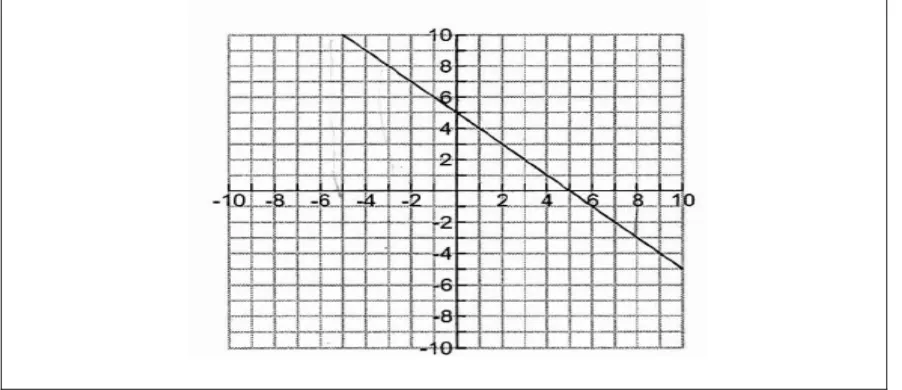
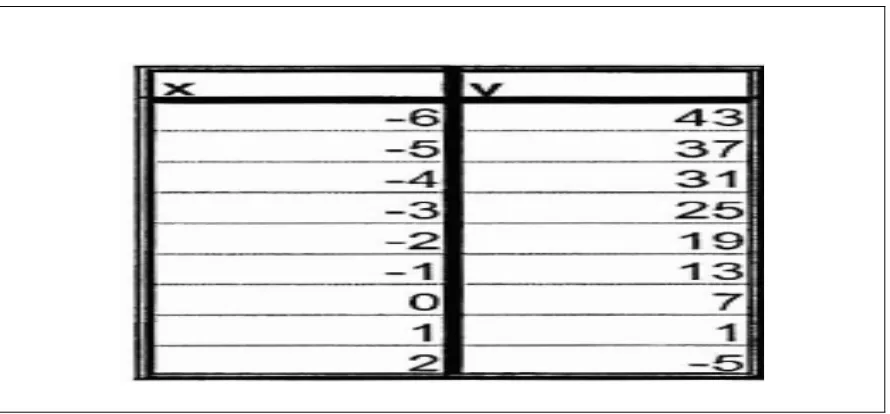
For example, a concept like linear function, may be abstracted through the; symbolic as a dependency relationship (Figure 1); the graph as a coordination or mapping between input-output values (Figure 2); the table as a correspondence between a
representations, it is arguably said that deeper and more flexible understanding of linear function would likely emerge (Even, 1998). Kozma (2003) noted that while experts were made to connect among multiple representations, novices on the other hand were most of the time constrained by the surface features of each individual representation. Ainsworth (1999) contended that this may arise due to the fact that when these approaches are emphasized, learners are faced with the complex task of not only understanding the form of the representations (how each representation encodes and present information) but also of understanding how these representations relate to the concept they represent and to each other.
F(x) = 2x +6
Figure 1 Example of a symbolic representation of a linear function
Figure 3 Example of a tabular representation of a linear function
At issue then is whether emphasizing multiple representational approaches during instruction necessarily ensures that students’ develop an understanding of the format of each of the representations and of the invariance of associated constructs across
representations. Thus a focus of this research is on the nature of students’ coordinations among standard representations of linear function after going through a course that emphasizes multiple representational approaches.
Research on Multiple Representations
A significant body of research has been published on the use of multiple representations in the teaching and learning of mathematics (e.g., Hollar & Norwood, 1999; Keller & Hirsch, 1998; Knuth, 2000a; Knuth, 2000b; McGowan & Tall, 1999). Some of these studies have focused on the impact of technology as a multiple
2000; Rider, 2004; Brenner et. al., 1997; Rich, 1995; Porzio, 1997). Still other studies have concentrated on students’ preferences for representations (e.g., Keller & Hirsch, 1998; Piez & Voxman, 1997).
A central theme emerging from these and other studies is the issue of students’ connections among representations. Reported findings from these studies suggest that students with compartmentalized view of functions were limited in their ability to make connections among multiple representations of associated concepts (e.g. Carlson, 1998; Hitt, 1998; Knuth, 2000). Other findings suggested that successful problem solvers were necessarily successful at making connections among different representations in given problem situations (e.g., Brenner, Herman, Ho & Zimmerman, 1999; Tchoshanov, 1997). Studies in which these connections were specifically highlighted and emphasized
(multiple representational approaches) however reveal mixed results (e.g., Aviles, 2004; Moseley & Brenner, 1997; Piez & Voxman, 1997; Porzio, 1999; Rider, 2004).
For example, a study by Tchoshanov (1997) explored the effect of different approaches to mathematics instruction on students understanding and connections among representations of trigonometric functions. Participants for the study were students from a pre calculus class in a high school in Russia. Students were put into three comparison groups; the first (“symbolic group”) was instructed using symbolic representations; the second (“visual group) was taught using only visual representations; the third and final group (“representational group) was taught via multiple representational approaches. The researcher reported that on a given test on trigonometric functions and proof, the
In a similar study, Porzio (1997) examined and compared the effects of three different instructional approaches on students understanding and connections among representations of function. Participants for the study were undergraduate students (n = 100) chosen from a large Midwestern University; one course (MA151), with 40 students utilized symbolic representations for instruction; the second (MA151G) with 24 students utilized all three standard representations of function; the third (MA151C) with 36 students also utilized these standard representations of function but placed special emphasis on students connections among these representations. On a test designed to assess knowledge and connections among standard representations, students’ from MA151C were better than students from the other groups at anticipating and connecting among graph, table and symbolic representations.
A study by Rich (1995) explored the effect of multiple representational approaches on the learning and retention of mathematical concepts. Participants were students (n = 59) from three regularly scheduled high school calculus classes; a traditional class with 20 students (control group); a class with 21 students (treatment group1) where different representations are used but the connections among these representations not highlighted nor emphasized; and a class with 18 students (treatment group2) where connections among these representations were highlighted and
A study on the impact of multiple representational curricula on students
understanding of functional relationships was conducted by Brenner, Mayer, Moseley, Brar, Duran, Reed & Webb (1997). Students (n=128) from three junior high schools in Southern California participated in the study. These students were placed into treatment and control groups; students in the treatment group (n=72) were taught using a unit of reform curriculum that emphasized connections among multiple representations; students in the control group (n=56) were taught using a traditional curriculum. On a test
instrument made up of routine problems, non-routine problems and linking
representations problems, the researchers reported that students in the control group produced significantly greater pre to post-test gains than did the treatment group (p < 0.01) on routine problems. In the case of the “non-routine problems” and the linking representation problems however, students from the treatment groups produced greater pre to posttest gains than did the control group (p < 0.01).
Similar results were reported in a study conducted by Aviles (2001) on students understanding of linear function. The researcher compared the mathematical performance of students in two classes of a college algebra course at a University in Puerto Rico. The focus of the study was on the impact of multiple representational approaches (via
significantly better than the control group on items assessing their ability to connect among the graph, table and symbolic representations of linear function.
While the above mentioned studies seem to suggest an increase in the levels of student connections when multiple representational approaches are emphasized (e.g. Porzio, 1999; Aviles, 2004; Moseley & Brenner, 1997), other studies seem to indicate other wise. For example, in one such study, Piez & Voxman (1997) reported that of the 20 students in a class where multiple representational approaches were emphasized, only one was able to correctly work with both graphs and symbolic representations in given problem situations. A similar study conducted by Ozgun-Koca (1998) revealed that, even though students acknowledged that mathematics problems could be solved in a variety of ways via different representations, most of them found it easier to work with one
representation than to deal with multiple representations. Similar finding was reported in a study by Poppe (1993). The study explored the effects of multiple representational approaches to calculus instructions on students understanding and connections among representations during problem solving. The researcher reported that although students realized that tables, graphs and other representations were equally important when solving given problem situations, students failed to use them in unfamiliar problem situations unless suggested to do so.
research is on the nature of students’ translations and coordinations among
representations of linear function after experiencing instruction that emphasizes multiple representational approaches.
Conceptual Framework
This section discusses both the theoretical perspective (basis) under-girding the study and the conceptual framework via which the results of the study would be interpreted.
Theoretical Foundation
The research is based on constructivism as a theory of knowing. This view on knowledge and how we come to know is shared by a majority of researchers (Janvier, 1987). The study is grounded in a radical orientation to constructivism (von Glasersfeld, 1984). This orientation is under-girded by the perspectives that; knowledge is actively constructed by the cognizing subject rather than passively transmitted by way of communication or through the senses; the function of cognition is adaptive tending towards fit or viability; cognition serves the subject’s organization of the experiential world not the discovery of an objective reality (von Glasersfeld, 1995, p. 50).
perspectives embrace the idea of knowledge as an instrument of adaptation that helps the learner to avoid external perturbations and internal contradiction (von Glasersfeld, 1980, 1999; Goldin, 1999; Noddings, 1999).
Knowledge was thus a repertoire of actions and thoughts, an invariant, a
cognizing subject constructs as he (she) sorts through records of experience, and which in the past have been viable for making sense of and in dealing with experiential situations (von Glasersfeld, 1987; 1999). Sfard (1992) uses the term conception for a learners’ knowledge with respect to a concept. A conception therefore was not merely a store of facts or procedures to be obtained, but rather an anticipated regularity in the learner’s experiential world (Simon & Tzur, 2004). For example, a conception of linear function may be the anticipated regularity a learner forms from coordinating the images of two independently varying linear quantities.
The regularity in this case may be that; any increment in one of the variables considered as independent is associated with a corresponding consistent increment in the other variable considered as dependent on the other variable (co-variation); the consistent ratio between dependent and independent increments is invariant and is quantifiable by a fixed number (slope); dependent and independent variable values are related by a rule or regularity. A mathematical conception in this light was thus the anticipated invariant or repertoire of actions and thoughts a learner constructs for making sense of representations and constructs pertaining to a concept.
Hiebert & Carpenter (1992) contended that insights into such conceptions may be gained via a focus on students’ work with external representations in task or problem situations. Thus by analyzing students work and articulations on task and problem situations
involving representations of linear function it is conceivable that the nature of their connections and anticipations for the linear function may be inferred; the SOLO Taxonomy (Biggs & Collis, 1982) was employed as the framework for this analysis.
Framework
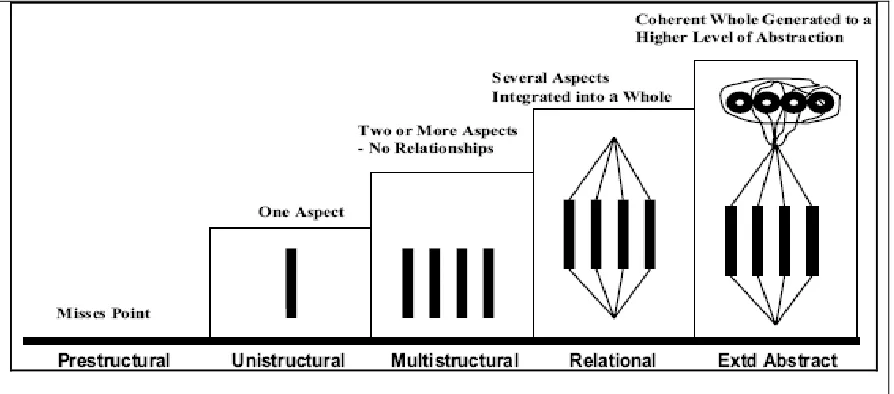
In order to better understand the nature of students’ connections among standard representations of linear function, research literature necessitated an analysis of students’ translations between and coordinations among these representations of linear function (Cunningham, 2005; Hitt, 1998; Duval, 1999). The framework employed for the analysis thus served as a lens via which students’ actions, articulations, anticipations and work with standard representations could be elucidated and the nature of their connections characterized. The SOLO Taxonomy (Biggs & Collis, 1982) was employed as the framework for characterizing student’s connections among representations of linear function. The acronym SOLO, which stands for Structure of Observed Learning Outcome, identifies characteristics of increasing quantity and quality of thought and categorizes mental activity by the observable product of student work.
of the different levels in order of increasing complexity (adapted from Biggs, 1999).
Figure 4 Graphical representation of the SOLO Taxonomy
A student at the prestructural level in relation to an assessed component or a questioned skill lacks knowledge of the element being assessed. A student at this level maybe easily misled or distracted by irrelevant aspects or detail of the assessed
A Student at the relational level in relation to an assessed component or a
questioned skill would be able to not only correctly complete more than one aspect of the task but also relate the different aspects of the task together. Such a student has an
understanding of more than one aspect of the element being assessed and of their significance to the whole and relationship to other aspects. A student at the extended abstract level in relation to an assessed component would be able to not only correctly work with and relate the different aspects of the component together but can also generalize to new and novel situations. Students at this level may be described as being able to see the element being assessed from an overall point of view.
In this research, the elements or components assessed were translations between and coordinations among representations of linear function. When applying the SOLO Taxonomy to the assessed components, students at either the unistructural or
multistructural level would be described as having developed procedural conceptions of the element being assessed. These students may arguably be said to have developed compartmentalized notions and ideas (conceptions) of the elements being assessed. Such conceptions allowed them to successfully work with the elements only in specific
instances or situations. Students at either the relational or extended abstract level on the other would be described as having developed foundational conceptions of the elements being assessed. These students may arguably be said to have abstracted regularities (from their experiences) that allowed them to successfully anticipate the element being assessed irrespective of the situation or instance.
METHODOLOGY
This chapter provides information on the specific research methods employed in the study. The design of the study as well as aspects such as the rationale for the research method, pilot study, participants, contexts, data collection and analysis procedures are discussed.
Rationale
In order to make knowledge claims about students’ mental processes or
conceptions, it was necessary to observe and investigate the mathematical activities and communications of students (Creswell, 2003, pp. 20). This was needed for understanding and inferring students’ meanings, knowledge structures, and cognitive processes (Goldin, 1998) with respect to linear function. Ernest (1998) argued that the general research tradition that allowed for such investigations was qualitative research. Qualitative research is an approach to research in which the researcher as a primary instrument of data collection seeks to establish the meanings of phenomenon based primarily on the views, experiences and perspectives of participants (Punch, 2000; Eisner & Peshkin, 1990; Strauss, 1990). It’s strategies of inquiry include narratives, phenomenologies, ethnographies, grounded theories and or case studies (Creswell, 2003; Stake, 1994, 1995). The specific strategy of inquiry employed in this study meets Creswell (1998) standard for a case study.
In general case studies are used to explore the interpretative and subjective
such cases could contribute to the extension of a theory through supporting existing principles or challenging those principles. Case studies involve an in-depth exploration of a program, an event, an activity, a process or one or more individuals using a variety of data collection procedures such as open-ended interviews, direct observation and documents (Creswell, 2003, Stake, 1995).
This study employed a set of case studies of students work and reasoning processes on given tests and task situations involving linear functions. This method enabled the investigation of students’ translations between and their co-ordinations among
representations of linear functions. Through students’ articulations and written work on given task and test items, the study addresses the nature of students’ connections among representations of linear functions. These interviews and tasks were open ended and were used as a means through which students’ mental processes could be elicited and their capability to successfully complete the given tasks determined; an interview protocol (Appendix B) was used to guide the interview process. Goldin (1998) argued that task-based interviews allowed for more in-depth questioning of subjects and helped alleviate some of the difficulties students may have with the questions posed. This data generating tool was tested in a pilot study during the summer session of 2005.
Pilot Study: Usefulness of instruments
The pilot was designed to determine the effectiveness of these instruments in generating the data needed to answer the research questions. Students (n=10) between the ages of seventeen and nineteen voluntarily elected to take part in the pilot study. These students were enrolled in a section of an Intermediate Algebra through Multiple
pilot proceeded through a series of one-on-one interviews with the students as they completed the given task.
Students were prompted to articulate their thinking processes as they worked on the problems, which involved both standard and non-standard representations of linear function. The task featured had two main parts. First students were asked to match linear function examples based on their standard representations then on their dynagraphs (Goldenberg, Lewis, & O’Keefe, 1992). Second, students were asked to match these representations of linear function (both standard and dynagraphs) using any preferred order for matching. Data from the pilot were analyzed first in terms of students’ work with standard representations and then the dynagraph.
Findings from the pilot indicated that students who participated in the study were more successful in matches involving the graph, table and symbolic representations than in matches involving the dynagraph. A notable finding was that students who
successfully matched all three standard representations were more successful at working with the dynagraphs. It was observed that these students were using their knowledge of these standard representations to constrain their interpretation of the dynagraph. Though the available instrument provided data to account for whether or not students could match the given representations of linear function, it could not be used to adequately account for the nature of students’ connections among these representations.
In the pilot, the instrument failed to provide conclusive evidence on students’ translations and coordinations among the given representations of linear function.
The instrument (Appendix F) was employed to ascertain students’ strategies in performing reversible translations (complementary pairs) between standard
representations. Also the task and interview protocol used to guide the interview process were adjusted to allow a focus on not only students’ matches but also their coordination among the given representations of linear function. This addition and adjustment were done for the explicit purpose of affording students ample opportunities at concept
articulation and allowing the researcher opportunities at gaining insight into the nature of students’ anticipations. This study built on the pilot by examining students’ matches as well as their coordinations, and translations between representations of linear function.
The Researcher’s Role
My perceptions on multiple representational approaches have being shaped by my experiences. From the period of spring of 2001 to spring 2004, I served as an instructor in sections of an intermediate algebra through multiple representations course; this course is the exact same course reported in this study. As an instructor, I utilized multiple
representations approaches to emphasize connections among representations of functions and to help students develop anticipations for these connections for functions. I believe my experiences and interactions in the course enhanced my awareness of and sensitivity to students’ understanding of these connections especially when the mode of instruction placed continual emphasis on connecting among such representations.
multiple representational approaches may represent an effective means for enhancing the connections that students make among these representations. Also because the theoretical foundation for the study is premised on the perspective that no individual has direct access to anyone else’s knowledge only to knowledge or experience the individual himself construct of those experiences (radical constructivism). I am of the opinion that any findings I end up with on the nature of students coordinations or translations however withstanding are personal models that I myself construct based on my experience with these students and as a result may only closely approximate the nature of conceptions developed by these students on linear function.
Main Study
The Context: An Intermediate Algebra Course
on their level of understanding and to ensure that their placement in the course was warranted.
The course was based on a functional approach to algebra instruction, in which the emphasis is on representations of functions (e.g. table, graph, symbolic) and the associated connections among these representations. A typical instructional unit in the course embodies the use of graphical, symbolic and tabular representations to explicate the notions and ideas associated with different function types. For instance, instead of solely utilizing the symbolic approach to develop function concepts, students were presented with tables and graphs at the same time as the symbolic, with instructional focus on their understanding of how these representations are linked. This approach is based on the assumption that by exposing students’ to different ways of signifying and connecting function ideas and representations they may be able to discern and abstract invariant relations and procedures across these representations and use that to develop foundational conceptions (Thompson, 1994a).
The Participants: Intermediate Algebra Students
The participants in the study were selected from a pool of students in several sections of the course. Guided by the researcher, instructors in the various sections acted as recruiting agents. Students in each section were informed of the study by their
The results of the study are based on the work of five (Shama, Ama, Jen, Rita, John) of the total pool of eighth students. These students were selected because of their differing ability levels (based on their class scores and teacher recommendation) and because they provided elaborated explanations of their work and actions and coherently articulated their reasoning process. John was a first year college student enrolled in the MATH 101 course at the time of the study. The course instructor reported that John was low achieving and a likely candidate to repeat the course.
On the test given after the linear function unit, John score of 57% was well below the course average of 75%. John’s course grade at the time of the study was well below the C minimum required to pass the course. Rita was a first year college student enrolled in the MATH 101 course at the time of the study. The course instructor described Rita as an average student overall. On the test given after the unit on linear function, Rita scored 81%. Rita’s grade for the course at the time of the study was borderline C. Jen was a first year college student enrolled in the MATH 101 course. Jen was viewed by the course instructor as an above average student. On the test given after the linear function unit, Jen had a score of 90. Jen’s grade for the course at the time of the study was a B-.
after the linear function unit, Shama had a perfect score of a 100. Shama’s grade for the course at the time of the study was an A+.
Data
Three main sources provided data: Task instrument (Appendix B), test instruments (Appendix F), student worksheeets (Appendix C). The task instrument (Appendix B) was used to generate data on students’ coordinations among
representations of linear functions (Keller & Hirsch, 1998; Even, 1998; Knuth, 2000). The two tasks on the instrument were open ended and were used as a means via which students’ mental processes could be elicited and their capability to successfully
coordinate given representations of linear function determined. The tasks on the
instrument were made up of problem situations involving both standard and non-standard representations of linear function. These problems were created with the Geometer’s sketchpad (Jackiw, 1991) and were posed to students via a computer screen.
Both task involved coordinating dynagraphs, graphs, tables and symbolic
representations of linear function. The difference between the two tasks was that one task had examples of linear function of the same slopes but different y-intercepts while the other had examples of linear function with different y-intercepts but the same slopes. The two tasks were posed to students in the form of a task based interview. Students were required on these interviews to articulate their thinking processes and to answer questions posed by the researcher as they completed the task. In order to ensure consistency among participants, an interview protocol (Appendix A) was used.
instruments. Students for the study were asked to select days and times that fitted their schedules. These time slots were coordinated so that the researcher could interview one student at a time; each interview lasted between 20 and 30 minutes. Each student was observed and interviewed as they worked on the given tasks. These observations were done for the purpose of gathering field notes (Bogden & Biklen, 2003) on students’ interactions with the task medium (computer screen) and for asking probing questions on specific actions employed by students. The interviews were used to elicit individual students’ conceptions and ways of working with representations of linear function. Students’ work on the task and interviews were videotaped for further examination.
Students’ worksheets (Appendix, C) were used to generate data on students’ answers to the given tasks. The worksheets were given to students in the course of the interviews and were used to follow their generation of solutions and to determine their success on the given tasks. These worksheets were structured in such a way that each of the tasks featured had a space allotted to it. An extra space was provided for any extra work by students. Each student was required to complete the worksheet by recording their matches on each task.
The test instrument (Appendix F) was utilized to generate data on students’ translations between standard representations of linear function.This instrument served as a means via which students strategies when moving from one mode of standard
instrument.
Data Analysis
Qualitative data analysis is viewed by Bogden & Biklen (2003) as a process of systematic searching and arrangement of interview transcripts and other data forms accumulated in the course of the study in order to come up with meaningful descriptions of participants’ thinking. To this end, data from the study were searched and arranged in a manner that allowed for meaningful interpretation of the nature of students connections among representations of linear function. The analysis was conducted in three phases; sorting, coding, rating. In the first phase of the analysis, student interviews were transcribed and coordinated with other forms of data collected (videotapes, audiotapes worksheets, etc.). Each student data was then stripped off any form of formal
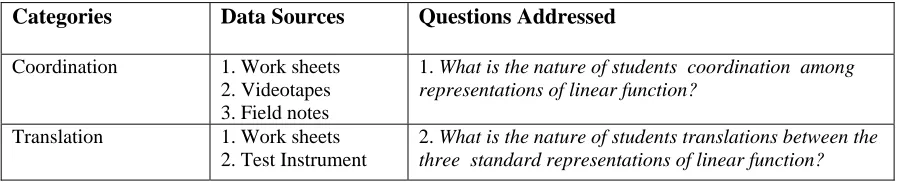
identification and pseudonyms were employed. The various forms of student data were then organized into categories based on the research questions they addressed (Table 1).
Table 1: Data sorted into categories based on research question
Categories Data Sources Questions Addressed
Coordination 1. Work sheets
2. Videotapes 3. Field notes
1. What is the nature of students coordination among representations of linear function?
Translation 1. Work sheets
2. Test Instrument
2. What is the nature of students translations between the three standard representations of linear function?
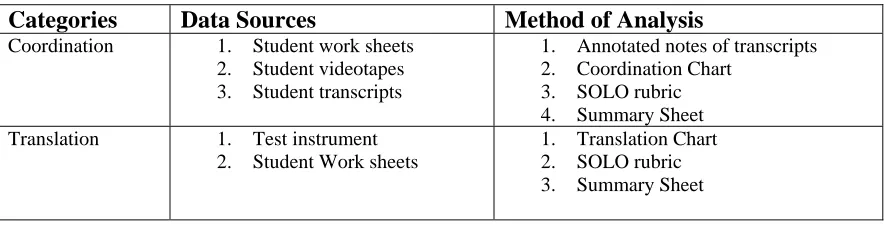
while student data for the translation category was represented in a translation chart (Appendix G). These charts facilitated the comparison of students’ data within each category.
Table 2: Data analysis methods
Categories Data Sources Method of Analysis
Coordination 1. Student work sheets
2. Student videotapes 3. Student transcripts
1. Annotated notes of transcripts 2. Coordination Chart
3. SOLO rubric 4. Summary Sheet
Translation 1. Test instrument
2. Student Work sheets
1. Translation Chart 2. SOLO rubric 3. Summary Sheet
In the third phase, student charts within each category were analyzed via the SOLO Taxonomy (Biggs & Collis, 1982). Two rubrics (Appendix E, Appendix H) based on an adaptation of the SOLO Taxonomy (Table 1) to the instruments in each category were used for this purpose. The specific rubric for each category applied the levels of the taxonomy to items on the associated instrument and gave exemplars of responses at the different levels on the SOLO corresponding to the assessed component.
Ethical Issues
were stored in a secure and safe location by the researcher. Pseuodonyms were employed on all data reports to ensure anonymity of all students. Student rights, interests and wishes determined any decisions made in regards to reporting data from the study.
Limitations of the Study
I believe that one of the limitations of the study was the effectiveness of the study instruments in generating the relevant data need for the study questions. To minimize this factor, before the study was done, a pilot study was conducted with a comparable sample of students to check the instruments for their effectiveness. Modifications were done to these instruments as a result of the findings from the pilot study. The pilot gave me a better sense on ways to effectively utilize these instruments to gather much needed data.
CONNECTIONS AMONG REPRESENTATIONS: THE NATURE OF
STUDENTS’ COORDINATIONS ON A LINEAR FUNCTION TASK
INTRODUCTION
Reform in the field of mathematics education with its focus on conceptual understanding is deeply rooted in finding ways of empowering students to learn to do mathematics (Thomasenia, 2000). A view on mathematical learning that has permeated research and reform oriented curricula over the past two decades seemingly suggests that central to mathematics understanding is facility in coordinating among multiple
representations of associated mathematical concepts (Kaput, 1992; Ainsworth, 1999). This facility has been described as the cognitive architecture via which students can recognize the same mathematical concept in different representations (Duval, 1999; Even, 1998; Porzio, 1998; Knuth, 2000a,; NCTM, 1989, 2000).
Facility in coordinating among multiple representations entailed among other things understanding the connection between the ways in which different representations exhibit the same properties of the mathematical concept. Ainsworth (1999) contended that this included being able to notice both regularities and discrepancies between representations of associated concepts and being able to relate these representations together via these regularities. While multiple representational approaches have been posited as a means for helping students develop facility in coordinating among representations of associated concepts (Brenner, et al, 1997; Knuth, 2000a; Piez & Voxman, 1997; Porzio, 1999) it is less clear if this is sufficient in the case of an algebraic concept such as linear function.