1
ONLINE ISOLATED HANDWRITING
AND TEXT RECOGNITION BASED ON
ANOTATED IMAGE FEATURES
Muhammad Faisal Zafar
Dzulkifli Mohamad
1 INTRODUCTION
The representation schemes of input pattern and model database are of particular importance since a classification method depends largely on them (Liu et al., 2004). Selecting the data representation is one of the most fundamental decisions to make (Jong, 2001). This chapter describes the simple techniques involved in extracting the annotated image features from online handwriting as well as printed isolated English alphabets and their representation in a standard form to be used by the recognition stage. Conventionally, the data obtained needs a lot of preprocessing including filtering, smoothing, slant removing and size normalization before recognition process. Instead of doing such lengthy preprocessing, here we present an easy approach to extract the useful character information. Here, the neural network approaches have been used for a writer-independent recognition system.
2 ON-LINE RECOGNITION OF ISOLATED CHARACTER HANDWRITING
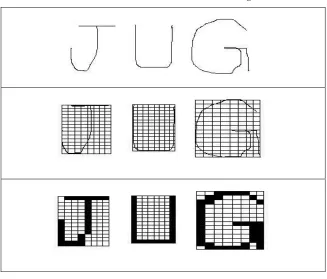
A block diagram of a proposed online recognition system of isolated roman characters is shown in Figure 1. There are three main modules of the system; data acquisition module, feature extraction module and classification module. The input to the system is a sequence of isolated handwritten character patterns. After receiving input from tablet the extreme coordinates i.e. left, right, top, and bottom are calculated. Then character is captured in a grid as shown in Figure 2. Sensing the character pixels in grid boxes, the character is digitized in a binary string. This binary string is applied at the input of neural network (counter propagation neural network or back propagation neural network) for training and recognition. Grid sizes of 14x8(i.e. 14 rows and 8 columns) and 15x11 were used in the experiments. In Figure 1, the flow of data during training is shown by the dashed line arrows, while the data flow during recognition is shown by solid line arrows.
2.1 Data Acquisition
Figure 1 Block diagram of the system
Online input from tablet
Classification Result Classifier (Neural Network) Character digitization Training Data
set
Grabbing character into grid
Extreme coordinates measurement
Trained data weight File
2.2 Feature Extraction
As stated above, selecting the data representation is one of the most fundamental decisions to make. The final choice of features may be influenced by which character recognition paradigm is used, or with a fixed choice of representation it may influence the other way around. This section will give a detailed discussion on annotated image features for online character recognition and how these features are extracted in our proposed system.
2.2.1 Annotated Image Features
On-line handwriting input has one dimensional sequence representation in structure. Converting off-line data to on-line version is hard to achieve reliably, but the other direction is relatively easier (Jong, 2001). Therefore, if a limited or refined form of image features can contribute substantially to the discriminative power, at least as a part of the overall feature set used by the system, then it would be well worth a try. The advantages of converting on-line data to image representation include:
• Stroke order invariance: In an image, the information on which order a shape was formed is not apparent and not relevant. This is not a problem since we already have the data in an on-line version. Only one image model is needed for the same shape class. This is not the case for on-line data: even for the same shape class, multiple models are necessary, one for each substantially different stroke orders.
involved topic. On the character level conversion from on-line to image, the size normalization is achieved easily by fitting the on-line data into the fixed size image, which is by contraction or expansion.
• Robustness: Image is a most natural, redundant, distributed and fully decoded type of representation. Therefore it fits well for a pattern recognition system like neural network, which works best on such a kind of representation. The robustness comes from the fact that such a recognition system learns and performs the feature extraction itself from the raw data, so that the choice and the development of features are automated instead of handcrafting that may be a fallible process.
• Higher level perspective: Image can naturally be made to represent a character or larger unit, so it provides even higher level of scope than the sub-character primitive features.
information from the off-line data, which is a daunting task. With an on-line recognizer that can handle image representation, the difficulty of the problem would be reduced substantially since such a recognizer will need only reasonable character segmentation, not an exact recovery of the temporal orderings.
2.2.2 The Features Used by Our System
In the proposed online handwriting recognition system, feature extraction consists of three steps: extreme coordinates measurement, grabbing character into grid, and character digitization. The handwritten character is captured by its extreme coordinates from left /right and top/bottom and is subdivided into a rectangular grid of specific rows and columns. The algorithm automatically adjusts the size of grid and its constituents according to the dimensions of the character. Then it searches the presence of character pixels in every box of the grid. The boxes found with character pixels are considered “on” and the rest are marked “off”.
Figure 2 Steps in Feature Extraction
Sections below describe in detail the procedure involved in different steps of feature extraction.
2.2.2.1 Character Detection
As stated earlier that a character is written with white digital ink, so the algorithm for character detection is quite simple. It searches from left to right for white pixels starting from left-top corner of the area specified for writing. A trace of a white pixel is the indication of the presence of a character.
2.2.2.2 Calculating the Number of Rows
By scanning from top to bottom, the algorithm search for the continuous presence and absence of white pixels. The continuous absence of white pixels (or presence of black pixels) could be a gap between two rows. To make sure whether it is a gap, algorithm searches from left to right against every black pixel, if there is no trace of white pixel for the entire row, the gap is confirmed. In this way, all the horizontal gaps, in the image, are traced out and from this, number of rows is calculated. Figure 4 shows a sequential algorithm for finding the number of rows in the document.
i. Find the text boundary of the whole image by scanning from top to bottom for upper border Y1, left to right for left border X1, right to left for right borderX2 and bottom to top for lower borderY2.
iii. If there is a black pixel, then scan from X1 to X2 for that particular row to detect any white pixel.
iv. If no white pixel found, there is a row gap.
v. Repeat steps ii - iii for the whole image to find total number of row gaps.
Figure 4 Sequential algorithm for finding the number of rows
2.2.2.3 Character Boundary Calculation
2.3 Experiments
2.3.1 Data Set and Model Parameters
The data used in this work was collected using tablet SummaSketch III. It has an electric pen with sensing writing board. An interface was developed to get the data from tablet. Anoop and A. K. Jain (2004) pointed out that the actual device for data collection is not important as long as it can generate a temporal sequence of x and y positions of the pen tip. However, the writing styles of people may vary considerably on different writing surfaces and the script classifier may require training on different surfaces.
2.3.2 Learning / Training
For classification purpose, two neural networks techniques: back propagation neural networks (BPN) and counter propagation neural networks have been used. In the BPN, sigmoid PEs were used in the hidden and the output layer. Twenty-six output layer processing elements (PEs) corresponded to Twenty-six English alphabets to be recognized. For example, a ‘high’ output value on the second PE in the output layer and ‘low’ on the others would mean that the network classifies the input as a ‘B’. As another example, a network output vector of [0.00 0.01 0.16 0.02 0.09 0.96 0.13 0.00 --- 0.15 0.04] would be translated as the model classifying the input character as ‘F’.
The GDR was preferred over the exact steepest descent algorithm because of the large difference in convergence time between the two. The author experimented with the number of hidden layer PEs in search of better convergence behaviour. The selection of learning rate and momentum coefficient (proportionality constant for sliding in the direction of negative gradient) was also more of an art than a science; their values were kept between 0 and 1 with typically a gradual decrease in magnitude as training progressed.
Experiments were started with a strict convergence criterion: training was stopped only when the network classified all the training samples correctly. While checking the network’s performance during training, an output layer PE’s output value of
≥ 0.9 was translated as ‘high’. Thus, for this criterion, an output vector [0.00 0.03 0.06 0.12 0.09 0.16 0.03 0.91 0.17 --- 0.15 0.14] for character ‘H’ in the training sample set would be termed as proper classification; a 0.85 instead of 0.91 in the output vector would render the training input as not properly recognizable.
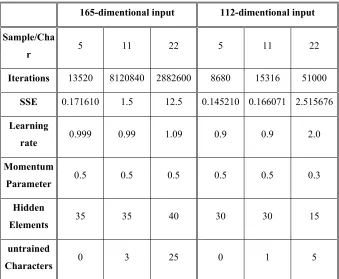
values used for BPN during training. Training was stopped for the 15x11 grid, with 3 samples (out of 286) and 25 samples (out of 572) remained unclassified after 8120840 and 2882600 training presentations for 11 samples/ character model and 22 samples/ character model respectively (see Table 1). Similarly, one sample and 5 samples remained unclassified after 15316 and 51000 training presentations for 11 samples/ character model and 22 samples/ character model respectively for the grid 14x8 (see Table 2).
Table 1 Details of Different parameter values used for BPN during Training Phase
165-dimentional input 112-dimentional input
Sample/Cha
r 5 11 22 5 11 22
Iterations 13520 8120840 2882600 8680 15316 51000
SSE 0.171610 1.5 12.5 0.145210 0.166071 2.515676
Learning
rate 0.999 0.99 1.09 0.9 0.9 2.0
Momentum
Parameter 0.5 0.5 0.5 0.5 0.5 0.3
Hidden
Elements 35 35 40 30 30 15
untrained
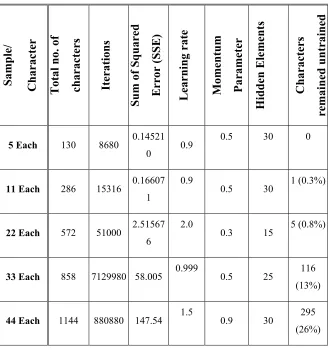
Remaining experiments were carried out using 14x8 grid size. Table 2 presents the detail of different parametric values for BPN during training phase.
Table 2 Details of Different parameter values used for BPN during Training Phase for 14x8 grid size
Sample/ Character
Total no. of characters Iterations
Sum of Squared Error (SSE) Learning rate
Momentum Paramete
r Hidden Elements Characters remained untrained
5 Each 130 8680 0.14521 0 0.9
0.5 30 0
11 Each 286 15316 0.16607 1
0.9
0.5 30 1 (0.3%)
22 Each 572 51000 2.51567 6
2.0
0.3 15 5 (0.8%)
33 Each 858 7129980 58.005 0.999 0.5 25 116
(13%)
44 Each 1144 880880 147.54 1.5 0.9 30 295
55 Each 1430 1801800 214.54 2.0 0.5 35 429 (30%)
66 Each 1716 3517800 172.54 0.9999 0.5555 40 345 (20%)
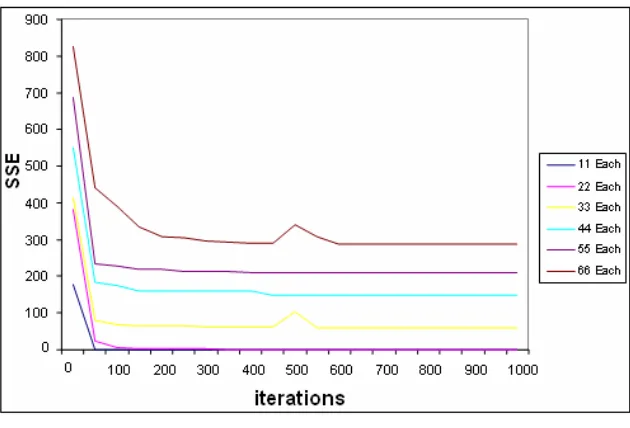
The learning trends for all data sets, presented in Table 2, have been shown graphically in Figure 5.
Figure 5 Convergence Trends of different BPN models
for reducing the size of the look-up table, a much simpler technique was employed. Since there were k samples for a character in a particular model, why not reduce the k vectors to one vector by taking the average of the sample vectors? Each component of the resultant averaged vector was average of the corresponding components of the k vectors. This somewhat simplistic approach is mentioned by Freeman & Skapura in their discussion of the CPN [(Freeman and Skapura, 1991), 238-258]. This technique is intuitively attractive if the k vectors lie close to one another in the n-dimentional Euclidean space (where n = no. of extracted image features). The underlying assumption would be that the clusters of input vector samples corresponding to different characters do not overlap. The performance of such models discussed in the next section indicates that the above assumption was reasonable.
In the CPN, twenty-six output layer processing elements (PEs) corresponded to Twenty-six English alphabets to be recognized. For example, a ‘high’ output value on the second PE in the output layer and ‘low’ on the others would mean that the network classifies the input as a ‘B’. As another example, a network output vector of [0.00 0.01 0.16 0.02 0.09 0.96 0.13 0.00 --- 0.15 0.04] would be translated as the model classifying the input character as ‘F’.
For developed CPN model, closeness was evaluated by measuring the angle between the normalized input and weight vectors. If I is the normalized input vector and Wi is the
normalized weight vector from the input layer to the ith hidden layer PE, then the cosine of the angle between the two can be found by evaluating the dot product (Wi . I = | Wi | | I | Cos θi =
character in the reference set to first locate the minimum angle, and then verifies that the minimum angle is less than the threshold.
2.4 Recognition Performance
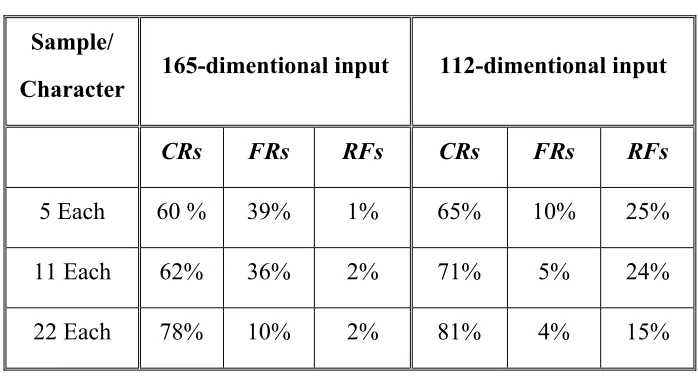
As mentioned earlier, models were evaluated on samples taken from individuals who did not participate in the initial process of setting up the training data set. This was done keeping in view the eventual aim of using the models in practical online recognition systems. The quality of an online handwriting recognizer is related to its ability to translate drawn characters irrespective of writing styles.
Table 3 Performance of BPN Details models with two Different input feature vectors
Sample/
Character 165-dimentional input 112-dimentional input
CRs FRs RFs CRs FRs RFs
5 Each 60 % 39% 1% 65% 10% 25%
11 Each 62% 36% 2% 71% 5% 24%
22 Each 78% 10% 2% 81% 4% 15%
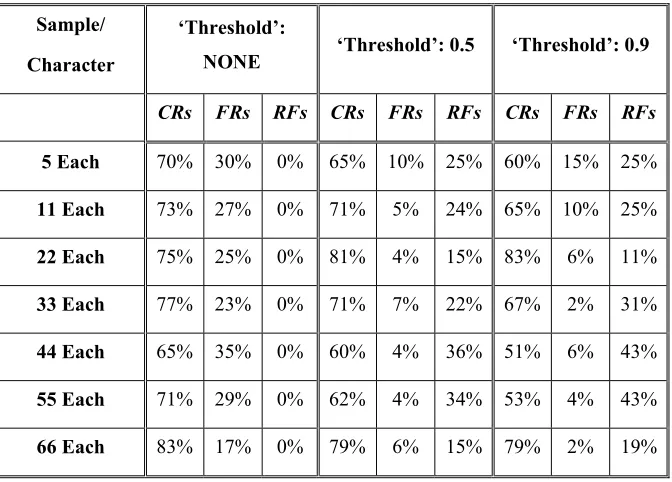
Table 4 Performance of BPN models with three different criteria of classification
Sample/
Character
‘Threshold’:
NONE ‘Threshold’: 0.5 ‘Threshold’: 0.9
CRs FRs RFs CRs FRs RFs CRs FRs RFs
5 Each 70% 30% 0% 65% 10% 25% 60% 15% 25%
11 Each 73% 27% 0% 71% 5% 24% 65% 10% 25%
22 Each 75% 25% 0% 81% 4% 15% 83% 6% 11%
33 Each 77% 23% 0% 71% 7% 22% 67% 2% 31%
44 Each 65% 35% 0% 60% 4% 36% 51% 6% 43%
55 Each 71% 29% 0% 62% 4% 34% 53% 4% 43%
66 Each 83% 17% 0% 79% 6% 15% 79% 2% 19%
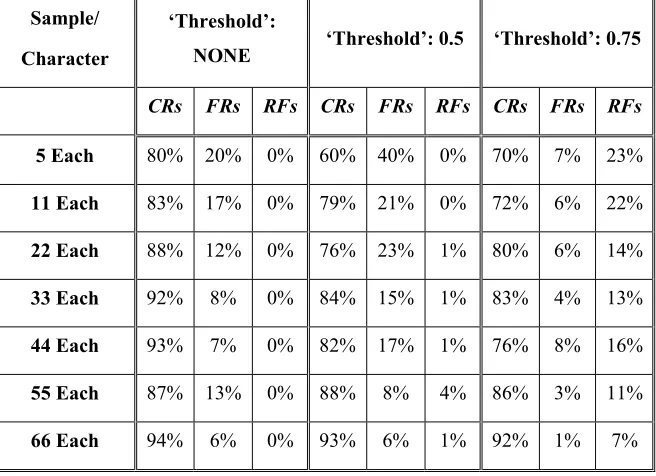
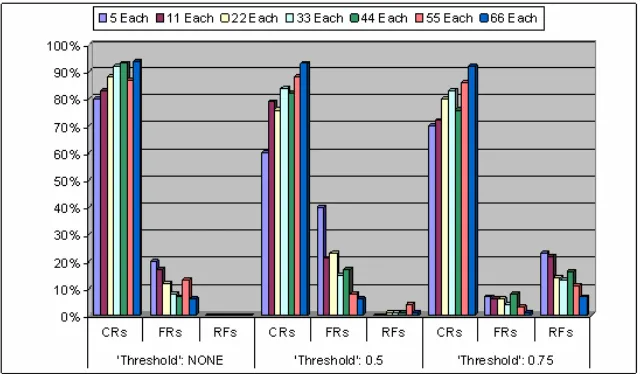
For a developed CPN model, the debate on a valid high PE output in the output layer was resolved by evaluating the performance for different decision making criteria. Model was tested with high thresholds of 0.0, 0.5, and 0.75, using the PE with the highest value above the thresholds for input classification.
performance of CPN with BPN. Table 5 presents the statistics.
Table 5 Performance of CPN models with three different criteria of classification
Sample/
Character
‘Threshold’:
NONE ‘Threshold’: 0.5 ‘Threshold’: 0.75
CRs FRs RFs CRs FRs RFs CRs FRs RFs
5 Each 80% 20% 0% 60% 40% 0% 70% 7% 23%
11 Each 83% 17% 0% 79% 21% 0% 72% 6% 22%
22 Each 88% 12% 0% 76% 23% 1% 80% 6% 14%
33 Each 92% 8% 0% 84% 15% 1% 83% 4% 13%
44 Each 93% 7% 0% 82% 17% 1% 76% 8% 16%
55 Each 87% 13% 0% 88% 8% 4% 86% 3% 11%
66 Each 94% 6% 0% 93% 6% 1% 92% 1% 7%
2.5 Performance Analysis
training and some samples remained yet to train (Table 1). On the other hand, in case of 112-dimentional input vector the training time was much less and untrained samples were few. This factor convinced the author to carry on further experiments with grid size of 14x 8.
For developed BPN models, it was observed that learning became more difficult and, even after long time of training, models were unable to fully learn the training sets. The gradual increase in the percentage of untrained samples can be seen in Table 2. An increase of hidden PEs was also helpful towards the convergence when sample/character were increased. Sometimes, initially a big value of learning rate showed a rapid learning even with less number of hidden PEs but most of the time a value < 1 appeared suitable for learning rate. Generally, the recognition performance of BPN models improved with increase in samples/character. It is important to note that the sigmoid functions in the output layer behave as ‘smoothed’ bipolar switches; the inputs to these bipolar switches are values of the decision functions. These decision functions or decision surfaces have positive value for a PE’s output greater than 0.5 and negative values for PE outputs of less than 0.5.
rate.
For developed CPN models, there was no need of training parameters nor it is an iterative method like BPN which took a long time for learning. A general trend of increase in performance with increase in samples/character has also been observed in this case. The difference in recognition rates with and without a threshold for input classification is understandable (Table 5). Though threshold reduces the correct recognitions but at the same time it prevents the system to go for more false recognitions. False Recognition (FRs) is another important factor in any recognition system, lower the false recognition rate, more reliable the system (Dzulkifli and Zafar, 2004). Instead of FRs, system goes for recognition failure (RFs) which is less dangerous than FRs. On the other hand, performance of the system increases without threshold
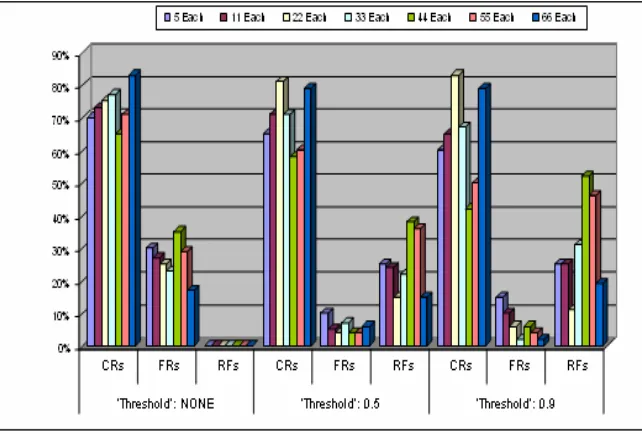
but at the cost of more FRs. Figure 7 presents a graphical overview of CPN performances with three different decision criteria of Recognition.
Figure 7 Graphical Presentation of CPN performances
an example of recognized handwritten text.
2.6 Similarity of Characters
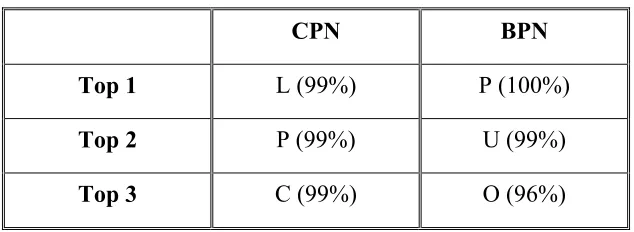
After analyzing the result files that describe target and actual outputs, it has been found that some classes got very high recognition rates, whereas some got the very low recognition rate. The top 3 recognition rates for CPN and BPN are given in Table 6.
Table 6 Top 3 Classification Rates
CPN BPN
Top 1 L (99%) P (100%)
Top 2 P (99%) U (99%)
Top 3 C (99%) O (96%)
of BPN performances with criteria of Recognition 0.75, 0.5 and 0.0.
Figure 9 Steps in Character Recognition
3 ON-LINE RECOGNITION OF OFF-LINE PRINTED TEXT
when the data already exists in machine-readable fonts (Muhammad Sarfraz et al., 2003). Many researches concerned with
Optical Character Recognition (OCR) have been reported in the literature (Yefeng et at., 2004; Kauniskangas and Hannu, 1999; Yang and Yan, 2000; Amin, 1998). Today there are many OCR devices in use based on a plethora of different algorithms. All of the popular algorithms sport high accuracy and most high speed, but still many suffer from a fairly simple flaw: when they do make mistakes (and they all do), the mistakes are often very unnatural to the human point of view. That is, mistaking a "5" for an "S" is not too surprising because most people are willing to agree that these two characters are similar, but mistaking a "5" for an "M" is counter-intuitive and unexpected. Algorithms make such mistakes because they generally operate on a different set of features than humans for computational reasons (Eric, 1992).
The ability to identify machine printed characters in an automated or a semi-automated manner has obvious applications in numerous fields. Since creating an algorithm with a one hundred percent correct recognition rate is quite probably impossible in our world of noise and different font styles, it is important to design character recognition algorithms with these failures in mind so that when mistakes are inevitably made, they will at least be understandable and predictable to the person working with the program (Eric, 1992).
3.1 System Overview
character pixels in grid boxes, the character is digitized in a binary string. If the character is new then the name of the character is added in the database, otherwise it is recognized directly. In the background, actually the counter propagation neural network accepts the binary string for online training and recognition.
3.2 Image Acquisition
Scanned and computer created text images have been used. An image file is created on computer in PCX format with the help of PAINT BRUSH. The image is made black and white as there is no need of colours. All the characters are typed in white colour with black background. All the alpha-numeric characters have been used. Figure 11 and Figure 12 show an input files.
Figure 11 An input file with upper case letters
As stated earlier that image is black and white in which characters are typed in white colour, so the algorithm for character detection is the same as discussed in section 2.2.1. Feature extraction is performed in similar fashion described in section 2.2. Calculation of the number rows, detection of character boundaries, and, section 2.2.2, and section 2.2.3 respectively. Figure 13 shows the steps of digitization of a printed character.
Figure 13 Steps in character digitization
3.3 Character Gap-width Calculation
between two characters / words. And if the gap width between two characters is greater than double of the average character width and less than triple of it, then there are ‘two-spaces’ between two characters / words and so on. Figure 14 shows two kinds of gaps.
Figure 14 A test image for gap measurement
3.4 Experiments
3.4.1 Data preparation
Figure 15 Computer created Text image with mixed letters
Figure 16 Computer created Text image with digits
Figure 18 Scanned Text image with dpi 400
3.4.2 Training
CPN was used for the online training and recognition of detected characters at the same time. The algorithm checks the look-up table, if the character, presented to CPN, already exits then the model directly goes for recognition, otherwise the character is added in the look-up table and is trained immediately. The training mathematics of CPN has already been discussed in section 2.3.2.
3.4.3 Recognition Performance
Table 7 Performance of CPN model for Text images having same font style
SCANNED IMAGES COMPUTER
CREATED IMAGES 200 dpi 400 dpi
CRs 100% 60% 80%
FRs 0% 0% 0%
RFs 0% 40% 20%
3.4.4 Analysis of Performance
CPN was tested with different text images, scanned as well as computer created. There is no problem of recognition at all for computer created images as there is no trace of noise and
characters are perfectly written. However, for scanned images the recognition is highly degraded. For scanned images, CPN was tested for 200 dpi and 400 dpi resolutions. A general trend of increase in performance with increase in dpi has been observed for a particular font. It is evident from 200dpi and 400dpi image recognition rates.
4 SUMMARY
annotated image features without any of preprocessing step. The system is writer-independent and classification is carried out by neural network approach. Neural Nets (NN) are quite popular, amongst the techniques which have been investigated for handwriting recognition. The most widely studied and used neural network is the Multi-Layer Perceptron (MLP) (Bishop, 1995). Such an architecture trained with back-propagation (LeCun, 1988a) is among the most popular and versatile forms of neural network classifiers and is also among the most frequently used traditional classifiers for handwriting recognition, see (Zhang, 2000) for a review.
The online drawn input character is simply captured into a grid of specified rows and columns. Each box of grid coded with binary ‘0’ or ‘1’ depending on whether it has any trace of written character or not. The binary feature vector produced could then be stored for training purposes or can be supplied to a developed model for making a decision regarding the class of the character. The preliminary results are quite encouraging. The experiments provided the author an opportunity to explore pattern recognition methodologies; the exercise provided a theoretical base for further investigations and impetus for development work in this discipline. Further increase in the training samples and introduction of slant removal would tremendously improve the accuracy of the system.
REFERENCE
AHMED, S.M.,ET.AL, (Nov.1995). Experiments in character
recognition to develop tools for an optical character recognition system, IEEE Inc. 1st National Multi Topic Conf. proc. NUST, Rawalpindi, Pakistan, 61-67.
AMIN,A. (1998). Off-Line Arabic Character Recognition system State of the Art. Pattern Recognition, 31(5): 517-530.
ANOOP M.NAMBOODIRI,ANIL K.JAIN. (2004). Online Handwritten
Script Recognition. IEEE Trans. PAMI. 26(1): 124-130
BISHOP M. (1995). Neural Networks for Pattern Recognition.
Oxford Univ. Press, Oxford-U.K.
DZULKIFLI MOHAMAD, AND ZAFAR, M. F., (2004). Comparative
Study Of Two Novel Feature Vectors For Complex Image Matching Using Counterpropagation Neural Network. Journal of Information Technology, Faculty of Computer Science and Information Sistem, Universiti Teknologi Malaysia,16(1).
ERIC W. BROWN. (1992). Character Recognition by Feature Point Extraction. College of Computer and Information Science, Northeastern University 360 Huntington Avenue Boston, Massachusetts 02115.
JONG OH. (2001). An On-Line Handwriting Recognizer with
Fisher Matching, Hypotheses Propagation Network and Context Constraint Models. PhD thesis, Department of Computer Science New York University USA.
KAUNISKANGAS, and HANNU. (1999). Document Image
Retrieval With Improvements In Database Quality. Infotech Oulu and Department of Electrical Engineering,
University of Oulu, Finland
LIU CHENG-LIN,STEFAN JAEGER,AND MASAKI NAKAGAWA, 2004.
MUHAMMAD SARFRAZ ET AL. (2003). Offline Arabic Text
Recognition System, International Conference on Geometric Modeling and Graphics (GMAG'03) , London, England.
Y.LECUN, 1988. A theoretical framework for Back-Propagation, in
Touretzky, D. and Hinton, G. and Sejnowski, T. (Eds), Proceedings of the 1988 Connectionist Models Summer School, 21-28, Morgan Kaufmann, CMU, Pittsburgh, Pa.
YANG,Y. AND YAN H.,(2000). An Adaptive Logical Method For
Binarization Of Degraded Document Images. Pattern Recognition, vol. 33: 787—807.
YEFENG ZHENG ET AL. (2004). Machine Printed Text and
Handwriting Identification in Noisy Document Images. IEEE Transactions On PAMI, 26(3).
ZAFAR M.F.,DZULKIFLI MOHAMAD AND IKRAM UL HAQ, (2004 a).
A Simple Approach For On-Line Isolated Handwritten Character Recognition Using Neural Networks. International Conference On AI Applications in Engineering And Technology (ICAIET 2004), 3-5 August, Kota Kinabalu, Sabah, Malaysia.
ZAFAR M.F.,DZULKIFLI MOHAMAD AND IKRAM UL HAQ, (2004 b).
Real-time Dynamic Offline Text Recognition system. Proc. Of 2nd National Conference on Computer Graphics and Multimedia,(Cogram04), Bangi, Kualampur Malaysia. Dec. 8-10.
ZAFAR M.F., DZULKIFLI MOHAMAD AND IKRAM UL HAQ,(2005).
Counter Propagation Neural Networks for On-line Recognition of Isolated Handwritten Character. Proceedings of 9th International Conference on Information Visualisation IV05 , 6-8 July 2005, London.
ZHANG G.P. (2000). Neural networks for classification: a survey.