ABSTRACT
WANG, TIANCONG. Architectural and Language Support for Efficient Programming on Non-Volatile Memory. (Under the direction of James Tuck).
Emerging Non-Volatile Main Memory (NVMM) technologies create a new opportunity for writing programs with a large, byte-addressable persistent storage that can be accessed through regular
memory instructions. These new memory-as-storage technologies impose a significant long-term
challenges to current programming models. All of our existing programming models assumes data in memory to be volatile and when data need to be persistent, we use file operations to serialize them
into files. In this dissertation, we propose several architectural and language supports to improve the
efficiency of programming with NVMM, in the aspect of both performance and programmability. The first part of this dissertation deals with the problem of addressing persistent data in NVMM.
In particular, some emerging persistent programming frameworks, like the Persistent Memory
Development Kit (PMDK), implement relocatable persistent objects that can be mapped anywhere in the virtual address space. To make this work, persistent objects are referenced using object
iden-tifiers (ObjectID), rather than pointers, that need to be translated to an address before the object
can be read or written. Frequent translation from ObjectID to address incurs significant overhead. We propose treating ObjectIDs as a new persistent memory address space and provide hardware
support for efficiently translating ObjectIDs to virtual addresses. With our design, a program can
use load and store instructions to directly access persistent data using ObjectIDs, and these new in-structions can reduce the programming complexity of this system. We also describe several possible
microarchitectural designs and evaluate them. We demonstrate for thePipelined implementa-tion that our design has an average speedup of 1.96×and 1.58×on an in-order and out-of-order processor, respectively, over the baseline software translation system on six microbenchmarks of
RANDOM pattern (place persistent data randomly into 32 persistent pools). For the same in-order and out-of-order microarchitectures, we measure a speedup of 1.17×and 1.12×, respectively, on the TPC-C application, and 1.19×and 1.18×speedup, respectively on Vacation application, on of
SEPARATE pattern (when B+Trees or linked-list and red-black trees are put in different pools and
rewritten to use our new hardware).
The second part of this dissertation deals with validating permissions to access ObjectIDs for
programs. The ObjectIDs consist of an identifier to a relocatable region, or apool, and a byte offset within the pool to locate persistent data. This provides direct access to persistent memory to
programmers but also incurs possible security issue when a program tries to access a pool without
having permissions. It incurs large overhead and programming burden if a programmer has to check permission on every ObjectID before accessing it. We identify permission checking in hardware as
simplify programming and fully benefit from hardware translation. To support it, we add a System
Persistent Object Table (SPOT) to support translation and permissions checks on ObjectIDs. The SPOT holds all known pools, their physical address, and their permissions information in memory.
When a program attempts to access a persistent object, the SPOT is consulted and its permissions
are verified without trapping to the operating system. We have implemented our new design in a cycle accurate simulator and compared it with software only approaches and prior work. We find
that our design offers a compelling 3.3x speedup on average for the microbenchmarks we studied
for RANDOM pattern and 1.4x and 1.7x speedup on TPC-C and vacation respectively for SEPARATE pattern.
The last part of this dissertation deals with a new dimension introduced by persistent programs:
how to migrate persistent data in the presence of code changes. In this work, we proposethe persis-tent data repersis-tention model, and we argue it should be specified as part of persistent programming models to describe what happens to persistent data when code that uses it is modified. We identify
two models present in prior work but not described as such, the Reset Model and Manual Model, and we propose a new one called the Automatic Model. The Reset Model discards all persistent data
when a program changes leading to performance overheads and write amplification. In contrast, if
data is to be retained, the Manual Model relies on the programmer to implement code that upgrades data from one version of the program to the next. This reduces overheads but places a larger
bur-den on the programmer. We propose the Automatic Model to assist a programmer by automating some or all of the conversion. We describe one such automatic approach, Lazily Extendable Data
Structures, that uses language extensions and compiler support to reduce the effort and complexity
associated with updating persistent data. We evaluate our PDRMs in the context of the Persistent Memory Development Kit (PMDK) using kernels and the TPC-C application. Manual Model shows
an overhead of 2.90% to 4.10% on average, and LEDS shows overhead of 0.45% to 10.27% on average,
depending on the workload. LEDS reduces the number of writes by 26.36% compared to Manual Model. Furthermore, LEDS significantly reduces the programming complexity by relying on the
© Copyright 2018 by Tiancong Wang
Architectural and Language Support for Efficient Programming on Non-Volatile Memory
by Tiancong Wang
A dissertation submitted to the Graduate Faculty of North Carolina State University
in partial fulfillment of the requirements for the Degree of
Doctor of Philosophy
Computer Engineering
Raleigh, North Carolina
2018
APPROVED BY:
Yan Solihin Greg Byrd
Xipeng Shen James Tuck
DEDICATION
To my father and mother, for bringing me to this wonderful world, for loving me to your hearts, and for making me the luckiest son in the world.
BIOGRAPHY
The author was born in a small town named Anshan in northeastern of China. I am the only child in my family. I was first introduced to computer programming when I was ten years old, and my
first programming language is Logo. I taught myself Pascal and algorithms during my high school
and got first prize in Olympics competition in Information in 2008. The prize got me admission to enter Peking University in 2009. In order to explore more on the computer system, I selected
Microelectronics as my major. I was exposed to a lot of low-level silicon device designs and theories, as well as circuit designs. In 2013, I got an offer from North Carolina State University in the PhD
program in Computer Engineering. I started my first year of PhD exploring many topics in the
computer area and computer architecture and compilers became my interest so I joined Dr. James Tuck’s group in 2014. Since then, I have learned a lot on hardware/software co-designs and started
my projects on solving issues related to programming on Non-Volatile Memory. I have interned
ACKNOWLEDGEMENTS
This dissertation would not exist without the guidance and support from many people - my advisor, many professors, my labmates, my friends and family.
I would like to thank my advisor, Dr. James Tuck, to my heart. Thank you for being a role model,
inspiring me to love what I do and help others with my best effort. Thank you for being a great mentor, guiding me through my confusions on the topics and helping me figure out technical
problems. Also thank you for being a good friend, always offering help when I need it the most. I also would like to thank Dr. Yan Solihin for cooperating on the MICRO-50 paper and offering
help on my researches. I also want to thank other members on my committee, Dr. Greg Byrd and Dr.
Xipeng Shen, for offering your valuable opinions to improve my researches.
I want to thank the senior lab-mates, Bagus Wibowo, Joonmoo Huh, Abhinav Agrawal, Seunghee
Shin and George Patsilaras for offering your valuable experiences in both academics and also
personal lifes. I also want to thank Sakthikumaran Sambasivam for helping me on the MICRO-50 and ISCA-18 papers. I also want to thank other lab-mates who offer suggestions on my researches
and presentations.
Lastly, I want to thank my parents for your sacrifices to always give me the best in my whole life and thank my wife for accompanying me through many obstacles in the PhD journey.
To all the people who have offered your help to me in my life, thank you and I believe I couldn’t
TABLE OF CONTENTS
LIST OF TABLES . . . .viii
LIST OF FIGURES. . . x
Chapter 1 Introduction. . . 1
1.1 Address Translation . . . 2
1.2 Permission Checks . . . 3
1.3 Persistent Data Retention Models . . . 4
1.4 Contributions . . . 5
1.5 Organization of the Dissertation . . . 5
Chapter 2 Background . . . 7
2.1 Non-Volatile Main Memory (NVMM) Technologies . . . 7
2.2 Persistent Programming . . . 8
2.2.1 Persistent Memory Development Kit (PMDK) . . . 10
2.3 Our vision and objectives: making persistent programming easier . . . 10
Chapter 3 Hardware Supported Persistent Object Address Translation . . . 12
3.1 Motivation: Baseline Persistent Programming Model and its limitations . . . 13
3.1.1 The Persistent Programming Interface . . . 13
3.1.2 Persistent Linked List Example . . . 17
3.2 Design: Hardware-supported Address Translation . . . 20
3.2.1 New Instructions . . . 20
3.2.2 Overall Architecture . . . 20
3.2.3 Supporting System and Library Modifications . . . 22
3.3 Microarchitecture . . . 22
3.3.1 Persistent Object Look-aside Buffer . . . 22
3.3.2 Persistent Object Table . . . 24
3.3.3 Memory Disambiguation . . . 26
3.3.4 Out-of-Order Pipeline . . . 27
3.3.5 In-order Pipeline . . . 28
3.4 Methodology . . . 28
3.4.1 Simulation . . . 28
3.5 Evaluation . . . 32
3.5.1 Overall Performance . . . 32
3.5.2 Reduce Instructions . . . 34
3.5.3 Overhead of Durability and Atomicity . . . 34
3.5.4 Sensitivity Analysis: POLB size . . . 35
3.5.5 Impact of Hardware POT Walk . . . 37
3.6 Summary . . . 37
4.1 Motivation . . . 40
4.1.1 Example . . . 40
4.1.2 Permissions Checking Support . . . 41
4.1.3 Optimizing Checks in Software . . . 42
4.1.4 Permissions Checks with Hardware Supported Translation . . . 44
4.2 Design: System Persistent Object Table (SPOT) . . . 45
4.2.1 System Persistent Object Table . . . 45
4.2.2 Pool Open Using SPOT . . . 45
4.2.3 Permission Checking Using SPOT . . . 46
4.2.4 Organization of the SPOT . . . 46
4.3 Implementation . . . 47
4.3.1 System Persistent Object Table . . . 47
4.3.2 Permission Checking Logic . . . 49
4.4 Evaluation . . . 51
4.4.1 Methodology . . . 51
4.4.2 Overall Performance . . . 52
4.4.3 In-order vs Out-of-order . . . 54
4.4.4 Impact of Page Size . . . 54
4.4.5 Comparison of HwT+SPOT and native hardware support plus SPOT . . . 55
4.4.6 Storage Overhead of SPOT . . . 57
4.5 Summary . . . 57
Chapter 5 Persistent Data Retention Models . . . 58
5.1 Motivation . . . 59
5.1.1 Comparison between persistent programming and file-based programming . 59 5.1.2 PDRMs in existing persistent programming models . . . 60
5.1.3 PMDK Library . . . 61
5.2 Persistent Data Retention Models . . . 63
5.2.1 Reset Model . . . 63
5.2.2 Manual Model . . . 63
5.2.3 Automatic Model . . . 64
5.2.4 Lazily Extendable Data Structures . . . 64
5.3 Implementations on PMDK . . . 65
5.3.1 Reset Model . . . 65
5.3.2 Implementation of Manual Model . . . 65
5.3.3 Implementation of LEDS . . . 69
5.3.4 Discussion . . . 71
5.4 Methodology . . . 72
5.4.1 Coverage Test . . . 72
5.4.2 Workloads . . . 74
5.5 Evaluation . . . 76
5.5.1 Coverage Test . . . 76
5.5.2 Overhead in Manual Model and Automatic Model . . . 77
5.5.3 Breakdown of overhead in Automatic Model . . . 78
5.5.5 Sensitivity Analysis: Ratio of working data set over total data set . . . 80
5.5.6 Write Amplification . . . 80
5.6 Summary . . . 82
Chapter 6 Related Work . . . 83
6.1 Persistent Programming Interfaces . . . 83
6.1.1 Address Translation . . . 84
6.1.2 Permission Checking . . . 84
6.1.3 Persistent Data Retention Model . . . 85
6.2 NVMM File Systems and Persistent Stores . . . 85
6.3 Durability and Failure Safety . . . 86
6.3.1 Dynamic Software Update (DSU) . . . 86
6.3.2 Struct Splitting . . . 86
Chapter 7 Conclusion. . . 87
7.1 Future Directions . . . 88
LIST OF TABLES
Table 2.1 Characteristics of PCM compared with DRAM and flash.[Vol11]. . . 8
Table 3.1 Summary of library calls required to support persistent memory programming. 14 Table 3.2 Average instructions executed in the
oid_direct
function with different num-ber of pools used (on ALL and EACH benchmarks), as described in Section 3.4.1.1. Last column shows the miss rate for the most recent translation pre-dictor on the EACH pattern. . . 19Table 3.3 New instructions to support translation directly in hardware. . . 20
Table 3.4 Architecture configuration used for simulation. . . 28
Table 3.5 Summary of workloads used in the simulation. . . 30
Table 3.6 Pool usage access patterns. . . 31
Table 3.7 Combined architecture and benchmark configurations. . . 31
Table 3.8 POLB miss rate of OPT benchmark pattern onPipelinedandParalleldesign respectively.Pipelinedonly shows the results of EACH here, because ALL and RANDOM withPipelinedonly misses 1 and 32 times (0.000%) during POLB warm-up respectively. . . 33
Table 3.9 Percentage of instructions saved with OPT benchmarks on micro-benchmarks and TPC-C . . . 34
Table 3.10 POLB miss rates on OPT_NTX using the RANDOM usage pattern onPipelined andParalleldesigns while increasing the size of the POLB. . . 36
Table 4.1 Pool and ObjectID Extended API to support permissions checking. . . 42
Table 4.2 Summary of the designs used in the evaluations. . . 52
Table 4.3 POLB miss rate for different page size with RANDOM/SEPARATE on HwT+SPOT on out-of-order processor . . . 55
Table 4.4 Comparison of SPOT walk performed in HwT+SPOT with system that has a direct-mapped POT. for different page sizes on RANDOM/SEPARATE on out-of-order processor. . . 56
Table 4.5 The size of tables on all levels of SPOT used in our workloads, for 4KB, 2MB and 1GB page size. . . 57
Table 5.1 PDRMs in existing persistent programming models that supports user-defined data types. . . 62
Table 5.2 PMDK interfaces that are referred to in this Chapter. . . 62
Table 5.3 Summary of the environment for experiments . . . 73
Table 5.4 Micro-benchmarks for coverage test . . . 74
Table 5.5 Description of the workloads from PMDK . . . 75
Table 5.6 Description of different configurations of inputs to the benchmarks in PMDK. 76 Table 5.7 Terms used in the experiments. . . 76
LIST OF FIGURES
Figure 2.1 An overview of NVM in current and future computer system. (a) Traditional view of system architecture; (b) Heterogeneous memory where some non-volatile memory extends or replaces DRAM to provide persistent access; (c) NVMM replaces DRAM and disk. . . 9 Figure 2.2 PM File Mode interface, depicted by the red dashed line, providing the
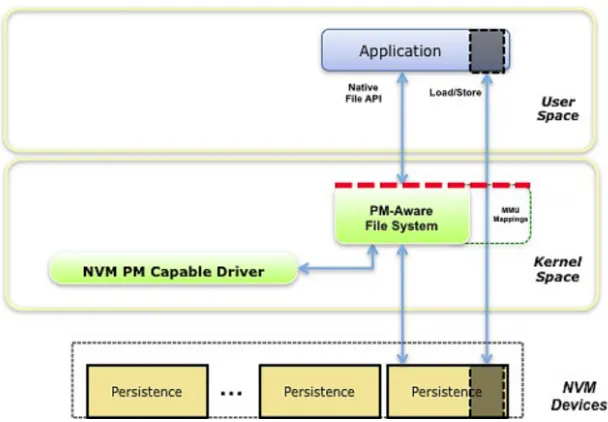
stan-dard file operations but with memory mapped files going directly to NVM, as described in[Rud13]. . . 9
Figure 3.1 Components of an ObjectID. . . 15 Figure 3.2 Relationship of pool, object, virtual, and physical address space. . . 16 Figure 3.3 Pseudo-code of
oid_direct.
most_recent_pool_idandmost_recent_base_-addressholds the most recent translated pool identifier and base address. OIDTranslationMapis a hash map that holds all the translations from pool id to base address. . . 17 Figure 3.4 Example of a persistent linked list insertion and search using our
program-ming interface. . . 18 Figure 3.5 Overall architecture depicting Persistent Object Look-aside Buffer and
Persis-tent Object Table. . . 21 Figure 3.6 Two designs for the Persistent Object Look-aside Buffer. . . 23 Figure 3.7 Hardware-based POT walk. . . 25 Figure 3.8 An example of hardware supported translation on an out-of-order processor
withPipelineddesign. The code snippet disassembles a simple C expression,
a++, but the variable
a
is held in a persistent pool. The data field of the LSQ is not shown. . . 27 Figure 3.9 Speedup of OPT over BASE for each usage pattern on in-order (a) andout-of-order (b) designs. The red dots show the speedup on an ideal architecture where there’s no penalty to perform a hardware translation. . . 32 Figure 3.10 Performance of all OPT_NTX benchmarks without persistence and
transac-tion supports on both Pipelined and Parallel designs. The results are normal-ized to the BASE_NTX benchmark running on baseline system. . . 35 Figure 3.11 Sensitivity analysis to POLB size. Each bar shows the normalized speedup
of OPT over BASE for the EACH pattern on Pipelined and Parallel design on in-order processor, with no POLB and POLB size=1, 4, 32, and 128, respectively. 36 Figure 3.12 Sensitivity analysis to POT walk penalty. Each bar shows the normalized
speedup of OPT over BASE for the EACH pattern on the in-orderPipelined design. . . 37
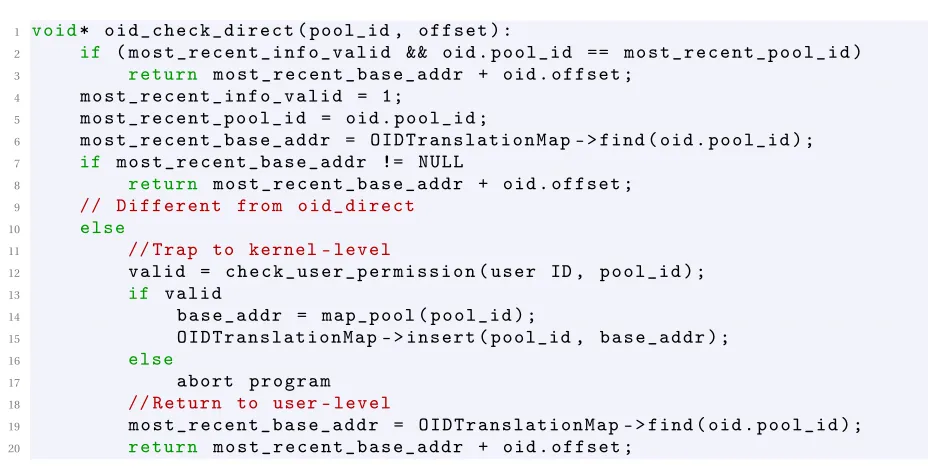
Figure 4.1 Persistent data structure spread across pools. Some pools are mapped and others are not. . . 40 Figure 4.2 Example of a persistent linked list traversal with permission check. . . 42 Figure 4.3 Pseudo-code of
oid_check_direct. The if-else part is added to handle the
Figure 4.4 Overview of the design of automatic permission checks with System Persistent Object Table (SPOT). . . 46 Figure 4.5 SPOT entry details on systems with 4KB or 2MB page size. . . 48 Figure 4.6 Hardware SPOT walk on 4KB page size system. 2MB and 1GB have similar
procedure with different number of SPOT levels. . . 49 Figure 4.7 Flowchart of the added hardware logic for permission check used during
SPOT walk. . . 50 Figure 4.8 Speedup of SwT-Opt, HwT and HwT+SPOT over SwT-Base for each usage
pat-tern on an out-of-order processor. (a) Shows the results of microbenchmarks with ALL and applications with COMBINED. (b) Shows only microbench-marks with EACH. (c) Shows microbenchmicrobench-marks with RANDOM and applica-tions with SEPARATE. . . 53 Figure 4.9 Performance of different designs on the in-order processor. . . 54 Figure 4.10 Performance of HwT+SPOT normalized to SwT-Base on architectures with
different page sizes for the RANDOM/SEPARATE pattern. . . 55 Figure 4.11 Comparison of proposed system with a system with a direct-mapped POT
and adds SPOT, for 4KB page size and RANDOM/SEPARATE workloads. . . 56
Figure 5.1 A comparison of having a persistent data structure using (a) traditional file-based programming models and (b) using persistent programming models.
. . . 61 Figure 5.2 An example of retention with Automatic Model: struct A adds a floating-point
type field to the struct A in the second version, and copy the integer value. . . 65 Figure 5.3 A description of the differences in Manual Model and Automatic Model using
LEDS when retaining persistent data in a changed program. The example shows a linked list with three nodes and searching in the updated linked list hits the first node. In Manual Model, a new linked list needs to be created. And in Automatic Model using LEDS, only the node accessed in the new program (first node) is being updated. . . 66 Figure 5.4 An example manual retention of a linked-list when adding a floating point
field and retaining the value from the integer field, with native PMDK libraries. 67 Figure 5.4 An example manual retention of a linked-list when adding a floating point
field and retaining the value from the integer field, with native PMDK libraries. 68 Figure 5.5 An example of retention with Automatic Model using LEDS: adding a floating
point value and initializing its value from the integer field of last run. . . 70 Figure 5.6 The original root object for coverage test. . . 73 Figure 5.7 Overall performance of the overhead of Manual Model and Automatic Model
on different workloads. (a) LAYOUT-CHANGE: key changes from 32-bit to 64-bit. (b) LAYOUT-ADD: add a new field to each node. The result of PMDK kernels is measured with 100000 operations in both P-ORIGINALand updated program, and the result of TPC-C is measures with 10 warehouses and 200000 random client operations. . . 77 Figure 5.8 A breakdown of the overheads in Automatic Model. The experiment is done
Figure 5.9 Sensitivity analysis of the impact of different data set on both (a) Manual Model and (b) Automatic Model. The experiment is done with PMDK-DEL of LAYOUT-CHANGE, with different number of operations of 100, 1000, 10000, 100000, resulting in different size of data set for retention. . . 80 Figure 5.10 Sensitivity analysis of different ratio of working data set in updated program
CHAPTER
1
INTRODUCTION
Non-volatile memory technologies are advancing rapidly and may supplant DRAM as main memory
given their higher capacities, lower stand-by power, and reasonably fast access latencies[IM15; Raj14; Lee10; Kaw07; Kul13; AS10; Wan15; Mor13; KK09; Zha13]. Products based on Intel’s and Micron’s 3D
Xpoint memory technology are already in the market[IM15]. These newnon-volatile main memory (NVMM) technologies are byte-addressable and have reasonably fast access latencies[IM15; Raj14; Lee10; Kaw07; Kul13; AS10].
As a short term solution, these NVMM technologies can replace either DRAM technologies to
provide denser main memory or replace disk technologies to provide faster storage. NVMM has the potential to bring revolutionary changes to the community when considering it provides a new
opportunities for programmers to operate on persistent data directly in memory.
Prior works on NVMM file systems[Con09; Dul14; WR11; Vol14; XS16; Xu17]gave programmers direct access to NVMM using regular loads and stores. This enabled programmers to store important
data inpersistentdata structures in memory instead of serializing it to the file system. This creates many challenges to existing programming models because they all assume data in memory to be volatile, and when data needs to be persistent, programmers must use file operations to serialize
them into files.
There are many prior works on new programming models on NVMM, orpersistent programming, but many aspects are yet to be explored. In this dissertation, we will explore architectural and
how programmers can efficiently manipulate persistent data,how they can ensure correctness when accessing data across different persistent regionsandwhat happens to persistent data in memory when the source code changes.
1.1
Address Translation
One area that needs more study is the mechanism that programmers will use to manipulate per-sistent objects. Ideally, programmers would access perper-sistent objects the same way they access
volatile memory, using pointers and references. In fact, many prior works assume precisely this with no modification. For example, Mnemosyne[Vol11]proposes adding a new keyword to the C
language, namely
persistent, that allows some data to be placed in non-volatile memory regions.
The assumption is that a segment of the virtual address space is reserved for persistent objects. However, assuming a fixed location within the address space prevents or restricts the use of Address
Space Layout Randomization (ASLR)[Bha03], an affordable and prevalent security mechanism in
most current systems.
Alternatively, NVHeaps[Cob11]and NVM Library(NVML)[Pme], two recently proposed libraries
for persistent memory, allow objects to be relocated within the virtual address space. In these
environments, programmers will open persistent regions orpools, much the way that files are opened on systems today, and they will be mapped into the virtual address space arbitrarily. Objects
within the pools will not be referenced using addresses. Instead, object identifiers (ObjectIDs),
consisting of a pool identifier and a byte offset within the pool, are used to identify and locate objects. ObjectIDs are general enough to access objects within the same pools or different pools, and
can serve as the basis for building linked structures within and across pools. However, ObjectIDs
requiretranslation to a virtual addressbefore they can be used to access a persistent object. ObjectIDs enable persistent memory programming on current systems with ASLR. However,
they pose significant challenges too. Translation of ObjectIDs is an onerous burden to place on
programmers[Mar17]. Anywhere an object is dereferenced, a translation is needed. Given the al-ready challenging problem of ensuring failure-safety[Pel14; Con09; Jos15a; Pme; Lu14a; Kol16b],
this translation requirement adds a significant additional complexity to the code. Furthermore,
translation can be a significant performance overhead. At a minimum, we need to perform a trans-lation of ObjectID to base address by looking up the ObjectID in a table. Even if this transtrans-lation is
cached in a fast data structure, like in NVML, the overhead for frequently accessing this structure
could be significant because it would require many instructions per translation.
Simultaneous work by Chenet al.evaluated various low-level software mechanisms to reduce overhead of manipulating ObjectIDs. However, we observe that the translation of ObjectIDs to virtual addresses is a problem that bears similarity to the problem of translating virtual addresses
translation directly in the microarchitecture. In our design, programmers directly reference memory
using ObjectIDs. We interpret ObjectIDs as a new address space layer that sits on top of virtual memory, and we provide new load and store instructions that directly access non-volatile memory
using ObjectIDs.
Chapter 3 will cover more details in hardware supported address translation. The work shows that on microbenchmarks that place persistent data randomly into persistent pools,Pipelined im-plementation has an average speedup of 1.96×and 1.58×on an in-order and out-of-order processor,
respectively, over the baseline system. This work was published in The 50th Annual IEEE/ACM International Symposium on Microarchitecture (MICRO-50)[Wan17].
1.2
Permission Checks
Even though hardware-supported translation of ObjectIDs make it easier to program and use
persistent objects, they are not as simple to use as normal pointers. Consider the following scenario:
after opening one pool and finding an ObjectID within it, we may want to dereference it. However, unless we have additional information, it is unknown if the corresponding object is in an
already-opened pool or not. The programmer must reason about whether the persistent pool has already
been opened and mapped into the process’ address space. Similarly, permissions (i.e. like file permissions in a conventional file system) also must be checked to ensure the pool can be mapped
to the current process. Without additional checks to ensure the pool is opened, the programmer
may incur memory protection errors.
Interestingly, this is quite different from programming with conventional pointers or references.
Typically, if a pointer address is known and non-NULL, it can be assumed legal and dereferenced,
assuming a correctly implemented program. However, ObjectIDs do not come with this guarantee because they persist across runs of the program, creating an additional step in reasoning about their
correctness. In current designs, the burden to perform these correctness checks rests fully on the
programmer to implement them in software.
Instead, we propose hardware support for validating ObjectIDs and checking their permissions
on demand. We borrow from well known architecture techniques used to support Virtual Memory,
and we extend them to support common file system operations to make using persistent objects simpler and higher performing. In particular, we extend the work of hardware address translation in
Chapter 3. We replace the per-process Persistent Object Table (POT) with a System Persistent Object
Table (SPOT) that holds all known pools in the system, their physical address, and their permissions information. When a program suffers a POLB miss, a privileged hardware SPOT walk traverses the
SPOT to find the relevant entry, check permissions, and copy it back into the POLB. If the persistent ObjectID is known and the permissions check out, the requesting process obtains the mapping and
With this design, we can improve program’s performance significantly. Part of the performance
improvement comes from our new hardware. Permission checking is performed by hardware along with fast hardware-supported address translation. Also, the hardware SPOT walk allows us to avoid
system calls for mapping pools to the program. Another part of the performance comes from
simplifying the software. Programmers can omit frequent and costly library calls that check the permission of pools they wish to reference. This streamlines the code and reduces overhead, pushing
some of the complexity into low latency hardware and system code.
Chapter 4 will cover more details in the hardware permission checks. This work We find that our design offers a compelling 2.9×speedup on average for microbenchmarks that access pools with the
RANDOM pattern and 1.4×and 1.8×speedup on TPC-C and vacation, respectively. This work was
published in The 45th International Symposium on Computer Architecture (ISCA 2018)[Wan18].
1.3
Persistent Data Retention Models
Programming persistent data structures poses many new challenges. Many prior works have pointed out the problem offailure-safety[Pel14; Con09; Jos15a; Pme]. Other works[Cob11; Vol11; Che17; Wan17]strive to make it easier to put data into persistent memory and use it. Chapter3 and Chapter 4
will discuss how to make it easier to write persistent data structures. We identify another new dimen-sion introduced by persistent programming:the problem of managing changes to the declarations and meanings of persistent data across the lifespan of software.
Since persistent data is retained across runs of a program, does a declaration of a type refer to the persistent data created in a previous run of the program or to the organization of the data
on the next run of the program? In systems with a conventional memory and storage hierarchy,
programmers trust that data types describe what will happen when the program runs next, because there is no data already in memory – memory is repopulated from scratch each run. However, in the
context of persistent memory the declarations describe both – what’s already in persistent memory
and what will happen on the next run.
To begin addressing this problem, we propose that programming environments define a Per-sistent Data Retention Model(PDRM) that explains how persistent data isretainedas programs are modified and change over time. Programmers need, at a minimum, a clearly specified model of behavior. The simplest one is that discard all persistent data anytime a program changes and
reset persistent memory. We call it theReset Model. Alternatively, we can make the programmer fully responsible for distinguishing such data and managing it across changes to the code. This is the conventional way for how files are handled, and it requires substantial programmer effort, so
we call it theManual Model. Last, we define theAutomatic Model. The Automatic Model assists programmers in the conversion of data and ensures the data continues to be used appropriately
along with possible limitations or restrictions, and which cannot after a program is modified.
Chapter 5 will discuss the three Persistent Data Retention Models with more details.
1.4
Contributions
This dissertation makes contributions in each of the three parts.
For the hardware translation part, we describe an efficient way to manipulate persistent data. (1) We describe novel architectural and system-level extensions that enable translation of ObjectIDs
to addresses, eliminating the need for programmers to directly translate ObjectIDs and the perfor-mance overhead of translation. (2) We design and evaluate critical microarchitectural choices as
it relates to translation and disambiguation of addresses for persistent objects. We consider two
different designs for Persistent Object Look-aside Buffer (POLB), one that translates to the virtual address and relies on a conventional Translation Look-aside Buffer (TLB) for conversion to the
phys-ical address, and another that works in parallel with the TLB and directly translates to the physphys-ical
address. We also consider the design implications of these POLBs on an out-of-order superscalar processor’s memory disambiguation logic. (3) We implement this system in a simulator based on
Sniper[Car14]. (4) We evaluate the system based on a suite of microbenchmarks and applications.
For the permission check part, we propose the problem of permission checks in persistent programming with multiple persistent regions, or pools. 1) We raise the problem to reconsider
providing permission checks of persistent pointers instead of leaving the burden to programmers. 2)
We explore different designs choices to provide permission checks on demand with native software translations and hardware supports. 3) We propose a design with hardware and system support
with small modifications to prior work and provide automatic permission checks and then evaluate
the design.
For the PDRM part, we are the first to explore the problem of defining what happens to the
persis-tent data when a persispersis-tent program changes. We propose three PDRMs and give definitions to the
three models. We also give implementations of the three model, in Persistent Memory Development Kit (PMDK, formerly known as NVML), especially a technique of Automatic Model, called Lazily
Extendable Data Structures (LEDS). Our experiments on various benchmarks show that Automatic
Model can save a lot of programmers’ effort with the expense of comparable overhead with Manual Model.
1.5
Organization of the Dissertation
The rest of the dissertation is organized as follows. Chapter 2 covers background on NVMM
tech-nologies. Chapter 3 discuss the work of hardware support ObjectID translation. Section 3.1 presents
the overall design to use Persistent Object Lookaside Buffer (POLB) and Persistent Object Table
(POT) to support direct load and store with new instructions. Section 3.3 discusses microarchi-tectural implementation details, and Section 3.5 presents an evaluation on the benchmark suite.
Chapter 4 discuss the work of permission check. Section 4.1 brings up motivations of permission
check and discuss different designs to provide permission security on persistent pools. Section 4.2 brings a hardware optimized design, including the System Persistent Object Table (SPOT), that
can reduce the overhead and also reduce the programming burden. Section 4.3 presents details
of architectural and system implementations. Section 4.4 evaluates the implementation on the same benchmark suite from Chapter 3 with permission checks added. Chapter 5 discuss the work
of Persistent Data Migration Models (PDMM). Section 5.1 gives a comparison of the traditional
file-based persistent programming with persistent memory programming models for NVMM and also explores the PDRMs in existing persistent programming extensions. Section 5.2 introduces the
definition of Reset Model, Manual Model and Automatic Model in general persistent programming
languages and points out key differences between Manual Model and Automatic Model. Section 5.3 demonstrates implementations of each model built in PMDK libraries, and Section 5.5 demonstrates
the overhead of Manual Model and Automatic Model and analyzes the components of the overhead
CHAPTER
2
BACKGROUND
2.1
Non-Volatile Main Memory (NVMM) Technologies
In a conventional computer system, disk is much slower than memory, but it is necessary because it
provides long-term persistent storage. Data that needs to be saved must be written to disk. Disks are connected to the computer system through slow I/O buses, so programmers take pains to hide
the longer latencies required to read and write from disk.
Recent breakthroughs in Non-Volatile Memory (NVM) technologies are poised to disrupt the
conventional computer system design1. NVM provides near-DRAM speed and byte-addressable persistent storage. These technologies allow persistent storage to be attached to the memory bus and accessed through load and store instructions[FW08]. Since it can be deployed as main memory,
we refer to this usage asNon-Volatile Main Memory(NVMM).
There are many different NVMM technologies, like Phase-Change Memory (PCM)[Lee10], Spin-Torque-Transfer RAM (STT-RAM)[Kul13]and memristors[Str08]. They all have slightly different
attributes. we will choose PCM as the main NVMM technology to model in this dissertation because
Intel and Micron has already shipped 3D Xpoint[IM15]based on PCM technology.
In this dissertation, our evaluation is based on battery backed DRAM, i.e. same read/write latency
as DRAM but with persistence. The comparison of DRAM, NAND flash and PCM is summarized in
Table 2.1. While NVM technologies are under development, we make several assumptions on the
NVMM behaviors based on many prior works[Vol11]. Although current PCM technologies are slower than DRAM, especially when writing, some research prototypes[Bed04; Vil10]predict it can achieve
similar read and write speed as modern-day DRAM. (1) We assume NVMM can support 64-bit
atomic read/write.[Con09]. (2) We assume data is considered to be persistent until it’s flushed to the NVM by some hardware instructions (e.g.clwbby Intel), similar to the fsync call for file systems.
Table 2.1Characteristics of PCM compared with DRAM and flash.[Vol11]
Technology Read Write Endurance
DRAM 60 ns 60 ns >1016
NAND flash 25µs 200-500µs 104-105
PCM (current) 115 ns 120µs 106
PCM (predicted) 50-85 ns 150-1000 ns 108-1012
2.2
Persistent Programming
Emerging NVMM technologies will encourage significant changes to the computer system. The
boundary of memory and disk will eventually blur. In this dissertation, we envision the future
computer system will lean towards the one depicted in Figure 2.1(b) and eventually Figure 2.1(c). In this dissertation, we discuss programming problems existing in a system like Figure 2.1(b) or
(c). These systems are going to significantly change our current programming models because
programmers can store persistent data in memory, instead of being forced to serialize them to disk using file operations. We refer to this asprogramming with persistent memory, or sometimes simply persistent programming, in the following sections.
There are many ways to provide persistent programming interfaces to programmers.
Rud-off[Rud13]summarized four ways to provide NVM programming models, where the PM Volume
Mode and PM File Mode are directly dealing with emerging NVMM technologies. The major differ-ences of the two models are whether user programs have direct access to NVMM. The PM Volume
Mode provides direct access to NVMM only from kernel code, so user programs need to use system
calls to access persistent data. Meanwhile, in PM File Mode, the operating system maps a region of NVMM directly to a program’s address space and allows user programs to use normal load and
store instructions to access persistent data. The following sections in this dissertation focus on this
model and its interface is depicted in Figure 2.2.
Many prior works[Vol11; Cob11; Pme; Ora15; Zho16]belong to this memory-mapped file model.
Figure 2.1An overview of NVM in current and future computer system. (a) Traditional view of system architecture; (b) Heterogeneous memory where some non-volatile memory extends or replaces DRAM to provide persistent access; (c) NVMM replaces DRAM and disk.
Mnemosyne [Vol11]proposes adding a new keyword to the C language, namely
persistent, that
allows static or global data to be placed in non-volatile memory regions. It also provides dynamic allocation interfaces similar to malloc() and free(), namely
pmalloc
andpfree. The assumption is
that a segment of the virtual address space is reserved for persistent objects. This makes minimal
changes to the current programming model. Persistent Memory Development Kit, on the other hand, points out assuming a fixed location within the address space prevents or restricts the use of Address
Space Layout Randomization (ASLR)[Bha03], an affordable and prevalent security mechanism in
most current systems. Thus they introduce the concept of relocatable persistent region, orpool, that is similar to the concept of a file, and programmers need to specify which pool is used to allocated
persistent data. More details about these works will be covered in Section??.
2.2.1 Persistent Memory Development Kit (PMDK)
In this dissertation, we will mainly focus on Persistent Memory Development Kit (PMDK), it provides
a collection of libraries for various use cases, which is tuned and validated to production quality and
thoroughly documented[Pme]. It targets server-class applications that require skilled programmers to write programs with low-level interfaces. There are 10 libraries in the PMDK and we will use the
interfaces exclusively from libpmemobj as described in the man page[Lib].
The main idea of PMDK is to store persistent regions in file abstractions, orpools. Pools are directly mapped to a program’s address space and programmers can refer to persistent data with
persistent pointers called ObjectIDs, or PMEMoid, which are the equivalent of addresses to persistent
memory.
In PMDK, all persistent data is held within pools. There are no persistent global variables, as in
Mnemosyne[Vol11], that are outside of a pool. Each pool has a root object, which is defined as a
struct, to store variables associated with the pool, some of which may be pointers to data structures in the pool. To modify persistent data, a coder would modify one or more struct definitions contained
within the persistent pool.
In Chapter 3 and Chapter 4, we will model a reduced collection of the interfaces of PMDK, we will cover more details on the interfaces we modeled in Table 3.1 and Table 4.1. In Chapter 5, we
will directly use the libpmemobj in PMDK and all the functions we will cover are summarized in
Table 5.2.
2.3
Our vision and objectives: making persistent programming easier
The adoption of NVMM in future computer systems will not happen all at once and is widely believed to be a multi-staged road[Swa17]. According to Prof. Swanson[Swa17], in Stage 1 (Legacy
memory capacity, or IO-starved applications can use the persistency of NVMM while ignoring its
byte-addressability. Either case is an extension in Figure 2.1(a). Neither of the usage will be satisfying since they never fully take advantage of NVMM. Thus, in Stage 2 (DAX and Expert Programmers), we
can use the NVMM as a part of the memory to create persistent data structures. As a step towards the
goal, we can provide direct access (DAX) to programmers so that they can map a file to memory and operate on it directly. Many libraries mentioned in Section 2.2([Vol11; Cob11; Ora15; Pme]) provide
interfaces for programmers to program with persistent memory, but it requires skilled programmers
to write a robust persistent program. Our goal in this dissertation is to provide some solutions to eventually help develop a computer system towards Stage 3 (Democratizing Persistence), where the
notion of persistence is integrated into the programming language, so the compiler and runtime
CHAPTER
3
HARDWARE SUPPORTED PERSISTENT
OBJECT ADDRESS TRANSLATION
In this Chapter, we will first answer the question:how programmers can efficiently manipulate persistent data?. With prior works like PMDK[Pme], programmers can use ObjectIDs to create permanent pointers using persistent pools that survive multiple program runs. However, the usage
of ObjectID remains a burden to programmers and also incur significant overhead. We will first visit this programming scheme in Section 3.1. Then we propose treating ObjectIDs as a new persistent
memory address space and provide hardware support for efficiently translating ObjectIDs to virtual addresses. With our design, a program can use load and store instructions to directly access persistent
data using ObjectIDs, and these new instructions can reduce the programming complexity of this
system. The details of the design will be discussed in Section 3.2. It’s also interesting to consider whether the ObjectID can be translated to virtual address or physical address since we are moving
the translation into hardware side. We will discuss it and other microarchitectural considerations
in Section 3.3. Section 3.4 will discuss the setup of our simulation environment, which will also be used in the next Chapter.
In Section 3.5, we evaluate our design on Sniper modeling both in-order and out-of-order
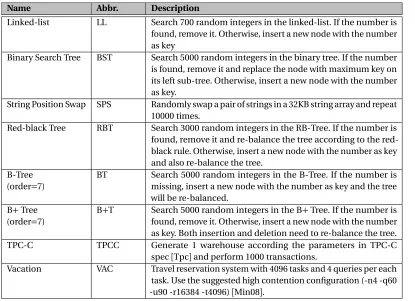
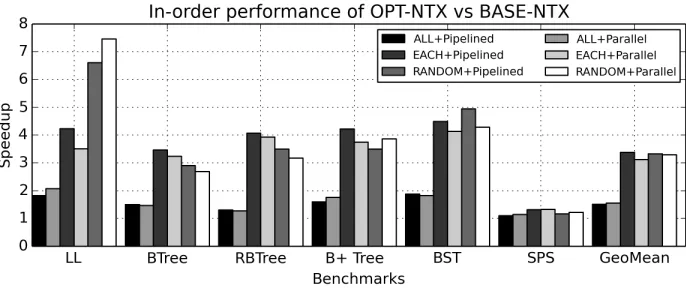
processors with 6 micro-benchmarks and the TPC-C application. The results show our design can give significant speedup over the baseline system using software translation. We demonstrate for
in-order and out-of-order processor, respectively, over the baseline system on microbenchmarks
that place persistent data randomly into persistent pools. For the same in-order and out-of-order microarchitectures, we measure a speedup of 1.17×and 1.12×, and 1.19×and 1.18×respectively,
on the TPC-C application and Vacation application.
This Chapter is written based on the published work
3.1
Motivation: Baseline Persistent Programming Model and its
limita-tions
In this section, we demonstrate the programming overheads and challenges ofpersistent program-mingusing the programming interface shown in Table 3.1. We first describe the interface and how to use it. Then, we present a code example and point out key overheads. We also discuss other overheads that are commonly presented in the context of logging for failure-safety.
3.1.1 The Persistent Programming Interface
Many designs for persistent programming interface are possible[Vol11; Cob11; Pme; Zho16]and
the community has not settled on any design yet. In this chapter, we base our interface on the Persistent Memory Development Kit (PMDK, formly known as NVM Library)[Pme], an open-source
library developed by the PMEM team at Intel that was inspired by prior works[Cob11; Vol11]. We
select it because it has garnered significant support from industry. However, because of its size and complexity, we have reduced it to an essential set of functions in order to give it C language
semantics and to narrow the focus to specific aspects of the interface that are important to our work in this Chapter. We expect that the findings of our work extend to PMDK and other systems with a
design based on ObjectIDs.
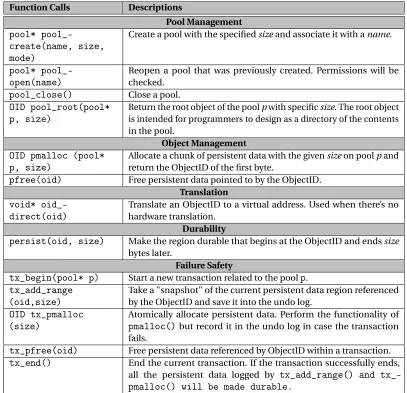
Table 3.1 contains a number of functions that support a few keys tasks: pool management, object management, translation, support for durability, and support for failure-safety.
3.1.1.1 Pool Management
As in most prior works[Pme; Cob11; Vol11], we assume that persistent objects are grouped into
file-like entities, calledpools, that are mapped in their entirety into a process’ address space. This is similar in concept tommapon Linux. Pools are then created from scratch (pool_create), opened (pool_open), or closed (pool_close) just like files. Like files, opening or creating a pool would
require an OS-level system call that verifies permissions and maps the pool into the address space. We do not further consider these mechanisms since they are similar, in principle, to ones that already
Table 3.1Summary of library calls required to support persistent memory programming.
Function Calls Descriptions
Pool Management
pool* pool_-create(name, size, mode)
Create a pool with the specifiedsizeand associate it with aname.
pool* pool_-open(name)
Reopen a pool that was previously created. Permissions will be checked.
pool_close() Close a pool.
OID pool_root(pool* p, size)
Return the root object of the poolpwith specificsize. The root object is intended for programmers to design as a directory of the contents in the pool.
Object Management
OID pmalloc (pool* p, size)
Allocate a chunk of persistent data with the givensizeon poolpand return the ObjectID of the first byte.
pfree(oid) Free persistent data pointed to by the ObjectID.
Translation
void* oid_-direct(oid)
Translate an ObjectID to a virtual address. Used when there’s no hardware translation.
Durability
persist(oid, size) Make the region durable that begins at the ObjectID and endssize
bytes later.
Failure Safety
tx_begin(pool* p) Start a new transaction related to the poolp.
tx_add_range (oid,size)
Take a "snapshot" of the current persistent data region referenced by the ObjectID and save it into the undo log.
OID tx_pmalloc (size)
Atomically allocate persistent data. Perform the functionality of
pmalloc()but record it in the undo log in case the transaction fails.
tx_pfree(oid) Free persistent data referenced by ObjectID within a transaction.
tx_end() End the current transaction. If the transaction successfully ends,
all the persistent data logged by tx_add_range() and
However, this is where the analogy to files ends, because pools are not byte serialized and they
contain objects. We assume, like prior work, that all pools must contain a root object, which serves as an entry point for the pool and aggregates key information for the pool. The last function shown
under Pool Management is
pool_root, and it provides access to the root object of a given pool.
3.1.1.2 Object Management
All objects within a pool are persistent, and we can allocate and deallocate them within the pool the same way that the heap works. We provide
pmalloc
andpfree
functions. Unlike malloc,pmalloc
needs to know the pool the object is being created within, and then it returns an ObjectID to the
newly allocated object.
unique pool identifier offset within the pool ObjectID:
32 bits 32 bits
Figure 3.1Components of an ObjectID.
As depicted by Figure 3.1, the ObjectID is the concatenation of a unique identifier given to the
pool and an offset within the pool where the object is located. We assume that the ObjectID is 64 bits to make it possible to hold it in one register. We devote the upper 32 bits to the pool identifier,
a unique system-wide number assigned to a pool when it is created, and the lower 32 bits for the offset. This can be interpreted as a segmented address space, where each segment is 4GB. However,
it can also be interpreted as a flat address space since an object in one pool can reference any other
pool using a legitimate ObjectID.
3.1.1.3 Translation
As shown in Figure 3.2, each pool is mapped into the virtual address space, and each page of the pool is individually mapped to a physical address using conventional approaches for virtual memory.
It’s worth noting that the same pool might map to different virtual addresses in different processes.
Furthermore, the mapping to physical address is handled by the virtual memory manager for the system in the conventional way.
Pool
Object
ObjectID
Virtual Address
Space
Pool
Object
Physical Address Space pool id:
offset
offset
Virtual to Physical Mapping
per Page
Pool Object
1 Page
Figure 3.2Relationship of pool, object, virtual, and physical address space.
into an address space, it has a base address, and the relation of pool id to base address is tracked
in an efficient data structure, like a hash table. For any given ObjectID, the translated address is
obtained by searching the data structure for the unique pool id, returning the address where the pool is mapped, and then adding the offset.
PMDK uses a combination of a hash table and a last value predictor to translate ObjectIDs. The
most recent pool id look-up is held in a variable. If the next translation request is for the same pool, the base address is quickly determined without searching the hash table. Otherwise, if there is no
match, the hash table is searched. Such an approach is efficient when translations tend to occur for
the same pool, but it loses efficiency when ObjectIDs are spread across many pools.
We adopt this same strategy in our
oid_direct
implementation, illustrated as pseudo-code inFigure 3.3. We use a global variable pair,
most_recent_pool_id
andmost_recent_base_addr,
to hold the most recent translations. If thepool_idpart of the ObjectID matches, the translation canbe calculated with the most recently translated pool id. Otherwise, a search is performed on the
hash table (OIDTranlationMapin the pseudo-code) to find the translation, and it also updates the most recently searched pair for use by subsequent translations.
If a translation is requested for a pool that has not been opened, it is considered an error, as it’s
the case in PMDK. Ideally, the API should be extended with error codes to allow recovery or handling by the programmer, but we omit this support and further discussion for the sake of keeping the API
small. In Chapter 4, we will revisit it, where it might not be an error if the programmer "forgets" to
1 v o i d* o i d _ d i r e c t(OID oid ) 2 {
3 if ( m o s t _ r e c e n t _ i n f o _ v a l i d && oid . p o o l _ i d == m o s t _ r e c e n t _ p o o l _ i d )
4 r e t u r n m o s t _ r e c e n t _ b a s e _ a d d r + oid . o f f s e t ;
5 m o s t _ r e c e n t _ i n f o _ v a l i d = 1;
6 m o s t _ r e c e n t _ p o o l _ i d = oid . p o o l _ i d ;
7 m o s t _ r e c e n t _ b a s e _ a d d r = O I D T r a n s l a t i o n M a p - > f in d ( oid . p o o l _ i d ) ;
8 r e t u r n m o s t _ r e c e n t _ b a s e _ a d d r + oid . o f f s e t ; 9 }
Figure 3.3Pseudo-code ofoid_direct.most_recent_pool_idandmost_recent_base_addressholds the most recent translated pool identifier and base address.OIDTranslationMapis a hash map that holds all the translations from pool id to base address.
3.1.1.4 Durability and Failure-Safety
Durability and failure-safety are two major aspects of persistent programming, and many prior
works have dealt with these topics[Pel14; Con09; Jos15a; Pme; Lu14a; Kol16b].
Durability refers to the process of ensuring that modified data has been written back to
non-volatile storage. Intel’s NVML extensions describe new instructions, like CLWB and CLFLUSHOPT [Pme; Int16], that force data to write back to memory. These instructions, in conjunction with SFENCE, allow the programmer to guarantee that data is written back to persistent memory. The
persist
function guarantees that all data starting at a given ObjectID and extendingsize
addi-tional bytes are written back to persistent storage.Failure-safety deals with the larger problem of how to update a persistent data structure so
that it is always in a consistent state or recoverable to one. Prior works have described how to use
write-ahead undo or redo logging to provide transactional semantics when persisting data. We add support for write-ahead undo logging.
Transactions begin and end using the
tx_begin
andtx_end
functions. Any persist objectcan be logged using the
tx_add_range
function which copies the specified range of addresses (ObjectID to ObjectID+size) to the log and makes them persistent.tx_pmalloc
andtx_free
arespecial versions of
pmalloc
andpfree
that can be undone.3.1.2 Persistent Linked List Example
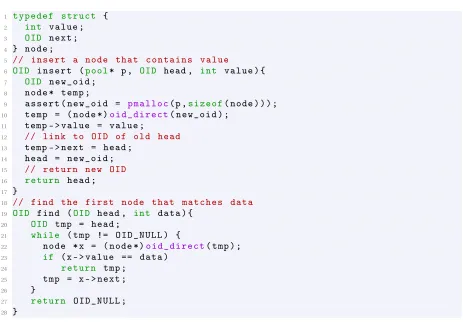
Figure 3.4 shows an example of inserting a node and searching for a node in a linked list. First,
consider the struct definition. Each node of the list contains a value and an ObjectID to the next
node in the list. This design allows the list to be fully contained in a single pool or span multiple pools.
The
insert
routine takes a pool, head, and value as arguments. Next, it creates a new node in1 t y p e d e f s t r u c t {
2 int v a l u e ;
3 OID n e x t ;
4 } n o d e ;
5 // i n s e r t a n o d e t h a t c o n t a i n s v a l u e
6 OID i n s e r t (po o l* p , OID head , int v a l u e ) {
7 OID n e w _ o i d ;
8 n o d e * t e m p ;
9 a s s e r t ( n e w _ o i d = p m a l l o c( p ,s i z e o f( n o d e ) ) ) ;
10 t e m p = ( n o d e *)o i d _ d i r e c t( n e w _ o i d ) ;
11 temp - > v a l u e = v a l u e ;
12 // l i n k to OID of old h e a d
13 temp - > n e x t = h e a d ;
14 h e a d = n e w _ o i d ;
15 // r e t u r n new OID 16 r e t u r n h ea d ; 17 }
18 // f i n d the f i r s t n o d e t h a t m a t c h e s d a t a
19 OID f i n d (OID head , int d a t a ) {
20 OID tmp = h e a d ;
21 w h i l e ( tmp != O I D _ N U L L ) {
22 n o d e * x = ( n o d e *)o i d _ d i r e c t( tmp ) ;
23 if ( x - > v a l u e == d a t a )
24 r e t u r n tmp ;
25 tmp = x - > n e xt ;
26 }
27 r e t u r n O I D _ N U L L ; 28 }
Figure 3.4Example of a persistent linked list insertion and search using our programming interface.
can initialize the new node. Next, we set the next pointer to the head and return the new node as
the head of the list. We have to be careful to set the next field using an ObjectID and to return the
ObjectID rather than the translated address.
The
find
routine traverses a list looking for a node with a matching value. During each iteration atranslation is required in order to access the elements of the node. Note that since the list could span
multiple pools, we are assuming that all such pools have already been mapped using
pool_open
orpool_create.
3.1.2.1 Overheads
The persistent linked list incurs more overhead compared with a normal linked list. Translations
from ObjectID to address are needed as compared to a conventional design. In the event that a list is fully contained within the same pool, some translation overhead can be eliminated within the
implementation and number of pools used by a program at any given time. Table 3.2 shows that the
oid_direct
function requires approximately 17 instructions when the last translation is reused (second column), but it increases to approximately 97 instructions, on average, when mosttransla-tions require the cost of a full look-up (third column). Also, as translation must precede execution,
these overheads fall on the critical path and have a major impact on performance.
Table 3.2Average instructions executed in theoid_directfunction with different number of pools used (on ALL and EACH benchmarks), as described in Section 3.4.1.1. Last column shows the miss rate for the most recent translation predictor on the EACH pattern.
Bench. Insns with one pool Insn with multiple pools
Miss on recent
Linked-list 17.0 99.3 99.7%
B-Tree 16.8 77.8 62.2%
Red-black Tree 17.0 104.7 91.0%
B+Tree 17.0 95.0 80.3%
Binary Search Tree 16.8 107.3 96.7%
String Position Swap 17.0 102.7 99.9%
Geometric Mean 17.0 97.3 87.2%
These translation overheads also bring many indirect inefficiencies. For example, they increase
the working set of the program, adding to increased pressure on the cache, and the compiler may be
less efficient since it cannot interpret ObjectIDs as addresses, limiting the success of many common optimizations.
3.1.2.2 Programmability Concerns
PMDK[Pme]targets server class applications that primarily require system programming experts to explicitly manage persistent data. Hence, it makes little effort to simplify persistent programming.
However, we argue that NVMM has the potential to be powerful on a wide range of systems, from
client applications to embedded domains. Prior work has pointed out many of the other challenges of persistent programming[Cob11; Pme; Vol11; Mar17], like providing failure-safety and ensuring
persistent objects are not leaked. Hence, given the already complex nature of programming for
persistence, it is important to ease the burden on the programmer when possible.
Unfortunately, in the current API, implementing a simple data structure is somewhat more
complex[Mar17]. In the case of the linked list, rather than keeping track of the address for a node, it
is imperative to track both the ObjectID and the translated address. Depending on the operation, one or the other may be required. Programming with pointers is already challenging and error
prone, and ObjectIDs add another kind of reference that must be properly used by the programmer.
address and the ObjectID.
Our hardware support can reduce this complexity by allowing a single reference, the ObjectID, to serve both purposes. To fully exploit the hardware, languages and compilers may need to be
modified in order to expose this simplicity to the programmer. We do not consider these additional
efforts in this paper, but we believe that such extensions are feasible.
3.2
Design: Hardware-supported Address Translation
We identify that translation from ObjectIDs to virtual address places a burden on the programmer and incurs significant performance overheads. We propose new instructions and architectural
support to accelerate ObjectID translation.
3.2.1 New Instructions
In our design, we interpret the space of all ObjectIDs as a new address space and provide hardware support for loading and storing directly to this address space. Rather than requiring translation in
software from ObjectID to virtual address, two new instructions will support translation in hardware,
as shown in Table 3.3.
nvld
allows a load directly from an ObjectID. New hardware will look-up the ObjectID, convert it to a virtual address, and perform the load all in one instruction. Likewise,nvst
will write to a location specified by an ObjectID.
While we do not show them explicitly, we assume that each instruction comes with variants for accessing data of varying widths (e.g. bytes, words, double words, and so on). Ultimately, the
language and compiler would need to facilitate selection of the appropriate width operation, but
we do not consider this issue more.
Table 3.3New instructions to support translation directly in hardware.
Instruction Description
nvld rd,rs1,imm rd=MEM[Lookup(rs1)+imm]
nvst rs1,rs2,imm MEM[Lookup(rs2)+imm] =rs1
3.2.2 Overall Architecture
Figure 3.5 provides a depiction of our architecture. To support translation from ObjectID to virtual address when an nvld or nvst executes, we need two structures, the Persistent Object Look-aside
Core Memory
Persistent Object Look-aside
Buffer (POLB) Persistent
Object Table (POT)
Load from ObjectID
Send Translated Address to Access
Memory
Figure 3.5Overall architecture depicting Persistent Object Look-aside Buffer and Persistent Object Table.
The POLB is similar to the TLB. It contains entries for the pools that have been mapped into a process’s address space. The entry allows for translation from an ObjectID to an actual address,
possibly virtual or physical (Section 3.3 will cover more details). The POLB is located inside the core
and is meant to be accessed with low latency so as to incur very little overhead on nvld and nvst operations. If an entry is present, hardware is allowed to perform the translation.
The POT serves a similar role as a page table. The POT tracks the current pool mappings for a process. In our design, the POT converts a pool id to a virtual address.
The POLB and POT work together to provide high performance translation. If a translation is
requested for an entry that is not present, the POT is checked to determine if the pool is mapped into the address space already. If a matching entry is present in the POT, it is simply moved to the
POLB by hardware. Note that the POT serves as a backing store for all such information, whereas
the POLB acts as a cache, holding only the most recent translations used by the core. However, if a requested translation is unknown to both the POLB and POT, it is treated like a page fault and a trap
to the operating system is required to handle it, which may abort the program or invoke some form
of signal handling to allow the application to recover.
3.2.2.1 Microarchitectural Considerations
While the design of the POLB and POT bear similarity to the TLB and Page Table, they are different.
There are a variety of microarchitectural design choices. For example, should the POLB translate
addresses, a cache access can proceed inparallelwith the POLB look-up. However, this leads to other complexities.
Another aspect is the problem of aliasing among normal loads and stores and nvld and nvst. It is
possible for code to simultaneously access a persistent object through both kinds of instructions. This
implies that the architecture must disambiguate virtual addresses and references based on ObjectIDs at the same time. For high performance, memory disambiguation and load-store forwarding should
operate correctly in the presence of aliased operations. For example, a store using an ObjectID
should be able to forward data directly to a regular load.
Furthermore, these design choices are inter-dependent. We consider two overall design strategies
for the POLB and POT, one that pipelines POLB accesses with the TLB and another that operates
in parallel with the cache. Because these choices interact with memory disambiguation, we also consider these designs in the context of an out-of-order and in-order processor pipeline.
Their complete implementations are described in Section 3.3.
3.2.3 Supporting System and Library Modifications
We modify our programming interface from Section 3.1 with support for our new instructions and
hardware.
In
pool_create()
orpool_open(), after the pool is created or verified, the persistent data
region will be mapped into the process’ address space. Also, the POT must be updated with a newentry for the pool.
Now,
oid_direct()
is no longer required. A programmer can dereference an ObjectID to read or write persistent data directly. Several of the library functions can also benefit from hardwareacceleration. For example, tx_add_range() can use these more efficienc instructions to when copying
data into undo logs. We modify all of the library calls that access persistent data to use faster nvld and nvst instructions.
3.3
Microarchitecture
We present the microarchitectural details of our new structures and how they integrate into the
pipeline.
3.3.1 Persistent Object Look-aside Buffer
The POLB is implemented as a small cache-like structure. Each entry in the POLB contains a tag, a valid bit, and a data value. The tag array is implemented as a Content Addressable Memory (CAM)
?
pool id VPN index offset
TLB
L1D cache POLB
Tag(32-bit) Valid Data (64-bit) 32-bit
32-bit
52-bit (a)
offset
offset
?
L1D cache POLB
52-bit index
(b) pool page#
Tag(52-bit) Valid Data (52-bit)
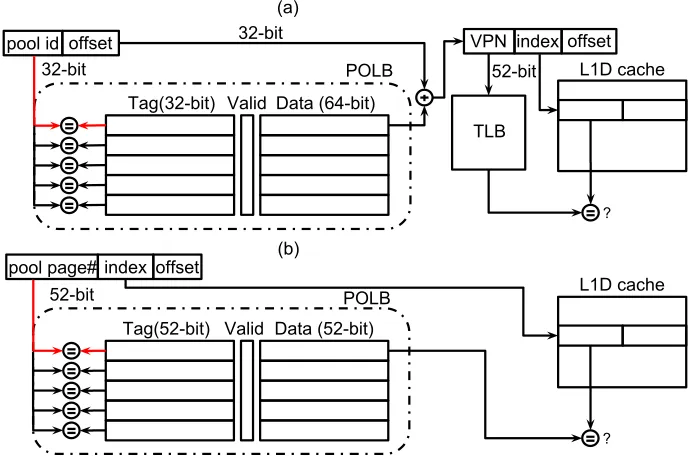
Figure 3.6Two designs for the Persistent Object Look-aside Buffer.
3.3.1.1 Pipelined
In the case of thePipelineddesign, the POLB stores the translation from the pool identifier to the base address. In this case, the tag will hold a pool identifier, and the data field holds a 64-bit virtual
address. On a lookup, the pool identifier from an ObjectID is checked against the tag array. If a
valid entry is found, the corresponding base address is obtained and added to the offset field of the ObjectID. The resulting virtual address is sent to the TLB and L1 data cache to access the memory
hierarchy. Figure 3.6(a) shows the process of translation forPipelined.
3.3.1.2 Parallel
ForParallelthe fields of the POLB have a different purpose because the goal is direct conversion to a physical address. In this case, we need to know both the pool identifier and the page within
the pool that is being referenced. This requires taking some of the bits from both the pool identifier
and the offset of the ObjectID. We assume 4 KB pages and a virtually-indexed physically-tagged cache, so the lower 12 bits can be forwarded directly to the L1 data cache. The upper 52 bits of the
ObjectID are used to search the POLB for a match. If a valid entry is found, a 52 bit physical address
3.3.1.3 Comparison
Pipelinedimposes a delay for translation from ObjectID to virtual address before accessing the cache. It’s unlikely the POLB delay can be added with no impact on load latency.Parallelcan avoid this delay by operating in parallel. This appears to lean in favor ofParallelin the absence of other microarchitectural considerations.
On the other hand, the size of the POLB inPipelinedonly needs to be big enough to track all pools currently mapped in the process’s address space, whereasParallelneeds to track all active pages in the pool. Some of these pages may be redundantly tracked in the TLB, since we allow
regular loads and stores to the same virtual addresses that nvlds and nvsts are accessing through ObjectIDs.
If the added cost of thePipelineddesign can be hidden or otherwise avoided, it may be preferable given its smaller size and that it avoids duplicate mappings with the TLB.
3.3.2 Persistent Object Table
We design the POT under a different set of assumptions than a typical page table. If we assume that
pools are like files, then it is reasonable that hundreds to thousands of files may be the limit that is needed. Many Linux systems limit the number of open files by a single process to 1024 or less,
which implies that a relatively small table would suffice.
The POT is accessed on a POLB miss, as described in Section 3.2, to look-up entries that need to be placed in the POLB. The POT must contain the information needed to determine if the access
is legal and to fill in an entry in the POLB. Each entry in the POT contains a pool identifier and a
corresponding virtual base address for the pool. We reserve a pool id of 0 to indicate a NULL pool which cannot exist. This allows us to initialize all entries as invalid.
For bothPipelinedandParallel, we design the look-up of the POT based on the X86 architecture’s hardware page table walk. Figure 3.7 depicts the POT walk. We presume a new architectural register can be used to hold the base virtual address of the POT in memory. The pool identifier from the
referenced ObjectID will be taken and calculated through a hash function to get the index within
the POT. A legal translation occurs when the POT entry is valid and the