PERFORMANCE ANALYSIS OF VOICE CODEC FOR VOIP
ALI ABD. KHUTHER
A project report submitted in partial fulfillment of the requirements for the award of the degree of
Master of Science (Computer Science)
Faculty of Computer Science & Information Systems Universiti Teknologi Malaysia
III
Thank To My Lord, Allah, My Parents And My Family Members,
IV
ACKNOWLEDGEMENT
“In the name of Allah, the most Beneficent, the most Merciful”
In preparing this project report, I was in contact with many people, researchers, academicians and practitioners. They have contributed toward the success, and given a moral support to accomplish this project. At the very beginning, I would like to thank my beloved father and mother for every thing, and I ask Allah the almighty to grant them the Paradise.
I wish to express my sincere appreciation to my supervisor, Dr. Md Asri Bin Nagadi for guidance, critics and friendship. And the great advice which he always used to gave me. I would like to thank Dr. Muhammad Shafie Abd. Latiff and Dr. Norafida Bte Ithnin too for their meaningful comments which are lead to improve my research skills.
V
ABSTRACT
VI
ABSTRAK
VII
TABLE OF CONTENTS
CHAPTER TITLE PAGE
DECLARATION II
DEDICATION III
ACKNOWLEDGEMENT IV
ABSTRACT V
ABSTRAK VI
TABLE OF CONTENTS VII
LIST OF TABLES XI
LIST OF FIGURES XII
LIST OF APPENDICES XV
1 PROJECT OVERVIEW
1.1. Introduction 1
1.2. Problem Background 2
1.3. Problem Statement 4
1.4. Project Objectives 5
1.5. Project Scopes 5
1.6. Project Justification 6
1.7. Report Organization 7
2 LITERATURE REVIEW
2.1. Introduction 8
2.2. VoIP (Voice over IP) 9
VIII
CHAPTER TITLE PAGE
2.3.1 SIP (Session Initiation Protocol) 11 2.3.2 Network Simulator (NS2) 13 2.3.2.1 OTcl and C++ 14
2.4. Main Parameters in VoIP 15
2.4.1 Quality Of Service 15
2.4.2 One -way delay 17
2.4.3 Jitter 18
2.4.4 Lost Data (Packet loss) 18
2.4.5 Throughput 19
2.5. Digital Audio Compression 20
2.5.1 Bit Rate 21
2.6. CODEC 21
2.6.1 G.711 CODEC 23
2.6.1.1 G.711 Frame (Sample Rate) 24
2.6.2 G.723.1 CODEC 25
2.6.2.1 G.723.1 Frame (Sample Rate) 26
2.6.3 G.729 CODEC 26
2.6.3.1 G.729 Frame (Sample Rate) 28
2.6.4 G.728 CODEC 28
2.6.5 G.722 CODEC 29
2.6.6 GSM CODEC 30
2.7. Mean Opinion Score 30
2.8. E Model 31
2.8.1 Mapping between E Model and MOS 32 2.9. Comparison and Contrast in Codecs 32
2.9.1 Codecs with Packet loss 33
2.9.2 Codec with Throughput 34
2.9.3 Codec with Jitter 36
2.9.4 Codecs with Wi-Fi Mesh Network 38 2.9.5 Comparison Between G.711 and G.729 39
IX
CHAPTER TITLE PAGE
3 RESEARCH METHODOLOGY
3.1. Introduction 43
3.2. Project Structure 44
3.3. Research Methodology 45
3.3.1 Literature Review and Initial
Requirements 47
3.3.2 Design and Architecture 47 3.3.3 Select Three Existing CODECS 48
3.3.4 Simulation 48
3.3.5 Comparison 48
3.4. Software and Hardware Requirement 50
3.5. Summary 50
4 DESIGN AND IMPLEMENTATION
4.1. Introduction 51
4.2 Architecture Design 51
4.3 Implementation 53
4.3.1 Platform Preparation 54
4.3.2 Topology 56
4.3.3 Simulation Scenario 58 4.3.3.1 UDP Packet Format 58 4.3.3.2 Set the Application Agent 58 4.3.3.3 Main Scenario 59
4.4. Trace File and AWK Result 62
5 RESULT AND EVALUATION
5.1 Introduction 66
5.2 QoS Parameters Analysis 66
5.2.1 Packet Loss 67
X
CHAPTER TITLE PAGE
5.2.3 Jitter 73
5.2.4 End to End Delay 75
5.3 Discussion 78
5.4 Conclusion 79
6 CONCLUSION
6.1 Conclusion 80
6.2 Future Work 81
REFERENCES 82
XI
LIST OF TABLES
TABLE NO. TITLE PAGE
1.1 Weakness For Each Codec 3
1.2 The Mean Opinion Score Scale (ITU) 4
2.1 Audio Codecs (What is a VoIP Codec, 2005) 22
2.2 The Mean Opinion Score Scale (ITU) 31
2.3 Mapping Between R Values And Estimated MOS (ITU) 32 2.4 Bit Rate Codec With Vary Packet Size (Toral and Torres,
XII
LIST OF FIGURES
FIGURE NO. TITLE PAGE
2.1 Interworking messages Between Two SIP Servers and
Their Client. 12
2.2 C++ and OTcl: The Duality (Network Simulator 2). 14 2.3 Digital Audio Processing (Kervy, 2006). 20
2.4 Different Bit Rate (Kervy, 2006). 21
2.5 Sample Rate for G.711. 24
2.6 Sample Rate For G.723. 26
2.7 Sample Rate For G.729. 28
2.8 Percentage Packet Losses vs. Number of Simultaneous Nodes Using G.711 Codec as a Function of Distance to
AP (Alias and Ong, 2006). 33
2.9 Percentage Packet Losses vs. Number of Simultaneous Nodes Using G.723.1 Codec as a Function of Distance
to AP (Alias and Ong, 2006). 34
2.10 Percentage Packet Losses vs. Number of Simultaneous Nodes Using G.729 Codec as a Function of Distance to
AP (Alias and Ong, 2006). 34
2.11 Throughput (Mbps) vs. Number of Simultaneous Nodes Using G.711 Codec as a Function of Distance to
AP (Alias and Ong, 2006). 35
2.12 Throughput (Mbps) vs. Number of Simultaneous Nodes Using G.723.1 Codec as a Function of Distance
XIII
FIGURE NO. TITLE PAGE
2.13 Throughput (Mbps) vs. Number of Simultaneous Nodes Using G.729 Codec as a Function of Distance to
AP (Alias and Ong, 2006). 36
2.14 Jitter (second) vs. Number of Simultaneous Nodes Using G.711 Codec as a Function of Distance to AP
(Alias and Ong, 2006). 37
2.15 Jitter (second) vs. Number of Simultaneous Nodes Using G.723.1 Codec as a Function of Distance to AP
(Alias and Ong, 2006). 37
2.16 Jitter (second) vs. Number of Simultaneous Nodes Using G.729 Codec as a Function of Distance to AP
(Alias and Ong, 2006). 38
2.17 Maximum Jitter During One Week (Toral and Torres,
2005). 40
2.18 Maximum End-To-End Delay During One Week
(Toral and Torres, 2005). 41
2.19 Maximum Packet Loss During One Week (Toral and
Torres, 2005). 41
3.1 Project Structure Steps. 45
3.2 Research Methodology. 46
3.3 Project Operational Framework. 49
4.1 SIP’s VoIP Architecture. 53
4.2 The Flow of Simulation Steps. 54
4.3 Tcl and C++ Files. 55
4.4 Tcl Code topology. 56
4.5 NS2 NAM Topology. 57
4.6 Tcl Code Initial. 59
4.7 Tcl Code Packet Option.. 60
XIV
FIGURE NO. TITLE PAGE
4.9 Tcl Code Scheduler. 61
4.10 Snapshot of Trace File. 63
4.11 AWK File Code for Packet Loss. 64
4.12 The Out Put from the AWK File. 65
5.1 Packet Loss for G.711, G.723 and G.729 with 64,128
and 200 Byte of Packet Size. 67
5.2 Packet Loss for G.711, G.723 and G.729 with 512 and
1000 Byte of Packet Size. 69
5.3 Throughput versus Number of Calls Using Codec G.711, G.723 and G.729 AT 64, 128 and 200 Bytes of
Packet Size. 71
5.4 Throughput versus Number of Calls Using Codec G.711, G.723 and G.729 AT 512 and 1000 Bytes of
Packet Size. 72
5.5 Jitter versus Number of Calls Using Codec G.711, G723 and G.729 At 64, 128 and 200 byte of Packet
Size. 74
5.6 Jitter versus Number of Calls Using Codec G.711,
G723 and G.729 At 512 and 1000 byte of Packet Size. 75 5.7 End to End delay versus Number of Calls Using Codec
G.711, G.723 and G.729 At 64, 128 and 200Bytes of
Packet Size. 76
5.8 End to End delay versus Number of Calls Using Codec G.711, G.723 and G.729 At 512 and 1000Bytes of
XV
LIST OF APPENDIXES
APPENDIX TITLE PAGE
A OTcl Simulation Code 84
B Overview Tables for Over All the Results
CHAPTER1
PROJECT OVERVIEW
1.1. Introduction
Voice communication recently became daily used whether by cellular, land phone PSTN or voice over Internet protocol (VoIP), the last one has been invented recently, so fast VoIP became very wide among the people. Nowadays, a human can communicate easily to all over the world whereby their IP contributed many services and protocols. Unfortunately, until now there is no clear guarantee to transmit the data over the network (Doherty, Anderson, 2006). Therefore, sending the samples of voice (packets) still does not reach the satisfaction of users, due to certainly the VoIP does not be as clear as the human conversation. Recently, after the VoIP has been invented, the next challenge for the researchers and engineers was the quality of voice service.
2
On the other hand, we need to improve certain techniques and codec in order to obtain high quality of voice. Many works, tools and techniques have been published and built with fully concerned about how to choose a proper codec techniques, the used codec should has suitable properties and features which aim to send a light and clear voice sample.
This proposal will investigate VoIP existing speech codecs techniques, aiming to study and compare encoding/decoding techniques with the certain parameters delay, jitter, throughput and packet loss, during transmitting the data through the network.
1.2. Problem Background
Any computer system has many methods to play the sound and also should have algorithm to compress the speech data, either for storage that file or send it through the network. However, compression the audio for sending it much more difficult than just storage, due to it is a real time operate, attempting to make the conversation as near as the real talk. On the other hand, when the voice navigates across many devices such as router, server, and the media itself, those things certainly will decrease the quality of voice until it reaches the receiver.
3
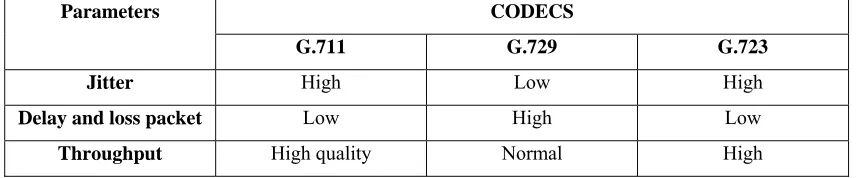
Problems that might happen over VoIP can be divided into three categories according to codec used (Honathan, 2007). Table 1.1 shows simply and generally the weakness of each codec and where the straight. The table reviews each codec how the jitter, delay, placket loss, and throughput have been affected to them.
Table 1.1: Weakness for Each Codec
CODECS Parameters
G.711 G.729 G.723
Jitter High Low High
Delay and loss packet Low High Low
Throughput High quality Normal High
Many techniques were introduced and applied throughout the whole project lifecycle just to make a good decision for choosing a better codec, these techniques are differ in their objectives and appliance, but it all gathers under best effort encoding/decoding voice to reduce the main three common parameters as mentioned above such as jitter, delay, and packet loss.
Encoding/decoding voice are the most serious problems during one way End-to-End VoIP (Oliver, 2000). Since other algorithms are depend on the situation of the network. On the other word, encoding the speech from analog form to digital representation (samples) and packetizing the data are occur in a critical time, parallel with high level of compression. All these problems are taken into account, in order to obtain a light data ready to send.
4
would complain from the inaudible conversation and from the delay of voice arriving specially if the calls come from long distance. MOS (mean opinion score) is a common measurement tool for voice quality (Alias and Ong, 2006), as described in the ITU recommendation P.800, the relation between audio performance characteristics and quality score make the MOS standard for network evaluation, from the table 1.2 MOS can be range from 5 (excellent) down to 1 (bad). Whereat MOS of 4 or higher is generally considered toll quality, and a MOS below 3.6 results in many users who are not satisfied with call quality.
Table 1.2: The Mean Opinion Score Scale (ITU)
MOS Quality Rating
5 Excellent
4 Good
3 Fair
2 Poor
1 Bad
From all various problems above show how really important to focus on the quality of voice service by choosing better speech codec techniques.
5
Reports (Alias and Ong, 2006; Amir, Tarik and Noor, 2005 and Kee, Yin and Moh, 2005) have shown that VoIP projects tend to attempt many compression techniques (CODECs) to obtain high quality of service. Similarly, they applied that codecs to other network area. Recently, researches are encountered a same area problem which are choosing a proper codec and control the main factors. In contrast to traditional views, the problems within VoIP are linked with each other.
1.4. Project Objectives
The objectives of this project are stated in the following points:
1. Investigate and analyze the audio encoding/decoding techniques in VoIP.
2. Simulate the selected encoding/decoding techniques of VoIP using NS2.
6
1.5. Project Scope
The objectives of this study are stated in the previous section. In order to achieve the study objectives, it is important to highlight the study area and its boundaries, which are stated in the following points:
1. Testing and simulation are going to be used on SIP server exactly with NS-2.
2. Only address the coding/decoding techniques.
3. Re-coding techniques will not be addressed in this project. 4. Linux Fedora Core 2 as an Operating system to install NS2.
1.6. Project Justification
The primary measurement of success VoIP quality is to perform high quality of voice measured from users’ satisfaction. Any project has its own problems, from this point determining the project success or fail comes from how this project can manage and control the problems.
84
REFERENCES
Adaptive Digital Technologies. (2007). U.S. : Adaptive Digital from : http://www.adaptivedigital.com.
Advance Waterfall Research Methodology. (1999). Malaysia : Research Methodology from : www.dspace.fsktm.um.edu.my/bitstream/1812/160/5/Chapter3.pdf
Alias, M. and Ong, L. L. (2006). Performance of Voice over IP (VoIP) over a wireless
LAN (WLAN) for different audio/voice codecs. Malaysia: Universiti Teknologi
Malaysia.
Amrir, M., Tariq, M.and Noor, M.(2005). Evaluation of VoIP Quality over the
Pakistan Internet Exchange (PIE) Backbone. Pakistan.
Christin, N., (2004). Building ns-2 on Cygwin[version 2.27, 2.26, and 2.1b9a(*), UC
Berkeley – School of Information Management and Systems.
Cisco Document Server, “Traffic Analysis for Voice over IP, Posted September 2002.
Daniel, M. and Emma, M. (2002). Delivering Voice Over IP Networks. (2nd Ed). U.S. : Wiley.
Davis, Y. P. (1993). Digital Audio Compression. A survey: IEEE, Part D. TJA03P8.
INTERNATIONAL TELECOMMUNICATION UNION. (1988). Switzerland: Geneva.
ITU-T Recommendation G.107. 2003, The E-model, a computational model for use in
transmission planning.
ITU-T Recommendation G.114, 2003, One way transmission time. ITU-T Recommendation P.59. Artificial conversational speech.
Ixia. (2005). Assessing VoIP Call Quality Using the E-model. CA 91302. Calabasas :
85
Jim, D. and Neil, A. (2006). Internet Phone Services Simplified. U.S.: Indianapolis
Cisco Press.
Jonthan, D. , James, P. , Manoj, B. Satish, K. and Sudipto, M. (2007). Voice Over IP
Fundamentals. (2nd Ed). U.S.: Indianapolis Cisco Press.
Kee,N.T.,Yin,and Moh. (2005). Voice Performance Study on Single Radio Multihop
IEEE 802.1 lb Systems with Chain Topology. Malaysia: Asian Research Center.
Kerry, C. (2006). A Guide to Open Source Audio Streaming. (1st Ed). U.S. : IT
Security Consultant.
Lin, C., Xuemin, S., Jon, W., Lin C.(2005). Voice Capacity Analysis of WLAN with
Unbalanced Traffic.China.
Michele, L.(1996). SIP Module for Network Simulator 2.Italia.
Monroe Street Santa Clara (2000). CA 95051-1450. U.S. : Extreme Networks. Network Simulator 2. http://www.isi.edu/nsnam.
Oliver, C. I. 2002, Converged Network Architectures, Delivering Voice and Data over
IP, ATM, and Frame Relay.1st edition. United States of America: John Wiley &
Sons, Inc.
Oliver, H. , David, G. and Jean, P. (2000). IP Telephony Packet-Based Multimedia Communications Systems. U.S. : Pantek Arts, maidstone.
Richard, S. (2002). Comparison of Voice over IP with circuit switching
Techniques. A survey: CiteSeer.ist.
Toral, H. and Torres, D. (2005). Traffic Analysis for IP Telephony. IEEE , 05EX1097.
Mexico: Guadalajara.
VOCAL Technologies. (2007). ITU Recommendation G.711. from: http://www.vocal.com/data_sheets/g711.html .