Int. J. Advance Soft Compu. Appl, Vol. 9, No. 2, July 2017 ISSN 2074-8523
A Self-Organizing Communication Model for
Disaster Risk Management
Mohammed Zuhair Al-Taie and Aida Ali
UTM Big Data Centre,
Universiti Teknologi Malaysia (UTM), Skudai, 81310 Johor, Malaysia e-mail: [email protected],
Abstract
Pandemic, industrial accidents, geological and meteorological hazards, airplane crashes, and bombings cause the death of tens to thousands of people and lead to severe damage to economy and environment. Previous studies estimated that since the 1990s, 60.000 people, on average, die every year while the lives and livelihoods of other millions are affected. In disaster time, communications between different parties become essential for disaster management. Although some organizations have already started using social media for disaster management, a full adoption by the community is still facing some obstacles. Highlighting the significance of the research issue, this study introduces a self-organizing communication model for disaster risk management. The model proposes the idea of the public is communicating directly to the public through social media tools, which establishes for a self-organizing communication projection that adds both decentrality and independency to its work, with reduced latency, interruptions, and failures in its internal communications. The proposed model can be used in real life scenarios for post-disaster recovery plans.
Keywords: Emergency Management, RiskCommunication, Self-Organizing, Social
1 Introduction
There has been a high increase, in recent decades, in both impact and number of disasters, including in particular natural disasters. Previous studies estimated that in the period 1997-2006, the number of reported natural disasters grew from 4,241 to 6,806 which resulted in the death of nearly 60,000 people on average. Moreover, the number of affected people rose from 1.6 in the period (1984-1993) to almost 2.6 billion in the period (1994-2003).
Notable disasters that have happened in the last fifty or sixty years are: the 2001 New York and Washington attacks, the tsunami in the Indian Ocean 2004, the active hurricane season in 2004 that hit central Florida in the US, the 2005 Pakistan earthquake, the bombings of Madrid in 2004 and of London in 2005, the 2008 Sichuan-China earthquake, the 2009 Victoria wildfires in Australia, the Deepwater Horizon oil spill in the Gulf of Mexico in 2010, the massive floods in Pakistan in 2010 and in Brazil, the 2010 Haiti and Chile earthquake, the 2011 Japan earthquakes and tsunami, in addition to the bombing attempts that targeted some US airplanes in recent years.
More recently, precisely in December 2014, a continuous rainfall caused by Northeast Monsoon led to severe floods in several areas of the Malaysia Peninsular, to include Northern and Eastern states of Kelantan, Terengganu, Pahang, Perak, Perlis and some parts in Sabah. As a result, the number of displaced population was 247,104. One of the reasons, according to analysts, was the absence of enough coordination and adequate information sharing between the different bodies that were involved in rescue efforts.
These catastrophes (among many others) forced many nations to start searching for treatments on how to deal not only with natural disasters but also with all types of hazards.
The aim of this work is to present a self-organizing communication model for
disaster risk management. The model considers the public as communicating
directly to the public with the help of social media tools while excluding the role
traditionally played by response agencies which have been acting as an
intermediary between the different communities of the public. The reason for this replacement is that many such agencies are still using the traditional tools of information dissemination and have shown to be slow in tapping into the use of social media techniques for warning and alert.
2 Related Work
The body of research on the use of social media during disaster time is growing. For example, reference [1] proposed the use of metadata (picture, video, text) extracted from Flicker.com or YouTube.com to identify sub-events related to an emergency. The authors in [2] investigated whether the use of online social networks would help governments and agencies in emergency management. Their results strongly encourage the use of social networks during emergencies to mitigate problems relevant to information dissemination and communications. The biggest challenges that official agencies face when adopting social media in crisis and emergency management were discussed in [3]. Reference [4] reviewed the importance of using Information and Communication Technologies (ICT) during disaster time as a way to communicate between geographically dispersed groups. The researchers in [5] discussed the benefits of four information technology tools that were used to support the Haiti relief efforts: CrisisCamp Haiti, OpenStreetMap, Ushahidi, and GeoCommons.
The description of Twitter handle @CDCemergency, a tool used by health-related agencies during the 2009 Salmonella Typhimurium outbreak, is given in [6]. The authors in [7] described a system that can be used to inform the situation awareness of an emergency as it unfolds to help crisis coordinators. The system was called the Emergency Situation Awareness - AutomatedWeb TextMining (ESA-AWTM). In [8], the researchers analyzed Twitter messages that were exchanged during the Oklahoma Grassfires of April 2009 and the Red River Floods that occurred in March and April 2009, with the aim of building enhanced situational awareness for emergencies. In an attempt to measure the use of social media on travel plans at disaster time, the researchers in [9] investigated the use of social media if a crisis to happen when traveling, and whether this use is influenced by internal, travel-related, or demographic factors.
3 Background
3.1 Disaster Risk Management
Disasters are neither predictable nor avoidable. By developing comprehensive emergency management plans that are potential to minimize vulnerability and risk, it becomes more likely to prevent hazards from turning into disasters. The implementation of disaster risk management plans requires the use of administrative organizations, decisions, operational skills, and capacities, which eventually would lead to mitigating the impact of disasters and their subsequent environmental and technological consequences [10].
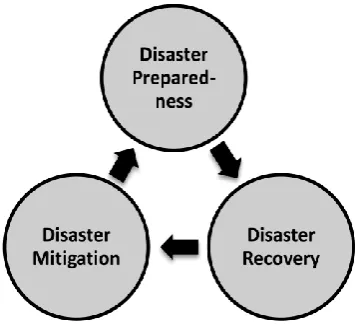
The details of these three stages are as follows:
1)Disaster Preparedness. Disaster preparedness (or risk reduction) aims at preventing disaster occurrence or, if possible, reducing its effects. It aims at strengthening the nation’s capacity to withstand, respond, and recover gradually from hazards. Preparedness covers activities such as the gathering of information, training of responders, the establishment of public awareness, the maintenance of financial, human and material resources, as well as the development of early warning systems. For this sake, countries are encouraged to initiate their plans at different levels, from villages and cities to local authorities and central governments. This phase is complex and requires the cooperation of various political, participatory, resource mobilization and technical entities.
2)Disaster Mitigation. Disaster mitigation aims at preventing emergencies, or lessening the size, scale, frequency, intensity and impact of them. Such measures include fighting fires, providing medical aid, searching for survivors, strengthening houses and public buildings, raising river banks, checking dams, reforestation, and others. Such actions can take place before, during or in the aftermath of a disaster. A successful mitigation strategy is the one that can reduce hazard losses.
3)Disaster Recovery. Disaster recovery (also known as disaster reconstruction or rehabilitation) aims at taking the necessary decisions and actions to rebuild the community in the aftermath of a disaster. It also includes restoring or improving the pre-disaster conditions and encouraging the necessary adjustments to minimize disaster risks. It is worth noting that the severe damages caused by disasters can persist for a long time and that the affected countries would deplete much of their
resources during the post-impact phase. In any case, fruitful and fast relief plans require the involvement of international parties besides local authorities.
3.2 Communications during Disaster Time
What is more important than merely collecting information is the ability to disseminate it to threatened communities: before, during (if possible) and after the disaster [11]. This implies that warning information must be timely enough and accurate. The goal is to achieve the following three goals [12]:
First, saving lives. This requires that emergency planners should put people and technology at the center of warning systems.
Second. In addition to saving lives, disaster information can also reduce people’s suffering. Information about lost family members and friends, why the disaster happened, where the displaced would be temporarily camped or how much they are going to be paid under the provision of compensation act can significantly improve the morals of the homeless and traumatized.
Third. Information during disasters can help comply with the first two provisions by verifying that disaster relief is appropriate and well distributed. Without dispute, assessing what is important against what is not can save precious time, money and resources.
The deterioration of local infrastructure during the first several days after a disaster may lead, in addition to other things, to minimal or no electrical power, degraded or overwhelmed telephony services, minimal, or no radio interoperability, overwhelmed satellite phone services, and limited Internet access.
Providing adequate communication services during disaster time is arguably a core function of any emergency management plan that, if properly practiced, can significantly enhance preparedness, improve coordination and cooperation, empower the public, facilitate logistics, reduce public anxiety, and limit and mitigate harm [13].
The extensive use of ICT technologies has paved the way to receive critical information during mass emergencies. Phones, short messaging systems, radio, data sharing, email, social media and Geographical Information Systems (GIS) information, are among other ICT applications and tools that are important for responders and rescuers during disaster time. Nevertheless, for ICT devices to be effectively used by responders, they should be small in size and lightweight, commercially available, non-military grade, energy independent and flexible [14].
First, the urgent need to disseminate messages to the affected public before, during and after a disaster. The traditional tools used for this purpose have been the radio, television, and sirens. Solving this issue would help affected public take particular actions, such as shelter-in-place, evacuate, boiling water, and so on.
The second is related to the coordination between different parties.
Arguably, the most tenacious problem in disaster response is how to coordinate response efforts among various agencies, groups, organizations and communities at the local, regional, national and even international levels.
3.3 Social Media for Disaster Risk Management
It was estimated that the amount of data produced from the dawn of civilization to 2003 is 5 exabytes, at a time that every two days, we generate the same volume of data. It is even expected that the volume of the digital universe of data will reach
eight zettabytes, a phenomenon commonly referred to by researchers as Big Data,
informationoverload or data deluge [15].
Social media tools (such as Twitter, Facebook, YouTube, Flickr and Google Maps) refer to a set of Internet-based tools that allow for many-to-many social communications to take place between people [16]. Some of these applications and services have dramatically played a vital role in disaster response and recovery by providing response information before, during and after disasters.
Social network applications, for instance, have been used to gather information for the 2010 Haiti Earthquake, 2009 Oklahoma Grassfires and 2008 Sichuan earthquake in China. They also assisted during and in the aftermath of the Japanese earthquake and subsequent tsunami. Besides, in the wake of the Indian Ocean tsunamis, aid agencies began to use blogging websites more efficiently. They posted detailed information about the disaster including death toll, the agencies that were involved in rescue efforts, the names of missing people, the kinds of assistance needed, affected areas, and so on.
Although some organizations have already started using social media for disaster management, a full adoption by the community is still facing some obstacles [17]:
Loss of Control. Social media data is not easy to control. Hence, officials have the problem of how to evaluate the validity and reliability of such data compared to data produced by traditional data sources.
Institutional Limitations. Adoption of new tools and technologies or investing in the training of individuals requires significant budgets and lot of funding.
The Common Alerting Protocol (CAP) and MQTT (MQ Telemetry Transport) protocol are two examples of the successfully adopted protocols.
The capability of Authorizing Users. Distributed identity management systems are required to ensure that only authorized individuals can issue official messages.
Authentication. Digital signatures are necessary for the authenticity of messages.
Warning and Alerting Overload. Limiting the transmission of messages that are sent to targeted areas protects the public from messaging overload and ensures that only intended people are exposed to the messages.
4 Proposed Model
The primary objective of this research is to develop a self-organizing communication model that can provide improved communication services between individuals (or groups) during disasters. Therefore, the model is built with the aim of offering reduced latency, interruptions, and failures in communication. The following two subsections describe the model and its dynamics.
4.1 Model Description
Fig.2: Proposed model
The three core elements of the design, as shown above, are (1) the public, (2) the
social media, and (3) the intelligent application as follows:
1. Public: The public is critical in crisis communication as it is the first component to experience a crisis. As such, the public is both the source of real-time information messages from the response community and the target of these messages as well.
2. Social Media: traditional forms of media (such as TV and radio) have
created the public space in which people meet, discuss and engage in
information sharing. However, the widespread of the new social media (or Web 2.0) technologies have increased the speed and the richness of exchange of information among different groups and individuals.
3. Intelligent Application: in the traditional models of emergency
management plans, the response agencies, from one side, communicate
Intelligent applications make use of their underlying social-media platforms to enable all parties to communicate and exchange information (for example, messages related to event updates, situational awareness, among others.) The aim is to achieve higher levels of interoperability between the different components while at the same time achieving high levels of robustness, rapidity, resourcefulness and redundancy.
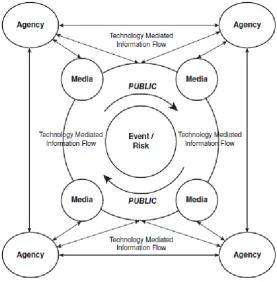
The proposed framework is inspired by a model (Fig. 3) introduced by Pechta,
Brandenburg and Seeger in 2010 (which they called the Four-Channel Model of
Communication) as a way to represent the dynamics of emergency communication [18]. However, our model is different from the preceding model
in that it considers the public, social media, and intelligent applications as the
three primary sources of the framework processes. Response agencies that represent the third element in the previous model have shown to be slow in tapping into today’s new types of communication tools, and many of them are still unaware of the merit of social media as a tool for warning and alert [19]. As a result, such agencies still prefer the use of traditional means of communication (for instance, TV, radio and walkie talkies).
4.2 Model Evolution
The elements of communication involved in this model include multiple audiences, social media, messages, coordination, integration, intelligent applications, dynamics of information flow, as well as modern communication technologies (such as the Internet and cell phones.) The model can depict the evolving, spontaneous and highly decentralized communication networks that develop in response to crises. Such systems emerge naturally without any pre-planning and without the need to be part of any formal emergency communication structures.
It is worth mentioning here that the flow of communication between the different components of this model is not linear, and that the links are multi-directional rather than unidirectional, which emphasizes the ongoing transactional dynamicity between the different entities. The three primary communication dynamics included in the model are:
1. Coordination messages between one individual (or a group of individuals)
and the intelligent application. These messages relate to event updates and situational awareness. Such coordination requires that the outgoing messages be passed through the underlying social media platform before reply messages are sent back to the source.
2. Coordination messages between different groups (individuals). These
messages aim at sharing information between entities. Besides passing through the intelligent application, they are also required to pass through the underlying social media platform.
3. Integration messages between the intelligent application and its underlying
social media platform. These messages are related to service authorization, synchronization, information updating, and others.
5 Case Study: Facebook Messenger
Facebook main service has been used to disseminate information to the public at disaster time. For example, information about severe weather conditions are delivered with the help of the National Weather Service iNWS to increase public awareness towards weird climatic conditions [18]. Facebook was also used for texting by the Haitians who were trapped under the debris during Haiti earthquake in 2010, and by the teaching staff in higher learning institutions [24] to socialize through mobile Web 2.0 tools.
Fig. 4:Snapshot from a smartphone of Facebook Messenger
Facebook Messenger, like some other instant messaging service and software applications, allows people to use text chat, voice (using VOIP protocol) and video calls, as well as sharing images, locations and stickers [22]. Running in the background, the service from time to time transmits and receives status messages, with more than 300 different activities and more than 30 different services that potentially communicate with each other [23].
Supported by one billion active users on Facebook, the messenger has the advantage of being both coherent and multi-platform. Unlike some other instant messaging applications, messages and chats can be traced on different devices.
The messenger was built on MQTT (MQ Telemetry Transport); a publish-subscribe and lightweight protocol for use on top of TCP/IP protocol. The protocol was designed to handle connections to remote places with limited bandwidth and short battery life [25]. Besides being part of the Facebook’s web-based chat feature, the protocol was also adopted by other recent technologies, particularly those used for communication with the different parts of the system such as signaling control systems (for instance, DeltaRail's IECC). Amazon Web Service announced in 2015 that its Internet of Things (IoT) service was based on MQTT. Other IoT-based platforms (such as EVRYTHNG) use the protocol to connect millions of components. It is expected that more open source projects will be based on the same protocol [26].
6 Conclusion
The model described in this study has implications for conceptualizing and implementing disaster risk management. It emphasizes the use of social media
technologies by the public and proposes the exclusion of relief agencies being an
intermediary between the public and social media since the majority of such agencies have shown to be slow in tapping into these new communication
patterns. Instead, we suggested that intelligent applications should take the
responsibility for coordinating communications between the different components involved in the communication circuit. The model assumes that the public is prepared to deal with various emergencies and is equipped with the required knowledge to use the latest technologies.
The assumption that the public communicates directly to the public proposes the idea of a self-organizing communication network that offers both decentrality and independency in its work at the time of emergency, which would help reduce latency, interruptions, and failures in communication. The final goal is to contain, limit, offset and mitigate harm as part of community recovery.
Although the model offers a description of how the public is going to communicate using different social media tools, new technologies are evolving every day which may mean more dynamics should be added to the model. Although the model does not provide information about how a crisis will emerge, it does give a general overview of the core processes and expected outcomes. To this end, without testing or directly being applied to any emergency situation, the utility of the proposed model remains unfounded, which is going to be our future challenge. The intelligent application addressed in this study, (it means Facebook Messenger), requires the inclusion of several improvements to the current application design before being ready to achieve better functionality under real-world scenarios.
ACKNOWLEDGEMENTS
This work is supported by Q.J130000.2509.13H82 (INTELLIGENT
PREDICTIVE ANALYTICS FOR RETAIL INDUSTRY) _ GUP GRANT. The authors would like to thank Research Management Centre (RMC), Universiti Teknologi Malaysia (UTM) for the support in R & D, and Soft Computing Research Group (SCRG) for the inspiration in making this study a success. The authors would also like to thank the anonymous reviewers who have contributed enormously to this work.
References
[1] Pohl, D., A. Bouchachia, and H. Hellwagner. Automatic sub-event detection in
emergency management using social media. in Proceedings of the 21st international conference companion on World Wide Web. 2012. ACM.
[2] White, C., et al., An online social network for emergency management.
[3] Díaz, P., et al. Towards Emergency 2.0: Social media and Civil Engagement in Emergency Management. in Workshop on Large Scale Ideation and Deliberation Systems. 2012.
[4] Shklovski, I., L. Palen, and J. Sutton. Finding community through information
and communication technology in disaster response. in Proceedings of the 2008 ACM conference on Computer supported cooperative work. 2008. ACM.
[5] ]Zook, M., et al., Volunteered geographic information and crowdsourcing
disaster relief: a case study of the Haitian earthquake. Available at SSRN 2216649, 2010.
[6] Schellong, A., Increasing social capital for disaster response through social
networking services (SNS) in Japanese local governments. 2007.
[7] Cameron, M.A., et al. Emergency situation awareness from twitter for crisis
management. in Proceedings of the 21st international conference companion on World Wide Web. 2012. ACM.
[8] Vieweg, S., et al. Microblogging during two natural hazards events: what
twitter may contribute to situational awareness. in Proceedings of the SIGCHI conference on human factors in computing systems. 2010. ACM.
[9] Schroeder, A. and L. Pennington-Gray, The role of social media in
international tourist’s decision making. Journal of Travel Research, 2015.
54(5): p. 584-595.
[10]Kadry, S. and M.Z. Al-Taie, Social network analysis: An introduction with an
extensive implementation to a large-scale online network using Pajek. 2014.
[11]Al-Taie, M. and S. Kadry, Applying Social Network Analysis to Analyze a
Web-Based Community. arXiv preprint arXiv:1212.6050, 2012.
[12]Cross, I.F.o.R., R.C. Societies, and C.f.R.o.t.E.o. Disasters, World disasters
report. 2005: Kumarian Press.
[13]Sellnow, T.L. and M.W. Seeger, Theorizing crisis communication. Vol. 4.
2013: John Wiley & Sons.
[14]Nelson, C.B., B.D. Steckler, and J. Stamberger. The evolution of hastily
formed networks for disaster response: technologies, case studies, and future trends. in Global Humanitarian Technology Conference (GHTC), 2011 IEEE. 2011. IEEE.
[15]Al-Taie, M.Z., S.M. Shamsuddin, and J.P. Lucas, Predicting the Relevance of
Search Results for E-Commerce Systems. Int. J. Advance Soft Compu. Appl, 2015. 7(3).
[16]Al-Taie, M.Z., S.M. Shamsuddin, and N.B. Ahmad, Flight MH370
[17]Watts, D., M. Cebrian, and M. Elliot, Public response to alerts and warnings using social media: report of a workshop on current knowledge and research gaps. 2013.
[18]Journal of Homeland Security and Emergency Management, 2010. 7(1).
[19]Danforth, E., et al., Applying social science and public health methods to
community-based pandemic planning. Journal of business continuity &
emergency planning, 2010. 4(4): p. 375-390.
[20]Chang, Y.-T., et al. Memory forensics for key evidence investigations in case
illustrations. in Information Security (Asia JCIS), 2013 Eighth Asia Joint Conference on. 2013. IEEE.
[21]Wuttidittachotti, P., et al. Quality of experience of VoIP for social network
services: Facebook vs. LINE over 3G networks in North Bangkok. in
Electrical Engineering/Electronics, Computer, Telecommunications, and Information Technology (ECTI-CON), 2014 11th International Conference
on. 2014. IEEE.
[22]Walnycky, D., et al., Network and device forensic analysis of Android
social-messaging applications. Digital Investigation, 2015. 14: p. S77-S84.
[23]Rasthofer, S., et al. Droidforce: enforcing complex, data-centric, system-wide
policies in android. in Availability, Reliability and Security (ARES), 2014 Ninth International Conference on. 2014. IEEE.
[24]Mtega, W.P., et al. Using mobile phones for teaching and learning purposes
in higher learning institutions: The case of Sokoine University of Agriculture in Tanzania. in Proceedings and report of the 15th UbuntuNet alliance Annual Conference. 2012.
[25]Karagiannis, V., et al., A Survey on Application Layer Protocols for the
Internet of Things. Transaction on IoT and Cloud Computing, 2015. 3(1): p. 11-17.
[26]Lee, S., et al. Correlation analysis of MQTT loss and delay according to QoS
level. in Information Networking (ICOIN), 2013 International Conference on. 2013. IEEE.
[27]Mohammed Zuhair, A.-T. and S. Siti Mariyam, Social Networks and