THE DEADLINE-BASED SCHEDULING OF DIVISIBLE REAL-TIME WORKLOADS ON MULTIPROCESSOR PLATFORMS
SURIAYATI BT CHUPRAT
THE DEADLINE-BASED SCHEDULING OF DIVISIBLE REAL-TIME WORKLOADS ON MULTIPROCESSOR PLATFORMS
SURIAYATI BT CHUPRAT
A thesis submitted in fulfilment of the requirements for the award of the degree of
Doctor of Philosophy (Mathematics)
iii
To
my beloved husband, Abd Hadi, my loving childrens, Aizat and Ainaa,
and
iv
ACKNOWLEDGEMENT
First of all, I thank ALLAH (SWT), the Lord Almighty, for giving me the health, strength, ability to complete this work and for blessing me with supportive supervisors, family and friends.
I wish to express my deepest appreciation to my supervisor, Professor Dr Shaharuddin Salleh for his idea, support, enthusiasm, and patience. I have learnt an enormous amount from working with him. My special thanks to my co-supervisor Professor Dr Sanjoy K. Baruah for his guidance, support, respect, and kindness. The opportunity to collaborate with him during my five months visit at the University of North Carolina, Chapel Hill, USA has benefited my research tremendously.
I would also like to thank Professor Dr James H. Anderson for giving me the opportunity to attend his class on Real-time Systems at UNC. Thanks to the Real Time Systems Group of UNC (Nathan, Bjeorn, John, Aaron, Hennadiy) for sharing their dynamic discussions during the “Real-time Lunch” weekly meeting.
I am forever indebted to my employer Universiti Teknologi Malaysia (UTM) for granted me the study leave, funds and the facilities for my research. Thanks to all management staff of KST Kuala Lumpur, HRD Skudai and Canselori UTMKL.
Life would be harder without the support of many good friends. Thanks to Dr Zuraini and Dr Ruzana for being such a good mentor, Arbai’ah and Haslina for sharing the challenging PhD years, Dr Nazli, Dr Maslin and Dr Liza for their support and motivations. Thank you to all my friends in KST Kuala Lumpur and UTM Skudai.
v
ABSTRACT
Current formal models of real-time workloads were designed within the context of uniprocessor real-time systems; hence, they are often not able to accurately represent salient features of multiprocessor real-time systems. Researchers have recently attempted to overcome this shortcoming by applying workload models from Divisible Load Theory (DLT) to real-time systems. The resulting theory, referred to as Real-time Divisible Load Theory (RT-DLT), holds great promise for modeling an emergent class of massively parallel real-time workloads. However, the theory needs strong formal foundations before it can be widely used for the design and analysis of real-time systems. The goal of this thesis is to obtain such formal foundations, by generalizing and extending recent results and concepts from multiprocessor real-time scheduling theory. To achieve this, recent results from traditional multiprocessor scheduling theory were used to provide satisfactory explanations to some apparently anomalous observations that were previously made upon applying DLT to real-time systems. Further generalization of the RT-DLT model was then considered: this generalization assumes that processors become available at different instants of time. Two important problems for this model were solved: determining the minimum number of processors needed to complete a job by its deadline; and determining the earliest completion time for a job upon a given cluster of such processors. For the first problem, an optimal algorithm called MINPROCS was developed to compute the minimum number of processors that ensure each job completes by its deadline. For the second problem, a Linear
Programming (LP) based solution called MIN- was formulated to compute the
vi
ABSTRAK
Model formal bagi beban kerja masa nyata asalnya direkabentuk dalam konteks sistem masa-nyata satu pemproses. Model ini kadangkala gagal mewakilkan secara tepat ciri-ciri sistem masa-nyata pemproses berbilang. Masalah ini cuba diatasi oleh para penyelidik dengan mengaplikasikan model beban kerja yang digunakan di dalam Teori Pembahagian Beban (DLT) kepada sistem masa nyata. Hasil aplikasi ini dikenali sebagai Teori Pembahagian Beban Masa Nyata (RT-DLT). Teori ini menunjukkan potensi yang meyakinkan bagi memodelkan beban kerja masa nyata selari dalam kelas besar. Walaubagaimanapun, sebelum teori ini boleh digunakan dalam merekabentuk dan analisis sistem masa nyata, ia memerlukan asas formal yang kukuh. Tujuan kajian tesis ini adalah untuk menghasilkan asas formal yang dimaksudkan dengan memperluaskan hasil kajian terkini dan menggunakan konsep dari teori sistem masa nyata pemproses berbilang. Untuk mencapai tujuan ini, hasil kajian terkini daripada teori penjadualan sistem masa nyata pemproses berbilang digunakan bagi menerangkan pemerhatian yang luar-biasa apabila Teori Pembahagian Beban diaplikasikan kepada sistem masa nyata. Tesis ini seterusnya mengkaji model Teori Pembahagian Beban Masa Nyata apabila berlaku keadaan di mana masa sedia pemproses-pemproses di dalam kluster adalah berbeza-beza. Dua masalah utama berjaya diselesaikan dalam kajian ini: menentukan bilangan minimum pemproses yang diperlukan untuk menyiapkan beban kerja sebelum sampai masa tamat; menentukan masa yang paling awal bagi menyiapkan sesuatu beban kerja. Bagi masalah pertama, satu algoritma optimal dinamakan MINPROCS telah dihasilkan. Dan untuk masalah kedua satu penyelesaian berasaskan Pengaturcaraan
Lelurus yang dinamakan MIN
-
telah direkabentuk. Melalui pembuktian formal danvii
TABLE OF CONTENTS
CHAPTER TITLE PAGE
DECLARATION ii
ACKNOWLEDGEMENT iii
ABSTRACT iv
ABSTRAK v
TABLE OF CONTENTS vii
LIST OF TABLES xi
LIST OF FIGURES xii
LIST OF ABBREVIATION xv
LIST OF SYMBOLS xvi
LIST OF APPENDICES xviii
1 INTRODUCTION
1.1 Overview 1
1.2 Research Problem and Motivation 3
1.3 Research Objectives 4
1.4 Scope of Research 5
1.5 Research Methodology 6
viii
2 LITERATURE REVIEW
2.1 Introduction 11
2.2 Real-time Systems 12
2.2.1 Real-time Workload 12
2.2.2 Platform Model 17
2.2.3 Scheduling Algorithms 19
2.3 Real-time Multiprocessor Scheduling and EDF 22 2.4 Parallel Execution upon Multiprocessors 28
Real-time Systems
2.4.1 Dynamic Scheduling Algorithm 28
2.4.2 Work Limited Parallelism 29
2.4.3 Maximum Workload Derivative First 30
With Fragment Elimination
2.4.4 Divisible Load Theory (DLT) 31
2.4.5 Real-time Divisible Load Theory 35 2.4.6 Extending Real-time Divisible Load Theory 37
3 DEADLINE-BASED SCHEDULING OF
DIVISIBLE REAL-TIME LOADS
3.1 Introduction 38
3.2 Application of DLT to Real-time Workloads 39
3.2.1 Scheduling Framework 41
3.2.1.1 Scheduling Algorithms 42
3.2.1.2 Node Assignment Strategies 42
3.2.1.3 Partitioning Strategies 43
ix
3.3 A Comparison of EDF-OPR-AN and 48
EDF-OPR-MN
3.3.1 Uniprocessor and Multiprocessor EDF 49 Scheduling of Traditional Jobs
3.3.2 When the Head Node is a Bottleneck 51 3.3.3 When the Head Node is not a Bottleneck 55
3.4 Summary 60
4 SCHEDULING DIVISIBLE REAL-TIME LOADS ON CLUSTER WITH VARYING PROCESSOR
START TIMES
4.1 Introduction 61
4.2 Motivation 62
4.3 Foundation 63
4.3.1 Processor Ready Times 63
4.3.2 Processor with Equal Ready Times 64 4.3.3 Processors with Different Ready Times 67 4.4 Determining the Required Minimum Number 68
of Processors
4.5 Computing the Exact Required Minimum Number 70 of Processors (MINPROCS)
4.6 Simulation Results 73
4.7 Summary 85
5 A LINEAR PROGRAMMING APPROACH FOR SCHEDULING DIVISIBLE REAL-TIME LOADS
5.1 Introduction 86
5.2 Computing Completion Time 87
x
5.4 Simulation Design 96
5.5 Experimental Evaluation 100
5.5.1 Performance Comparison 100
5.5.3 Heterogeneous Platforms 107
5.5.3 Effect of Number of Processors 108
5.6 Summary 109
6 CONCLUSION AND FUTURE WORK
6.1 Conclusions 110
6.2 Contributions and Significance 111
6.3 Future Research 114
REFERENCES 116
xi
LIST OF TABLES
TABLE NO. TITLE PAGE
3.1 Bound on Inflation Factor 55
3.2 Cost, for selected values of E and n (assumingVCm 1) 57
4.1 Comparison of generated nmin with increasing deadline 75
and a cluster of n 16 processors
4.2 Comparison of generated nmin with increasing deadline 76
and a cluster of n 32 processors
4.3 Comparison of generated nmin with increasing Cm 77
and a cluster of n 16 processors
4.4 Comparison of generated nmin with increasing Cm 78
cost Cmand a cluster of n 32 processors
4.5 Comparison of generated nmin with increasing Cp 80
cost Cmand a cluster of n 16 processors
4.6 Comparison of generated nmin with increasing Cp 81
cost Cmand a cluster of n 32 processors
4.7 Comparison of generated nmin with increasing workload size 83
cost Cmand a cluster of n 16 processors
4.8 Comparison of generated nmin with increasing workload size 84
cost Cmand a cluster of n 32 processors
xii
LIST OF FIGURES
FIGURE NO. TITLE PAGE
1.1 Conducted phases in this research 6
1.2 Thesis organization 9
2.1 Typical parameters of a real-time job 12 2.2 Example of arrivals and executions of jobs generated by 14
periodic tasks
2.3 Example of arrivals and executions of jobs generated by 15
sporadic tasks
2.4 The layout of a SMP platform 18
2.5 Uniprocessor scheduling 20
2.6 Uniprocessor scheduling with preemption 20
2.7 A multiprocessor global scheduling 21
2.8 A multiprocessor partitioned scheduling 21
2.9 Example of an EDF schedule on uniprocessor platforms 23 2.10 Feasible schedule exists for a non-preemptive system 24
2.11 EDF schedule in a non-preemptive system 24
2.12 An example of Dhall’s effect 26
2.13 An example of two processors platform and a task 27 systems that are schedulable by other scheduling
strategies but not schedulable by EDF
2.14 Minimizing total workload and eliminating a fragmented workload 30
2.15 Single-Level Tree Network ¦ 32
2.16 Timing Diagram of Single-Level Tree Network with Front-End 33 2.17 Timing Diagram of Single-Level Tree Network without Front-End 35
xiii
3.1 The abstraction of RT-DLT framework 41
3.2 Timing diagram for EPR-based partitioning 44
3.3 Timing diagram for OPR-based partitioning 45
4.1 Data transmission and execution time diagram when 65 processors have equal ready times
4.2 Data transmission and execution time diagram when 67 processors have different ready times
4.3 Computing nmin 71
4.4 Comparison of generated nminwith increasing deadline, 74
and a cluster of n 16processors
4.5 Comparison of generated nminwith increasing deadline 75
and a cluster of n 32processors
4.6 Comparison of generated nmin with increasing Cm 77
and a cluster of n 16processors
4.7 Comparison of generated
min
n with increasing Cm 78
and a cluster of n 32 processors 4.8 Comparison of generated
min
n with increasing Cp 79
and a cluster of n 16 processor
4.9 Comparison of generated nmin with increasing Cp 80
and a cluster of n 32 processors
4.10 Comparison of generated nmin with increasing load size 82
and a cluster of n 16 processors
4.11 Comparison of generated nmin with increasing load size 83
and a cluster of n 32 processors
5.1 Computing the completion time – LP formulation 91
5.2 The Simulation Design 96
xiv
5.8 Comparisons – computed completion time when n 20 105
5.9 Computed completion time with various Cmvalues 106
5.10 Computed completion time with various Cpvalues 106
xv
LIST OF ABBREVIATIONS
AN All Nodes
ATLAS AToroidal LHC ApporatuS CMS Compact Muon Solenoid DAG Directed Acyclic Graph DLT Divisible Load Theory DM Deadline Monotonic EDF Earliest Deadline First EDZL Earliest Deadline Zero Laxity EPR Equal Partitioning
EPU Effective Processor Utilization FIFO First In First Out
IIT Inserted Idle Time LLF Least Laxity First LP Linear Programming
MN Minimum Nodes
MWF Maximum Workload Derivative First OPR Optimal Partitioning
RM Rate Monotonic
RT-DLT Real-time Divisible Load Theory
SMP Symmetric Shared Memory Multiprocessor UMA Uniform Memory Access
xvi
LIST OF SYMBOLS
i
a
- Arrival Time of th
i job
i
c
- Execution Requirement of ithjob
m
C
- Communication Cost
p
C
- Computation Cost
j i
c
- Computation Time
i
C
- Worst Case Requirement of ithtask
i
d
- Deadline of th
i job
i
D
- Deadline of th
i task
i
e
- Worst Case Execution Time of ithjob
i
f
- Completion Time of th
i job
i
J
- th
i Job
I - Collection of Jobs
i
L
- th
i Link
n - Number of Processors
min
n - Minimum Number of Processors
i
p
- Period or Inter-arrival between successive jobs
i
P - ithProcessor
i
r
- Ready Time ithjob
i
s
- Start Time th
i job ( )
S t - Schedule as Integer Step Function
i
T
- Minimum Inter-arrival separation of th
i task
xvii
i
U
- Utilization of ith task
( )
sum
U W
- Total Utilization of a task system W
max( )
U W
- Maximum Utilization of a task system W
max( )
V W
- Maximum Utilization of a task system W
in non-preemptive system
( )
sum
V W
- Total Utilization of a task system W
in non-preemptive system
max( )
e W
- Maximum execution time of task W
Greek Symbols
i
W - ithTask
i
V - th
i Workload
i
D - th
i Fraction of Workload
E - Ratio of
p
C and (Cp+Cm)
G - Density of th
i task
max( )
G W - Total Density of a task system W
( )
sum
G W - Largest Density of a task system W
i
[ - Execution Time of th
i workload
I - Off set
( )n
xviii
LIST OF APPENDICES
APPENDIX TITLE PAGE
A PAPERS PUBLISHED DURING THE 125
1
CHAPTER 1
INTRODUCTION
1.1
Overview
Real-time computer application systems are systems in which the correctness of a computation depends upon both the logical and temporal properties of the result of the computation. Temporal constraints of real-time systems are commonly specified as deadlines within which activities should complete execution. For hard-real-time systems, meeting timing constraints is crucially important – failure to do so may cause critical failures and in some cases cause hazard to human life (Buttazzo, 2004). In soft-real-time systems, by contrast, the consequences of an occasional missed deadline are not as severe (Buttazzo et al., 2005). Given the central importance of meeting timing constraints in hard-real-time systems, such systems typically require guarantees prior to deployment – e.g., during system design time – that they will indeed always meet their timing constraints during run-time. This thesis is primarily concerned with hard-real-time systems.
2 Such real-time application systems demand complex and significantly increased functionality and it is becoming unreasonable to expect to implement them upon uniprocessor platforms. Consequently, these systems are increasingly coming to be implemented upon multiprocessor platforms, with complex synchronization, data-sharing and parallelism requirements.
Formal models for representing real-time workloads have traditionally been designed for the modeling of processes that are expected to execute in uniprocessor environments. As real-time application systems increasingly come to be implemented upon multiprocessor environments, these same models have been used to model the multiprocessor task systems. However, these traditional models fail to capture some important characteristics of multiprocessor real-time systems; furthermore, they may impose additional restrictions (“additional" in the sense of being mandated by the limitations of the model rather than the inherent characteristics of the platform) upon system design and implementation.
One particular restriction that has been extended from uniprocessor models to multiprocessor ones is that each task may execute upon at most one processor at each instant in time. In other words, they do not allow task parallel execution. However, this is overly restrictive for many current multiprocessor platforms; to further exacerbate matters, this restriction is in fact one significant causal factor of much of the complexity of multiprocessor scheduling. Indeed, as Liu (1969) pointed out, “the simple fact that a [job] can use only one processor even when several processors are free at the same time adds a surprising amount of difficulty to the scheduling of multiple processors." Certainly, the next generation of embedded and real-time systems will demand parallel execution.
3
1.2
Research Problem and Motivations
Real-time Divisible Load Theory (RT-DLT) holds great promise for modeling an emergent class of massively parallel real-time workloads. However, the theory needs strong formal foundations before it can be widely used for the design
and analysis of hard real-time safety-critical applications. In this thesis, we address the general problem of obtaining such formal foundations, by generalizing and extending recent results and concepts from multiprocessor real-time scheduling theory. Within this general problem, here are some of the specific issues we address:
i. Prior research in RT-DLT has reported some apparently anomalous findings, in the sense that these findings are somewhat counter-intuitive when compared to results from “regular” (i.e., non-real-time) DLT. What explains these (previously-identified) apparent anomalies in RT-DLT?
ii. When the processors in a multiprocessor platform all become available at the same instant in time, the issue of scheduling a real-time divisible workload on such platforms is pretty well understood. However, the reality in many multiprocessor environments is that all the processors do not become available to a given workload at the same instant (perhaps because some of the processors are also being used for other purposes). How does one extend RT-DLT to render it applicable to the scheduling of real-time workloads upon platforms in which all the processors are not made available simultaneously? Specifically we address two important problems:
x Given a divisible job Wi ( ,ai Vi,di) and varying processor ready-times
1, , ,...2 3
r r r what is the minimum number of processors needed to meet a job’s deadline?
4
1.3
Research Objectives
As stated above, the goal of this thesis is to develop strong formal foundations that enable the application of RT-DLT for the design and analysis of multiprocessor hard real-time systems. To achieve this goal, we must build theoretical foundations and accurate simulation environments for experimenting with, and explaining the behavior of, hard real-time DLT systems. Some of the specific objectives that we have identified as needing to be accomplished in order to achieve this goal are as follows:
i. To investigate the application of Divisible Load Theory (DLT) models to real-time workloads, in order to obtain a deep and detailed understanding of the behavior of such systems.
ii. To theoretically explain the apparent anomalies of Real-time Divisible Load Theory (RT-DLT).
iii. To extend RT-DLT so that they are able to handle cluster and workload models that are as general as possible. Specifically, we hope that these extensions will be applicable to platforms in which all processors do not become available simultaneously.
iv. To build efficient scheduling algorithms that will compute the exact minimum number of processors that must be assigned to a job in order to guarantee that it meets its deadline — on clusters in which all processors are not simultaneously available.
5
1.4
Scope of Research
In this thesis, we focus upon a particular formal model of real-time workloads that is very widely used in real-time and embedded systems design and implementation. In this model, it is assumed that there are certain basic units of work, known as jobs that need to be executed. Such jobs are generated by recurring processes known as periodic or sporadic tasks – each such task represents a piece of straight-line code embedded within a potentially infinite loop. This workload model is described in greater detail in Chapter 2.
There are several kinds of timing constraints considered in the real-time scheduling literature; in this thesis, we restrict our attention for the most part to just one of these kinds of constraints – meeting deadlines of jobs.
With respect to system resources, we will focus for the most part on minimizing the number of processors used. (Although other system resources, such as network bandwidth, energy, etc. are also important, optimization with respect to these resources does not lie within the scope of this thesis.)
6
1.5
Research Methodology
We conducted this research in six major phases, as shown in Figure 1.1. The six phases are: Literature Review, Analysis and Problem Formulations, Algorithms Design, Algorithms Implementation, Algorithms Evaluations and Documentation. Each of these phases will be described in greater detail in the following pages.
Literature Review
Analysis and Problem Formulations
Algorithms Design
Algorithms Implementation
Algorithms Evaluation
7
i. Literature Review
We performed literature review on various topics related to the research conducted in this thesis. The topic includes:
x State of the art of Real-time Systems
x State of the art of Real-time scheduling theory
x Current findings on Divisible Load Theory (DLT)
x Current findings on Real-time Divisible Load Theory (RT-DLT)
ii. Analysis and Problem Formulations
In this phase, we studied the applicability of DLT to multiprocessor scheduling of real-time systems. Specifically we analyzed series of work on RT-DLT (Lin et al., 2006a, 2006b, 2007a, 2007b, 2007c) and formulated three important problems arises upon these works. We explain these formulations in Chapter 3, 4 and 5 accordingly.
iii. Algorithms Design
8
iv. Algorithms Implementation
In this phase, we developed series of simulations to compare the degree of improvement of our proposed algorithms to prior existing ones. For the second problem, we implemented the algorithm using C++ and for the third problem we developed the simulation programs using MATLAB.
v. Algorithms Evaluation
We evaluated our proposed algorithms by analyzing the results produced by our simulation programs. We compared the results produced by our algorithm with the ones produced by previous algorithms. In all comparisons, our algorithms showed significant improvement over pre-existing ones. We also provide lemmas and proofs to support our results and discussion in this thesis.
We conducted phase 3, 4 and 5 in three cycles for the three problems formulated.
vi. Documentations
9
1.6
Thesis Organization
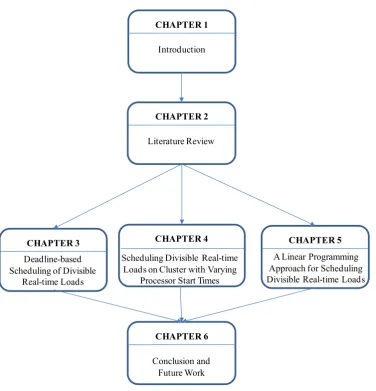
This thesis is organized into six chapters. Figure 1.2 shows the flow of the thesis organization; descriptions are given in the following pages.
CHAPTER 1
Introduction
CHAPTER 2
Literature Review
CHAPTER 3
Deadline-based Scheduling of Divisible
Real-time Loads
CHAPTER 5
A Linear Programming Approach for Scheduling Divisible Real-time Loads
CHAPTER 6
Conclusion and Future Work
CHAPTER 4
Scheduling Divisible Real-time Loads on Cluster with Varying
Processor Start Times
Figure 1.2 Thesis organization
10 results concerning real-time multiprocessor scheduling. The discussion mainly focuses on global multiprocessor scheduling with the Earliest Deadline First (EDF) scheduling algorithm. This chapter also discusses in greater detail the concept of Divisible Load Theory (DLT) and the application of this theory to multiprocessor scheduling of real-time systems, referred to as RT-DLT. We review some of the prior work done in RT-DLT, which we extend as part of this thesis.
In Chapter 3, we will report our first contribution presented in this thesis. We describe the initial work of Lin et al. (2006a, 2006b and 2007a) and their apparently anomalous findings with respect to a scheduling framework integrating DLT and EDF. We then present our results that provide a theoretical analysis to some of these anomalies.
In Chapter 4, we describe our study on scheduling problems in RT-DLT when applied to clusters in which different processors become available at different time-instants. We present an algorithm that efficiently determines the minimum number of processors that are required to meet a job’s deadline. We then describe and discuss simulation results evaluating the proposed algorithm, and comparing it to previously-proposed heuristics for solving the same problem.
We have proposed a Linear Programming (LP) based approach to efficiently determine the earliest completion time for the job on a given processors which may become available at different times. This LP based approach is described in Chapter 5. We then present extensive experimental simulations to evaluate this LP based approach and consequently show how this approach significantly improves on the heuristic approximations that were the only techniques previously known for solving these problems.