PROJECT MANAGERS’ KNOWLEDGE MANAGEMENT AND COMPETENCY MODEL FOR CONSTRUCTION IN MALAYSIA
ELMAHDEE M.A.B.A HASHIM
PROJECT MANAGERS’ KNOWLEDGE MANAGEMENT AND COMPETENCY MODEL FOR CONSTRUCTION IN MALAYSIA
ELMAHDEE M.A.B.A HASHIM
A thesis submitted in fulfilment of the
requirements for the award of the degree of
Doctor of Philosophy
School of Graduate Studies Universiti Teknologi Malaysia
iii
DEDICATION
To my beloved mother, my lovely wife Khawla, my daughters (Nadia, Dana), my son (Mohammed), my sister Soad, my cousins Hashim and Mohammadin, and my
iv
ACKNOWLEDGMENT
“Praise be to Allah, the cherisher and the sustainer of the world”, “praise be to him he who taught by the pen, taught human, that which he does not know”
First and foremost, my sincere thanks to God, who endowed me to complete this PhD thesis. I would like to thank my supervisors, Prof. Madya Dr. Aminah Binti Md Yusof and Prof. Madya Ir. Dr. Rosli B. Mohamad Zin for all your guidance, support, brilliant ideas, numerous hours of discussions, patience, and the opportunities you have presented me. Your managerial skills and uncompromising quest for excellence always motivated me to present the best of what I can. Special thanks to Prof. Dr. Zaidatun Bt. Tasir who helped and supported my all the time. Without your support and help, it was impossible to finish my PhD.
I would like to thank my cousins Hashim and Mohammadin and my sister Soad for their help and patience during all my PhD. And most importantly, I would like to thank to my family for their love and support, especially my mother, my wife, and my daughters for their continuous support and supplication.
v
ABSTRACT
The construction industry in Malaysia plays a critical role in its economic
development. However, this sector suffers frequent problems, including time and
cost overrun, low quality, and poor performance and productivity. One of the critical
factors leading to these problems is the incompetent project managers who lead and
execute projects. This study investigated the role of the knowledge management
approach in improving project managers' competencies through testing the
relationship between knowledge management (KM) and project managers'
competencies (PMC). Despite the direct linkage between knowledge management
and competencies, literature rarely shows a model that presents this direct
relationship, particularly in the construction industry. This study applied a
quantitative method using an online survey for data collection. The target
respondents were project managers in construction companies in Malaysia. The
questionnaire was distributed to randomly selected 480 construction companies from
the CIDB website. A total number of 227 completed responses were collected from
181 companies. The data was analyzed using descriptive analysis, a reliability test,
and exploratory factor analysis using SPSS software. However, the research model
and research hypotheses were tested through structural equation modeling (SEM)
using AMOS software. The results of the descriptive analysis indicated that the
application of knowledge management in Malaysian construction companies is
modest. Also, the findings indicated that knowledge management has a positive
causal effect on project managers' competencies. The KM-PMC model developed in
this study capable for predicting and improving project managers’ competencies
using the knowledge management approach. As this study is limited to the direct
effect of knowledge management on project managers’ competencies, future research
may explore the mediator factors that affect relationships within the KM-PMC
vi
ABSTRAK
vii
TABLE OF CONTENTS
CHAPTER TITLE PAGE
DECLARATION ii
DEDICATION iii
ACKNOWLEDGEMENT iv
ABSTRACT v
ABSTRAK vi
TABLE OF CONTENTS vii
LIST OF TABLES xiii
LIST OF FIGURES xvi
LIST OF ABBREVIATION xviii
LIST OF APPENDICES xx
1 INTRODUCTION 1
1.1 Background of Research 1
1.2 Area of Research 3
1.3 Problem Statement 8
1.4 Research Questions 9
1.5 Aim and Objectives of the Research 10
1.6 Scope of Research Study 11
1.7 Significance of the Study 13
1.8 Operational Definitions 15
viii
2 PROJECT MANAGERS’ COMPETENCIES 18
2.1 Introduction 18
2.2 Project Success 19
2.3 Project Failure 29
2.4 Project Manager 34
2.4.1 Roles and Responsibilities 35
2.4.2 Successful Project Manager 39
2.5 Competency and Competence 40
2.6 Project Manager Competencies 43
2.6.1 International Competency Standards
Associations 44
2.6.1.1 Project Manager Competency
Development (PMCD) Framework 44
2.6.1.2 IPMA Competence Baseline (ICB)
Version 3.0 47
2.6.2 Project Management Competencies 48
2.6.2.1 Project Integration Management
Competency 49
2.6.2.2 Project Scope Management
Competency 50
2.6.2.3 Project Time Management
Competency 50
2.6.2.4 Project Cost Management
Competency 51
2.6.2.5 Project Quality Management
Competency 51
2.6.2.6 Project Human Resource Management
Competency 52
2.6.2.7 Project Communications Management
Competency 53
2.6.2.8 Project Risk Management
Competency 53
ix
Competency
2.6.3 Personal Competencies 55
2.6.3.1 Leadership Competency 57
2.6.3.2 Communication Competency 58
2.6.3.3 Problem Solving Competency 59
2.7 Summary 60
3 KNOWLEDGE MANAGEMENT 61
3.1 Introduction 61
3.2 Knowledge Management 62
3.3 Knowledge Management in Construction Industry 66
3.4 Knowledge Management Processes 81
3.4.1 Creating Knowledge 83
3.4.2 Capturing Knowledge 83
3.4.3 Organizing Knowledge 84
3.4.4 Storing Knowledge 85
3.4.5 Disseminating Knowledge 85
3.4.6 Applying Knowledge 86
3.5 Knowledge Management and Competencies 86
3.6 Summary 90
4 RESEARCH METHODOLOGY 92
4.1 Introduction 92
4.2 Theoretical Framework 93
4.3 Research Model and Proposed Hypotheses 94
4.3.1 Research Model 95
4.3.2 Research Hypotheses 97
4.3.2.1 The Relationship between Knowledge
Management and Project
Management Competencies
Hypotheses 98
4.3.2.2 The Relationship between Knowledge
x
Competencies Hypotheses
4.4 Research Paradigm 100
4.5 Research Methods 103
4.6 Research Design and Procedures 106
4.6.1 Phase 1: Research Establishment 108
4.6.2 Phase 2: Research Methodology 108
4.6.3 Phase 3: Data Collection 109
4.6.4 Phase 4: Data Analysis 109
4.6.5 Phase 5: KM-PMC Model Validation 110
4.7 Sampling Design 110
4.8 Measurements 111
4.8.1 Section 1: Demographic Information 112
4.8.2 Section 2: The Application of Knowledge
Management in Your Company 112
4.8.3 Section 3: Project Management Competencies 115
4.8.4 Section 4: Personal Competencies 118
4.8.5 Pilot Study 120
4.9 Data Collection Method 124
4.10 Data Analysis 126
4.10.1 Reliability Analysis 126
4.10.2 Exploratory Factor Analysis (EFA) 127
4.10.3 Structural Equations Modeling (SEM) 133
4.10.3.1 Goodness-of-Fit Criteria 136
4.10.4 Data Analysis Procedures 141
4.10.4.1 Demographic Information
Descriptive Analyses 141
4.10.4.2 Descriptive Analysis of Knowledge
Management 142
4.10.4.3 Descriptive Analysis of Project
Managers' Competencies 142
4.10.4.4 Validation of Instruments 143
4.10.4.5 Structural Equation Modeling 143
xi
5 RESULTS AND DISCUSSION 147
5.1 Introduction 147
5.2 Demographic Information Descriptive Analysis 148
5.3 Descriptive Analysis of Knowledge Management 154
5.4 Descriptive Analysis of Project Management
Competencies 158
5.5 Descriptive Analysis of Personal Competencies 162
5.6 Validation of Instruments 165
5.6.1 Reliability Analysis 165
5.6.2 Exploratory Factor Analysis (EFA) 168
5.6.2.1 Exploratory Factor Analysis for
Knowledge Management Constructs 168
5.6.2.2 Exploratory Factor Analysis for
Project Management Competencies
Constructs 172
5.6.2.3 Exploratory Factor Analysis for
Personal Competencies Constructs 176
5.6.2.4 Exploratory Factor Analysis for All
Constructs 179
5.7 KM-PMC Model Development 187
5.7.1 First Order CFA Measurement Model of
Knowledge Management 188
5.7.2 Second Order CFA Measurement Model for
Knowledge Management 192
5.7.3 First Order CFA Measurement Model for
Project Management Competencies 196
5.7.4 First Order CFA Measurement Model for
Personal Competencies 201
5.7.5 Structural CFA Model 205
5.7.6 Hypotheses Testing 210
5.7.7 The Most Affected Project Managers'
xii
Knowledge Management
5.8 KM-PMC Model Validation by Experts 218
5.9 Summary 223
6 SUMMARY AND CONCLUSION 225
6.1 Introduction 225
6.2 Summary of Findings 225
6.2.1 Objective 1: The Current Practice of
Knowledge Management 226
6.2.2 Objective 2: The Level of Project Managers'
Competencies 227
6.2.3 Objective 3: The Relationship between
Knowledge Management and Project
Management Competencies
228 6.2.4 Objective 4: The Relationship between
Knowledge Management and Personal
Competencies 229
6.2.5 Objective 5: The Most Affected Project
Managers' Competencies by the
Implementation of Knowledge Management 230
6.2.6 Knowledge Management and Project
Managers' Competencies (KM-PMC) Model 231
6.2.7 KM-PMC Model Validation 238
6.3 Conclusion 239
6.4 Implication of the Study 241
6.5 Limitation of the Study 241
6.6 Recommendations for Future Research 242
References REFERENCES 243
xiii
LIST OF TABLES
TABLE NO. TITLE PAGE
2.1 Findings Summary of Garbharran, Govender, and Msani
(2012) Study 23
2.2 Critical Success Factors (CSF) 26
2.3 CSF Controlled by the Project Manager 28
2.4 Causes of Construction Project Failure 32
2.5 Factors Controlled by the Project Manager 34
2.6 Definitions of Competency and Competence 41
2.7 Personal Competencies in Previous Studies 55
3.1 Studies and Models of KM in Construction Industry 79
3.2 Knowledge Management Processes by Authors 82
4.1 Knowledge Management Instruments and Sources 113
4.2 Project Management Competencies Instruments and
Sources 116
4.3 Personal Competencies Instruments and Sources 118
4.4 Cronbach's Alpha Reliability Coefficient Rules 122
4.5 Cronbach's Alpha Values for Knowledge Management
Instruments 122
4.6 Cronach's Alpha Values for Project Management
Competencies Instruments 123
4.7 Cronbach's Alpha Values for Personal Competencies
Instruments 124
4.8 Fit Indices Used 140
4.9 Summary of Data Analysis 145
xiv
5.2 The Responses by the Role to the Project 149
5.3 Project Management Experience 150
5.4 Academic Achievement of Respondents 150
5.5 Professional Certification of Respondents 151
5.6 Currently Membership of the Respondents 151
5.7 The Most Important Competency for Project Managers 152
5.8 Number of Completed Projects by Respondents 152
5.9 Current Project Budget 153
5.10 Cross-Tabulation of the Projects Type and Specialization 153
5.11 Descriptive Analysis of Knowledge Management 155
5.12 Descriptive Analysis of Project Management
Competencies 158
5.13 Descriptive Analysis of Personal Competencies 162
5.14 Reliability Test Results 166
5.15 The Pattern Matrix of Knowledge Management Variables 170
5.16 EFA for Knowledge Management Summary 171
5.17 The Pattern Matrix of Project Management Competencies
Variables 173
5.18 EFA for Project Management Competencies Summary 174
5.19 The Pattern Matrix of Personal Competencies Variables 177
5.20 EFA for Personal Competencies Summary 178
5.21 The Pattern Matrix of Proposed Model Variables 181
5.22 EFA for Full Model Summary 185
5.23 First Order Knowledge Management Measurement Model
Results 190
5.24 Second Order Knowledge Management Measurement
Model Results 194
5.25 First Order Project Management Competencies
Measurement Model Results 199
5.26 First Order Personal Competencies Measurement Model
Results 203
5.27 Structural Model Results 208
xv
5.29 Hypotheses Test Results 214
5.30 The Impact of Knowledge Management 216
5.31 KM-PMC Model Applicability 219
5.32 KM-PMC Model Usefulness 220
xvi
LIST OF FIGURES
FIGURE NO. TITLE PAGE
1.1 Research Roadmap 17
2.1 Input and Outputs of Competencies 42
2.2 Dimensions of Competence 46
2.3 Overview of the Competence Elements 48
3.1 The Circular KM Implementation Framework for CE
Construction Firms 74
3.2 O’Dell and Grayson’s (1998) Knowledge Management
Model 76
3.3 Tupenaite, Kanapeckiene, and Naimaviciene's (2008)
Knowledge Management Model for Construction Projects 77
3.4 Effective Knowledge Sharing (EKS) Framework 79
4.1 Theoretical Framework 94
4.2 The Research Model 96
4.3 Research Design and Procedures 107
4.4 Exploratory Factor Analysis Stages for this Study 132
5.1 Hypothesized First Order Model for Knowledge
Management 188
5.2 Revised First Order Model for Knowledge Management 191
5.3 Hypothesized Second Order Model for Knowledge
Management 192
5.4 Revised Second Order Model for Knowledge
Management 195
5.5 Hypothesized First Order Model for Project Management
xvii
5.6 Revised first order CFA for Project Management
Competencies 200
5.7 Hypothesized First Order Model for Personal
Competencies 201
5.8 Revised First Order Model for Personal Competencies 205
5.9 Hypothesized Structural (KM-PMC) Model 206
5.10 Resultant KM-PMC Model 209
xviii
LIST OF ABBREVIATIONS
AEC - Architecture, Engineering and Construction
AGFI - Adjusted Goodness-of-Fit Index
AHP - Analytical Hierarchy Process
APM - Association for Project Management
CFA - Confirmatory Factor Analysis
CFA - Confirmatory Factor Analysis
CFI - Comparative Fit Index
CHAOS - Refers to Standish Group Reports
CIDB - Construction Industry Development Board
COMs - Comfort, Competence, Communication, and Commitment
CSF - Critical Success Factors
EFA - Exploratory Factor Analysis
EFA - Exploratory Factor Analysis
GDP - Gross domestic product
GFI - Goodness-of-Fit Index
ICB - IPMA Competence Baseline
IPMA - International Project Management Association
KM - Knowledge Management
KMO - Kaiser-Meyer-Olkin
KM-PMC - Knowledge Management and Project Managers’ Competencies
KMS - Knowledge Management Systems
NFI - Normed Fit Index
NNFI - Non-Normed Fit Index
PC - Personal Competencies
xix
PGFI - Parsimonious Goodness-of-Fit Index
PM - Project Management
PMBOK - Project Management Body of Knowledge
PMC - Project Management Competencies
PMCD - Project Manager Competency Development
PMI - Project Management Institute
PMO - Project Management Office
PMP - Project Management Professional
PNFI - Parsimonious Normed Fit Index
RMR - Root Mean Square Residual
RMSEA - Root Mean Square Effort of Approximation
SEM - Structural Equations Modeling
SME - Small and Medium Enterprises
SRMR - Standardized root mean square residual
SSM - Soft System Methodology
STV - Subject-to-Variable ratio
xx
LIST OF APPENDICES
APPENDIX TITLE PAGE
A Survey Questionnaire 275
B The Abbreviations and Questionnaire Measurement 283
C Exploratory Factor Analysis Results 288
D KM-PMC Model Variables 305
CHAPTER 1
INTRODUCTION
1.1 Background of Research
Nowadays, in highly technological and high level of competitive
environment, project managers play a critical role in a project success. Their
selection, assignment, and on-going development are the critical key to a project
ultimate success. Pinto and Kharbanda (1995) argued that project management is a
leader-intensive endeavour, and competent project managers can help a project to be
succeeded even in the face of substantial challenges. Additionally, Crawford (2000)
pointed out that a competent project manager is a strong factor that affects a project
success or failure. Bedingfield and Thal (2008) pointed outthat by selecting the most
appropriate and competent project manager, project success would be enhanced.
Also, Cheng, Dainty, and Moore (2005) indicated that there is a growing awareness
of the relationship between construction project managers’ competencies and
achieving project success. Therefore, a competent project manager can contribute to
2
Despite the promising role of the competent project managers in the project
success, construction projects suffer a high ratio of project failure in terms of cost,
time, and quality (Rahman et al., 2012). Frame (1997) conducted a study on 8,000
construction projects and found that only 16% of them satisfied the three criteria of
time, cost, and quality. Flyvbjerg, Holm, and Buhl (2003) conducted a study on 258
construction projects in 20 countries and concluded that 9 out of 10 projects were
cost overrun. Omoregie and Radford (2006) and Apolot, Alinaitwe, and Tindiwensi
(2011) stated that time and cost overrun are the major problems in the construction
project globally. Whereas, Malaysian construction industry is not an exception,
Ahmad et al. (2009) stated that 87% of Malaysian construction projects encountered
time overrun of 10-40%. Memon et al. (2011) studied MARA large projects and
found that the projects encountered an overrun with the average of 23.74% of
contract duration. Rahman et al. (2012) found that 92% of Malaysian construction
projects were overrun with an amount between 5-10% in terms of time and cost.
Endut, Akintoye, and Kelly (2009) stated that only 20.5% of Malaysian public
projects and 33.35 % of private projects were completed within the estimated time,
and 46.8% of public projects and 37.2% of private projects were completed within
the estimated budget. Furthermore, the Malaysian Auditor General Reports
illustrated many examples of project failure in Malaysia, for example, the Electrified
Double Track Project between Rawang and Ipoh that has been completed with a cost
overrun of RM 1.43 billion (National Audit Department Malaysia, 2011). Another
example is the Construction and Upgrading of Rural Road Projects in Sarawak with
175 projects, 38 projects (37.6%) out of 101 projects were delayed from 15 to 242
days; and 13 projects (17.4%) out of 74 projects under construction were behind
schedule by more than 20% (National Audit Department Malaysia, 2011). The high
ratio of project failure attracted the researchers to study the factors that cause project
failure in the construction projects.
In order to reduce the high ratio of project failure, project managers must
possess the core competencies that make them able to confront project problems
(Dainty, Cheng, and Moore, 2004; Crowford, 2000; Stevenson and Starkweather,
2010; Turner and Muller, 2005). However, previous studies indicated that lack of
3
project failure (Zimmerer and Yasin, 1998; Kivrak et al., 2008; Nguyen and
Chileshe, 2013; Rahman, Memon, and Abd Karim, 2013; Sambasivan and Soon,
2007; Hamzah et al., 2011). Construction companies usually use training to improve
their project managers’ competencies. However, training is very costly and must be
conducted off-site (Wang and Dunston, 2007; Hill, 2010). In addition, despite the
high expenditure on the traditional methods such as training, the construction project
failure ratio still high. This makes the senior managers feel unsure of what is the best
way to develop and provide competent project managers for the future (Pinto and
Kharbanda, 1995). Therefore, construction companies need a new strategy that
enables their project managers to improve their competencies and lead their projects
to success.
1.2 Area of Research
Construction industry is a critical sector that contributes positively to the
economics of any country. It plays an important role in establishing the infrastructure
required for the socioeconomic development and contributing directly to the country
economic growth (Fadhlin et al., 2004). The construction products provide the
necessary public infrastructure and private physical structures for many productive
activities such as services, commerce, utilities and other industries. This industry is
not only important for its finished products, but also employs a large number of
people (directly and indirectly), e.g. the employment in the Malaysian construction
industry represents 8% of the total Malaysian labour (CIDB, 2012). However, any
construction project has a high level of risk and is susceptible to loss if its completion
is delayed, exceeded its budget, or did not meet the quality expectations (Khamidi,
Khan, and Idrus, 2011).
The construction industry in Malaysia can be described as the economic
4
electrical machinery (MGCC, 2010; 2011; 2012). It is separated into two areas. The
first area is general construction which includes residential construction,
non-residential construction and civil engineering construction. However, the second area
is the special trade works which includes metal works, electrical works, refrigeration
and air-conditioning works, plumbing, sewerage and sanitary works, painting works,
carpentry, tiling and flooring works and glass works (MGCC, 2010). In order to
support the need of learning, information, and development for the construction
industry, the Malaysian government has established the Construction Industry
Development Board (CIDB) that represents a statutory board under the Ministry of
Works. This board also aims to make the construction industry more dynamic to
enable it to be globally competitive (MGCC, 2010).
Although the Malaysian government's attention is to the construction sector
and the efforts of CIDB in developing the sector by providing training and
development, Malaysian construction sector suffers high ratio in project failure in
terms of cost, time, and quality (Rahman et al., 2012; Endut, Akintoye, and Kelly,
2009). Previous studies in the construction project failure in Malaysia found that lack
of knowledge and skills of the project managers is a critical factor that causes project
failure in Malaysia (Abdullah, Mukmin and Samad, 2011; Tan, 2013; Esa and
Samad, 2011; Malaysia Productivity Corporation, 2011; Rahman et al., 2012).
Therefore, Malaysian construction companies need to focus on and assess the core
competencies of their project managers to increase the probability of project success.
Ruuska and Vartiainen (2003) revealed that the project manager's
competencies are the key aspect of a project's success. Therefore, researchers
emphasized that project managers must possess the core competencies needed to
complete their projects on time and cost, and according to estimated specifications
(Dainty, Cheng, Moore, 2004; Crowford, 2000; Stevenson and Starkweather, 2010;
Turner and Muller, 2005). However, there is a wide range of project managers'
competencies in different calcifications, e.g. Omidvar et al. (2011b) categorized
these competencies into three groups which are Person-related competencies,
5
competencies include project management competencies, technical competencies,
and personal competencies (Omidvar et al., 2011b). However, recent research
findings in Malaysia stated that the lack of project management and personal
competencies significantly affect the project success in Malaysia (Abdullah,
Rahman, and Awang, 2011; Tan, 2013; Esa and Samad, 2011; Malaysia Productivity
Corporation, 2011; Rahman et al., 2012).
The Project Management Institute (PMI) in 2002 identified nine project
management competencies in its Project Management Competency Development
(PMCD) Framework. These nine competencies are: Project Integration Management
competency; Project Scope Management competency; Project Time Management
competency; Project Cost Management competency; Project Quality Management
competency; Project Human Resource Management competency; Project
Communication Management competency; Project Risk Management competency;
and Project Procurement Management competency. Brill, Bishop, and Walker (2006)
and Crawford (2004) stated that PMCD competencies are very useful for project
managers to ensure high performance and project success. Therefore, these nine
competencies of PMI (2002) may be appropriate in representing the project
management competencies for the project managers.
Personal competencies include the personal characteristics of the project
manager such as Leadership, Interpersonal Communication, Problem Solving,
Human Skills, and Conceptual Skills. Gido and Clements (2007) described the
effective project manager who has strong leadership ability, high interpersonal skills,
and problem solving skills. Also, Leadership; Personal Communication, and Problem
Solving competencies were identified by many researchers as the most important
personal competencies needed for the project managers (Brill, Bishop, and Walker,
2006; Pinto and Kharbanda, 1995; Gushgari, Francis and Saklou, 1997; Brugger,
Gerrits and Pruitt, 2000; Hauschildt, Keim and Medeof, 2000; Crawford and
6
Despite the high importance of the project managers’ competencies such as
project management and personal competencies, the development of these
competencies is not an easy task. Construction companies often use traditional
methods such as training for developing their project managers’ competencies, as well as the project managers’ competencies standards such as PMCD framework by
PMI and IPMA Competence Baseline (ICB) by IPMA. Despite the important role of
training and competencies standards, projects still have high ratio of project failure.
Therefore, there is a need to find a new strategy and model that able to provide a
continuous development for the project managers’ competencies. By looking for this
new strategy, it is found that knowledge management may help because of the direct
linkage with competencies (Prahalad and Hamel, 1990; Owira and Ogollah, 2014).
Landaeta (2008) figured out that projects generate serious challenges for
project managers due to the complex and unpredictable nature of them and suggested
that knowledge represents one of the key project capabilities that enable project
managers and their teams to cope with these challenges. Additionally, Prahalad and
Hamel (1990) described knowledge as the only asset that can offer competitive
advantage to the organizations due to the strong linkage between knowledge and the
core competencies. However, knowledge is not easily transformable; Ismail, Nor and
Marjani (2009) pointed out that inability to share new knowledge quickly and
effectively amongst project teams is one of the critical limitations of project
managers. They emphasized the encouragement of sharing knowledge among project
teams to increase the probability of project success. Therefore, knowledge creation
and sharing should be a part of the daily practice of a project (Koskinen, 2000;
Ruuska, 2005). This was further strengthen when Yu, Liu, and Fu (2009), concluded
that it is very important to execute knowledge management systematically to create,
accumulate, and refine the experiences of every project manager in order to promote
the diffusion and sharing of the tacit knowledge. Therefore, managing the knowledge
resources effectively may help an organization to sustain its competitive position in a
7
In order to overcome the lack of project managers’ competencies, and
provide continues improvement, knowledge management (KM) approach can be
examined as a solution. Knowledge management (KM) is the process of creating
value from the organization's knowledge assets (Davenport and Prusak, 1998) by
generating, sharing, adapting, applying, and modifying knowledge (Gupta, 2008). It
deals with creating, capturing, securing, combining, coordinating, retrieving, and
distributing knowledge (Tserng and Lin 2005; Fong and Chu, 2006). Also,
knowledge management can create and establish a knowledge sharing environment
to increase the organization’s capabilities (Liebowitz and Beckman, 1998).
Moreover, knowledge management is directly correlated with competencies, and
considered to be the most important source for improving competencies (Grant,
1996; Sanchez, 2001; Lara, 2008; Zollo and Winter, 2002; Liebowitz and Beckam,
1998; Ranft and Lord, 2002). Therefore, knowledge management would be an
appropriate strategy that can provide continuous improvement for not only project
managers, but also all staff.
The idea of using knowledge management in overcoming the lack of project
managers' competencies is that knowledge management can gather existed and new
knowledge and experiences from experts and professionals, store them, and make
them available for future use. It facilitates knowledge and experience sharing among
the organization's staff to acquire new knowledge, skills, attitudes, and experiences
while projects are executed. Also, knowledge management prevent the losing of
knowledge that inherent in people mind to increase the organizations' intellectual
assets and competitive advantage. Another reason is that as construction projects are
temporary, project teams also are temporary and consist of multidisciplinary teams.
After the completion of a project, parties involved move on to new projects, resign,
or retire. However, project managers accumulate new knowledge, skills, and
experience from each project (Yu, Liu and Fu, 2009). Generally, much knowledge
gained is lost and the lessons learned are dispersed at the end of the projects if not
recorded or shared properly (Hills et al., 2008; Ismail, Nor and Marjani, 2009).
Therefore, knowledge management can be an appropriate method for the
construction companies in saving their knowledge asset and reuse it in increasing
8
Therefore, knowledge management may provide a new paradigm to increase
the project managers' competencies in terms of project management competencies
and personal competencies. To achieve this objective, Malaysian construction
companies need to well understand how they manage their knowledge and to what
level it affects the project managers' competencies. Also, they need to understand
what particular competencies can be increased by using the knowledge management
approach. Finally, they need a model that combines knowledge management and
project managers’ competencies to guide them in increasing their project managers'
competencies by using knowledge management.
1.3 Problem Statement
Despite the critical role played by construction industry in the Malaysian
economic development, it faces problems such as time and cost overrun, low quality,
and poor performance and productivity (Abdullah, Rahman and Awang, 2011;
Abdullah, Mukmin and Samad, 2011; National Audit Department Malaysia, 2011;
Malaysia Productivity Corporation, 2011; Endut, Akintoye, and Kelly, 2009;
Flanagan, 2013; Hai et al., 2012; Hamid, 2013; Khamidi, Khan and Idrus, 2011;
Rahman, et al., 2012; Tan, 2013). These problems affect all parties involved in the
construction industry such as contractors, government, clients, and users. Time delay
and cost overrun resulted huge financial loss and in most cases cause dramatic
disputes between parties due to the extra cost (Khamidi, Khan and Idrus, 2011;
National Audit Department Malaysia, 2011), and decrease benefits to each party
(Flanagan, 2013; Tan, 2013). The low quality and poor performance and productivity
make clients dissatisfied and frequently making complaints. Therefore, clients
including government and users enforce contractors to fix the defects in the projects
that may need extra huge cost (Flanagan, 2013; Tan, 2013). Without an effective
solution for these problems, contractors will lose their money or profit, competitive
advantage, and reputation; the projects will lose their viability; clients, government,
9
Researchers and reports addressed these problems as the main indicator of
construction project failure in Malaysia. In general, lack of competent project
manager is one of the factors that cause project failure (CHAOS, 2003; Zimmerer
and Yasin, 1998). It is found that lack of knowledge and skills of the construction
workforce in particular project managers is one of the critical factors that cause these
problems (Abdullah, Mukmin and Samad, 2011; Tan, 2013; Esa and Samad, 2011;
Malaysia Productivity Corporation, 2011; Rahman, et al., 2012). A competent
project manager is a critical factor that affects project success or failure (Smith,
Carson, and Alexander, 1984; Karpin, 1995; Pinto and Kharbanda, 1995; Crawford,
2000; Bedingfield and Thal, 2008). In order to settle this problem, construction
companies often use training as a method to improve their project managers'
competencies, however, training is very costly and difficult to be conducted on-site
while projects are executed (Wang and Dunston, 2007; Hill, 2010). Also, the high
cost of training makes companies to be late in the payment of the training fees, or
postpone the current training (Hasmori, Ismail, and Said 2012). Despite the high
expenditure on training by contractors, new research findings still state that the
problem of lack of project managers' competencies is not totally solved and remains
as a barrier to project success. Therefore, construction companies need an alternative
method to solve this problem besides training.
1.4 Research Questions
The main research questions of this study are:
i. What is the current implementation of Knowledge Management in
Malaysian construction companies?
ii. What is the current level of Project Managers’ Competencies in Malaysian
10
iii. What is the relationship between Knowledge Management and project
managers' project management competencies in Malaysian construction
companies?
iv. What is the relationship between Knowledge Management and project
managers' personal competencies in Malaysian construction companies?
v. Which competencies are the most affected by the implementation of
Knowledge Management in Malaysian construction companies?
vi. What is the model that can help Malaysian construction companies in
increasing their project managers' project management and personal
competencies by using Knowledge Management approach?
1.5 Aim and Objectives of the Research
The aim of this study is to provide a model of Knowledge Management and
Project Managers’ Competencies (KM-PMC) that is able to predict the changes of project managers’ competencies by the changes of knowledge management. In order
to achieve this aim, the main objectives of this study are:
i. To assess the current practice of Knowledge Management in Malaysian
construction companies.
ii. To assess the current level of Project Managers’ Competencies in Malaysian
construction companies.
iii. To identify the causal relationship between Knowledge Management and
project managers' Project Management Competencies in Malaysian
11
iv. To identify the causal relationship between Knowledge Management and
project managers' Personal Competencies in Malaysian construction
companies.
v. To identify the most affected Project Managers' Competencies by the
implementation of Knowledge Management.
1.6 Scope of Research Study
Through reviewing the literature, it is found that previous studies on
knowledge management in construction industry are very limited, and focused only
on the importance of knowledge management, assessment, and barriers and factors
identification. Also few studies on knowledge management models in construction
context have been found; however, most of them focused on knowledge management
systems perspective. This is in line with Kivark et al. (2008) who stated that
knowledge management is a new topic and still limited in the construction industry.
Furthermore, there is lack of previous studies that explains the relationship between
knowledge management and project managers' competencies in construction industry
context. Also, there is lack of the models that explains this relationship and provides
continuous development for construction project managers. This is in line with Hills
et al. (2008) when they stated that despite the role of knowledge management, its
application in improving project management performance and competencies is not
widely discussed. This study attempts to fill this gap of knowledge by explaining the
causal relationships between knowledge management and project manager's
competencies by formulating a model that ensure continuous improvement for
12
Because of the wide range of project managers' competencies in construction,
this study focused on two groups of competencies. The first group is project
management competencies and includes nine competencies as adopted from PMI’s
PMCD (2002) Framework by Project management institution. PMI’s PMCD (2002)
framework identified three dimensions of project managers’ competencies. These
three dimensions are: Project Management Knowledge Competencies; Project
Management Performance Competencies; and Personal Competencies. This study
focused on Project Management Knowledge Competencies that reflect what the
project manager knows about project management. Project Management Knowledge
Competencies included nine competencies. These nine competencies are project
Integration Management Competency, Project Scope Management Competency,
Project Time Management Competency, Project Cost Management Competency,
Project Quality Management Competency, Project Human Resource Management
Competency, Project Risk Management Competency, Project Communication
Management Competency, and Project Procurement Management Competency.
The second group is personal competencies and contains three competencies
that collected from the literature and considered as the most important for the project
manager. These three competencies are Leadership Competency, Personal
Communication Competency, and Problem Solving Competency. The choice of
these two groups of competencies is because they complement each other and only
one group of competencies will be useless without the other group (Dainty, Cheng,
and Moore, 2004). Therefore, the combination of project management competencies
and personal competencies will give more strengthen to the research model because
of the variety of competencies included. Furthermore, as this study aims to examine
knowledge management as a solution in improving project managers' competencies
beside or as alternate of training, these groups of competencies may be considered as
the mostly frequented training programs that occurred by construction companies
13
In order to assess the practice level of knowledge management, the researcher
compared 12 KM models and concluded that Lawson’s (2003) KM model covers the
most needed processes for knowledge management. Also, Lawson’s (2003) KM
model is a combination of the processes identified by Wiig (1993); Horwitch and
Armacost (2002); and Parikh (2001) who contributed to knowledge management.
Lawson’s (2003) KM model includes six processes of knowledge management.
Therefore, this study focused on these six processes which are: Creating Knowledge;
Capturing Knowledge; Organizing Knowledge; Storing Knowledge; Disseminating
Knowledge; and Applying Knowledge.
Finally, this study focused on the construction companies located in
Malaysia. The focus is on the project managers who are working at companies under
Grade 6 (G6) and Grade seven (G7). The focusing on G6 and G7 is because only
these two grades are awarded for big contracts, however, companies under G1 to G5
are considered as small and medium enterprise, and their awarded projects are very
limited (CIDB, 2012). Also, because of the companies’ size under G1 to G5 are very
small, they may have no attention to knowledge management.
1.7 Significance of the Study
This study contributes to knowledge theory by developing a new model that
integrates knowledge management and project managers' competencies in the field of
construction industry. This model aims to explain the causal relationship between
knowledge management and project managers' competencies to provide a solution of
the problem of lack of project managers' competencies in the way that will ensure
continuous improvement for such competencies. Also, it provides a constructive
contribution to the knowledge base of the project management discipline and
knowledge management as well, not only in the construction industry but also to all
14
management and project managers' competencies, the expected results of the study
may generate a new insight that offers a basis to improve project managers'
competencies not only through training but also through a good sharing of
knowledge and experiences. The expected results of the study also may help senior
leadership with more insight to the project management and personal competencies
that can be enhanced by using appropriate knowledge management systems. This
study may be useful for creating a new paradigm for:
i. Construction companies to review and encourage knowledge sharing culture
and encourage project managers and other project teams to share their
knowledge and experience.
ii. Project Management Institute (PMI) and other standard parties to include a
new area of the body of knowledge that describes the importance of
knowledge sharing and how to share knowledge among project managers in
the way that enhance their competencies and experience.
iii. Information system companies that develop project management systems to
include an effective and appropriate knowledge management system within
their packages.
Finally, this study aims to be as a new strategy to overcome the deficiencies
of project managers through enhancing their project management and personal
15
1.8 Operational Definitions
Competency: Is knowledge, skills, abilities, experience, and behaviour needed to
lead and perform the project.
Construction Industry: Is the industry that includes construction projects such as
infrastructure projects and residential and non-residential construction projects.
Personal Competencies: Is knowledge, skills, and abilities that formulate the
personal characteristics of the project manager such as leadership, interpersonal
communication, conceptual thinking, and problem solving.
Project Failure: Is the failure in completing the project within the contract budget,
schedule, and quality.
Project Management Competencies: Are knowledge, skills, and abilities of the
project manager according to project management approach by Project Management
Institute (PMI).
Project Management: Is the application of knowledge, skills, tools and techniques
to project activities in order to meet or exceed stakeholder’s needs and expectations
from a project.
Project Manager: Is a person who is responsible for delivering all the components
of the project and works based on the project management approach.
Project Success: Is completing the project scope within the contract budget,
schedule, and quality to satisfy all project parties.
Project: Is a complex and temporally endeavor to produce a unique product or
service by using the organization's resources in order to achieve its objectives under
16
1.9 Thesis Organization
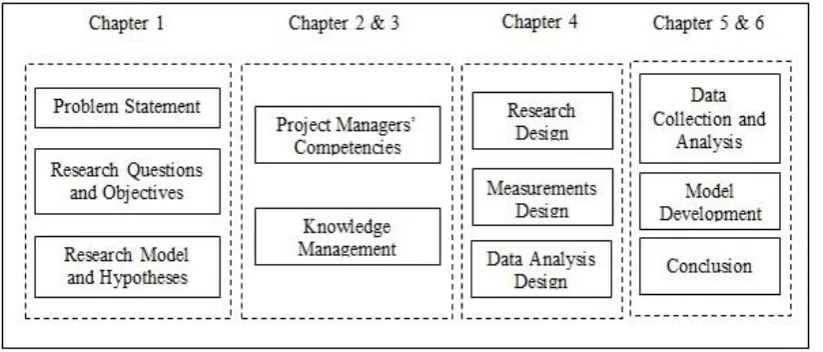
As shown in the research roadmap in Figure.1.1, the research is driven by the
problem statement which generated the research questions and developed the
research hypotheses. Following is a synopsis of the subsequent chapters in the study:
i. Introduction: Chapter 1 presented a brief background for the research
followed by the area of research. The problem statement has been identified
and supported by some evidences. Then, research questions were generated.
Also, the research objectives were identified to be the endeavour of the study
followed by research model and hypotheses, research scope, and significance
of the study. Finally, key and operational definitions for the most significant
terms were defined.
ii. Project Managers’ Competencies: Chapter 2 presents the literature and
related studies related to project managers, and project managers'
competencies.
iii. Knowledge Management: Chapter 3 presents the literature and related
knowledge management, and knowledge management in construction
industry.
iv. Research Methodology: Chapter 4 describes the most appropriate research
methodology followed to answer the research questions and achieve the
objectives followed by a description of the survey instrument design; the
sample and population, data collection protocol, and data analysis procedures.
v. Data Analysis: Chapter 5 of the research study is completed after the survey
data is collected. It contains the descriptive analysis of the demographic
information, descriptive analysis of knowledge management and project
managers' competencies, and testing the research model and the hypotheses
17
vi. Conclusion: Chapter 6 of the research study presents the findings of the
results in Chapter 5, followed by the conclusion and recommendations for
future research.
242
This limitation is because it is very difficult to validate complex models through
SEM unless gathering data from huge sample size (may be at least 1000 feedbacks).
However, in the case of this study, the target respondents are the project managers,
and it was very hard to collect data from them, and may be impossible to collect huge
data.
6.6 Recommendations for Future Research
This study has examined the capability of Knowledge Management in
improving 12 competencies of project managers in Malaysian construction context.
The findings provide strong evidence about the positive impact of Knowledge
Management on the studied competencies. Also, the research model explain the
direct causal relationship between Knowledge Management and Project Managers'
Competencies, it can serve as a base model for future research. Therefore the
recommendations for future research are:
Further research needed to cover other competencies such as technical
competencies.
Future research may include another factors that affect Knowledge Management
practice such as organizational culture and attitude to use Knowledge
Management systems, and dependent factors such as project success.
Further research is needed in other contexts to provide evidence of the
generalization of the research model and because of some factors can be varied
from country to country such as project complexity, organizational culture, and
REFERENCES
Abdullah, A. A., Mukmin, M. N., and Samad, Z. A. (2011). Application of Project
Management Methods in the Construction of Bungalow House Project: A Case
Study in Kuala Terengganu, Malaysia. International Journal of Economics and
Management Sciences, 1(2), 42–58.
Abdullah, A. A., Rahman, H. A., and Awang, M. S. (2011). Identification of the
Major Project Management Issues in Oil and Gas Industry in Malaysia.
International Journal of Business and Social Science, 2(11), 182–194.
AbdulMajid, N. (2007). Academic Report Writing From Research to Presentation (p.
242). Selangor Malaysia: Prentice Hall.
Ahmad, S. A., Hassan, F., Hassan, S., Mat, M. C., Nasir, N. M., and A., Z. S. (2009).
A Study on The Practise of Delay Analysis Techniques in the Malaysian
Construction Industry. In 13th Pacific Association of Quantity Surveyors
Congress (PAQS) (pp. 24–31).
Ahmed, P. K., Lim, K. K., and Loh, A. Y. E. (2002). Learning Through Knowledge
Management. Oxford: Butterworth/Heinemann.
Alainati, S. (2009). Competency in the Context of Knowledge Management. In
European and Mediterranean Conference on Information Systems (Vol. 2009,
pp. 1–8).
Alainati, S., Alshawi, S. N., and Al-karaghouli, W. (2011). The Effect of Knowledge
Management and Organisational Learning on Individual Competencies.
European, Mediterranean and Middle Eastern Conference on Information
Systems, 672–685.
Alavi, M., and Leidner, D. E. (2001). Review : Knowledge Management and Knowledge Management Systems : Conceptual Foundation and Research
Issues. MIS Quarterly, 25(1), 107–137.
Al-Husseini, A. M. (2006). The Impact of Transformational Leadership and
Empowerment on Project Management. University of Phoenix.
Alhaji, K. M., Amiruddin, R., & Abdullah, F. (2013). Project Knowledge
Management in Civil Engineering Construction Firms In Nigeria. Australian
244
Allen, G. (2013). The Influence of Organizational Culture on Affinity for Knowledge
Management Practices of Registered Nurses. Walden University.
Amy, W. (2002). The Management of Customer Relationships in the Retail Industry.
Monash University, Australia.
Anderson, S. D., and Tucker, R. L. (1994). Improving Project Management of
Design. Journal of Management in Engineering, 10(4), 35–44.
Anderson, T. W., and Rubin, H. (1956). Statistical Inference in Factor Analysis. In
Proceedings of the Third Berkeley Symposium on Mathematical Statistics and
Probability (pp. 111–150). Berkeley: University of California Press.
Apolot, R., Alinaitwe, H., and Tindiwensi, D. (2011). An Investigation into the
Causes of Delay and Cost Overrun in Uganda’s Public Sector Construction
Projects. In Second International Conference on Advances in Engineering and
Technology (pp. 305–311).
Arbuckle, J. L., and Wothke, W. (1999). Amos 4.0 User’s Guide. Chicago, IL:
SmallWaters Corporation.
Argote, L., Beckman, S. L., and Epple, D. (1990). The Persistence and Transfer of
Learning in Industrial Settings. MANAGEMENT SCIENCE, 36(2), 140–154.
Arrindell, W. A., and Ende, J. Van Der. (1985). An Empirical Test of the Utility of
the Observations-To-Variables Ratio in Factor and Components Analysis.
Applied Psychological Measurement, 9(2), 165–178.
Assaf, S. A., and Al-hejji, S. (2006). Project Causes of Delay in Large Construction
Projects. International Journal of Project Management, 24, 349–357.
Auster, E., and Choo, C. W. (1996). Managing Information for the Competitive Edge
(p. 554). New York: Neal-Schuman.
Babbie, E. (2002). The Basic of Social Research (p. 459). Canada: Thomson
Learning
Backebjörk, R., & Johansson, I. (2013). Can a Knowledge Sharing Model be built for
the Construction Industry ? Examensarbeten I Technology Management.
Bagozzi, R. P., and Philips, L. W. (1982). Representing and Testing Organizational
Theories: A Holistic Construal. Administrative Science Quarterly, 27(3), 459–
489.
Bahra, N. (2001). Competitive Knowledge Management (p. 258). New York, NY:
Palgrave.
245
Baker, T. L. (1994). Doing Social Research second edition (p. 499). New York:
McGraw-Hill, Inc.
Barrett, P. (2007). Structural Equation Modelling: Adjudging Model Fit. Personality
and Individual Differences, 42(5), 815–824.
Bauer, B. J. (2005). A Success Paradigm for Project Managers in the Aerospace
Industry. Capella University December.
Baumgartner, H., and Homburg, C. (1996). Applications of Structural Equation
Modeling in Marketing and Consumer Research: A Review. Int J Res Mark,
13(2), 139–161.
Bedingfield, J. D., and Thal, A. E. (2008). Project Manager Personality as a Factor
for Success. In PICMET 08 2008 Portland International Conference on
Management of Engineering Technology (pp. 1303–1314). IEEE.
Bennett, J. A. (2000). Physical Functioning in Elders: Testing the Fit of a Conceptual
Model using Structural Equation Modeling. University of California San
Francisco.
Bennis, W., and Goldsmith, J. (1997). Learning to Lead. Reading, MA: Perseus
Books.
Bentler, P. M., and Bonett. (1980). Significance Tests and the Analysis of Goodness
of Fit in the Analysis of Covariance Structures. Psychological Bulletin, 88,
588–606.
Bergmann, B. (2000). Kompetenzentwicklung und Berufsarbeit. Waxmann Verlag.
Bhatt, G. D. (2000). Organizing Knowledge in the Knowledge Development Cycle,
4(1).
Bloodgood, J. M., and Salisbury, W. D. (2001). Understanding the Influence of
Organizational Change Strategies on Information Technology and Knowledge
Management Strategies. Decision Support Systems, 31, 55–69.
Blyth, B. (2008). Mixed mode: the only ‘fitness’ regime? International Journal of
Market Research. 50(2), 241–266.
Bohn, R. E. (1994). Measuring and Managing Technological Knowledge. Sloan
Management Review, 36(1), 61–73.
Bollinger, A. S., and Smith, R. D. (2001). Knowledge as a Strategic Asset. Journal of
Knowledge Management, 5(1), 8–18.
Boomsma, A. (2000). Teacher’s Corner Reporting Analyses of Covariance
246
Boonyanan, A., Robinson, H., Naoum, S., & Fong, D. (2013). Relationship and
Knowledge Management in Construction Projects in Thailand Part 2: The
Studies of Knowledge Management Process and the Three-stage Project
Development Performance Improvement Framework. JARS, 10(1), 147–164.
Bowenkamp, R. D., and Kleiner, B. H. (1987). How to be a Successful Project
Manager. Industrial Management & Data Systems, 87(3/4), 3–6.
Bower, D., Ashby, G., Gerald, K., and Smyk, W. (2002). Incentive Mechanisms for
Project Success. Journal of Management in Engineering, 18(1), 37–43.
Bowman, B. J. (2002). Building Knowledge Management Systems. Information
Systems Management, 19(3), 32–40.
Brand, A. (1998). Knowledge Management and Innovation at 3M. Journal of
Knowledge Management, 2(1), 17 – 22.
Brill, J. M., Bishop, M. J., and Walker, A. E. (2006). The Competencies and
Characteristics Required of an Effective Project Manager: A Web-Based Delphi
Study. Educational Technology Research and Development, 54(2), 115–140.
Brooking, A. (1997). The Management of Intellectual Capital. Long Range Planning
Vol., 30(3), 364–365.
Brugger, W. E., Gerrits, R. J., and Pruitt, L. L. (2000). Effective Project Management
Equals Successful Military Engineering. Cost Engineering, 42(11), 33–37.
Bryant, F., and Yamold, P. (1995). Principal-Components Analysis and Exploratory
and Confirmatory Factor Analysis. In Reading and Understanding Multivariate
Statistics (pp. 99–136). Washington, D.C.: American Psychological
Association.
Bryde, D. J., and Robinson, L. (2005). Client Versus Contractor Perspectives on
Project Success Criteria. International Journal of Project Management, 23(8),
622–629.
Businessdictionary. (2012). Competence. Retrieved from
http://www.businessdictionary.com/definition/competence.html
Byme, B. M. (2001). Structural Equation Modeling with AMOS: Basic Concepts,
Applications, and Programming. Mahwah, NJ: Lawrence Erlbaum Associates,
Publishers.
Byrne, B. M. (1986). A Primer of LISREL: Basic Applications and Programming for
247
Byrne, B. M. (1989). A primer of LISREL: Basic Applications and Programming for
Confirmatory Factor Analytic Models. New York: Springer-Verlag.
Byrne, B. M. (1998). Structural Equation Modeling with LISREL, PRELIS, and
SIMPLIS: Basic Concepts, Applications, and Programming. Mahwah, NJ:
Lawrence Erlbaum.
Byrne, B. M. (2001). Structural Equation Modeling with AMOS: Basic Concepts,
Applications, and Programming. Mahwah, NJ: Lawrence Erlbaum Associates,
Publishers.
Byrne, B. M. (2011). Structural Equation Modeling with Mplus : Basic Concepts,
Applications, and Programming (p. 430). Routledge: Taylor & Francis Group.
Cairns, G. (2010). Concept of Prioritisation and Capture of Tacit Knowledge.
International Atomic Energy Agency.
Carillo, P. M., and Anumba, C. J. (2002). Knowledge Management in the AEC
Sector: an Exploration of the Mergers and Acquistion Context. Knowledge and
Process Management, 9(3), 149–61.
Carlson, D. S. (1999). Personality and Role Variables as Predictors of Three Forms
of Work–Family Conflict. Journal of Vocational Behavior, 55(2), 236–253.
Carmines, E. G., and Mclver, J. P. (1981). Analyzing Models with Unobserved
Variables. In Social Measurement: Current Issues. Beverly Hills: SAGE
Publications.
Carneiro, A. (2000). How does Knowledge Management Influence Innovation and
Competitiveness? Journal of Knowledge Management, 4(2), 87–98.
Carrillo, P., Robinson, H., Al-Ghassani, A., and Anumba, C. (2004). Knowledge
Management in UK Construction: Strategies, Resources and Barriers. Project
Management Journal, 35(1), 46–56.
Carson, D., Gilmore, A., Perry, C., & Gronhaug, K. (2001). Qualitative Marketing
Research. London: Sage.
Cartwright, C., and Yinger, M. (2007). Project Management Competence
Development Framework: Second Edition. In PMI Global Congress
Proceedings (pp. 1–13).
Casais, E. (2002). Project Management and Leadership Competencies. Eduardo
248
Castro, A. L., Yepes, V., Pellicer, E., and Cuéllar, A. J. (2012). Knowledge
Management in the Construction Industry: State of the Art and Trends in
Research. Revista de La Construcción, 11(3), 62–73.
Cattell, R. B. (1978). The Scientific Use of Factor Analysis. New York: Plenum.
Cavaleri, S. A. (2004). Leveraging Organisational Learning Performance. The
Learning Organisation, 11(2), 159–176.
CHAOS. (2003). The CHAOS Report 2003. The Standish Group International.
Retrieved from http://www.standishgroup.com/
Chen, L., and Mohamed, S. (2010). Empirical Analysis of Knowledge Management
Activities in Construction. International Society for Computing in Civil and
Building Engineering, 61(0), 1–10.
Cheng, M. I., Dainty, A. R. J., and Moore, D. R. (2005). What Makes a Good Project
Manager? Human Resource Management Journal, 15(1), 25–37.
Chin, W. H. (1998). Partial Least Squares approaches to structural equation
modeling. In Modern methods for business research. Mahwah, New Jersey:
Lawrence Erlbaum Associates.
Chin-loy, C., and Mujtaba, B. G. (2007). The Influence of Organizational Culture on
the Success of Knowledge Management Practices with North American
Companies. International Business & Economics Research Journal –, 6(3), 15–
28.
Choi, S. Y., Kang, Y. S., and Lee, H. (2008). The Effects of Socio-Technical
Enablers on Knowledge Sharing: an Exploratory Examination. Journal of
Information Science, 34(5), 742–754.
Churchill, G. A. (1996). Basic Marketing Research (3rd Ed). Fort Worth, TX: The
Dryden Press.
CIDB. (2012). Malaysia – IDBG Investment Forum Investing in Construction Sector.
Kuala Lumpur: Malysia Islamic Development Bank Group Investment Forume.
CIDB. (2014). Country Report Malaysia. In 20th AsiaConstruct Conference. Hong
Kong.
Cleland, D. I. (1995). Leadership and the Project Management Body of Knowledge.
International Journal of Project Management, 13(2), 82–91.
Coakes, E. (2006). Storing and Sharing Knowledge: Supporting the Management of
Knowledge Made Explicit in Transnational Organisations. The Learning
249
Cohen, L., Manion, L., and Morrison, K. (2007). Research Methods in Education.
New York: Routledge.
Comrey, A. L., and Lee, H. B. (1992). A first Course in Factor Analysis. Hillsdale,
NJ: Erlbaum.
Connelly, L. M. (2008). Pilot studies. Medsurg Nursing, 17(6), 411–412.
Cooper, D. R., and Schindler, P. S. (2003). Business Research Methods (8th ed.).
New York: McGraw-Hill Higher Education.
Costello, A. B., and Osborne, J. W. (2005). Best Practices in Exploratory Factor
Analysis : Four Recommendations for Getting the Most from Your Analysis.
Practical Assessment Research & Evaluation, 10, 1–9.
Crawford, L. (1997). A Global Approach To Project Management Competence. In
Proceedings of the 1997 AIPM National Conference, Gold Coast (pp. 220–
228).
Crawford, L. (2000). Profiling the Competent Project Manager. In Project
Management Research at the Turn of the Millenium: Proceedings of PMI
Research Conference (pp. 3–15).
Crawford, L. (2004). Senior Management Perceptions of Project Management
Competence. International Journal of Project Management, 23(1), 7–16.
Crawford, L. H. (1998). Project Management Competence for Strategy Realisation.
In 14th World Congress on Project Management (pp. 10–21). Slovenia.
Crawford, L., and Nahmias, A. H. (2010). Competencies for Managing Change.
International Journal of Project Management, 28(4), 405–412.
Crawford, L., Pollack, J., and England, D. (2007). How Standard Are Standards : An
Examination of Language Emphasis. Project Management Journal, 38(3), 6–21.
Creswell, J. W. (2002). Educational research: Planning, conducting, and evaluating
quantitative and qualitative approaches to research. Upper Saddle River, NJ:
Merrill/Pearson Education.
Creswell, J. W., Clark, P.V. L., Gutmann, M. L., and Hanson, W. E. (2003).
Advanced mixed methods research designs. In A.Tashakkori & C.Teddlie
(Eds.). Handbook of mixed methods in social and behavioral research (pp.
209–240). Thousand Oaks, CA: Sage.
Creswell, J.W. and Clark, P.V.L. (2007). Designing and Conducting Mixed Methods
250
Crowley, S. L., and Fan, X. (1997). Structural Equation Modeling: Basic Concepts
and Applications in Personality Assessment Research. Journal of Personality
Assessment, 68(3), 508–531.
Dainty, A., Cheng, M. I., and Moore, D. (2004). A Competency-Based Performance
Model for Construction Project Managers. Construction Management and
Economics, 22(8), 877–886.
Daniel, J. (2012). Sampling Essentials: Practical Guidelines for Making Sampling
Choices. SAGE Publications, Inc.
Dave, B., and Koskela, L. (2009). Automation in Construction Collaborative
knowledge management: A Construction Case Study. Automation in
Construction, 18(7), 894–902.
Dave, M., Dave, M., and Shishodia, Y. S. (2012). Knowledge Management and
Organizational Competencies : A Harmonic Collaboration. International Journal
of Advanced Research in Computer Science and Software Engineering, 2(12),
45–50.
Davenport, T. H., Long, D., David, W., and Michael, C. (1998). Successful
Knowledge Management Projects. Sloan Management Review, 39(2), 43–57.
Davenport, T. H., and Prusak, L. (1998). Working Knowledge : How Organizations
Manage What They Know. ACM: Ubiquity, 1–15.
Davies, N. J. (2000). Knowledge management. BT Technology Jo