© Associated Asia Research Foundation (AARF)
A Monthly Double-Blind Peer Reviewed Refereed Open Access International e-Journal - Included in the International Serial Directories.
Page | 380
ASSESSING SELF-MANAGEMENT COMPETENCY OF WORKING
MANAGERS: AN EMPIRICAL STUDY
Anand Bhardwaj
Assistant Professor, KIIT College of Engineering, Gurugram (Haryana)
ABSTRACT
Purpose- Objective of this research paper is to assess self-management competency of Working Managers.
Research Methodology- 273 Respondents were selected by using random sampling method from various parts of Delhi-NCR. Structured questionnaire was designed to assess self-management competency of working managers. Statistical tools like mean, t-test, F-test (ANOVA) are used to analyze data with the help of SPSS.
Findings: Results show that variables like work experience, relevant qualification for job and position in the organization have emerged as a significant differentiators for self-management competency for working managers. Demographical variable like gender, age, serving sectors don’t bring significant difference in the self-management competency of working managers.
Implications- Managers should have clear personal and professional goals. They should take responsibility for professional and personal life decisions. Working managers should accept responsibility. They are also supposed to develop strategies and look for opportunities which would help them in achieving professional and personal long term growth.
Keywords: Managerial Competencies, Self-Management Competency, Assessing.
International Research Journal of Human Resources and Social Sciences ISSN(O): (2349-4085) ISSN(P): (2394-4218) Impact Factor- 5.414, Volume 5, Issue 01, January 2018 Website- www.aarf.asia, Email : [email protected] , [email protected]
© Associated Asia Research Foundation (AARF)
A Monthly Double-Blind Peer Reviewed Refereed Open Access International e-Journal - Included in the International Serial Directories.
Page | 381 INTRODUCTION AND REVIEW OF LITERATURE
Effective managers are those who take responsibility for their professional and personal life. According to Hellriegel et al. (2005), “Taking responsibility for your life at work and beyond is a manager‟s self-management competency.” Often when things go wrong, people are likely to blame others for bad situations. Good managers take full responsibility of their work life and do not engage in such practices. Managers who are good at self-management competency enjoy their professional and personal life.
The self-management competency consists of the following dimensions:
Integrity and Ethical Conduct
Personal Drive and Resilience
Balancing Work and Life Issues and
Self-Awareness and Development (Hellriegel et al., 2005).
Integrity and Ethical Conduct
Flanagan and Finger (2004) defined integrity as “honesty, soundness, uprightness, trueness to self or stated values, beliefs or ethics.” An organization can grow only when its integrity is reflected in its management. A manager should have clear standards for integrity and ethical conduct in professional as well as in personal life. He should admit his mistakes and doesn‟t hesitate to accept responsibility for his own behavior and actions (Singla, 2014).
Personal Drive and Resilience
© Associated Asia Research Foundation (AARF)
A Monthly Double-Blind Peer Reviewed Refereed Open Access International e-Journal - Included in the International Serial Directories.
Page | 382 Balancing Work and Life Issues
Managers must be able to enjoy lives at professional as well as personal front. Good managers prioritize task and accordingly establish work and life related goals (Hellriegel et al., 2005). A manager should know how to enjoy the leisure time to refresh him for the next assignment.
Self-Awareness and Development
The awareness about self and initiating development effort are instrumental for a dynamic and ever changing work environment. Managers who entertain development and training opportunities learn much more as compared to those who don‟t (Hellriegel et al., 2005). Good managers always accept responsibility and engage themselves in continuous learning and development. They also develop strategies and look for opportunities which would help them in achieving personal long term growth (Singla, 2014).
Following table shows the key skills/competencies which are possessed by successful managers as per the different studies and therefore needed to be developed:
Table1: Managerial Competencies Needed To Be an Effective and Successful Manager
No. Author(s) Year Managerial Competencies
1 Pandit 2001 commitment, persistence, risk-taking, curiosity, difference, values, learning, persuasiveness, focus, humility
2 Hellriegel et. al.
2005 Communication, planning and administration, teamwork, strategic action, global awareness, and self-management
3 Ram Charan 2007 Ambition, appetite for learning, drive and tenacity, psychological openness, realism, self-confidence
4 Hopkins and Bilimoria
2008 self-confidence, achievement-orientation, inspirational leadership, change catalyst
*Authors‟ own work adapted from Bhardwaj and Punia (2013).
The present study focuses on assessment of self-management competency for working managers.
RESEARCH METHODOLOGY
© Associated Asia Research Foundation (AARF)
A Monthly Double-Blind Peer Reviewed Refereed Open Access International e-Journal - Included in the International Serial Directories.
Page | 383 Objectives of the Study
The main objective of this paper is to assess the self-management competency of working managers. The specific sub-objectives of the study are as following:
1. To assess self-management competency of working managers.
2. To suggest workable guidelines for improving the self-management competency of working managers.
Hypothesis of the Study
1. There is no significant difference in across various age groups of working managers for the self-management competency.
2. There is no significant difference between working managers of different gender for the self-management competency.
3. There is no significant difference across various experienced groups of working managers for the self-management competency.
4. There is no significant difference in self-management competency of working managers on the basis of relevant qualification for job.
5. There is no significant difference between working managers having different positions in organisations for the self-management competency.
6. There is no significant difference in self-management competency of working managers serving different sectors.
Research Design
In the present study, exploratory cum descriptive research design has been used.
Sampling Design and data collection
© Associated Asia Research Foundation (AARF)
A Monthly Double-Blind Peer Reviewed Refereed Open Access International e-Journal - Included in the International Serial Directories.
Page | 384 Research Instrument
To collect the relevant data for the current study from the respondents the researcher utilized systematically developed and validated scale developed by Don Hellriegel, Susan E. Jackson, and John W. Slocum (Jr.).
Data Analysis and Interpretation
Statistical tools like mean, t-test, F-test (ANOVA) were applied on the data using SPSS. Test of significance has been used to check the significance of hypothesis assumed.
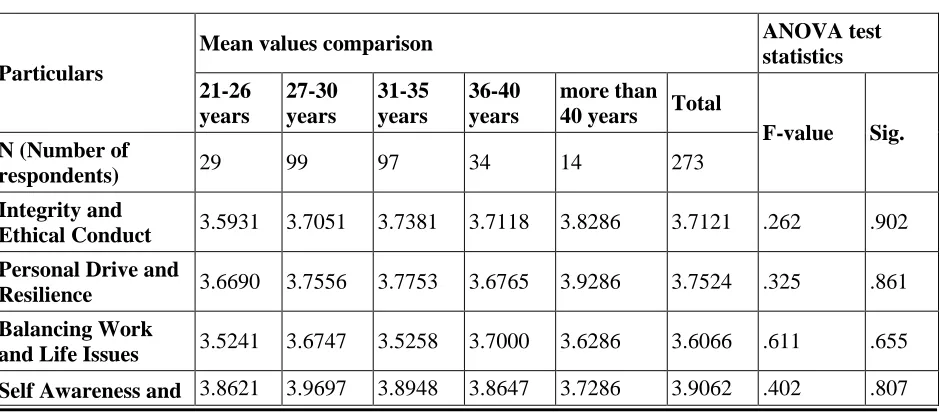
[image:5.612.73.545.475.681.2]Table 2 examines the association between age and self-management competency of working managers. Self-management competency has four sub-dimensions namely „integrity and ethical conduct‟, „personal drive and resilience‟, „balancing work and life issues‟, and „self awareness and development‟. Comparison of mean values across different age groups indicates that competency level of working managers does not differ much, which means that working managers of different age groups possess similar level of self-management competency. F-statistics also indicates that competency level of working managers does not have a significant difference among different age groups. So the table 2 reveals that age does not contribute any significant variation in self-management competency levels of working managers across different age groups.
Table 2: Self-Management Competency on the basis of Age of Working Managers
Particulars
Mean values comparison ANOVA test
statistics
21-26 years
27-30 years
31-35 years
36-40 years
more than 40 years Total
F-value Sig. N (Number of
respondents) 29 99 97 34 14 273
Integrity and
Ethical Conduct 3.5931 3.7051 3.7381 3.7118 3.8286 3.7121 .262 .902 Personal Drive and
Resilience 3.6690 3.7556 3.7753 3.6765 3.9286 3.7524 .325 .861 Balancing Work
© Associated Asia Research Foundation (AARF)
A Monthly Double-Blind Peer Reviewed Refereed Open Access International e-Journal - Included in the International Serial Directories.
Page | 385 Development
Self-Management
[image:6.612.70.545.127.301.2]Competency 3.6621 3.7763 3.7335 3.7382 3.7786 3.7443 .169 .954 Source: Primary data
Table 3: Self-Management Competency on the basis of Gender of Working Managers
Particulars Mean values Mean
Difference
t-test for Equality of Means
Male Female
t-value Sig. (2-tailed) N (Number of respondents) 160 113
Integrity and Ethical Conduct 3.7650 3.6372 .12783 1.309 .192 Personal Drive and Resilience 3.8225 3.6531 .16940 1.687 .093 Balancing Work and Life
Issues 3.5825 3.6407 -.05821 -.588 .557
Self Awareness and
Development 3.9363 3.8637 .07253 .763 .446
Self-Management Competency 3.7766 3.6987 .07789 .918 .360 Source: Primary data
The table 3 indicates that whether gender brings any significant variation in competency level of working managers for self-management competency and its sub-dimensions. Comparison of mean values between male and female working managers indicates that competency level of male and female working managers for all the dimensions of self-management competency does not vary so much, which means that working managers of both genders possess similar level of self-management competency. The t-statistics also indicates that competency level of working managers does not have a significant difference between male and female working managers for self-management competency.
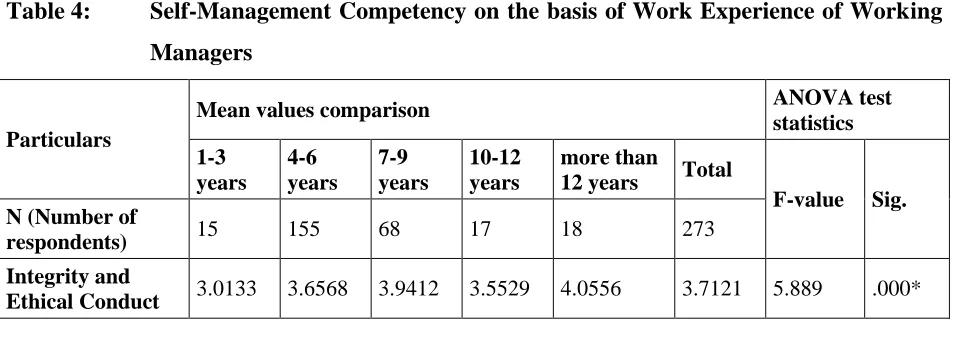
Table 4: Self-Management Competency on the basis of Work Experience of Working
Managers
Particulars
Mean values comparison ANOVA test
statistics
1-3 years
4-6 years
7-9 years
10-12 years
more than
12 years Total
F-value Sig. N (Number of
respondents) 15 155 68 17 18 273
Integrity and
[image:6.612.69.548.504.679.2]© Associated Asia Research Foundation (AARF)
A Monthly Double-Blind Peer Reviewed Refereed Open Access International e-Journal - Included in the International Serial Directories.
Page | 386 Personal Drive
and Resilience 3.3600 3.6671 3.9676 3.6118 4.1333 3.7524 3.685 .006* Balancing Work
and Life Issues 3.3867 3.5600 3.7206 3.6000 3.7667 3.6066 .927 .448 Self Awareness
and Development 3.5867 3.8284 4.1294 3.9412 3.9667 3.9062 2.546 .040* Self-Management
Competency 3.3367 3.6781 3.9397 3.6765 3.9806 3.7443 3.736 .006* Source: Primary data
*significant at .05 level of significance
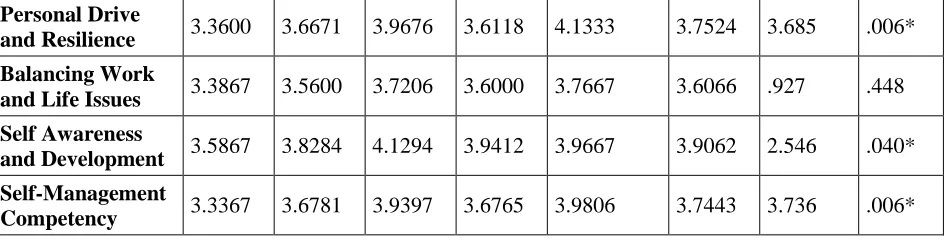
Table 4 gauges self-management competency of working managers across various experience groups. Comparison of mean values across different experience groups indicates that competency level of working managers vary for the „integrity and ethical conduct‟, „personal drive and resilience‟, and „self awareness and development‟ dimensions which means that working managers having different levels of experience possess different level of self-management competency for these dimensions. For fourth dimension „balancing work and life issues‟, all the working managers irrespective of their level of experience possess similar level of competence. Working managers having more experience are more competent in self-management skills than lesser experienced working managers. F-statistics indicates that competency level of working managers have a significant difference among differently experienced groups. This difference is not significant for the sub- dimension „balancing work and life issues‟, whereas for other dimensions this difference in significantly different. So the table 4 reveals that level of experience contributes a significant variation in competency levels of working managers for self-management competency.
Table 5: Self-Management Competency on the basis of Relevant Qualification for Job of
Working Managers
Particulars
Mean values
Mean Difference
t-test for Equality of Means
Technical/
Professional General
t-value Sig. (2-tailed) N (Number of
respondents) 202 71
Integrity and Ethical
[image:7.612.72.545.38.158.2] [image:7.612.70.544.532.678.2]© Associated Asia Research Foundation (AARF)
A Monthly Double-Blind Peer Reviewed Refereed Open Access International e-Journal - Included in the International Serial Directories.
Page | 387 Personal Drive and
Resilience 3.8228 3.5521 .27066 2.413 .016*
Balancing Work and
Life Issues 3.6990 3.3437 .35535 3.255 .001*
Self Awareness and
Development 3.9703 3.7239 .24635 2.330 .021*
Self-Management
Competency 3.8141 3.5458 .26833 2.853 .005*
Source: Primary data
[image:8.612.74.545.39.158.2]*significant at .05 level of significance
Table 5 indicates that whether educational background produces variation in competency level between working managers for self-management competency. Mean values comparison between working managers indicates that level of self-management competency varies between working managers possessing different educational background for all the dimensions of self-management competency except for „integrity and ethical conduct‟ dimension. The t-statistics also indicates that educational qualification brings a significant variation for all the dimensions of self-management competency except for „integrity and ethical conduct‟ in working managers. It means that working managers possessing technical/professional education are more competent than working managers possessing general education for self-management competency.
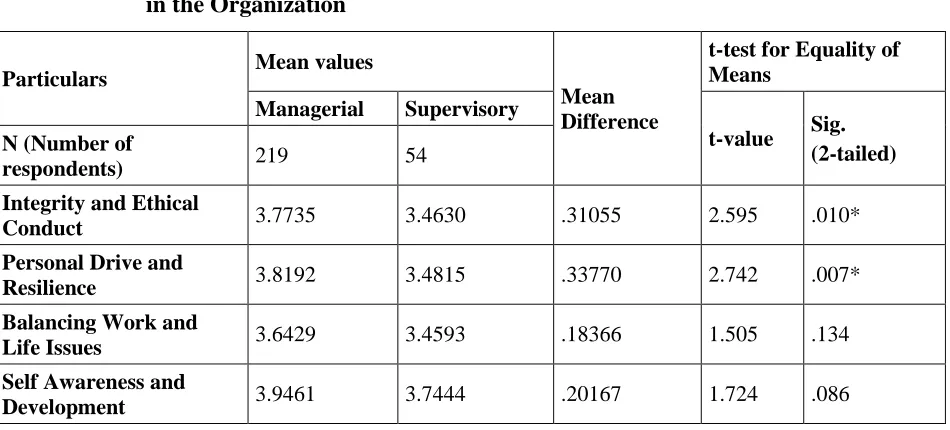
Table 6: Self-Management Competency on the basis of Position of Working Managers
in the Organization
Particulars Mean values
Mean Difference
t-test for Equality of Means
Managerial Supervisory
t-value Sig. (2-tailed) N (Number of
respondents) 219 54
Integrity and Ethical
Conduct 3.7735 3.4630 .31055 2.595 .010*
Personal Drive and
Resilience 3.8192 3.4815 .33770 2.742 .007*
Balancing Work and
Life Issues 3.6429 3.4593 .18366 1.505 .134
Self Awareness and
[image:8.612.71.546.454.669.2]© Associated Asia Research Foundation (AARF)
A Monthly Double-Blind Peer Reviewed Refereed Open Access International e-Journal - Included in the International Serial Directories.
Page | 388 Self-Management
Competency 3.7954 3.5370 .25840 2.486 .014*
Source: Primary data
*significant at .05 level of significance
Table 6 examines self-management competency of working managers working at managerial and supervisory positions. Mean values comparison between managerial and supervisory working managers indicates that competency level of managerial and supervisory working managers does not vary much for „balancing work and life issues‟ and „self awareness and development‟ dimensions, which means that managers working in different positions in the organization possess similar level of „balancing work and life issues‟ and „self awareness and development‟ competency. For the remaining dimensions „integrity and ethical conduct‟, „personal drive and resilience‟ and for overall self-management competency managerial and supervisory working managers possess different levels of competency. Comparison of mean values also indicates that working managers at managerial position are more competent than working managers at supervisory position for „integrity and ethical conduct‟, „personal drive and resilience‟ and for overall self-management competency.
[image:9.612.69.541.524.680.2]Further, t-statistics also indicates that competency level of working managers does not have a significant difference between managerial and supervisory working managers for „balancing work and life issues‟, and „self awareness and development‟ dimensions. This difference is significant for „integrity and ethical conduct‟, „personal drive and resilience‟ and for overall self-management competency. So the table 4.46 reveals that variation in position of the working managers at organization contributes significant variation in self-management competency level of working managers.
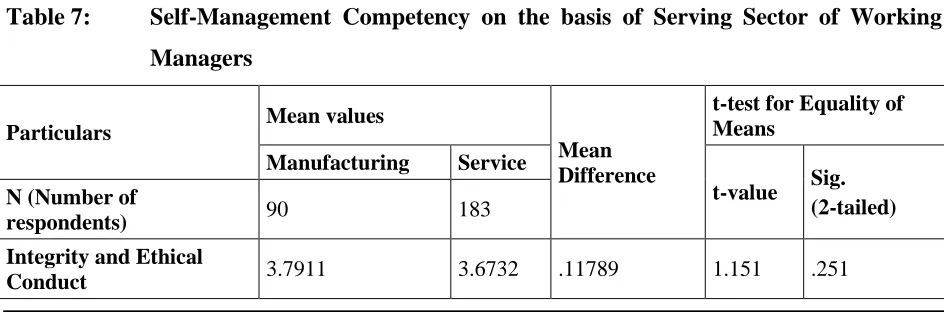
Table 7: Self-Management Competency on the basis of Serving Sector of Working
Managers
Particulars Mean values
Mean Difference
t-test for Equality of Means
Manufacturing Service
t-value Sig. (2-tailed) N (Number of
respondents) 90 183
Integrity and Ethical
© Associated Asia Research Foundation (AARF)
A Monthly Double-Blind Peer Reviewed Refereed Open Access International e-Journal - Included in the International Serial Directories.
Page | 389 Personal Drive and
Resilience 3.9000 3.6798 .22022 2.099 .037*
Balancing Work and Life
Issues 3.7578 3.5322 .22554 2.191 .029*
Self Awareness and
Development 3.9800 3.8699 .11005 1.107 .269
Self-Management
Competency 3.8572 3.6888 .16842 1.903 .058
Source: Primary data
*significant at .05 level of significance
Table 7 gauges the self-management competency of manufacturing and service sector working managers. Comparison of mean values between manufacturing and service sector working managers indicates that competency level does not differ much for „integrity and ethical conduct‟, and „self awareness and development‟ dimensions which means that working managers serving in different serving sectors possess similar level of competency for these dimensions. For the remaining dimensions „personal drive and resilience‟, „balancing work and life issues‟ and for overall self-management competency manufacturing and service sector working managers possess different level of self-management competency. Comparison of mean values also indicates that managers working in manufacturing sector are more competent than managers working in service sector for dimensions „personal drive and resilience‟, „balancing work and life issues‟ and for overall self-management competency.
The t-statistics also indicates that competency level of manufacturing and service sector working managers does not have a significant difference for „integrity and ethical conduct‟ and „self awareness and development‟ dimensions. This difference is significant for „personal drive and resilience‟, „balancing work and life issues‟ and for overall self-management competency. So the table 7 shows that the service sector of the working managers brings a significant variation in self-management competency level of working managers.
CONCLUSIONS AND DISCUSSION
[image:10.612.71.545.38.157.2]© Associated Asia Research Foundation (AARF)
A Monthly Double-Blind Peer Reviewed Refereed Open Access International e-Journal - Included in the International Serial Directories.
Page | 390 possess higher levels of self-management competency. Managers having technical/professional qualification are more competent in self-management competency as compare to managers having general qualifications. In the same way, managers working at managerial positions are more competent in self-management competency as compare to their counterparts working at supervisory positions. Demographical variable like gender, age, serving sectors don‟t bring significant difference in the self-management competency of working managers. It is also apparent from the results that working managers feel themselves at the above average level for self-management competency.
MANAGERIAL IMPLICATIONS
Managers should have clear personal and professional goals. They should take responsibility for professional and personal life decisions. Working managers should accept responsibility and engage themselves in continuous learning and development. They are also supposed to develop strategies and look for opportunities which would help them in achieving professional and personal long term growth. Good managers always learn from their work and life experiences. So, it is very important for a manager to focus on self-management competency.
REFERENCES
Bhardwaj, Anand and Punia, B.K.(2013), “Managerial Competencies and their influence on Managerial Performance- A Literature Review”, International Journal of Advance Research in Management and Social Sciences, Volume 2, Issue 5, pp 70-84.
Flanagan, N., & Finger, J. (2004). The Management Bible. Cape Town: Zebra Press.
Hellriegel, Don, Jackson S.E., and Slocum J.W., Jr., (2005), Management a competency-based approach, Cengage Learning, New Delhi.
Hopkins, M. and Bilimoria, Diana (2008), “Social and emotional competencies predicting success for male and female executive”, Journal of Management Development, Vol. 27, No. 1, pp. 13-35.
© Associated Asia Research Foundation (AARF)
A Monthly Double-Blind Peer Reviewed Refereed Open Access International e-Journal - Included in the International Serial Directories.
Page | 391 Ram Charan (2007), Know -How: The eight skills that separate people who perform from those
who don’t, Crown Business, New York.
Singla, Jagdeep (2014), Management Concepts & Applications, Thakur Publishers, Lucknow.