• No results found

Bit inverting map method for improved steganography scheme

N/A
N/A
Protected

Academic year: 2020

Share "Bit inverting map method for improved steganography scheme"

Copied!
41
0
0

Loading.... (view fulltext now)

Full text

(1)

BIT INVERTING MAP METHOD FOR IMPROVED STEGANOGRAPHY

SCHEME

AMMAR MOHAMMEDALI FADHIL

A thesis submitted in fulfilment of the

requirements for the award of the degree of

Doctor of Philosophy (Computer Science)

Faculty of Computing

Universiti Teknologi Malaysia

(2)

To my virtuous professors who taught me in a truthful, fair, and honorable way

To my colleagues in the Universiti Teknologi Malaysia

To all those who contributed to the success of this research

(3)

ACKNOWLEDGEMENT

Initially, all praise is to Allah, the most kind and the merciful for helping me

to accomplish this study. Special appreciation goes to my family, friends, studying

colleagues and supervisors for standing beside me in the good and bad times spent to

complete this research. The great effort goes to Prof. Dr. Siti Mariyam Shamsuddin

for support me to complete this research praying to Allah Almighty to grant her all

that is good.

(4)

ABSTRACT

(5)

ABSTRAK

(6)

TABLE OF CONTENTS

CHAPTER

TITLE

PAGE

DECLARATION

ii

DEDICATION

iii

ACKNOWLEDGEMENT

iv

ABSTRACT

v

ABSTRAK

vi

TABLE OF CONTENTS

vii

LIST OF TABLES

xi

LIST OF FIGURES

xii

LIST OF ABBREVIATIONS

xix

LIST OF SYMBOLS

xx

LIST OF APPENDIX

xxi

1

INTRODUCTION

1

1.1

Introduction

1

1.2

Problem Background

3

1.2.1

Security Issues in Steganography

3

1.2.2

Embedding method Issues in

Steganography

4

1.2.4

Capacity

5

1.3

Steganography Model

6

1.4

Problem Statements

7

1.5

Objective of the Study

8

(7)

1.7

Significant of the Study

10

1.8

Thesis Organization

11

2

LITERATURE REVIEW

12

2.1

Introduction

12

2.2

History of information hiding

14

2.3

Steganography

15

2.3.1

Steganography Definition

16

2.3.1.1

Steganography

Classification

16

2.3.1.2

Structure of Steganography

18

2.3.1.3

Steganography and

Cryptography

19

2.3.1.4

Steganography applications

21

2.3.1.5

Steganography techniques

21

2.3.2

Image Preparation

22

2.3.2.1

Fibonacci decomposition

23

2.3.2.2

Huffman coding

26

2.3.2.3

Knight Tour

29

2.3.3

Embedding Methods

36

2.3.3.1

LSB Substitution Method

37

2.3.3.2

Pixel Value Differencing

(PVD)

38

2.3.3.3

Histogram Based Method

40

2.3.3.4

Difference Expansion (DE)

Method

40

2.3.3.5

Color Palette Based method

41

2.3.3.6

Spread Spectrum Method

41

2.3.3.7

DFT Domain Steganography

42

2.3.3.8

DCT Domain

Steganography

44

2.3.4

Attacks on Steganography

45

2.3.4.1

Human Visual System

(8)

2.3.4.2

Chi-square (X2) Attack

49

2.4

Dataset

52

2.5

Steganography Properties

53

2.5.1

Imperceptibility

53

2.5.2

Robustness

54

2.5.3

Payload Capacity

54

2.6

Related Work in Steganography for Image

Hiding

55

2.7

Summary

65

3

METHODOLOGY

66

3.1

Introduction

66

3.2

Research Framework

67

3.3

Data preparation

69

3.3.1

Cover image and Fibonacci

69

3.3.2

Secret message preparation

73

3.4

Embedding Process

76

3.4.1

Random (RND) Process

78

3.4.2

Knight Tour (KT) Process

79

3.4.3

Bit Inverting Map (BIM) Process

79

3.5

Performance Evaluations

80

3.6

Extracting Stage

82

3.7

Dataset

83

3.8

Summary

85

4

A NEW BIT INVERTING MAP FOR IMAGE

EMBEDDING

86

4.1

Introduction

86

4.2

Fibonacci Decomposition

87

4.3

Huffman Coding

92

4.4

A New Bit Inverting Map for Embedding

97

4.4.1

Least Significant Bit in Bit Inverting

(9)

4.4.2

Embedding process in Bit Inverting

Map

101

4.5

Results and Discussion

107

4.6

Summary

117

5

SECURITY

ANALYSIS

OF

THE

BIT

INVERTING MAP SCHEME

118

5.1

Introduction

118

5.2

Location of Embeddingby Bit Inverting Map

119

5.2.1

Random Stage (RND) in Proposed

Scheme

120

5.2.2

Knight Tour (KT) in Proposed scheme

125

5.2.3

Pixels selectionin Proposed Scheme

131

5.3

Performance Evaluation of Improved Bit

Inverting Map

133

5.3.1

Chi-Square (X

2

) Attack

133

5.3.2

Human Visual System (HVS) attack

137

5.4

Summary

140

6

CONCLUSION AND FUTURE WORK

141

6.1

Thesis Summary

141

6.2

Proposed Scheme

142

6.3

Contributions of the Study

143

6.4

Evaluation of the System

144

6.5

Future Work

144

REFERENCES

146

(10)

LIST OF TABLES

TABLE NO.

TITLE

PAGE

2.1

Summary of reviewed literatures (2012-2016)

61

4.1

Impact of each Binary bitplane into the whole

image

84

4.2

Calculation of ones and zeros for binary image in

BIM

98

4.3

Calculation of ones and zeros for Fibonacci

sequence in BIM

99

4.4

Results of PSNR for Lena image with different

(11)

LIST OF FIGURES

FIGURE NO.

TITLE

PAGE

1.1

Three key issues for information hiding

2

1.2

Steganography domain

2

1.3

Embedding methods for spatial domain

5

1.4

The model of steganography and steganalysis

7

2.1

Structure of chapter 2

13

2.2

Classification of steganography

17

2.3

Classification of security system (Atawneh, S., et

al., 2013)

18

2.4

Image steganography technique

19

2.5

Cryptography system (Rani, M., et al., 2016)

20

2.6

Steganography system (Westfeld, A. and

Pfitzmann, A., 2000)

20

2.7

Cover image preparation

25

2.8

Fibonacci decomposition (Yan, F., et al., 2016)

26

2.9

Steganography

and

Huffman

compression

(Venkatachalam, S., et al ., 2015)

27

2.10

Huffman coding on text (Novamizanti, L., 2015)

28

2.11

Euler’s solution for the KTP. It was one of the

first attempts at generalizing the KTP(Philip, A.,

2013)

29

2.12

Special repeated path by (Chakravarthy, S., et

al., 2016)

30

(12)

2.14

Complete Knight Tour 8 x 8 cylinder

31

2.15

Embedding process proposed by(Thanikaiselvan,

V. and Arulmozhivarman, P., 2015)

33

2.16

Knight Tour strategy where the blocks contain

more than 8x8 pixels and their diamonds

34

2.17

Embedding approach by (Bansal, A.,et al., 2016)

34

2.18

Algorithm of embedding method (Al-Arashi, W.,

2015)

35

2.19

Embedding approach by (Bansal, A., et al.,

2016)

36

2.20

Embedding method with DFT

43

2.21

Simple steganography system (Westfeld, A. and

Pfitzmann, A., 2000)

46

2.22

Mechanism of visual attack (Westfeld, A. and

Pfitzmann, A., 2000).

48

2.23

Two types of attack on image (floor tile) (Liu, J.,

et al., 2016)

50

2.24

Best methods in 2015

59

2.25

Different strategies of steganography in 2016

60

3.1

General framework

66

3.2

Least Significant Bit of RGB image

68

3.3

LSB replacement process within Bit Inverting

Map

68

3.4

8-bitplane distribution

69

3.5

Bit distribution over colour and gray image

69

3.6

Fibonacci sequence used in Bit Inverting Map

70

3.7

Cover image of the proposed scheme

70

3.8

Secret message preparation

71

3.9

Steganographyprocess

74

3.10

Pixels selection

75

3.11

Evaluation used with proposed method

77

3.12

Embedding and extracting of the proposed

(13)

3.13

Standard dataset used in the proposed BIM

81

3.14

Images taken by mobile camera for testing

81

4.1

Lena image with decomposition of (a) 8-bitplane

and (b) 12-bitplanes in the proposed BIM.

85

4.2

Huffman coding in improved BIM

90

4.3

Coding the message within Huffman

91

4.4

Huffman tree according to the tables

92

4.5

Embedding with Bit Inverting Map

95

4.6

Bits order in Bit Inverting Map

96

4.7

Pixels of colour and gray image in BIM scheme

97

4.8

Inverting method in proposed scheme

101

4.9

Embedment in improved BIM

102

4.10

Fibonacci pixel embedment in BIM

103

4.11

Segments of secret message used in BIM

104

4.12

Comparison of embedded image using three

different methods

108

4.13

Payload and PSNR of colour images for standard

dataset

109

4.14

Payload and PSNR results for three different

gray images shown on the top

110

4.15

Payload and PSNR results of colour images for

selected images

111

4.16

The benchmarking with 6.25% of embedding

data hiding

111

4.17

The inverse relationship between payload

capacity and PSNR values

112

5.1

First layer blocks of cover image

117

5.2

Randomizing the blocks in RND

119

5.3

Random procedure of BIM

120

5.4

Pixels movement within embedding stage

121

5.5

Three layers block in BIM

122

5.6

(a) KT movements' direction (b) movements that

(14)

5.7

Closed KT movements (a) directions and (b)

moverments order

124

5.8

Improved BIM using KT

125

5.9

Constrictions of KT vector in the proposed

scheme

126

5.10

Pixel selection stage in the proposed BIM

128

5.11

Three vectors (layers) used in the proposed BIM

129

5.12

Chi-squared test for original image of Peppers

131

5.13

Chi-squared test of simple LSB method with

16384 embedded data

132

5.14

Chi-squared test for the proposed BIM after

embedding 16384 bytes

132

5.15

Proposed method of UTM gate image with

embedding (a) 49152 bytes and (b) 32768 bytes

133

5.16

The visual attacks for different bitplanes of

Peppers image

134

5.17

HVS attach for three methods of original Lena

image

135

5.18

Bitplane (1) of UTM gate and UTM Masjid

(15)

LIST OF ABBREVIATIONS

BIM

-

Bit Inverting Map

DCT

-

Discrete Cosine Transform

DE

-

Difference Expansion

DFT

-

Discrete Fourier Transform

EMD

-

Exploiting Modification Direction

FFT

-

Fractional Fourier Transform

GA

-

Genetic Algorithm

HDWT

-

Haar Discrete Wavelet Transform

HVS

-

Human Visual System

JPEG

-

Joint Photographic Experts Group

KT

-

Knight Tour

LSB

-

Least Segnificant Bit

LZW

-

Lempel Ziv Welch

MSB

-

Most Significant Bit

OPAP

-

Optimal Pixels Adjustment Process

PDF

-

partial difference equation

PND

-

Random

PoV

-

Pairs of Values

PSNR

-

Peak Signal-to-Noise Ratio

PVD

-

Pixel Value Differencing

RGB

-

Red, Green and Blue

RPE

-

Random Pixel Embedding

SIS

-

Steganography Image System

(16)

LIST OF SYMBOLS

-

Exponential

u

-

New x Pixel

v

-

New y Pixel

(17)

LIST OF APPENDICES

(18)

CHAPTER 1

INTRODUCTION

1.1

Introduction

In the last decade, problems related to the security of hiding information has

received considerable attention. Lately, security of hiding data in images has become

attractive to the vision community due to widespread application domain in

diversified fields of studies particularly in image security and steganography.

(19)

Figure 1.1

Three key issues for information hiding

Since the rise of the internet one of the most important factors of information

communication is the security of the information. Many methods have been

developed in the literature in order to keep the message secret. Information hiding is

the practice of concealing messages or information within other non-secret images or

data, and it is synonymous with the word steganography.

There are many types of information hiding, as information can be hidden in

a text, image, video, audio, or protocol. Each has its pros and cons. On the other

hand, most media on the internet use images due to availability and ease of use

(Singh

et al. 2016). Thus hiding information in the image gains more facilities in

terms of reliability, capacity, and the ability to hide information

without being

observed by intruder. Hiding text into images is called steganography, and there are

many types of data to be hidden in different host media as shown in Figure 1.2.

Figure 1.2

Steganography domain

Security

Capacity

Robutness

steganography

(20)

Steganography is the art of hiding sensitive data like text within media in a

manner that is not visible or noticeable. Images are used as hosting media because of

the ability to absorb large amounts of data and the difficulty of intruders to observe

this data.

1.2 Problem background

Most of the effort devoted to hiding information in order to secure the system

as best as possible in a way that keeps the image that contain the hidden message is

eye-catching. Several approaches are proposed for image steganography (Gupta,

2015; Rai. et al., 2015). However, hiding data in carrier image has attracted great

interest in terms of security; in contrast, other media like text and protocol are mostly

ignored. Security, capacity, and embedding methods remain far from being achieved

and research in these fields is ongoing. These issues are discussed in the following

sections.

1.2.1 Security Issues in Steganography

(21)

Due to the popularity of using images in many applications, images have become a

very accepted choice among other existing media to host the secret message. Security

of the data embedded based on the method that handles the secret message inside the

cover image and the security issue still remains an outstanding challenge. At present

attackers have become more expert and have more knowledge about security, thus

finding or developing new techniques has become a problem that deserves attention

in order to safeguard the sending of information between acknowledged parties

Amritha et al,. (2016).

1.2.2 Embedding Method Issues in Steganography

Reducing the amount of secret message embedded to the system has led to

improve the security of a steganography system via reducing bits in the cover image.

This happen when secret bits are significantly less than which available bits in the

hosting image Al-Dmour and Al-Ani, (2016); Kuo, (2016). The researches on

steganography and steganalysis have attracted more interest during past decade

Vikranth et al., (2015); Rai et al., (2015). Despite the fact that steganography system

only considers the bits to be of little importance, there remains a trace that can be

detected by attacks. From this point of view it is easy to imagine the importance of

embedding method and how users should be cautious.

(22)

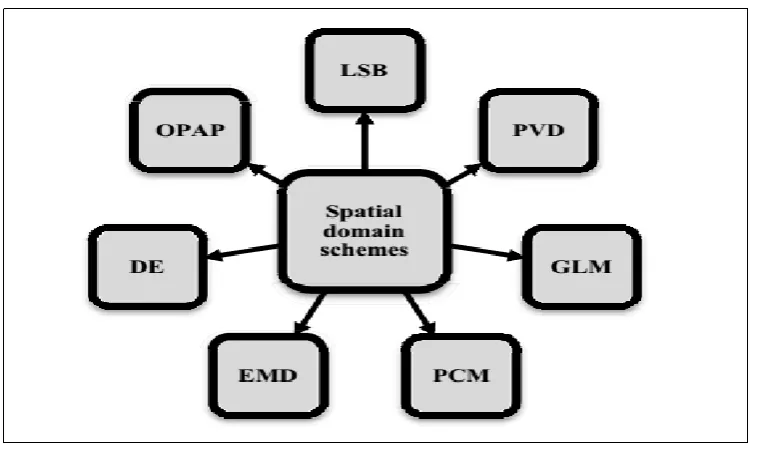
Figure 1.3

Embedding methods for spatial domain

1.2.3 Capacity

(23)

System (HVS) Zargar and Singh, (2016) where an attack is sensitive to exchanging

in LSB. Increasing secret data payload capacity in stego image also effects the

robustness of the system. In conclusion, the background problem of increasing the

capacity of secret message is no easy task and a balance must be kept between

security and robustness.

1.3 Steganography model

(24)

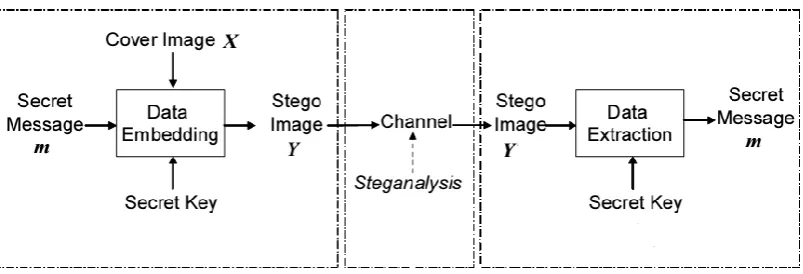
Figure 1.4

The model of steganography and steganalysis

Adoption of a strong and safe method for embedding data in stego image

makes the steganography model more robust and suitable. Secret key, sometimes

called stego key, includes all the information needed for extracting secret data from

stego image. Any weakness in one stage of this model will render the entire model

ineffective.

1.4 Problem Statements

Some researchers in the literature introduced different methods for hiding

secret information in image, or in other words, new steganography system has been

developed (Hamed,

et al., 2016; Rai

et al., 2015). This research aims to develop

method based on Bit Inverting Map (BIM) for hiding data in an image. In this

research, the focus is on embedding secret message in reliable hosting image. There

are three main problems:

i.

How to increase the capacity of the system while maintaining the

Peak Signal-to-Noise Ratio (PSNR).

ii.

How to embed the payload capacity of secret message.

(25)

In order to answer these primary questions, a set of secondary research

questions that address the problem in detail are posed as follows:

i.

How to design and develop secure approach using Bit Inverting Map

which provides high hiding capacity and security?

ii.

How to improve the steganography system to achieve high capacity?

iii.

How to evaluate and test steganography system using standard and

self-created images.

This study proposes use improved Bit Inverting Map (BIM) for embedding

the secret message in an image. Fibonacci decomposition is used to increase both

capacity and robustness of the system. To increase the capacity of embedding secret

message, Huffman coding is used to compress the message 30% before embedding.

Three types of evaluation are used to evaluate the results including PSNR,

Chi-square attack, and HVS attack, all with different criteria.

1.5 Objectives of the Study

The main goal of this research is to improve the security of hiding

information in an image by using a new embedding method based on BIM.

Therefore, this thesis is carried out in order to fulfil the following objectives:

i.

To design new hiding method of improved steganography scheme for

embed secret message into the image.

ii.

To propose Bit Inverting Map method for increasing payload capacity

while maintaining the PSNR.

(26)

iv.

To evaluate the improved Bit Inverting Map using standard dataset to

benchmark with literature and to test the Bit Inverting Map with new

images taken by mobile.

Due to the spread of Internet and its applications that require security

information and widely used digital images through the internet, developing a new

security system is of utmost necessity especially with the applications that use

images. It is worth developing such a system that considers the use of highly secret

message capacity inserted in trusted media. Many applications at the present time

used images as a main factor, and for this reason, this research tries to come up with

a new technique to serve these applications.

1.6 Scope of the Study

This research focuses on introducing the best security improved Bit Inverting

Map in terms of steganography and maintaining of the PSNR, robustness, and

imperceptibly. Some existing techniques are used with the improved Bit Inverting

Map. The scope of this research covers the following points:

i.

Improved Bit Inverting Map focus is on embedding text files in

image media with condition of steganography.

ii.

Manipulation of the image such as rotation, zooming, scaling, etc.

is not considered in this study

(27)

iv.

Improved Bit Inverting Map has been tested using images taken by

mobile phone such Masjid, UTM gate, and Santa Claus.

v.

Results are evaluated using PSNR, Chi-square attack, and Human

Visual System (HVS) attack.

1.7 Significance of the Study

(28)

1.8 Thesis Organization

(29)

REFERENCES

Agrawal, S., and Kumar, M. (2016). An Improved Reversible Data Hiding

Technique Based on Histogram Bin Shifting. In Proceedings of 3rd

International Conference on Advanced Computing, Networking and

Informatics (pp. 239-248). Springer India.

Akhtar, N. (2016). An Efficient Lossless Modulus Function Based Data Hiding

Method. In Proceedings of 3rd International Conference on Advanced

Computing, Networking and Informatics (pp. 281-287). Springer India.

Akhtar, N. (2016). An LSB Substitution with Inversion Steganography Method.

In Proceedings of 3rd International Conference on Advanced Computing,

Networking and Informatics (pp. 515-521). Springer India.

Al-Ataby, A., and Al-Naima, F. (2008). A modified high capacity image

steganography technique based on wavelet transform. changes, 4, 6.

Al-Dmour, H., and Al-Ani, A. (2016). A steganography embedding method based on

edge identification and XOR coding. Expert Systems with Applications, 46,

293-306.

Al-Tamimi, A. G. T., and Alqobaty, A. A. (2015). Image Steganography Using Least

Significant Bits (LSBs): A Novel Algorithm. International Journal of

Computer Science and Information Security, 13(1), 1.

Amritha, P. P., Induja, K., and Rajeev, K. (2016). Active Warden Attack on

Steganography Using Prewitt Filter. In Proceedings of the International

Conference on Soft Computing Systems (pp. 591-599). Springer India.

Amritha, P. P., Muraleedharan, M. S., Rajeev, K., and Sethumadhavan, M. (2016).

(30)

Anandpara, D., and Kothari, A. (2015). Working and Comparative Analysis of

Various Spatial Based Image Steganography Techniques. International

Journal of Computer Applications, 113(12), 8-12.

Aroukatos, N. G., Manes, K., and Zimeras, S. (2016). Social Networks Medical

Image Steganography Using Sub-Fibonacci Sequences. In mHealth

Ecosystems and Social Networks in Healthcare (pp. 171-185). Springer

International Publishing.

Baig, F., Khan, M. F., Beg, S., Shah, T., and Saleem, K. (2016). Onion

steganography: a novel layering approach. Nonlinear Dynamics, 1-16.

Bansal, A., Muttoo, S. K., and Kumar, V. (2015). Secure Data Hiding by Optimal

Placement of Queen Along Closed Knight Tour. i-Manager's Journal on

Information Technology, 4(3), 18.

Bansal, A., Muttoo, S. K., and Kumar, V. (2016). Secure Data Hiding Along

Randomly Selected Closed Knight's Tour. Journal of Applied Security

Research, 11(1), 90-100.

Barr, K. C., and Asanović, K. (2006). Energy-aware lossless data compression. ACM

Transactions on Computer Systems (TOCS), 24(3), 250-291.

Bhatt, S., Ray, A., Ghosh, A., and Ray, A. (2015, January). Image steganography and

visible watermarking using LSB extraction technique. InIntelligent Systems

and Control (ISCO), 2015 IEEE 9th International Conference on (pp. 1-6).

IEEE.

Bhattacharya, D., Chakraborty, S., Roy, P., Kairi, A., and IEM, K. (2015). An

Advanced Dictionary Based Lossless Compression Technique for English

Text Data. Biometrics and Bioinformatics, 7(1), 4-11.

Böhme, R. (2010). Principles of Modern Steganography and Steganalysis.

InAdvanced Statistical Steganalysis (pp. 11-77). Springer Berlin Heidelberg.

Botta, M., Cavagnino, D., and Pomponiu, V. (2016). A modular framework for color

image watermarking. Signal Processing, 119, 102-114.

(31)

Bucerzan, D., and Raţiu, C. (2016). Image Processing with Android Steganography.

In Soft Computing Applications (pp. 27-36). Springer International

Publishing.

Budiman, G., and Novamizanti, L. (2015). White Spacesteganography On Text By

Usinglzw-Huffman Double Compression.International Journal of Computer

Networks and Communications, 7(2), 136A.

Chakravarthy, S., Sharon, V., Balasubramanian, K., and Vaithiyanathan, V. (2016).

Art of Misdirection Using AES, Bi-layer Steganography and Novel

King-Knight’s Tour Algorithm. In Advances in Signal Processing and Intelligent

Recognition Systems (pp. 97-108). Springer International Publishing.

Chandran, S., and Bhattacharyya, K. (2015, January). Performance analysis of LSB,

DCT, and DWT for digital watermarking application using steganography.

In Electrical, Electronics, Signals, Communication and Optimization

(EESCO), 2015 International Conference on (pp. 1-5). IEEE.

Chang, C. C., Chen, T. S., and Chung, L. Z. (2002). A steganographic method based

upon

JPEG

and

quantization

table

modification. Information

Sciences,141(1), 123-138.

Channalli, S., and Jadhav, A. (2009). Steganography an art of hiding data.

Computer

Science , Cryptography and Security, arXiv:0912.2319.

Charbal, A., Dufour, J. E., Guery, A., Hild, F., Roux, S., Vincent, L., and Poncelet,

M. (2016). Integrated Digital Image Correlation considering gray level and

blur variations: Application to distortion measurements of IR camera. Optics

and Lasers in Engineering, 78, 75-85.

Chary, A. S. (2016) "Invisible Image Watermarking Using Hybrid DWT

Compression-Decompression

Technique".

International

Journal

of

Advanced Research Foundation,Vol 3,Issue 1.

Chen, P. Y., and Lin, H. J. (2006). A DWT based approach for image

steganography. International

Journal

of

Applied

Science

and

Engineering,4(3), 275-290.

(32)

Das, S. K., and Dhara, B. C. (2015, April). An Image Secret Sharing Technique with

Block Based Image Coding.

In Communication Systems and Network

Technologies (CSNT), 2015 Fifth International Conference on (pp.

648-652). IEEE.

Deval, N. M. (2015) Secure Steganography Algorithm Based on Cellular Automata

using Fibonacci Representation and Reverse Circle Cipher Application for

Steganography.

International Journal of Soft Computing and Engineering

(IJSCE). Vol 5. Issue 1.

Dooley, J. F. (2015). Review of Prisoners, Lovers, and Spies by Kristie

Macrakis. Cryptologia, 1-6.

El-Emam, N. N., and Al-Diabat, M. (2015). A novel algorithm for colour image

steganography using a new intelligent technique based on three

phases.Applied Soft Computing, 37, 830-846.

Fathimal, P. M., and Rani, P. A. J. (2016). K Out of N Secret Sharing Scheme with

Steganography and Authentication. In Computational Intelligence, Cyber

Security and Computational Models (pp. 413-425). Springer Singapore.

Fridrich, J., and Goljan, M. (2003, June). Digital image steganography using

stochastic modulation. In Electronic Imaging 2003 (pp. 191-202).

International Society for Optics and Photonics.

Fridrich, J., Goljan, M., and Du, R. (2001, October). Reliable detection of LSB

steganography in color and grayscale images. In Proceedings of the 2001

workshop on Multimedia and security: new challenges (pp. 27-30). ACM.

Ghasemi, E., Shanbehzadeh, J., and Fassihi, N. (2011, March). High capacity image

steganography

using

wavelet

transform

and

genetic

algorithm.

InProceedings of the international multiconference of engineers and

computer scientists (Vol. 1).

Ghebleh, M., and Kanso, A. (2014). A robust chaotic algorithm for digital image

steganography. Communications in Nonlinear Science and Numerical

Simulation, 19(6), 1898-1907.

Gupta, J. (2015). A Review on Steganography techniques and methods. ICAET vol,1,

1-4.

(33)

and Jagadeesha S., 2015 "Design and Implementation of Image

Steganography by using LSB Replacement Algorithm and Pseudo Random

Encoding Technique".

International Journal on Recent and Innovation

Trends in Computing and Communication, Volume: 3 Issue: 7.

Herrigel, A., Voloshynovskiy, S. V., and Hrytskiv, Z. D. (2000, June). Optical/digital

identification/verification system based on digital watermarking technology.

In International Workshop on Optoelectronic and Hybrid Optical/Digital

Systems for Image/Signal Processing (pp. 170-176). International Society

for Optics and Photonics.

Hoggatt, V. E. (1972). Generalized Zeckendorf theorem. Fibonacci Quarterly,

In

Combinatorial and Additive Number Theory. Springer New York.10 (1),

89-94.

Holub, V., and Fridrich, J. (2013, June). Digital image steganography using universal

distortion. In Proceedings of the first ACM workshop on Information hiding

and multimedia security (pp. 59-68). ACM.

Huang, F., and Kim, H. J. (2016). Framework for improving the security

performance of ordinary distortion functions of JPEG steganography.

Multimedia Tools and Applications, 75(1), 281-296.

Huffman, D. A. (1952). A method for the construction of minimum-redundancy

codes. Proceedings of the IRE, 40(9), 1098-1101.

Ibrahim, R., and Kuan, T. S. (2011). Steganography algorithm to hide secret message

inside an image. Computer Technology and Application. Vol.2.pp:102-108.

Islam, M. N., Islam, M. F., and Shahrabi, K. (2015). Robust information security

system using steganography, orthogonal code and joint transform

correlation. Optik-International

Journal

for

Light

and

Electron

Optics, 126(23), 4026-4031.

Jain, N., Meshram, S., and Dubey, S. (2012). Image Steganography Using LSB and

Edge–Detection Technique. International Journal of Soft Computing and

Engineering (IJSCE) ISSN, 223.

(34)

Jero, S. E., and Ramu, P. (2016). Curvelets-based ECG steganography for data

security. Electronics Letters.

Jiang, N., Zhao, N., and Wang, L. (2016). Lsb based quantum image steganography

algorithm. International Journal of Theoretical Physics, 55(1), 107-123.

Johnson, N. F., and Jajodia, S. (1998, January). Steganalysis of images created using

current steganography software. In Information Hiding (pp. 273-289).

Springer Berlin Heidelberg.

Kanan, H. R., and Nazeri, B. (2014). A novel image steganography scheme with high

embedding capacity and tunable visual image quality based on a genetic

algorithm. Expert Systems with Applications, 41(14), 6123-6130.

Kaur, A., Dhir, R., and Sikka, G. (2010). A new image steganography based on first

component alteration technique. Computer Science. Multimedia

Vol.5.

Issue.21.

Kaur, S. P., and Jindal S. (2016) "A Review on Various Approaches for Data

Hiding.", International Journal of Science and Research. Vol. 2. Pp.

2319-7064.

Khan, S., Ahmad, N., and Wahid, M. (2016). Varying index varying bits substitution

algorithm for the implementation of VLSB steganography.Journal of the

Chinese Institute of Engineers, 39(1), 101-109.

Kim, C., Yun, S., Jung, S. W., and Won, C. S. (2016). Color and Depth Image

Correspondence for Kinect v2. In Advanced Multimedia and Ubiquitous

Engineering (pp. 333-340). Springer Berlin Heidelberg.

Knapp, J. F., and Worrell, S. W. (2015). U.S. Patent No. 9,002,134. Washington,

DC: U.S. Patent and Trademark Office.

Kolakalur, A., Kagalidis, I., and Vuksanovic, B. (2016). Wavelet Based Color Video

Steganography. International Journal of Engineering and Technology,8(3),

165.

Kumar, A., Ghrera, S. P., and Tyagi, V. (2016). Modified Buyer Seller

Watermarking Protocol based on Discrete Wavelet Transform and Principal

Component Analysis. Indian Journal of Science and Technology, 8(35).

Kumar,

N.

(2016).

Steganographic

Methods:

A

Survey

on

Novel

(35)

Kuo, W. C., Chang, S. Y., Wang, C. C., and Chang, C. C. (2016). Secure multi-group

data hiding based on gemd map. Multimedia Tools and Applications, 1-19.

Kuo, W. C., Wang, C. C., and Hou, H. C. (2016). Signed digit data hiding

scheme. Information Processing Letters, 116(2), 183-191.

Laha, S., and Roy, R. (2015, December). An improved image steganography scheme

with high visual image quality. In Computing, Communication and Security

(ICCCS), 2015 International Conference on (pp. 1-6). IEEE.

Lee, K. D., and Hubbard, S. (2015). Heuristic Search. In Data Structures and

Algorithms with Python (pp. 281-297). Springer International Publishing.

Lee, Y. K., and Chen, L. H. (2000, June). High capacity image steganographic

model. In Vision, Image and Signal Processing, IEE Proceedings (Vol. 147,

No. 3, pp. 288-294). IET.

Li, B., He, J., Huang, J., and Shi, Y. Q. (2011). A survey on image steganography

and steganalysis.Journal of Information Hiding and Multimedia Signal

Processing, 2(2), 142-172.

Liu, J., Tian, Y., Han, T., Wang, J., and Luo, X. (2016). Stego key searching for LSB

steganography on JPEG decompressed image. Science China Information

Sciences, 1-15.

Lunghi, T., Brask, J. B., Lim, C. C. W., Lavigne, Q., Bowles, J., Martin, A., ... and

Brunner,

N.

(2015).

Self-Testing

Quantum

Random

Number

Generator.Physical review letters, 114(15), 150501.

Maheswari, S. U., and Hemanth, D. J. (2015). Frequency domain QR code based

image steganography using Fresnelet transform. AEU-International Journal

of Electronics and Communications, 69(2), 539-544.

Meligy, A. M., Nasef, M. M., & Eid, F. T. (2016). A Hybrid Technique for

Enhancing the Efficiency of Audio Steganography. International Journal of

Image, Graphics and Signal Processing, 8(1), 36..

Mishra, A. (2016). An Approach for Information Hiding Using Inverse Z-Transform

and Genetic Algorithm. JIMET, 1(1).

(36)

Mohamed, M. H., and Mohamed, L. M. (2016). High Capacity Image Steganography

Technique based on LSB Substitution Method. Applied Mathematics and

Information Sciences, 10(1), 259.

Mohapatra, C., and Pandey, M. (2015). A Review on current Methods and

application of Digital image Steganography. International Journal of

Multidisciplinary Approach and Studies, 2(2).

Morkel, T., Eloff, J. H., and Olivier, M. S. (2005, June). An overview of image

steganography.

Information and Computer Security Architecture (ICSA)

.

Vol.5. (pp. 1-11)

Muhammad, K., Ahmad, J., Farman, H., and Jan, Z. (2016). A New Image

Steganographic Technique using Pattern based Bits Shuffling and Magic

LSB for Grayscale Images. Sindh Univ. Res. Jour. (Sci. Ser.) Vol. 47 (4)

723-728.

Muhammad, K., Ahmad, J., Farman, H., and Zubair, M. (2015). A novel image

steganographic approach for hiding text in color images using HSI color

model. Computer Science .Multimedia Journal. Vol(2). Pp.354-366.

Mungmode, S., Sedamkar, R. R., and Kulkarni, N. (2016). An Enhanced Edge

Adaptive Steganography Approach Using Threshold Value for Region

Selection. Computer Security Journal. Vol (3). Issue. 12.

Nag, A., Biswas, S., Sarkar, D., and Sarkar, P. P. (2015). Semi Random Position

Based Steganography for Resisting Statistical Steganalysis. IJ Network

Security, 17(1), 57-65.

Nag, A., Singh, J. P., Biswas, S., Sarkar, D., and Sarkar, P. P. (2014). A Huffman

Code Based Image Steganography Technique. In Applied Algorithms (pp.

257-265). Springer International Publishing.

Nayak, R. (2015). Steganography with BSS-RSA-LSB technique: A new approach to

Steganography. International Journal of Science Engineering and Advance

Technology IJSEAT, 3(5), 187-190.

Parberry, I. (1997). An efficient algorithm for the Knight's tour problem.Discrete

Applied Mathematics, 73(3), 251-260.

(37)

Patel, F. R., and Cheeran, A. N. (2015). Performance Evaluation of Steganography

and AES encryption based on different formats of the Image.Performance

Evaluation, 4(5).

Patel, K., and Ragha, L. (2015, May). Binary image Steganography in wavelet

domain. In Industrial Instrumentation and Control (ICIC), 2015

International Conference on (pp. 1635-1640). IEEE.

Patterson, N. M., and Lee, S. F. (2015). Image Steganography.

Philip, A. (2013). A Generalized Pseudo-Knight s Tour Algorithm for Encryption of

an Image. Potentials, IEEE, 32(6), 10-16.

Priya, S., and Amritha, P. P. (2016). Information Hiding in H. 264, H. 265, and

MJPEG. In Proceedings of the International Conference on Soft Computing

Systems (pp. 479-487). Springer India.

Raeiatibanadkooki, M., Quchani, S. R., KhalilZade, M., and Bahaadinbeigy, K.

(2016). Compression and Encryption of ECG Signal Using Wavelet and

Chaotically Huffman Code in Telemedicine Application. Journal of medical

systems, 40(3), 1-8.

Rai, P., Gurung, S., and Ghose, M. K. (2015). Analysis of Image Steganography

Techniques:

A

Survey. International

Journal

of

Computer

Applications, 114(1).

Raja, K. B., Venugopal, K. R., and Patnaik, L. M. (2006, December). High capacity

lossless secure image steganography using wavelets. In Advanced

Computing and Communications, 2006. ADCOM 2006. International

Conference on (pp. 230-235). IEEE.

Ramalingam, M., and Isa, N. A. M. (2015). A steganography approach over video

images to improve security. Indian Journal of Science and Technology, 8(1),

79-86.

Ramu, P., and Swaminathan, R. (2016). Imperceptibility—Robustness tradeoff

studies for ECG steganography using Continuous Ant Colony

Optimization.Expert Systems with Applications, 49, 123-135.

(38)

Rao, C. S., and Devi, V. B. (2016). Comparative Analysis of HVS Based Robust

Video Watermarking Scheme. In Microelectronics, Electromagnetics and

Telecommunications (pp. 103-110). Springer India.

Rasheed, Z. A. S. (2015). ’Steganography Technique for Binary Text

Image. International Journal of Science and Research (IJSR) ISSN (Online),

2319-7064.

Rayappan, J. B. B. (2013). Kubera kolam: A way for random image

steganography. Research Journal of Information Technology, 5(3), 304-316.

Sanguinetti, B., Traverso, G., Lavoie, J., Martin, A., and Zbinden, H. (2016).

Perfectly secure steganography: hiding information in the quantum noise of

a photograph. Physical Review A, 93(1), 012336.

Sedighi, V., Cogranne, R., and Fridrich, J. (2016). Content-Adaptive Steganography

by Minimizing Statistical Detectability. Information Forensics and Security,

IEEE Transactions on, 11(2), 221-234.

Seyyedi, S. A., Sadau, V., and Ivanov, N. (2016). A Secure Steganography Method

Based on Integer Lifting Wavelet Transform. International Journal of

Network Security, 18(1), 124-132.

Shelke, S. G., and Jagtap, S. K. (2015, February). Analysis of Spatial Domain Image

Steganography Techniques. In Computing Communication Control and

Automation (ICCUBEA), 2015 International Conference on (pp. 665-667).

IEEE.

Silman, J. (2007) Steganography and steganalysis: an overview.

Information and

Computer Security Architecture (ICSA).Vo(4). Issue.11.

Singh, J., Kaur, G., and Garcha, M. K. (2015, June). Review of Spatial and

Frequency Domain Steganographic Approaches. In International Journal of

Engineering Research and Technology (Vol. 4, No. 06, June-2015). ESRSA

Publications.

Singh, M., Kakkar, A., and Singh, M. (2015). Image Encryption Scheme Based on

Knight's Tour Problem. Procedia Computer Science, 70, 245-250.

(39)

Singh, S., Singh, R., and Siddiqui, T. J. (2016). Singular Value Decomposition Based

Image Steganography Using Integer Wavelet Transform. In Advances in

Signal Processing and Intelligent Recognition Systems (pp. 593-601).

Springer International Publishing.

Srinivasan, B., Arunkumar, S., and Rajesh, K. (2015). A Novel Approach for Color

Image, Steganography Using NUBASI and Randomized, Secret Sharing

Algorithm. Indian Journal of Science and Technology, 8(S7), 228-235.

Stanley, C. A. (2005). Pairs of Values and the Chi-squared Attack. Master's Thesis,

Department of Mathematics, Iowa State University.

Sun, S. (2016). A novel edge based image steganography with 2 k correction and

Huffman encoding. Information Processing Letters, 116(2), 93-99.

Tang, W., Li, B., Luo, W., & Huang, J. (2016). Clustering steganographic

modification directions for color components. IEEE Signal Processing

Letters, 23(2), 197-201..

Thakur, P., Kushwaha, S., and Rai, Y. (2015). Enhance Steganography Techniques:

A Solution for Image Security. International Journal of Computer

Applications, 115(3).

Thampi, S. M. (2004). Information hiding techniques: A tutorial review. ISTE-STTP

on Network Security and Cryptography, LBSCE.

Thanikaiselvan, V., and Arulmozhivarman, P. (2013). Horse Communication against

Harsh Attack: A Stego Ride. Research Journal of Information

Technology, 5(3), 263-276.

Thanikaiselvan, V., and Arulmozhivarman, P. (2015). RAND

STEG: an integer

wavelet transform domain digital image random steganography using

knight's tour. Security and Communication Networks.

Thomas, E. (2015).

The Fibonacci Sequence Through a Different Lens (Doctoral

dissertation).‏

(40)

Tuncer, T., and Avci, E. (2016). A reversible data hiding algorithm based on

probabilistic

DNA-XOR

secret

sharing

scheme

for

color

images. Displays,41, 1-8.

Tutuncu, K., and Hassan, A. A. (2015). New Approach in E-mail Based Text

Steganography. International

Journal

of

Intelligent

Systems

and

Applications in Engineering, 3(2), 54-56.

Udhayavene, S., Dev, A. T., and Chandrasekaran, K. (2015). New Data Hiding

Technique in Encrypted Image: DKL Algorithm (Differing Key

Length).Procedia Computer Science, 54, 790-798.

Venkatachalam, S., Banu, A. S., and Padmaa, M. (2015). A Robust Image

Steganography

using

CDF

Lifting

Scheme

and

Huffman

Encoding.International Journal of Computer Applications, 110(11).

Venugopal, D., Mohan, S., and Raja, S. (2016). An efficient block based lossless

compression of medical images. Optik-International Journal for Light and

Electron Optics, 127(2), 754-758.

Vikranth, B. M., Momin, M. H., Mohsin, S. M., Rimal, S., and Pandey, S. R. (2015,

April). A Survey Of Image Steganography. In Journal of Emerging

Technologies and Innovative Research (Vol. 2, No. 4 (April-2015)). JETIR.

Wang, X., Wei, C., and Han, X. (2015). Steganography forensics method for

detecting least significant bit replacement attack. Journal of Electronic

Imaging, 24(1), 013016-013016.

Weng, S., and Pan, J. S. (2016). Integer transform based reversible watermarking

incorporating block selection. Journal of Visual Communication and Image

Representation, 35, 25-35.

Wu, B., Chang, M., Shastri, B., Ma, P., and Prucnal, P. (2016). Dispersion

Deployment and Compensation for Optical Steganography Based on Noise.

Yan, F., Iliyasu, A. M., and Venegas-Andraca, S. E. (2016). A survey of quantum

image representations. Quantum Information Processing, 15(1), 1-35.

Yang, B., Rozic, V., Mentens, N., and Verbauwhede, I. (2015). On-the-Fly Tests for

(41)

Yang, C. H., Lin, Y. K., Chang, C. H., and Chen, J. Y. (2016). Data Hiding for H.

264/AVC Based on the Motion Vector of 16 Grids. In Advanced Multimedia

and Ubiquitous Engineering (pp. 389-395). Springer Berlin Heidelberg.

Yiannakou, M., Trimikliniotis, M., Yiallouras, C., and Damianou, C. (2016).

Evaluation of focused ultrasound algorithms: Issues for reducing pre-focal

heating and treatment time. Ultrasonics, 65, 145-153.

Zanganeh, O., and Ibrahim, S. (2011). Adaptive image steganography based on

optimal embedding and robust against chi-square attack. Information

Technology Journal, 10(7), 1285-1294.

Zargar, A. J., and Singh, A. K. (2016). Robust and imperceptible image

watermarking in DWT-BTC domain. International Journal of Electronic

Security and Digital Forensics, 8(1), 53-62.

Zhang, W., Wang, S., and Zhang, X. (2007). Improving embedding efficiency of

covering codes for applications in steganography. Communications Letters,

IEEE, 11(8), 680-682.

Zhang, X., and Wang, S. (2005). Steganography using multiple-base notational

system and human vision sensitivity. Signal Processing Letters, IEEE,12(1),

67-70.

Figure

Figure 1.1 Three key issues for information hiding
Figure 1.3 Embedding methods for spatial domain
Figure 1.4 The model of steganography and steganalysis

References

Related documents

Here we design a novel LSB image steganography scheme by using the pseudorandom bit generation algorithm based on the Hitzl-Zele chaotic function, Section II.. We consider plain

International Journal of Emerging Trends & Technology in Computer Science (IJETTCS). The Image Steganography and Steganalysis Based On Peak-Shaped Technique for MP3..

From the parameters it was found that encoding with two bits for set 2 type images offers best results as size of carrier image and data hiding capacity of provided

In this paper, author have propose a steganographic technique by using improved LSB (least significant bit) replacement method for 24 bit color image capable of producing

The challenge of using steganography in computer images is to hide as much data as possible with the least noticeable difference in the image. There are a number of

Figure 5.6: Cover Text Character Usage for Data Hiding Using Stream-bit 1 Technique

Abstract - Steganography is the art and science of hiding secret data information in other media like digital images. The secret message is hidden in such a way

Ahirwal, “A novel image steganography method with adaptive number of least significant bits modification based on private stego-keys”, International Journal of Computer