A HYBRID RESULTANT MATRIX ALGORITHM BASED ON THE SYLVESTER-B ´EZOUT FORMULATION
SHAMSATUN NAHAR BINTI AHMAD
A thesis submitted in fulfilment of the requirements for the award of the degree of
Doctor of Philosophy (Mathematics)
Faculty of Science Universiti Teknologi Malaysia
iii
To
my beloved husband, Mohd Hanip Aspar and my lovely children
Nurul Hidayah, Nurfatihah, Muhammad Aflah Saifuddin, and Nur Aishaturradhiah.
Specially dedicated to
iv
ACKNOWLEDGEMENT
Praise be to Allah who has subjected everything from the beginning of my study till the completion of this thesis. I wish to express my sincere appreciation to my supervisor Assoc. Prof. Dr Nor’aini Aris and Assoc. Prof. Dr Ali Ab Rahman, who was my co-supervisor. Everything I know about computational algebra is due to them. Assoc. Prof. Dr Nor’aini Aris had introduced me to the fascinating area of symbolic computation and the problem that I could possibly examine. Her enthusiasm, thoughtful consideration, and valuable suggestions and guidance throughout the preparation of the thesis is greatly appreciated.
I wish to express my special recognition to Muhammad Haqie for assisting me in completing my C++ program. I owe a special gratitude to Professor Bernd Sturmfels who initiated the idea of resultant matrix and who has always been responsive to questions regarding some concepts in manipulating the resultant matrix. I have also referred to his works, in particular, his Sylvester-type formula on multigraded systems. I would also like to express my appreciation to my colleagues at the Mathematics Department, Faculty of Computer and Mathematical Sciences, Universiti Teknologi MARA (Johor), whom I enjoy working and whose assistance have contributed towards the pursue of this research.
v
ABSTRACT
vi
ABSTRAK
TABLE OF CONTENTS
CHAPTER TITLE PAGE
DECLARATION ii
DEDICATION iii
ACKNOWLEDGEMENT iv
ABSTRACT v
ABSTRAK vi
TABLE OF CONTENTS vii
LIST OF TABLES xi
LIST OF FIGURES xii
LIST OF SYMBOLS xiv
LIST OF APPENDICES xvi
1 INTRODUCTION 1
1.1 Preface 1
1.2 Research Background 2
1.3 Motivation 7
1.4 Problem Statement 8
1.5 Research Objectives 10
1.6 Scope of the Study 12
1.7 Significance of Findings 12
1.8 Research Methodology 12
1.9 Thesis Organization 14
2 LITERATURE REVIEW 17
viii
2.2 Preliminaries on Algebraic Geometry 18
2.2.1 The Newton Polytope of a Polynomial System 18
2.2.2 Mixed Volume 20
2.2.3 Sylvester and B´ezout Resultant Formulas for
Univariate Polynomials of Arbitrary Degree 25
2.2.4 Multihomogeneous Polynomials 27
2.2.5 Affine and Projective Varieties 30
2.2.6 Toric Variety and Newton Polytope 33
2.3 Development on Resultant Matrix 35
2.3.1 Foundation Works on Sparse Resultant Matrix 36 2.3.2 Computation of Resultant Matrices 38 2.3.3 Conditions for Optimal Sylvester Matrices 41
2.3.4 Resultants 43
2.3.5 Determinantal Resultant Formula 48
2.3.6 The Maple Package “multires” 51
2.3.7 New Evolution in Resultants 53
2.4 Conclusion 54
3 SYLVESTER TYPE FORMULAS AND THE
CONSTRUCTION OF OPTIMAL RESULTANT
MATRIX 57
3.1 Introduction 57
3.2 Empirical Observations on Optimality Conditions 57 3.3 Determinantal Formula of Sylvester type 59 3.4 Construction and Implementation of the Optimal
Sylvester Type Matrix Algorithm 65
3.5 Further Implementations and Observations 74
3.6 Conclusion 76
4 THEORETICAL BASIS FOR THE CONSTRUCTION
OF THE HYBRID RESULTANT MATRIX 78
4.1 Introduction 78
4.2 Basis for the Construction of the Sylvester and
ix
4.2.1 Cones and Fan 83
4.2.2 Weil Divisors and The Complexes 86
4.3 The B´ezout Matrix in The Sylvester-B´ezout Matrix
Formulation 92
4.4 Conclusion 92
5 HYBRID RESULTANT MATRIX ALGORITHM FOR
SPARSE POLYNOMIALS 94
5.1 Introduction 94
5.2 Hybrid Resultant Matrix Construction 95
5.2.1 Computing the Sylvester-B´ezout Resultant Matrix 98
5.2.2 Algorithms for B´ezout Block 108
5.2.3 Constructing Hybrid Resultant Matrix 114 5.3 Complexity of the Sylvester-B´ezout Matrix Algorithm 115
5.3.1 Analysis Algorithm of Phase (i) 115
5.3.2 Analysis Algorithm of Phase (ii) 117 5.3.3 Analysis Algorithm of Phase (iii) 119 5.3.3 Analysis Algorithm of Phase (iv) 120
5.4 Conclusion 121
6 IMPLEMENTATION OF ALGORITHM AND
ANALYSIS OF RESULTS 123
6.1 Introduction 123
6.2 Implementation of Algorithms and Analysis of
Results 123
6.3 Limitations of the Hybrid Construction 131
6.4 Some Observations 133
6.5 Application of the Package 136
6.6 Conclusion 140
7 CONCLUSION 142
7.1 Introduction 142
7.2 Significance of Findings and Conclusions 142
x
REFERENCES 145
LIST OF TABLES
TABLE NO. TITLE PAGE
3.1 Degree of variables of homogeneous polynomials 69
3.2 The set of monomials inK1 70
3.3 The set of monomials inK0 70
3.4 The set of monomials inK1 for three groups of variables 73 3.5 The empirical results on the properties of
multihomogeneous systems 75
5.1 The combinationu, v, wfor allα∈ Qwhenh= 1 108 6.1 Homogeneous coordinate for the case p = q = 0 and
p, q >0 127
6.2 Homogeneous coordinate whenh6=k 129
6.3 The empirical results comparison on size of the matrix 135 6.4 The value ofxandyforz = 0.988659216 in Example 6.4 140
LIST OF FIGURES
FIGURE NO. TITLE PAGE
1.1 Classes of polynomials systems and resultant matrix approach 4
1.2 Research framework 11
1.3 Resultant matrix methods 13
1.4 Thesis organization 16
2.1 Newton polytopes and Minkowski sum for Example 1.1 19
2.2 Newton polytopes for Example 1.2 19
2.3 2-fold Minkowski sum and subdivision of convex hull 20
2.4 The Newton polytope of an unmixed system (2.3) 22
2.5 Literature Review 56
4.1 An edge and inward normal 81
4.2 Example of cones 83
4.3 The cones of Example 4.2 84
4.4 The fan of gluing three cones 85
5.1 Newton polytope of polynomial system in (5.1) 96
5.2 Translated Newton polytope of system in (5.2) 97
5.3 Two dimensional cone for vertex (0,0) 101
5.4 The fan of Figure 5.2 whenh= 1 101
5.5 Construction of B´ezout block in the hybrid
Sylvester-B´ezout matrix 109
5.6 Construction of hybrid Sylvester-B´ezout matrix 111
6.1 Newton polytopes Conv(A1) and Conv(Ah) 129
A.1 Setting for valuek 152
xiii
A.3 The linear mapping 154
A.4 The linear combination 154
A.5 The Sylvester matrix 155
A.6 Error message for invalid sum 155
A.7 Message for undisplay matrix 155
C.1 Setting for valueS 164
C.2 Data of polytope,a:= (a1, . . . , as) 165
C.3 B´ezout Matrix 169
LIST OF SYMBOLS
Ai ⊆Zn - support offi
A+B ={a+b|a∈A, b∈B} - Minkowski sum of setsAandB
C - set of complex numbers
C[y1, y2, . . . , ys] - homogeneous coordinate ring D=Ps
i=1aiDi - Weil divisor
F0 =F1 =. . .=Fn= 0 - homogeneous polynomials
f1 =f2 =· · ·=fm = 0 - polynomial equations
fi =Pα∈AiCi,αxα - terms in each polynomial with coefficients
Ci,α ∈Zn
Hq=p−v(X, m−pd)
„
n+ 1
p
«
- cohomology
Kv(m) - terms in complexes
(l1, . . . , lr;k1, . . . , kr) - type of multihomogeneous system
MV(Q) - mixed volume of Newton polytope
P - projective space
Pn(K) = (Kn+1 − {0}) - n-dimensional projective space
Qi =Conv(Ai)⊆Xn - Newton polytopes (convex hull of supportAi)
R - set of real numbers
R(f0, . . . , fn) - resultant
S =C[y1, y2, . . . , ys] - polynomial ring
[uvw] - entries of B´ezout matrix
[uvw]yu+v+w−α−ω - monomial in homogeneous polynomial ring
V(F)⊂Pn - projective variety of Pn for homogeneous
xv
Z - set of integer numbers
α={α1, . . . , αs} ⊆Zn - exponent vectors ofx
δk - defect vectors for multihomogeneous systems
ΣQ - fan
σs - cones
' - approximately equal
φQ :Zn →Zs - homogenization map
v - similarity or equivalent
LIST OF APPENDICES
APPENDIX TITLE PAGE
A MANUAL FOR SYLVESTER MATRIX PACKAGE 150
B ALGORITHMS OF SYLVESTER-B ´EZOUT MATRIX 156
C MANUAL FOR SYLVESTER-B ´EZOUT MATRIX PACKAGE 161
CHAPTER 1
INTRODUCTION
1.1 Preface
Research on polynomial systems has a wide range of applications in science and engineering. For example, B´ezier-Bernstein splines have been used to model mechanical components in computer aided design (CAD) and computer aided manufacturing (CAM) systems [1]. In robotics, when a robot moves, it needs to detect whether it will collide with an obstacle. So, the movement of the robot and the obstacle can be represented as polynomial systems and the collision detection is then reduced to solving a polynomial system. Another example is in modeling geometric and kinematic constraints whereby the algebraic problem representing the motion of a camera is reduced to a well constrained system of polynomial equations.
Such problems are in real life applications which are very seldom modeled as dense polynomials. Generally sparse polynomials are more suitable for real applications representations. The sparseness of such system can be utilized by considering the combinatorial structure of the polynomials represented as theNewton polytopes, which is the convex set of the exponent vectors of the polynomials’ variables.
2
revealed in the works of [2–6], the resultants are the most powerful of the computational techniques for solving systems of polynomial.
Computing resultants has many applications in geometrical modeling for computer aided geometric design (CAGD) [7, 8] and robot kinematics [2, 5, 9]. These applications can be thought as fundamental problems in geometric computations and crucial or challenging problems in algorithmic algebra. For some problems, the computational complexity of the method involved, makes it very difficult to solve the problem.
An introduction to the research area on the resultant of multivariate polynomial systems is first presented in the following section.
1.2 Research Background
In this section some important concepts which are related to the research topic are discussed. Some notations and basic properties for homogeneous polynomials are also introduced. The discussion leads to the problem formulation for the research.
A system of polynomial equations is a set ofnpolynomials with coefficients over an arbitrary field. Fori= 1,2, . . . , n, let
fi :=
X
α∈A
Ciαxα (1.1)
be the polynomial with coefficientCiα and monomials xα. If fi is a polynomial in m
variables thenx=xα1
1 , xα22, . . . , xαmm andα = (α1, α2, . . . , αm)is the exponent vector of
x. The set of all exponent vectors of the monomials offi is called the support offiand is
denoted asAi. The system of polynomials (1.1) is an unmixed system if its supports are
3
If A is the support of a polynomial f then the convex hull of A is called the Newton polytope which is denoted asQ=conv(A).
The following examples are to describe the notion of mixed or unmixed supports of a multivariate polynomial system.
Example 1.1 Consider a polynomial system of two variables of mixed supports,
f :=a1+a2xy+a3x2; g :=b1x+b2x2 +b3y+b4x2y. (1.2)
The system has supportA1 ={(0, 0), (1, 1), (2, 0)},A2 ={(1, 0), (2, 0), (0, 1), (2, 1)}. Observe that both sets of supports are not identical.
Example 1.2 [10] Consider three polynomials in two variables of a mixed system below,
f1 :=C11+C12x1+C13x1x2+C14x21x2, f2 :=C21x1+C22x2+C23x21x2+C24x21x22, f3 :=C31+C32x1+C33x2+C34x1x2.
The supports of this mixed system areA1 = {(0, 0), (1, 0), (1, 1), (2, 1)};A2 ={(1, 0), (0, 1), (2, 1), (2, 2)};A3={(0, 0), (1, 0), (0, 1), (1, 1)}and they are also not identical.
Example 1.3 [4] Consider an unmixed polynomial system in two variables below,
fi :=Ci1+Ci2x1+Ci3x2+Ci4x1x2+Ci5x21+Ci6x22, i= 1,2,3.
The supports of this unmixed system are identical which areAi ={(0, 0), (1, 0), (0, 1),
(1, 1), (2, 0), (0, 2)},i= 1, 2, 3.
4
5
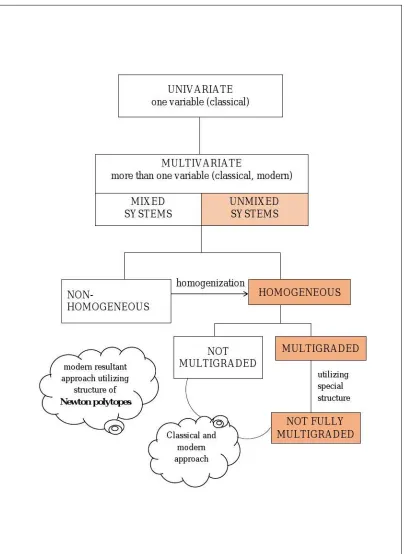
Classical resultant approach is for univariate or multivariate polynomials, but modern resultant approach only for multivariate polynomials. In addition, modern resultant approach utilizing structure of Newton polytope. The research starts from studying the univariate polynomial system and going down to multivariate system which is either mixed or unmixed systems. Types of polynomial systems are non-homogeneous and homogeneous systems. It is known that all non-homogeneous polynomial systems can be homogenized by certain technique. Then the homogeneous systems may fall under a subclass of multihomogeneous that arenot multigradedsystems andmultigraded systems. For sparseness criteria, by utilizing special structure the multigraded systems can be formed to not fully multigraded. This thesis focuses to the coloured boxes as shown in Figure 1.1.
Let
Fi =
X
|α|=di
ui,αxα, i= 0, . . . , n (1.3)
ben+ 1homogeneous polynomials inn+ 1variables over the real number field of degree d0, . . . dn, where for each monomial xα of degree di, its coefficients are the variables
ui,α. Let N be the total number of these variables, so thatCN is an affine space with
coordinatesui,α for all i = 0, . . . , nand |α| = di. A point ofCN will be written(ci,α).
Therefore, in order to describe a polynomial in the coefficients of theFi, each variable
ofui,αis replaced with the corresponding coefficientci,α whenFi is evaluated at (ci,α)∈
CN. For instance in the special case of a linear system, n = 3, d1 = d2 = d3 = 1,
which has a nonzero solution if and only if the determinant of3×3-determinant is zero [11]. The determinant may be regarded as a cubic polynomial in the ring of polynomials with integer coefficients in variablesui, i.e.,Z[u0, u1. . . , un]. Theorem 1.1 describes the
properties of resultant.
Theorem 1.1 [11] Letd1, . . . , dnpositive degrees, then a unique (up to sign) irreducible
polynomialRes∈Z[u]has the following properties:
(i) If f1, . . . , fn ∈ C[x1, . . . , xn] are homogeneous of degree d1, . . . , dn then
the equations of polynomial have a nonzero solution in Cn if and only if
6
(ii) Ris irreducible, even when regarded as a polynomial inC[u].
The elements ofC[u]are polynomial functions on the affine spaceCN and regards x = (x1, . . . , xn)as variables for the complex projective space Pn−1. This gives (u, x)
is the coordinates on the product variety. The polynomialR is called the (multivariate) resultant of the given system of polynomials. Next, the degree of the resultant is provided. This theorem has appeared in several references, for instance in [11] and Chapter 13 in [12]. The generalization of this theorem is the theorem on mixed volumes [13]. In the following, the underlying background knowledge involves in the construction of the Sylvester matrix fromn+ 1 homogeneous polynomials inn+ 1 variables is presented.
Theorem 1.2 The resultant R(F0, F1, . . . , Fn) is a homogeneous polynomial in the coefficients of each formFiof degreed0d1. . . di−1di+1. . . dn.
Consider the homogeneous system
F0 =F1 =. . .=Fn= 0. (1.4)
In general, for most values of the coefficients of Fi the homogeneous system with
homogeneous coordinates,x, has no nontrivial solutions in the complex projective space Pn(C)or Pn, while for certain special values of the coefficients, the solutions exist. In fact the condition for the existence of a solution for the system inPnis a condition on the coefficients of the Fi’s. If these coefficients are undetermined variables, then there is a
7
In the next section, the motivation for this research is further described.
1.3 Motivation
Sylvester type formulas give Sylvester type matrices whose non zero entries are coefficients of the polynomials when a determinantal formula exists. The determinant of the matrix equals precisely the resultant and the resultant matrix is said to be optimal.
An empirical implementation of Dickenstein and Emiris search algorithm [14] via the Maple package “mhomo.mpl” shows that for every multihomogeneous system with zero defect vector, a determinantal Sylvester type formula can be derived from certain degree vectors. A multigraded system which is an unmixed system of multihomogeneous system of type(l1, . . . , lr;di, . . . , dr), such that eitherli ordi is 1 for eachi = 1,2, . . . , r
belongs to this class.
In finding the resultant matrix, a determinantal formula is first sought. If the determinantal formula does not exist, a reasonably small square matrix whose determinant is a nonzero multiple of the resultant is then the next best solution. In the original work of Sturmfels and Zelevinsky [15], the formulation of the Sylvester type formula for fully multigraded system is derived. However if the system is not fully multigraded, the size of the Sylvester matrix remains the same even though some or most of the coefficients can be zero, since the matrix is optimal in the Sylvester form. In this thesis, a formulation that takes advantage of the sparseness property of such system shall be determined using a hybrid construction from the Sylvester-B´ezout formulation.
8
calculate the dimension of the matrix (dimK1= dimK0), while the entries of the matrix have not been explicitly determined.
On the other hand, Khetan [6] had proposed a Sylvester-B´ezout hybrid matrix formulation by applying exterior algebra concepts and bracket variables for the construction of the B´ezout matrix entries. This formulation is investigated, determining the methods of homogenizing variables which applies the concepts from toric varieties and homogeneous coordinate rings involving projective vector spaces. The underlying algebraic geometry tools such as the theories on divisors and fans as a collection of cones are presented in order to construct and implement the Sylvester-B´ezout formulation leading to a new hybrid resultant matrix algorithm which can be implemented using the computer.
1.4 Problem Statement
An optimal resultant matrix can be derived from every generic multihomogeneous polynomial system, in particular from an unmixed system, known as fully multigraded system. Sturmfels and Zelevinsky [15] have formulated a determinantal formula of Sylvester type for fully multigraded system that gives exact resultant which can be derived from certain degree vectors . The formula is characterized by showing a bijection with the permutation of {1, . . . , r} and is implemented in Maple package “mhomo” by Dickenstein and Emiris [14]. However, the implementation only focuses on the dimension of the matrix and the Sylvester type formula does not take advantage of the sparseness conditions in cases when the system is not fully multigraded with some coefficients being zero. This means that the size of the Sylvester type matrix remains the same for both fully and not fully multigraded system in [14, 15].
9
is zero or the extraneous factors equal zero. This phenomenon leads to the problem for finding solutions to the system since there exists the problem of extracting the resultant from the determinant of the resultant matrix when the determinant equals to zero. Certain polynomial systems in two variables from [4, 6] are found to have this problem. In such cases a hybrid resultant matrix is sought.
A hybrid matrix of Sylvester-B´ezout type had been proposed in [14] by suggesting the dimension of the submatrices from cohomology theories on the terms in the complexes, using multihomogeneous representation of the system. Even though the size of the hybrid matrix is smaller, the entries of the matrix have not been explicitly determined. Meanwhile, the hybrid matrix of Sylvester-B´ezout type by Khetan [6] had used the techniques of exterior algebra and toric varieties intensively in the construction of the B´ezout block for the hybrid matrix. In addition, this hybrid matrix can give exact resultant and its entries can be determined explicitly. The formulation of this hybrid matrix involved algebraic geometry objects such as toric varieties, Newton polytope and divisors. These objects are very important for the formulation of the set of inequalities that was formulated by [6] which contribute to the construction of the B´ezout block in the hybrid Sylvester-B´ezout resultant matrix.
10
1.5 Research Objectives
The objectives of this research are:
1. To construct explicit formula for each entry of the Sylvester type matrix of multigraded systems.
2. To develop an efficient algorithm for solving the 5-Rule equations.
3. To formulate and implement the Sylvester-B´ezout hybrid matrix algorithm for certain classes of bivariate polynomial systems.
4. To investigate its application in solving multivariate polynomial equations.
The first objective is achieved by applying linear maps and permutations of groups of variables. Meanwhile the second objective is achieved by determining the homogenizing variables by using technique of homogeneous coordinate ring, solve the set of inequalities in 5-Rule and determine the entries of the B´ezout block. For the third objective, the Sylvester-B´ezout matrix algorithm for unmixed bivariate sparse polynomial systems is constructed and implemented on several cases of the multigraded systems and the empirical results are observed into several cases are made. Then the conditions that give optimal matrix are generalized. For the completion of the research, the fourth objective is added.
11
12
1.6 Scope of the Study
The research focuses on systems of three unmixed sparse polynomial equations with two variables for constructing and implementing Sylvester-B´ezout hybrid matrix. Appropriate algebraic geometry tools or combinatorics are applied in determining possible dimensions of the resultant matrix. The hybrid construction also gives an alternative practical construction to multihomogeneous systems which are not fully multigraded with some coefficients equal zero.
1.7 Significance of Findings
Problems in solving polynomials equations have been reduced to linear algebra problem with the use of resultant matrix. This can be solved numerically with the help of new algorithms and package produced from the research.
1.8 Research Methodology
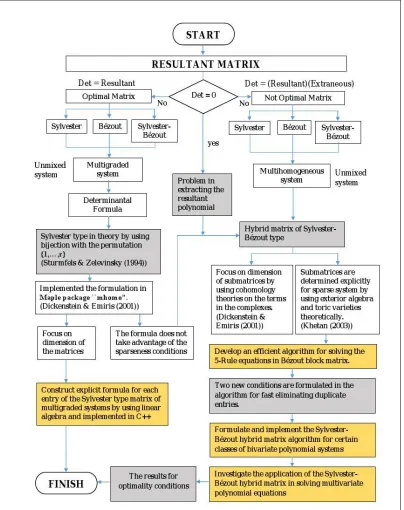
13
14
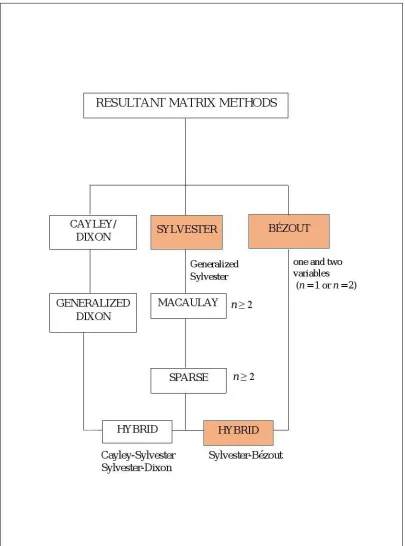
Figure 1.3 shows resultant matrix methods, and the coloured boxes are the methods involve in this research. The main resultant matrix method in this thesis is hybrid Sylvester-B´ezout.
1.9 Thesis Organization
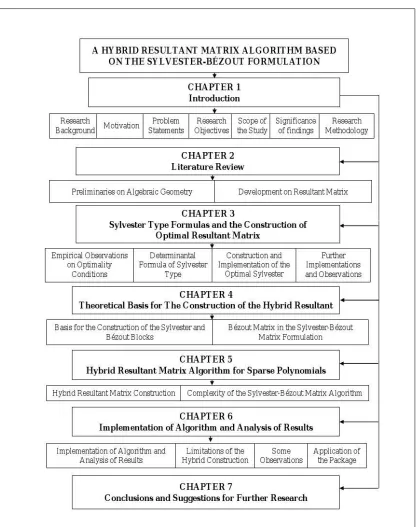
The first chapter serves as an introduction to the whole thesis. This chapter introduces the concept of resultants. Chapter 1 also includes motivation of this research, problem statements, research objectives, scope of the study as well as significant of findings.
Chapter 2 presents the literature review of this research. This chapter is divided into two parts. Firstly is on various works by different researchers regarding the development or construction of resultant matrices ranging from classical work to modern approach are presented. Secondly, this chapter presents the preliminary research work on resultant and mixed volume. In order to determine whether a smaller possible matrix or an optimal matrix have been obtained, computation of the mixed volume and the determinant of the resultant matrix is applied. Mixed volume computation has relation with algebraic geometry and combinatoric basis. The “multires” package in Maple software is used to compare the size of sparse resultant matrices with the mixed volume, so the optimal or smallest matrix can be determined. Based on the literature review and preliminary empirical observations of existing methods, it is important to utilize the structure of the Newton polytopes of the polynomial system to produce the desired matrix with smallest possible dimension. Moreover the mixed volume of the Minkowski sum of the convex polytopes computation is very efficient to predict the number of roots for such systems.
15
determines the corresponding linear map and dimension of the matrix is developed. This extends the ”mhomo” package which only computes the matrix dimension without explicitly computing the entries of the resultant matrix.
Chapter 4 presents the formulation of the B´ezout matrix for sparse polynomials. Some theoretical basis of algebraic geometry and the combinatorial approach used for the construction of the Sylvester-B´ezout hybrid matrix, in particular for the entries of B´ezout matrices are presented. The notion of toric varieties such as cones and fans, projective space and divisor D = P
aiDi that determines a convex polytope are applied in the
formulation.
Chapter 5 provides the details of the Sylvester-B´ezout hybrid matrix algorithm for unmixed bivariate sparse polynomial systems which belongs to a class of multigraded system. The algorithm comprises four phases. The important subroutines are presented in terms of pseudo codes. In addition, the complexity of the algorithm is also discussed in this chapter.
The results of implementation of the hybrid Sylvester-B´ezout resultant matrix algorithm are presented in Chapter 6. In this chapter, the unmixed bivariate polynomial equations are categorized into several cases, so that the results can be analysed and generalized. In addition an application of the algorithm to the problem of optimization a variable in the unmixed bivariate polynomial system and to determine the solutions of such system is presented. Besides the C++ package, Maple software is also used to assist the computations in this chapter.
Chapter 7 presents the conclusion which highlights the contribution of the thesis and include suggestions to further work.
16
143
type matrix. A Sylvester-type matrix based on the permutation on the set{1,2, . . . , r} which forms the row and column spaces of certain linear maps of the resultant matrix have been constructed. The work in [14] only displays the dimensions of the Sylvester-type resultant matrix for multihomogeneous systems and is implemented in the Maple package. The Sylvester-type matrix algorithm in this thesis is implemented in C++ and determines the vector spaces that defines the linear map and the Sylvester-type resultant matrix for the class of multigraded systems. Thus this research applies an alternative method of constructing optimal matrices extending the work in [14] by providing the matrix, focusing on the multigraded systems.
Secondly, the efficient algorithm is developed for solving the 5-Rule equations such that the systematic procedures are formulated based on Theorem 4.2. Besides the determination of the homogenizing variables given by Definition 4.5, the 5-Rule is the main component and basis in developing the algorithm for constructing the B´ezout block in the hybrid Sylvester-B´ezout resultant matrix. The theoretical concepts of toric varieties such as hyperplane, cones, fan and divisors in the formulation of the 5-Rule have been investigated. The formulation of the 5-Rule is due to [6] and this work proceed to solve the inequalities given by the rule and determines the entries of B´ezout matrix. Two conditions have been proposed in the algorithm for effectiveness and efficiency eliminating duplicate elements. The algorithm is also implemented in C++. Thus the application and implementation of Theorem 4.2 have been realized with the development of the Sylvester-B´ezout matrix algorithm and C++ package.
Thirdly, the results of the implementation of the Sylvester-B´ezout resultant matrix algorithm have been analyzed and generalized. The analysis is based on several cases of unmixed polynomial equations and conditions that give an optimal matrix in the Sylvester-B´ezout formulation have been derived and proven.
144
7.3 Suggestions for Further Research
This study is an application of algebraic geometry. However there are still many problems to be resolved further as listed below.
• Systems that do not fall in the class of multigraded systems may not have a determinantal formula. Therefore, optimal matrix for such system cannot be derived. This observation is illustrated in Section 3.5 by presenting three systems which are not multigraded, which do not have a Sylvester-type formula. For such cases, Dickenstein and Emiris [14] proposed the hybrid matrix for one of the examples whereby the system is not multigraded of type (3,2;2,3). However the proposed hybrid matrix is not shown explicitly. [14] only gives the dimension of the submatrices that can lead to a hybrid matrix construction. The study on cohomologies and its complexes can be further investigated in order to derive the hybrid resultant matrix proposed in [14].
• In this thesis the new hybrid Sylvester-B´ezout matrix algorithm cannot be applied to some cases of multigraded system that have a Newton polytope such that the edges of the Newton polytope are parallel to xy-axis. The algorithm fails to produce the B´ezout block and is due the number of partitions of the fan associated with the system. The method of partition is mainly based on Khetan’s formulation in [6]. The theoretical bases of this formulation needs further investigation to be able to handle these cases in future.
REFERENCES
[1] Sederberg, T. W. Applications to computer-aided geometric design. In Cox, D. and Sturmfels, B. (Eds.). Applications of Computational Algebraic Geometry: Short Course, San Diego, California. Rhode Island, USA: AMS. 67–89. 1997.
[2] Canny, J. F. The Complexity of Robot Motion Planning. MIT Cambridge Mass: Ph.D. Thesis. 1987.
[3] Chionh, E. W. Base Points, Resultants, and The Implicit Representation of Rational Surface. University of Waterloo: Ph.D. Thesis. 1990.
[4] Chtcherba, A. D. A New Sylvester-type Resultant Method based on the Dixon-Bezout Formulation. Dept. Computer Science, University of New Mexico, Mexico:
Ph.D. Thesis. 2003.
[5] Emiris, I. Z.Sparse Elimination and Applications in Kinematics. Computer Science Division, University of California, Berkeley: Ph.D. Thesis. 1995.
[6] Khetan, A. Formulas for Resultant. Graduate Division, University of California, Berkeley: Ph.D. Thesis. 2003.
[7] Chionh, E. W., Zhang, M. and Goldman, R. Implicitization matrices in the style of Sylvester with the order of B´ezout. Curve and Surface Design: Saint Malo 1999. 2000: 17–26.
[8] Dietz, R., Hoschek, J. and J¨uttler, B. An algebraic approach to curves and surfaces on the sphere and other quadrics. Computer Aided Geometric Design. 1993. 10: 211–229.
[9] Manocha, D. Algebraic and Numeric Techniques for Modeling and Robotics. Computer Science Division, University of California, Berkeley: Ph.D. Thesis. 1992. [10] Canny, J. F. and Emiris, I. Z. A Subdivision-Based Algorithm for the Sparse
146
[11] Sturmfels, B. Introduction to resultants. In Cox, D. and Sturmfels, B. (Eds.). Applications of Computational Algebraic Geometry: Short Course, San Diego,
California. Rhode Island, USA: AMS. 25–39. 1997.
[12] Gelfand, I., Kapranov, M. and Zelevinsky, A. (Eds.). Discriminants, Resultants and Multidimensional Determinants: Math. Theory Appl. Boston: Modern Birkhuser Classics. 2008.
[13] Emiris, I. Z. Toric Resultants and Applications to Geometric Modeling. In Dickenstein, A. and Emiris, I. Z. (Eds.). Algorithms and Computation in Mathematics. Berlin: Springer-Verlag. vol. 14. 267–285. 2005.
[14] Dickenstein, A. and Emiris, I. Z. Multihomogeneous resultant formulae by means of complexes. Journal of Symbolic Computation. 2003. 36: 317–342.
[15] Sturmfels, B. and Zelevinsky, A. Multigraded resultants of Sylvester type. Journal of Algebra. 1994. 163: 115–127.
[16] Emiris, I. Z. and Canny, J. F. A practical method for the sparse resultant. InProc. ACM-ISSAC, Kiev, Ukraine. 1993. 183–192.
[17] Bi, J., Cheng, Q. and Rojas, J. M. Sub-linear root detection and new hardness results for sparse polynomials over finite fields. ISSAC’13 Proceeding of the 38th International Symposium on Symbolic Algebraic Computation. ACM New York
USA. 2013. 61–68.
[18] Emiris, I. Z., Fisikopoulos, V., Konaxis, C. and Pe¨navanda, L. An output-sensitive algorithm for computing projections of resultant polytopes. Proceeding of the 28th Annual Symposium on Computational Geometry. ACM New York USA. 2012. 179–
188.
[19] Dickenstein, A., Emiris, I. Z. and Fisikopoulos. Combinatorics of 4-dimensioal resultant polytopes. Proceeding of the 38th International Symposium on Symbolic and Algebraic Computation. ACM New York USA. 2013. 173–180.
[20] Emiris, I. Z., Konaxis, C. and Zafeirakopoulos, Z. Minkowski decomposition and geometric predicates in sparse implicitization. Proceeding of the 40th International Symposium on Symbolic and Algebraic Computation. ACM New York USA. 2015.
147
[21] Canny, J. F. and Emiris, I. Z. An Efficient Algorithm for the Sparse Mixed Resultant. InLNCS Proceedings of AAECC. Berlin, German: Springer-Verlag. 1993. 89–104. [22] Huber, B. and Sturmfels, B. Bernstein’s Theorem in Affine Space. vol. 17. New
York: Springer-Verlag. 1997.
[23] Sturmfels, B. Polynomial Equations and Convex Polytopes. The Amer. Maths. Monthly. 1998. 105(10): 907–621.
[24] Canny, J. F. and Pederson, P. An Algorithm for Newton resultant. Technical Report. Computer Science Department, Cornell University. 1993. Tech. Report 1394. [25] Saxena, T. Efficient variable elimination using resultants. Computer Science
Department, State University of New York, Albany, College of art and sciences: Ph.D. Thesis. 2007.
[26] Kushnirenko, A. G. Newton polytopes and the B´ezout theorem. Functional Anal. Appl.. 1976. 10: 233–235.
[27] Khovanskii, A. G. Newton polytopes and toric varieties. Functional Anal. Appl.. 1977. 11: 289–298.
[28] Cox, D. A., Little, J. and O’Shea, D. (Eds.). Using Algebraic Geometry, Graduate Texts in mathematics. vol. 185. New York: Springer-Verlag. 2005.
[29] Emiris, I. Z. and Canny, J. F. Efficient incremental algorithms for the sparse resultant and the mixed volume. Journal of Symbolic Computation. 1995. 20: 117–149. [30] Sturmfels, B. On the Newton polytope of the resultant. Journal of Algebraic
Combinatorics. 1994. 3: 207–236.
[31] Cox, D. A. B´ezoutians and tate resolutions. Journal of Algebra. 2007. 311: 606– 618.
[32] Guckenheimer, J., Mayers, M. and Sturmfels, B. Computing Hopf bifurcations. SIAM Journal of Numerical Analysis. 1997. 34: 1–21.
[33] Wampler, C. W. B´ezout number calculations for multi-homogeneous polynomial systems. Appl. Math. & Computation. 1992. 51: 143–157.
148
[35] Chtcherba, A. D. and Kapur, D. Conditions for Exact Resultants using the Dixon Formulation. In Proc. ISSAC’00, St. Andrew, Scotland. New York: ACM. 2000. 62–70.
[36] Cox, D. A., Little, J. and O’Shea, D. (Eds.). Ideals, Varieties, and Algorithms: an introduction to computational algebraic geometry and commutative algebra.
Second edition. New York: Springer-Verlag. 1996.
[37] Cox, D. A. What is a Toric Variety? Topics in algebraic geometry and geometric modeling. Contemporary Mathematics. 2003. 334: 203–223.
[38] Eisenbud, D., Grayson, D. R. and Stillman, M. E. Using Macaulay 2. In Vasconcelos, W. (Ed.). Algorithms and Computation in Mathematics: Computational Methods in Commutative Algebra and Algebraic Geometry. Berlin:
Springer-Verlag. vol. 2. 367–391. 2004.
[39] Pan, V. Y. Solving a Polynomial Equation : Some history and recent progress.SIAM REV. 1997. 39(2): 187–220.
[40] Kolodny, R., Leonidas, G. and Koehl, M. L. P. Inverse Kinematics in Biology : The Protein Loop Closure Problem. The International Journal of Robotics Research. 2005. 24(2–3): 151–163.
[41] Manocha, D., Zhu, Y. S. and Wright, W. Conformational-analysis of molecular chains using nano kinematics. Computer Application of Biological Sciences. 1995. 11: 71–86.
[42] Wang, D. Computational Polynomial Algebra and its Biological Applications. Algebraic Biology. 2005: 127–137.
[43] Dietz, R., Hoschek, J. and J¨uttler, B. Rational patches on quadratic surfaces. Computer Aided Geometric Design. 1995. 27: 27–40.
[44] Peternell, M., Pottmann, H. and Ravani, B. On the computational geometry of ruled surfaces. Computer-aided Design. 1999. 13: 17–32.
[45] Kapur, D., Saxena, T. and Yang, L. Algebraic and geometric reasoning using the Dixon resultants. In Proceedings ISSAC’94, Oxford, England. New York: ACM. 1994. 99–107.
149
[47] Emiris, I. Z. and Pan, V. Y. Symbolic and Numeric Methods for Exploiting Structure in Constructing Resultant Matrices. Journal of Symbolic Computation. 2002. 33: 393–413.
[48] D’Andrea, C. Macaulay-style formulas for the sparse resultant. Trans. Of the AMS. 2002. 354(7): 2595–2629.
[49] D’Andrea, C. and Emiris, I. Z. Hybrid sparse resultant matrices for bivariate polynomials. Journal of Symbolic Computation. 2002. 33(5): 587–608.
[50] Cattani, E., Dickenstein, A. and Sturmfels, B. Residues and resultants. Journal Mathematical Sciences. 1998: 119–148.
[51] D’Andrea, C. and Dickenstein, A. Explicit formulas for the multivariate resultant. Journal of Pure Appl. Algebra. 2001. 164(1–2): 59–86.
[52] Chtcherba, A. D. and Kapur, D. Exact resultants for corner-cut unmixed multivariate polynomial systems using the Dixon formulation. Journal of Symbolic Computation. 2003. 36(3–4): 289–315.
[53] Khetan, A. The resultant of an unmixed bivariate system. Journal of Symbolic Computation. 2002. 36: 425–442.
[54] Khetan, A. Exact matrix formula for the unmixed resultant in three variables. Journal of Pure Appl. Algebra. 2005. 198: 237–256.
[55] Huber, B. and Sturmfels, B. A polyhedral method for solving sparse polynomial systems. Mathematics of Computation. 1995. 64: 1541–1555.
[56] Mantzaflaris, A. Study of Multihomogeneous Polynomial Systems via Resultant Matrices. Dept of Informatics and Telecoms, University of Athens, Greece: Master’s Thesis. 1989.
[57] Choinh, E. W. Rectangular corner cutting and Dixon A-resultants. Journal of Symbolic Computation. 2001. 31(6): 651–669.
[58] Zhang, M. and Goldman, R. Rectangular corner cutting and Sylvester A-resultants. Proc. of the ISSAC, St. Andrews, Scotland. 2000: 301–308.
150
[60] Chionh, E. W., Zhang, M. and Goldman, R. Transformations and Transitions from the Sylvester to the B´ezout Resultant. In citeseerx.ist.psu.edu/viewdoc/download?doi=10.1.1.47.309. 2000: 1–12.
[61] Emiris, I. Z. and Pan, V. Y. The structure of sparse resultant matrices. InProceeding ISSAC’97, Hawaii. New York: ACM. 1997. 189–196.
[62] D’Andrea, C. and Emiris, I. Z. Computing Sparse Projection Operators. In E. L. Green, R. C. L., S. Hosten and Powers, V. A. (Eds.). Symbolic Computation: Solving Equations in Algebra, Geometry and Engineering. Providence, RI: AMS.
vol. 286. 121–139. 2001.
[63] Emiris, I. Z. and Mantzaflaris, A. Multihomogeneous resultant formulae for systems with scaled support. In Proceeding ISSAC’09, Seoul, Korea. New York: ACM. 2009. 143–150.
[64] Chtcherba, A. D. and Kapur, D. Conditions for Determinantal Formula for Resultant of a Polynomial System. In Proc. ISSAC’06, Genova, Italy, July 9-12. New York: ACM. 2006. 55–62.
[65] Emiris, I. Z. Using The Maple Multires Package. Source code available at: http://www.sop.inria.fr/galaad/logiciel/multires.html. 2003.
[66] Chtcherba, A. D. and Kapur, D. A complete analysis of resultants and extraneous factors for unmixed bivariate polynomial systems using the Dixon formulation.
Technical Report. Computer Science Department, Univ. of New Mexico. 2001. TR-CR-2001-36.
[67] Chionh, E. W., Goldman, R. and Zhang, M. Hybrid Dixon resultant. InProc. 8th IMA Conf. Math. Of Surfaces. 1998. 193–212.
[68] Sun, W. and Li, H. On the Construction of Generic Mixed Cayley-Sylvester Resultant Matrix. MM Research preprints. 2005. 24: 117–137.
[69] Khetan, A. Determinantal formula for the Chow form of a toric surface. In Proceedings ISSAC’02. New York: ACM. 2002. 145–150.
[70] Eisenbud, D., Floystad, G. and Schreyer, F. O. Sheaf cohomology and free resolutions over exterior algebras. Trans. Amer. Math. Soc.. 2003. 355: 4397–4426. [71] Cox, D. A. The homogeneous coordinate ring of a toric variety.Journal of Algebraic