Communication
1
Exploring High-Symmetry
Lanthanide-2
Functionalized Polyoxopalladates as Building Blocks
3
for Quantum Computing
4
José J. Baldoví 1,*, Aleksandar Kondinski 2,*
5
1 Max Planck Institute for the Structure and Dynamics of Matter, Luruper Chaussee 149, DE-22761
6
Hamburg, Germany;
7
2 Department of Chemistry, KU Leuven, Celestijnenlaan 200F, B-3001 Leuven, Belgium;
8
* Correspondence: [email protected] Tel.: +49 (0)40-8998-88324,
9
[email protected] Tel.: +32 16 37 29 41;
10
11
Abstract: The structural, electronic and magnetochemical properties of the star-shaped
12
polyoxopalladate [Pd15O10(SeO3)10]10− (POPd) and its lanthanide functionalized derivatives have
13
been investigated on the basis of density functional theory followed by a ligand field analysis using
14
the Radial Effective Charge (REC) model. Our study predicts that heteroPOPd is a robust cryptand
15
that enforces D5h symmetry around the encapsulated Ln3+ centers. This rigid coordination
16
environment favors interesting potential magnetic behavior in the Er and Ho derivatives, which
17
may be of interest for molecular spintronics and quantum computing applications.
18
Keywords: lanthanides, single-ion magnets, spin qubits, polyoxopalladates, density functional
19
theory.
20
21
1. Introduction
22
Quantum computing is an emerging area of research based on the explicit use of
quantum-23
mechanical phenomena to implement logic operations for the purposes of highly-efficient
24
information and communication technologies. In contrast to conventional computers which store
25
information in one of the two definite states ‘0’ or ‘1’, the basic units of a quantum computer are
26
quantum bits (qubits), which can be a superposition of the basis states. Within this new paradigm,
27
magnetic molecules are quantum two-levels systems that have been proposed as promising
28
candidates to build up quantum computers.1-6 In this regard, magnetic molecules exhibit remarkable
29
structural and chemical versatility, tunable physicochemical properties and inherent scalability,
30
considering the enormous opportunities of (self-)organization.7 Although the current prospects for
31
their technological implementation remain elusive due to challenges such as loss of quantum
32
coherence,8 many recent advances in the field have been encouraging. 9-14
33
In this context, polyoxometalate (POM) chemistry has shown some advantageous chemical,
34
structural and electronic features such as robustness, highly-symmetrical encapsulating
35
environments and absence of nuclear spins around the magnetic ion.15 Indeed, lanthanide-based
36
polyoxometalates (POMs) are among the first examples of single-ion magnets (SIMs)16 and have also
37
contributed to the field of molecular spin qubits.17,18 Some relevant examples in molecular magnetism
38
include two families of lanthanide-containing polyoxomolybdates19 and the cube-shaped
39
polyoxopalladates (POPds).20
40
In this work, we focus on a different series of lanthanide-containing POPds as model systems
41
with the aim to rationally design new molecular nanomagnets. This polynuclear, negatively charged
42
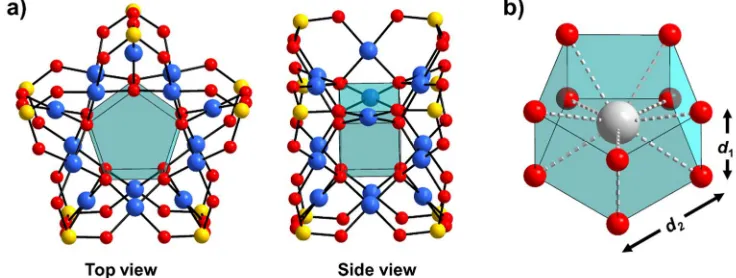
nanocluster is the star-shaped Delferro-Hu [Pd15Se10O40]10− (1) polyanion (Figure 1a)21,22 which exhibits
43
internal cavity defined by ten oxo ligands positioned at the vertices of a virtual pentagonal prism that
44
is suitable for encapsulation of metal cations and water molecules (Figure 1b).21-25 In comparison to
45
the other available phosphate or phenyl arsenate capped derivatives,21-25 its chemical structure
46
exhibits relatively low negative charge and the lowest number of atoms, whereas it retains the high
47
overall D5h symmetry. Using density functional theory (DFT) we initially explore the diamagnetic
48
[NaPd15Se10O40]9− (1-Na) POPd system and we find a suitable level of theory that can accurately
49
estimate the geometry of the inner cavity. As a second step, we calculate and discuss the structural
50
and electronic properties of three lanthanide encapsulating model systems with general formula
51
[LnPd15Se10O40]7−, where Ln = La(1-La), Gd(1-Gd) and Lu(1-Lu). Finally, we use the optimized
52
molecular geometry of the Gd3+ derivative to explore the spin energy levels and ground doublet
53
composition of the Tb3+(1-Tb), Dy3+(1-Dy), Ho3+(1-Ho) and Er3+(1-Er) derivatives. Our approach
54
provides an inexpensive estimation of the potential of these analogues as molecular nanomagnets.
55
56
Figure 1. Combined polyhedral and ball-and-stick representation polyanion 1 (a) with detail on the
57
inner cavity suitable for encapsulation of metal cations (b). The assigned d1 and d2 refer to interatomic
58
O∙∙∙O distances that define the size of the inner cavity (vide infra). Color code: Se = yellow, Pd = blue
59
and O = red spheres, {O10}/{MO10} = cyan transparent polyhedra.
60
2. Results and Discussion
61
2.1. Structural and electronic properties
62
The structural and electronic properties of 1, 1-Na, 1-La, 1-Gd and 1-Lu were investigate by
63
means of relativistic density functional theory (DFT) as implemented in the ADF code.26 The geometry
64
of 1-Na in water was followed at different theoretical levels (Table S1) that have been previously
65
successfully used for an accurate estimation of the structure of noble metal-based POMs.27-30
66
Considering that for the ligand field analysis it is more essential to have geometries that primarily
67
provide an accurate estimation of positions of the oxo ligands that coordinate to the encapsulated
68
lanthanide centers, we have found that geometry optimization calculations of the model system
1-69
Na at BP86/TZ2P/ZSC/COSMO-water level provide the most accurate approximation of the
70
coordination environment around the Na+ center, while the Pd-O and Se-O bonds are also well
71
approximated (see Table S1). Subsequently, polyanions 1, 1-La, 1-Gd and 1-Lu were optimized at this
72
level as well. All insights on the electronic structure and bonding energies are discussed based on
73
single point calculation performed at (U)B3LYP/TZ2P/ZSC/COSMO-water level (see SI).
74
Our calculations show that polyanions 1, 1-Na, 1-La, 1-Gd and 1-Lu exhibit very narrow Se-O,
75
Pd-O(Pd), Pd-O(Se) bond lengths in the ranges of 1.731-1.733 Å, 1994-2.008 Å and 2.058-2.092 Å
76
respectively (Table S2). The interatomic distances d1(O∙∙∙O) and d2(O∙∙∙O) that define the internal
77
pentagonal cavity (Figure 1b) are found on the range of 2.646-2.701 Å and 2574-2672 Å respectively.
78
The changes induced by encapsulation of the different cations are on the range of < 0.1 Å, which
79
implies that the internal cavities are generally unaffected by the encapsulation. The calculated Ln-O
80
bonds/distances are in the range of 2.559-2.644 Å, which are characteristic for lanthanide-containing
81
POM systems.16-20
82
The optimized systems 1-La, 1-Gd and 1-Lu exhibit a gap energy of ca 3.5-3.6 eV between the
83
highest occupied and the lowest unoccupied molecular orbital (i.e. HOMO and LUMO). The high
84
gap energy is comparable to that of the reported polyanions 1 (3.4 eV) and 1-Na (3.5 eV), which
substantiates that the proposed lanthanide encapsulating systems exhibit significant intrinsic
86
stability making them promising candidates for future preparation (See Table S4). The HOMO in
87
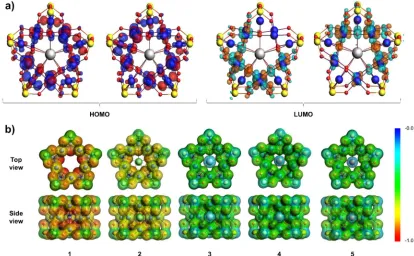
systems 1-La, 1-Gd and 1-Lu is doubly degenerate and is composed of Pd-centered - and -type
88
orbitals and O-centered p-type orbitals (Figure 2a). The LUMO in 1-La, 1-Gd and 1-Lu is also doubly
89
degenerate and populates mainly O and Pd centers but also minorly Se4+ and Ln3+ centers (Figure 2a).
90
The antibonding LUMO exhibits nodes between the Pd-centered -type orbitals and O-centered
91
p-type orbitals, suggesting that population of this molecular orbital (e.g. via electrochemical
92
reduction) can destabilize these bonds. The transition between the HOMO to LUMO corresponds
93
predominantly to d-d transitions accompanied by metal to ligand charge transfer (Pd O) (Table S5).
94
In our view polyanions 3-9 can be potentially prepared in two steps approach, where polyanions
95
1 or 2 serve as precursors and are reacted with the lanthanide trications to yield [LnPd15Se10O40]7−,
96
either by direct encapsulation or by Na+ cation exchange. Some aspects of the DFT calculations
97
substantiate this opportunity. First polyanions 1 and 1-Na exhibit pentagonal entrance defined by
98
five oxo ligands that is comparable in size to that of the Preyssler type polyoxoanions (Figure S1)
99
which is well-known to permeate lanthanide cations.16 The inscribed virtual radius of the pentagonal
100
entrance in 1 is ca. 1.79 Å, which is significantly larger than the effective ionic radius of the bare
101
lanthanide trications.31 Second, Mulliken charge analysis (Table S3) and molecular electrostatic
102
potential (Figure 2b) of 1 show that the inner oxygen atoms defining the inner cavity are highly
103
negatively charged and thus very nucleophilic. The high nucleophilicity of the inner cavity is the
104
driving force for encapsulation of Na+ showing favorable binding energies of -201.2 kcal/mol, which
105
is in line with the experimental evidence.21 In contrast the lanthanide trications show few times more
106
negative binding energies which increase along the lanthanide series (La3+ = -983.9 kcal/mol, Gd3+ =
-107
1031.1 kcal/mol and Lu3+ = -1060.6 kcal/mol).
108
109
110
Figure 2. (a) The doubly degenerate HOMO and LUMO of 1-La which is also representative for 1-Gd
111
and 1-Lu; (b) MEP plotted over the density isosurface of polyanions 1-5. Most negative potentials are
112
colored in red. All calculations are performed at (U)B3LYP/TZ2P/ZSC/COSMO-water level. Color
113
code: Se = yellow, Pd = blue and O = red spheres.
114
115
2.2. Ligand field analysis
116
Starting from the DFT-relaxed structure of the 1-Gd, we have applied the Radial Effective
117
Charge (REC) model using the SIMPRE computational package to the 1-Tb, 1-Dy, 1-Ho and 1-Er
derivatives.32,33 This parametric model introduces covalency effects by placing an effective charge at
119
an effective distance determined by a radial displacement Dr (see Section 5 of SI for details). One of
120
its main advantages is that, for similar families of homoleptic coordination complexes, such
121
parameters are reusable, allowing an inexpensive determination of the spectroscopic and magnetic
122
properties.34 Thus, we have taken advantage of the semi-empirical information of the recently reported
123
[LnPd12(AsPh)8O32]5− series20 to provide an estimation of the ligand field splitting of the ground-J
124
multiplet as well as the ground state composition of each derivative. As the coordination number in
125
these two families of POPds is different, 8 in the case of [LnPd12(AsPh)8O32]5− and 10 in
126
[LnPd15Se10O40]7− and we do not have access to the X-ray structures, we have explored different
127
possibilities for the REC parameters, always keeping constant the total f=DrZi product.35 The scanning
128
of the REC parameters at different levels of covalency allows us to evaluate the robustness of the
129
composition of the ground state with the aim of identifying which candidates are more suitable to
130
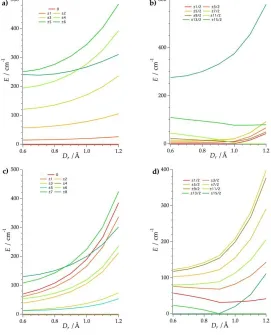
exhibit single-molecule magnet behavior. The resulting energy level pattern as a function of the value
131
of the radial displacement for 1-Tb, 1-Dy, 1-Ho and 1-Er is reported in Figure 3.
132
133
134
Figure 3. Energy level scheme of the (a) 1-Tb, (b) 1-Dy, (c) 1-Ho and (d) 1-Er as a function of Dr using
135
the REC model. The different colors indicate the main MJ contribution to the wave function.
136
137
A general trend that one can observe in the evolution of the energy levels versus Dr is that the
138
larger the covalent correction, the larger the total ligand field splitting. This is related with the 1/(RiK+1)
139
dependence of the k=2,4,6 ligand field parameters in the model, where Ri is the effective distance
140
between the point charge and the Ln3+ ion (see Section 5 of SI, equations 2a, 2b and 2c). Due to the
141
almost perfect D5h geometry around the lanthanide, the extradiagonal ligand field Bkq parameters,
142
which are responsible of the mixing between MJ microstates, are practically negligible. This results in
143
almost pure wave functions (~100% |MJ>) (Table S7). Regarding the ground state compositions, one
144
can notice that for the non-Kramers ions (1-Tb and 1-Ho) the same MJ is the most stable along our
exploration. In the case of 1-Tb, the equatorial geometry of {Pd15Se10O40} yields to a diamagnetic state
146
MJ = 0, whereas for 1-Ho the ground state is composed by two 4 microstates. This suggests that we
147
can practically discard the 1-Tb as a molecular nanomagnet, whereas the 1-Ho derivative is a
148
potential candidate as a two-level quantum system, as long as small distortions in the real structure
149
of the complex create a sufficiently large tunneling splitting between these two states.17 On the other
150
hand, the ground states of the 1-Dy and 1-Er derivatives present two different possibilities based on
151
our magnetostructural investigation. Thus, we cannot state accurately the main MJ contribution to
152
the ground doublet of these systems as it will be very sensitive to the real coordinates of the
153
compounds. However, whereas the 1-Dy analogue can be either 1/2 or 11/2, the 1-Er analogue is
154
clearly the most promising of the series, as the model consistently predicts a ground state determined
155
by a pure high MJ microstate (either 15/2 or 13/2). This preference of the polyoxoanion for
156
stabilizing larger spin microstates in 1-Er is a direct consequence of the equatorial distribution of the
157
electrostatic charge around the magnetic center5,36 Thus, according to our calculations, we can
158
conclude that compound 1-Ho presents an interesting composition of the ground state to design a
159
molecular spin qubit with possible operating points, whereas 1-Er has a very favorable coordination
160
environment to exhibit slow relaxation of the magnetization.
161
3. Conclusions
162
In summary, we have theoretically investigated the structural, electronic and magnetic
163
properties of a high-symmetry molecular structure based on POPds. Our calculations based on
164
density functional theory and a ligand field approach indicate that the rigid coordination
165
environment leads to almost pure spin states in all the systems of the series. The
equatorially-166
expanded charge distribution around the lanthanide favors the stabilization of a high-spin ground
167
doublet in the 1-Er derivative, which can be considered as a potential single-ion magnet. On the other
168
hand, the ground state of the 1-Ho derivative offers an interesting playground to break 4 degeneracy
169
through ligand-field-induced tunneling splitting which can be of interest for quantum computing
170
applications. Our efforts to shed more experimental light on these systems are currently underway.
171
172
Supplementary Materials: The following are available online at www.mdpi.com/xxx/s1. Figure S1: Combined
173
ball-and-stick and polyhedral representation of the [P5W30O110]15– polyanion shown in top (left) and side view
174
(right). Figure S2. Ball-and-stick representation depicting segment of the 1, 1-Na, 1-La, 1-Gd and 1-Lu polanions.
175
Figure S3: Spin density isosurface of 1-Gd indicating accumulation of α spins at the GdIII center as calculated at
176
UB3LYP/TZ2P/ZSC/COSMO level. Color code: Pd = blue, O = red, and Se = yellow spheres. Table S1:
177
Characteristic bond lengths of polyanion 1-Na system as calculated at different theoretical levels. Table S2
178
Characteristic bond lengths and interatomic distances in polyanions 1, 1-Na, 1-La, 1-Gd and 1-Lu as calculated
179
at BP/TZ2P/ZSC/COSMO-water levels. Table S3: Mulliken charge populations of 1, 1-Na, 1-La, 1-Gd and 1-Lu
180
obtained at (U)B3LYP/TZ2P/ZSC/ COSMO for different O atoms following the labeling in Figure S2. Table S4:
181
HOMO, LUMO and HOMO-LUMO gap (∆LUMO-HOMO) energies in eV of 1, 1-Na, 1-La, 1-Gd and 1-Lu,
182
calculated at (U)B3LYP/TZ2P/ZSC/COSMO. Table S5: Contributions (in %) of the Kohn-Sham orbitals centered
183
on palladium, oxygen, selenium and the incorporated cations to the HOMO and the LUMO orbitals of 1, 1-Na,
184
1-La, 1-Gd and 1-Lu. Table S6. Crystal-field parameters ( < >; Stevens notation) in cm-1 calculated for
1-185
Tb, 1-Dy, 1-Ho and 1-Er. Table S7. Ground multiplet energy level scheme (cm-1) and main |MJ> contributions to
186
the wave function calculated for 1-Tb, 1-Dy, 1-Ho and 1-Er.
187
Author Contributions: JJB conceived the original idea on this project. JJB and AK conceptualized the project,
188
generated, analyzed and discussed the results and contributed in writing the manuscript.
189
Funding: JJB thanks the EU for a Marie Curie Fellowship (H2020-MSCA-IF-2016-751047). AK thanks Research
190
Foundation Flanders (FWO) for postdoctoral research grant (166497/12Y9218N LV 5457).
191
Acknowledgments: Max Planck Institute for the Structure and Dynamics of Matter (MPSD) and KU Leuven are
192
thanked for research support.
193
References
195
1. Hill, S.; Edwards, R. S.; Aliaga-Alcalde, N.; Christou, G. Quantum Coherence in an Exchange-Coupled
196
Dimer of Single-Molecule Magnets. Science 2003, 302(5647), 1015–1018, DOI: 10.1126/science.1090082.
197
2. Cerletti, V.; Coish, W. A.; Gywat, O.; Loss, D. Recipes for spin-based quantum computing. Nanotechnology
198
2005, 16(4), R27, DOI: 10.1088/0957-4484/16/4/R01.
199
3. Bertaina, S.; Gambarelli, S.; Mitra, T.; Tsukerblat, B.; Müller, A.; Barbara, B. Quantum oscillations in a
200
molecular magnet. Nature 2008, 453, 203–206, DOI: 10.1038/nature06962.
201
4. Stamp, P. C. E.; Gaita-Ariño, A. Spin-based quantum computers made by chemistry: hows and whys. J.
202
Mater. Chem. 2009, 19 (12), 1718–1730, DOI:10.1039/B811778K.
203
5. Baldoví, J. J.; Cardona-Serra, S.; Clemente-Juan, J. M.; Coronado, E.; Gaita-Ariño, A.; Palii, A. Rational
204
Design of Single-Ion Magnets and Spin Qubits Based on Mononuclear Lanthanoid Complexes. Inorg. Chem.
205
2012, 51(22), 12565–12574, DOI: 10.1021/ic302068c.
206
6. Atzori, M.; Morra, E.; Tesi, L.; Albino, A.; Chiesa, M.; Sorace, L.; Sessoli, R. Quantum Coherence Times
207
Enhancement in Vanadium(IV)-based Potential Molecular Qubits: the Key Role of the Vanadyl Moiety. J.
208
Am. Chem. Soc. 2016, 138, 11234–11244, DOI: 10.1021/jacs.6b05574.
209
7. Gaita-Ariño, A.; Prima-García, H.; Cardona-Serra, S.; Escalera-Moreno, L.; Rosaleny, L. E.; Baldoví, J. J.
210
Coherence and organisation in lanthanoid complexes: from single ion magnets to spin qubits. Inorg. Chem.
211
Front. 2016, 3, 568-577, DOI: 10.1039/C5QI00296F.
212
8. Schleich, W. P. Quantum physics: Engineering decoherence. Nature 2000, 403, 256–257,
213
DOI:10.1038/35002223.
214
9. Goodwin, C. A. P.; Ortu, F.; Reta, D.; Chilton, N. F.; Mills, D. P. Molecular magnetic hysteresis at 60 kelvin
215
in dysprosocenium. Nature 2017, 548, 439–442, DOI: 10.1038/nature23447.
216
10. Guo, F.‐S.; Day, B. M.; Chen, Y.‐C.; Tong, M.‐L.; Mansikkamäki, Akseli; Layfield, R. A. A Dysprosium
217
Metallocene Single‐Molecule Magnet Functioning at the Axial Limit. Angew. Chem., Int. Ed. 2017, 56, 11445–
218
11449, DOI: 10.1002/anie.201705426.
219
11. Zadrozny, J. M.; Niklas, J.; Poluektov, O. G.; Freedman, D. E. Millisecond Coherence Time in a Tunable
220
Molecular Electronic Spin Qubit. ACS Cent. Sci. 2015, 1 (9), 488–492, DOI: 10.1021/acscentsci.5b00338.
221
12. Bader, K.; Dengler, D.; Lenz, S.; Endeward, B.; Jiang, S.-D.; Neugebauer, P.; van Slageren, J. Room
222
temperature quantum coherence in a potential molecular qubit. Nat. Commun. 2014, 5, 5304, DOI:
223
10.1038/ncomms6304.
224
13. Donati, F.; Rusponi, S.; Stepanow, S.; Wäckerlin, C.; Singha, A.; Persichetti, L.; Baltic, R.; Diller, K.; Patthey,
225
F.; Fernandes, E.; Dreiser, J.; Šljivančanin, Ž.; Kummer, K.; Nistor, C.; Gambardella, P.; Brune, H. Magnetic
226
remanence in single atoms. Science 2016, 352, 318–321, DOI: 10.1126/science.aad9898.
227
14. Escalera-Moreno, L.; Baldoví, J.J.; Gaita-Ariño, A.; Coronado, E. Spin states, vibrations and spin relaxation
228
in molecular nanomagnets and spin qubits: a critical perspective. Chem. Sci. 2018, 9, 3265-3275, DOI:
229
10.1039/C7SC05464E.
230
15. Clemente-Juan, J. M.; Coronado, E.; Gaita-Ariñoa, A. Magnetic polyoxometalates: from molecular
231
magnetism to molecular spintronics and quantum computing. Chem. Soc. Rev. 2012, 41(22), 7464–7478, DOI:
232
10.1039/c2cs35205b.
233
16. Cardona-Serra, S.; Clemente-Juan, J. M.; Coronado, E.; Gaita-Ariño, A.; Camón, A.; Evangelisti, M.; Luis,
234
F.; Martínez-Pérez, M. J.; Sesé, J. Lanthanoid Single-Ion Magnets Based on Polyoxometalates with a 5-fold
235
Symmetry: The Series [LnP5W30O110]12– (Ln3+ = Tb, Dy, Ho, Er, Tm, and Yb). J. Am. Chem. Soc. 2012, 134 (36),
236
14982–14990, DOI: 10.1021/ja305163t.
237
17. Shiddiq, M.; Komijani, D.; Duan, Y.; Gaita-Ariño, A.; Coronado, E.; Hill, S. Enhancing coherence in
238
molecular spin qubits via atomic clock transitions. Nature 2016, 531, 348–35, DOI: 10.1038/nature16984.
239
18. Baldoví, J.J.; Cardona-Serra, S.; Clemente-Juan, J. M.; Coronado, E.; Gaita-Ariñoa, A.; Prima-García, H.
240
Coherent manipulation of spin qubits based on polyoxometalates: the case of the single ion magnet
241
[GdW30P5O110]14−. Chem. Commun. 2013, 49, 8922–8924, DOI: 10.1039/C3CC44838J.
242
19. Baldoví, J.J.; Duan, Y.; Bustos, C.; Cardona-Serra, S.; Gouzerh, P.; Villanneau, R.; Gontard, G.;
Clemente-243
Juan, J. M.; Gaita-Ariño, A.; Giménez-Saiz, C.; Proust, A.; Coronado, E. Single ion magnets based on
244
lanthanoid polyoxomolybdate complexes. Dalton Trans. 2016, 45, 16653-16660, DOI: 10.1039/C6DT02258H.
245
20. Baldoví, J.J; Rosaleny, L. E.; Ramachandran, V.; Christian, J.; Dalal, N. S.; Clemente-Juan, J. M.; Yang, P.; U.
246
polyoxopalladates: design criteria to enhance quantum coherence. Inorg. Chem. Front. 2015, 2, 893-897, DOI:
248
10.1039/C5QI00142K.
249
21. Delferro, M.; Graiff, C.; Elviri, L.; Predieri, G. Self-assembly of polyoxoselenitopalladate nanostars [Pd15(μ3
-250
SeO3)10(μ3-O)10Na]9− and their supramolecular pairing in the solid state. Dalton Trans. 2010, 39, 4479-4481,
251
DOI: 10.1039/B927537A.
252
22. Lin, Z.-G.; Wang, B.; Cao, J.; Chen, B.-K.; Gao, Y.-Z.; Chi, Y.-N.; Xu, C..; Huang, X.-Q.; Han, R.-D.; Su,
253
Shuang-Yue; Hu, C.-W. Cation-Induced Synthesis of New Polyoxopalladates. Inorg. Chem. 2012, 51 (8),
254
4435–4437 DOI: 10.1021/ic300428g.
255
23. Yang, P.; Xiang, Y.; Lin, Z.; Lang, Z.; Jiménez-Lozano, P.; Carbó, J. J.; Poblet, J. M.; Fan, L.; Hu, C.; Kortz, U.
256
Discrete Silver(I)-Palladium(II)-Oxo Nanoclusters, {Ag4Pd13} and {Ag5Pd15}, and the Role of Metal-Metal
257
Bonding Induced by Cation Confinement. Angew. Chem. Int. Ed. 2016, 55, 15766-15770, DOI:
258
10.1002/anie.201608122.
259
24. Xu, F.; Scullion, R. A.; Yan, J.; Miras, H. N.; Busche, C.; Scandurra, A.; Pignataro, B.; Long, D.; Cronin, L. A
260
Supramolecular Heteropolyoxopalladate {Pd15} Cluster Host Encapsulating a {Pd2} Dinuclear Guest:
261
[PdII2⊂{H7PdII15O10(PO4)10}]9−. J. Am. Chem. Soc. 2011, 133, 4684-4686, DOI: 10.1021/ja1105514.
262
25. Izarova, N. V.; Biboum, R. N.; Keita, B.; Mifsud, M.; Arends, I. W. C. E.; Jameson, G. B.; Kortz, U.
Self-263
assembly of star-shaped heteropoly-15-palladate(II). Dalton Trans. 2009, 9385-9387, DOI: 10.1039/B917079K.
264
26. (a) te Velde, G.; Bickelhaupt, F. M.; Baerends, E. J.; Guerra, C. F.; Van Gisbergen, S. J. A.; Snijders, J. G.;
265
Ziegler, T. J. Comput. Chem. 2001, 22, 931– 967, DOI: 10.1002/jcc.1056. (b) ADF 2017, SCM, Theoretical
266
Chemistry, Vrije Univesity, Amsterdam, The Netherlands, http://www.scm.com.
267
27. Izarova, N.; Lin, Z.; Yang, P.; Kondinski, A.; Vankova, N.; Heine, T.; Kortz, U. The polyoxo-22-palladate(II),
268
[Na2PdII22O12(AsVO4)15(AsVO3OH)]25−. Dalton Trans. 2016, 45, 2394-2398, DOI: 10.1039/C5DT04526F.
269
28. Kondinski, A.; Vankova, N.; Schinle, F.; Jäger, P.; Hampe, O.; Kortz, U.; Heine, T. How Counterions Affect
270
the Solution Structure of Polyoxoaurates: Insights from UV-Vis Spectral Simulations and Electrospray Mass
271
Spectrometry. Eur. J. Inorg. Chem. 2014, 3771–3778, DOI: 10.1002/ejic.201402494.
272
29. Izarova, N.; Kondinski, A.; Vankova, N.; Heine, T.; Jäger, P.; Schinle, F.; Hampe, O.; Kortz, U. The mixed
273
gold-palladium polyoxo-noble-metalate, [NaAuIII4PdII8O8(AsO4)8]11−. Chem. Eur. J. 2014, 20, 8556–8560, DOI:
274
10.1002/chem.201403032.
275
30. Barsukova‐Stuckart, M.; Izarova, N. V.; Barrett, R.; Wang, Z.; van Tol, J.; Kroto, H. W.; Dalal, N. S.; Keita,
276
B.; Heller, D.; Kortz, U. 3 d Metal Ions in Highly Unusual Eight‐Coordination: The Phosphate‐Capped
277
Dodecapalladate(II) Nanocube. Chem. Eur. J. 2012, 18, 6167-6171, doi:10.1002/chem.201200060.
278
31. Shannon, R. D. Revised Effective Ionic Radii and Systematic Studies of Interatomie Distances in Halides
279
and Chaleogenides. Acta Cryst., 1976, A32, 751-767, DOI: 10.1107/S0567739476001551.
280
32. Baldoví, J. J.; Borrás-Almenar, J. J.; Clemente-Juan, J. M.; Coronado, E.; Gaita-Ariño, A. Modeling the
281
properties of lanthanoid single-ion magnets using an effective point-charge approach. Dalton Trans. 2012,
282
41, 13705-13710, DOI: 10.1039/C2DT31411H.
283
33. Baldoví, J. J.; Cardona-Serra, S.; Clemente-Juan, J. M.; Coronado, E. Gaita-Ariño, A.; Palii, A. SIMPRE: A
284
software package to calculate crystal field parameters, energy levels, and magnetic properties on
285
mononuclear lanthanoid complexes based on charge distributions. J. Comput. Chem. 2013, 34, 1961-1967,
286
DOI: 10.1002/jcc.23341.
287
34. Baldoví, J.J.; Duan, Y.; Morales, R.; Gaita-Ariño, A.; Ruiz E.; Coronado, E. Rational Design of Lanthanoid
288
Single-Ion Magnets: Predictive Power of the Theoretical Models. Chem. Eur. J. 2016, 22, 13532-13539, DOI:
289
10.1002/chem.201601741.
290
35. Baldoví, J. J.; Gaita-Ariño, A.; Coronado, E. Modeling the magnetic properties of lanthanide complexes:
291
relationship of the REC parameters with Pauling electronegativity and coordination number. Dalton Trans.
292
2015, 44, 12535–12538, DOI: 10.1039/C5DT01839K.
293
36. Rinehart. J.D.; Long, J.R. Exploiting single-ion anisotropy in the design of f-element single-molecule
294
magnets. Chem. Sci. 2011, 2, 2078-2085, DOI: 10.1039/C1SC00513H.