Article
Probabilistic Substrate Classification with
Multispectral Acoustic Backscatter: A Comparison of
Discriminative and Generative Models
Daniel Buscombe1,∗, and Paul E. Grams2
1 School of Earth & Sustainability, Northern Arizona University, Flagstaff, AZ; [email protected] 2 U.S. Geological Survey, Southwest Biological Science Center, Grand Canyon Monitoring & Research
Center, Flagstaff, AZ; [email protected] * Correspondence: [email protected]
Abstract: We propose a probabilistic graphical model for discriminative substrate characterization, to support geological and biological habitat mapping in aquatic environments. The model, called a fully connected conditional random field (CRF), is demonstrated using multispectral and monospectral acoustic backscatter from heterogeneous seafloors in Patricia Bay, British Columbia, and Bedford Basin, Nova Scotia. Unlike previously proposed discriminative machine learning algorithms, the CRF model considers both the relative backscatter magnitudes of different substrates and their relative proximities. The model therefore combines the statistical flexibility of a machine learning algorithm with an inherently spatial treatment of the substrate. The CRF model predicts substrates such that nearby locations with similar backscattering characteristics are likely to be in the same substrate class. The degree of proximity and allowable backscatter similarity are controlled by parameters that are learned from the data. CRF model results were evaluated against a popular generative model known as a Gaussian Mixture model that doesn’t include spatial dependencies, only covariance between substrate backscattering response over different frequencies. Both models are used in conjunction with sparse bed observations/samples in a supervised classification. A detailed accuracy assessment, including a leave-one-out cross-validation analysis, was performed using both models. Using multispectral backscatter, the GMM model trained on 50% of the bed observations resulted in a 75% and 89% average accuracies in Patricia Bay and Bedford Basin, respectively. The same metrics for the CRF model were 78% and 95%. Further, the CRF model resulted in a 91% mean cross-validation accuracy across four substrate classes at Patricia Bay, and a 99.5% mean accuracy across three substrate classes at Bedford Basin, which suggest that the CRF model generalizes extremely well to new data. This analysis also showed that the CRF model was much less sensitive to the specific number and locations of bed observations than the generative model, owing to its ability to incorporate spatial autocorrelation in substrates. The CRF approach therefore may prove to be a powerful ‘spatially aware’ alternative to other discriminative classifiers.
Keywords:multibeam echosounder; backscatter; multi-frequency; machine-learning
1. Introduction
High resolution bathymetry and acoustic backscatter can be gathered in a cost-effective manner over large areas in aquatic systems with multibeam sonar. Automated substrate classification for benthic habitat and geologic mapping is a growing area of research [1–3] due to the efficiency with which dense information on both terrain and substrates may be collected with a single instrument, driven by a pressing need for accurate substrate maps for the purposes of marine spatial planning and management, design of marine protected areas, fisheries resource management, maritime archeology, minerals exploration, and scientific research in the fields of submarine geology and benthic ecology [4,5]. Similar needs in freshwater environments are driving increasing use of multibeam backscatter
in rivers and lakes [6,7]. Recently, the appropriate collection and analysis of backscatter [8,9], including studies into the uncertainty [10] and repeatability [11] of backscatter measurements have made substrate acoustics a more accessible field for ecologists and geologists. The quantitative analysis of substrate topography has been reviewed by [12]. General overviews of substrate classification using multibeam acoustic backscatter are provided by [2,13].
Existing approaches to benthic substrate characterization using data collected by multibeam echosounders can be categorized as unsupervised, which determine the type and number of substrates from the data itself, or supervised (or ‘task-specific’) that estimate substrates based on some independent information about the distribution of sediments, such as physical samples or benthic photographs. Many unsupervised approaches employ analytical models that capture the physics of substrate-sound interactions [14,15] and are especially suitable for relatively simple clastic substrates at relatively low acoustic frequencies [6]. Supervised methods are more commonly used for heterogeneous substrates with a large biogenic component [4,16], especially at relatively high frequency (several hundred kilohertz) [17]. Supervised approaches typically require a set of training samples to find the relationship between relatively sparse ground-truth bed observations and features derived from multibeam data, to quantitatively describe the associated substrate [2]. Extrapolating this relationship to broad scales from limited observations requires robust spatial modeling. To that end, machine learning has proved a popular approach based on single frequency (monospectral) multibeam backscatter [4,18–20], for two principal reasons. First, the outputs are readily amenable to probabilistic interpretation, whereas quantification of spatially distributed uncertainty is more difficult to achieve using unsupervised approaches. Second, technological advances in collecting images of the bed using cabled and autonomous video systems [21] have been commensurate with advances in global positioning systems and inertial navigation, sonar hardware and automated substrate classification algorithms.
The goal of all probabilistic models for substrate classification is to find P(y|x), that is, the conditional probability distribution of a single discrete label y = yi given a vector of features xi assigned to grid node i = {1, . . . ,N}, where yi can take any value from a pre-defined set, M= {1, 2, . . .}, numeric labels each corresponding to an observed discrete substrate substrate type. Feature vectorxmay in practice be any combination of the primary data streams from multibeam echosounders (bathymetry and backscatter) or derived bathymetric products such as roughness, slope, aspect, etc [4,18] or derived backscatter metrics [22]. One way to formalize the problem is as a function approximation. We assumey= f(x)for some unknown function f. The goal of a machine learning algorithm is to estimate f given a labeled training data set, and then to make predictions using ˆy= fˆ(x)(the ˆ symbol denotes an estimate). To handle ambiguity, the most probable substrate type is found by solving, whereCis a vector of possible substrate classes,
ˆ
y= fˆ(x) =argmaxC c=1
p(y=c|x), (1)
where
p(y=c|x) = e xTwc
∑K k=1ex
Tw
k (2)
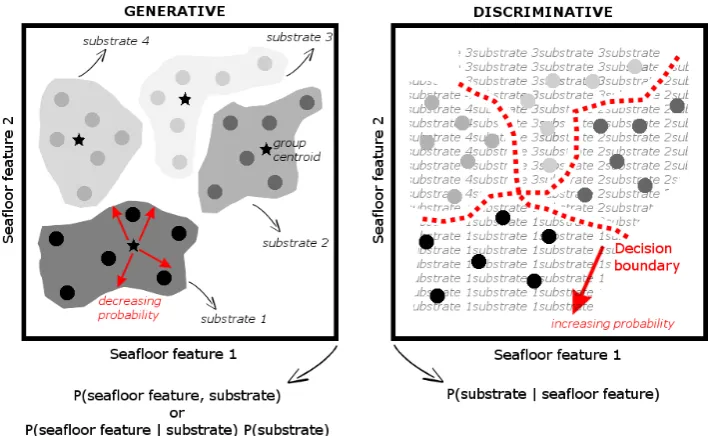
the probability distributions of individual substrate labels (classes) to then generate estimates of their posterior probabilities. With a discriminative model, instead of first modeling the joint distribution ofxandytogether,P(x,y), a conditional distribution ofygivenx,P(y|x)is modeled directly, without attempting to model underlying (or ‘generating’) probability distributions. This bypasses the need to capture the distributions overx, to model the correlations between them, and therefore to specify an underlying prior model that describesP(x,y). Any chosen set of featuresxmay have complicated dependencies, and the relationships amongx, and betweenxandy, might significantly change when applied to the next data set, the next location, the next time, the next spatial scale, etc. Discriminative approaches, including neural networks [25], support vector machines [18], decision trees [26], and random forests [27], have therefore been popular.
Figure 1. Schematic of generative versus discriminative approaches to probabilistic substrate classification. Both approaches train a model from the data that make optimal label assignments. The generative approach first models the label-conditioned probabilities (P(x|y)) for each label class individually, or joint distribution (P(x,y)) between substrate features and substrate types (labels), then finds the posterior probabilities of each label (P(y|x)). The discriminative approach learns a decision boundary (or discriminant function) between labels that maps substrate features directly into labels.
2. Methods
2.1. Discriminative Probabilistic Substrate Classification
2.1.1. Conditional Random Field
A conditional random field (CRF) is an undirected graphical model that we use here to probabilistically predict substrate labels based on weak supervision, which in the present case is manual label annotations of substrate types in discrete locations. Seafloor (backscatter) featuresxand their associated labels yare mapped to graphs, whereby each node is connected by an edge to its neighbors according to a connectivity rule. Linking each node of the graph created fromxto every other node enables modeling of the long-range spatial connections within the data by considering both proximal and distal pairs of grid nodes, resulting in pixel (fine) scale labeling at boundaries and transitions between different label classes.
Conditional Random Fields (CRFs) [30] have been used extensively for task-specific predictions where estimates of labels for sparse regions of the data are used in conjunction with the underlying features, to draw decision boundaries for each label, resulting in a label per feature. The primary advantage of CRFs for substrate classification is the relaxation of the independence assumption [30], which says that the substrate features do not depend on each other. Especially for multispectral backscatter, this is not always the case and it could lead to serious inaccuracies.
A CRF is parameterized the same as a Gibbs distribution, but is normalized differently. We start with an unnormalized measure of the joint distribution
e
PΦ(x,y) = I
∏
i=1
φi(Di) (3)
whereΦ = {φi(Di), . . . ,φI(DI)}, φi are factors and whereDi are a set of vectors of backscatter at each locationithat are termed the ‘scope’ of their associatedφi[31]. In order to model the conditional distribution P(y|x), a normalization constant (called a partition function), Z, is required that is a function ofx[31]:
ZΦ(x) =
∑
ye
PΦ(x,y). (4)
Then the the probability of a substrate labelingygiven the multibeam-derived dataxis
P(y|x) = 1
Z(x)PeΦ(x,y). (5)
We modelPeΦ(x,y)as a Gibbs energy function,E, and the conditional distribution is rewritten
P(y|x,θ) = 1
Z(x,θ)exp(−E(y|x,θ)) (6)
2.1.2. Fully Connected Conditional Random Field
Linking each node of the graph created fromxto every other enables modeling of the long-range connections within the data by considering both proximal and distal pairs of grid nodes, resulting in pixel (fine) scale labeling at boundaries and transitions between different substrate. Eq. (6) is obtained by summing unary (ψi(yi)) and pairwise (ψij(yi,yj)) potentials:
E(y|x,θ) =
∑
i
ψi(yi,xi|θ) +
∑
i<j
ψij(yi,yj,fi,fj|θ) (7)
whereiandjrange from 1 toN, the number of backscatter grid cells. The vectorsfiandfjare features created fromx. Here,fiandfjare a function of both the relative position as well as magnitudes of the data. Whereas unary potentials depend on the label describing the backscattering of the substrate at a single grid location, pairwise potentials depend on the labels of the acoustic response at two grid locations. The unary potentials,ψi, define a log-likelihood over the label assignmenty, and therefore
represent the cost of assigning labelyito grid nodei. In this paper, unary potentials are defined using photographic observations of the bed at discrete locations. The pairwise potentialsψij(yi,yj)are the cost of simultaneously assigning labelyito grid nodeiandyjto grid nodej, defined as
ψij(yi,yj,fi,fj|θ) =Λ(yi,yj|θ)
L
∑
l=1
klfil,fjl (8)
where l denotes feature vector derived from x, where each kl is a function that determines the similarity between connected grid nodes by means of a given feature fl. The functionΛquantifies label ‘compatibility’, by imposing a penalty for nearby similar grid nodes that are assigned different labels. The so-called ‘Potts’ model is used for the compatibility functionΛ(yi,yj) = [yi 6= yj], that isΛ(yi,yj) = 1 if|i−j| ≤ µand 0 otherwise. We make the proximity toleranceµ(units of pixels,
controlling the minimum distance betweeniandjthat are assigned different labels) a free parameter. A computationally efficient inference algorithm for a fully connected CRF was introduced by [33], whereby the pairwise potentials (8) are linear combinations of Gaussian kernels, k, which are filters applied to the backscatter data that preserve strong edges [34]. We use a simplified version of the pairwise kernels proposed by [33], given by:
klfil,fjl=exp −|xi−xj|
2
2θ2β !
+exp −|pi−pj|
2
2θ2γ !
(9)
wherepiandpjare grid positions. The first kernel quantifies the observation that nearby grid nodes with similar multifrequency backscatter response are likely to be in the same substrate class. The degree of similarity is controlled by the hyperparameter θβ (non-dimensional). As θβ increases,
larger differences on thel-th feature are tolerated. The second kernel removes small isolated regions. Following [33], we set θγ = 1. The parameters µ and θβ are then determined from the data. The true distribution, P(y), cannot be directly computed [33]. Rather it is approximated through inference by evaluating a set of candidate distributionsQ(y), minimizing the Kullback-Leibler (KL) divergence to the true distribution, computing the product of independent marginalsQ(yι|x)over each variable as an approximation of P(y|x) using the iterative algorithm detailed by [33,35] to minimize∆(Q||P) =∑ιQιln(Qι/Pι).
2.2. Generative model
y∗=arg max
y∈MP(x|y)P(y) =arg maxy∈MP(x,y). (10) With the joint probability distribution function, given a particulary, you can then calculate (or ‘generate’) its respectivex. For this reason they are called generative models, because sampling can ‘generate’ synthetic data.
2.2.1. Naïve Bayes Model
One approach is to infer the label-conditioned probabilities,P(x|yi)for each label individually, yi, and separately infer prior label probabilities P(yi). Then one may find the posterior label probabilitiesP(y|x)using Bayes’ theorem
P(y|x) = P(x|y)P(y)
P(x) (11)
where
P(x) =
∑
P(x|y)P(y) (12)For illustrative purposes, perhaps the simplest way to accomplish this would be to assume that once the class label is known, all the features are independent. The resulting so-called ‘naïve Bayes’ classifier is
P(y|x) =P(y) M
∏
i=1
P(xi|y) (13)
which ignores the correlations between the features. For most substrate classification tasks, this is an unreasonable assumption. For example, backscatter response of a given substrate type at a given frequency would be correlated, at least to some degree, to that at a different frequency. Further, backscatter response of a given substrate at a given frequency would correlate with that of a similar substrate. If backscatter and roughness were both input features, they would likely correlate with each other. In short, any chosen set of features x may have complicated dependencies, and the relationships betweenx, and betweenxandy, might significantly change when you move onto the next data set, the next location, the next time, the next spatial scale, etc.
2.2.2. Gaussian Mixture Model
A potentially significant downfall of generative models such as Eq. (13) for substrate characterization is that they ignore any correlation structure between the features (such as backscatter), which is often an incorrect independence assumption that leads to spurious statistical confidence between features and their labels. Therefore, more sophisticated types of generative models than Eq. (13) are typically used for substrate classification that allow quantification of the correlations betweenx. Instead of using Eq. (11) to find the posterior probabilities of each label, one may model the joint distribution ofxandytogether,P(x,y), and then normalize to obtain posterior probabilities. An example of one such approach is the Gaussian Mixture Model (GMM) [6,7,24,36], which is a weighted sum ofMcomponent Gaussian probability density functions,g, with unknown parameters, given by (e.g. [7])
P(x|λ) = M
∑
m=1
wmg(x|µm,Σm) (14)
expectation-maximization (EM) algorithm, which maximizes the likelihood of the model given the training data (see [7,37] for more details of the implementation). The relationships betweenx are modeled by means ofwandΣ. There are many functional forms forΣ[7] but for simplicity, here we only consider the full covariance matrix between featuresx:
Σ= 1
N−1 N
∑
n=1
(xm−µm) (xm−µm)T. (15)
3. Data
3.1. Backscatter
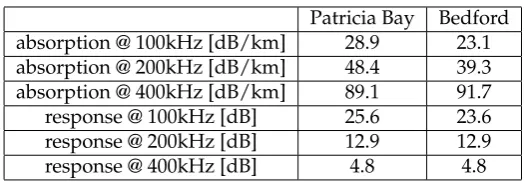
All backscatter data used in this study were collected using an R2Sonic 2026 multibeam echosounder. All data are provided by R2Sonic for the 2017 Multispectral Challenge, with positional/attitude corrections applied, and corrected for tide and sound velocity effects, with gross outliers removed. Backscatter snippet (time-series) records were processed usingQimera FMgeocoder toolbox(FMGT) version 7.7.8. Backscatter data were corrected for system frequency response (Table1), transmit power, receive gain, beam pattern and angular effects. Corrections for frequency-dependent spreading/absorption by water (Table 1) were computed using standard methods based on ideal seawater [38] (ignoring the influence of bubbles, suspended sediment and biological organisms) given provided data from CTD casts taken during the surveys. Backscatter data were mosaicked using no data within 10o of nadir where possible, using 50% line blending, and filling gaps using adjacent backscatter where feasible. In order to meet the objectives of the present paper, it is not necessary to either compute and display the backscatter in units of decibels, nor further process the data for additional acoustic or physical variables. Both the GMM and CRF models would function the same with backscatter in arbitrary linear units or acoustic power on a decibel-scale. All backscatter grids were exported as 1×1 m resolution GeoTIFF images and all subsequent processing was carried out using the ‘PriSM’ toolbox written by the authors (see Acknowledgments), implementing all methods in the above section.
Table 1.Acoustic Processing Parameters
Patricia Bay Bedford absorption @ 100kHz [dB/km] 28.9 23.1 absorption @ 200kHz [dB/km] 48.4 39.3 absorption @ 400kHz [dB/km] 89.1 91.7 response @ 100kHz [dB] 25.6 23.6 response @ 200kHz [dB] 12.9 12.9 response @ 400kHz [dB] 4.8 4.8
Two datasets were processed in this way. The first comes from Patricia Bay, British Columbia, Canada (survey conducted in November 2016). The second dataset comes from Bedford Basin, Nova Scotia, Canada (survey conducted in April 2016). See [39] for a description of this site.
3.2. Bed Observations
In Bedford Basin, 61 georeferenced images of the substrate were provided by R2Sonic at 27 survey stations. Following [41], each photo was classified visually into one of three substrate classes, namely: Class 1 –mud; Class 2 –cobbles and boulders with interstitial mud; and Class 3 –cobbles, gravel and boulders.
Figure 2. A and B (Patricia and Bedford sites, respectively): False color image with red, green and blue values of each pixel corresponding to 8-bit values of backscattering strength at, respectively, 100, 200 and 400 kHz outgoing acoustic frequencies. Overlain are the locations of bed observations, color-coded according to the legend. A1 through A3 and B1 through B3 (Patricia and Bedford sites, respectively): Normalized non-dimensional [-] frequency distributions of 8-bit digital integers of backscatter intensity, compiled based on locations of known substrate types. From left to right: response at 100, 200 and 400 kHz, respectively.
The sparse labels, y, are derived from direct observations of the substrate at a few discrete locations, and featuresx are derived from the multibeam data. Whereas both the CRF and GMM models are designed to work with multivariate input featuresx to any depth (i.e. any number of layers of information on coincident spatial grids), in this contribution we wish to explore the utility of backscatter alone for supervised substrate characterization. We compare models using inputs of both monospectral (grids of backscattering response at individual outgoing acoustic frequencies) and multispectral backscatter, to explore and ultimately demonstrate the enhanced discriminatory power of the latter. Future work will explore any added classification benefits of additional information from derived products from the bathymetry and backscatter, and this is further discussed in the Discussion section.
Despite the considerable amount of overlap between the resulting curves, which is partially a result of the inherently stochastic nature of backscatter [42] as well as the unaccounted-for variability within the substrate groups, the generally modest degree of separation between the peaks show that the task of using the GMM or CRF model for pixel-level substrate classification is, at the very least, analytically tractable. This analysis also serves to demonstrate the value of multispectral over monospectral backscatter. In a general sense, because each substrate has a different distribution of backscatter magnitude according to outgoing frequency, there is much more information for a probabilistic classifier to draw decision boundaries. For example, the backscatter associated with Bedford substrates Class 2 and Class 3 have a narrower range at high frequency compared to low, and all curves tend to be more multimodal at lower frequencies and more unimodal at higher frequencies. Further, the backscatter associated with Patricia Bay substratesmSandFSare only distinguishable at 100 kHz (Fig.2A.1.).
3.2.1. GMM model implementation details
Following [7], the GMM model was initialized using the observed per-substrate mean backscatter for µm, and unit weight wm and covariance Σm. Model fitting continued until a
convergence criterion was satisfied, which in the present study was when the average gain in posterior probability from the previous iteration went below 0.01.
The number of Gaussians may be optimized using the data (see [6] and [7] for two different approaches). In the present study, however, in order to keep the focus on the relative performance of the two models and the two types of backscatter (monospectral and multispectral), the number of modeled Gaussians in the mixture was set to equal the number of substrates known to be present in the surveyed area (four for Patricia, and three for Bedford). Any posterior probability below a certain threshold was reclassified as ‘unknown’ substrate. This threshold was arbitrarily set to 0.8 for all data sets. A 50% subsample of the bed observations, drawn at random but with the condition that at least 1 bed observation per class was included, was used to train the model. The remaining 50% of the bed observations were used to test the performance of the substrate classification model.
3.2.2. CRF model implementation details
To explore the sensitivity of the CRF model toθβ, the model was run using 10 equal-increment values between 30 and 800 and the results evaluated. Once the appropriate value forθβ across all
data sets had been decided and fixed, the model was run using equal-increment 10 values of Potts compatibility parameterµbetween 3 and 300. In these tests, all inference algorithms were run for
30 iterations. Once the appropriate value forµacross all data sets had been decided and fixed, we
explored the effects of number of inference iterations, from 1 to 20. Average posterior probabilities at the final model iteration tended to be high for the CRF model. Therefore, in the sensitivity tests involving varyingθβ and µparameters we instead used per-pixel posterior probabilities averaged over all model iterations, which was a more conservative estimate of probability being, for each pixel, a function of the rate of convergence to the final posterior probability, and therefore showed greater variability across entire ranges of parameter values.
4. Results
4.1. Conditional Random Field (CRF) model: Sensitivity toθβandµ
The hyperparameterθβ controls the degree of allowable similarity in backscatter between CRF graph nodes. Relatively large θβ means backscatter features with relatively large differences in
magnitude are assigned the same substrate label. Keepingµconstant at a value of 100, the model
was run using 10 equal-increment values ofθβbetween 30 and 800, using multispectral backscatter.
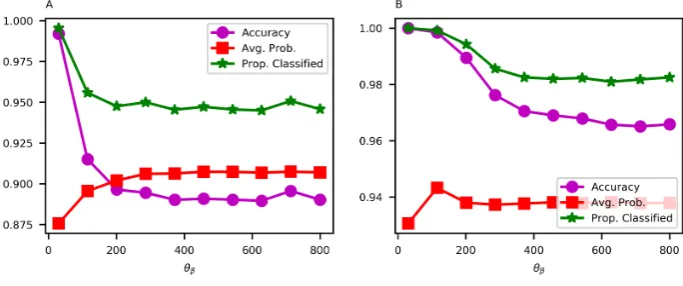
The response ofθβwas not sensitive to value ofµ. For each, three metrics were computed: 1) accuracy (the number of correctly labeled pixels divided by the number of all tested pixels), 2) average posterior probability, and 3) proportion of the pixels with posterior probabilities>0.8. An appropriate value forθβwas considered to be one at which all three metrics stabilized. Accuracy is based on comparing
pixels with known and model-predicted labels. Whenθβ is small, accuracies (determined only at those calibration locations within the vicinity of available observations of the bed) are spuriously high because the average probability across the entire survey (i.e. in areas in and outside of the calibration) may be relatively low. Asθβincreases, accuracy and percent classified both tend to slightly decrease,
stabilizing at uncertainty values that are more realistic given the observed variability in backscatter vectors (Fig. 3). Based on the above criteria, across data from both sites, the appropriate value was determined to beθβ=300.
Figure 3. Accuracy, average posterior probability and proportion classified as a function ofθβ, for Patricia (A) and Bedford (B) datasets.
The compatibility function imposes a penalty for grid nodes that have similar backscattering but are assigned different labels, up to a distance ofµ. This ‘proximity tolerance’ hyperparameter
therefore specifies the distance between pairs of pixels beyond which they are considered far enough apart to have similar backscattering but different substrate labels. The model was run using 10 equal-increment values ofµbetween 3 and 300 (Fig.3). The optimal value ofµ=100 was determined
by the same criteria used to determineθβ.
4.2. CRF: Number of Iterations
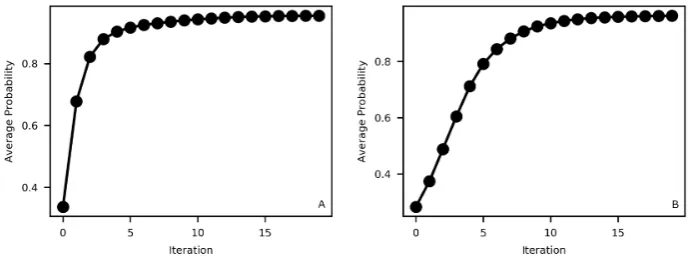
The effect of the number of CRF model iterations of the classification result was evaluated using average posterior probability as a metric. From the above, withθβ = 300 andµ= 100, the number
Figure 4. Accuracy, average posterior probability and proportion classified as a function ofµ, for
Patricia (A) and Bedford (B) datasets.
the fastest convergence rate, and Bedford having the lower spatial density of bed observations and correspondingly the lower convergence rate (Fig.5).
Figure 5.Average CRF posterior probability as a function of iteration, for the Patricia (A) and Bedford (B) sites.
4.3. Patricia Bay Substrate Classification
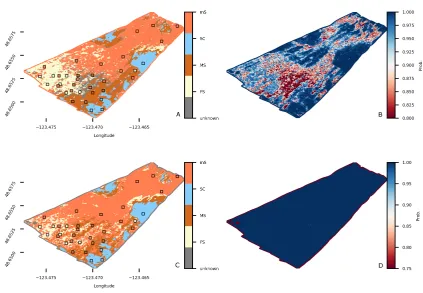
Each model was trained using a 50% subsample of the bed observations, drawn at random but with the condition that at least 1 bed observation per class was included. The remaining 50% of the bed observations were used to test the performance. Any posterior probability below 0.8 was reclassified as ‘unknown’ substrate. The GMM approach was used to generate, from multispectral backscatter inputs, a substrate classification map (Fig. 6A) and associated map of prediction probabilities (Fig. 6B). Using optimal settings (θβ = 300, µ= 100, and 15 iterations), the
Figure 6. Substrate classification using multispectral Patricia Bay data. Top row: substrate map (A) and associated probability (B) using the GMM algorithm. Bottom row: substrate map (C) and associated probability (D) using the CRF algorithm.
The GMM and CRF approaches were also used to generate substrate classification maps (Fig. 7), using each of the three monospectral bands separately as inputs. There is generally a much greater propensity for the GMM model to (over-) predict theFSclass (Fig.7A.1 through A.3) because the GMM model takes into account only relative backscatter magnitudes, not their relative spatial locations like the CRF model does.
4.4. Bedford Basin Substrate Classification
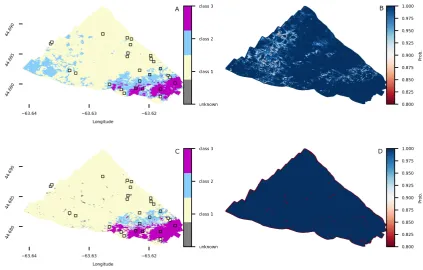
Each model was trained using a 50% subsample of the bed observations, drawn at random but with the condition that at least 1 bed observation per class was included. The remaining 50% of the bed observations were used to test the performance. Any posterior probability below 0.8 was reclassified as ‘unknown’ substrate. Like at the Patricia Bay site, both the GMM and CRF approaches were used to generate substrate classification maps (Fig.8A and C) and associated maps of prediction probabilities (Fig.8B and D).
Figure 7.Substrate classification using monospectral Patricia Bay data. Top row (A.1. through A.3.): substrate maps generated with the GMM algorithm using 100, 200 or 400 kHz backscatter inputs. Bottom row: (B.1. through B.3.): substrate maps generated with the CRF algorithm using 100, 200 or 400 kHz backscatter inputs.
Figure 8. Substrate classification using multispectral Bedford Basin data. Top row: substrate map (A) and associated probability (B) using the GMM algorithm. Bottom row: substrate map (C) and associated probability (D) using the CRF algorithm.
again, there is generally a much greater propensity for the GMM model to (over-) predict a certain class, this time Class 2 (Fig. 9A.1 through A.3), especially at 200 kHz. It seems likely that the GMM model assigns spuriously high weights to this intermediate substrate class because the simple covariance structure of the model is unable to capture the correlations between the two end member substrate classes, therefore the intermediate class becomes a ‘probability sink’. Like at Patricia Bay, the CRF-derived substrate maps are spatially more homogeneous because the relative spatial locations of the bed observations are given weighting comparable to that given to relative differences in backscattering magnitude. At both sites, the relative spatial homogeneity of CRF-predicted classes seems more physically plausible than the relative heterogeneity of the GMM predictions. That isn’t to say that such variability in substrates isn’t real: in fact, it is entirely possible that the acoustic variability is due to variability in substrate composition that is not adequately captured by the few classes that all bed observations were grouped into. However, given the limited number of substrate classes, the GMM models have ‘over-fit’ [23] the backscatter data, capturing acoustic variability as substrate variability, unfiltered by the strong effects of spatial autocorrelation over the substrate, which is picked up well by the CRF model.
Figure 9.Substrate classification using monospectral Bedford Basin data. Top row (A.1. through A.3.): substrate maps generated with the GMM algorithm using 100, 200 or 400 kHz backscatter inputs. Bottom row: (B.1. through B.3.): substrate maps generated with the CRF algorithm using 100, 200 or 400 kHz backscatter inputs.
4.5. Synthesis of all model results
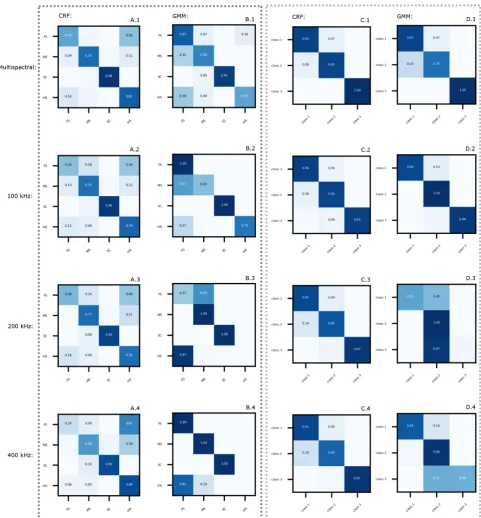
Figure 10.Confusion matrices for CRF and GMM-derived substrate classifications, for Patricia (A and B) and Bedford (C and D) sites. Rows, from top to bottom, indicate multispectral, 100 kHz, 200 kHz, and 400 kHz inputs, respectively. Columns, from left to right, indicate Patricia/CRF, Patricia/GMM, Bedford/CRF, and Bedford/GMM, respectively. The numbers in each cell indicate the proportion of all classifications for each class.
overall accuracy for CRF and GMM models, respectively). Care must be taken to interpret these task-specific classification results in physical terms. For example, these results do not necessarily reflect the relative importance (or, strictly speaking, information content) of each acoustic frequency compared to multispectral backscatter, because the relative contributions of the different frequencies to overall model performance would not be linear, nor additive.
We also performed leave-one-out cross-validation for multispectral inputs whereby, upon successive iterations, one bed observation is randomly removed and a previously removed observation is replaced, and the model refitted. We did this for each site and each model: 35 iterations for Patricia and 27 iterations for Bedford, corresponding to the number of bed observations stations at each site. This procedure checks how well a model generalizes to data, by examining the variability in each classified grid cell over those many iterations, and also provides a means to examine spatially which areas of the bed were sensitive to a lack of ground truth bed observation. Such information could be used, for example, to target further bed sampling.
At Patricia Bay, the CRF result was a 91% mean accuracy across all four substrate classes. The maximum variability in accuracy between folds was largest (6.1%) for theFSclass and relatively small for classMS(3.9%),SC(2.3%), and classmS(0.07%). The GMM result was significantly worse: 65% mean accuracy across all four substrate classes with variability in accuracy between folds between 20 and 39% depending on the class. At Bedford Basin, the result was a 99.5% mean accuracy across all three substrate classes. The maximum variability in accuracy between folds was largest (2.9%) for Class 2 and relatively small for Class 1 (1.53%) and Class 3 (1.47%). The GMM result was 84% mean accuracy across all substrate classes with variability in accuracy between folds between 4 and 16% depending on the class.
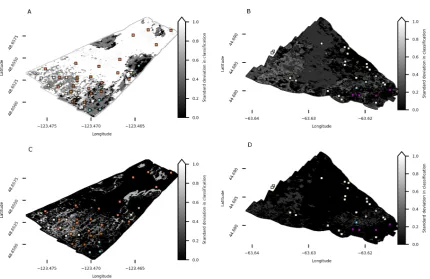
Overall, the CRF model creates outputs that are much less sensitive to the number and location of bed observations, compared with the GMM model, which suggests that the CRF model generalizes to data much better. The standard deviations in bed classifications (Fig.11) show that, at both sites, the GMM model was much more sensitive to the presence and location of individual bed observations, especially at Patricia Bay (Fig. 11A). The CRF model is much less sensitive (standard deviation in classifications are much lower), owing to its ability to incorporate spatial autocorrelation in substrates as well as relative differences in backscattering magnitude.
5. Discussion and Conclusions
We suggest that the high classification accuracies and probabilities of the CRF model outputs were the result of that model incorporating spatial information, as well as backscatter magnitudes, through the use of pairwise potentials that quantify the computational cost of simultaneously assigning labelyito grid nodeiandyjto grid nodej(8), parameterized using a ‘proximity tolerance’ hyperparameterµ. It is encouraging that substrate classification outputs were not overly sensitive to
parameter values (Fig. 3), at least beyond a certain low value. Collectively, this suggests that CRF models applied elsewhere might use similar values forθβ, which controls the degree of allowable
similarity in backscatter between graph nodes, andµ. Model parametersθβandµhave clear physical
meaning and are related to physical proximity and backscatter similarity, respectively. The model might be further extended by adding a kernel to (9) that captures only the spatial proximity of features, with a parameter controlling the degree of allowable similarity in position between graph nodes. The ‘Potts model’ for label compatibility is oversimplistic because it penalizes a pair of nearby grid nodes the same irrespective of their labels. Compatibility functions that learn from the data could be implemented using methods discussed by [35], whereby substrates that are physically likely to be proximal are penalized less than those unlikely to be nearby.
Figure 11. Standard deviation in substrate classifications computed using 35 and 27 realizations of model outputs at Patricia (A and C) and Bedford (B and D), respectively. The top row shows results from GMM outputs, and the bottom row shows CRF outputs. Each realization was based on a 1 fewer bed observation than the full set, drawn randomly. The bed observations are shown for reference.
decision trees [20,26], neural networks [25], and random forests [27], among others, there are many potential advantages to the CRF. The biggest advantage is that a CRF model does not need to make independence assumptions about the data, or model the correlations between substrate features, to learn a discriminant function that best maps inputsxdirectly into labelsy. This is especially important for use with emerging multispectral sonar technology because, until it is understood how substrates respond to multiple frequencies, we require a substrate model that does not rely on a statistical assumption of independence, which says that the substrate features do not depend on and affect each other.
We used CRF models based on gridded backscatter magnitude only, purposefully ignoring other potentially useful derived products of bathymetry (depth, roughness, slope, aspect, curvature, etc) or backscatter [22]. While the CRF model can use featuresx consisting of any number of spatially co-registered inputs, using backscatter alone demonstrates suitability for task-specific substrate classification without transforming the data into a chosen set of inputs amenable to a specific machine learning algorithm from among a set of candidate inputs. A disadvantage of this so-called feature engineering is that it makes it harder to evaluating the relative importance of all features that make up a given realization ofx, especially among disparate data sets. Using backscatter alone is relatively powerful, elegant and parsimonious.
Figure 12. Example of label-conditional probability densities (left) for two substrates,y1 andy2, as a function of a single substrate feature,x, and the corresponding posterior probabilities (right). The vertical line in the right plot shows the discriminative decision boundary. Notice that the left-hand mode of substratey1in the left plot has no effect on the corresponding posterior probability in the right plot. Figure modified from [37].
[37], “excessively demanding of data”. The label-conditional probabilities may contain a lot of detail that isn’t used. An example of this is shown in Fig. 12in which the left-hand mode of substratey1 in the left plot has no effect on the corresponding posterior probability in the right plot. Compare the multiple modes in the label-conditional probabilities shown in Fig.2, where we may also observe that the label-conditional density assumptions of the GMM, namely, that each class may be modeled as a Gaussian —that is, a unimodal function —gave a comparatively poor approximation to the true distributions.
However, generative models are by definition more powerful when direct observations of the bed are relatively scarce: if the joint probability distribution function is statistically well behaved, given a particulary, you can then calculate (or ‘generate’) its respectivex. For generative models, therefore, the training set in theory can contain data from multiple sites and times. If the generative model is sufficiently broad in scope, it can be applied to areas of the substrate with no bed observations, whereas the discriminative approach tends to rely on bed observations from within the area mapped by the sonar. Thus far, however, in practice this tends not to be the case. In other words, models to estimate substrates tend to be built for specific sites and are not typically transferred between sites without recalibration or reparameterization, and the practical scope of generative and discriminative models has become similar. In the longer term, this situation may change, and generative models may be more widely applicable outside of their calibration. Until that time, however, we predict that discriminative models will remain a popular and useful approach to task-specific substrate classification, especially if they better model spatial dependencies, such as the CRF. Given the relative advantages of both model types, there has long been interest in a hybrid approach [43], which is perhaps now on the horizon with the discovery of the generative applications [44] of deep neural networks [45,46] which, to our knowledge, have yet to be applied to substrate characterization but would be an interesting and potentially useful development.
Author Contributions: Conceptualization: D.B.; methodology: D.B. and P.G.; software: D.B.; validation: D.B. and P.G.; formal analysis: D.B.; data curation: D.B.; writing—original draft preparation: D.B. and P.G.; writing—review and editing: D.B. and P.G.; visualization: D.B.; and funding acquisition: D.B. and P.G.
Conflicts of Interest:The authors declare no conflict of interest.
References
1. A. Kenny, I. Cato, M. Desprez, G. Fader, R. Schuttenhelm, and J. Side. “An overview of seabed-mapping technologies in the context of marine habitat classification,”ICES J. Mar. Sci., vol. 60, pp. 411–418, 2003. 2. C. Brown, S. Smith, P. Lawton, and J. Anderson, “Benthic habitat mapping: A review of progress towards
improved understanding of the spatial ecology of the substrate using acoustic techniques,”Estuar. Coast. Shelf S., vol. 92, pp. 502–520, 2011.
3. L. Mayer, M. Jakobsson, G. Allen, B. Dorschel, R. Falconer, V. Ferrini, G. Lamarche, H. Snaith, and P. Weatherall. “The Nippon Foundation–GEBCO Seabed 2030 Project: The Quest to See the World’s Oceans Completely Mapped by 2030,”Geosciences, vol. 8, no. 2, 2018.
4. D. Ierodiaconou, J. Monk, A. Rattray, L. Laurenson, and V. Versace, “Comparison of automated classification techniques for predicting benthic biological communities using hydroacoustics and video observations,”Cont. Shelf Res., vol. 31, pp. S28–S38, 2011.
5. P. Harris, and E. Baker, “1 - Why map benthic habitats?” insubstrate Geomorphology as Benthic Habitat, Elsevier, London, 2012, pp. 3–22.
6. A. Amiri-Simkooei, M. Snellen, and D. Simons, “Riverbed sediment classification using multi-beam echo-sounder backscatter data,”J. Acoust. Soc. Am., vol. 126, no. 4, pp. 1724–1738, 2009.
7. D. Buscombe, P. Grams, and M. Kaplinski, “Compositional signatures in acoustic backscatter over vegetated and unvegetated mixed sand-gravel riverbeds,” J. Geophys. Res. Earth Surf., vol. 122, pp. 1771–1793, 2017.
8. G. Lamarche, and X. Lurton, “Recommendations for improved and coherent acquisition and processing of backscatter data from substrate-mapping sonars,”Mar. Geophys. Res., vol. 39, pp. 5–22, 2018.
9. A. Schimel, J. Beaudoin, I. Parnum, T. Le Bas, V. Schmidt, G. Keith, and D. Ierodiaconou, “Multibeam sonar backscatter data processing,”Mar. Geophys. Res., vol. 39, pp. 121–137, 2018.
10. M. Malik, X. Lurton, and L. Mayer, “A framework to quantify uncertainties of substrate backscatter from swath mapping echosounders,”Mar. Geophys. Res., vol. 39, pp. 1–18, 2018.
11. M. Roche, K. Degrendele, C. Vrignaud, S. Loyer, T. Le Bas, J. Augustin, and X. Lurton, “Control of the repeatability of high frequency multibeam echosounder backscatter by using natural reference areas,”Mar. Geophys. Res., vol. 39, pp. 89–104, 2018.
12. V. Lecours, M. Dolan, A. Micallef, V.L. Lucieer, “A review of marine geomorphometry, the quantitative study of the substrate,”Hydrol. Earth Syst. Sc., vol. 20, no. 8, 2016.
13. M. Diesing, P. Mitchell, and D. Stephens, “Image-based seabed classification: what can we learn from terrestrial remote sensing?,”ICES J. Mar. Sci., vol. 73, no. 10, pp. 2425–2441, 2016.
14. D. Jackson, D. Winebrenner, and A. Ishmaru, “Application of the composite roughness model to high frequency bottom backscattering,”J. Acoust. Soc. Am., vol. 79, no. 5, pp. 1410–1422, 1986.
15. D. Jackson, and M. Richardson, High-frequency substrate acoustics, 1st ed., Springer Science & Business Media, New York, 2007, pp. 616.
16. R. Kloser, J. Penrose, and A. Butler, “Multi-beam backscatter measurements used to infer seabed habitats,”
Cont. Shelf Res., vol. 30, 1772–1782, 2010.
17. D. Jackson, K. Briggs, K. Williams, and M. Richardson, “Tests of models for high-frequency substrate backscatter,”IEEE J. Ocean. Eng., vol. 21, 458–470, 1996.
18. M. Diesing, and D. Stephens, “A multi-model ensemble approach to seabed mapping,”J. Sea Res., vol. 100, pp. 62–69, 2015.
19. D. Stephens, and M. Diesing. A comparison of supervised classification methods for the prediction of substrate type using multibeam acoustic and legacy grain-size data. PLoS ONE, vol. 9, no. 4, pp. e93950, 2014.
20. P. Dartnell, and J. Gardner. Predicting substrate facies from multibeam bathymetry and backscatter data.
21. V. Huvenne, K. Robert, L. Marsh, C. Iacono, T. Le Bas, and R. Wynn, “ROVs and AUVs,” inSubmarine Geomorphology, pp. 93–108. Springer, 2018.
22. D. Buscombe, P. Grams, and M. Kaplinski, “Characterizing riverbed sediments using high-frequency acoustics 1: Spectral properties of scattering,”J. Geophys. Res. Earth Surf., vol. 119, pp. 2674–2691, 2014. 23. K. Murphy, “Machine learning: A probabilistic perspective,” MIT press Cambridge, 2012.
24. D. Simons, and M. Snellen, “A Bayesian approach to substrate classification using multi-beam echo-sounder backscatter data,”Appl. Acoust., vol. 70, pp. 1258–1268, 2009.
25. I. Marsh, and C. Brown, “Neural network classification of multibeam backscatter and bathymetry data from Stanton Bank (Area IV),”Appl. Acoust., vol. 70, pp. 1269–1276, 2009.
26. D. Buscombe, P. Grams, and M. Kaplinski, “Characterizing riverbed sediments using high-frequency acoustics 2: Scattering signatures of Colorado River bed sediments in Marble and Grand Canyons,” J. Geophys. Res. Earth Surf.vol. 119, pp. 2692–2710, 2014.
27. V. Lucieer, N. Hill, N. Barrett, and S. Nichol, “Do marine substrates ‘look’ and ‘sound’ the same? Supervised classification of multibeam acoustic data using autonomous underwater vehicle images,”Estuar. Coast. Shelf S., vol. 117, pp. 94–106, 2013.
28. J. Beaudoin, J. Hughes Clarke, M. Doucet, C. Brown, M. Brissette, and V. Gazzola, “Setting the stage for multispectral acoustic backscatter research,”GeoHab 2016, Winchester, UK, 2016.
29. P. Feldens, I. Schulze, S. Papenmeier, M. Schönke, and J. Schneider von Deimling, “Improved Interpretation of Marine Sedimentary Environments Using Multi-Frequency Multibeam Backscatter Data,”Geosciences, vol. 8 (6), 214, 2018.
30. J. Lafferty, A. McCallum, and F. Pereira, “Conditional random fields: Probabilistic models for segmenting and labeling sequence data,”Int. Conf. Mach. Learn. (ICML), Williamstown, USA, pp. 282–289, 2001. 31. D. Koller, and N. Friedman,Probabilistic graphical models: principles and techniques, MIT press, pp. 104 – 109. 32. S. Kumar, and M. Hebert, “Discriminative random fields,”Int. J. Comput. Vision, vol. 68, no. 2, pp. 179–201,
2006.
33. P. Krähenbühl, and V. Koltun, “Efficient inference in fully connected CRFs with Gaussian edge potentials,” inAdv. Neur. In. (NIPS), Granada, Spain, pp. 109–117, 2011.
34. M. Tappen, C. Liu, E. Adelson, and W. Freeman. Learning Gaussian conditional random fields for low-level vision.IEEE. Conf. Comp. Vision (CVPR), Minneapolis, USA, pp. 1—8, June 2007.
35. P. Krähenbühl, and V. Koltun, “Parameter learning and convergent inference for dense random fields,”Int. Conf. Mach. Learn. (ICML), Atlanta, USA, pp. 513–521, 2013.
36. D. Hamill, D. Buscombe, and J.M. Wheaton, “Alluvial substrate mapping by automated texture segmentation of recreational-grade side scan sonar imagery,”PloS ONE, vol. 13, e0194373, 2018.
37. C. Bishop. (2006).Pattern recognition and machine learning, pp. 738. New York: Springer Science and Business Media.
38. M. Ainslie, and J. McColm, “A simplified formula for viscous and chemical absorption in sea water,”J. Acoust. Soc. Am., vol. 103, no. 3, pp. 1671–1672, 1998.
39. G.B.J. Fader, and R.O. Miller, “Surficial geology, Halifax Harbour, Nova Scotia”. Geological Survey of Canada, Bulletin 590, 163pp, 2008.
40. B. Biffard. Seabed remote sensing by single-beam echosounder: models, methods and applications. Doctoral dissertation, University of Victoria, Canada, 2011.
41. C. Brown, and H. Varma, “Multispectral seafloor classification: Applying a multidimensional hypercube approach to unsupervised seafloor segmentation”. R2Sonic Multispectral Backscatter Competition Entry, available fromhttps://www.r2sonic.com/geohab2018/.
42. A. Gavrilov, and I. Parnum, “Fluctuations of substrate backscatter data from multibeam sonar systems,”
IEEE J. Ocean. Eng., vol. 35, no. 2, 209–219, 2010.
43. J. Lasserre, C. Bishop, and T. Minka. “Principled hybrids of generative and discriminative models,”IEEE. Conf. Comp. Vision (CVPR), pp. 87—94, June 2006.
44. I. Goodfellow, J. Pouget-Abadie, M. Mirza, B. Xu, D. Warde-Farley, S. Ozair, A. Courville, and Y. Bengio. “Generative adversarial nets,”Adv. Neur. In., pp. 2672—2680, 2014.
45. Y. LeCun, Y. Bengio, and G. Hinton. “Deep learning,”Nature, vol. 521, no. 7553, p. 436, 2015.