Robust Analysis of Mimimizing Papr Reduction by Using Low
Density Symbol Check
#1
G.JAGGA RAO, Ph.D Scholar, Dept of ECE, Shri JJT University, Rajasthan.
#2
Dr. Y.CHALAPATHI RAO, Associate Professor & HOD,Dept of ECE,
GUNTUR ENGINEERING COLLEGE, YANAMADALA, ANDHRA PRADESH.
Abstract: MIMO-Constant Envelop Modulation CEM) is a very energy and complexity green system, which is brought as alternative candidate to the presently used MIMO-Orthogonal Frequency Division Multiplexing (OFDM). CEM system enables to apply excessive green nonlinear power amplifier on the transmitter aspect and 1 bit (low resolution) analog to virtual converter (ADC) at the receiver aspect. Due to adopting the low resolution at the receiver facet a fantastic discount in hardware complexity and energy consumption can be done. However, there could be a considerable degradation on the overall performance of bit blunders rate (PAPR) at the receiver facet due to sever quantization error brought through the low-resolution ADC, so a forward mistakes correction coding is critical to decorate the PAPR. In this paper a LDSC coded MIMO-CEM device turned into used as a substitute for MIMO-OFDM to address the PAPR degradation hassle of the CEM gadget. The performance of the LDSC coded MIMO-CEM with Gaussian Minimum Phase Shift Keying (QPSK) modulation is evaluated over a multi-route Rayleigh fading channel. It confirmed that LDSC codes are powerful to improve the PAPR overall performance of CEM on Rayleigh fading channels.According to the simulation consequences, the MIMO-CEM system affords a large development in PAPR overall performance and outperforms the un-coded and the unique convolution coder primarily based CEM structures.
_____________________________________________________________________________
I. INTRODUCTION
MIMO-CEM is an efficient and promising alternative candidate to the MIMO-OFDM. One of the principle troubles in OFDM based totally gadget is the high Peak to Average Power Ratio (PAPR) of transmitted alerts which reasons nonlinear distortion so nonlinear power green electricity amplifier (PA) like elegance C cannot be used for OFDM transmission. Instead, linear energy inefficient PA have to be used like elegance A and class A/B and this therefore degrades the energy performance of system. Many efforts had been made to date to resolve this foremost hassle in OFDM systems. Moreover, at the OFDM receiver a high
decision ADC have to be followed, which consequently increases the strength intake. Therefore, the complexity and the high energy necessities save you the layout of high branches MIMO-OFDM.
the receiver aspect are required to compensate excessive-nonlinearity added via 1 bit ADC, there can be a fantastic enhancement in hardware complexity and strength consumption because of omitting of extra than analog levels at the receiver i.E. The Automatic Gain Control (AGC). Due to the low complexity of CEMgadget, the employing of greater MIMO branches is expected than OFDM system and as a result a spectral efficiency enhancement might be executed. On the alternative hand, there are many challenges nonetheless existing to almost use CEM system due to the software of the IF based 1 bit ADC.
Considerable work been accomplished on overcoming the CEM drawbacks and many efficient strategies for channel estimations and equalization have been proposed. Moreover, due to the extreme impact of one bit ADC on PAPR performance of the device, a proper channel coding techniques want to be proposed for MIMO-CEM to extraordinarily beautify its PAPR performance. Forward Error Correction (FEC) scheme is added to shield the information earlier transmission and to growth the transmitted information rate and. Low-Density Symbol-Check (LDSC) codes are one of the FEC scheme firstly added by means of Gallager. LDSC codes rediscovered via Mackay and taken into consideration one of the maximum effective errors protection codes that allow the transmission fee of records near the theoretical Shannon’s restrict. Moreover, LDSC codes are hired in many standards i.E. DVB-S2 and also has been included inside the IEEE 802.16e cell WiMAX as an opportunity errorcorrecting scheme. Soft, tough or hybrid selection schemes can be adopting for LDSC interpreting. Soft interpreting algorithms have higher overall performance while require a lot higher decoding complexity.
II. LOW-DENISTY
SYMBOL-CHECK (LDSC)
Low density symbol test codes belong to linear blockcodes family. Therefore, all the codeword, X, spread throughoutthe null area of symbol test matrix H:
H.X=0 (1)
The (H) matrix for LDSC codes is a binary spares matrixwhich every organization of row and column factors are selected toattain a preferred weight characteristic. Moreover, thefactors organizations in the graph are limited to limit theoverlapping of rows and columns. These restrictions inconstructing the symbol test matrix (H) lead to a sturdy codesimilarly to have efficient algorithms for interpreting. Forencoding block of bits, N, there might be redundant symbol bits,M, in order that the code charge may be calculated via:
R=(N-M)/N (2)
check nodes through iterations until a desired result is achieved or the process is stopped. Different message passing algorithms are classified according to the type of messages passed or according to the type of operation performed at the nodes. In some decoding algorithms, such as bit-flipping decoding, the messages are binary and in other algorithms, such as belief propagation decoding, the messages are probabilities which represent a level of belief about the actual value of the code word bits. Belief propagation decoding is usually called “sum-product decoding” and this happened when representing probability values in form of log likelihood ratios, and then using these values for calculations at the bit and check node using both sum and product operations.
Both of symbol and reliability information are needed for LDSC soft decision decoding. Reliability information is considered extra information and requires more bits to be generated for each message or edge in the Tanner graph. Reliability update is performed at check nodes in the same time with the symbol update to merge the reliability of the other incoming messages and generate a calculated reliability for each outgoing message. Actually, this reliability information isconsidered the log likelihood ratios for each message and the update operation include the hyperbolic tangent function similar to MAP decoding algorithm was introduced. In the hard decision decoder, the same updating operation for decoded value and the message values at each node is done as in soft decoder. The change is in the reliability values of the received bit and the messages are considered as a scaling value for their associated weighting in a majority function or adder.
III. THE PROPOSED LDSC CODED
MIMO-CEM SYSTEM
The block diagram of the LDSC coded 2x2 MIMO-CEMtransceiver is shown in Fig. 1. In the transmitter side the inputbinary information from the source is encoded the use of the LDSCchannel encoder for you to improve the PAPR performanceespecially with the existence of one bit ADC. The encoded recordsare then interleaved to disperse a large burst of errors over thefading channel. The interleaved information is then break up into wide varietyof streams equal to the numPAPR of transmitted antennas. Afterthat a differential encoding observed by means of a Gaussian MinimumShift Keying (QPSK) modulation are carried out to facts streamsto assemble a constant envelop phase (CEM) modulatedsignals. These signals are transmitted over MIMO Rayleighmultipath fading channel.
a). PERFORMANCE EVALUATION
TRANSMITTER
Fig1: Ldsc Data Transmission For Qpsk Model
Fig2: block diagram for LDSC based MIMO-CEM system
b).Performance of the proposed LDSC based SIMO-CEM system
The PAPR overall performance of the proposed QPSKLDSCbased totally SISO-CEM is evaluated underneath Rayleigh fading channeland QPSK modulation for BT=1 and BT=0.Three. The enterrandom binary statistics was protected with the aid of the LDSC scheme andtransmitted over the fading channel.The pleasant of reception is measured by using gazing PAPR
over a fixed of Eb/N0 values. For the motive, evaluation theperformance of the proposed machine is compared to theoverall performance of the convolutional code based original CEM.
Three show the PAPR overall performance of theproposed machine as a characteristic
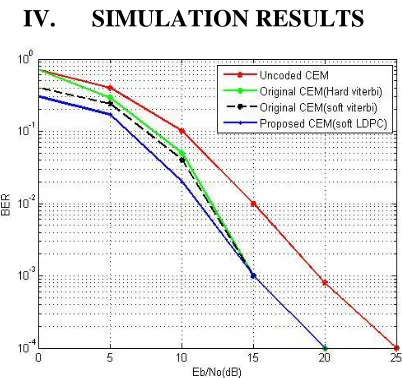
BT=1,respectively. The PAPR performance in case of uncoded andauthentic SISO-CEM structures is likewise shown. As may bedetermined from the figures the PAPR performance of theproposed LDSC coded gadget outperforms the uncoded andthe unique convolutional primarily based CEM systems.
For example with BT=0.3 it could be visible that the0 errors interpreting turns into viable with the LDSC baseddevice after an Eb/N0 of 12 dB, which is ready 2 dB less thanthe original one based totally onsmooth Viterbi interpreting. Also withBT=1indicatesthat for a goal PAPR of zero.001 the proposeddevice achieves a coding benefit of about 1 dB over the smoothViterbi deciphering unique system and about 6 dB over the toughdecoding based totally one. Also from those figures, it's far foundthat as the BT cost decreases the PAPR performance isdegraded because ISI is elevated.
c).Performance of the proposed LDSC based MIMO-CEMsystem
In this section, the PAPR performance are tested with theLDSC based totally 2x2 MIMO-CEM system over the Rayleighfading channel with the fading parameters presented in Table1.Fig. Four and Fig. Five depict the PAPR performance for theproposed device. The PAPR performances of the uncoded andconvolution code based machine also are indicated for thecause of contrast.
smooth Viterbibased totally gadget. Also from fig. 5 with BT=1 it is able to be locatedthat for a goal PAPR of zero.001 the proposed machine can acquirea electricity benefit price of 2.5 dB than the unique one with gentleViterbi decoding. Moreover, from Fig. 5 it's miles surely that theproposed machine drastically outperforms uncoded and thedifficult Viterbi based totally CEM structures.
IV. SIMULATION RESULTS
Fig3: ThePAPR performances of the proposed and original SISO-CEMsystem with BT=.3
Fig 4: The PAPR performances of the proposed and original SISO-CEMsystem with BT=0.1
Fig5: The PAPR performances of the proposed and originalMIMO-CEM system with BT=0.3
Fig6: PAPR performance of the proposed and original MIMO-CEMsystem with BT=1
V. CONCLUSION
strength gain costof 2.5 dB than the authentic one with gentle Viterbi interpreting for atarget PAPR of 0.001. Also with BT=zero.Three it may be discovered thatthe mistake loose interpreting may be acquired with the LDSC primarily basedproposed MIMO-CEM device after an Eb/N0 of 10 dB whichis four dB and 6 dB lower than the price with the original gentleand hard Viterbi based totally MIMO-CEM structures respectively.Better performance can be completed with LDSC based totally on lengthycode words within the rate of the system complexity, and a trading off among the PAPR overall performance and the low complexitycan be needed.
REFERENCES
[1] O. Muta and H. Furukawa, “Study on MIMO
Wireless Transmissionwith Constant Envelope
Modulation and a Low-Resolution ADC,”IEICE
Technical Report, RCS2010-44, pp.157-162, 2010.
[2] O. Muta and Y. Akaiwa, “Weighting Factor
Estimation Method for PeakPower Reduction Based
on adaptive Flipping Of parity B its in Turbo-Coded
OFDM systems,” IEEE Trans. Vehicular
Technology, vol.57,no.6, Nov.2008.
[3] Usama S. Mohammed, Osama A. Omer and
Ahmed S. A. Mubarak,“Progressive Image
Transmission over OFDM System with
MinimumPAPR”, The 2nd Saudi Int. Electronics,
Communications and PhotonicsConference,
SIECPC'13, Riyadh, Saudi Arabia, 30-27 April, 2013
.
[4] J. Kim and Y. Shin, "An Effective Clipped
Companding Scheme forPAPR Reduction of OFDM
Signals”, Proceedings of the IEEE
ICC'08,pp.668-672, 2008.
[5] L. Guan, T. Jiang, D. Qu and Y. Zhou, "Joint
Channel Estimation andPTS to Reduce
Peak-to-AveragePower Radio in OFDM Systemswithout Side
Information", IEEE Signal Processing Letters, Vol.
17, No.10, pp. 883-886, OctoPAPR 2010.
[6] M. Sawada, H. Okada, T. Yamazato and M.
Katayama, “Influence ofADC Nonlinearity on the Performance of an OFDM Receiver,” IEICETrans.
Info and Sys. ,vol. E89-B, no.12, pp.3250-3256,
2006.
[7] T. K. Paul and T. Ogunfunmi, “Wireless LAN
Comes of Age:Understanding the IEEE 802.11n
Amendment,” IEEE Magazine ofCircuits and Systems, vol.8, no.1, pp. 28 -54, 2008.
[8] S. A. Mujtaba, “TGn sync proposal technical
specification. doc.: IEEE802.11-04/0889r7,” Draft
proposal, 2005.
[9] E. M. Mohamed, O. Muta and H. Furukawa,
“Adaptive ChannelEstimation Techniques for
MIMO-Constant Envelope Modulation,”IECE Trans.
Commun., Vol.E95-B, no.07, pp.2393-2404, 2012.
[10] E. M. Mohamed. “A Complexity efficient
Equalization Technique forMIMO-constant Envelop
Modulation,” IEEE Symposium on
WirelessTechnology and Application (ISWTA),