Steganalytic Methods for
3D Objects
Zhenyu Li
Doctor of Philosophy University of York Computer Science January 2018Abstract
This PhD thesis provides new research results in the area of using 3D features for steganalysis. The research study presented in the thesis proposes new sets of 3D features, greatly extending the previously proposed features. The proposed steganlytic feature set includes features representing the vertex normal, curvature ratio, Gaussian curvature, the edge and vertex position of the 3D objects in the spherical coordinate system. Through a second contribution, this thesis presents a 3D wavelet multiresolution analysis-based steganalytic method. The proposed method extracts the 3D steganalytic features from meshes of different resolutions. The third contribution proposes a robustness and relevance-based feature selection method for solving the cover-source mismatch problem in 3D steganalysis. This method selects those 3D features that are robust to the variation of the cover source, while preserving the relevance of such features to the class label. All the proposed methods are applied for identifying stego-meshes produced by several steganographic algorithms.
Contents
Abstract iii
List of Tables vii
List of Figures xiv
Acknowledgements xv
Declaration xvii
1 Introduction 1
2 Literature Review 5
2.1 3D information hiding methods . . . 5
2.2 Image and video steganalysis . . . 14
2.3 3D steganalysis . . . 18
2.4 The cover source mismatch problem . . . 19
2.5 Summary . . . 21
3 Local Geometry-Based Feature Set for 3D Steganalysis 23 3.1 Introduction . . . 23
3.2 3D steganalysis framework . . . 24
3.3 Local geometry-based feature set . . . 26
3.4 Experimental results . . . 34
3.5 Conclusion . . . 50 v
vi CONTENTS
4 3D Wavelet Multiresolution Analysis-Based Features for Steganalysis 53
4.1 Introduction . . . 53
4.2 Multiresolution analysis of meshes using 3D wavelets . . . 54
4.3 Experimental results . . . 63
4.4 Conclusion . . . 75
5 Solving the Cover Source Mismatch Problem in 3D Steganalysis 77 5.1 Introduction . . . 77
5.2 Definition of features’ robustness and relevance . . . 79
5.3 Robustness and relevance-based feature selection algorithm . . . 82
5.4 Experimental results . . . 85
5.5 Conclusion . . . 106
6 Conclusion 107 6.1 Contributions . . . 107
6.2 Limitations and future work . . . 109
List of Symbols 111
Abbreviations 115
List of Tables
3.1 Median values and the standard deviations of the detection errors for the steganalysis results of three information hiding algorithms when using the FLD ensemble classifier trained over the HKS-based features for 30 different splits of the training/testing sets. . . 34 3.2 Median values of the area under the ROC curves for the steganalysis results of
the six information hiding algorithms when using the FLD ensemble classifier. The best results are shown in bold. . . 49 3.3 Median values of the area under the ROC curves for the steganalysis results
of the six information hiding algorithms when using the QDA classifier. The best results are shown in bold. . . 50 4.1 A list of the proposed geometric features based on the 3D wavelet
multireso-lution analysis. . . 61
List of Figures
2.1 Using the Hamiltonian path for ordering the vertices from the mesh surface. The vertices and edges in red are covered in the constructed path, the green edges are compared in order to find the next vertex in the path. This figure was reproduced after Figure 2 (b) from [Itier and Puech, 2017] . . . 8 2.2 The illustration of one iteration of the lazy wavelet decomposition on the
triangle meshes. . . 11 2.3 The illustration of the hierarchical watermarking framework proposed in [Wang
et al., 2008]. This figure corresponds to Figure 2 from [Wang et al., 2008] . . 12
3.1 The 3D steganalysis framework based on learning from statistics of the local feature sets and classification by means of machine learning methods. . . 25 3.2 Dihedral angles and vertex-based normals for representing local geometry
properties of the surface. . . 29 3.3 The spherical coordinate system, where R is the radial distance of vertex vi,
θ and ϕare its azimuth angle and elevation angle, respectively. . . 31 3.4 3D objects used in the steganalytic tests. . . 35 3.5 Histograms of dihedral angles featureφ9 and its logarithm of the cover, in (a)
and (c), and stego versions, in (b) and (d), of the “Head statue” object from the database from [Chen et al., 2009]. . . 38 3.6 Histograms of vertex normal featureφ11and its logarithm of the cover, in (a)
and (c), and stego versions, in (b) and (d), of the “Horse” object from the database from [Chen et al., 2009]. . . 39
x LIST OF FIGURES
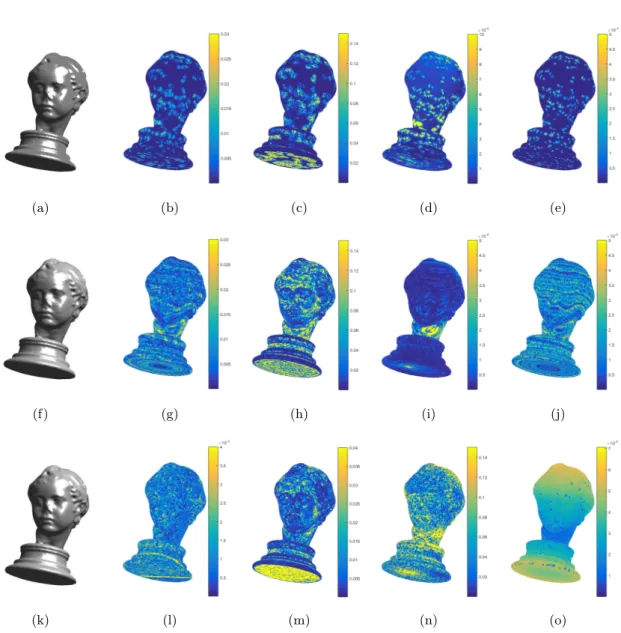
3.7 Stego-objects and the visualization of differences in the detection of features used for steganalysis. (a), (f) and (k) are the stego-objects obtained after using the information hiding algorithms, SRW [Yang et al., 2017b], MRS [Cho et al., 2007] and MLS [Chao et al., 2009], respectively; (b), (g) and (l) show the absolute differences of vertex normals φ11 between those stego-objects
and their corresponding cover-object, respectively; (c), (h) and (m) for the curvature ratios φ13; (d), (i) and (n) for the azimuth angle φ14; (e), (j) and
(o) for the radial distance φ16. . . 41
3.8 Stego-object and the visualization of differences in the detection of features used for steganalysis. (a) The stego-object obtained after using SRW algo-rithms described in [Yang et al., 2017b]; (b) The absolute differences of vertex normals φ11 between the stego-objects and their corresponding cover-object;
The absolute differences in (c) for the curvature ratiosφ13; (d) for the azimuth
angle φ14; (e) for the radial distance φ16. . . 42
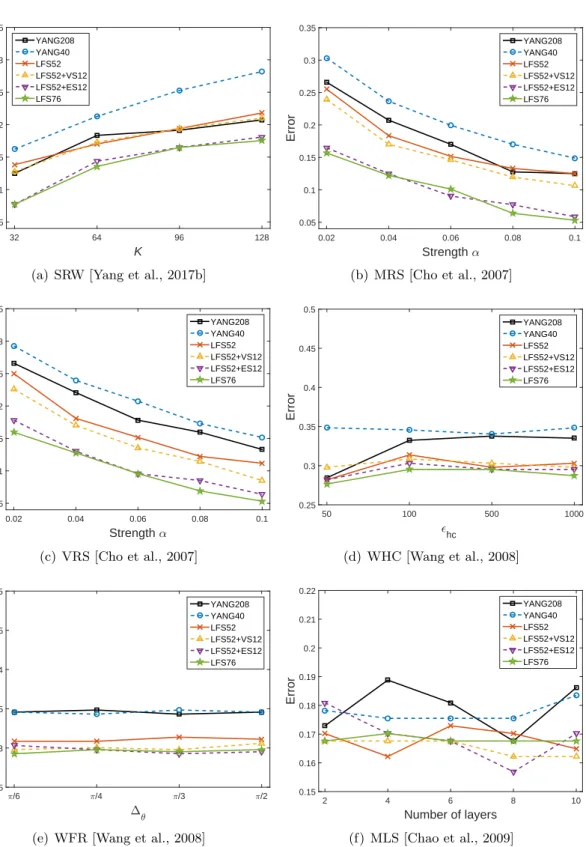
3.9 Median value of detection errors of the steganalyzers trained as FLD ensemble classifiers on the testing set over 30 independent splits for the six information hiding methods with different values for the embedding parameters. . . 44 3.10 Median value of detection errors of the steganalyzers trained as QDA classifiers
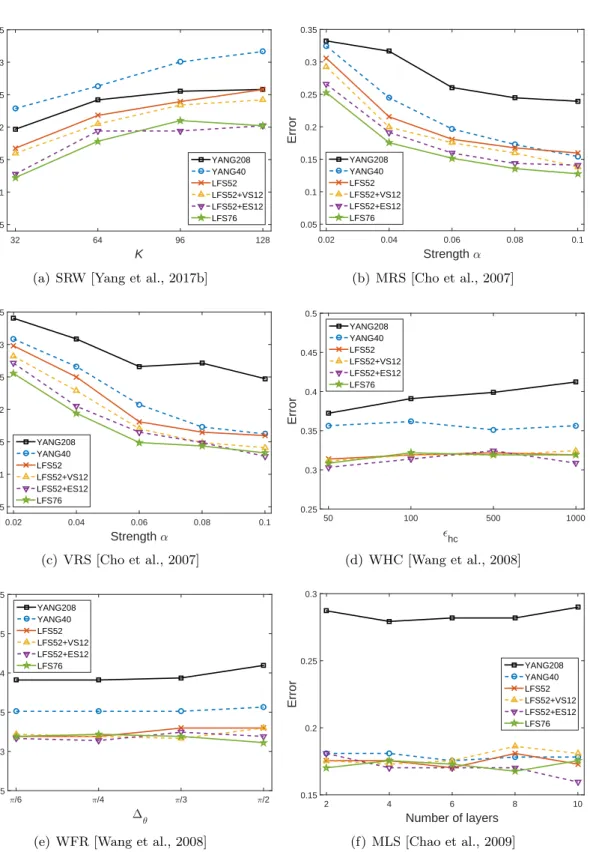
on the testing set over 30 independent splits for the six information hiding methods with different values for the embedding parameters. . . 45 3.11 The relevance between the features and the class label, for cover-objects (0) or
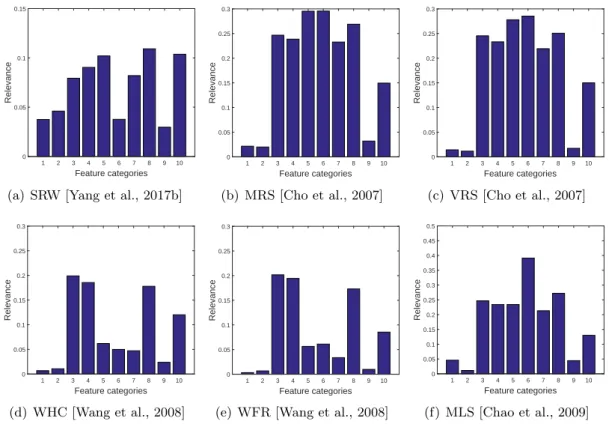
stego-objects (1), where the stego-objects are generated by the six information hiding methods, SRW, MRS, VRS, WHC, WFR and MLS, respectively. The meaning of the category labels are: 1, the vertex coordinates in Cartesian coordinate system; 2, the vertex norm in Cartesian coordinate system; 3, the vertex coordinates in Laplacian coordinate system; 4, the vertex norm in Laplacian coordinate system; 5, the face normal; 6, the dihedral angle; 7, the vertex normal; 8; the curvature; 9, the vertex coordinates in spherical coordinates system; 10, the edge length in spherical coordinate system. . . 49
LIST OF FIGURES xi
4.1 Generating the multiresolution meshes using 3D wavelet decomposition and Butterfly subdivision. . . 54 4.2 Extracting the edge vectors and their flipped counterparts from the mesh of
initial resolution. . . 56 4.3 The illustration of the 3D wavelet decomposition for a mesh from its initial
resolution to a lower resolution. . . 56 4.4 The illustration of the 3D wavelet subdivision for the mesh from the initial
resolution to a higher resolution. . . 59 4.5 ROC curves of the steganalysis of WHC (hc= 100) and WFR (∆θ=π/3) for
one trial using the FLD ensembles trained on various 3D steganalytic feature sets. . . 66 4.6 Median values of the area under the ROC curves of the detection results of
the steganalyzers on the testing set over 30 independent splits for WHC and WFR when considering various values of the parameters. . . 67 4.7 Median values of the detection errors of the steganalyzers on the testing set
over 30 independent splits for WHC and WFR when considering various values of the parameters. . . 68 4.8 Box plots showing the confidence intervals for the area under the ROC curves
of the detection results of steganalyzers trained when testing over 30 indepen-dent splits for the six 3D information embedding algorithms. . . 69 4.9 Box plots showing the confidence intervals for the detection errors of
ste-ganalyzers trained when testing over 30 independent splits for the six 3D information embedding algorithms. . . 70 4.10 The relevance between the features and the class label, where the stego-meshes
are obtained using eight information hiding methods, WHC, WFR, HPQ, HPQ-R, MLS, MRS, VRS and SRW, respectively. The category labels corre-spond with the index of the geometric features from Table 4.1. . . 74
5.1 The 3D steganalysis framework based on statistical feature extraction and selection and machine learning methods. . . 79
xii LIST OF FIGURES
5.2 The feature sets that included in WAL304. . . 86 5.3 Example when using surface simplification on the cover-object to test the
cover-source mismatch paradigm in 3D steganalyzers . . . 88 5.4 Box plots showing the steganalysis detection errors for the information
hid-ing methods proposed in [Chao et al., 2009, Wang et al., 2008, Cho et al., 2007, Yang et al., 2017b] when considering and without addressing the CSM challenge due to different 3D shape modifications. Label 1 represents the re-sults without considering the CSM challenge during the training and testing. Labels 2 to 5 represent the results with the CSM due to additive noise at the levels of β ∈ {1·10−5,2·10−5,3·10−5,5·10−5}. Labels 6 to 9 rep-resent the results with the CSM due to mesh simplification at the level of
ξ ∈ {0.98,0.95,0.9,0.8}. . . 89 5.5 The variation for the threshold of the features’ robustness θq when using the
RRFS-PCC algorithm with ∆ ∈ {2,10,20,30,40,50} in order to select N0
features over one split of data into training/testing sets. . . 91 5.6 Median values of the detection errors for MLS [Chao et al., 2009] when the
steganalyzers are trained over the feature subsets selected by the RRFS-PCC with τ ∈ {2,10,20,30,40,50}in the CSM scenarios over 10 different splits of the training/testing set. . . 93 5.7 Median values of the detection errors when the information was hidden in
3D objects by the MLS algorithm, proposed in [Chao et al., 2009], using the steganalyzers trained over the feature subsets selected by different feature selection algorithms, where the results are calculated over 10 different splits of the training/testing sets. . . 94 5.8 Median values of the detection errors when the information was hidden in
3D objects by the WHC algorithm, proposed in [Wang et al., 2008], using the steganalyzers trained over the feature subsets selected by different feature selection algorithms, where the results are calculated over 10 different splits of the training/testing sets. . . 95
LIST OF FIGURES xiii
5.9 Median values of the detection errors when the information was hidden in 3D objects by the MRS algorithm, proposed in [Cho et al., 2007], using the steganalyzers trained over the feature subsets selected by different feature selection algorithms, where the results are calculated over 10 different splits of the training/testing sets. . . 96 5.10 Median values of the detection errors when the information was hidden in
3D objects by the SRW algorithm, proposed in [Yang et al., 2017b], using the steganalyzers trained over the feature subsets selected by different feature selection algorithms, where the results are calculated over 10 different splits of the training/testing sets. . . 97 5.11 ROC curves for the steganalysis results when the information is hidden in
3D objects by the MLS under the CSM paradigm after applying the feature selection algorithms or without the Feature Selection. . . 100 5.12 ROC curves for the steganalysis results when the information is hidden in
3D objects by the WHC under the CSM paradigm after applying the feature selection algorithms or without the Feature Selection. . . 101 5.13 ROC curves for the steganalysis results when the information is hidden in
3D objects by the MRS under the CSM paradigm after applying the feature selection algorithms or without the Feature Selection. . . 102 5.14 ROC curves for the steganalysis results when the information is hidden in
3D objects by the SRW under the CSM paradigm after applying the feature selection algorithms or without the Feature Selection. . . 102 5.15 The accumulated selection ratios of the features, as being discriminative
be-tween the stego-objects, created by using the embedding methods, MLS [Chao et al., 2009], WHC [Wang et al., 2008], MRS [Cho et al., 2007] and SRW [Yang et al., 2017b] and their corresponding cover-objects, by using RRFS-PCC, un-der the specific CSM scenarios. The features correspond to the moments of the shape data they characterize, such as the mean, variance, skewness, kurtosis. 104
xiv LIST OF FIGURES
5.16 The accumulated selection ratios of the features, as being discriminative be-tween the stego-objects, created by using the embedding methods, MLS [Chao et al., 2009], WHC [Wang et al., 2008], MRS [Cho et al., 2007] and SRW [Yang et al., 2017b] and their corresponding cover-objects, by using RRFS-PCC, under the specific CSM scenarios. The features correspond to the subsets of WAL304, such as LFS76, WFS-I, WFS-L, and WFS-H. . . 105
Acknowledgements
I would like to express my sincere gratitude to my supervisor Dr. Adrian G. Bors for his support and encouragement for my study, research and academic writing during the past three years. I have learnt a lot of research and writing skills from him. I am grateful to him for arranging my research visit to LIRMM, France and funding me to some flagship international conferences. I am also indebted to his regular meetings, constructive suggestions and helpful corrections on the writing that helped me finish this thesis in a timely manner. It is a very pleasant experience to work with him.
My gratitude also goes to my assessor Prof. Richard Wilson for the helpful discussions in the TAP meetings and his precise assessment of my work. Thanks are also due to all my colleagues in the CVPR group who shared a lot of happy time with me and provided me kind help. I am very grateful to Prof. William Puech for providing me the opportunity to visit LIRMM for one month. The collaboration with the researchers in LIRMM is a treasurable experience to me. I would like to acknowledge the scholarship received from Zhengzhou Institute of Information Science and Technology.
Many thanks are due to my friends in UK for their help and support during my PhD study. I would also like to thank the friends I met in Holgate Hall and International Cafe who gave me a lot of encouragement and made my life more enjoyable.
Lastly and most importantly, I wish to thank all my family members for their support and love. My very special gratitude goes to my mother Xinxia Lyu and my father Can Li to whom I owe everything I am today. I am so grateful to them for always encouraging me to pursue higher education and helping me with my emotional intelligence throughout my entire life.
Declaration
I declare that this thesis is a presentation of original work, which I undertook at the Uni-versity of York during 2015 - 2018, and I am the sole author. This work has not previously been presented for an award at this, or any other, University. All sources are acknowledged as References.
Some parts of this thesis have been published in conference proceedings and journals; where items were published jointly with collaborators, the author of this thesis is responsible for the material presented here.
Conference Papers
• Zhenyu Li and Adrian G. Bors. 3D mesh steganalysis using local shape
fea-tures. Proceedings of 41th International Conference on Acoustics, Speech and Signal
Processing (ICASSP), pages 2144-2148. IEEE, 2016.
• Zhenyu Li and Adrian G. Bors. Selection of robust features for the cover
source mismatch problem in 3D steganalysis. Proceedings of 23rd International
Conference on Pattern Recognition (ICPR), pages 4251-4256. IEEE, 2016.
• Zhenyu Li, S´ebastien Beugnon, William Puech, and Adrian G. Bors. Rethinking
the high capacity 3D steganography: Increasing its resistance to steganaly-sis. Proceedings of 19th International Conference on Image Processing (ICIP), pages 510-514. IEEE, 2017.
Journal Papers
• Zhenyu Li and Adrian G. Bors. Steganalysis of 3D objects using statistics of
Chapter 1
Introduction
Each day, billions of digital images, video, audio or 3D objects are shared through the Internet. Based on these digital files, some secret messages can be hidden in plain sight using the technique known as “information hiding”. Information hiding is the practice of concealing information within media data, whilst causing no perceptible effect on the given object, so that no one would suspect there is a hidden message in the object. An object which has been embedded with hidden information is called stego-object, while the original object, i.e. without any information embedded in, is called cover-object. Research in 3D steganography started more than 17 years ago, shortly after research in image watermarking developed. Nowadays, there are several 3D steganographic approaches.
The word steganography originates from two Greek words, steganos (στ γαυoς´ ) and graphein (γραϕιυ´ ), meaning “covered or concealed” and “writing”, respectively. Steganog-raphy hides the information into the innocuous cover-objects, obtaining the stego-objects with hidden messages. One of the famous example of the steganography in the real life is using an invisible ink to write on the paper. The message will disappear after the paper is dry and appear once the paper is close to the heat. Whilst the modern steganography usually uses the digital files to hide the secret messages and send through the Internet. Compared to cryptography, steganography is concerned with concealing the fact that a secret message is being sent, whereas cryptography is about protecting the contents of a message. While cryp-tography changes completely the data, by encoding it according to a code, steganography does not apparently alter the cover-data, but aims to hide the information unnoticed.
2 CHAPTER 1. INTRODUCTION
Digital watermarking technique is similar to the steganography, which can hide a certain amount of information through a code, called watermark, in the digital files. There are two kinds of digital watermarking algorithms, robust watermarking and fragile watermarking. The goal of robust watermarking is to make the watermark robust against attacks, such as denoising, compression and remodulation, so the watermark can then be used as evidence for copyright protection. Since the focus of robust watermarking is on the robustness, the em-bedding capacity would be rather low, because we are restricted when emem-bedding additional bits of information by the requirement for robustness. Meanwhile, the fragile watermarking is considered for the authentication applications, in another word, it is used to identify whether the object has been tampered with or not. So the fragile watermark has to be sensitive to any modifications of the stego-objects. In term of the capacity, some fragile watermarking algorithms have an embedding capacity as high as the steganography.
Since steganography can provide a covert communication channel for two parties, it can be used maliciously by unlawful organisations, becoming a threat to the modern society. For example, steganography was utilized by the terrorists to communicate, according to a report published by BBC in 2013 [Gardner, 2013]. Only recently, steganography is started being used by malware operators to develop covert communication channels between infected computers and their command and control servers, as reported in the Black Hat Europe 2015 [Bureau and Dietrich, 2015]. The modifications on the objects produced by the information hiding algorithms are too small to be noticed with the naked eye. Nevertheless, through a technique, called steganalysis we can identify whether a message was embedded or not in a given media object.
Steganalysis represents the method for identifying whether a message was hidden in a certain media, using steganography or not. Steganalysis becomes a more and more impor-tant research topic, because the potential threat of steganography being used for malicious purposes is on the increase under the current security threats. Steganalysis employs feature extraction algorithms from a specific media, which are then used for training a classifier in order to distinguish cover-objects from stego-objects.
Following the development of steganography, in diverse media such as audio signals, images and video, steganalytic algorithms have been developed for these media as well.
3
Steganalysis for detecting the hidden information in images was studied in [Ker, 2005, Chen and Shi, 2008, Fridrich and Kodovsk´y, 2012], in audio [Liu et al., 2009, Ren et al., 2017] and in video [Cao et al., 2012, Wang et al., 2014]. Unlike in the case of images or video, which contain information structured on regular lattices, 3D objects are defined by their geometry. In this thesis we consider mesh based representations or 3-D objects, encoding the geometry of their surfaces. Such representations correspond to meshes, where vertices are connected through edges and polygons.
Despite the development of new 3D information hiding algorithms during the past two decades, 3D steganalysis received little interest from the research community. The first paper about the 3D steganalysis was published in 2014 [Yang and Ivrissimtzis, 2014]. The 3D steganalytic approach proposed in [Yang and Ivrissimtzis, 2014] uses a 208-dimensional feature set, YANG208, and quadratic classifier to detect the stego-objects embedded by six information hiding algorithms. However, the performance of the steganalyzers trained in [Yang and Ivrissimtzis, 2014] still needs further improvement.
The Cover Source Mismatch (CSM) problem is a barrier when attempting to apply the steganalytic approaches in the real world, and this is represented by the scenario that the objects used for training the steganalyzer may be originated from a different cover source than the one used for hiding the information [Ker et al., 2013] by the steganographier.
In our study, we would like to concentrate on improving the performance of 3D steganal-ysis in order to be used in a practical situation.
In 3D steganalysis, specific features are extracted from the surface of the 3D object, and their characteristic statistical parameters are then fed into a classifier in order to distinguish cover-objects from stego-objects. In 3D steganalysis, geometric features of stego-objects and cover-objects are modelled statistically. The geometric features locally capture the shape of the object, such as the vertex position, the face normal, the dihedral angle between two adjacent faces, and so on. Based on this idea, we propose a more comprehensive local feature set, considering some new geometric features, for instance, the vertex normal, the Gaussian curvature, the curvature ratio, and features from the spherical coordinates of the vertex, for steganalysis. The new local features would more effectively capture the slight distortions caused by the information embedding, thus increasing the detection accuracy of
4 CHAPTER 1. INTRODUCTION
the steganalyzer.
The 3D wavelet transforms provide a set of tools for the multi-scale analysis of mesh-based representations of surfaces. Some steganographic methods have been proposed for hiding information in the 3D wavelet domain and such information is hardly detectable by the existing 3D steganalyzers.
In this study we propose to extract a set of 3D wavelet features from the initial resolution triangle mesh, the lower resolution one and the higher resolution one. During the experi-ments, we compare the proposed wavelet feature set with other steganalytic features when detecting the stego-objects embedded by various information hiding algorithms.
When the steganalyzer is applied in the real world, it has to address the CSM problem, which is due to the fact that the cover source used for the training of the steganalyzer is different from the data used in the testing. This is a challenging problem, which greatly restricts the applications on steganalyzers in the real situations.
After analyzing the techniques used to mitigate the CSM problem in the image steganal-ysis, we propose to select those features which are robust to the variation of the cover source but sensitive to the embedding changes. So we propose a feature selection algorithm consid-ering both the feature’s robustness to the variation of the cover source and their relevance to the class label.
The remainder of the thesis is organized as follows: Chapter 2 gives a detailed review of the research literature related to the work presented in this thesis. Chapter 3 presents the proposed the local feature set used for 3D steganalysis and provides experimental re-sults when detecting information hidden by six different steganographic algorithms. Then, Chapter 4 presents the 3D wavelet analysis-based feature set for the steganalysis of the 3D triangle meshes and evaluates the results of the proposed methodology in the context of information hidden by several steganographic algorithms. Furthermore, Chapter 5 describes the robustness and relevance-based feature selection algorithm for solving the cover source mismatch problem in 3D steganalysis. Chapter 6 concludes this thesis and points to several problems that deserve further research.
Chapter 2
Literature Review
Steganography and steganalysis have been considered for many types of data, including audio, images and video. In this thesis we consider the steganalysis of 3D graphical objects and models. Firstly, we outline the main approaches in 3D steganography and information hiding. Then existing steganalytic algorithms for digital images, video and 3D meshes are introduced. Finally, the research studies about the cover source mismatch problem in image steganalysis are discussed as well.
2.1
3D information hiding methods
The 3D information hiding methods are classified into three categories: embedding in the spatial domain, those embedding in a transform domain, and those algorithms embedding in the vertex ordering in the mesh representation. In the following, we first discuss the requirements for information hiding and then introduce the 3D embedding methods for each category.
2.1.1 Requirements for information hiding
Embedding information in media has several requirements, including the imperceptibility of changes produced, security, high bit capacity and robustness. The most important is that the embedded information should not produce visible changes. The security of the embedded information is also a very important issue. The use of information hiding should not be
6 CHAPTER 2. LITERATURE REVIEW
easily detected by steganalysis and the embedded messages should be extracted only by the owners of a secret key, in the case of private communication channels, or by using a public key otherwise. The bit capacity is also an important feature, representing the amount of bits embedded in a certain media. Another requirement is that of robustness, which measures how well the embedded messages can survive attacks, such as media compression, cropping, smoothing, noise addition, vertex reordering and so on.
In fact, the steganographiers have to find a balance between these factors. Higher capacity usually means more modifications, which will affect the invisibility and security negatively. Meanwhile, while aiming to increase the robustness to various attacks, the information hid-ing may produce visible changes in the media, while the data capacity may suffer as well. Additionally, seeking to increase the security will influence all the other factors, because security changes require additional data modifications.
2.1.2 Embedding information into spatial domain
Ohbuchi et al. [Ohbuchi et al., 1997] published the first paper on 3D information hiding describing two methods. The two methods use different geometrical primitives for embed-ding: Triangle Similarity Quadruple (TSQ) and Tetrahedral Volume Ratio (TVR). The TSQ algorithm first finds a macro embedding unit in a triangle mesh which consists of four neigh-boring triangles with one triangle surrounded by the other three. During the procedure, it avoids the triangles already used for embedding. Then, for each embedding unit, a quadruple
{subscript, mark, data1, data2}is embedded into the four triangles by displacing vertices by small amount. It repeats these steps until the entire message is embedded. Meanwhile, the TVR algorithm finds a sequence of triangles based on the spanning tree of vertices on the triangular mesh. Then, a sequence of tetrahedrons which are subtended by two triangles adjacent to the same edge is generated. The tetrahedron with the largest volume is selected as the first one in the sequence while its volume is considered as the common denominator. While the volumes of other tetrahedrons are used for numerators. The message is embedded by changing the ratio of the volumes for the tetrahedrons, after displacing the vertices which are contained in those selected for the numerator.
2.1. 3D INFORMATION HIDING METHODS 7
includes two steps: firstly it selectes a list of triangles from the mesh that contains the payload driven by the secret key; then, each so-called admissible triangle in the list is modified or or is left unchanged according to the binary symbol it conveys, which is called a Macro Embedding Procedure (MEP). In the first step, the list of triangles starts with the triangle determined on the basis of a specific geometric characteristic, such as the triangle area or the intersections of the principal axes by considering the Principal Component Analysis (PCA) of the mesh. The next triangle in the list is either the first or the second neighbored triangle in clockwise order, depending on the key. The edge of the triangle which is shared with its predecessor is named the entry edge. The entry edge is divided into two subsets of intervals, for embedding either the symbol 0 or 1, and this decomposition is an application of Quantization Index Modulation (QIM) [Chen and Wornell, 2001] to 3D meshes. Then, the vertex opposite to the entry edge is used to embed information by displacing it such that the vertex’s projection on the entry edge is located within a certain interval in order to embed the hidden bit. Wang and Cheng [Wang and Cheng, 2005] modified the method of Cayre and Macq and proposed a Multi-Level Embedding Procedure (MLEP) to embed information by sliding, extending or rotating the triangle. The sliding method is very similar to the method proposed in [Cayre and Macq, 2003]. In the extending approach, QIM is applied by displacing a vertex of the triangle so that the height of the triangle is located within a certain interval according to the message’s bit. Finally, they apply the same concept to the rotating level by embeding messages in the degree of the dihedral angle.
Chao et al. [Chao et al., 2009] proposed a Multi-Layer Steganography (MLS) for 3D objects. Firstly, this method defines a vertex embedding order by traversing the triangles in the mesh using the same method as in [Cayre and Macq, 2003]. When considering a single layer, this method applies PCA on the 3D object and finds the two extreme vertices according to their locations with respect to the first principal axis. Then they cut this axis into two-state region sets, used to embed the message bit of 0 or 1. Next, it projects the x-coordinates of all the vertices onto this axis. The location of a vertex is changed or not, defining a certain projection on the principal axis of the object, according to the bit to be embedded. This method can be easily extended to multiple layers. When implementing this method, we found that not all the bits embedded by this method are retrievable and some
8 CHAPTER 2. LITERATURE REVIEW
are lost.
Figure 2.1: Using the Hamiltonian path for ordering the vertices from the mesh surface. The vertices and edges in red are covered in the constructed path, the green edges are compared in order to find the next vertex in the path. This figure was reproduced after Figure 2 (b) from [Itier and Puech, 2017]
The 3D steganographic algorithm, Hamiltonian Path Quantization (HPQ), proposed in [Itier and Puech, 2017] utilizes a synchronization technique to guarantee that the order of the embedded data is the same during the embedding and extraction stages. It builds a Hamiltonian path over the complete graph of the vertices in the 3D object without using the connectivity information. The Hamiltonian path is an approach for ordering all the vertices from the 3D object, starting from a specific vertex, chosen by a secret key. For each step, as illustrated in Figure 2.1, the algorithm chooses the nearest neighborvi+1of the
current vertex vi. The message is embedded by changing the relative position of a vertex
vi+1 with respect to its predecessor vi once the vertex vi+1 is added to the Hamiltonian
path Pn. In order to embed a large bit capacity, the vertex vi+1 is displaced along three
coordinates in the Spherical Coordinate System (SCS) which originates in the location of the previously chosen vertex. The algorithm applies QIM by splitting each section of the path into intervals, controlled by the quantization parameter ∆. A given interval is subdivided intossub-intervals which correspond to different embedded bits. The vertex is then moved to a specific location within the interval, according to the embedded information. The new position of the vertex is converted back to the Cartesian coordinate system after the embedding.
A recent study [Li et al., 2017] shows that a variation of the HPQ algorithm, named HPQ-R, which changes the vertex only in the radial distance coordinate of the SCS can increase its resistance to steganalysis to a large extent. The study from [Li et al., 2017] analyses the
2.1. 3D INFORMATION HIDING METHODS 9
influence of the parameter ∆ and shows that a smaller value for this parameter leads to a smaller distortion in the 3D stego-shapes. By increasing the resistance to steganalysis we increase the protection of the information stored into the 3D objects.
Watermarking algorithms have better robustness but lower embedding capacity than the steganographic algorithms mentioned above. For example, two watermarking algorithms proposed in [Cho et al., 2007] are based on modifying the Mean or the Variance of the distribution of the vertices’ Radial distance coordinates in the Spherical coordinate system, named MRS and VRS. Both algorithms transform the meshes from the Cartesian coordinate system to spherical coordinate system. Then they divide the radial distances coordinates of the vertices into a set of histogram bins according to their values. The mean or variance of the elements in each bin is adjusted to a certain range, which indicates the embedded watermark bit, by modifying the radial distance coordinates of the vertices. During the extraction stage, for each bin, extracted following the same procedure as for the embedding, if the mean or variance of the bin’s elements is larger than the preset threshold, then the embedded bit is ‘1’, but otherwise it is ‘0’.
Based on a similar idea used in [Cho et al., 2007], Yang et al. [Yang et al., 2017b] proposed a Steganalysis-Resistant Watermarking (SRW) algorithm. It also uses the spherical coordinate system to represent the positions of the vertices. In the SRW algorithm, the heights of the histogram bins containing the vertices’ radial distance coordinates are changed so that certain information is embedded. For instance, after the displacement of the vertices belonging to the related bins, the height of the (k+1)th bin should be higher than that of the
kth bin, so that bit ‘0’ is embedded. The stego-meshes watermarked by the SRW algorithm are harder to be identified by the steganalyzer, when compared to those watermarked by the MRS or VRS algorithms.
2.1.3 Embedding information into transform domain
There are a number of information hiding methods in one of the transform domains of 3D meshes. Ohbuchi et al. [Ohbuchi et al., 2001] proposed the first 3D watermarking method in the spectral domain of 3D meshes in 2001. Firstly, spectral analysis is applied to the mesh in order to obtain the spectral coefficients of the mesh. Then, it repeatedly embeds
10 CHAPTER 2. LITERATURE REVIEW
the same information a certain number of times in order to increase the resistance of the watermark against additive random noise. The information is embedded by altering the spectral coefficients based on a known stego-key and the modulation amplitude parameter. After embedding the messages, an inverse transformation converts the watermarked spectral coefficients back into the original mesh. Nevertheless, this is a non-blind watermarking algorithm, which means it needs both the cover mesh and the watermarked one during the watermark extraction. Moreover, some of the bits embedded by this method are lost during the extraction.
Luo and Bors [Luo and Bors, 2008] proposed a blind watermarking method using spectral coefficients. It is known that the low frequency spectral coefficients correspond to large scale features and the high frequency ones correspond to the detailed information [Karni and Gotsman, 2000]. To avoid the visible changes, their approach embeds the watermark into the middle and high frequency range of the spectral coefficients. This method firstly splits the coefficients of the upper 85% of the coefficients into a number of bins. Each set of coefficients forms a point cloud whose shape is analyzed by using PCA. Then the cloud of 3D points is “squashed” when embedding a bit of 1 and “inflated” to a well defined sphere for a bit of 0. This watermarking approach is blind so that it is able to retrieve the watermark without the cover mesh. During the extraction, the spectral coefficients are extracted and grouped into sets in the same way used during the embedding. Finally, the information is retrieved by calculating the ratio between the largest variance and the smallest variance of the point cloud formed by the watermarked coefficients.
3D wavelet multiresolution analysis, introduced in [Lounsbery et al., 1997], allows the mesh to be represented at various resolutions. 3D wavelet analysis leads to various ap-plications, including filtering [Abdul-Rahman et al., 2013], mesh compression [Payan and Antonini, 2006, Kammoun et al., 2012], subdivision [Shao et al., 2014], as well as informa-tion hiding [Date et al., 1999, Uccheddu et al., 2004, Kim et al., 2005, Kim et al., 2006, Wang et al., 2008, Zaid et al., 2015].
In the following we outline the 3D wavelet decomposition. Figure 2.2 illustrates one it-eration of the lazy wavelet decomposition, proposed in [Lounsbery et al., 1997], as a simple implementation of the 3D wavelet decomposition. The decomposition is applied on meshes
2.1. 3D INFORMATION HIDING METHODS 11
3D wavelet decomposition
Wavelet coefficient vectors The coarser mesh
The initial mesh
Figure 2.2: The illustration of one iteration of the lazy wavelet decomposition on the triangle meshes.
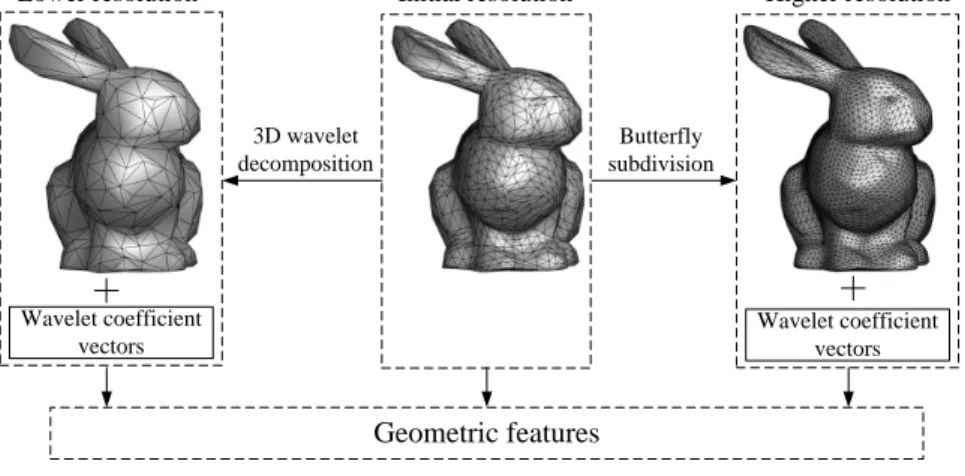
consisting of triangles. In the following for illustrative purposes we consider four triangles, including one triangle in the centre surrounded by the other three triangles, as shown in Figure 2.2. During the 3D wavelet decomposition, the three vertices, defining the central triangle, are removed, while the remaining three vertices would form a new triangle. Conse-quently, following the 3D wavelet decomposition, the four original triangles are transformed into a single triangle, part of a coarser mesh. At the same time, three Wavelet Coefficient Vectors (WCVs) are obtained as the vectors from the midpoints of the new edges to the vanished vertices. The new edges in the larger triangle are called the support edges for the WCVs. The new larger triangle preserves the basic shape formed by the former four triangles and the WCVs encode the local details of the 3D shape. This decomposition propagates on the whole mesh generating a coarser mesh together with a number of WCVs. This decompo-sition can then continue recursively. The limitation of this wavelet decompodecompo-sition approach is that it requires the high resolution mesh to be a semi-regular mesh. The mathematical formulation defining the 3D wavelet decomposition can be found in [Lounsbery et al., 1997]. A 3D wavelet-based watermarking algorithm was proposed by Kanaiet al. [Date et al., 1999], which modifies the ratio between the norm of a WCV and the length of its support edge. However, this 3D watermarking method is non-blind, which significantly reduces its potential for application. Uccheddu et al. [Uccheddu et al., 2004] proposed a blind 3D wavelet-based watermarking algorithm that embeds information by changing the position of the WCV’s terminal point, according to a watermarking map generated by a secret key. Kim
et al. [Kim et al., 2005] proposed a robust watermarking algorithm which hides information by changing the WCVs’ norms. Another 3D wavelet-based robust watermarking algorithm
12 CHAPTER 2. LITERATURE REVIEW
was also proposed by Kim et al. [Kim et al., 2006], which applies a technique similar to the one used in [Cho et al., 2007] in order to embed information into the histogram of WCVs’ norms.
Figure 2.3: The illustration of the hierarchical watermarking framework proposed in [Wang et al., 2008]. This figure corresponds to Figure 2 from [Wang et al., 2008]
Multiple iterations of 3D wavelet decomposition of the triangle mesh is the foundation of the hierarchical watermarking method. At each iteration of the 3D wavelet decomposition, the mesh is decomposed into a coarser mesh representation and a set of WCVs. The 3D wavelet decomposition continues recursively, until the mesh obtained cannot be decomposed any further. A hierarchical 3D watermarking methodology based on the wavelet transform was developed by Wanget al. [Wang et al., 2008], which includes three different algorithms, each one enforcing one of the following requirements: robustness, high-capacity and fragility for authentication. The framework of this method is illustrated in Figure 2.3. A robust watermark is embedded by modifying the norms of the WCVs associated with the lowest resolution level of the mesh. Then, a denser mesh is reconstructed based on the lowest resolution mesh and its corresponding watermarked WCVs. In order to embed a high bit capacity watermark code, at each iteration, the WCVs are indexed according to the lengths of their support edges for synchronization. A controlling parameter is defined asp=lav/hc,
where lav is the average length of the WCVs’ support edges, andhc is a specific constant.
The watermark is embedded by adjusting the residuals of the WCVs’ norms divided by the parameter p, into a certain sequence. Finally, the fragile watermark is embedded before
2.1. 3D INFORMATION HIDING METHODS 13
the last iteration of the mesh reconstruction. In the case of fragile watermark embedding, an identical symbol is embedded by two different embedding approaches. One approach is based on the quantization of the angle between the WCV and its support edge using the M-symbol scalar Costa scheme [Eggers et al., 2003], which depends on a quantization step ∆θ. In the second embedding approach, the symbol is embedded by adjusting the
norm-length ratio of the WCV and its support edge. Finally, the hierarchically watermarked mesh is reconstructed to the size of the cover-object.
2.1.4 Embedding through changing the ordering of the vertices
Changing the ordering of vertices in the mesh representation, using permutations, has been used for 3D steganography in certain approaches. In this case by the mesh representation we mean the order or list in which the vertices and faces are stored in the files representing the 3D object.
In [Cheng and Wang, 2006], Cheng and Wang used the vertex representation order, face representation order and the face index order, with respect to a conventionally defined vertex or face ordering, in order to embed secret information. The algorithm firstly produces a specific ordering of the vertices which is geometrical invariant and which is then used as a reference order for embedding. The vertex ordering in the sequence is used to embed the information. A similar embedding idea is applied to the face representation order. When embedding information by modifying the face index, a triangular face is corresponding to one of three states according to the type of face index order. The algorithm uses two triangles as a unit for embedding, resulting into nine states, which can embed three bits of information. A high capacity steganographic method, proposed in [Bogomjakov et al., 2008], also embeds information by modifying the order of the vertex. It firstly computes a reference ordering of faces and vertices, as in the Edgebreaker mesh compression algorithm [Rossignac, 1999]. In the second stage, the message is encoded as a permutation of the mesh vertices and faces relative to their reference order. During the extraction, the message is decoded by comparing the representation order to the reference one. During the following year, Huanget al. [Huang et al., 2009] improved the embedding capacity of the permutation steganography proposed in [Bogomjakov et al., 2008].
14 CHAPTER 2. LITERATURE REVIEW
As for the advantages of the steganographic methods in the representation domain, first of all, they would not cause any distortions, because they do not actually change the coordinates of the vertices at all. Moreover, the embedding capacity of these methods is very high, resulting into more than 10 Bits Per Vertex (BPV). However, some fatal flaws limit the application of these steganographic methods. The third party can obtain the embedded messages if they find the reference order which is generated by public algorithms. In addition, these methods are fragile to the vertex reordering attack. If the order of the vertices is changed, the recipient can no longer extract the message correctly.
There are a few 3D steganographic algorithms using the connectivity of the mesh as the carrier, for instance, the algorithm proposed in [Amat et al., 2010]. These algorithms do not change the geometry of the mesh surface, so no distortion is produced to the 3D objects. Nevertheless, their weakness consists in the fact that they are vulnerable to the remeshing attack.
2.2
Image and video steganalysis
In the following we discuss some approaches adopted for image and video steganalysis. Im-age steganalysis has received significant attention from the academic community since 1998 [Johnson and Jajodia, 1998]. The early steganalytic approaches for digital images usually would just detect the changes produced by a particular information hiding algorithm by considering some flaws of the embedding algorithm. For example, Westfeld and Pfitzmann [Westfeld and Pfitzmann, 1999] presented a chi-square test to detect the changes of the Dis-crete Cosine Transform (DCT) coefficients caused by the JSteg [Upham, 1997] embedding algorithm. Fridrich et al. [Fridrich et al., 2000] proposed a steganalytic approach based on the observation that the Least Significant Bit (LSB) encoding would increase the number of unique colors in the true-color images.
A concept of calibration was introduced in [Fridrich et al., 2002a] as a method of us-ing a reference image in order to improve features’ sensitivity to embeddus-ing changes while reducing image-to-image variations. Based on the histograms of low frequency DCT coef-ficients of the original image and those of the reference image, the steganalytic approach
2.2. IMAGE AND VIDEO STEGANALYSIS 15
proposed in [Fridrich et al., 2002a] can estimate the length of the secret message embedded by the steganographic algorithm F5 [Westfeld, 2001]. Later, some higher-order features for Joint Photographic Experts Group (JPEG) image steganalysis were proposed in [Fridrich, 2004] which considers the absolute differences between the statistics that extracted from the original images and those of the reference image as the steganalytic features. Image cali-bration was used in image steganalysis in many approaches[Ker, 2005, Pevn´y and Fridrich, 2007, Kodovsk`y and Fridrich, 2012].
A Markov process-based steganalytic approach used to identify the changes produced by the JPEG steganography was proposed in [Shi et al., 2006]. In this approach, differences between 2-D arrays of JPEG coefficients corresponding to horizontal, vertical and oblique directions between the cover-images and stego-images, are modelled as a Markov process. The elements from the transition probability matrices are then considered as features in the classifier used as steganalyzer. A truncation technique is used to limit the range of the elements in the transition probability matrix in order to reduce the dimensionality of the feature vectors. In another approach [Chen and Shi, 2008], the interblock correlation among the JPEG coefficients are used to improve the steganalysis performance. The idea of modelling the differences between pixels by higher-order Markov chains was proposed in [Pevny et al., 2010]. This approach calculates the difference between the adjacent pixels along different directions and obtains the difference arrays. Then, it models the difference arrays by both first-order and second-order Markov processes. The elements in the corresponding transition probability matrices are considered as a 686-dimensional feature set, called the Subtractive Pixel Adjacency Model (SPAM).
Many high-dimensional features are proposed for image steganalysis in the case of adap-tive steganographic algorithms, such as Highly Undetectable steGO (HUGO) [Pevn`y et al., 2010], Wavelet Obtained Weights (WOW) [Holub and Fridrich, 2012], Uniform Embedding Distortion (UED) [Guo et al., 2012], UNIversal WAvelet Relative Distortion (UNIWARD) [Holub and Fridrich, 2013]. For example, the steganalytic approach proposed in [Kodovsk`y and Fridrich, 2011] considers using the co-occurrence matrices of selected DCT coefficient pairs, together with the features proposed in [Chen and Shi, 2008] and [Pevn´y and Fridrich, 2007], as a 48,600-dimensional feature set. Another high-dimensional feature set, Spatial
16 CHAPTER 2. LITERATURE REVIEW
Rich Models (SRM) [Fridrich and Kodovsk´y, 2012], is based on the co-occurrence matrices of neighboring samples from the truncated and quantized noise residuals of the image ob-tained by using linear and non-linear high-pass filters. Some stgeanalytic approaches such as [Tang et al., 2014, Denemark et al., 2014] improved the SRM features by considering the knowledge of the embedding change probabilities, according to the distortion functions used by the adaptive steganographic algorithms. Song et al. [Song et al., 2015] proposed a steganalytic approach for JPEG compressed images which extracts the histogram features from the residuals of the image obtained by using the 2D Gabor filters with different scales and orientations.
Machine learning tools used for image steganalysis are also very important for the perfor-mance of the steganalyzer. Fisher Linear Discriminant (FLD) and Support Vector Machine (SVM) were among the machine learning methods used in the early studies of image ste-ganalysis [Farid, 2002, Lyu and Farid, 2002, Pevn´y and Fridrich, 2007]. However, because the dimensionality of the steganalytic feature set has significantly increased, the curse of dimensionality led to a high complexity of training and the degradation of the generalisation ability of the steganalyzer. In order to solve this problem, the framework of using an ensem-ble of base FLD classifier for image steganalysis was proposed in [Kodovsk`y and Fridrich, 2011, Kodovsk`y et al., 2012]. During the training of this framework, multiple base classifiers as FLDs are trained over various subsets of the feature set. Then, the base classifiers are combined by taking a majority vote of their decisions, which means that, for each instance, the class chosen by most number of base classifier is the ensemble decision. Since the di-mensionality of the feature subset is much lower than that of the whole set, the complexity of training a base classifier is much lower. Furthermore, the combination of multiple base classifiers can produce a stronger classifier ensemble with better generalization ability. Con-sequently, the FLD ensemble has been the most popular machine learning tool used in the area of image steganalysis [Fridrich and Kodovsk´y, 2012, Tang et al., 2014, Denemark et al., 2014, Song et al., 2015].
Deep learning methods have recently been applied to image steganalysis [Tan and Li, 2014, Qian et al., 2015, Xu et al., 2016, Yang et al., 2017a, Ye et al., 2017, Wu et al., 2017] and some deep learning approaches achieved better performance than other steganalytic
2.2. IMAGE AND VIDEO STEGANALYSIS 17
approaches. It is noted that the structure of the Convolutional Neural Network (CNN) used for steganalysis is quite different from that of the CNN used in the computer vision tasks, such as image recognition and classification. For instance, the weights in the first layer of the CNN proposed in [Ye et al., 2017] are initialized with the high-pass filter set used in SRM, which aims to suppress the image content. Meanwhile, the output of the first layer of the CNN is processed by a new activation function called the Truncated Linear Unit (TLU), which truncates the output to a fixed range. Furthermore, the knowledge of the selection channel is exploited to boost the steganalysis performance for the adaptive steganographic algorithms. The CNN-based steganalytic approach, proposed in [Ye et al., 2017], provides better performance than SRM [Fridrich and Kodovsk´y, 2012], maxSRM [Denemark et al., 2014] and FLD ensemble classifier when detecting the stego-images embedded by certain adaptive steganography.
Most of the video steganalytic approaches aim to detect the motion vector modification produced by the video steganographic methods. The motion vectors are the results of block-based motion estimation during video coding, which are commonly exploited by the video steganography. Suet al. [Su et al., 2011] proposed a video steganalytic method based on the statistical analysis of the neighboring motion vectors in both spatial and temporal domain. Later, Caoet al. [Cao et al., 2012] applied the calibration technique to video steganalysis and proposed the features characterizing the changes of the motion vectors during recompression in order to differentiate the stego-video from the cover-video.
The works from [Wang et al., 2014] and [Ren et al., 2014] pointed out that the modifica-tions of the motion vectors may destroy the local optimality which is the aim of the motion estimation in video compression. Following the same framework proposed in [Wang et al., 2014], Zhanget al. [Zhang et al., 2017] improved the method of checking the local optimality of motion vectors by considering both distortion and bit estimation associated with motion vectors.
While 3D objects can be represented in various ways, their most usual data representation is by means of meshes. Such irregular representations, modelling complex 3D objects, are very different from the regular structural arrays representing digital images or video signals. Consequently, the existing image and video steganalytic algorithms cannot be successfully
18 CHAPTER 2. LITERATURE REVIEW
applied to 3D objects. In the following, we would introduce the approaches adopted for 3D steganalysis so far.
2.3
3D steganalysis
There are much fewer steganalytic approaches for 3D objects than for images and video signals. The first steganalytic algorithm for 3D meshes was proposed in [Yang and Ivris-simtzis, 2014]. This 3D steganalytic algorithm is based on the features of 3D meshes and by using machine learning, for distinguishing stego-objects from cover-objects. During 3D steganalysis, both cover- and stego-objects are smoothed using one Laplacian smoothing iteration. Then, the geometric features such as the vertex position and norm in Cartesian and Laplacian coordinate systems [Yang and Ivrissimtzis, 2010], the dihedral angle of edges and face normals, are extracted from the original mesh and the smoothed one. It calculates the absolute differences between the features from the original mesh and those from the smoothed mesh. The feature vectors used for steganalysis are the four statistical moments of the logarithm of the absolute differences between the object and its smoothed counter-part. Meanwhile, the histograms of the differences between the features corresponding to the original objects and their smoothed counterparts are formed and used for extracting the steganalytic features. Finally, this steganalytic approach uses quadratic discriminate analysis to train the classifiers for separating the stego-objects, produced by several stegano-graphic algorithms from their corresponding cover-objects. The experimental results show that the steganalyzers trained as quadratic classifiers achieve high detection rates for certain 3D information hiding algorithms.
More recently, Yang et al. [Yang et al., 2014, Yang et al., 2017b] proposed a new ste-ganalytic algorithm, specifically designed for the robust 3D watermarking algorithm, MRS, proposed in [Cho et al., 2007]. During steganalysis, the number of bins, K, used in the watermarking algorithm is estimated using exhaustive search. For eachK, the steganalytic algorithm classifies the bins into two clusters using a standard clustering algorithm fitting the data with a mixture of two Gaussian distributions. The estimate of K corresponds to that which maximizes the Bhattacharyya distance between the two clusters. Then it uses
2.4. THE COVER SOURCE MISMATCH PROBLEM 19
a normality test to decide if the bins of the mesh can be modeled by a single Gaussian, in which case the mesh would not contain any hidden information. Otherwise, the distribution is bimodal and consequently the mesh is watermarked. The limitation of this algorithm is that it is only effective for the information embedded by the MRS algorithm and would not be useful when the mesh is embedded by other information hiding algorithms than MRS.
Kimet al. [Kim et al., 2017] extended the approach from [Li and Bors, 2016], which is presented in this thesis in Chapter 3, and proposed to use some additional features such as the edge normal, mean curvature and total curvature as supplement to LFS52 and formed LFS64 for 3D steganalysis. The improvement shown for LFS64 with respect to LFS52 is limited to the steganalysis of the information embedded by certain information hiding algorithms and the associated experiments are explained in the experimental part of Chapter 4.
2.4
The cover source mismatch problem
The Cover Source Mismatch (CSM) problem consists of the realistic scenario that the ob-jects used for training a steganalyzer may be originated in a cover source that is different from those which the steganographier actually used for hiding information [Ker et al., 2013]. A thorough study of the implications for the CSM paradigm in image steganalysis was ad-dressed during the “Break Our Steganographic System” (BOSS) contest [Bas et al., 2011]. The mismatch between the training set and testing set caused many difficulties to the partic-ipants in this contest [Bas et al., 2011, Fridrich et al., 2011, Gul and Kurugollu, 2011]. In the machine learning community, the methods of domain adaptation [Patel et al., 2015, Long et al., 2015] and transfer learning [Pan and Yang, 2010, Long et al., 2014] were studied in order to learn a target classifier using labeled data from a different distribution. More specifically, in image steganalysis, the CSM problem was addressed by considering the fol-lowing aspects: the training sets, the feature set and the machine learning methods used for steganalysis.
In principle, in order to increase the generalisation ability of the steganalyzer we have to increase the diversity of the training set. In the case of digital images, the study [Kodovsky et al., 2014] mitigated the CSM’s impact by training the steganalyzers over a mixture of
20 CHAPTER 2. LITERATURE REVIEW
images taken by different cameras and by using a diversity of JPEG compression quality factors. Xu et al. [Xu et al., 2015] constructed an image set for training steganalyzer by selecting the samples from a large data set of images taken from various sources from the Internet. Meanwhile, they removed repetitions of images in order to reduce the redundancy of the training set.
The feature space is also a factor related to the impact of CSM paradigm. Gul and Kuru-gollu [Gul and KuruKuru-gollu, 2011] proposed a feature selection algorithm, in the context of the BOSS contest, which calculates the correlation between a feature vector and the embedding rate as the criterion for selecting the features. Pasquetet al. [Pasquet et al., 2014] proposed to use the ensemble classifier enabled with a feature selection mechanism in order to address the CSM problem. The feature selection was considered by evaluating the importance of each feature in the learning process in [Chaumont and Kouider, 2012]. A feature condensing method, called Calibrated Least Squares (CLS) was proposed in [Pevn`y and Ker, 2013] to make the high dimensional feature sets compatible with the anomaly detector employed for steganalysis. A method to mitigate the CSM due to changes in the features of the cover image was presented in [Ker and Pevny, 2014]. This approach normalizes the cover features for all steganographiers by subtracting the centroid of their joint distribution.
Other research studies addressing the CSM problem in images aim to find a classifier that would be robust to the variation between training and testing data. In [Lubenko and Ker, 2012] it was shown that simple classifiers, such as the FLD ensemble and the Online Ensemble Average Perceptron (OEAP) had better performances than other more complex classifiers, when faced with the cover source mismatch problem. To mitigate the mismatch due to various changes in steganalytic features, Ker and Pevn`y [Ker and Pevny, 2014] used an ensemble of classifiers which gave more weight to those classifiers that were robust to the changes in the steganalytic features. A similar weighting strategy for improving the FLD ensemble’s performance in the CSM paradigm was presented in [Xu et al., 2015].
2.5. SUMMARY 21
2.5
Summary
In this chapter, we revised the main 3D information hiding algorithms, the various approaches adopted for image and video steganalysis, the 3D steganalytic methods and the studies on solving the cover source mismatch problem in steganalysis. The 3D information hiding algorithms are categorized into three groups according to the domain they embed message in, namely, the spatial domain, the transform one and the vertex ordering domain. The basic ideas and the encoding procedure of the 3D embedding algorithms are introduced. Afterwards, the research studies on image and video steganalysis are briefly reviewed from two aspects, the statistical features and the machine learning tools used for steganalysis. The 3D steganography has received a significant attention during the last 20 years, almost similar to the one received by image and video steganography. Nevertheless, while there are several studies of image and video steganalysis, 3D steganalysis is still in its infancy. The cover source mismatch problem has recently been studied in the case of image steganalysis but not for 3D object steganalysis. This PhD thesis includes research studies for proposing new feature sets for 3D steganalysis. Moreover, it analyses for the first time, the efficiency of 3D steganalysis under the cover source mismatch paradigm.
Chapter 3
Local Geometry-Based Feature Set
for 3D Steganalysis
3.1
Introduction
From the literature review about the 3D steganalysis, it is clear that the research field of 3D steganalysis is still in its infancy. 208 features have been proposed for 3D steganalysis in [Yang and Ivrissimtzis, 2014]. In this chapter, we propose to use, a new set of features derived from the local geometry of the 3D surface, for 3D steganalysis. The proposed features are used in combination with some of the features proposed in [Yang and Ivrissimtzis, 2014], while other features proposed before are dropped. We propose to use the statistics of the Gaussian curvature and the curvature ratio in order to capture the changes of the surface’s curvatures. Furthermore, the vertex normal is also considered for finding the changes in the orientation of polygon faces containing a certain vertex. We also propose to use the statistics of spherical coordinates, and the length of the edge defined in spherical coordinates, for 3D steganalysis. The spherical coordinate system is often used for hiding information in 3D objects, but it has not been previously used in 3D steganalysis. The statistics of sets of 3D features are then fed into machine learning algorithms, for example, the Fisher Linear Discriminant (FLD) ensemble [Kodovsk`y et al., 2012], which was successfully used for image steganalysis.
In the experimental part, we consider 354 3D objects from the Princeton Mesh Seg-23
24 CHAPTER 3. LFS FEATURE SET FOR 3D STEGANALYSIS
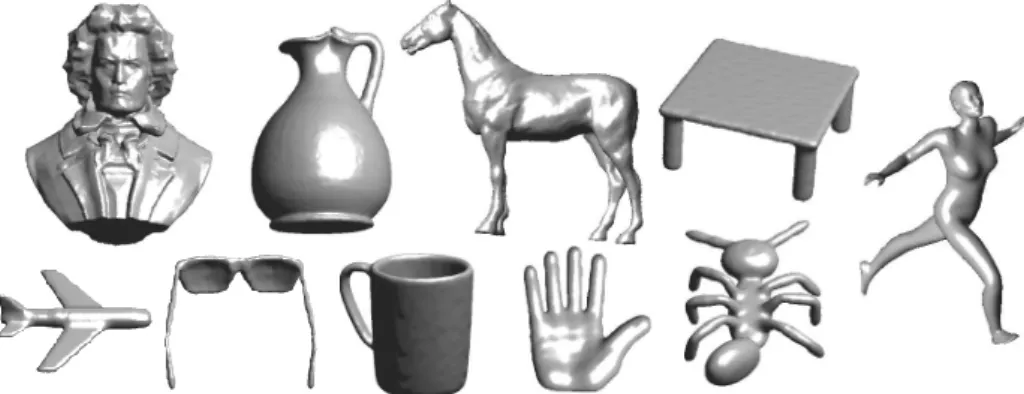
mentation project [Chen et al., 2009] database for training and testing the proposed 3D steganalyzer. This database contains a large variety of shapes, covering the human pos-tures, animals, tools and so on. The stego-objects are generated by applying six different embedding algorithms, which embed information into spatial or transform domain of the 3D objects.
With the aim of evaluating the proposed 3D steganalytic features, we use the proposed steganalytic features extracted from 260 pairs of cover- and stego-objects, produced by a certain information hiding algorithm, in order to train a steganalyzer. Then, we test the performance of the trained steganalyzer when identifying the stego-objects from the other 94 pairs of cover- and stego-objects.
This chapter was published in [Li and Bors, 2017]. The rest of this chapter is organized as follows: The description of the 3D steganalysis framework formulated in this study is provided in Section 3.2. The 3D feature set, used by the steganalyzer is presented in detail in Section 3.3. The experimental results are provided in Section 3.4, while the summary of this chapter are outlined in Section 3.5.
3.2
3D steganalysis framework
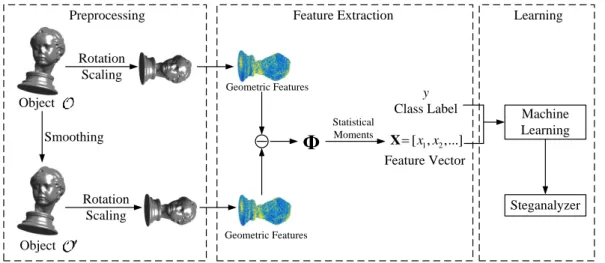
In this section, we provide a brief introduction of the 3D steganalysis framework. The ste-ganalysis framework is treated as a machine learning problem, consisting of training and testing stages. The training of the steganalyzer has the following processing steps: prepro-cessing, feature extraction and learning, as illustrated in Figure 3.1. The result of these processing steps consists of a parameter set discriminating between the 3D objects carrying hidden information and those that are not. The testing stage includes the same preprocess-ing and feature extraction steps as the trainpreprocess-ing stage, while applypreprocess-ing the parameters learnt during the training on the features extracted from various sets of test objects.
Firstly, during the preprocessing stage, Laplacian smoothing is applied on all the graph-ical objects. The idea of 3D object smoothing was borrowed from image steganalysis, where it was observed that the difference between the stego-image and its smoothed version is more significant than the difference between the coimage and its corresponding smoothed
ver-3.2. 3D STEGANALYSIS FRAMEWORK 25 Object Object Smoothing Rotation Scaling Rotation Scaling
Φ
Statistical Moments y Class Label Feature Vector Steganalyzer Machine Learning Preprocessing Feature Extraction Learning1 2 [ ,x x,...] X Geometric Features Geometric Features
Figure 3.1: The 3D steganalysis framework based on learning from statistics of the local feature sets and classification by means of machine learning methods.
sion [Fridrich et al., 2002b, Kodovsky and Fridrich, 2009]. Similarly, it is expected that the difference between a mesh and its smoothed version is larger for a stego mesh than for a cover mesh. In most 3D watermarking algorithms, the changes produced to the stego-object, following the watermark embedding, can be associated to noise-like changes. Consequently, when smoothing a cover mesh, the resulting modifications will be smaller than those ob-tained when smoothing its corresponding stego mesh. We consider Laplacian smoothing for the object O, resulting in its smoothed version O0. Then the rotation and scaling are used
to normalize the objects such that their size is constrained within a cube with sides of one, in order to eliminate the perturbation on the features, caused by the variation of the size in the objects from the training set.
Features, characterizing the local geometry of 3D objects are extracted after the prepro-cessing stage. In Section 3.3 we propose to use a new set of 3D features for steganalysis. Then, Φ represents the absolute difference between the geometric feature extracted from the object O and its smoothed versionO0. In order to statistically model the difference, we consider the first four statistical moments, representing the mean, variance, skewness and kurtosis, of the logarithm of Φas the feature vectorX, which is then used as an input to a machine learning algorithm along with the class label y for the object O.
In the supervised learning phase, a classifier is trained over the extracted feature vectors and the corresponding class labels of the objects. The classifier, which is also known as the
26 CHAPTER 3. LFS FEATURE SET FOR 3D STEGANALYSIS
steganalyzer, separates the feature space defining the stego-objects from that of the cover-objects. In this research study we propose to use the FLD ensemble [Kodovsk`y et al., 2012] for training the steganalyzer.
3.3
Local geometry-based feature set
3D watermarking and steganographic methods are specifically designed to embed information in a way that does not visibly alter the surface of the objects [Luo and Bors, 2011, Bors and Luo, 2013]. 3D steganalysis aims to find computationally such changes, separating the stego-objects from the cover-objects. Depending on the specific algorithm used, such changes could be randomly distributed on the surface of the 3D mesh [Bors, 2006] or they could be specifically located in certain regions of the object [Alface et al., 2007]. Artefacts produced in objects, following the information hiding embeddings, could be assimilated to low level protuberances on mesh surfaces and consequently could be identified by feature detection algorithms. In the following we outline some 3D local features which can be used for identifying whether objects have been watermarked or not. Such feature detectors range from very simple vertex displacement measurements to algorithms that take into account the local neighbourhoods and measure specific shape characteristics.
Let us assume that we have the shape of a 3D object, considered as a cover meshO =
{V,F,E}, containing the vertex set V = {vi|i = 1,2, . . . ,|V|}, where |V| represents the
number of vertices in the object O, its face setF, and its edge setE, respectively. We define the neighbourhood N(vi) of a vertex vi as{vj ∈ N(vi)|e(i,j) ∈ E}, where e(i,j) is the edge
connecting verticesvi and vj.
3.3.1 Preprocessing
As already mentioned in Section 3.2, the preprocessing of the 3D objects is an essential phase for extracting the steganalytic features. One iteration Laplacian smoothing is firstly applied to the 3D object O, which updates the vertexvi intov0i as follows, [Taubin, 1995]:
v0i ←vi+ λ P vj∈N(vi)wij X vj∈N(vi) wij(vj−vi), (3.1)
![Figure 2.3: The illustration of the hierarchical watermarking framework proposed in [Wang et al., 2008]](https://thumb-us.123doks.com/thumbv2/123dok_us/1320143.2676452/30.892.184.663.253.531/figure-illustration-hierarchical-watermarking-framework-proposed-wang-et.webp)
![Figure 3.5: Histograms of dihedral angles feature φ 9 and its logarithm of the cover, in (a) and (c), and stego versions, in (b) and (d), of the “Head statue” object from the database from [Chen et al., 2009].](https://thumb-us.123doks.com/thumbv2/123dok_us/1320143.2676452/56.892.189.689.159.706/figure-histograms-dihedral-angles-feature-logarithm-versions-database.webp)
![Figure 3.6: Histograms of vertex normal feature φ 11 and its logarithm of the cover, in (a) and (c), and stego versions, in (b) and (d), of the “Horse” object from the database from [Chen et al., 2009].](https://thumb-us.123doks.com/thumbv2/123dok_us/1320143.2676452/57.892.242.739.163.704/figure-histograms-vertex-normal-feature-logarithm-versions-database.webp)