Multi user Environments for Dynamic data storage avoiding
Duplication
Mudigonda Pooja Manaswini & Pogaku Rajkumar
1. PG Scholar, Department of CSE, Vaagdevi College of Engineering, Autonomous,
Bollikunta, Warangal Telangana, Mail.id:[email protected]
2. Associate Professor Department of CSE,Vaagdevi College of Engineering, Autonomous
Bollikunta, Warangal Telangana, Mail id:[email protected]
ABSTRACT: Dynamic Proof of Storage (PoS)
could be a helpful scientific discipline primitive
that allows a user to see the integrity of
outsourced files and to with efficiency update the
files in a very cloud server. Though researchers
have planned several dynamic PoS schemes in
single user environments, the matter in multi-user
environments has not been investigated
sufficiently. A sensible multi-user cloud storage
system wants the secure client-side cross-user
deduplication technique, that permits a user to
skip the uploading method and procure the
possession of the files now, once alternative house
owners of an equivalent files have uploaded them
to the cloud server. To the simplest of our data,
none of the present dynamic PoS will support this
system. during this paper, we have a tendency to
introduce the conception of deduplicatable
dynamic proof of storage associated propose an
economical construction referred to as DeyPoS,
to realize dynamic PoS and secure cross-user
duplication, at the same time. Considering the
challenges of structure diversity and personal tag
generation, we have a tendency to exploit a
unique tool referred to as Homomorphic genuine
protection of our construction, and therefore the
theoretical analysis and experimental results
show that our construction is economical in
follow. KEYWORDS: Deduplication, Proof of
ownership, Dynamic proof of storage, Cloud
Computing.
I. INTRODUCTION Users ought to be
convinced that the files keep within the server
don't seem to be tampered. Ancient techniques for
safeguarding knowledge integrity, like message
authentication codes (MACs) and digital
signatures need users to transfer all of the files
from the cloud server for verification that incurs a
significant communication value. These
techniques don't seem to be appropriate for cloud
storage services wherever users could check the
integrity oftentimes, like each hour. Thus,
researchers introduced Proof of Storage (PoS) for
checking the integrity while not downloading files
from the cloud server. What is more, users may
need many dynamic operations, like modification,
insertion, and deletion, to update their files,
whereas maintaining the potential of PoS.
Dynamic PoS is projected for such dynamic
operations. In distinction with PoS, dynamic PoS
employ structures, like the Merkle tree. Thus,
once dynamic operations are dead, users
regenerate tags (which are used for integrity
checking, like MACs and signatures) for the
updated blocks solely, rather than create for all
blocks. To rised perceive the subsequent contents.
We tend to gift additional details concerning PoS
and dynamic PoS. In these schemes, every block
of a file is hooked up a (cryptographic) tag that is
employed for substantiating the integrity of that
block. Once a champion desires to ascertain the
integrity of a file, it every which way selects some
block indexes of the file, and sends them to the
cloud server. Consistent with these challenged
indexes, the cloud server returns the
corresponding blocks beside their tags. The
champion checks the block integrity and index
correctness. The previous are often directly
bonded by cryptanalytic tags. a way to affect the
latter is that the major distinction between PoS
and dynamic PoS In most of the PoS schemes, the
block index is “encoded” into its tag, which
implies the champion will check the block
integrity and index correctness at the same time.
However, dynamic PoS cannot cypher the block
indexes into tags, since the dynamic operations
could modification several indexes of
non-updated blocks that incurs reserve computation
and communication value. As an example, there's
a file consisting of one thousand blocks, and a
replacement block is inserted behind the second
block of the file. Then, 998 block indexes of the
should generate and send 999 tags for this update.
Structures are introduced in dynamic PoSs to
unravel this challenge. As a result, the tags are
hooked up to the structure instead of the block
indexes .However, dynamic PoS remains to be
improved in an exceedingly multi-user
atmosphere, because of the necessity of cross-user
American state duplication on the client-side. This
means that users will skip the uploading method
and acquire the possession of files now, as long
because the uploaded files exist already within the
cloud server. As a result, the tags area unit
connected to the structure rather than the block
indexes .However, dynamic PoS remains to be
improved in associate extremely multi-user
atmosphere, due to the requirement of cross-user
American state duplication on the client-side. This
suggests that users can skip the uploading
methodology and acquire the possession of files
currently, as long as a result of the uploaded files
exists already among the cloud server. This
methodology can shrink house for storing for the
cloud server, and save transmission metric for
users. To the only of our information, there aren't
any dynamic PoS that will support secure
cross-user American state duplication.
II. LITRATURE SURVEY
1.COMPACT PROOFS OF
RETRIEVABILITY Authors: Hovav Shacham
Description: In this paper, built from BLS
signatures and secure in the random oracle model,
features a proof-ofretrievability protocol in which
the client’s query and server’s response are both
extremely short. This scheme allows public
verifiability: anyone can act as a verifier, not just
the file owner. Our second scheme, which builds
on pseudorandom functions (PRFs) and is secure
in the standard model, allows only private
verification. It features a proof-of-retrievability
protocol with an even shorter server’s response than our first scheme, but the client’s query is
long. Both schemes rely on homomorphic
properties to aggregate a proof into one small
authenticator value.
2. A Dynamic Proof of Retrievability (PoR)
Scheme with O(logn) Complexity Authors:
Zhen Mo, Yian Zhou, Shigang Chen
Description:
In this paper, Cloud storage brings security
concerns. One major concern is about the data
integrity. In this paper, we extend the staticPoR
scheme to dynamic scenario. We propose a new
authentication data structure called Cloud Merkle
B+ tree (CMBT). Compared with the existing
communication complexity is O(logn) instead of
O(n).
3. Practical Dynamic Proofs of Retrievability
Authors: Elaine Shi, Emil Stefano,
Charalampos Papamanthou Description:
In this paper,We propose a dynamic PoR scheme
with constant client storage whose bandwidth cost
is comparable to a Merkle hash tree, thus being
very practical. Our construction outperforms the
constructions of Stefanov et al. and Cash et
al.both in theory and in practice. Specifically, for
n outsourced blocks of bits each, writing a block
requires +O(log n)bandwidth and O(log n) server
computation (is the securityparameter). Audits are
also very efficient, requiring + O(_2 log n)
bandwidth. We also show how to make our
scheme publicly verifiable, providing the first
dynamic PoR scheme with such a property. We
finally provide a very efficient implementation of
our scheme.
4. Proofs of Ownership in Remote Storage
Systems Authors: Shai Halevi, Danny Harnik,
Benny Pinkas Description: In this work we put
forward the notion of proof-of-ownership, by
which a client can prove to a server that it has a
copy of a file without actually sending it. This
allows to counter attacks on file-deduplication
systems where the attacker obtains a “short
summary” of the file and uses it to fool the server
into thinking that the attacker owns the entire file.
5. Dynamic Proofs of Retrievability for Coded
Cloud Storage Systems Authors: Zhengwei
Ren, Lina Wang, Qian Wang, Mingdi Xu
Description: In this paper, we proposed a new
dynamic proof of retrievability scheme for coded
cloud storage systems. Network coding and
erasure codes are adopted to encode data blocks to
achieve within-server and cross-server data
redundancy, tolerating data corruptions and
supporting communicationefficient data recovery.
By using rb23Tree and an improved version of
ASBB scheme, 16. 0411122 20255 our
construction can support efficient data dynamics
while defending against data replay attack and
pollution attack. Security analysis and
experimental evaluations demonstrated the
practicality of our construction in coded cloud
storage systems.
III. PROPOSED SYSTEM
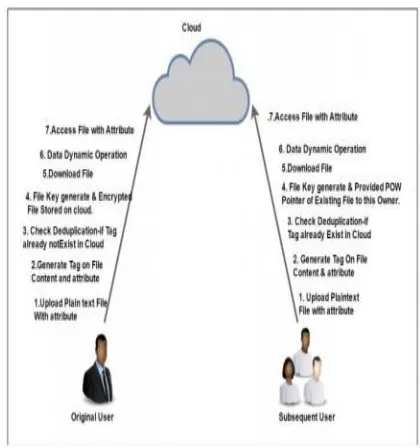
A. SYSTEM MODEL The entire document
should be in Times New Roman or Times font.
Type 3 fonts must not be used. Other font types
may be used if needed for special purposes. As
the user World Health Organization uploaded the
file to the cloud server, whereas ulterior user is
that the user World Health Organization
established the possession of the file however
didn't truly transfer the file to the cloud server.
There square measure 5 phases during a
deduplicatable dynamic PoS system: pre-process,
upload, deduplication, update, and proof of
storage.
B. PRE-PROCESS PART Users will transfer
their native files. The cloud server decides
whether or not these files ought to be uploaded. If
the transfer method is granted, enter the transfer
phase; otherwise, enter the deduplication part
C. UPDATING Users will transfer their native
files. The cloud server decides whether or not
these files ought to be uploaded. If the transfer
method is granted, enter the transfer phase;
otherwise, enter the deduplication part.
Fig 1: System Architecture
D. DEDUPLICATION CHECK The files to be
uploaded exist already within the cloud server. the
next users possess the files domestically and also
the cloud server stores the structures of the files.
ulterior users got to persuade the cloud server that
they own the files while not uploading them to the
cloud server. If these 3 phases (pre-process,
upload, and deduplication) square measure dead
just one occasion within the life cycle of a file
from the angle of users. That is, these 3 phases
seem only if users will transfer files. If these
phases terminate unremarkably, i.e., users end
transfering within the upload part, or they pass the
verification within the deduplication part, we are
saying that the users have the ownerships of the
E. USERS PROOF OF STORGE Users solely
possess a little constant size information
domestically and that they need to examine
whether or not the files square measure
dependably hold on within the cloud server while
not downloading them. The files might not be
uploaded by these users however they pass the
deduplication part and prove that they need the
ownerships of the files. Note that, the update part
and also the proof of storage part will be dead
multiple times within the life cycle of a file. Once
the possession is verified, the users will randomly
enter the update part and also the proof of storage
part while not keeping the first files domestically.
IV. CONCLUSION
We planned the great necessities in multi-user
cloud storage systems and introduced the model
of deduplicatable dynamic PoS. we had develop a
unique tool known as HAT that is Associate in
Nursing economical genuine structure. Supported
HAT, we had planned the primary sensible
deduplicatable dynamic PoS theme known as
DeyPoS and evidenced its security within the
random oracle model. The theoretical and
experimental results show that our DeyPoS
implementation is economical,
REFRENCES
[1] H. Shacham and B. Waters, “Compact Proofs of Retrievability,”Journal of Cryptology, vol. 26,
no. 3, pp. 442–483, 2013.
[2] Z. Mo, Y. Zhou, and S. Chen, “A dynamic
proof of retrievability (PoR) scheme with o(logn)
complexity,” in Proc. of ICC, pp. 912–916, 2012.
[3] E. Shi, E. Stefanov, and C. Papamanthou,
“Practical dynamic proofs of retrievability,” in
Proc. of CCS, pp. 325–336, 2013.
[4] C. Erway, A. K¨upc ¨u, C. Papamanthou, and
R. Tamassia, “Dynamic provable data
possession,” in Proc. Of CCS, pp. 213–222, 2009.
[5] S. Halevi, D. Harnik, B. Pinkas, and A.
Shulman-Peleg, “Proofs of ownership in remote
storage systems,” in Proc. of CCS, pp. 491–500,
2011.
[6] Z. Ren, L. Wang, Q. Wang, and M. Xu,
“Dynamic Proofs of Retrievabilityfor Coded Cloud Storage Systems,” IEEE Transactionson
Services Computing, vol. PP, no. 99, pp. 1–1,
2015.
[7] R. Tamassia, “Authenticated Data
Structures,” in Proc. of ESA,pp. 2–5, 2003. 16.
0411122 20257
[8] Q. Wang, C. Wang, J. Li, K. Ren, and W.
dynamics for storage security in
cloudcomputing,” in Proc. of ESORICS, pp. 355–
370, 2009.
[9] F. Armknecht, J.-M. Bohli, G. O. Karame, Z.
Liu, and C. A. Reuter, “Outsourced proofs of retrievability,” in Proc. of CCS, pp. 831–
843,2014.
[10] J. Douceur, A. Adya, W. Bolosky, P. Simon,
and M. Theimer,“Reclaiming space from
duplicate files in a serverless distributedfile
system,” in Proc. of ICDCS, pp. 617–624, 2002.
[11] A. Juels and B. S. Kaliski, Jr., “PORs: Proofs of retrievability forlarge files,” in Proc. of CCS,
pp. 584–597, 2007.
[12] H. Shacham and B. Waters, “Compact proofs of retrievability,” inProc. of ASIACRYPT, pp.
90–107, 2008.
[13] Y. Dodis, S. Vadhan, and D. Wichs, “Proofs
of retrievability via hardness amplification,” in
Proc. of TCC, pp. 109–127, 2009.
[14] K. D. Bowers, A. Juels, and A. Oprea,
“HAIL: A high-availabilityand integrity layer for cloud storage,” in Proc. of CCS, pp. 187 198