ISSN 2286-4822 www.euacademic.org
Impact Factor: 3.1 (UIF) DRJI Value: 5.9 (B+)
E-Archiving Management System: Analysis, Design,
and Implementation (A Case Study at Computer
Center, Thi-Qar University)
MEERAS SALMAN JUWAD AL-SHEMARRY Computer Science Department College of Science, Karbala University Karbala, Iraq ELHAM MOHAMMED THABIT ABDALAMEER Computer Science Department College of Science, Karbala University Karbala, Iraq DAWOOD SALLEM HUSSIAN Computer Center Thi-Qar University Thi-Qar, Iraq
Abstract:
organization.
Key words: Requirements, Requirement model, unified modeling language (UML), functional requirements, e-Archiving Management System (eAMS).
1. Introduction
make sure the system which is being develop will meet the user’s need and within budget. The purpose of this research is to analysis, design and implementation a requirements model of eAMS to help any organization to document, record, and manage as well as monitor all e-archives activities in effective and easy way. All system requirements must fulfill to obtain on a complete system. The computer center of Thi-Qar University was chosen as a case study to implement this model.
2. Existing Related Work on e-Archiving Management System
2.1. Model Requirements for Electronic Records Management System (ERMS)
This document is a part of the original document was developed by the National Archives of Malaysia under the first phase of the e-SPARK project. It's discussed the creation and management of electronic records. This model explains the requirements list, which must provide in electronic records management system to all possible system functions and specific functional requirements with the user roles either as a relevant mandatory requirements or specify limitation to an authorized user. This model can be concluded that all the information that associated with electronic record management system are containing in the model. With this model, it can be as a reference for developer, designer and users themselves to understand the requirements before developing the system.
2.2. E-Document Management Systems (EDMS)
audible, or visual manner. Bielawski and Boyle (1997) listed the benefit of EDMS, which can be obtained by the organizations that implement EDMS in their company.
• Reduced the cost of create and distribute documents. • Improve the way of access to the documents.
• Faster implementation to the operations of creation and update documents.
• Raise the operation of reuse and leverage from existing information.
• Improve collaboration among the employees. • More complete regulatory compliance.
• Strengthen the control and security on the document. • Best user / client satisfaction.
3. Research Methodology
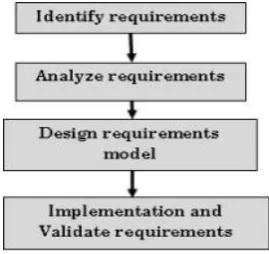
The Object-Oriented method was selected to accomplish this study; it covered the area of evaluation for performance analysis and designs the requirements model using selected ways to gather information. The system analysis method shown in figure (1) by Whitten et al. (2001), used to construct a requirements model for eAMS.
4. Finding and Results
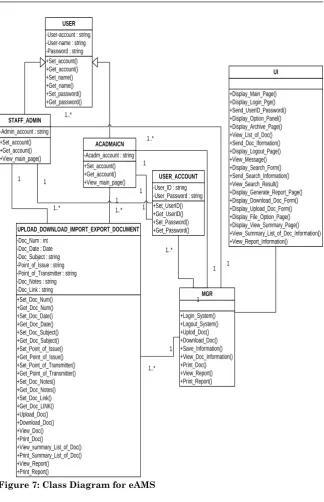
The finding and results of this study gathered from defined the requirement phase which based on fact finding techniques, review of the existing software application, and interview were used to gather the user requirements for eAMS, and analyze the requirement phase which using UML notation to construct the requirement model by using requirement list, use case diagram, class diagram, and activity diagram.
4.1. Define requirement phase
The review of the existing software application depends on the
analysis result that illustrates in table (1) for some software application such as Document Management System (EDMS) and Model Requirements for Electronic Records Management System (ERMS), found some functions and characteristics to these systems to manage the users functionalities by the current system and that can be followed it to produce the best requirements model for eAMS. Interview that conducts to understand and explain what the users opinion of used the eAMS instead of used the manual system to archive documents.
REQUIREMENTS MODELS
EDMS REQUIREMENTS FOR ERMS Search Provide searching and retrieving
function with specific requirements which must and should have in ERMS.
Does not stated what type of indexing and retrieval will be available and to whom.
Not stated but provide Meta data elements for ERMS. The Meta data elements present in a table.
Give surface explanation about searching function by providing requirement sample accessibility guideline for searching function and indexing using keystrokes.
View List specific requirements which must and should have to display the records.
Also provide function for
printing the record either full record or summary list of selected records
Creation Not stated about document creation.
Stated about capturing records function with its requirements
Not stated about this requirement.
security Provide control and security function in order to control user access to the record
Explain about access, audit trails, backup and recovery, tracing record movements, authenticity and security categories.
Provide access control model
Mention in detail the functional requirement either as a relevant mandatory requirement or to specify limitation to an authorized user.
Table 1: Analysis Result of EDMS and ERMS Models
4.2. Analyze Requirement Phase 4.2.1. Functional Requirement
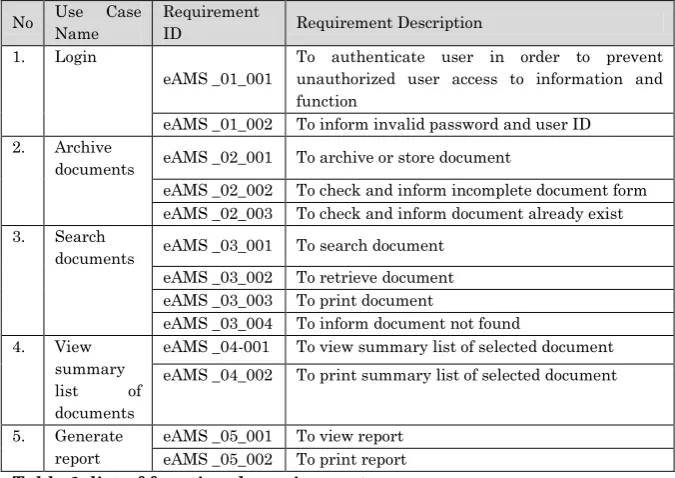
The table (2) shows the list of functional requirements for eAMS.
Table 2: list of functional requirements
No Use Case Name
Requirement
ID Requirement Description 1. Login
eAMS _01_001
To authenticate user in order to prevent unauthorized user access to information and function
eAMS _01_002 To inform invalid password and user ID 2. Archive
documents eAMS _02_001 To archive or store document
eAMS _02_002 To check and inform incomplete document form eAMS _02_003 To check and inform document already exist 3. Search
documents eAMS _03_001 To search document eAMS _03_002 To retrieve document eAMS _03_003 To print document
eAMS _03_004 To inform document not found 4. View
summary list of documents
eAMS _04-001 To view summary list of selected document eAMS _04_002 To print summary list of selected document
5. Generate report
4.2.2 Constructed Requirement Model For eAMS
All requirements should be documented and recorded by using an effective way or technique to model out the requirement and to understand all system requirements. This technique calls requirement model. According to Compton et al. (2004), a requirement model describes the functionality of a software system. Many tools have been used in analysis and design of programs and this UML has emerged as a standard technique in object oriented approach (Eichelberger 2003). In this study, the unified modeling language (UML) is used as a tool to define as well as to construct the requirement model for eAMS. The following diagrams and supporting textual information constitute the requirement model were stated as below:
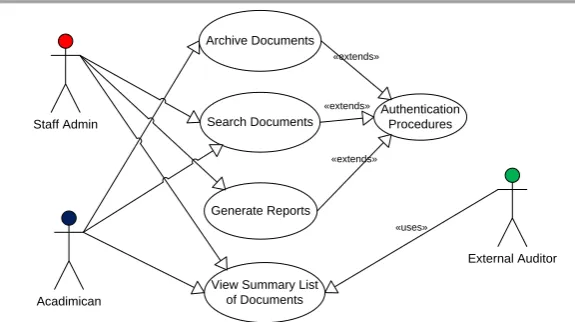
I. Use Case Diagram: this diagram provides an easy and clear way to introduce the requirement structure in software system (Wuwei et al.,2004).The use case diagram for eAMS as shown in figure (2) consist of five use cases and the requirement model for eAMS have three actors that deal with this use cases :
a. Admin staff : the admin staff refers to dean, head of department and selected clerk. They can search documents, generate report, and view summary list of documents after they have log into the system.
b. Academician: the academician can store , search, and view summary list of documents. But they must login first in order to use these functions.
Archive Documents
Search Documents
Generate Reports
View Summary List of Documents
Authentication Procedures Staff Admin
Acadimican
External Auditor «extends»
«extends»
«extends»
«uses»
Figure 2: Use Case Diagram for eAMS
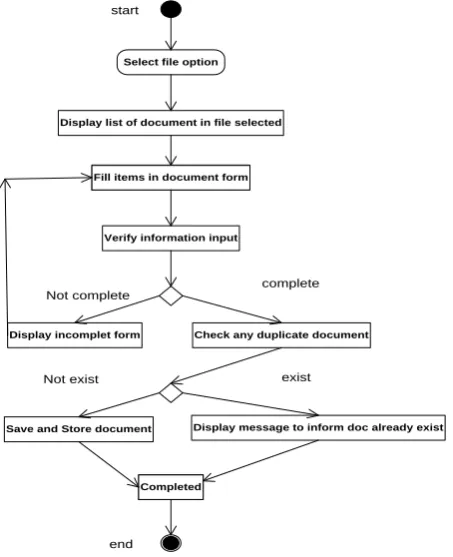
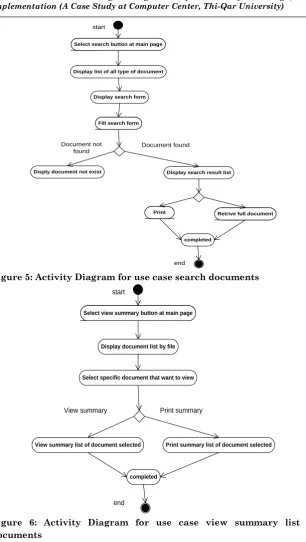
II. Activity diagram: this diagram is logical model represent the business domains and operational activities without suggestion how they are conducted. Activity diagram contains five diagrams that constructed for all use cases. In other word, each use case have activity diagram. Figures (3, 4, 5 and 6) show the activity diagrams for some use cases of eAMS.
select option button
Login
Enter username and password
Re-enter username or/and password Disply option panel
completed
successfull Not successfull
end start
Figure 3: Activity Diagram for use case authentication procedure
Select file option
Display list of document in file selected
Fill items in document form
Verify information input
Display incomplet form Check any duplicate document
Display message to inform doc already exist Save and Store document
Completed start
end
complete Not complete
exist Not exist
Select search button at main page
Display list of all type of document
Fill search form
Display search result list Disply document not exist
completed Document not
found
Document found
end start
Display search form
Print Retrive full document
Figure 5: Activity Diagram for use case search documents
Select view summary button at main page
Display document list by file
Print summary list of document selected View summary list of document selected
completed
View summary Print summary
end start
Select specific document that want to view
+Set_account() +Get_account() +Set_name() +Get_name() +Set_password() +Get_password() -User-account : string -User-name : string -Password : string
USER
+Set_account() +Get_account() +View_main_page() -Admin_account : string
STAFF_ADMIN
+Set_account() +Get_account() +View_main_page() -Acadm_account : string
ACADMAICN
+Set_UserID() +Get_UserID() +Set_Password() +Get_Password() -User_ID : string -User_Password : string
USER_ACCOUNT +Set_Doc_Num() +Get_Doc_Num() +Set_Doc_Date() +Get_Doc_Date() +Set_Doc_Subject() +Get_Doc_Subject() +Set_Point_of_Issue() +Get_Point_of_Issue() +Set_Point_of_Transmitter() +Get_Point_of_Transmitter() +Set_Doc_Notes() +Get_Doc_Notes() +Set_Doc_Link() +Get_Doc_LINK() +Upload_Doc() +Download_Doc() +View_Doc() +Print_Doc() +View_summary_List_of_Doc() +Print_Summary_List_of_Doc() +View_Report() +Print_Report() -Doc_Num : int -Doc_Date : Date -Doc_Subject : string -Point_of_Issue : string -Point_of_Transmitter : string -Doc_Notes : string -Doc_Link : string
UPLOAD_DOWNLOAD_IMPORT_EXPORT_DOCUMENT +Login_System() +Logout_System() +Uplod_Doc() +Download_Doc() +Save_Information() +View_Doc_Information() +Print_Doc() +View_Report() +Print_Report() MGR +Display_Main_Page() +Display_Login_Pge() +Send_UserID_Password() +Display_Option_Panel() +Display_Archive_Page() +View_List_of_Doc() +Send_Doc_Iformation() +Display_Logout_Page() +View_Message() +Display_Search_Form() +Send_Search_Information() +View_Search_Result() +Display_Generate_Report_Page() +Display_Download_Doc_Form() +Display_Upload_Doc_Form() +Display_File_Option_Page() +Display_View_Summary_Page() +View_Summary_List_of_Doc_Information() +View_Report_Information() UI 1 1 1 1 1 1..* 1 1..* 1 1..* 1 1..* 1..* 1 1..* 1
4.3Validation Requirement Model
This section describes a special method that is used to verify the functional requirements for this model. The Sample system (prototype) was developed as a guide to validate these requirements and to show the user interfaces which is very important to capture all requirements that meet and validate the needs of system users.
5. Conclusion and Recommendation
This study was successfully achieve the objectives by constructing a requirement model for eAMS which is completely developed according to the Computer Center of Thi-Qar university requirements. The focus of this study were to understand and develope the suitable as well as applicatable requirement model specifically on archiving documents subject as a preparation to develope a complete system for this eAMS in the future. furthermore, this model will provide the greatest service to educational organizations or other organizations and individuals with minimal amount of effrot. As a result, the model produced in this project is suitable for organization interested in managing their needs in a proper way.
6. Significance and Contribution
In general, this study provides specific important information to develope a requirement model related to e-archiving management area in future. Further more, this developed requirement model as well as system sample (prototype) can be extended to complete system development to support and overcome all e-archiving management problems. Within requirements, the process of developing a system can make sure that all the activities to move smoothly. In addition; it helps the organization to increase the quality of system development. Moreover, efficient interaction and communication when using this system between the staffs and their organizations will be raised to the best level after implementing a complete eAMS.
BIBLIOGRAPHY:
for better, faster, and cheaper systems.” Proceedings
from VHDL International Users Forum Fall Workshop. 3
– 6.
Bielawski, L. and J. Boyle. 1997. Electronic Document Management System: A User Centered Approach for
Creating Distributing and Managing Online
Publications. New Jersey, NJ: Prentice Hall PTR.
Compton, K., Huggins, J., Shen, W., Guizani, M., & Yang, Z. 2004. “Execution of a Requirement Model in Software Development.” Proceedings of the ISCA 13th International Conference on Intelligent and Adaptive
Systems and Software Engineering. 203-208. Nice,
France.
Dennis, A., Wixom, B. H., and Tegarden, D. 2005. Systems Analysis and Design: An Object Oriented Approach with UML. 2nd ed. New York, NY: John Wiley & Sons, Inc. Eichelberger, H. 2003. “All things UML: Nice class diagrams
admit good design?” Proceedings of the 2003 ACM
symposium on Software Visualization. 159–165. New
York, NY, USA: ACM Press.
Kohn, D. 2002. “Electronic Document Management systems an overview.” Topics in Health Information Management
23(1): 1.
Pressman, R. 2001. Software Engineering: A Practitioner’s Approach. 5th edition. McGraw-Hill.
Raynes, M. 2002). “Document management system: is the time now right?” Work Study 51(6): 303-308.
Whitten, J.L., Betley, L.D., and Diltman, K.C. 2001. System
analysis and design method. 5th ed. Boston, MA:
McGraw-Hill Education.
Wuwei, S., Mohsen, G., Zijiang, Y., Kevin J. C., and James, H. 2004. “Execution of a Requirement Model in Software Development.” In Proceedings of the ISCA 13th International Conference on Intelligent and Adaptive
Nice, France.
Zhang, J. and Wang, Z. 1996, September. NDHORM: An OO
Approach to Requirements Modeling. 21(5): 65 – 69. New