CHROMOSOME
PAIRING
IN
MAIZE1v2
CHARLES R. BURNHAM, JOHN T. STOUT, WILLIAM H. WEINHEIMER,
RICHARD V. KOWLES AND RONALD L. PHILLIPS3
Department of Agronomy and Plant Genetics, University of Minnesota,
St. Paul, Minnesota 55101
Manuscript received November 16, 1971 Revised copy received January 13, 1972
ABSTRACT
This report summarizes our observations at pachytene on opposite-arms intercrosses between stocks of interchanges that involve chromosomes 1 and 5
in maize.-Pairing does not begin at the centromeres in these intercrosses. -We propose a model which assumes different probability values along each chromosome arm for the initial or primary site of pairing. Observations on the frequencies of the different types of configurations at pachytene were used to estimate probability values which satisfactorily fit the data.-There is a relatively low probability (of the order of .I to .3) for the initial pairing to be in a short terminal segment (about .I of the arm length). Initial pairing in the one or two short segments adjacent to the tip segment is much higher. Initial pairing is much lower in segments successively closer to the middles of the chromosome arms, and then zero or nearly zero in the proximal half of the arm. This means that the initial pairing may fail occasionally even i n a relatively long interchanged segment and produce a T-shaped (3-armed) con- figuration.-After the initial pairing has occurred, the average probability that a secondary site of pairing is adjacent to the centromere in a segment .3 to .4 the length of a n arm is low (, 13, ranging from .02 to .29) .-We can predict that in an intercross i n which both breakpoints in both parental inter- changes are far out on the chromosomes, “pairs” will be formed with non- homologous ends (homologous differential segments paired). In these pairing could have begun at any point in the interstitial segments, but not likely in segments close to the centromeres.-Multiple secondary sites which vary i n time or in order of pairing will explain the variation in position of the cross- shaped pachytene configuration in interchange heterozygotes.-The observed configuration in any one cell is the result of a particular combination of pair- ing events at the various sites. This is a i e r y different concept of pairing from previous interpretations which described it as a result of zipper-like action, and the variation in position of the pachytene cross-configuration as the result of “shifts” in position.-Our cytogenetic results and their interpretation are in close agreement with reports on chromosome ultrastructure and molecular events i n the early stages of meiosis, i.e. the attachment of chromosome ends
to the nuclear membrane, the manner in which synaptonemal complexes de- velop, and the regions of DNA whose replication is delayed until zygonema.
* This work was supported by National Science Foundation Grants G.B. 1586, G.B. 5543, and G.B. 8742.
’
Paper No. 7812, Scientific Journal Series, Minnesota Agricultural Experiment Station, St. Paul, Minnesota.a Professor; Assistant Scientist 1963-1965, Associate Scientist 1966-1969; Assistant Scientist July 1969-1971; Research Assistant 1962-1966; Assistant Professor 1967-date, University of Minnesota. We wish to acknowledge the assistance of
112 c . R. BURNHAM et al.
pairing of homologous chromosomes is one of the most significant events TYnEmeiosis. In higher organisms, pairing is probably necessary for efficient crossing over and also for the orderly disjunction of the chromosomes.
I n diploids with normal pairs, pairing could begin at any point, and if it pro- ceeds by a zipper-like action, the final result is pairing throughout the length of the chromosome. I n heterozygotes for chromosomal aberrations, e.g. inver- sions, deficiences, duplications, and translocatiom (including interchanges as well as other types of transpositions), in which one member of a pair contains a structural rearrangement, the position and timing of pairing will affect the type of configuration seen at prophase I of meiosis. Studies of these heterozygotes should furnish information on pairing not obtainable from normal material. W e assume that the aberration does not change molecular events that lead to homo- logous pairing.
Intercrosses between stocks of interchanges that involve the same two chromo- somes are particularly useful f o r this purpose. For the past seven years, we have concentrated our cytogenetic studies on such intercrosses and their parents. I n this paper we report information from studies at pachytene that we believe pro- vides answers to two questions regarding chromosome pairing in maize: (1) Where does chromosome pairing begin? (2) Once pairing has begun, where is it next initiated? The model we propose to fit our observations assumes different probability values along the chromosome arm for the initial pairing (primary site). W e also propose that subsequent pairing is initiated at multiple (sec- ondary) sites along the chromosome and that the position, or timing. or both may be variable.
MATERIALS
For this report we used the maize interchanges that involve chromosomes 1 and 5, designated TI-5. These were selected because both chromosomes are long and have nearly median centro- meres. Using S and L to designate the short and the long arm, respectively, and taking the length of chromosome 10, the shortest one, as 100, the relative lengths for chromosome 1 and its arms
S 103 126 L S 85 90 L
are 0 , a total of 229; and for chromosome 5, --O----,
a total of 175. Both lacked distinctive cytological markers (knobs) in most of the stocks used. Although these would have aided in the determination of breakpoints, their absence removed one factor that might have affected pairing. In segments heterozygous for knobs, asynapsis is frequent .
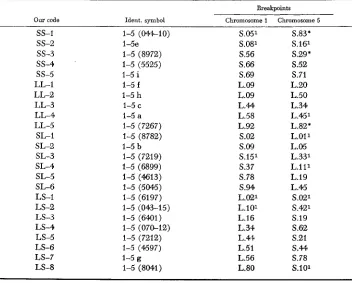
We used all the available TI-5 interchanges. Table 1 lists them, together with their break- point positions. The following explains the code designations in column 1 which will be used for ease of reference. The breakpoint in chromosome 1 for the first interchange in Table 1 , TI-5
(044-IO), was at S.05; that is, the segment between the centromere and the breakpoint in that chromosome was .05 of the total length of the short arm. Since the breakpoint in chromosome 5 was also in the short arm, this interchange is designated as an SS interchange. They are listed in groups in Table 1 in this order: SS, LL, SL, and LS; and numbered I, 2, 3, etc. within each group in the order of increasing distance of the breakpoint from the centromere in chromosome 1. This report is on the “opposite arms” type intercrosses, i.e., SS x LL and SL x LS. Most of the pachytene observations were made by one person (Stout). Reports on the other types of intercrosses will be in other papers.
METHODS
MAIZE CYTOGENETICS 113
parental interchanges and from F, intercrosses between the interchange stocks. W e fixed the material in a mixture of 3 parts 95% ethyl alcohol : 1 part glacial acetic acid. After 7 to 10 days at room temperature, the material was stored at about 0°F. After 1 to 2 months, we replaced the fixative with two changes of 70% alcohol and continued storage at the low temperature. Propiono- carmine and aceto-carmine smear methods were used for all materials examined cytologically.
RESULTS
Determination of breakpoints in the parental interchanges: For 21 o f the 24 interchange heterozygotes, measurements of the position of the center of the cross were obtained in several cross-shaped pachytene configurations. For a few of the interchanges our information indicated one or both breakpoints were in the opposite arm from that published by LONGLEY (1961). These changes are marked with in Table 1. For SL-1, LONGLEY listed the breakpoints as being at both centromeres. For the others, each breakpoint listed is an average of the average of our measurements and the values reported by LONGLEY. Since the position of the cross varies, in some cases widely, the breakpoint positions may be subject to considerable error. This variation might lead to a n error in determin- ing the arms in which the breakpoints had occurred. This is most likely for the
TABLE 1
TI-5 chromosomal interchanges used, together with breakpoint positions
Our code
Breakpoints Ident. symbol Chromosome 1 Chromosome 5
ss-1 ss-2
ss-3
ss-4 ss-5 LL-1 L L 2 LL-3 LL-4 LL-5 SL-1 SL-2 SL-3 SL-4 SL-5 SL-6 LS-1 LS-2 LS-3 LS-4 LS-5 LS-6 LS-7 LS-81-5 (044-10)
1-5e 1-5 (8972) 1-5 (5525) 1-5 i 1-5 f
1-5 h
1-5 c 1-5 a 1-5 (7267) 1-5 (8782) 1-5 b
1-5 (6899) 1-5 (4613) 1-5 (5W5) 1-5 (6197)
1-5 (6401)
1-5 (7212) 1-5 (7219)
1-5 (043-15)
1-5 (070-12)
1-5 (4597) 1-5 g
1-5 (8041)
S.051 S.081 S.56 S.66 S.69 L.09 L.09 L.44 L.58 L.92 s.02 S.09 S.151 s.37 S.78 s.94 L.021 L.101 L.16 L.34 L.4) L.51 L.56 L.80 5.83* 5.161 5.29* 5.52 5.71 1.20 1.50 1.34 1.451 1.82* 1.011 1.05 1.331 1.111 1.19 1.45 5.021 5.421 5.19 5.62 5.21 S.M 5.78 5.101
114 c. R. BURNHAM et al.
three with both breakpoints very close to the centromeres, SL-1, SL-2, and LS-1. The diakinesis observations on the entire series of intercrosses involving each of these indicate only that each is SL or
LS
(BURNHAM and STOUT, in preparation). I t is also possible that one or more of these might have one or both breakpoints in the centromere. This would affect the expectations, since the interchanged chromosomes would have no interstitial segments.For two interchanges (LL-1 and LS-3) with breakpoints not as close to the centromers, pachytene observations on “same arms” intercrosses involving them showed that these breakpoints are placed correctly ( WEINHEIMER, unpub.)
.
For a third one, SS-2, we have no supplemental information.Pachytene obseruations on intercrosses. Does pairing begin at the centromere?:
If homologous segments are paired in the “opposite arms” type intercrosses, there will be a 2-cross configuration at pachytene as shown in Figure 1A-3 which is drawn to scale for the lengths of the two chromosomes. Each “cross” corre- sponds to the cross-shaped configuration that would be observed in the heterozy- gote for the particular parental interchange. The two regions that connect the two “crosses” are the differential segments, each of which is comprised of two interstitial segments (the segments between the centromeres and the break-
A-1: Breakpoints
-
1
126 103
‘
83.2 ,f 41.8’
96.E 6.2LS-4 S L . 6
32.3 52.7 *--- 40.5 1 4 9 . 5
-
----_ 5
85 9 0
A - 2 : New Chromosomes
49.5 5
---
116 96 8
i
From SL-6 85 4 0 5 b 2
5
_ _ _ _ _ _ _ -
C.---LlA - 3
49 5
_---
96 8
B
i
-
495 96 8 116---
5---
k-43.3- 103 42.8 32.3 6 5 0 . 9 - 1
C
- 49.5 9 6 8
fl
1265 = = = = =
51.7 83.2
90
FIGURE 1.-Diagrams illustrating the TI-5 SL-6 x TI-5 LS-4 intercross. A-1. Breakpoint positions for the two interchanges. A-2. The new interchanged chromosomes. A-3. Pachytene, 2-cross configuration if homologous parts are paired. B. Chromosome “pairs” formed by homolo-
gous pairing of the segments that include the centromeres. C. Chromosome “pairs” formed if
MAIZE CYTOGENETICS 115
FIGURE 2.-Two-cross configuration at pachytene in a T1-5 SS-5
x
Ti-5 LL-4 intercross. A. Photomicrograph. B. Camera Lucida tracing.points). Figure 2A is a photomicrograph of a 2-cross pachytene configuration Figure 2B is the camera-lucida tracing.
The occurrence of 2-cross configurations immediately suggests that pairing is initiated in the two differential and also in each of the four interchanged seg- ments in the interchange complex.
LLPairs” formed as a result of pairing that proceeded only from the centromeres or adjacent regions of the four interchanged chromosomes would have non- homologous end segments. If the interchanged segments differ in length, one member of the “pair” would be longer than the other as shown in Figure 1B.
“Pairs” formed as the result of pairing that proceeded only from homologous end segments would have non-homologous middle segments, but homologous end segments (Figure 1 C)
.
116 c . R. BURNHAM et al.
TABLE 2
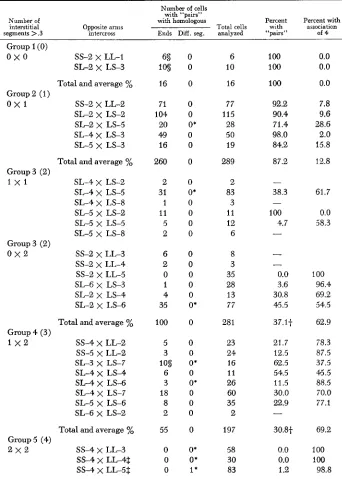
Summary of pachytene observations for opposite arms type intercrosses grouped according to the number of interstitial segments (centromere to breakpoint) in each parent longer
than 30% of the arm length
Included are the numbers of cells with each type of “pair” and the percentages of cells with an association of four.
Number of cells with “pairs”
Number of with homologous Percent Percent with interstitial Opposite arms Total cells with assmiahon segments >.3 intercross Ends Diff. seg. analyzed “pairs” of 4
Group 1 (0)
o x o
ss-2x
LL-1 SL-2x
LS-3Total and average % Group 2 (1)
0 x 1 ss-2
x
LL-2S G 2
x
LS-2 SL-2x LS-5 SL-4x
LS-3 SL-5x
LS-3Total and average % Group3 (2)
1 x 1 SL-4
x
LS-2SL-4
x
LS-5 SL-4x
LS-8 SL-5x
LS-2sL-5
x
LS-5SL-5
x
LS-8Group3 (2)
o x 2 ss-2
x
LL-3ss-2
x
LL-4 ss-2 x LL-5 SL-6x
LS-3 SL-2x
LS-4 SL-2x
LS-6 Total and average % Group 4 (3)1 x 2 ss-4 x LL-2
ss-5 x LL-2 SL-3 x LS-7 SL-4 x LS-4
sL-4 x LS-6 SL-4
x
LS-7 SL-5 X LS-6 SL-6 X LS-2Total and average % Group 5 (4)
2 x 2 ss-4
x
L L 3ss-4
x
LL-4$ ss-4x
LL-5.471 0 77
104 0 115
20 O* 28
49 0 50
16 0 19
260 0 289
2 0 2
31 O* 83
1 0 3
11 0 11
5 0 12
2 0 6
6 0 8
2 0 3
0 0 35
1 0 28
4 0 13
35 O* 77
100 0 281
5 0 23
3 0 24
10s 0’ 16
6 0 11
3 Of 26
18 0 60
8 0 35
2 0 2
55 0 197
0 O* 58
0 O* 30
0 I * 83
MAIZE CYTOGENETICS 117
ss-5
x
L L 3ss-5
x
LL-4 ss-5 x LL-5$ SL-6 x LS-4$ SL-6 x LS-6$ SL-6 X LS-7$Total and average % Grand Total
2 O* 59 3.4 96.6
0
o*
60 0’ 113 0.0 100
12 0 41 32.7 67.3
3 0 39 7.7 92.3
0 0 24 0.0 100
17 1 453 5.w 94.4
-
448 1 1236
$j Not heteromorphic if pairs of this type were formed, all others very heteromorphic.
* Not heteromorphic if pairs of this type were formed, all others very heteromorphic.
t
These averages do not include the ones with very few cells.$ Total length of differential segments exceeds that of the interchanged segments.
cytes of many of the intercrosses accounts for the very small number of observa- tions for several of the intercrosses and the lack of data for others. The different intercrosses in Table 2 are divided into five groups according to the number of
interstitial segments longer than 30% of the arm. The first column also shows the number of such segments contributed by each parent, e.g. 0 x 0, 0 X 1, etc. Columns 3 and 4 which summarize the pachytene observations on the types of “pairs” furnish the answer to the question, LLDoes pairing begin at the cen- tromere?” I n all but one of 449 cells in which the four interchanged chromosomes were present as “pairs”, the end segments i n those “pairsy7 were paired homolo-
These numbers may be too high, since SL-2 may be LS as noted earlier. The intercrosses in Table 2 that involve SL-2 would then be the “same arms” type. If the intercrosses that involve SL-2 are omitted, there were 275 cells i n which the “pairs” had homologous ends. If SS-2 also is incorrect and is actually
LL,
there were 190 cells with “pairs” that had homologous ends. Hence pairing had not begun at the centromeres or in regions adjacent to them in any of these cells. The one exceptional cell was in group 5 in a n intercross in which the two break- points in one parental interchange were at .8 or farther out in the chromosomes, and the two breakpoints in the other parent were at .66 or greater. I n that one cell, pairing between homologues that proceeded from any point within the dif- ferential segments would have led to the observed exception. W e can state un- equivocally that in all the other cells pairing did not begin at the centromeres.
If not at the centromere, where does pairing begin?: A partial answer to the question of where pairing begins comes from pachytene observations on the same intercrosses. Of the nine intercrosses in which the four breakpoints were farther out than .3 (the 2
x
2 group), only three had cells in which the four interchanged chromosomes formed “pairs” and again these had homologous ends. In the few cells with “pairs” (1 7 in 139), the initial pairing must have begun at some point in the interchanged terminal segments. If it had begun between homologues at a n y point in the interstitial segments (between the breakpoints and the cen- tromeres), the type of “pair” with homologous differential segments would have been formed, as it did in the one exception.118
I
c . R. BURNHAM et al.
TABLE 3
Kinds of configurations formed in three intercrosses with TI-5 LL-5
Portion Observed
from parents
Type of configuration SS IL-5 ss-2 ss-4 ss-5
numbers from L L 5 X
~~
2-cross 1 cross
+
T* T + T1 cross
cross cross 2 0 25
cross T 10 20 53
T T 0 0 16
19 0
35 20 113
.-
-
cross no cross 23
-
* T = A 3-armed configuration.
kinds of associations formed at pachytene by the four interchanged chromosomes in three intercrosses with LL-5, the interchange that had both breakpoints far out on the two chromosomes, at 1L.92 and 5L.82. The kinds of configurations observed, all by the same person, in these three intercrosses are in Table 3.
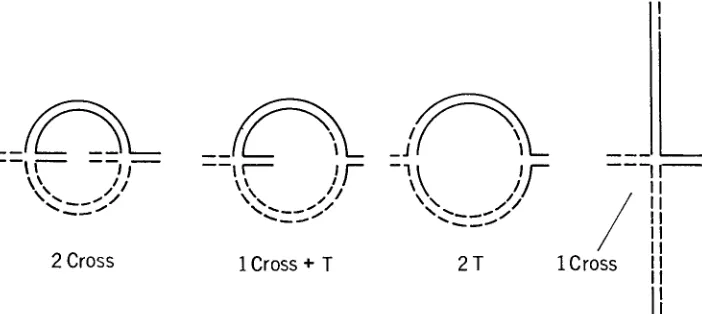
The diagrams in Figure 3 illustrate the four types of configurations listed in the first column of Table 3. Only in the 2-cross ones did the four interchanged segments pair homologously. I n these, one “cross7’ was contributed by each par- ent. A T-shaped (3-armed) configuration is formed if the “cross” is out of posi- tion so far distally that the shorter interchanged segment is associated with its homologue only at the ends o r not at all. In the 1-cross plus one T-shaped ones, probably one or the other of the short LL-5 interchanged segments failed to pair, forming the T-configuration; the cross being from the other interchange parent. I n the 1-cross configurations, both of the interchanged LL-5 segments failed to pair, and the LLcross7’ was from the other parent.
M A I Z E C Y T O G E N E T I C S
PROBABILITIES
OF INITIAL F A I R I N G
119
FIGURE 4.-Probabilities of initial pairing in segments equal to .I the length of either arm
of chromosomes 1 and 5.
ity for pairing to begin in either short terminal segment, and a much higher probability in the one or two adjacent regions. This leads us to propose the fol- lowing as a model. Consider the chromosome as a series of segments equal to .1
of the length of a particular arm. Then ask the question “What is the probability that the initial pairing occurs in each segment?” By trial and error fitting of various probabilities to the data, we arrived a t the probability values shown in Figure
4
for the distal szgments in either arm of either chromosome 1 or 5. Then for LL-5 (breaks at 1L.92 and 5L.82) the probability of the initial pairing in l L i s . 3 , a n d i n 5 L i s . 8 (i.e..54-
.3).The following tabulation from Table 3 shows the observed frequencies of the different configurations for the LL-5
x
SS-5 intercross, and the ones calculated using these probabilities:numbers (LL-5 X SS-5) Initial pairing in LL-5 i n calculated obs. calc. both interchanged segments .3 X .8 = .24 25 27
1.62 6Y 70 interchanged seg. of 5
interchanged seg. of neither .7 x .2 = .14 19 16
The fit is surprisingly good.
Also in this same intercross, there were 16 cells with 2-T configurations, one of which must have been formed by the SS-5 interchange with breakpoints at .69 and .72, i.e. probably failure of the initial pairing sometimes in one, sometimes i n the other interchanged segment. Using the values shown in the above dia- gram, the probability of initial pairing in either interchanged segment from SS-5 would be .3 f .5 -I- .I4 = .94. The expected frequency of T-configurations f o r SS-5 would be (1
-
.94) .94+ .94 (1-
.94) = .113. The observed frequency was .14, again a good fit.The intercross of LL-5 with SS-2 (the latter with breakpoints close to the centromeres) shows the low frequency of 2-cross configurations, but there was a
high frequency of no association in either interchanged segment from LL-5 (Table 3, column 4 ) . To fit these results, a low probability for initial pairing in each of the two distal segments, .1 for the terminal segment and .2 for the adjacent one, gives values that approach those observed.
120 c . R. BURNHAM et al.
One possible explanation for this big difference between intercrosses involving the same LL-5 interchange is that the presence of the SS-2 LLcross7’ in the short arms near the centromeres influenced the pairing behavior for the LL-5 ‘Lcross77. This is important, if true, but more data are needed to check this possibility.
The data consistently show a low probability (of the order of .1 to .3) for the initial or primary site of pairing to be in the short terminal chromosome seg- ments in the short and the long arms of the interchanged chromosomes.
W h a t happens following the initial pairing?: The frequencies of associations of four at pachytene shown in the last column of Table
2,
furnish information on what happens following the initial pairing. I n group 1, data were obtained on only two intercrosses. For all the other groups, there was a wide range of varia- tion in the frequencies of associations of four. The small numbers observed in several intercrosses may account for this in part. For several of those in group 5 , the numbers are larger because of an intensive search for cells with “pairs” at pachytene.I n group 1, many more cells were scanned than the number recorded without finding any evidence of a n association-of-four. Hence, if the breakpoints are correct, no secondary site of pairing had occurred in these short segments (.2 or shorter) proximal to the centromeres.
For the five intercrosses in group
2
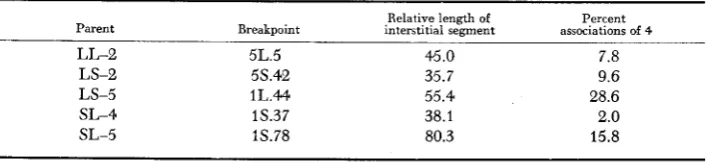
with only one of the four interstitial seg- ments longer than 30% of the arm, the breakpoint position in this arm, the length of the corresponding interstitial segment, and the frequencies of associa- tions of four are shown in Table4.
Breaks in both the long and short arms of chromosomes 1 and 5 are represented in those intercrosses. Only in the cells with a n association of four was there a secondary site of pairing between the cen- tromere and the breakpoint listed. For the two which differed greatly in length of the interstitial segment in 1 s (both intercrossed with LS-3) there was a much higher frequency of associations of four for the one with the longer segment (15.8 us. 2.0%) as expected. The other three intercrosses involved different arms of chromosomes 1 and 5 , but for LS-2 and LS-5 (both crossed with SL-2), the higher frequency again was for the longer interstitial segment.In group 3, one of the two low values was for a cross with LL-5 in which both breakpoints were far out in both chromosomes, the other was with SL-6 with one breakpoint even farther out. In group 5 , one of the intercrosses with SL-6 had a
TABLE 4
Frequencies of associations of four in intercrosses with only one interstitial segment longer than .3 of a n arm, including breakpoint position in that arm, and length of that interstitial segment
Relative length of Percent Parent Breakpoint interstitial segment associations of 4
LL-2 5L.5 45.0 7.8
LS-2 58.42 35.7 9.6
LS-5 1L.44 55.4 28.6
SL-4 1S.37 38.1 2.0
MAIZE CYTOGENETICS 121
*
I ** *
/ ‘ **
*
/
100.
90. *
*
80. /
70.
*
* /
/
*/
/
/ *
* /
f
/
/ * * /
/
50. /
/ / *
U) U)
/
40. /
/
..
//
* /
f
30. // W
/
I
V
$ 20. / *
/ / *
*
1 L
20 4% 60 80 100 i l o i i o ilo 180 200 210 2io 2Zo 280 380 350 3 i o
T O T A L L E N G T H OF D I F F E R E N T I A L S E G M E N T S T O T A L L E N G T H OF D I F F E R E N T I A L S E G M E N T S
I
FIGURE 5.-Scatter diagram showing the relationship between frequencies of associations of four at pachytene and total lengths of the differential segments in each intercross. Lengths are relative to 100, the length assigned to chromosome IO.
much lower frequency of associations of four than the other eight. It is tempting to suggest that the variation may be in part dependent on the particular chromo- some, as well as the length of the interstitial segment. Scatter diagrams show a general relationship between lengths of the interstitial segments and the fre- quencies of associations of four. Figure 5 shows this frequency plotted against the total length of the differential segments in each intercross. As this length in- creases, the frequencies of associations of four also increase.
This same trend is shown by the average values for the frequencies of associa- tions of four and “pairs” in groups 1 to 5 (Table 2). This is shown graphically in Figure 6. As the number of interstitial segments longer than 30% of the arm increased from zero in group 1 to four in group 5 , the average number of cells with an association of four increased, and the frequency of “pairs” decreased. Stated in terms of pairing, the chance of at least one secondary site of pairing being in a n interstitial segment, resulting in a n association of four, increased as the number of longer interstitial segments increased. The probability of one being in a short segment (at positions ranging from 0 to .3) adjacent to the centromere was low.
122
0
-
2 0TI-
0’
- 4 0 0
a
v,m
-r
- 6 0
6
0a,
a.
I
-
80100
c. R. BURNHAM et al.
100
0 1 2 3 4
Number
of
Interstitial Segments
Longer than
0.3
Arm
FIGURE 6.-Frequencies of ‘‘pairs’’ and associations of four at pachytene in relation to the number of interstitial segments longer than 0.3 of an arm.
DISCUSSION
Most of the studies of chromosome pairing have relied on counts of positions and frequencies of chiasmata at diplotene or later stages. The argument is that pairing must have occurred in those regions in which chiasmata appeared (see reviews by JOHN and LEWIS 1965; SVED 1966; DARLINGTON 1965).
Observations at diakinesis and metaphase I on intercrosses between inter- change stocks are useful in the identification of the chromosomes involved
(BURNHAM 1962 pages 90-91 for maize and barley; LAMM and MIRAVALLE 1959 for Pisum); and for the identification of chromosomal ends (CLELAND 1950, and EMERSON and STURTEVANT 1931 for Oenothera; and BLAKESLEE 1929 for DATURA).
MAIZE CYTOGENETICS 123
centromeres, intercrosses could be used for identification only when there were secondary pairing sites on both sides of the breakpoints.
Our studies show that the information at diakinesis is only part of the story. Probably nothing will substitute for observations at pachytene for a more com- plete understanding of pairing behavior.
Several studies of pairing at pachytene have been reported by MAGUIRE (1962, 1968). In a study of a sectorial chimera in maize, she reported (1962) that “com- plementary isochromosomes [for chromosome 61 which shared homologies only for the centromere region and one or two adjacent chromomeres were rarely found associated at pachytene.” She questioned the role of the centromere in the initiation of synapsis. The two arms of each monocentric chromosome paired; and when there was a chiasma, there was normal repulsion in the regions on either side of the chiasma which was probably not initiated by the single cen- tromere. She therefore questioned the role of the centromere in this repulsion. MORRIS (1955) reported similar observations in maize on 18 plants with pseudo- isochromosomes, each the result of an interchange involving opposite arms of a pair of homologues. MOENS (1969), in a study of chromosome pairing in Locusta, concluded that the centromeres did not seem to initiate pairing.
I n studies of “opposite-arms” type intercrosses at pachytene in maize, TABATA (1963) also reported that the “pairs” formed had homologous ends, and con- cluded that pairing began at the ends of the chromosomes. However, in none of his studies did the total length of the differential segments exceed the total lengths of the interchanged segments. I n other words, the four breakpoints were not far out in the arms of the chromosomes. For six of the intercrosses in Table 2 (all in group
5
and indicated by $ in column 2) the total length of the differential segments was greater than that of the interchanged segments.At the outset, we presumed that as the differential segments became longer, there would be an increasing number of “pairs” in which pairing had begun in the interstitial segments which comprise these differential segments. This was not found in any of the intercrosses that could be made with the available inter- changes. As the differential segments became longer, the frequency of associa- tions of four increased, that is, there was pairing between homologues on both sides of the breakpoints.
124
c. R. BURNHAM et al.tional type of “pair” would be much more frequent. There is no T1-5 SS inter- change with breakpoints at .8 or .9 available for the intercross with T1-5 LL-5 to make the test. However, the occurrence of such “pairs” in that intercross would not mean that pairing had begun at the centromeres, but might have be- gun at any point in the interstitial segments. Note that we have avoided the use of such terms as “zipper action” and “shift” in position of the cross-shaped pachytene configuration. W e prefer the concept that the observed configuration in any one cell is the result of a particular combination of pairing events at the various sites.
There is evidence in several species that chromosome ends (telomeres?) are attached to the nuclear membrane during the prophase stages of meiosis (SVED 1966, WETTSTEIN and SOTELO 1967;
WOOLAM,
FORD and MILLEN 1966, and MOENS 1969). The observations of MOENS (1969), based on electron micro- graphs of Locusta spermatocytes, also showed that chromosome pairing was initiated in a distal segment and then proceeded toward the nuclear membrane. Assuming this is true of maize also, if the telomeres of a particular chromosome are attached in a certain general area, but not always adjacent to each other, the initial pairing might well be at a short but variable distance from the tip, as observed in our experiments reported here.In the “pairs” with homologous ends formed i n the T1-5 opposite-arms inter- crosses, the remaining portions which are the differential segments are non- homologous. These should furnish information on the synaptonemal complex
if
preparations suitable for study could be made.
TING (1969) has shown in haploids in maize that the synaptonemal complex does form between non-homologously paired segments.
The experiments of HOTTA, PARCHMAN and STERN (1968) and STERN and HOTTA ( 1969a,b), using explants of sporogenous tissue, have furnished informa- tion on the biochemical and cytologically observable events during meiosis, par- ticularly on the timing of DNA replication and protein synthesis in relation to chromosome pairing and chiasma formation. HOTTA et al. (1968). state that their results “offer convincing evidence that synthesis of certain nuclear proteins is essential to the synthesis of DNA and that the combination of these syntheses that occur during zygonema and pachynema is essential to chromosome pairing and chiasma formation.” The critical feature of the diagrams used by STERN and HOTTA (1969b, p. 536) to represent their findings is that, located along the entire length of the chromosome, there are relatively short segments of the DNA filament which do not replicate until zygonema. They speculate that these are the primary sites of pairing between homologs.
The short segments mentioned above may be the initial and secondary sites of
pairing indicated by our studies.
After the initial pairing event, pairing may begin at several secondary sites. Variations in timing o r in the order of pairing initiation at these sites could ac- count for the observed variation in position of the cross-shaped configuration in interchange heterozygotes. Results obtained in this laboratory by WEINHEIMER
M A I Z E C Y T O G E N E T I C S 125
HOLLIDAY
(1968) suggested there might be specific short base sequences, ir- regularly distributed along the chromosome, which might play a role in pairing.The model proposed by
KING
(1970) assumes the presence along the chromo- some of “synaptomeres” which play a role in pairing and in formation of the synaptonemal complex.Our model for initial pairing undoubtedly needs refinements, but it is one that can be tested. It is likely that the probabilities are related to physical length at pachytene or earlier stages, rather than to lengths expressed as tenths of an arm length. The particular chromosomes involved in the interchange and the relative lengths of the interchanged segments may modify the probabilities. We need more data on the same intercrosses with TI-5 LL-5, also on single TI-5 hetero- zygotes for LL-5 and those with one breakpoint at .8 or .9, and heterozygotes for interchanges with breakpoints at similar positions in other chromosomes. The latter would enable us to compare the pairing characteristics of different chromo- somes. Statistical methods of estimating probabilities can be used when more extensive data are available. Stocks of the TI-5 interchanges with and without subterminal knobs would be useful in determining the effect of knobs on pairing.
L I T E R A T U R E C I T E D
BLAKESLEE, A. F., 1929 Cryptic types in Datura due to chromosomal interchange, and their geographical distribution. J. Heredity 20 : 177-190.
BURNHAM, C. R., 1962 Discussions in Cytogenetics. pp. 90-91. Burgess Publishing Co., Minne- apolis, Minn.
BURNHAM, C. R. and JOHN T. STOUT (in preparation) Cytogenetics of TI-5 interchanges in maize and the applicability of the “intercross” method of locating breakpoints.
CLELAND, R. E., 1950 Studies in Oenothera cytogenetics and phylogeny. Indiana Univ. Publ. Sci. Series 16: 5-9.
DARLINGTON, C. D., 1965 Part 11. Recent Advances in Cytology 1937-1964. J. and A. Churchill, London.
EMERSON, S. H. and A. H. STURTEVANT, 1931 Genetic and cytological studies on Oenothera 111.
The translocation hypothesis. Zeits. i. Abst. U. Vererb. 59: 395-419.
HOLLIDAY, R., 1968 Genetic recombination in fungi. pp. 1 6 1 6 7 . In “Replication and recombi- nation of genetic material.” Edited by PEACOCK and BROCK. Academy of Science. Canberra, Australia.
HOTTA, Y., L. G. PARCHMAN and H. STERN, 1968 Protein synthesis during meiosis. Proc. Natl. Acad. Sci. U.S. 60: 575-582.
JOHN, B. and K. R. LEWIS, 1965 The meiotic system. In: Protoplasmatologia: 6F1. Edited by
L. V. HEILBRUNN.
KASHA, K. J. and C. R. BURNHAM, 1965 The location of interchange breakpoints in barley. 11.
Chromosome pairing and the intercross method. Canad. J. Gen. and Cytol. 7: 620432. KING, R. C., 1970 The meiotic behavior of the Drosophila oocyte. Internat. Rev. Cytol. 28:
LAMM, R. and R. J. MIRAVALLE, 1959 LONGLEY, A. E., 1961
125-1 68.
A translocation set in Pisum. Hereditas 45: 417-440. Breakage points for four corn translocation series and other corn chromo- some aberrations. U.S. Dept. of Agr. Res. Service. A.R.S.-34-16: 1-40.
126 c. R. BURNHAM et al.
maize. Science 138: 445-446.
-
,
1968 Chromosome pairing in altered constitutions and models of synapsis and crossing over. Genet. Res. 12: 21-27.The fine skructure of meiotic chromosome polarization and pairing in Locusta migrutoriu spermatocytes. Chromosoma 28: 1-25.
Induced reciprocal translocations involving homologous chromosomes in maize. Amer. Jour. Bot. 42 : 546-550.
DNA synthesis in relation to chromosome pairing and chiasma formation. Genetics 61 (Supplem.) : 27-39.
-
, 19691, Biochemistry of meiosis. pp. 520-539. In: Handbook of Biochemical Cytology. Wylie, N.Y.Telomere attachment of chromosomes. Some genetical and cytological conse- quences. Genetics 53: 747-756.
Chromosome pairing in intercrosses between stocks of interchanges involving the same two chromosomes in maize. 11. Pachytene configuration in relation to breakage positions. Cytologia 28: 278-292.
TING, Y. C., 1969 Fine structure of the meiotic first prophase chromosomes in haploid and diploid maize. Abstr. Genetics 61 Supplement No. 2/part 2 ~ 5 8 (follows p. 519, Supp.).
WETTSTEIN, R. and J. R. SOTELO, 1967 Electron microscope serial reconstruction of the sperma- tocyte nuclei at pachytene. Jour. de Microscopie 6: 557-576.
WOOLAM, D. H. M., E. H. R. FORD, and J. W. MILLEN, 1966 The attachment of pachytene chromosomes to the nuclear membrane in mammalian spermatocytes. Exptl. Cell Res. 42:
MOENS, PETER B., 1969
MORRIS, R., 1955
STERN, H. and Y. HOTTA, 1969a
SVED, J. A., 1966
TABATA, M., 1963