TinyPBC: Pairings for Authenticated Identity-Based
Non-Interactive Key Distribution in Sensor Networks
Leonardo B. Oliveira
∗UNICAMP, Brazil
[email protected]
Michael Scott
Dublin City University
[email protected]
Julio L´opez
UNICAMP, Brazil
[email protected]
Ricardo Dahab
UNICAMP, Brazil
[email protected]
Abstract
Key distribution in Wireless Sensor Networks (WSNs) is challenging.
Symmet-ric cryptosystems can perform it efficiently, but they often do not provide a perfect
trade-off between resilience and storage. Further, even though conventional public key
and elliptic curve cryptosystem are computationally feasible on sensor nodes,
proto-cols based on them are not. They require exchange and storage of large keys and
certificates, which is expensive. Using Pairing-based Cryptography (PBC) protocols,
conversely, parties can agree on keys without any interaction. In this work, we (i)
show how security in WSNs can be bootstrapped using an authenticated
identity-based non-interactive protocol and (ii) present TinyPBC, to our knowledge, the most
efficient implementation of PBC primitives for an 8-bit processor. TinyPBC is an open
source code able to compute pairings as well as binary multiplication in about 5.5s and
4019.46µs, respectively, on the ATmega128L 7.3828-MHz/4KB SRAM/128KB ROM
processor – the MICA2 and MICAZ node processor.
1
Introduction
Wireless sensor networks (WSNs) [1, 2] are ad hoc networks composed primarily of perhaps thousands of tiny sensor nodes with limited resources and one or more base stations (BSs).
∗Supported by CAPES (Brazilian Ministry of Education) grant 4630/06-8 and FAPESP grant
They are used for monitoring purposes, providing information about the area of interestto the rest of the system [3].
On the other hand, Pairing-Based Cryptography (PBC) [4, 5, 6], is an emerging field of Elliptic Curve Cryptography (ECC [7, 8, 9]) that allows a wide range of applications. Pairings have been attracting the interest of the international cryptography community because it enables the design of original cryptographic schemes and makes well-known cryptographic protocols more efficient. Perhaps the main evidence of this is the realization of Identity-Based Encryption (IBE) [10], which in turn, has facilitated complete schemes for Identity-Based Cryptography (IBC) [11].
In the context of a WSNs, the issue of securing and authenticating communications is a difficult one, especially as currently nodes have no capacity for the secure storage of secret keys and are frequently deployed in unprotected areas, which make them more vulnerable to attacks [12, 13, 14]. One simple idea to introduce some kind of security is to fit each sensor node with the same cryptographic key to be used for all communications (e.g. [15]). But this does not authenticate the source of a message, and furthermore if one node is successfully attacked, all communications are compromised.
Assume now that there arennodes, and that each has its own unique identifier (ID) from 0 ton−1. A better idea would be to fit each pair of nodes with a unique mutual key for all
communications between them. But if that were the case each node would have to storen−1
secret keys, and furthermoren(n−1)/2 such keys would need to be generated in all. This is
a big requirement in terms of time and storage for large n, especially considering that after deployment not all nodes will be in a position to talk with all other nodes. Furthermore, if new nodes are to be deployed at a later stage all existing ones must be recalled to be fitted with new keys.
Now consider this scenario: each node is issued with (i) a unique ID; and (ii) a unique secret, not shared with any other entity. Two parties, each knowing only the ID of the other and without communicating, are then able to derive a mutual secret unknown to any other party, and use that secret to derive a cryptographic key to secure their communications. It is also trivial to dynamically add new nodes to the the WSN without any impact on existing nodes
only IDs are required – in particular no extra public key data is needed. It isNon-Interactive, as only the ID of the “other” is required to determine the key – no interaction is required. And it is a Key Distribution Scheme, because each ends up with the same key value. Also, the protocol is authenticated as each party knows that only the other can possibly calculate the same key 1
.
One issue has not been addressed – where does each entity get its unique secret from? It gets it from aTrusted Authority. This authority generates the unique secret from nodes IDs and a master secret of its own. Note that this “trusted authority” must be just that, as it is in a position to determine all the keys used within the system. It is our contention that such a set-up is an ideal way to bootstrap a WSN for security. The Trusted Authority is simply the deployer of the network, and there will be no issue in assuming their trustworthiness. Indeed it might even be regarded as a “feature” that the deployer is in a position to monitor all wireless traffic.
An alternative idea is to use the well-known Diffie-Hellman [18] interactive key exchange to dynamically derive a mutual key between pairs of nodes. But this in not authenticated, and hence is subject to a deadly man-in-the-middleattack. Also interaction involves com-munication, and wireless communication is expensive in terms of power consumption.
Can the method we suggest be realized using regular public key cryptography? No it cannot. Indeed it is only relatively recently that a viable scheme has been discovered, and its implementation is quite difficult and computationally costly. However we only suggest it as a boot-strapping mechanism. Once the WSN nodes are deployed, they can cache keys, and create their own local keys for use within their own neighborhood. In this way the ID-NIKDS protocol need only be required very occasionally. Note that the ID-NIKDS secret is the only long-term secret that the node possesses, and that possession of such a secret is unavoidable if authentication is a requirement.
We do not claim that a scheme like this is by itself sufficient for securing WSNs. We do not claim that a network bootstrapped in this way will be immune from attack. An attacker could after all in theory compromise every node in the network. We do however claim that it is the best possible way to bootstrap a WSN, given that a node does not have secure storage for its secrets. Built on top of such a system, the network can dynamically evolve and develop routing and communications algorithms with maximum confidence that
1
the damage caused by an attacker will be localized and minimized.
In this work, we firstly discuss why and how ID-NIKDS should be used used to boot-strap security in WSNs. After that, we present TinyPBC, to our knowledge the most effi-cient implementation of PBC primitives for an 8-bit processor, and its performance on an ATmega128L (the MICA2 and MICAZ node microcontroller [19]). TinyPBC is based on Multiprecision Integer and Rational Arithmetic C/C++ Library (MIRACL) [20] – which is a publicly available and open source library – and able to compute pairings, the most expensive operation of PBC, in about 5.5s. To sum up, our key contributions are:
1. demonstrate how sensor networks can exchange keys in an authenticated and non-interactive way;
2. present the fastest pairing computation on an 8-bit platform; and
3. show the best figures for binary field multiplication on an 8-bit platform.
The remainder of this work is organized as follows. In Section 2, we discuss the need for new security solutions in WSNs. We point out the synergy between IBC and WSNs in Section 3. In Section 4 we show how ID-NIKDS can bootstrap security in WSNs. Implemen-tation and results are presented in Section 5. Finally, we discuss related work and conclude in Sections 6 and 7, respectively.
2
Bootstrapping Security in WSNs: Need for New
Ap-proaches
Security is mainly justified in WSNs because of their battlefield applications. We believe, however, that, once WSNs start to be deployed in large scale, security will become much more common than it is thought today. Apart from the well-known battlefield applications, confidentiality is likely to be a requirement in market and industrial scenarios. For example industries/farmers that employ WSNs to monitor their supply-chains/crops may want to keep their data private from competitors. Additionally, authentication might be useful even in domestic WSNs, avoiding interaction with nodes from a neighboring network.
re-node they wish, and (ii) the compromise of a re-node should be restricted to itself. (Note that these properties should apply even to nodes deployed at different times.) Also the scheme should be low-cost in terms of both communication and computation.
In WSNs, security is typically bootstrapped using key distribution schemes. Most of standard key distribution schemes in the security literature [21], however, are ill-suited to WSNs: conventional public key based distribution, because of its processing requirements; global keying, because of its security vulnerabilities; complete pairwise keying, because of its memory requirements; and those based on a key distribution center, because of its ineffi-ciency. (See Carman et al. [22] for a good introduction to key distribution in WSNs.)
Symmetric key based distribution schemes (e.g., [23, 24, 25, 26, 27, 28, 29, 30, 31, 32, 33, 34]) have been specifically designed for WSNs. While they are well-suited for the applications and organizations they were designed for, they might not be adequate for others. They provide a trade-off between connectivity and resilience, not providing an ideal level of both. Further, most schemes rely on some sort of interaction between nodes so that they can agree on keys.
More recently, it has been shown that alternative methods of Public Key Cryptography (PKC) are feasible in WSNs [35, 36, 37]. Because in those systems communicating parties only have a pair of keys, a private and a public key, PKC schemes are scalable and easy to use. This convenience, though, comes at a price: a way of authenticating public keys must be provided. And key authentication, in turn, whether traditional (PKI and/or certificates) or especially tailored to WSNs (e.g. [38]), often ends up in overhead – which is especially ill-suited to WSNs.
As we will show in Section 4, by using ID-NIKDS we are able to resolve these security issues.
3
Synergy between IBC and WSNs
PBC has paved the way for a new wide range of cryptographic protocols and applications [39]. It has also allowed many long-standing open problems to be solved elegantly. Perhaps the most impressive among those applications is IBE [10], which in turn has allowed complete IBC schemes [11], 2
.
2
One may thus ask why IBC is still not widely deployed in security systems. Besides the usual time it takes for new technologies to be adopted in security systems, this is because IBC faces additional drawbacks. In particular they require a Trusted Authority (TA). A TA is an entity in charge of generating and escrowing users’ private keys. That is, it is able to impersonate anybody else in the system. For that reason, a TA must be an entity that is unconditionally trusted by all network users. Such an entity, however, cannot be identified in many systems.
In WSNs, conversely, this is not a problem at all. The deployer – who loads software into nodes, deploys them in areas of interest, and observes collected data – is, obviously, trusted. In the world of WSNs, the deployer’s role is represented by BS nodes. These nodes possess both laptop-level resources and physical protection. In other words, they can play the role of TA perfectly.
Another requirement is that the keys must be delivered over confidential and authen-ticated channels to users. If the cryptographic scheme is being used to bootstrap security – as very often is the case – there such channels will not exist. But again this is not a great concern to WSNs. In their security model, there is clearly a point in the time (i.e., prior to deployment) where secure channels between the BS and ordinary nodes do exist. Along with application software, nodes’ private keys can be preloaded into nodes during the pre-deployment stage.
4
Authenticated Identity-Based Non-Interactive Key
Distribution in Sensor Networks
4.1
Pairings: Definition
Bilinear pairings – or pairings for short – were first used in the context of cryptanalysis [6], but their pioneering use in cryptosystems is due the works of Sakai, Ohgishi, and Kasahara [4] et al. and Joux [41]. In what follows, let E/Fq be an elliptic curve over a finite field Fq, E(Fq) be the group of points of this curve, and #E(Fq) be the group order.
Bilinear pairing. Let n be a positive integer. Let G be an additively-written group of
order n with identity O, and let GT be a multiplicatively-written group of order n with
identity 1.
A bilinear pairing is a computable, non-degenerate function
e:G×G→GT
The most important property of pairings in cryptographic constructions is the bilinearity, namely:
∀P, Q∈G, and ∀a, b∈Z∗, we have
e([a]P,[b]Q) =e(P,[b]Q)a=e([a]P, Q)b =e(P, Q)ab.
In practice, the group Gis implemented using a group of points on certain elliptic curves
and the groupGT is implemented using a multiplicative subgroup of a finite extension field.
For more on pairing definitions, see for instance Galbraith [42].
Here we are using Type 1 pairings (in the sense of Galbraith, Paterson and Smart [43]), and so we have the additional property that
e(P, Q) =e(Q, P).
In addition, pairings of Type 1 permit strings to be hashed to a specific group. Those two aforementioned properties are required for efficient and simple implementation of the protocol (pairings of Types 2 and 3 do not provide, at once, both properties).
4.2
Setup
private key. To do this it first maps each node’s identity to a point on the elliptic curve, via a hashing-and-mapping functionφ, so for nodeX,PX =φ(idX). It then calculates the node’s
private key as SX= [s]PX. It next preloads each nodeX with the following information: (i)
the node’s IDidX, (ii) the node’s private keySX. Each node is also equipped with the function
φ so that it can take any ID (e.g. idY) as input and outputs the public key corresponding
to the ID (e.g. PY), 3
.
Note that, besides the BS, only node X knows the key SX.
4.3
Applying ID-NIKDS in WSNs
WSNs are composed of maybe thousands of tiny resource-constrained sensor nodes for which the scarcest resource is energy. Communication, on the other hand, is the activity that consumes most energy. This, in turn, means that besides meeting the needs described in Section 2 (i.e., perfect connectivity and resilience), an ideal key agreement scheme for WSNs should also not require any exchange of messages.
With the advent of PBC, however, a method of accomplishing this has come available. That is, PBC provides means to non-interactively distribute keys between any two network nodes, even if they were deployed at different times. Further, because nodes employ asym-metric primitives, the effect of node compromise is strictly local. In what follows, we show how the protocol due to Sakai, Ohgishi, and Kasahara, ID-NIKDS [4], can be employed to achieve such a goal. We assume that the setup protocol shown in Section 4.2 has been already carried out.
Suppose two nodes A and B that know each other’s IDs wish to decide on a secret key. Recall from Section 4.2 that nodes A’s and B’s private keys are SA = [s]PA and SB = [s]PB,
3
respectively. Consequently, by bilinearity (Section 4.1) we have
ˆ
e(SA, PB) = ˆe([s]PA, PB)
= ˆe(PA, PB)
s
= ˆe(PA,[s]PB)
= ˆe(PA, SB)
= ˆe(SB, PA).
Note that A possesses SA and can compute PB = φ(idB). Likewise, B possesses SB and
can compute PA=φ(idA). Therefore, both A and B are able to compute the secret key
kA,B = ˆe(SA, PB) = ˆe(SB, PA).
(Formally speaking, a key derivation function must first be applied to kA,B in order to
generate a key appropriate for cryptosystems. For details on this and other PBC protocols refer, e.g., to Paterson [39] and Duquesne and Lange [44].) Additionally, A knows that only B – and the BS, a trusted authority – possess SB and vice-versa, and consequently the
protocol is authenticated.
Observe that due to the non-interactive nature of the communication nodes can agree on keys even if they are not online simultaneously. This is particularly useful in WSNs, where nodes might follow sleeping patterns, may be deployed at different times, and often become temporarily unavailable due to physical obstacles or malfunctions.
Lastly, notice that we assume that nodes already know one another’s IDs. And we understand that it is a reasonable assumption in WSN context. Since routing reports towards the BS already demands nodes to get to know their neighbor’s IDs, exchange of IDs cannot be considered an overhead incurred by the key distribution protocol. Additionally, ID size is negligible when compared to public key and certificate sizes.
5
Evaluation
with 160-bit numbers – PBC works with 1024-bit numbers. In this section, we assess the costs incurred by PBC on an ATmega128L microcontroller, as included in the MICA2 and MICAZ node microcontroller [19]. The platform features an 8-bit/7.3828-MHz processor, 4KB of SRAM, and 128KB of flash memory (ROM).
5.1
Implementation
By far the most time consuming part when evaluating PBC protocols is the pairing com-putation itself 4
. In this section we present TinyPBC, an implementation of the ηT [46]
pairing (pronounced “eta-t”) for resource-constrained nodes – the source code is available at www.lca.ic.unicamp.br/∼loliveira#tinypbc. Throughout the section, we do not
de-scribe in depth all implementation details. Instead, we do point the reader out to more descriptive sources. (For instance, we recommend those not familiar with ECC and pairing implementation to look at Hankerson, Menezes, and Vanstone [47] and Scott [48] for a good introduction to the former and the latter, respectively.)
Security Requirements To meet their needs for efficiency security requirements in WSNs are often relaxed. For example, some (e.g. [23]) have adopted a 64-bit security level. We, conversely, adopted a more conservative posture and thus used a 80-bit security level, as recommended by the NIST.
Pairing The ηT [46] is possibly the fastest known pairing. It was proposed by Barreto,
Galbraith, hEigeartaigh, and Scott, following the earlier work of Duursma and Lee [49]. Like most pairings, it uses a variant of Miller’s algorithm to evaluate pairings. Its main feature, however, is that the ηT pairing requires only half the number of iterations of the Miller’s
loop compared with other pairings (see Line 4, Algorithm 3 of [46]).
ηT spends most of its time performing extension field multiplications. Our code uses
binary fields (F2m), and the supersingular curve y
2
+y = x3
+x2
, which has an embedding degree of four. In other words, this means that our implementation spends most of its time carrying out multiplications inF24×271, the quartic extension field. Next we will describe how
TinyPBC computes binary field multiplication.
4
Finite Field and Big Number Arithmetic The fastest known algorithms for multi-plication on F2m first multiply the field elements as polynomials and then reduce the result
modulo an irreducible polynomialf(x). For the particular binary fieldF2271, we have selected
the pentanomial f(x) = x271
+x207
+x175
+x111
+ 1, given in [50], which leads to a faster field square-root algorithm on a computer platform with word length of 8 or 16 bits.
Multiplication in our case is carried out using the L´opez-Dahab (LD) method [51]. To compute the productab, LD requires a look-up table for storing the product of polynomials of small degree by the operand b. We have used a look-up table of 16 polynomials; i.e., we process four bits in each iteration. For b = (B[t−1], B[t−2], . . . , B[0]), the look-up
table is defined as the matrix T[i][j] = (i· b)[j], i = 0,1, ...,15 and j = 0, . . . , t. In our
code, T is computed by columns, i.e., in the following order: T[i][t], T[i][t−1], . . . , T[i][0] for
(i= 0, ...,15).
Finite field multiplication is the most important operation, but not the only one that needs to be fast for efficiently computing pairings. To carry out other group and finite field operations as well as big number arithmetic, TinyPBC relies on MIRACL, a publicly available library written in C. The library has been used as basis for numerous works on efficient implementation. Also MIRACL already contains a highly efficient code for the
ηT pairing. Running the code in resource-constrained nodes, such as those that use the
ATmega128L, however, is not straight forward and thus adaptations have been made in order to fit MIRACL into the platform. In particular RAM usage must be minimized.
Optimization In order to speed up the binary field multiplication (polynomial of size 34 bytes – as required to store 271 bits), we have come up with an implementation of LD that uses Karatsuba’s method [52], another multiplication technique, of the depth-1. In other words, we use the LD method to multiply three polynomial of size 17 bytes. In this case, LD’s main loop, given by
for(i=0;i<17;i++){
u = a[i]>>4;
for(j=0;j<18;j++)
c[i+j]^= T[u][j];
LSHIFT4(c); /* left shift c 4 bits*/
for(i=0; i<17; i++){
u = a[i] & 0xf;
for(j=0; j<18; j++)
c[i+j]^= T[u][j];
}
was replaced by a code that uses a software pipeline technique and processes 8 bits in each iteration, namely
for(i=0;i<17;i++){
u0 = a[i]&0xf; u1 = a[i]>>4;
s0 = T[u0][0]; s1 = T[u1][0];
c[i]^= s0^(s1<<4);
s0 = T[u0][1]; s2 = T[u1][1];
for(j=2;j<18;j++){
c[i+j-1]^= s0^(s2<<4)^(s1>>4);
s2 = s1; s0 = T[u0][j];
s2 = T[u1][j];
}
c[i+17]^= s0^(s2<<4)^(s1>>4);
}.
Our improved version reduces the number of stores (forc) and it was observed that saves some cycles when compared to the original LD algorithm.
It is worth noting that we have not used assembly and therefore our code is portable to other platforms.
5.2
Performance
In this section we summarize performance numbers. Figures are based on the avr-gcc com-piler using optimization level -O3 in modules with time critical functions.
10.96s to compute pairings. This is mainly due to our faster binary multiplication. The time required to compute binary multiplication with our LD implementation, averaged over 20 trials, is just 4019.46µs (Table 1), with a standard deviation of 1.82µs. This is 44% faster than Karatsuba’s method, which was employed in [53]. The result is particularly interesting because it contrasts sharply with results presented in [54], which claims that Karatsuba’s is the most appropriate method for embedded devices.
Time
Multiplication Pairing
4019.46µs 5.45s
Table 1: Time costs to evaluate binary multiplication and the ηT pairing on ATmega128L
using TinyPBC.
5.3
Storage
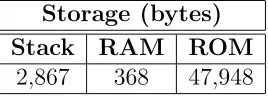
Table 2 summarizes storage requirements of TinyPBC. The requirements for stack and static RAM as well as ROM are 2,687, 368 and, 47,948 bytes, respectively (Table 2). Note that our approach allocates virtually all the RAM from the stack, which means that once the pairing is computed the memory is available for other operations. Plus, because theηT pairing does
not benefit from precomputation, ROM is saved.
Storage (bytes) Stack RAM ROM
2,867 368 47,948
Table 2: Memory costs to evaluate theηT pairing on ATmega128L using TinyPBC.
Besides the cryptographic code, a node needs to store its private key and public parame-ters in order to run ID-NIKDS. Public parameparame-ters are part of the specification of the pairing and they are already taken into consideration in our code. A private key, on the other hand, requires a point on E(F2271). That is, an elliptic curve point that in turn is represented by
coordinates (x, y) from the field F2271, 271-bits each. Given xand a single bit of y, however,
6
Related Work
WSNs are a subclass of MANETs, and much work (e.g., [55, 56]) has been proposed for securing MANETs in general. These studies are not applicable to WSNs because they assume laptop or palmtop-level resources, which are orders of magnitude larger than those available in WSNs. Conventional public key based methods are an example of a type of application which, while practical in a MANET, would be impracticable for a WSN.
Among the studies specifically targeted to resource-constrained WSNs, some (e.g, [12, 13]) have focused on attacks and vulnerabilities. Wood and Stankovic [12] surveyed a number of denial of service attacks against WSNs, and discussed some possible countermeasures. Karlof and Wagner [13] focused on routing layer attacks, and showed how some of the existing WSN protocols are vulnerable to these attacks.
Many security proposals for WSNs (e.g., [23, 24, 25, 26, 27, 28, 29, 30, 32, 31, 33, 34]) have focused on efficient key management of symmetric encryption schemes. Perriget al.[23] pro-posed SPINS, a suite of efficient symmetric key based security building blocks. Eschenauer et al. [24] looked at random key predistribution schemes, which provoked a large number of follow-on studies [29]. In [25] Zhu et al. proposed LEAP, a rather efficient scheme based on local distribution of secret keys among neighboring nodes.
The studies specifically targeted to PKC have tried either to adjust conventional algo-rithms (e.g. RSA) to sensor nodes, or to employ more efficient techniques (e.g. ECC) in this resource-constrained environment. All the seminal papers of Watro et al. [35], Gura et al. [36], and Malan et al. [37] have targeted the ATmega128L. Watro et al. [35] proposed TinyPK. To perform key distribution, TinyPK assigns the efficient RSA public operations to nodes and the expensive RSA private operations to better equipped external parties. Guraet al.[36] reported results for ECC and RSA primitives on the ATmega128L and demonstrated convincingly that the former outperforms the latter. Their ECC implementation is based upon arithmetic in the prime finite field Fp. Malan et al. [37] have presented the first ECC
implementation over binary fields F2m for sensor nodes. They used a polynomial basis and
presented results for the ECDH key exchange protocol.
not provide perfect resilience, as after a certain percentage of nodes have been compromised, the whole network would be compromised as well. Others (e.g [60, 61, 62]) have employed IBC from PBC. The works of Zhang et al. [60], Doyle et al., [61] and Oliveira et al. [62] employ IBC to distribute keys between nodes. However, they all use interactive protocols and therefore nodes are required to exchange messages to agree on keys.
Software implementation of pairings has also been focus of research. Oliveira et al. [63] have come up with an implementation of the Tate pairing. TinyTate, as it is called, uses TinyECC [57] as the underlying library and also targets the ATmega128L. TinyTate, how-ever, takes around 31s to compute pairings and its level of security, equivalent to RSA-512, is not appropriate for all applications. More recently, Szczechowiak et al. [53] have shown performance number for ECC operations as well as pairings over binary and primes fields. Their implementation of ηT uses the Karatsuba’s multiplication method and takes 10.96s to
be evaluated.
7
Conclusion
In spite of intense research efforts, the achievement of security in WSNs using cryptography still requires solutions. On the other hand, the advent of PBC has enabled a wide range of new cryptographic solutions. In this work, we first have shown how security in WSNs can be bootstrapped using ID-NIKDS. Subsequently we have presented TinyPBC, to our knowledge, the most efficient implementation of PBC primitives for an 8-bit processor. TinyPBC is able to compute pairings, the most expensive primitive of PBC, in about 5.5s on ATmega128L and it is based on MIRACL, an open source library.
8
Acknowledgment
We would like to thank Kenneth G. Paterson and Diego F. Aranha for their valuable com-ments on this work.
References
263–270, 1999.
[2] G. J. Pottie and W. J. Kaiser. Wireless integrated network sensors. Commun. ACM, 43(5):51–58, 2000.
[3] Ian F. Akyildiz, W. Su, Yogesh Sankarasubramaniam, and Erdal Cayirci. Wireless sensor networks: a survey. Computer Networks, 38(4):393–422, December 2002.
[4] R. Sakai, K. Ohgishi, and M. Kasahara. Cryptosystems based on pairing. InSymposium on Cryptography and Information Security (SCIS’00), pages 26–28, Jan 2000.
[5] Antoine Joux. The weil and tate pairings as building blocks for public key cryptosystems. InANTS-V: the 5th Int’l Symposium on Algorithmic Number Theory, pages 20–32, 2002.
[6] A. Menezes, T. Okamoto, and St Vanstone. Reducing elliptic curve logarithms to loga-rithms in a finite field. IEEE Trans. on Information Theory, 39(5):1639–1646, 1993.
[7] V. Miller. Uses of elliptic curves in cryptography, advances in cryptology. InCrypto’85, Lecture Notes in Computer Science, volume 218, pages 417–426. Springer-Verlag, 1986.
[8] N. Koblitz. Elliptic curve cryptosystems. Mathematics of computation, 48:203–209, 1987.
[9] Julio L´opez and Ricardo Dahab. An overview of elliptic curve cryptography. Technical Report IC-00-10, Institute of Computing – UNICAMP, May 2000.
[10] Dan Boneh and Matthew Franklin. Identity-based encryption from the weil pairing. SIAM J. Comput., 32(3):586–615, 2003. Also appeared in CRYPTO ’01.
[11] Adi Shamir. Identity-based cryptosystems and signature schemes. In CRYPTO’84, pages 47–53. Springer-Verlag, 1984.
[12] Anthony D. Wood and John A. Stankovic. Denial of service in sensor networks. IEEE Computer, 35(10):54–62, 2002.
[14] Madhukar Anand, Eric Cronin, Micah Sherr, Matt Blaze, Zachary Ives, and Insup Lee. Sensor network security: more interesting than you think. In HOTSEC’06: 1st conference on USENIX Workshop on Hot Topics in Security, pages 5–5, Berkeley, CA,
USA, 2006. USENIX Association.
[15] C. Karlof, N. Sastry, and D. Wagner. Tinysec: A link layer security architecture for wireless sensor networks. In 2nd ACM SensSys, pages 162–175, Nov 2004.
[16] R´egis Dupont and Andreas Enge. Provably secure non-interactive key distribution based on pairings. Discrete Applied Mathematics, 154(2):270–276, 2006.
[17] Kenneth G. Paterson and Sriramkrishnan Srinivasan. On the relations between non-interactive key distribution, identity-based encryption and trapdoor discrete log groups. Cryptology ePrint Archive, Report 2007/453, 2007. urlhttp://eprint.iacr.org/.
[18] Whitfield Diffie and Martin E. Hellman. New directions in cryptography. IEEE Trans-actions on Information Theory, IT-22(6):644–654, 1976.
[19] Jason L. Hill and David E. Culler. Mica: A wireless platform for deeply embedded networks. IEEE Micro, 22(6):12–24, 2002.
[20] Michael Scott. MIRACL—A Multiprecision Integer and Rational Arithmetic C/C++ Library. Shamus Software Ltd, Dublin, Ireland, 2003. Available at http://indigo.ie/ mscott.
[21] B. Schneier. Applied Cryptography. Wiley, second edition, 1996.
[22] David W. Carman, Peter S. Kruus, and Brian J. Matt. Constraints and approaches for distributed sensor network security. Technical Report 00-010, NAI Labs, Network Associates, Inc., 2000.
[23] A. Perrig, R. Szewczyk, V. Wen, D. Culler, and J. D. Tygar. SPINS: Security protocols for sensor networks. Wireless Networks, 8(5):521–534, 2002. Also in MobiCom’01.
[25] Sencun Zhu, Sanjeev Setia, and Sushil Jajodia. LEAP: efficient security mechanisms for large-scale distributed sensor networks. In 10th ACM conference on Computer and communication security (CCS’03), pages 62–72. ACM Press, 2003.
[26] R. Di Pietro, L. V. Mancini, and A. Mei. Random key-assignment for secure wireless sensor networks. In 1st ACM workshop on Security of ad hoc and sensor networks (SASN’03), pages 62–71, 2003.
[27] Haowen Chan, Adrian Perrig, and Dawn Song. Random key predistribution schemes for sensor networks. In IEEE Symposium on Security and Privacy (S&P’03), pages 197–213, may 2003.
[28] R. Kannan, L. Ray, and A. Durresi. Security-performance tradeoffs of inheritance based key predistribution for wireless sensor networks. In1st European Workshop on Security in Wireless and Ad-Hoc Sensor Networks (ESAS’04), 2004.
[29] Joengmin Hwang and Yongdae Kim. Revisiting random key pre-distribution schemes for wireless sensor networks. In 2nd ACM workshop on Security of ad hoc and sensor networks, pages 43–52, 2004.
[30] Seyit A. C¸ amtepe and B¨ulent Yener. Combinatorial design of key distribution mecha-nisms for wireless sensor networks. In 9th European Symposium on Research Computer Security (ESORICS’04), pages 293–308, 2004.
[31] W. Du, J. Deng, Y. S. Han, P. K. Varshney, J. Katz, and A. Khalili. A pairwise key pre-distribution scheme for wireless sensor networks. ACM Trans. on Info. and System Security, 8(2):228–58, 2005. Also in ACM CCS’03.
[32] Donggang Liu, Peng Ning, and Rongfang Li. Establishing pairwise keys in distributed sensor networks. ACM Trans. on Info. and System Security, 8(1):41–77, 2005. Also in ACM CCS’03.
[34] Leonardo B. Oliveira, Adrian Ferreira, Marco A. Vila¸ca, Hao Chi Wong, Marshall Bern, Ricardo Dahab, and Antonio A. F. Loureiro. SecLEACH– on the security of clustered sensor networks. Signal Process., 87(12):2882–2895, 2007.
[35] Ronald J. Watro, Derrick Kong, Sue fen Cuti, Charles Gardiner, Charles Lynn, and Peter Kruus. TinyPK: securing sensor networks with public key technology. In 2nd ACM Workshop on Security of ad hoc and Sensor Networks (SASN’04), pages 59–64,
2004.
[36] N. Gura, A. Patel, A. Wander, H. Eberle, and S. C. Shantz. Comparing elliptic curve cryptography and rsa on 8-bit cpus. In Workshop on Cryptographic Hardware and Embedded Systems (CHES’04), pages 119–132, 2004.
[37] David J. Malan, Matt Welsh, and Michael D. Smith. A public-key infrastructure for key distribution in tinyos based on elliptic curve cryptography. In 1st IEEE International Conference on Sensor and Ad Hoc Communications and Networks (SECON’04), 2004.
[38] Wenliang Du, Ronghua Wang, and Peng Ning. An efficient scheme for authenticating public keys in sensor networks. In6th ACM MobiHoc ’05, pages 58–67, New York, 2005.
[39] K. G. Paterson. Cryptography from pairings. In Ian F. Blake, Gadiel Seroussi, and Nigel Smart, editors, Advances in Elliptic Curve Cryptography, volume 317 of London Mathematical Society Lecture Notes, chapter X, pages 215–251. Cambridge Univ. Press,
2005.
[40] Clifford Cocks. An identity based encryption scheme based on quadratic residues. In 8th IMA Int’l Conference on Cryptography and Coding, pages 360–363. Springer-Verlag,
2001.
[41] Antoine Joux. A one round protocol for tripartite diffie-hellman. J. Cryptology, 17(4):263–276, 2004. Also in ANTS’00.
[42] S. D. Galbraith. Pairings. In Ian F. Blake, Gadiel Seroussi, and Nigel Smart, editors, Advances in Elliptic Curve Cryptography, volume 317 of London Mathematical Society
[43] S. D. Galbraith, K. G. Paterson, and N. P. Smart. Pairings for cryptographers. Cryp-tology ePrint Archive, Report 2006/165, 2006. http://eprint.iacr.org/.
[44] Lange T. Duquesne, S. Pairing-based cryptography. In G. Frey In H. Cohen, editor, Handbook of Elliptic and Hyperelliptic Curve Cryptography, chapter 24, pages 573–590.
Chapman and Hall/CRC Press, Boca Raton FL, USA, 2006.
[45] Prasanth Ganesan, Ramnath Venugopalan, Pushkin Peddabachagari, Alexander Dean, Frank Mueller, and Mihail Sichitiu. Analyzing and modeling encryption overhead for sensor network nodes. InACM Int’l conf. on Wireless sensor networks and applications, pages 151–159, 2003.
[46] Paulo S. L. M. Barreto, Steven Galbraith, Colm O hEigeartaigh, and Michael Scott. Efficient pairing computation on supersingular abelian varieties. In Designs Codes And Cryptography, 2006.
[47] Darrel Hankerson, Alfred Menezes, and Scott Vanstone. Guide to elliptic curve cryp-tography. Springer, 2004.
[48] Michael Scott. Computing the tate pairing. InTopics in Cryptology - CT-RSA, volume 3376 of Lecture Notes in Computer Science, pages 293–304. Springer, 2005.
[49] M. Duursma and Hyang-Sook Lee. Tate pairing implementation for hyperelliptic curves y2 = xp-x + d. In 9th Int’l Conference on the Theory and Application of Cryptology and Information Security (ASIACRYPT’03), pages 111–123. Springer, 2003.
[50] Michael Scott. Optimal irreducible polynomials for GF(2m) arithmetic. Cryptology
ePrint Archive, Report 2007/192, 2007.
[51] Julio L´opez and Ricardo Dahab. High-speed software multiplication in GF(2m). In
Progress in Cryptology - INDOCRYPT’00, pages 203–212, 2000. Lecture Notes in
Com-puter Science.
[53] Piotr Szczechowiak, Leonardo B. Oliveira, Michael Scott, Martin Collier, and Ricardo Dahab. NanoECC: Testing the limits of elliptic curve cryptography in sensor networks. In European conference on Wireless Sensor Networks (EWSN’08), 2008. To appear.
[54] S. Bartolini, I. Branovic, R. Giorgi, and E. Martinelli. Effects of instruction-set ex-tensions on an embedded processor: a case study on elliptic curve cryptography over GF(2m). IEEE Transactions on Computers, 2007. To appear.
[55] Lidong Zhou and Zygmunt J. Haas. Securing ad hoc networks. IEEE Network, 13(6):24– 30, 1999.
[56] Jean-Pierre Hubaux, Levente Butty´an, and Srdan Capkun. The quest for security in mobile ad hoc networks. In 2nd ACM int’l symposium on Mobile ad hoc networking & computing, pages 146–155, 2001.
[57] A. Liu, P. Kampanakis, and P. Ning. Tinyecc: Elliptic curve cryptography for sensor networks (ver. 0.3), 2005. http://discovery.csc.ncsu.edu/software/TinyECC/.
[58] Carlo Blundo, Alfredo De Santis, Amir Herzberg, Shay Kutten, Ugo Vaccaro, and Moti Yung. Perfectly-secure key distribution for dynamic conferences. InCRYPTO ’92, pages 471–486, 1992.
[59] R. Blom. An optimal class of symmetric key generation systems. InEUROCRYPT’ 84, pages 335–338, 1984.
[60] Y. Zhang, W. Liu, W. Lou, and Y. Fang. Securing sensor networks with location-based keys. InIEEE Wireless Communications and Networking Conference (WCNC’05), 2005.
[61] Barry Doyle, Stuart Bell, Alan F. Smeaton, Kealan McCusker, and Noel O’Connor. Security considerations and key negotiation techniques for power constrained sensor networks. The Computer Journal, 49(4):443–453, 2006.
[62] Leonardo B. Oliveira, Ricardo Dahab, Julio Lopez, Felipe Daguano, and Antonio A. F. Loureiro. Identity-based encryption for sensor networks. In 5th IEEE Int’l Conference on Pervasive Computing and Communications Workshops (PERCOMW ’07), pages