Dr Fiona Spotswood
Bristol Social Marketing Centre
Bristol Business School
University of the West of England
Using Social Practice Theory to frame the contribution of social marketing in the multidisciplinary future of ‘behaviour change’
Background
The 2011 House of Lords Behaviour Change reporti concluded that ‘behaviour change’ must
become multi-disciplinary, criticising the government’s myopic commitment to ‘nudge’. It emphasised that any single-approach strategy will fail to tackle the scale of problems like incommunicable disease. Given this and other calls for multi-disciplinarityii,iii, the lack of
commentary around the place of social marketing (sm) within a multi-disciplinary framework is of concern. Rather, publications tend to focus on effectivenesse.g.iv; definitione.g.v,vi;
innovation of sm approachese.g.vii and practitioner guidancee.g.viii. In response, this paper
introduces Social Practice Theory (SPT) as a framework for scrutinizing sm’s contribution to multi-disciplinary ‘behaviour change’.
Social Practice Theory
Practice theories, which have recently regained prominenceix, are a type of cultural theory
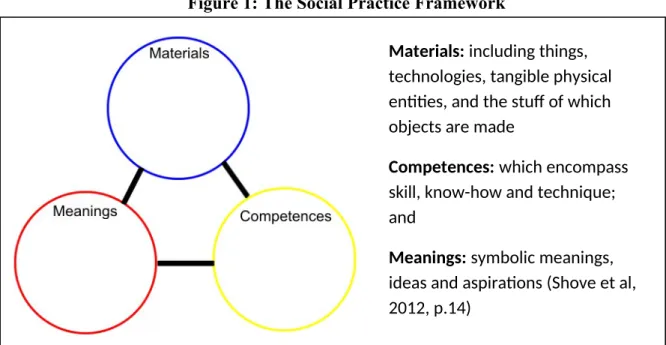
which consider humans as agents who act within the structures of practice. Agents ‘carry’ practices, which they ‘perform’. Thus understanding society using SPT focuses not on the experience of the individual actor as the subject of research or intervention, but on the practice itself. Practices are deconstructed into “several elements, interconnected to one another”x, and although various configurations have been proposedxi,xii ,xiii,xiv the simplified
model devised by Shove et alxv, (figure 1), has the most potential when considering
‘behaviour change’ research and intervention/policy responsexvi.
Figure 1: The Social Practice Framework
The practice of cycling is used to illustrate. Required ‘competences’ include the skills necessary for riding a bicycle, navigation and time-management. ‘Materials’ include a bicycle, the road network, cycle paths and storage. ‘Meanings’, referring to understandings shared by the group about the practice, include a sense that cycling is not an appropriate method of commuting for ‘important’ people or that cyclists are intimidatingxvii. The practice
comprises a combination of these elements, and changes to any element will create evolution of the practice. Such deconstruction can enable researchers to achieve a holistic
understanding of a practice and also potentially, albeit in an untested wayxviii, examine the Materials: including things,
technologies, tangible physical entities, and the stuff of which objects are made
Competences: which encompass skill, know-how and technique; and
ways it might be changed to benefit society. (The approach also holds for social marketers the appeal of avoiding criticisms of political individualism as identified in recent commentaryxix,
although examining this potential is not the purpose of this paper).
The role of social marketing in multi-disciplinary ‘behaviour change’
The SPT framework can help identify how sm, in combination with other approaches, might be used to change the various elements of ‘problem’ practices. SPT analysis of the low numbers of British utilityxx cyclists, for example, provides a range of footholds for change,
requiring multi-disciplinary solutions extending beyond sm’s core competences. Sm would be suitable for changing the ‘meanings’ around cycling by using techniques such as branding and integrated marketing communications combined with insights into consumer behaviour to change perceptions and attitudes. (A comparable example of such an approach is the ‘Truth’ campaign, which changed teen perceptions towards smokingxxi). Analysis using SPT
may also illuminate an upstream role for sm to work with local policy makers to establish policies for educational approaches such as adult cycle training. However, other approaches would be required to change ‘materials’; such as urban planners for designing cycle paths, law enforcers for restricting driving speeds and engineers for providing ‘desire-line’ cycle bridges and cycle parking.
Conclusion
This paper does not argue that sm should be reduced to social advertising, and the panoply of marketing-based approaches used by social marketers is wholly acknowledged. Rather, it acknowledges that stand-alone sm interventions have enjoyed limited effectiveness on
population-level problems (seexxii), and thus it is posited that social marketers should
routinely consider their contribution to ‘behaviour change’ as part of a multi-disciplinary
approach. The 3-element SPT model may provide a useful framework for analysing the
iReferences
The House of Lords Science and Technology Select Committee, (2011) Behaviour Change. Report number: HL Paper 179. London: The Stationary Office Ltd.
ii Nash, J.M., Collins, B.N., Loughlin, S.E., Solbrig, M., Harvey, R., Krishnan-Sarin, S., Unger, J.,
Miner, C., Rukstalis, M., Shenassa, E., Dube, C. and Spirito, A. (2003), Training the
transdisciplinary scientist: A general framework applied to tobacco use behavior. Nicotine and Tobacco Research, Vol. 5 Supplement 1, pp.s41-s53.
iii West, R. (2006) Tobacco control: present and future. British Medical Bulletin, Vol. 77-78,
pp.123-136.
iv Friedman, A.; Bozniak, A.; Ford, J.; Hill, A.; Olson, K.; Ledsky, R.; Inokuchi, D.; Brookmeyer,
K. (2014), Reaching Youth With Sexually Transmitted Disease Testing: Building on Successes, Challenges, and Lessons Learned From Local Get Yourself Tested Campaigns. Social Marketing Quarterly, Vol. 20, pp.116-138.
v Lefebvre, C. (2011), An integrative model for social marketing. Journal of Social Marketing, Vol.
1 No.1, pp.54-72.
vi McAuley, A. (2014) Reflections on a decade in social marketing. Journal of Social Marketing,
Vol. 4 No. 1, pp.77 – 86.
vii Bernhardt, J.M.; Mays, D. and Hall, A.K. (2012), Social marketing at the right place and right
time with new media. Journal of Social Marketing, Vol. 2 No.2, pp.130 – 137.
viii Lynes, J.; Whitney, S. and Murray, D (2014), Developing benchmark criteria for assessing
community-based social marketing programs: a look into Jack Johnson’s "All at Once" campaign. Journal of Social Marketing, Vol. 4 No.2.
ix Reckwitz, A. (2002), “Toward a theory of social practices: A development in culturalist
theorizing”, European Journal of Social Theory, Vol. 5 No. 2, pp. 243-263.
x Ibid, p.249
xi Schatzki,T. (1996), Social Practices: A Wittgensteinian Approach to Human Activity and the
Social. Cambridge: Cambridge University Press.
xii Reckwitz, 2002
xiii Shove, E., Pantzar, M. and Watson, M. (2012), The Dynamics of Social Practice, SAGE: London.
xiv Warde, A. (2005), “Consumption and Theories of Practice”, Journal of Consumer Culture, Vol. 5
No. 2, pp.131-153.
xv 2012
xvi Chatterton, T. and Anderson, O., (2011) An Introduction to Thinking about 'Energy Behaviour': A
Multi-Model Approach. A Paper for the Department of Energy and Climate Change. Bristol: University of the West of England.
xvii Leonard, S.; Spotswood, F.; and Tapp, A. (2012), Overcoming the self-image incongruency of
non-cyclists. Journal of Social Marketing, Vol. 2 No. 1, pp.23 – 36.
xix Raftopoulou, E. and Hogg, M.K. (2010), The political role of government-sponsored social
marketing campaigns. European Journal of Marketing, Vol. 44 No.7/8, pp.1206 – 1227.
xx Utility cyclists are those who cycle for regular, short journeys, such as to work.
xxi Farrelly, M.C.; Healton, C.G.; Davis, K.C.; Hersey, J.C.; Haviland, M.L. (2002). Getting to the
Truth: Evaluating National Tobacco Countermarketing Campaigns, American Journal of Public Health, Vol 92, No.6, pp.901-907.
xxii Stead, M.G., Angus, K. and McDermott, L. (2007), A systematic review of social marketing