
M E T H O D O L O G Y
Open Access
A guide to using the Theoretical Domains
Framework of behaviour change to
investigate implementation problems
Lou Atkins
1*, Jill Francis
2,3, Rafat Islam
3, Denise O
’
Connor
4, Andrea Patey
3, Noah Ivers
5, Robbie Foy
6,
Eilidh M. Duncan
7, Heather Colquhoun
8, Jeremy M. Grimshaw
3,9, Rebecca Lawton
10and Susan Michie
1Abstract
Background:
Implementing new practices requires changes in the behaviour of relevant actors, and this is facilitated by
understanding of the determinants of current and desired behaviours. The Theoretical Domains Framework (TDF) was
developed by a collaboration of behavioural scientists and implementation researchers who identified theories relevant to
implementation and grouped constructs from these theories into domains. The collaboration aimed to provide a
comprehensive, theory-informed approach to identify determinants of behaviour. The first version was published in 2005,
and a subsequent version following a validation exercise was published in 2012. This guide offers practical guidance for
those who wish to apply the TDF to assess implementation problems and support intervention design. It presents a brief
rationale for using a theoretical approach to investigate and address implementation problems, summarises the TDF and
its development, and describes how to apply the TDF to achieve implementation objectives. Examples from the
implementation research literature are presented to illustrate relevant methods and practical considerations.
Methods:
Researchers from Canada, the UK and Australia attended a 3-day meeting in December 2012 to
build an international collaboration among researchers and decision-makers interested in the advancing use
of the TDF. The participants were experienced in using the TDF to assess implementation problems, design
interventions, and/or understand change processes. This guide is an output of the meeting and also draws
on the authors
’
collective experience. Examples from the implementation research literature judged by authors
to be representative of specific applications of the TDF are included in this guide.
Results:
We explain and illustrate methods, with a focus on qualitative approaches, for selecting and specifying
target behaviours key to implementation, selecting the study design, deciding the sampling strategy, developing study
materials, collecting and analysing data, and reporting findings of TDF-based studies. Areas for development include
methods for triangulating data, e.g. from interviews, questionnaires and observation and methods for designing
interventions based on TDF-based problem analysis.
Conclusions:
We offer this guide to the implementation community to assist in the application of the TDF to
achieve implementation objectives. Benefits of using the TDF include the provision of a theoretical basis for
implementation studies, good coverage of potential reasons for slow diffusion of evidence into practice and a
method for progressing from theory-based investigation to intervention.
Keywords:
Theoretical Domains Framework, Guide, Methods
* Correspondence:[email protected]
1Centre for Behaviour Change, University College London, London, UK Full list of author information is available at the end of the article
Background
Implementing new practices and/or changing existing
practices in organisations, services and systems require
changes in individual and collective behaviour. Changing
behaviour requires an understanding of the influences
on behaviour in the context in which they occur.
Behavioural theories provide an explicit statement of
the structural and psychological processes hypothesised
to regulate behaviour and behaviour change and are
therefore relevant to investigating implementation
prob-lems and informing implementation interventions. There
have been calls for more explicit use of theory to identify
influences on behaviour change (i.e. facilitators of and
barriers to change) [1, 2]; understand mechanisms of
change, including how and in which contexts
interven-tions are effective [3
–
5]; and inform implementation
in-terventions [6
–
13]. Despite this, systematic reviews of
interventions designed to change professional practice
have shown only small numbers of rigorous evaluations
reporting the use of theory to assess implementation
problems or guide intervention design [8, 13, 14].
The Theoretical Domains Framework (TDF) was
ini-tially developed for implementation research to identify
influences on health professional behaviour related to
implementation of evidence-based recommendations
and has been cited in over 800 peer-review publications
(Web of Knowledge accessed April 2017). A synthesis of
33 theories of behaviour and behaviour change clustered
into 14 (originally 12) domains [15, 16]; the TDF is a
theoretical framework rather than a theory; it does not
propose testable relationships between elements but
pro-vides a theoretical lens through which to view the
cogni-tive, affeccogni-tive, social and environmental influences on
behaviour.
In addition to understanding health professional
be-haviour, the TDF was extended to be relevant to other
areas in which changing behaviour is important such as
changing patient behaviours. Examples include
increas-ing physical activity in children with motor impairments
[17] and stroke survivors [18]. Other examples relate to
changing general population behaviours, e.g. reducing
loneliness in older adults [19] and increasing physical
ac-tivity[20]. This article focuses on implementation.
Despite its extensive use in implementation research,
no formal guidance exists on how to apply the TDF. In a
study of using the TDF, health professionals from a
range of disciplines reported that it increased their
confi-dence in undertaking projects, provided a broad
per-spective and provided a means of understanding the
implementation problem and potential solutions in
the-oretical terms. Reported challenges to using the TDF
in-cluded lack of time and other resources and insufficient
expertise to operationalise the TDF [21]. Participants
suggested training and resources to support to use of the
TDF. This guide is intended to address these challenges
with the aim of making the TDF more useable by a
wider audience of researchers and practitioners with an
interest in implementation.
The guide begins by presenting a rationale for using
be-havioural theory to investigate and address implementation
problems before describing the TDF, its development and
main applications. The guide then describes the
methodo-logical considerations for using the TDF including selecting
and specifying a target behaviour, selecting study design,
deciding the sampling strategy, developing an interview
schedule and collecting and analysing data. It aims to
pro-vide methodological and practical guidance to those
inter-ested in using the TDF to inform implementation efforts.
We primarily focus on qualitative approaches (mainly
interview studies) as this is the most common approach
adopted when using TDF. Other potential approaches are
discussed but in a lesser detail. Throughout the guide,
im-plementation studies are presented to illustrate
recom-mended methods and practical considerations. We finally
discuss limitations, challenges and opportunities.
Development of the TDF
Eighty-three theories of behaviour and behaviour change
have recently been identified in a review across
disci-plines in social and behavioural sciences [22]. Selecting
from such a large number of potentially relevant,
some-times overlapping, theories can be challenging. In an
ef-fort to make theories more accessible to those working
in implementation, a team of behavioural scientists
de-veloped the TDF in collaboration with implementation
researchers [15]. The TDF is an integrated theoretical
framework synthesised from 128 theoretical constructs
from 33 theories judged most relevant to
implementa-tion quesimplementa-tions. The consensus process used by this
cross-disciplinary group to develop the framework
in-cluded (i) identifying theories and theoretical constructs
relevant to behaviour change; (ii) simplifying these
the-ories and constructs into overarching theoretical
do-mains; (iii) evaluating the importance of the theoretical
domains; (iv) conducting a cross-disciplinary evaluation
and synthesis of the domains and constructs; (v)
validat-ing the domain list; and (vi) pilotvalidat-ing a series of interview
questions to elicit views about the constructs and
do-mains. Whilst the domains cover the physical and social
environment, the majority relate to individual motivation
and capability factors. For clarity, the original version of
the TDF is referred to in this guide as TDF(v1).
84 theoretical constructs. For clarity, this 14-domain
ver-sion of the TDF is referred to in this guide as TDF(v2).
Both versions are used in research and practice, and
given their similarity, either can be used depending on
users
’
familiarity and preference. Both versions are
pre-sented in Table 1.
Use of the TDF in published implementation research
The TDF has been applied across a wide range of
health-care settings and clinical behaviours and was the subject
of a thematic series appearing in
Implementation Science
(http://www.implementationscience.com/series/TDF)
[23]. It has been the explicit basis of studies with a range
of objectives and designs including the following:
Identifying influences on behaviours. Exploration of
barriers and facilitators to implementing specific
evidence-based behaviours. Examples of interview
studies include investigating facilitators and barriers
to offering a family intervention to families of people
with schizophrenia [24], transfusing with red blood
cells [25,
26], discussing human papillomavirus
(HPV) vaccination with patients [27], routinely
or-dering pre-operative tests [28], error-free prescribing
[29], managing acute low back pain without ordering
an X-ray [30], dementia diagnosis and management
[31] and mild traumatic brain injury management
[32]. Examples of questionnaire studies include
in-vestigating facilitators and barriers to hand hygiene
[33], providing tobacco use prevention and cessation
counselling among dental providers [34] and
mid-wives engaging with pregnant women to stop
smok-ing [35].
Systematic intervention design. Examples include
GPs, physiotherapist and chiropractors to manage
acute low back pain [36,
37]; emergency department
staff management of mild traumatic brain injury
[38]; hospital clinician adherence to national
guidelines on the management of suspected viral
encephalitis [39]; and implementation of guidelines
to promote safe use of nasogastric tubes [40].
Process evaluations of randomised trials to better
understand the effect of implementing evidence, e.g.
in the Canadian CT Head Rule trials among
emergency physicians [41].
Guidance on identifying behaviour change
techniques [7,
42] and designing broader
intervention strategies [43].
The TDF has also been used beyond health, for
ex-ample, to behaviours related to recycling behaviours
[44]. References for published example applications of
the TDF are presented in Additional file 1.
Table 1
The Theoretical Domains Framework (v1 [15] and v2
[16]) with definitions and component constructs
Version 1[15]
Domain Constructs
Knowledge Knowledge
Knowledge about condition/ scientific rationale
Schemas + mindsets + illness representations
Procedural knowledge
Skills Skills
Competence/ability/skill assessment
Practice/skills development Interpersonal skills Coping strategies Social/professional role
and identity
Identity
Professional identity/boundaries/ role
Group/social identity Social/group norms Alienation/organisational commitment
Beliefs about capabilities Self-efficacy
Control—of behaviour and material and
Social environment Perceived competence Self-confidence/professional confidence
Empowerment Self-esteem
Perceived behavioural control Optimism/pessimism Beliefs about consequences Outcome expectancies
Anticipated regret Appraisal/evaluation/review Consequents
Attitudes Contingencies
Reinforcement/punishment/ consequences
Incentives/rewards Beliefs
Unrealistic optimism Salient events/sensitisation/ critical incidents
Characteristics of outcome expectancies—physical, social, emotional; sanctions/rewards, proximal/distal, valued/not valued, probable/improbable, salient/not salient, perceived risk/threat
Motivation and goals Intention; stability of intention/ certainty of intention Goals (autonomous, controlled) Goal target/setting
Goal priority Intrinsic motivation Commitment
Distal and proximal goals Transtheoretical model and stages of change Memory, attention and
decision processes
Table 1
The Theoretical Domains Framework (v1 [
15
] and v2
[
16
]) with definitions and component constructs
(Continued)
Attention control Decision-making Environmental context and
resources
Resources/material resources (availability and management) Environmental stressors Person × environment interaction Knowledge of task environment Social influences Social support
Social/group norms Organisational development Leadership Team working Group conformity Organisational climate/culture Social pressure Power/hierarchy Professional boundaries/roles Management commitment Supervision Inter-group conflict Champions Social comparisons Identity; group/social identity Organisational commitment/ alienation
Feedback
Conflict—competing demands, conflicting roles
Change management Crew resource management Negotiation
Social support: personal/professional/ organisational, intra/interpersonal, society/community
Social/group norms: subjective, descriptive, injunctive norms Learning and modelling
Emotion Affect Stress Anticipated regret Fear Burn-out Cognitive overload/tiredness Threat Positive/negative affect Anxiety/depression Behavioural regulation Goal/target setting
Implementation intention Action planning Self-monitoring Goal priority Generating alternatives Feedback
Moderators of intention-behaviour gap
Project management Barriers and facilitators Nature of the behaviours Routine/automatic/habit
Breaking habit
Direct experience/past behaviour Representation of tasks Stages of change model Version 2
Domain (definition) Constructs
Table 1
The Theoretical Domains Framework (v1 [
15
] and v2
[
16
]) with definitions and component constructs
(Continued)
1. Knowledge
(An awareness of the existence of something)
Knowledge (including knowledge of condition/scientific rationale) Procedural knowledge Knowledge of task environment 2. Skills
(An ability or proficiency acquired through practice)
Skills Skills development Competence Ability Interpersonal skills Practice Skill assessment 3. Social/professional role and
identity
(A coherent set of behaviours and displayed personal qualities of an individual in a social or work setting) Professional identity Professional role Social identity Identity Professional boundaries Professional confidence Group identity Leadership Organisational commitment 4. Beliefs about capabilities
(Acceptance of the truth, reality or validity about an ability, talent or facility that a person can put to constructive use)
Self-confidence Perceived competence Self-efficacy
Perceived behavioural control Beliefs
Self-esteem Empowerment Professional confidence 5. Optimism
(The confidence that things will happen for the best or that desired goals will be attained)
Optimism Pessimism Unrealistic optimism Identity
6. Beliefs about Consequences (Acceptance of the truth, reality, or validity about outcomes of a behaviour in a given situation)
Beliefs
Outcome expectancies Characteristics of outcome expectancies
Anticipated regret Consequents 7. Reinforcement
(Increasing the probability of a response by arranging a dependent relationship, or contingency, between the response and a given stimulus)
Rewards (proximal/distal, valued/not valued, probable/improbable) Incentives Punishment Consequents Reinforcement Contingencies Sanctions 8. Intentions
(A conscious decision to perform a behaviour or a resolve to act in a certain way)
Stability of intentions Stages of change model Transtheoretical model and stages of change 9. Goals
(Mental representations of outcomes or end states that an individual wants to achieve)
Goals (distal/proximal) Goal priority Goal/target setting Goals (autonomous/controlled) Action planning Implementation intention 10. Memory, attention and
decision processes
Methods
Researchers from Canada, the UK and Australia
repre-senting health psychology, sociology, implementation
and health services research, statistics and a range of
clinical disciplines, including general practice,
occupa-tional therapy and chiropractic, participated in a 3-day
collaborative meeting in December 2012 to discuss the
state of the science in using the TDF in implementation
research and to identify areas needing further
develop-ment to advance its application. Specific objectives of
the meeting were to:
Review current evidence for TDF
Identify gaps in the evidence and develop a plan to
build an international collaboration among
researchers and decision-makers interested in
advan-cing the use of TDF
Outline an agenda for a series of studies focused on
the TDF
Participants had experience of using the TDF to assess
implementation problems, design interventions and/or
understand mechanisms of change. In reviewing gaps in
TDF research and drawing on their collective experience
using the TDF, the group identified that a guide to using
the TDF would be useful to those applying it in
imple-mentation research.
To produce this guide, the group identified key steps
in applying the TDF from selecting a behaviour to
change through analysing and reporting data. The
group
’
s experience and expertise were pooled to
elabor-ate each of these steps. The group selected examples
from the literature that best illustrated each of these
steps to provide readers with instruction on how to use
the TDF and examples of applications.
Results
This section describes a range of methods used in
TDF-based implementation research but guidance focuses on
qualitative approaches
—
primarily interviews and focus
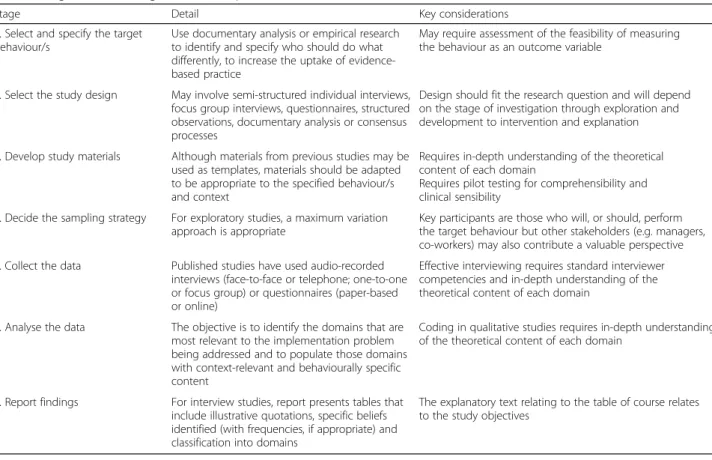
groups. Stages for conducting TDF-based research are
presented in Table 2.
The steps are selecting and specifying a target
behav-iour, selecting study design, deciding the sampling
strat-egy, developing an interview schedule and collecting and
analysing data. Each step is described in detail and
ac-companied by an example from the published
imple-mentation research literature.
1. Select and specify the target behaviour/s
The first step is to identify the behaviour(s) that
need to be changed to address the implementation
problem. In the contexts in which they are
performed, the key behaviours are often
interdependent with other behaviours within the
individual and with behaviours of others. Other
attributes include the inherent complexity of
behaviour, including whether it is performed by
individual healthcare professionals or by healthcare
teams, and the frequency of opportunities for
performing the behaviour.
The next step is to specify these behaviours in terms
of who needs to do what differently, when, where,
how and with whom? If there are multiple
behaviours, it is helpful to start with one or, possibly,
two behaviours to target in the first instance. The
criteria to consider when prioritising behaviours
include (i) how modifiable it is likely to be and (ii)
how central it is in bringing about the desired
change in clinical practice; (iii) the
‘
spillover
’
effect,
i.e. the positive or negative effect on other related
behaviours if change occurred (known in the
literature as conflicting and facilitating behaviours)
[45]; and (iv) the amenability to measurement.
Selection is usually influenced by a thorough
assessment based on a range of sources of
information about the problem and careful
examination of evidence-based recommendations
and empirical research, both published and local.
Table 1
The Theoretical Domains Framework (v1 [
15
] and v2
[
16
]) with definitions and component constructs
(Continued)
11. Environmental context and resources
(Any circumstance of a person’s situation or environment that discourages or encourages the development of skills and abilities, independence, social competence and adaptive behaviour)
Environmental stressors Resources/material resources Organisational culture/climate Salient events/critical incidents Person × environment interaction Barriers and facilitators
12. Social influences
(Those interpersonal processes that can cause individuals to change their thoughts, feelings, or behaviours)
Social pressure Social norms Group conformity Social comparisons Group norms Social support Power
Intergroup conflict Alienation Group identity Modelling 13. Emotion
(A complex reaction pattern, involving experiential, behavioural, and physiological elements, by which the individual attempts to deal with a personally significant matter or event)
Fear Anxiety Affect Stress Depression
Positive/negative affect Burn-out
14. Behavioural regulation (Anything aimed at managing or changing objectively observed or measured actions)
There are inevitable trade-offs in prioritising
behav-iours for investigation.
The more precisely the behaviour is specified, the
greater the specificity of the facilitators and barriers
identified. There are three aspects of this process: (1)
decide the appropriate level of behavioural
specificity; (2) identify who performs the behaviour,
when, where and how; and (3) consider the
attributes of the target behaviour such as
complexity, action sequences and interdependence
of team-level behaviours. We explain each of these
aspects below, using examples from the
implementa-tion research literature to illustrate each point.
Behavioural specificity
There is a balance between being highly
behaviourally specific (to maximise the likelihood of
identifying barriers to and facilitators of that
behaviour) and being general enough to be relevant
to a range of contexts. For example, to investigate
the management of diabetes in primary care, a more
specific description is
‘
general practitioners measure
the blood glucose levels of their patients with
diabetes every 6 months
’
whereas a less specific
description is
‘
general practitioners managing their
patients with diabetes according to guidelines
’
. The
more specific description is more likely to identify
the sources of implementation problems that need
to be changed because it is clear what the behaviour
is, who needs to perform the behaviour and how
often it is performed. Thus, study findings are more
likely to be interpretable if the behaviour targeted
for change is defined carefully in terms of
who
needs
to perform the behaviour,
what
they need to do,
when
they need to do it,
where
they need to do it,
how often
they need to do it and
with whom
will
they need to do it [43,
46,
47]. Furthermore, it is
important that the behaviour be specified in terms
of
target
behaviour, e.g. GPs to advise patients with
sore throats to take painkillers and drink plenty of
cool or warm fluids, rather than the
problem
behaviour, e.g. GPs prescribing antibiotics for sore
throats. There are cases where it is not possible to
isolate and target one behaviour for change, for
example if designing an intervention to help GPs
improve diabetes control; there are more than 10
interdependent behaviours that could be targeted for
change. One way of addressing this challenge is to
prioritise two or three key behaviours. The example
in Table
3
illustrates the specification of a
professional behaviour according to the principle of
behavioural specificity. It may be that a goal has
been set, e.g. reducing infections in a particular
setting, but the behaviours required to achieve that
goal are not immediately obvious. In these cases,
Table 2
Stages in conducting TDF-based implementation research
Stage Detail Key considerations
1. Select and specify the target behaviour/s
Use documentary analysis or empirical research to identify and specify who should do what differently, to increase the uptake of evidence-based practice
May require assessment of the feasibility of measuring the behaviour as an outcome variable
2. Select the study design May involve semi-structured individual interviews, focus group interviews, questionnaires, structured observations, documentary analysis or consensus processes
Design should fit the research question and will depend on the stage of investigation through exploration and development to intervention and explanation
3. Develop study materials Although materials from previous studies may be used as templates, materials should be adapted to be appropriate to the specified behaviour/s and context
Requires in-depth understanding of the theoretical content of each domain
Requires pilot testing for comprehensibility and clinical sensibility
4. Decide the sampling strategy For exploratory studies, a maximum variation approach is appropriate
Key participants are those who will, or should, perform the target behaviour but other stakeholders (e.g. managers, co-workers) may also contribute a valuable perspective 5. Collect the data Published studies have used audio-recorded
interviews (face-to-face or telephone; one-to-one or focus group) or questionnaires (paper-based or online)
Effective interviewing requires standard interviewer competencies and in-depth understanding of the theoretical content of each domain
6. Analyse the data The objective is to identify the domains that are most relevant to the implementation problem being addressed and to populate those domains with context-relevant and behaviourally specific content
Coding in qualitative studies requires in-depth understanding of the theoretical content of each domain
7. Report findings For interview studies, report presents tables that include illustrative quotations, specific beliefs identified (with frequencies, if appropriate) and classification into domains
analysis of audit data and discussion with
stakeholders can support the identification of
relevant behaviours and agreement on target
behaviours.
2. Select the study design
As with all research, the appropriate study design
depends on the research question and the state of
knowledge in the given field of research. For
example, qualitative interviews may be more useful
when little is known about an implementation
problem and the study design allows researchers to
probe in greater detail providing richer data which
can be helpful when developing theory-informed
in-terventions in that they may provide better insight
into needed content of interventions. They are also
likely to be useful to understand the mechanism of
action in interventions. Survey studies may be more
relevant when more is known about the problem
and potentially relevant influencing factors, but the
aim is to identify those factors/domains predictive of
behaviour change in a more representative sample,
or to explore mechanism of action of interventions
(mediation analyses). Structured observation and
ap-proaches such as documentary analysis may be
use-ful to supplement interview/survey studies (data can
be triangulated), but they are unlikely to be
suffi-ciently comprehensive for all domains (for example
cognitions are not observable or documented). As
the TDF has largely been applied at exploratory and
formative stages of a research programme to inform
problem analysis and intervention development,
most reported work have used qualitative interviews
(one-on-one or focus groups) to elicit health
profes-sionals
’
perceptions of TDF-related barriers and
fa-cilitators. However, the TDF is potentially applicable
to other research designs for which methods can be
further developed, e.g. structured observations,
documentary analysis, case study designs.
The TDF has been used in questionnaire studies
(Table
4). There are three published validated
questionnaire measures of the TDF to identify
influences on the following behaviours: health care
professionals
’
patient safety behaviours [48], physical
activity in the general population [20] and generic
health professional behaviours [49].
The TDF also has the potential to inform systematic
reviews by synthesising influences on behaviours
across studies according to theoretical domains
(Table
5) and understanding effect size (Table
6).
3. Decide the sampling strategy
The target population needs to include the target
adopters of the behaviours and/or other relevant
stakeholders. These could be individuals (e.g.
clinicians, patients, students or members of the
Table 3
Specification of the target behaviour according to the
principle of behavioural specificity
Study title
Evaluation of a TDF-informed implementation intervention for the management of acute low back pain in general medical practice
Rationale for changing behaviour
Management of low back pain in general medical practice is common, but this management is not always concordant with recommended evidence-based guidelines. In particular, x-rays are overused which leads to unnecessary harm due to radiation exposure and possible detection of incidental irrelevant findings, and an intervention of known effectiveness, giving advice to stay active, is underused.
Study design and materials Three phase study:
1. Qualitative methods: focus groups with general practitioners (GPs) (n= 42) using TDF to identify barriers to and facilitators of two evidence-based target behaviours related to the management of acute low back pain: one related to diagnosis, that plain film x-rays are necessary only if fracture is suspected, and one related to treatment, that of providing advice to stay active, including the avoidance of advising more than two days of bed rest. Here is an example of specifying these behaviours using the criteria:Whois performing the behaviour?Whatdo they need to do?Whendo they need to do it?Wheredo they need to do it? If applicable, the behaviour should also be specified in terms ofhow oftenandwith whomit should be done.
Behaviour 1: Manage patients without referring for plain X-ray Who–GPs
What–Manage patients with acute low back pain without referring for plain X-ray
When–On assessment or review of patients presenting with acute, uncomplicated low back pain of less than 3 months duration and without any serious underlying pathology suspected
Where–In clinic
How often–On assessment and review
With whom–Behaviour not depended on others
Behaviour 2: Provide advice to stay active Who–GPs
What–Provide advice to stay active
When–When managing patients with acute, uncomplicated low back pain of
less than 3 months duration and without any serious underlying pathology suspected
Where–In clinic
How often–On assessment and review
With whom–Behaviour not depended on others
2. Intervention development: mapping of barriers and facilitators within TDF domains to behaviour change techniques (detail provided in French et al. [36]). The TDF was used to guide the choice of behaviour change techniques and intervention components.
3. Cluster randomised trial: evaluation of a TDF-based intervention compared to simple dissemination of the guideline (results provided in French et al. [69]). Outcomes measured included behavioural predictors (e.g. knowledge, attitudes and intentions), fear avoidance beliefs, behavioural simulation (clinical decision about vignettes) and rates of X-ray and CT-scan (medical administrative data). Forty seven practices (53 GPs) were randomised to the control and 45 practices (59 GPs) to the intervention.
Findings and conclusions
The TDF allowed for the systematic identification of multiple barriers and facilitators in general medical practice and subsequent mapping to behaviour change techniques. The intervention consisted of interactive workshops designed to improve the knowledge, skills, intentions and clinical decision-making of the general practitioners. The intervention had some influence on GP adherence to an evidence-based guideline for the management of lower back pain at 12 months post-intervention. Overall, the intervention led to small changes in GP intention to practice in a manner consistent with an evidence-based guideline, but it did not result in statistically significant changes in actual behaviour measured via administrative data. Study outputs
public), dyads (e.g. clinicians and patients; teachers
and students) or teams (e.g. teams of clinicians and
managers or business workgroups). The
organisational level at which change is proposed to
occur could be at different levels, e.g. individual,
team, organisation or population levels. Change may
need to be coordinated across different
organisational levels [50], with different types of
behaviours being enacted by a range of individuals
or groups.
There are several challenges to collecting data for
implementation research which need to be
considered when deciding sampling strategy. First,
studies have largely relied on self-report data and
individuals may be biassed in their views about the
problem and attribute failures to external
(environ-ment or other people) rather than internal (ability,
effort) factors [51,
52]. Therefore, it is important to
include multiple perspectives (e.g. from users,
man-agers, commissioners as well as providers of health
care) and, where possible, to use multiple sources of
data (e.g. clinician self-report of influences on
behav-iour via interviews and/or surveys, practice and
pol-icy documents and direct observation of behaviour)
[53,
54]. In this way, the validity of findings are likely
to be improved through integration or
‘
triangula-tion
’
. Triangulation is the
‘
process of studying a
problem using different methods to gain a more
complete picture
’
[55]. A number of triangulation
techniques are available to researchers, and
integra-tion can be carried out at the analysis and/or
inter-pretation stages (for an overview of methods, see
O
’
Cathain et al. [55]).
Although sample size for interview and focus group
studies can be determined by the sampling
procedure (such as purposive sampling for
maximum variation) and the implementation
problem under investigation, specifying a minimum
sample size a priori is recommended. Francis et al.
recommend that a minimum of 10 interviews be
conducted for initial data analysis, followed by three
additional interviews until no new theme emerges
(stopping criterion) [56]. Sample size will also
depend on whether the study involves different
groups of health care professionals and whether they
Table 4
Using a TDF questionnaire to understand an
implementation problem; the example of designing hospital
patient safety interventions
Study title
The demonstration of a theory-based approach to the design of localized patient safety interventions
Rationale for changing behaviour
Between 3.7 and 17.7% of patients in hospital are inadvertently harmed either by healthcare professional error or deviations from recommended practice. In this example, the TDF was used to understand behaviours related to implementing a patient safety guideline promoting safe nasogastric feeding.
Study design and materials
The Influences on Patient Safety Behaviours Questionnaire IPSBQ [48], a 34-item tool based on the 12-domain version of the TDF was completed by staff in three hospitals to identify influences on locally identified target behaviours relating to safe nasogastric feeding. MANOVA was used to identify highest scoring domains.
Findings and conclusions
Social influences, environmental context and resources, skills and emotion were identified as the most influential domains. Relevant domains were further explored in focus groups and intervention strategies generated using explicit links between theoretical domains and behaviour change techniques [7].
Study outputs Taylor et al. [72]
Table 5
Using the TDF to synthesise evidence; the example of
barriers to diabetes management in primary care
Study title
Identifying barriers to primary care type 2 diabetes management: qualitative systematic review
Rationale for changing behaviour
There is broad consensus and a strong evidence base to guide the care of diabetes. Despite encouraging trends in the delivery and outcomes of care for people with diabetes, there remains significant scope for improvement. Most clinical management of diabetes now occurs in primary care. Interventions to enhance the implementation of evidence-based guidelines to improve the care of people with diabetes have shown small to modest effects. To ensure that interventions address barriers to behaviour change and build on known facilitators, it is important to understand primary care clinicians’beliefs around their day-to-day management of such patients.
Study design and materials
Systematic review of qualitative studies, including searches of following databases from 1980 to 2013: MEDLINE, EMBASE, CINAHL, PsycINFO and ASSIA. Qualitative studies examining diabetes management in primary care were eligible. Following screening of abstracts and full texts, data were coded to TDF domains and other themes if required. This review focused on behaviours to address clinical targets (including control of blood sugar, cholesterol and blood pressure) and processes of care (including foot examination). Findings were synthesised to identify barriers and facilitators common across or unique to clinical management goals, as well as apparent and potentially unexplored gaps in the literature.
Findings and conclusions
Out of 32 included studies; 17 address general diabetes care, 11 glycaemic control, three blood pressure, and one cholesterol control. Clinicians struggle to meet evolving treatment targets within limited time and resources and are frustrated with resulting compromises. They lack confidence in knowledge of guidelines and skills, notably initiating insulin and facilitating patient behaviour change. Changing professional boundaries have resulted in uncertainty about where clinical
responsibility resides. Accounts are often couched in emotional terms, especially frustrations over patient adherence and anxieties about treatment intensification.
are being analysed together or as separate groups. If
multiple groups are involved and the plan is to
analyse them separately to get varying group
perspectives, 10 interviews plus three per group are
advised as a minimum (Francis et al. [56]). Table
7
illustrates the selection of professional stakeholder
groups to achieve maximum variation in the sample
of a TDF-based qualitative interview study. Focus
groups involving all stakeholders have the potential
to provide multiple perspectives and potentially
re-duce the tendency to focus only on external
influ-ences on behaviour. Our recommendations would be
a minimum of 3 groups if the focus is on a specific
care setting.
4. Develop interview schedule
Interview schedule
As in all interview studies, a key step in a TDF-based
interview study is the development of an interview
schedule. We advise using language relevant to the
target population and piloting schedules to check
comprehension. The schedule typically consists of an
open question for each theoretical domain to elicit
the first response, followed by a series of follow-up
prompts to probe more deeply. Each question
fo-cuses explicitly on the target behaviour. The TDF
was developed to promote a comprehensive
consid-eration of possible influences on a given behaviour
so there is no specific order in which the questions
should be asked. We recommend flexibility in the
order in which domains are covered to harness the
natural flow of the conversation if a respondent
vol-unteers
’
information relating to a domain not yet
covered. The number of domains covered and
Table 6
Using the TDF to understand effect size; the example
of post-fracture management of patients at risk of osteoporosis
Study title
Understanding effects in reviews of implementation interventions using the Theoretical Domains Framework
Rationale for changing behaviour
There is evidence that two behaviours related to post-fracture management of patients at risk of osteoporosis are sub-optimally performed: 1) primary and secondary healthcare professionals scanning bone mineral density and 2) prescribing anti-resorptive therapy (bisphosphonate medication). This study used the TDF to identify which theoretical factors were targeted in a systematic review of interventions to improve quality of care in post-fracture investigation and their relation to observed effect sizes.
Study design and materials
A behavioural scientist and a clinician independently coded TDF domains in intervention and control groups in 10 interventions identified in a systematic review. For example, part of an intervention describing an‘algorithm for diagnosis and treatment of osteoporosis’ was coded in the domain memory, attention and decision processes. Pearson’s correlations were used to explore the relationship between intervention effect size and total number of domains identified in reviews.
Findings and conclusions
The five domains coded most frequently (in order of frequency highest to lowest) were:
1. Memory, attention and decision processes 2. Knowledge
3. Environmental context and resources 4. Social influences
5. Beliefs about consequences
Correlational analysis identified a statistically significant inverse relationship between both the domain count and frequency with the observed effect size in interventions for scanning bone mineral density, i.e. interventions with a small number of domains coded infrequently tended to have larger effect sizes than interventions with a greater number of domains coded more frequently. This relationship was not observed for interventions to improve bisphosphonate prescribing. Study outputs
Little et al. [74]
Table 7
Sampling for maximum variation when using TDF to
understand influences on behaviour
Study title
A study of the perceived risks, benefits and barriers to the use of selective decontamination of the digestive tract (SDD) in adult critical care units
Rationale for changing behaviour
Critically ill patients who require management in an Intensive Care Unit (ICU) are particularly susceptible to hospital acquired infections which are associated with high morbidity and mortality. SDD may reduce these infections and improve mortality but has not been widely adopted into practice. Adoption of SDD would involve a set of protocolised behaviours performed by a range of healthcare professionals, so this investigation sought the views of multiple professional stakeholders.
Study design and materials
A four-phase study in three regions (the UK, Canada and Australia/ New Zealand) of which Phase 2 was a Delphi study. Round 1 of the Delphi study involved one-to-one telephone interviews based on the TDF. Four key clinician groups (ICU physicians, ICU pharmacists, infectious disease clinicians/medical microbiologists, ICU clinical leads/nurse managers) were sampled using databases within each region. The researchers aimed for 10 from each group in each region. Purposive diversity sampling was used to identify a wide range of views, based on the following variables:
•Hospital is academic-affiliated or not
•Years of experience (time working in intensive care)
•Size of ICU (number of beds)
•Current practice (routinely perform SDD or not)
Potential participants were ranked according to these variables and invited to participate in the Delphi study based on their ranking. During the interview phase, diversity on these factors was tracked using a diversity sampling table.
Findings and conclusions
141 participants were interviewed. Beliefs about Consequences was the most populous domain.“SDD increases antibiotic resistance”,“SDD reduces Ventilator Associated Pneumonia”and“SDD benefits the patients to whom it is delivered”were the most frequently mentioned beliefs, illustrating the problematic balance between potential harms and benefits.
Study outputs
number of questions within each domain depend on
the target behaviour and existing evidence. For
ex-ample, where previous research has established a
do-main is not relevant to a target behaviour,
researchers may consider omitting questions relating
to that domain and focusing more on exploring
do-mains considered more relevant to the target
behav-iour. However, as with all qualitative research,
coding using the TDF can only code the text in the
interview transcript. If questions are not asked, the
text cannot be coded. Researchers will have to
deter-mine the value of including all domains to ensure
coverage whilst balancing the evidence surrounding
the target behaviour. An in-depth understanding of
the theoretical content of domains and context of
the implementation problem will help ensure
inter-view schedules elicit a maximum amount of useful
information. Published TDF questionnaires may be
helpful in developing interview schedules [20,
48,
49]. Example questions to explore domains in
imple-mentation research taken from Huijg et al. [49] are
provided in Additional file
2.
5. Collect the data
Data can be collected using the TDF by one or more
of the following: interviews, surveys, observation and
documentary analysis. For example, in a study to
inform implementation of a hospital care pathway to
reduce sepsis mortality, the TDF was used to gather
data by interviews with the care team, observation of
ward staff and analysis of hospital protocols.
Behaviour change techniques identified through
observation and interview were then mapped to TDF
to identify mechanisms of action [54]. Interviews
can be conducted in groups or individually either
face-to-face or by telephone. Our experience has
been that interviews typically last on average
be-tween 25
–
45 min for one-on-one interviews and
50
–
90 min for focus group interview but is of course
dependent on the number of behaviours being
investigated.
As with all interviewing, follow-up questions are the
key to eliciting a good understanding of the ways in
which the domains contribute to the target problem
or could be used to bring about change. For
ex-ample, a question such as
‘
how confident are you in
doing x?
’
with a follow-up probing question
‘
what
has made you confident?
’
allows for the participant
to be specific as they reflect on their confidence but
also gives them an opportunity to reflect on
situa-tions that limit their confidence. Anchoring
discus-sion to the target behaviour(s) can help to keep
discussion focused and avoid a drift into general
is-sues. As with developing study materials,
inter-viewers with an underlying understanding of the
theoretical constructs underpinning domains will
promote appropriate probing during interview.
6. Analyse the data
The TDF is intended for use by researchers and
practitioners from many disciplines. Whilst users do
not necessarily need expertise in using particular
theories, a good understanding of the domains and
the theoretical constructs each represents are
recommended to aid interpretation of data. Data can
be analysed deductively, using the TDF to generate
the framework for a content analysis and,
inductively, generating themes that can then be
considered in relation to domains. Some research
teams have used this approach as the basis for
designing predictive questionnaires to collect
quantitative data to test out hypotheses generated by
the qualitative analysis (Fig.
1). Intervention
designers can select behaviour change techniques
either directly from identified relevant theoretical
domains using validated linkages [7,
42] or by
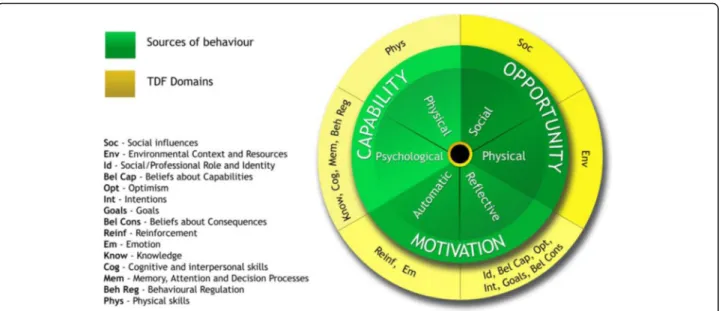
linking to the Behaviour Change Wheel to guide the
selection of intervention functions, policy categories
and behaviour change techniques [43].
Develop a coding guideline
A coding guideline is a set of explicit statements of
how the TDF is to be applied to a specific data set.
Statements provide guidance on strength of confidence
that a piece of text indicates a domain where change is
likely to be helpful in changing behaviour.
The coding guideline should be developed at the
same time as the interview schedule and updated
iteratively during data collection. Independent
coding by two people allows discrepancies to be
discussed and coding guidelines refined until
acceptable reliability is achieved between coders.
Coding difficulties may arise because the interviewer
has not sufficiently probed to clarify how responses
relate to the domain under investigation. Reviewing
transcripts during the data collection period rather
than at the end will allow interviewers to refine the
interview schedule as more understanding of the
problem being studied is gained. Many uncertainties
by the coding team can be eliminated if the
interviewer is familiar with the implementation
problem under investigation, the TDF and published
studies using it.
Deductive analyses
theory and/or relevant research findings to interpret
meaning from the content of qualitative data for
initial codes [57]. New users are advised to ensure
that all coded texts relate to the target behaviour
and not other behaviours interviewees or focus
group participants may discuss but which are not
relevant. Whilst the domains are purposively design
to be broad groupings of the possible factors to
influence behaviour, the intent is to explore the
important domains in further detail. Some text may
seem to fit in multiple domains. For example,
everything a HCP does can be dependent on context
so everything can be coded in environmental
context and resources. However, this is a somewhat
simplistic assumption and other domains permit the
division of the contextual factors influencing
behaviour and identify those that are amenable to
change (i.e social context reflected in social
influencing, reinforcement likely delivered by the
context, beliefs about capabilities which are
typically situation-specific and organisations which
can make certain actions easier or more difficult).
Text should be coded into the domains that best
reflect the key theme, despite the inclination to
code everything into one domain. Users with no
or limited experience with the TDF should
ini-tially meet frequently to discuss coding and
chal-lenges to address concerns early in the process.
Once the users are comfortable with the TDF, it
is recommended that two researchers code data
independently into theoretical domains following a
mutually agreed coding guideline to increase the
reliability of coding.
Disagreements in coding are not uncommon, and
discussions to resolve them can be informative both
about the process and the substantive questions
addressed by the study. In order to facilitate
consensus among coders, we recommend that the
coders articulate their understanding of the coded
text (i.e. key meaning) and justify their rationale for
selecting the domain. Justification for why the text
should not be coded in the alternate domain should
also be discussed, with each coder given the
opportunity to discuss the other
’
s point. When
consensus cannot be reached, discussion with an
expert in the area being studied and an experienced
researcher who is familiar with the TDF and the
theories from which it draws can help guide coders
to interpret the text in relation to the domains and
the theoretical constructs within the domains. When
agreement on assigning text to a single domain
cannot be reached, consensus can be achieved by
assigning the text to all the domains identified by
both the coders. Coders should document which
text is attributed to which theoretical domain/s.
Table
8
illustrates this step.
Data saturation: Data saturation is reached when the
data collected do not contribute any new
information about barriers and facilitators
influencing the implementation problem. If data are
collected progressively, concurrent with analysis, this
will inform final sample size [58]. A number of
factors can influence saturation including the design
or scope of the study [59], the heterogeneity of the
population [60] and the nature of the
implementation problem [61].
Reliability: Reliability between the two coders may
be assessed by an inter-rater reliability coefficient,
for example through assessing a kappa score across
all domains [28]. Calculating simple percentage
agreement can also be used to establish agreement
among coders [62]. Reliability between two coders is
acceptable if kappa score > 0.6 or percentage
agree-ment > 60% is achieved [63]. PABAK kappa which
corrects for negative agreement when Cohen
’
s kappa
is marginal can also be used.
Statistical software: NVivo software, or other
qualitative analysis package, may be used for data
analysis. It can enhance analysts
’
efficiency at data
storage, retrieval, coding, editing and revising
coding, organising data and sharing files across
researchers and can be used to assess reliability.
Inductive Analyses
Generating themes and/or belief statements: For
thematic analyses, researchers are encouraged to
follow established methods [64,
65] and report
explicitly the processes used to analyse the data.
After coding data into theoretical domains, some
researchers have used the following methods to
further analyse the data within domains: generate
overarching themes for a number of responses with
similar underlying ideas and/or generate statements
of specific underlying beliefs for each response [26].
The overarching themes represent the factors which
are perceived to influence performance of the target
behaviour. A belief statement is a collection of
responses with a similar underlying belief that
suggest a problem and/or influence of the beliefs on
the target implementation problem [25]. For
example, these responses,
‘
guidelines are just
guidelines
’
,
‘
guidelines are not gospel
’
and
‘
there are
no rules about going outside guideline
’
, were
grouped under the belief statement
‘
I can make my
decision outside the guidelines
’
[26]. For efficient use
of time, one coder can generate belief statements
and the other coder can interrogate and confirm
those. In the example given above reported in
Francis et al. [15], this step resulted in a list of belief
statements supported by responses made in the
interviews within each theoretical domain. Each
belief statement was counted once within each
interview to generate a frequency count across all
interviews. This step in the analysis results in a list
of belief statements with frequency counts for each
of the belief statements and/or overarching themes
within each theoretical domain. Frequency count of
belief statements is not warranted in the case of
focus group interviews as nonverbal behaviour such
as nodding in agreement with a belief statement
from another participant would not always be
Table 8
Reaching agreement when coding data using TDF and
identifying beliefs within domains
Study title
Anaesthesiologists’and Surgeons’ Perceptions about Routine Pre-operative testing in low risk patients: application of the Theoretical Domains Framework (TDF) to identify factors that influence physicians’ decisions to order pre-operative tests.
Rationale for changing behaviour
Routine pre-operative tests for anaesthesia management are ordered by both anaesthesiologists and surgeons for healthy patients undergoing low-risk surgery, often without any clinical indication and the subsequent test results are rarely used. Identifying factors that influence why anaesthesiologists’and surgeons’order these routine tests for healthy patients undergoing low risk surgery provide more effective targets for intervention development. Study design and materials
Interview study–sixteen clinicians (eleven anaesthesiologists and five surgeons) throughout Ontario were recruited. An interview guide based on the TDF was developed to identify beliefs about pre-operative testing prac-tices. Physicians’statements were content analysed into the relevant theor-etical domains. Two researchers coded interview participants’statements into the relevant theoretical domains. The first pilot interview was coded in tandem to develop the coding strategy and the second was used to ensure the two coders were comfortable with the strategy developed from the first. Subsequent coding of the remaining interviews was completed independ-ently and Fleiss’s Kappa (κ) was calculated for all domains and interviews to assess whether the two researchers coded the same text into the same do-main. Within each domain, the primary coder wrote a belief statement that captured the core thought of each utterance. For example, the following ut-terances were coded under the domains Social Influences:“…if a surgeon ordered it I am somewhat reluctant to cancel one of their tests even though I don’t feel that it’s necessary”&“Sometimes they are ordered and then (we) might be reluctant to cancel some of the tests because I am not privy to their thought process….”. These 2 utterances were from 2 different respon-dents but reflect the same core thought: I’m reluctant to cancel tests or-dered by other physicians. Identical beliefs statements were then grouped together. Statements that centred on same theme or were polar opposites of a theme were also grouped together for the ease of further analysis. For example, the following 3 belief statements from Social Influences grouped under the theme influence of colleagues: The opinions of others do not in-fluence my decision to order routine tests. I’m reluctant to cancel test or-dered by other physicians. I order tests I feel are unnecessary because my conservative colleague may be in the operating room on the day of the sur-gery and want to see the routine test that I would not.
Belief statements that were coded in different domains by the researchers were discussed to establish consensus. Where single domain allocation agreement could not be reached, researchers agreed that the statement could be placed in both domains.
Findings and conclusions
Seven domains were identified as likely relevant to changing clinicians’behaviour about pre-operative test ordering for anaesthesia management (Social/professional role and identity, Beliefs about cap-abilities and Social influences, Environmental context and resources, Be-liefs about consequences, Behavioural regulation, Nature of the behaviour). Key beliefs identified within these domains included: conflicting comments about who was responsible for the test-ordering, inability to cancel tests ordered by fellow physicians, and the problem with tests being completed before anaesthesiologists see patients. Anaesthesiologists often ordered tests based on who may be the attending anaesthesiologist on the day of surgery while surgeons ordered tests they thought anaesthesiologists might need. There was also a range of comments about the consequences associated with reducing testing, from negative (delay or cancel patients’ surgeries), to indifference (little or no change in patient outcomes), to posi-tive (save money, avoid unnecessary investigations).
captured. Also, social influence effects may elicit
more agreement with such a statement than would
be identified in one-to-one interviews.
Challenges in coding data
Sometimes there can be uncertainties when coding
data into theoretical domains, a feature not
uncommon in qualitative coding. This should not
impede progress of the study. Coding into
theoretical domains may require a certain amount of
interpretation of theoretical constructs by
researchers.
Coding interview transcripts into some theoretical
domains can be more challenging compared to other
domains depending upon the implementation
problems under investigation. A single response may
involve more than one theoretical domain, and
often, several domains are addressed in a single
response to a particular interview question (see
Additional file
3
for examples). An attempt to tease
out different domains for the purpose of coding into
appropriate theoretical domain may result in losing
the context of the response. To avoid such
occurrences, we recommend that the entire
response be coded in all identified domains.
Sometimes responses may not clearly fit any
theoretical domain despite guidance on
interpretation by trained psychologists or those with
a good understanding of the TDF from the study
team. It is important to note such occurrences as
these effectively test the capacity of the TDF to
account for all the interview data. The most
common reason for utterances not fitting into a
domain is that it is not about the target behaviour.
Coding difficulties then become an opportunity to
check the adequacy of the behavioural specification.
Hence, we recommend coding wider contextual
information into a separate code for ease of retrieval
and completion of descriptive summaries of
participants and their practice characteristics.
Identification of relevant theoretical domains: In this
step, relevant theoretical construct domains (i.e.
domains that should be targeted in an intervention)
are identified by judging the importance of specific
beliefs or themes. The following three criteria have
been applied in published studies: (1) relatively high
frequency of specific beliefs and/or themes (not
relevant to focus group interviews); (2) presence of
conflicting beliefs; and (3) evidence of strong beliefs
that may affect the target behaviour [28]. At the
completion of this step, the researchers will have a
list of relevant theoretical domains that are most
likely to influence the target implementation
problem and associated behaviours. Table
9
illustrates this point.
Time estimates for conducting research using TDF
The time to complete each of the steps described will be
highly variable according to available resources such as
staff, funding and any restrictions on timing. We provide
broad estimates of days, weeks or months to complete
the steps:
Steps 1
–
3: Selecting and specifying the target
behaviour, selecting study design, and deciding the
sampling strategy may take days or weeks. In
relation to identification of the target behaviour,
conducting interviews and follow-up work will have
cost implications so there needs to be good evidence
Table 9
Identifying key domains to target in an intervention
Study title
A cross-country comparison of intensive care physicians’beliefs about their transfusion behaviour: A qualitative study using the theoretical domains framework.
Rationale for changing behaviour
Transfusion of blood, a scarce and costly resource, is used for treating a variety of medical conditions. There is a wide variation in blood transfusion behaviour across different medical disciplines including intensive care physicians. A restrictive transfusion is, at least, equivalent and possibly superior to a more liberal transfusion. The aim of the study was to elicit beliefs about specified behaviour within each theoretical domain and role of the domain in influencing the behaviour in intensive care units across Canada.
Study design and materials
Ten intensive care physicians throughout Canada were interviewed. Physicians’responses were coded into theoretical domains, and specific beliefs were generated for each response. Theoretical domains relevant to behaviour change were identified if they included belief statements that might be potential barriers for changing transfusion behaviour and fulfilled the following criteria: (1) relatively high frequency of specific beliefs, (2) presence of conflicting beliefs, and (3) evidence of strong beliefs that may impact on the behaviour. All three criteria were considered concurrently to judge relevance of the domains. Beliefs within the domains were analysed for psychological constructs and were subsequently used to select psychological theories using the methodology proposed by Francis et al. [25].
Findings and conclusions
Seven theoretical domains populated by 31 specific beliefs were identified as relevant to the target behaviour using all criteria. The relevant theoretical domains were Knowledge, Social/professional role and identity, Beliefs about capabilities, Beliefs about consequences, Motivation and goals, Social influences and Behavioural regulation. For example, Knowledge domain was identified as potentially relevant because majority participants reported the belief that there is not enough evidence to support watching and waiting in all patient populations. Motivation and goals was identified as a key domain because conflicting specific beliefs were elicited (e.g. Watching and waiting conflicts with other goals in opposition to Watching and waiting is compatible with other goals). When the belief that‘emotion does not affect my decision to transfuse’was consistently reported, it was concluded that the Emotion domain was not relevant to the transfusion behaviour. For greater detail please see the published article. Study outputs
![Table 1 The Theoretical Domains Framework (v1 [15] and v2 [16]) with definitions and component constructs](https://thumb-us.123doks.com/thumbv2/123dok_us/7728098.162159/3.892.365.766.179.1082/table-theoretical-domains-framework-v-definitions-component-constructs.webp)
![Table 1 The Theoretical Domains Framework (v1 [ 15 ] and v2 [ 16 ]) with definitions and component constructs (Continued)](https://thumb-us.123doks.com/thumbv2/123dok_us/7728098.162159/4.892.87.801.171.1109/table-theoretical-domains-framework-definitions-component-constructs-continued.webp)
![Table 1 The Theoretical Domains Framework (v1 [ 15 ] and v2 [ 16 ]) with definitions and component constructs (Continued)](https://thumb-us.123doks.com/thumbv2/123dok_us/7728098.162159/5.892.86.429.169.632/table-theoretical-domains-framework-definitions-component-constructs-continued.webp)
![Fig. 2 Linking TDF to the COM-B model [43]](https://thumb-us.123doks.com/thumbv2/123dok_us/7728098.162159/14.892.84.438.563.1070/fig-linking-tdf-com-b-model.webp)
