smectics - a simulation study
Frank Jenz,1 Mikhail A. Osipov,2Stefan Jagiella,1 and Frank Giesselmann1,a)
1)
Institute of Physical Chemistry, Pfaffenwaldring 55, University of Stuttgart, Stuttgart Germany
2)Department of Mathematics and Statistics, G1 1XH, University of Strathclyde,
Glasgow UK
(Dated: 13 September 2016)
Simple smectic A liquid crystal phases with different types of prescribed orientational distribution functions have been simulated and compared in order to study the possibility to distinguish between the Maier-Saupe
type and cone-like orientational distributions using the popular method of Davidson et al. This method
has been used to extract the orientational distribution functions from simulated diffraction patterns, and the results have been compared with actual distribution functions which have been prescribed during simulations. It has been shown that it is indeed possible to distinguish between these two qualitatively different types of orientational distribution already from the shape of the 2D diffraction pattern. Moreover, typical experimental diffraction patterns for ”de Vries”-type smectic liquid crystals appear to be close to the ones which have been simulated using the prescribed Maier-Saupe orientational distribution function.
Keywords: Liquid Crystals, X-ray Diffraction, Order Parameter, Orientational Distribution Function
I. INTRODUCTION
There exist a number of experimental techniques to de-termine the orientational order parameters which spec-ify the degree of the orientational order of anisotropic molecules in various liquid crystal phases. In particular,
both the second rank orientational order parameter S2
and the fourth rank order parameter S4 can be
deter-mined from 2D X-ray diffraction patterns as was
origi-nally suggested by Leadbetter and Norris1. A more
re-fined method has later been suggested by Davidson,
Pe-termann and Levelut2 and this procedure has been used
by different authors to measure the order parameters of
the nematic, smectic A and smectic C phases3–6.
The method of Davidson et al. is based on a number
of approximations and it is not cleara priori what is the
accuracy of the results even though the values of S2 are
known to correlate well with the results obtained by other experimental techniques like NMR, via dielectric
relax-ation, optical birefringence or Raman spectroscopy7–12.
In a previous paper we have used computer simulations
to evaluate the accuracy of this method13. We could
show that the method of Davidson et al. is reliable but, due to translational correlations between orientationally
ordered molecules14, which are not taken into account,
it slightly underestimates the order parameterS2by
ap-prox. 0.05.
One notes that all phases, simulated in13, are
charac-terised by a Maier-Saupe like orientational distribution function (Fig. 1a) and rather high values of the
orien-tational order parameter S2. On the other hand, it is
very interesting to investigate if the method of David-son et al. can be used to distinguish between smectic
liquid crystals with different shapes of the orientational distribution function. In particular, starting from the
original works of de Vries15,16some authors assume that
in the so-called smectics A of ”de Vries” type the long molecular axes are tilted by a more or less constant angle
with respect to the smectic layer normal17. This
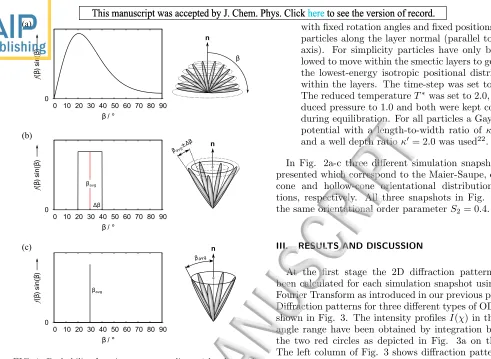
corre-sponds to the so-called hollow-cone orientational distri-bution shown schematically in Fig. 1c. A more general orientational distribution of this kind corresponds to the so-called diffuse cone model presented in Fig. 1b.
A comparison of the initial orientational distribution functions of qualitatively different shapes with the corre-sponding functions extracted from the simulated diffrac-tion patterns can be undertaken if the actual orienta-tional distribution is fixed during the simulations of the structure factor and the corresponding diffraction pat-tern. In this paper we undertake such simulations using a very simple model of the smectic A phase with per-fect smectic order, prescribed values of the orientational variables, which correspond to a given shape of the distri-bution function, and 2D positional freedom of molecular centres of mass inside a given smectic layer.
So far, the existing experimental data do not pro-vide conclusive epro-vidence whether or not these hypotheti-cal cone-like distributions really exist in ”de Vries”-type smectics18–21. This knowledge is however essential to
βavg βavg ±Δβ (a) (b) (c) β n 0
0 10 20 30 40 50 60 70 80 90
f ( β ) sin( β )
β/°
0
0 10 20 30 40 50 60 70 80 90
f ( β ) sin( β )
β/°
0
0 10 20 30 40 50 60 70 80 90
f ( β ) sin( β )
β/°
βavg
Δβ
βavg
n
[image:2.612.41.532.32.391.2]n
FIG. 1. Probability functions corresponding to the three ori-entational distribution functions: (a) Maier-Saupe distribu-tion. (b) Diffuse-Cone distribudistribu-tion. (c) Hollow-Cone distri-bution.
II. SIMULATION PROCEDURE
The smectic A phases composed of uniaxial particles with prescribed orientational distribution function and perfect translational order has been simulated. In this
case the translational order parameter Σ = 1.0 and the
instant orientation of a particle is specified by the polar
angleθ with respect to the smectic layer normal (or the
molecular tilt angle) and the azimuthal angle in the plane of the layers. Then the simulation snapshots have been generated by the following steps:
1. The molecular tilt angles of the particles in the sim-ulation box have been set in accordance to the pre-scribed ODF.
2. Azimuthal angles of all particle have been set
ran-domly between 0 and 360◦.
3. Position of each particle in the simulation box was set randomly. Overlapping of particles has been thereby prevented.
4. The simulation has been equilibrated by Molecu-lar Dynamics (MD) using 200000 integration steps
with fixed rotation angles and fixed positions of the particles along the layer normal (parallel to the z-axis). For simplicity particles have only been al-lowed to move within the smectic layers to generate the lowest-energy isotropic positional distribution within the layers. The time-step was set to 0.001.
The reduced temperatureT∗ was set to 2.0, the
re-duced pressure to 1.0 and both were kept constant during equilibration. For all particles a Gay-Berne
potential with a length-to-width ratio of κ = 4.0
and a well depth ratioκ′ = 2.0 was used22.
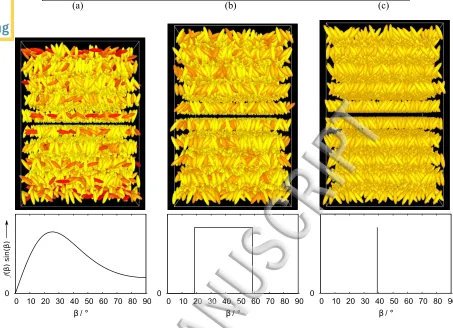
In Fig. 2a-c three different simulation snapshots are presented which correspond to the Maier-Saupe, diffuse-cone and hollow-diffuse-cone orientational distribution func-tions, respectively. All three snapshots in Fig. 2 have the same orientational order parameterS2= 0.4.
III. RESULTS AND DISCUSSION
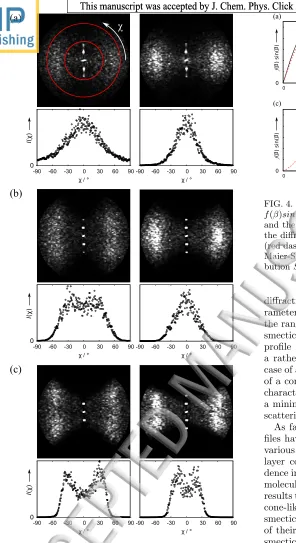
At the first stage the 2D diffraction patterns have been calculated for each simulation snapshot using Fast Fourier Transform as introduced in our previous paper13. Diffraction patterns for three different types of ODFs are shown in Fig. 3. The intensity profilesI(χ) in the wide angle range have been obtained by integration between the two red circles as depicted in Fig. 3a on the left. The left column of Fig. 3 shows diffraction patterns for
S2= 0.4 while the right column corresponds to a second
simulation series withS2= 0.7.
One notes that the diffraction pattern obtained from simulations of smectic A phases with different types of prescribed orientational distribution function are quali-tatively different. In particular, the diffraction pattern, which corresponds to the Maier-Saupe ODF (Fig. 3a), is characterised by only one maximum in the wide angle range, and the peak is becoming more narrow with in-creasingS2. In contrast, for the smectic A phase with the
diffuse-cone distribution (Fig. 3b) one obtains a broad, plateau-like maximum. This maximum becomes sharper
for higher S2 and in this case the pattern is closer to
the one obtained for smectics with the Maier-Saupe dis-tribution. Finally the diffraction pattern for the system with the hollow-cone ODF (Fig. 3c) is characterised by two distinct maxima which are visible for both small and largeS2.
It should be noted also that typical experimentally measured 2D X-ray diffraction patterns3,17,23,24are closer
to our simulated patterns obtained for smectics A with the Maier-Saupe ODF.
Another interesting observation in the diffraction pat-terns of Fig. 3 is that - even though the translational
order parameter is fixed to Σ = 1.0 in all simulations
- the intensity ratios of the smectic layer peaks change with both, the shape of the ODF and the orientational
order parameterS2 in a non-obvious way. This
(a) (b) (c)
0
0 10 20 30 40 50 60 70 80 90
β/°
0
0 10 20 30 40 50 60 70 80 90
β/°
0
0 10 20 30 40 50 60 70 80 90
β/°
f
(
β
) sin(
β
)
FIG. 2. Top: Simulation snapshots for (a) Maier-Saupe distribution , (b) Diffuse-Cone distribution and (c) Hollow-Cone distribution of polar angles of rod-like particles, respectively. Red particles are perpendicular and yellow particles are parallel to the director. Bottom: Prescribed orientational distribution functions used in the simulation above. All three depicted snapshots are characterised by the same nematic order parameterS2= 0.4.
parameters such as ⟨P2(cosβ) cos(2πz/d)⟩as it was
re-cently pointed out by Palermoet al.25
At the second stage the orientational distribution func-tion was extracted from the calculated diffracfunc-tion
pat-terns using the method of Davidson et al. The results,
presented in Fig. 4, have then been compared with the corresponding prescribed ODFs. In the case of smectics A with the Maier-Saupe distribution function the ODF is reproduced very well. In contrast, for systems with cone-like distributions the agreement between the prescribed and the calculated ODFs is rather poor which is related to the cosine series expansion employed in the method
of Davidson et al. The cone-like distribution functions
can adequately be described only using a large number of terms in the series expansion.
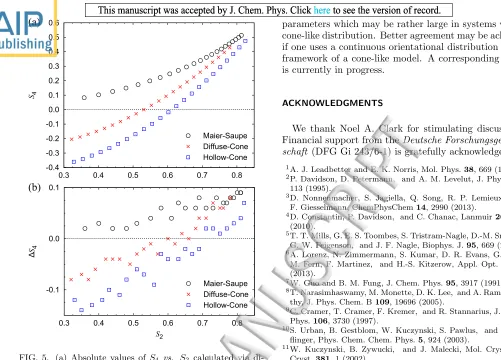
Finally we have calculated the values of the orienta-tional order parameter S4 for all three types of the
ori-entational distribution function. In Figure 5 we depict the error inS4obtained by subtracting the values ofS4,
calculated directly from the snapshots, from the values
of S4, extracted from the simulated diffraction patterns
(Fig. 3) using the method of Davidson et al. One can
readily see that for smectics with Maier-Saupe like dis-tribution the deviation is close to zero, and hence the
calculation of the order parameterS4 via the method of
Davidsonet al. is reliable. In contrast, for systems with cone-like distributions the calculated values ofS4are not
very reliable which may be due to truncation errors in the expansion of the wide-angle intensity profile in the cosine series.
IV. CONCLUSIONS
In this paper we have calculated the orientational dis-tribution functions and the orientational order
param-eters S2 and S4, using the method of Davidson et al.,
from the diffraction patterns which have been simulated for a simple smectic A phase with prescribed orienta-tional distribution of molecules. We have used the ori-entational distribution, which corresponds to the Maier-Saupe model, typical for conventional smectics A and the cone-like distributions, which are sometimes assumed to characterize smectics A of the ”de Vries” type.
[image:3.612.78.531.51.379.2]χ
(a)
-90 -60 -30 0 30 60 90
χ/°
-90 -60 -30 0 30 60 90
χ/°
I ( χ ) 0 (b)
-90 -60 -30 0 30 60 90
χ/°
-90 -60 -30 0 30 60 90
χ/°
I ( χ ) 0 (c)
-90 -60 -30 0 30 60 90
χ/°
-90 -60 -30 0 30 60 90
χ/°
I
(
χ
)
0
FIG. 3. 2D Diffraction patterns of simulations with prescribed orientational distribution function. The wide-angle intensity profiles I(χ) are depicted below the related diffraction pat-terns. Left: Orientational order parameterS2 = 0.4. Right:
Orientational order parameterS2= 0.7. (a) Maier-Saupe
dis-tribution (Fig. 2a). The red circles define the region where theI(χ)-profile has been calculated. (b) Diffuse-Cone distri-bution (Fig. 2b). (c) Hollow-Cone distridistri-bution (Fig. 2c).
f ( ) sin( ) 0 0 f ( ) sin( ) (a) (b) (c) (d)
0 15 30 45 60 75 90
/° Prescribed Diffraction pattern
0 15 30 45 60 75 90
/°
0 15 30 45 60 75 90
/°
0 15 30 45 60 75 90
[image:4.612.53.349.39.582.2]/°
FIG. 4. Comparison of the orientationl distribution functions
f(β)sin(β), prescribed during the simulations (black line), and the corresponding distribution functions extracted from the diffraction patterns using the method of Davidsonet al.
(red dashed line). (a) Maier-Saupe distributionS2= 0.4. (b)
Maier-Saupe distributionS2 = 0.7. (c) Diffuse-Cone
distri-butionS2= 0.4. (d) Hollow-Cone distributionS2= 0.4.
diffraction pattern provided the orientational order pa-rameter is not too high, i.e. S2 <0.7. In particular, in
the range ofS2 between 0.4 and 0.6, which is typical for
smectics A of ”de Vries” type, the azimuthal intensity profile I(χ) of the diffuse wide-angle scattering possess a rather pronounced and well-defined maximum in the case of a Maier-Saupe type distribution, while in the case of a cone-like distribution the same diffraction profile is characterized by a rather flat plateau or sometimes even a minimum at small azimuthal angles with a significant scattering of data in that region.
As far as we know, the latter type of diffraction pro-files have experimentally never been observed so far for various ”de Vries”-type smectics with anomalously weak
layer contraction. Thus there is no experimental
evi-dence in favour of a cone-like orientational distribution of molecules in smectics of ”de Vries” type. The simulation results thus give strong support to earlier claims18–21that
cone-like distributions do not exist in ”de Vries”-type smectics even though they could nicely explain many of their striking properties, in particular the absence of smectic layer contraction in the tilting transition to smec-tic C.
A good agreement between the initial values of the
order parameterS2and the corresponding values,
calcu-lated from the diffraction patterns, has been found for all three types of the orientational distribution consid-ered. In all cases the method slightly underestimates the
value ofS2 (by approximately 0.04) which is related to
the contribution of the translational fluctuations between orientationally ordered molecules14.
In contrast, the calculated values of the order
param-eterS4 are less reliable as the discrepancy between the
(a)
(b)
-0.4 -0.3 -0.2 -0.1 0.0 0.1 0.2 0.3 0.4 0.5 0.60.3 0.4 0.5 0.6 0.7 0.8
S4 Maier-Saupe Diffuse-Cone Hollow-Cone -0.1 0.0 0.1
0.3 0.4 0.5 0.6 0.7 0.8
∆ S4 S 2 Maier-Saupe Diffuse-Cone Hollow-Cone
FIG. 5. (a) Absolute values of S4 vs. S2 calculated via
di-agonalisation of the order tensor. In case of Maier-Saupe ODF,S4 is positive over the total range of S2. For
Diffuse-Cone distributions, S4 decreases faster with decreasing S2
and becomes negative below S2 = 0.52. For Hollow-Cone
distributions, S4 decreases even faster with decreasing S2
than in the Diffuse-Cone case and becomes negative already below S2 = 0.7. (b) Deviation of higher order parameter
S4, calculated from the simulated diffraction patterns using
the method of Davidson et al., from the value of S4
calcu-lated directly from simulations for smectics A with Maier-Saupe, Diffuse-Cone and Hollow-Cone orientational distribu-tion funcdistribu-tions. Note that the error is small in the case of Maier-Saupe ODF.
thus comparable to the size of S4 itself. In particular,
the relative deviation is particularly large for hypotheti-cal smectics A with a cone-like distribution in the region whereS4is close to zero. This may be related to the
trun-cation errors. Indeed, both hollow-cone and diffuse cone orientational distributions are discontinuous and thus can be correctly represented by a Fourier series only if a large amount of terms is taken into account. In other words,
a large discrepancy in the values of S4 may represent a
sum of discrepancies in the values of other higher order
parameters which may be rather large in systems with a cone-like distribution. Better agreement may be achieved if one uses a continuous orientational distribution in the framework of a cone-like model. A corresponding study is currently in progress.
ACKNOWLEDGMENTS
We thank Noel A. Clark for stimulating discussions.
Financial support from theDeutsche
Forschungsgemein-schaft (DFG Gi 243/6-1) is gratefully acknowledged.
1A. J. Leadbetter and E. K. Norris, Mol. Phys.38, 669 (1979). 2P. Davidson, D. Petermann, and A. M. Levelut, J. Phys. II5,
113 (1995).
3D. Nonnenmacher, S. Jagiella, Q. Song, R. P. Lemieux, and
F. Giesselmann, ChemPhysChem14, 2990 (2013).
4D. Constantin, P. Davidson, and C. Chanac, Lanmuir26, 4586
(2010).
5T. T. Mills, G. E. S. Toombes, S. Tristram-Nagle, D.-M. Smilgies,
G. W. Feigenson, and J. F. Nagle, Biophys. J.95, 669 (2008).
6A. Lorenz, N. Zimmermann, S. Kumar, D. R. Evans, G. Cook,
M. Fern, F. Martinez, and H.-S. Kitzerow, Appl. Opt.22, E1 (2013).
7W. Guo and B. M. Fung, J. Chem. Phys.95, 3917 (1991). 8T. Narasimhaswamy, M. Monette, D. K. Lee, and A.
Ramamoor-thy, J. Phys. Chem. B109, 19696 (2005).
9C. Cramer, T. Cramer, F. Kremer, and R. Stannarius, J. Chem.
Phys.106, 3730 (1997).
10S. Urban, B. Gestblom, W. Kuczynski, S. Pawlus, and A.
Wr-flinger, Phys. Chem. Chem. Phys.5, 924 (2003).
11W. Kuczynski, B. Zywucki, and J. Malecki, Mol. Cryst. Liq.
Cryst.381, 1 (2002).
12A. Sanchez-Castillo, M. A. Osipov, and F. Giesselmann, Phys.
Rev. E81, 021707 (2010).
13F. Jenz, S. Jagiella, M. A. Glaser, and F. Giesselmann,
ChemPhysChem17, 1568 (2016).
14M. A. Osipov and B. I. Ostrovskii, Cryst. Rev.3, 113 (1992). 15A. de Vries, A. Ekachai, and N. Spielberg, Mol. Cryst. Liq. Cryst.
49, 143 (1979).
16A. de Vries, J. Chem. Phys.71, 25 (1979).
17H. Yoon, D. M. Agra-Kooijman, K. Ayub, R. P. Lemieux, and
S. Kumar, Phys. Rev. Lett.106, 087801 (2011).
18J. P. F. Lagerwall and F. Giesselmann, ChemPhysChem7, 20
(2006).
19S. T. Lagerwall, P. Rudquist, and F. Giesselmann, Mol. Cryst.
Liq. Cryst510, 148 (2009).
20A. Sanchez-Castillo, M. A. Osipov, S. Jagiella, Z. H. Nguyen,
M. Kaspar, V. Hamplova, J. Maclennan, and F. Giesselmann, Phys. Rev. E: Stat., Nonlinear, Soft Matter Phys. 85, 061703 (2012).
21Y. Yamada, A. Fukuda, J. K. Vij, N. Hayashi, and T. Ando,
Liq. Cryst.4, 864 (2015).
22J. G. Gay and B. J. Berne, J. Chem. Phys.74, 3316 (1981). 23C. P. J. Schubert, A. Bogner, J. H. Porada, K. Ayub, T. Andrea,
F. Giesselmann, and R. P. Lemieux, J. Mater. Chem. C2, 4581 (2014).
24K. M. Mulligan, A. Bogner, Q. Song, C. P. J. Schubert, F.
Gies-selmann, and R. P. Lemieux, J. Mater. Chem. C2, 82708276 (2014).
25M. F. Palermo, A. Pizzirusso, L. Muccioli, and C. Zannoni, J.
[image:5.612.35.536.35.395.2]β
avg
β
avg±
Δβ
(a)
(b)
(c)
β
n
0
0 10 20 30 40 50 60 70 80 90
f
(
β
) sin(
β
)
β
/
°
0
0 10 20 30 40 50 60 70 80 90
f
(
β
) sin(
β
)
β
/
°
0
0 10 20 30 40 50 60 70 80 90
f
(
β
) sin(
β
)
β
/
°
β
avgΔβ
β
avgn
(a)
(b)
(c)
0
0
10 20 30 40 50 60 70 80 90
β
/
°
0
0
10 20 30 40 50 60 70 80 90
β
/
°
0
0
10 20 30 40 50 60 70 80 90
β
/
°
f
(
β
) sin(
β
χ
(a)
-90
-60
-30
0
30
60
90
χ
/
°
-90
-60
-30
0
30
60
90
χ
/
°
I
(
χ
)
0
(b)
-90
-60
-30
0
30
60
90
χ
/
°
-90
-60
-30
0
30
60
90
χ
/
°
I
(
χ
)
0
(c)
-90
-60
-30
0
30
60
90
χ
/
°
-90
-60
-30
0
30
60
90
χ
/
°
I
(
χ
)
f
(
) sin(
)
0
0
f
(
) sin(
)
(a)
(b)
(c)
(d)
0
15
30
45
60
75
90
/
°
Prescribed
Diffraction pattern
0
15
30
45
60
75
90
/
°
0
15
30
45
60
75
90
/
°
0
15
30
45
60
75
90
(b)
-0.4
-0.3
-0.2
-0.1
0.0
0.1
0.2
0.3
0.4
0.5
0.3
0.4
0.5
0.6
0.7
0.8
S
4Maier-Saupe
Diffuse-Cone
Hollow-Cone
-0.1
0.0
0.1
0.3
0.4
0.5
0.6
0.7
0.8
∆
S
4S
2