Peter Kahna, Peter Goodhewa, Matt Murphya and Lorraine Walshb aUniversity of Liverpool, UK; bUniversity of Dundee, UK
The Scholarship of Teaching and Learning (SoTL) has yet to fully enter the mainstream of life in higher education. In this case study, we consider a specific network focused on the reform of engineering education. The network involves global collaboration within the discipline of engineering, and is based around curricular activity that affects entire departments or groups of staff within departments. We suggest that SoTL should pay greater attention to collaboration that addresses substantive disciplinary purposes. We further frame our argument around a theoretical model of collaborative working in higher education, and go on to offer a synoptic overview of ways to articulate common purpose around teaching and learning at large. Our account highlights potential drivers for such collaborative activity in other settings. In this way we offer a means for others to develop the collective commitments and understanding needed to mainstream SoTL within specific disciplinary or departmental settings.
Higher Education Research and Development, Published online 16th August 2013. Please note that
this is the pre-review version of the article.
Introduction
It has been argued that the Scholarship of Teaching and Learning (SoTL) remains on the margins of life in universities. Boshier (2009) claims this situation arises from such factors as conceptual
confusion around the term SoTL, operational challenges and delays in impact. For instance, he argues that the lack of clarity as to what SoTL means has made it difficult for committees considering cases for promotions to weigh up the evidence. As a result, SoTL advocates face difficulties in convincing colleagues that such scholarship represents a good use of time and resources. Brew (2010, p.107), meanwhile, suggests that the literature tends to view SoTL as ‘a set of activities of particular kinds’ rather than as a way that academic practice is approached. This is evident, for instance, in relation to Boyer’s four types of scholarship (Boyer, 1990), which have been interpreted as separate domains of academic work. She suggests that a focus on specific forms of academic work is increasingly hard to sustain in a higher education environment that is characterised by inexhaustible demands and by a high degree of uncertainty as to how best to proceed.
Attention has also been directed to ways in which individuals have a tendency to downplay the value of activity of which they have limited understanding or which has not affected what matters to a social group as an entirety. Habermas (1984) contends that open forms of communication are required for mutual understanding to emerge. Walsh & Kahn (2009, p. 59), however, point out that collaboration around issues of substantive academic purpose is a pervasive feature of research, given the preponderance of research groups, funding for collaborative projects, learned societies, specialist conferences and so on. But in relation to teaching, the collaboration that does occur is typically oriented to matters of organisation or student support; rather than to substantive disciplinary matters. While colleagues within given departmental settings do establish common working cultures in relation to teaching, as Knight & Trowler (2000) argue, the act of teaching itself usually remains individual. Temple (2006), for instance, identifies a range of challenges to finding a distinctive purpose or set of values in relation to teaching. While methods of quality assurance do provide some consistency, extensive freedom remains for academics to teach according to their own individual perspectives.
An emphasis on the individual is, furthermore, apparent within the literature on the
which SoTL has been embedded within institutions, as Kreber & Cranton (2000) suggest. Menges (1996) earlier described awards to individual faculty members as the most common approach to rewarding teaching. But this picture only serves to emphasise how the Scholarship of Teaching and Learning is grounded in the activity of the individual. Even where a communal dimension to SoTL is considered, then this typically follows on from prior scholarship as an individual. Shulman (2000), for instance, suggests that the scholarship of teaching is communal in the sense of a professional
obligation to pass on what we have discovered and experienced as individuals. The emphasis in Shulman & Hutchings (2004) is on making one’s own work as a teacher available to others. This emphasis on the individual also complements the tendency that Vardi (2011) identifies for the SoTL to be largely limited to a concern with classroom activity, although there are some communal forms of classroom practice.
It is helpful here to make reference to Brew’s proposals (Brew, 2010) for dealing with the challenges that she has highlighted in today’s academic environment. She proposes a scholarship of academic practice, whereby inquiry into problematic aspects of academic work is addressed as an integral feature of academic practice. She suggests that developing capacity for critical reflection will help staff to deal with the rapidly changing world of academia. Cranton (2011) offers a similar transformative perspective specifically on SoTL. We would suggest, though, that the critique of Elliott (2005), which was formulated in relation to action research within teacher education, applies equally well to the possibilities for critical reflection within higher education. Elliott argues that action does not derive straightforwardly from any transformed consciousness. What is required is a
consideration of concrete ways to organise for action on the basis of undistorted understanding. The challenge here is to create spaces, motivations and capacities for action. In line with a philosophical tradition going back to Aristotle, Elliott contends that activity involving interaction with others cannot be constructed simply on the basis of a pre-determined understanding.
In looking to develop forms of scholarly activity that are suited to an increasingly pressured higher education environment, attention needs to be devoted to creating these spaces, motivations and capacities for action. Gustavsen (2001) suggests that capacity for new forms of action is affected most directly by the extent to which a rich and diverse network of professional relationships is present. Archer (2000, p. 182-4) points out that shared practice constitutes an essential basis for new
discursive knowledge to impact on practice. One cannot expect mutual understanding to emerge of its own accord as to how new knowledge should be integrated into existing practice. Boshier’s argument (2009) in large part involves pointing to an absence of mutual understanding and commitments in relation to teaching and learning, and its enhancement. Indeed, he concludes that the main challenge SoTL faces concerns the contested purposes of the twenty-first century university.
We suggest that attention needs to be devoted to developing forms of disciplinary and departmental practice around teaching and learning that are both shared and substantive. There is scope to consider the role played by academic purpose in the local disciplinary setting. This builds on earlier work by Benjamin (2000), which identified ways in which teaching in teams could support scholarly engagement with teaching. There is also some overlap with institutional concerns. Recent work on the Scholarship of Teaching and Learning has addressed the institutional dimension, with institutional research drawing particular attention (Schroeder, 2007; Shreeve, 2011). But it is clear that academic identity is strongly rooted in local disciplinary and departmental settings, as Becher & Trowler (2001) argue.
To what extent might the marginalisation of SoTL be linked to an absence of both shared practice and structures to support collaborative endeavour around issues of substantive academic purpose? This paper seeks to explore the collaborative basis for the Scholarship of Teaching and Learning within a specific disciplinary setting, offering a means to bring SoTL into the mainstream where the appropriate conditions pertain. We do not offer a new definition of the Scholarship of Teaching and Learning, but suggest that shifts in practice on the ground are essential in order to allow for mutual understanding and action in common.
A case study approach allows one to give sustained attention to specific forms of practice within a given disciplinary setting. This allows us to illuminate the collaborative basis for the Scholarship of Teaching and Learning in a case where disciplinary practice is both shared and substantive. Our case comprises the CDIO (Conceive-Design-Implement-Operate) initiative, a global network of
universities that was established in the late 1990s to realign engineering education around professional practice (Crawley, Malmqvist, Östlund, & Brodeur, 2007). The network, which has now grown to include more than 50 universities in over 33 countries, bases engineering education around the processes: conceive, design, implement and operate. The intention is to produce engineering graduates who understand design and manufacturing process, can adopt multi-disciplinary perspectives, retain good communication skills, and so on. The network’s aim is to shift engineering education from a focus on individuals mastering aspects of engineering science, to a more holistic focus on team-based approaches to creating engineering products. This involves a shift from a basing education on
engineering science, and individualistic approaches to research and development, to a model of education predicated on engineering practice, products and teams. The activity of the network is, furthermore, directly focused on tasks that are closely aligned to the Scholarship of Teaching and Learning. The network’s annual conference and six-monthly business meetings involve both practitioners and education researchers, and task groups have considered many issues relating to pedagogy.
But if such an initiative is to be adapted for other disciplines or, indeed, if other models of shared practice are to be taken up more widely, then it is helpful to understand the underlying features of this particular approach. We thus also draw on a model of collaborative working in higher
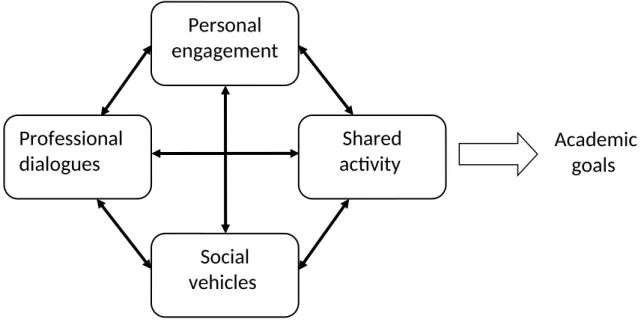
education adapted from Walsh & Kahn (2009) in order to illuminate the case (see Figure 1). The bold arrows indicate mutual interactions between the identified variables, in pursuit of specific academic goals. According to Walsh & Kahn (2009), collaborative working is understood to involve two or more parties pursuing shared practice in order to achieve goals that pertain to that practice. The model itself is grounded in perspectives from the paradigm of critical realism (Bhaskar, 1998), as for instance in the assumption that social realities can be constituted in relation to open systems (see Walsh & Kahn, 2009, for a fuller discussion). The model offers a holistic account of collaborative working, identifying the relevance of underlying patterns of personal engagement, professional dialogue and social vehicles in shaping shared practice. The term ‘social vehicle’ is employed within the model itself to highlight how specific social realities, whether centres, organisations, relationships or so on, underpin a collaboration. The specific choice of CDIO as the focus of our case study here arises in part from its earlier inclusion within Walsh & Kahn (2009): see (Goodhew, 2009).
The model suggests that these varied factors mutually influence each other, as parties in a collaboration seek to realise substantive academic outcomes. The dialogue that occurs between the professionals involved is, for instance, affected by the shared practice, with that dialogue in turn influencing the practice that unfolds. One evident challenge is to characterise the way that these factors mutually influence each other, with this paper further exploring these interactions in relation to the given case. There are links, here, to the debate around the relation between structure and agency (see Ashwin, 2008)), although the model further integrates a direct role for social interaction, shared activity and issues of purpose in understanding collaborative working within academia.
network. Ideas were also identified in advance from Walsh & Kahn (2009) to stimulate a mutual exploration of extensions to other disciplines, whether related to potential ways forward or to barriers. This overall approach was designed to establish a rich account of experiences related to CDIO, rather than seek more formulaic connections with the model.
Figure 1: A model of collaborative working in higher education, adapted from (Walsh & Kahn, 2009).
The dialogue was recorded and fully transcribed. This yielded an 11,300-word transcript, which was coded on the basis of the categories related to the model and the issues highlighted for discussion. This allows one to give considered attention to the relationships between instances of the identified categories. Instances of two or more categories were said to be connected to each other if they were each used to code the same sentence or closely integrated section of a paragraph, with the requirement also that a clear link was evident in the text. There are similarities here to the axial coding undertaken in grounded theory (Strauss & Corbin, 1998), whereby each category is subjected to analysis drawing out its relationship to other categories. It is this consideration of relationships that provides the heart of our analysis, allowing one as it does to represent CDIO’s reform of engineering education in terms of the model of collaborative working. In viewing the social reality constituted by CDIO as an open system, attention in this way is devoted most directly to relationships between the identified elements in the system, rather than to categories perceived in isolation. Such a focus on connections helps us to address bias that might result from two members of a network playing up its value. The challenge in part is to tease out the different relationships between the entities that constitute the system, whether one entity mediates an interaction between two other entities or influences another in a more direct fashion.
The CDIO network as a system
Our primary interest is in considering CDIO as a system, as already indicated, but it is helpful initially to provide an overall perspective on the categories yielded by the data analysis. The analysis of the transcript identified 126 instances of 19 categories, including such categories as personal engagement, professional dialogue, specific social vehicles (e.g. ‘Department’, ‘CDIO’) and specific academic outcomes (e.g. ‘Educational reform’). These categories were connected to each other on 73 occasions, with no category not identified as connected to another category. The most densely connected categories relate to the focus of the discussion itself. The category ‘CDIO activity’, for instance, was used to refer to the creation of support materials, running workshops, attracting new members and so on; and this was connected to 14 other categories. Otherwise, the categories, ‘Mainstream local
Professional
dialogues
Shared
activity
Social
vehicles
Personal
engagement
activity’, ‘Educational reform’, ‘Societal needs’ and ‘Professional dialogue’, ‘Personal engagement’ and ‘Professional roles’ were linked to 10-12 other categories each. For instance, DP2 indicated during the dialogue “The focus of everything that the network does or talks about is the reform of what you teach and how you teach it.” This text was assigned to the categories ‘Network activity’ and ‘Educational reform’.
CDIO conceived as a system
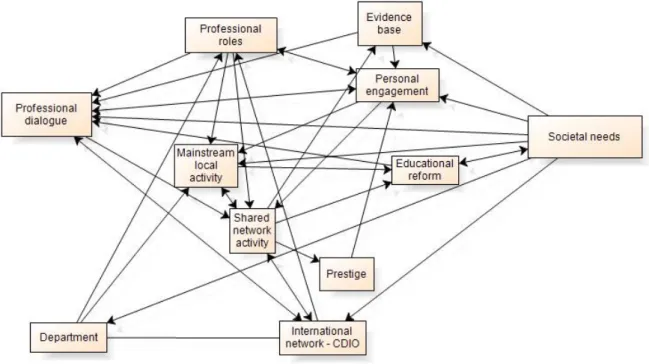
We highlight here the categories and their connections that pertain to the collaboration itself, with Figure 2 portraying these as a system. Collaborative working is conceived here as a socio-cultural system, encompassing as it does a set of mutually-interacting cultural and structural entities. It is apparent here that curricular reform provides a basis for collaborative endeavour, directly linked as it is to the intellectual substance of the discipline. DP2 put it starkly: “We all develop, and then we all share our experiences of that development.” The network grounds SoTL in tasks that engage entire departments or groups of staff, with faculty development supported by interactions with partners and the need to adapt the CDIO standards to the local context. International links also heighten the associated esteem, helping to mainstream the activity. International recognition is indeed an important element in relation to establishing research excellence, as Tijssen (2003) argues.
Figure 2: A model of CDIO as collaborative working
The nature of these interactions here is complex. The reform of engineering education itself constitutes a substantive academic goal, whose pursuit incorporates shifts in the identity and capacities of staff, revised educational practices, new buildings and graduates emerging with
additional capacities. Furthermore, change in the entities that make up the model may themselves be regarded as elements of the desired academic outputs, as with a new departmental role that contributes towards a reformed student experience.
activity: “They start by explaining the need to reform engineering education to build on what it was from when I was a student, all technical and no skills or employability.” The need for reform to engineering education is seen in this quote to influence the character of the professional dialogue that occurs within the network. The immediate academic goal of the reform of engineering education is itself focused on addressing societal needs: “Engineering education isn’t doing the job it needs to. If we don’t change very quickly then there’s going to be drastic consequences or severe consequences.” (DP2). We further see how the network provides space for informed discussion. DP2 suggested:
We’ve changed the way we teach, but we’ve hardly changed the way we assess. There are still many fundamental questions that we need to answer, but so does everyone else. By keeping plugged in those answers emerge from people’s work, we’ll be there to take them over.
DP1 also indicated: “I don’t consider as myself a ‘Liverpool’ microscopist. I’m a ‘world’ microscopist because I would have to go somewhere else to get an intelligent conversation. We shouldn’t be surprised when that’s so in teaching in a way.” Gustavsen (2001) similarly argues that social organisation plays an important role in allowing one to initiate and develop a range of ideas, an essential element in capacity for development. Benjamin (2000) meanwhile identified specific ways in which collaborative practice within a teaching team was able to support SoTL. Indeed, where a teaching team failed to work together, it was clear in her study that limited scope remained for communication and discussion that expanded existing understandings of teaching and learning. In the case of CDIO, there is then a further challenge is to draw others locally into the wider aspects of this informed conversation. DP2 identified ways in which local colleagues were drawn into the dialogue:
When DP1 and I go to every meeting (of the network), we try and bring someone different. ... Fifteen or twenty have come with us to various meetings and presented. Some of them have become quite a fixture in the network. ... It’s a real thing; it is a real network. It’s had the effect of drawing more people into the field.
The way in which one category influences another does vary. We see, for instance, how one element may mediate an interaction between two other elements. Professional roles, for instance, are made possible through the social vehicles involved, with roles in turn facilitating opportunities for personal engagement. Archer (2000) argues that such elements as roles provide an important point of contact between structure and agency. Social structure can allow for specific roles, which in turn shape the exercise of agency. DP1 noted, for instance, the way that the network is able to act as a broker, so that those engaged in the practice of engineering education are able to work with
educational researchers linked to the network with each party making its own specialist contribution. Or we see a cultural entity, such as an evidence base, affording new possibilities for dialogue or to catalyse personal engagement, as DP2 argues:
... employers surveys. I mentioned briefly earlier that many of our partners have done this and followed the same procedure, the same method as us, and the same questions; and have got the same ranking of abilities and knowledge and skills. These have been collated so we’ve got all this data that says “Look, every employer in the world says you need to move from that to that. When you talk to your next door neighbour, who might never have thought of this before, that’s quite persuasive.
the collaboration, as with an international network offered in relation to a global challenge). This suggests that the underlying model of collaborative working should also incorporate such feedback loops.
Tensions in a large-scale network
Given our intention to explore the possibility of extending this collaboration to other disciplines, we address here the connections between those categories that pertain to the uptake of members in the network and tensions for a large-scale network. Part of the challenge with a global network such as CDIO is to shift the culture within the discipline at large, something that is more likely to be affected when greater scale is reached.
The analysis indicates that multiple influences were at work, with categories specifically identified as influencing the category ‘Uptake of CDIO membership’ as follows: Personal
engagement, Professional roles, Funding, Endorsement from national educational authorities, Personal contacts, Advocacy, Competition, Student recruitment, Evidence base, Mainstream local activity, Societal needs, Other networks, and Prestige. There were clear indications as to mutual interaction amongst these elements. DP1, for instance, indicated: “I was Head of School at the time. ... It seemed to me to be a way of delivering something we had already decided.” Here we see the department, a professional role, personal engagement and a connection with the department’s mainstream activity all in evidence to secure take up of membership in the network.
Funding was also seen as relevant for initial take up of membership in the discussion, something that required the presence of significant drivers. There is scope for other disciplines to employ force-field analyses (Cummings & Worley, 2000) and asset audits (Kretzmann & McKnight, 1993) in assessing the leverage for change in any given situation. DP2 indicated: “The reason (CDIO) were funded is because they realised engineering education isn’t doing the job it needs to do. If we don’t change it very quickly then it’s going to be drastic consequences or severe consequences.” Issues of reform of engineering education and societal needs were clearly highly relevant to the uptake of the network.
The scale of the network does open out onto issues of competition between universities. Comments by DP1 encapsulate this conundrum:
Industry have started to recognise that a graduate from a CDIO programme as different and distinctive from a graduate from a non-CDIO programme. Our involvement gives us a competitive advantage for the recruitment of students. The more people we invite in, that advantage diminishes.
It is clear that success in the reform of engineering education has led to an increased uptake in membership of CDIO, although this tension is potentially resolvable in part through higher levels of recruitment to engineering as a whole, given the profession’s capacity to make connections to the substantive concerns of potential students.
Extensions to other disciplines
research collaboration, they also have the potential to contribute to disparities between what is required in professional practice and the actual student experience in higher education.
Other factors may be relevant in further settings, as with collaboration focused on technological change. Collaboration, for instance, has occurred in relation to the use of Computer Algebra Systems in mathematics or the emerging digital humanities. Shifts in the discipline itself may also mean that change is required in the way that education is offered in that discipline. Student recruitment, meanwhile, offers some potential as a basis for collaboration. International collaboration in the education of students is particularly realistic where stakeholders have complementary interests, as Knight (1999) argues. Finally, new disciplines potentially offer scope for collaboration in
establishing an initial market for educational programmes.
It will help for other disciplines to consider the extent to which such substantive drivers might provide a rationale for improved forms of education in their own setting. The Scholarship of Teaching and Learning is predicated on enhanced university education. What we see in our case study is the value of connecting such enhancement activity to substantive disciplinary purposes that are valued in the local setting, providing as these do a driver for collaboration. While an international network may not always be possible, change may still be possible in local settings. It is clearly important to take into account underlying drivers that are at work in any given context. Gibbs, Knapper, & Picinnin (2008) indicated that local change, in this case in research-intensive institutions, was typically catalysed by some external threat to the viability of the department. Our analysis here suggests it will help to align the Scholarship of Teaching and Learning more directly to institutional, disciplinary and societal priorities. This will clearly assist also in securing pump-prime funding or in engaging
substantive groupings of academic staff or entire departments.
The substantive sharing of practice is particularly important in relation to establishing mutual understanding. Such understanding is evidently an essential underpinning for peer review, as Boshier (2009) also argues. McKenzie, Alexander, Harper, & Anderson (2005) suggest that effective
embedding of teaching innovations in new contexts usually involves personal contact between the originators and the adopters, rather than simply occurring on the basis of someone reading about an innovation in a journal or case study report, for instance. Gravestock (2002), similarly, argues that dissemination of innovative practice is particularly effective when the target audience has already been involved in the innovation as co-developers. Collaborative practice provides a specific means by which the understanding needed to adapt and develop practice might be effected. Without the shared values that emerge from collaborative work it is hard to see how mutually-agreeable judgments could be reached in peer review panels. This mutual understanding is doubly important in relation to teaching, as compared to research for instance. Outcomes that pertain to teaching are inherently challenging to quantify because they concern complex personal and socio-cultural realities. For instance, the calibre of an academic outcome such as a research paper is easier to quantify in
comparison to the calibre of a graduate from a reformed degree programme, with further challenges in determining the extent to which the reforms led to the graduate’s attributes and whose contributions to the reforms made most difference.
Conclusions
The Scholarship of Teaching and Learning faces a challenge in securing substantive commitment from the academic community at large. We have proposed in this paper an approach to the
This paper has further contributed to the development of the underlying model of collaborative working proposed by Walsh & Kahn (2009). In emphasising the extent to which feedback loops are at work, we see that the achievement of an academic goal is integrally linked the associated social and cultural entities involved in the process by which that goal is pursued. Goals thus substantially affect the character of the collaborative work that unfolds. The interactions between the different elements of the model are clearly essential in understanding the value of the model, in that these factors are seen to mutually influence each other. There is thus further scope to consider ways in which the theory of complex systems (see for instance Mason, 2008) might inform our understanding of collaborative working in higher education.
We suggest that developing the collaborative basis for the SoTL would help to ensure that common understanding is present locally as to the value of different activities. This proposal prioritises change in disciplinary and departmental practices as opposed to any transformation of consciousness. Transformation may also well result, but this is not a primary focus as it is for Brew (2010) or Cranton (2011). We instead highlight the concrete establishment of shared forms of practice, resolving in this way in specific ways the contestation that Boshier (2009) argues is central to the challenges faced by SoTL. We suggest that realignment around collaborative working on substantive academic tasks is possible; and essential if the Scholarship of Teaching and Learning is to enter the mainstream.
References
Archer, M. S. (2000). Being human: The problem of agency. Cambridge: Cambridge University Press. Ashwin, P. (2008). Accounting for structure and agency in “close-up” research on teaching, learning
and assessment in higher education. International Journal of Educational Research, 47(3), 151–158.
Becher, T., & Trowler, Paul. (2001). Academic Tribes and Territories: Intellectual Enquiry and the Cultures of Disciplines (2nd ed.). Maidenhead: Open University Press.
Benjamin, J. (2000). The Scholarship of Teaching in Teams: What does it look like in practice?
Higher Education Research & Development, 19(2), 191-204. Bhaskar, R. (1998). The possibility of naturalism. New York: Routledge.
Boshier, R. (2009). Why is the Scholarship of Teaching and Learning such a hard sell? Higher Education Research & Development, 28(1), 1–15.
Boyer, E. L. (1990). Scholarship reconsidered. Princeton, NJ: Carnegie Foundation for the Advancement of Teaching.
Brew, A. (2010). Transforming academic practice through scholarship. International Journal for Academic Development, 15(2), 105–116.
Burbules, N. C. (1993). Dialogue in teaching: Theory and practice. New York: Teachers College Press.
Cranton, P. A. (2011). A transformative perspective on the Scholarship of Teaching and Learning.
Higher Education Research & Development, 30(1), 75-86.
Crawley, E. F., Malmqvist, J., Östlund, S., & Brodeur, D. (2007). Rethinking engineering education: the CDIO approach. Düsseldorf: Springer Verlag.
Cummings, T., & Worley, C. (2000). Organization Development & Change (7th ed.). Mason: Thomson Learning.
Elliott, J. (2005). Becoming critical: the failure to connect. Educational Action Research, 13(3), 359– 374.
Gibbs, G., Knapper, C., & Picinnin, S. (2008). Departmental leadership for quality teaching-an international comparative study of effective practice. London: Leadership Foundation for Higher Education.
Goodhew, P. (2009). CDIO: A case study in international collaboration. In L. Walsh and P.E. Kahn,
Gravestock, P. (2002). Making an impact through dissemination. In B. C. (Ed.), Managing
educational development projects: effective management for maximum impact (pp. 109-24). London: Routledge.
Gustavsen, B. (2001). Theory and practice: The mediating discourse. Handbook of action research: The concise paperback edition, 17–26.
Habermas, J. (1984). The theory of communicative action. Boston: Beacon.
Knight, J. (1999). Internationalisation of higher education. Quality and internationalisation in higher education, 1999, 13–28.
Knight, P., & Trowler, P. (2000). Department-level Cultures and the Improvement of Learning and Teaching. Studies in Higher Education, 25(1), 69-83.
Kreber, C., & Cranton, P. A. (2000). Exploring the scholarship of teaching. Journal of Higher Education, 71(4), 476–495.
Kretzmann, J. P., & McKnight, J. (1993). Building communities from the inside out: A path toward finding and mobilizing a community’s assets. Center for Urban Affairs and Policy Research, Neighborhood Innovations Network, Northwestern University.
Mason, M. (2008). What Is Complexity Theory and What Are Its Implications for Educational Change? Educational Philosophy and Theory, 40(1), 35-49.
McKenzie, J., Alexander, S., Harper, C., & Anderson, S. (2005). Dissemination, adoption & adaptation of project innovations in higher education. Sydney: University of Technology. Menges, R. J. (1996). Awards to individuals. New Directions for Teaching and Learning, 1996(65),
3–9.
Schroeder, C. M. (2007). Countering SoTL marginalization: A model for integrating SoTL with institutional initiatives. International Journal for the Scholarship of Teaching and Learning,
1(1), 1–9.
Shreeve, A. (2011). Joining the dots: the Scholarship of Teaching as part of institutional research.
Higher Education Research & Development, 30(1), 63-74.
Shulman, L. S. (2000). From Minsk to Pinsk: Why a scholarship of teaching and learning? Journal of Scholarship of Teaching and Learning, 1(1), 48–53.
Shulman, L. S., & Hutchings, P. (2004). Teaching as community property. Hoboken: Jossey-Bass. Strauss, A. L., & Corbin, J. M. (1998). Basics of qualitative research: techniques and procedures for
developing grounded theory. Thousand Oaks: Sage.
Temple, P. (2006). Branding higher education: illusion or reality? Perspectives: Policy and Practice in Higher Education, 10(1), 15-19.
Tijssen, R. (2003). Scoreboards of research excellence. Research Evaluation, 12, 91-103.
Vardi, I. (2011). The changing relationship between the Scholarship of Teaching (and Learning) and universities. Higher Education Research & Development, 30(1), 1-7.