Volume 2007, Article ID 45768,8pages doi:10.1155/2007/45768
Research Article
Quasi-Cyclic LDPC Codes of Column-Weight Two
Using a Search Algorithm
Gabofetswe Malema and Michael Liebelt
School of Electrical and Electronic Engineering, The University of Adelaide, North Terrace, Adelaide 5005, SA, Australia
Received 16 February 2006; Revised 11 August 2006; Accepted 6 February 2007
Recommended by Richard Heusdens
This article introduces a search algorithm for constructing quasi-cyclic LDPC codes of column-weight two. To obtain a submatrix structure, rows are divided into groups of equal sizes. Rows in a group are connected in their numerical order to obtain a cyclic structure. Two rows forming a column must be at a specified distance from each other to obtain a given girth. The search for rows satisfying the distance is done sequentially or randomly. Using the proposed algorithm regular and irregular column-weight-two codes are obtained over a wide range of girths, rates, and lengths. The algorithm, which has a complexity linear with respect to the number of rows, provides an easy and fast way to construct quasi-cyclic LDPC codes. Constructed codes show good bit-error rate performance with randomly shifted codes performing better than sequentially shifted ones.
Copyright © 2007 G. Malema and M. Liebelt. This is an open access article distributed under the Creative Commons Attribution License, which permits unrestricted use, distribution, and reproduction in any medium, provided the original work is properly cited.
1. INTRODUCTION
Gallager has shown that column-weight-two codes have min-imum distance increasing logarithmically with code length, compared to a linear increase when the column-weight is at least three [1]. Despite the low increase in minimum dis-tance, these codes have shown potential in some applications such as partial response channels [2, 3]. These codes also have less computation because columns have only two con-nections.
Although LDPC code performance has been shown to be good, their hardware implementation still remains a chal-lenge. This is mainly because of their large sizes and com-plex random (unstructured) row-column connections. Ap-plications have power, area, latency, and cost constraints that LDPC encoders and decoders must meet. Structured codes have been developed to reduce hardware implementa-tion complexity by constraining code construcimplementa-tion. However, constraining row-column connections may reduce the max-imum girth (smallest cycle) attainable [4]. It has been shown that increasing the girth or average girth of a code increases its decoding performance [5,6]. The girth also determines the number of iterations before a message propagates back to its original node. Performance of structured codes could therefore be improved by increasing their girths.
In [7] girth 16 and 18 codes with row-weights of 4 and 3 are constructed from graphical models. The method does not provide an easy way of constructing codes for high row-weights and expanding codes. In [3] cyclic codes are constructed algebraically with girth of twelve for row-weights of k, where k −1 is prime. Large-girth column-weight-two codes can also be derived from distance graphs [8]. However, most of the derived codes are not easily im-plementable because of their row-column interconnection structure. In this paper, we construct quasi-cyclic codes with a wide range of girths, rates, and lengths using a search al-gorithm. Quasi-cyclic codes have a structure that is rela-tively easy to implement in hardware for both encoder and decoder[9,10].
Rows
1
5 2
4 3
Distance graph
Columns (a)
1 1 1 1 0 0 0 0 0 0 1 0 0 0 1 1 1 0 0 0 0 1 0 0 1 0 0 1 1 0 0 0 1 0 0 1 0 1 0 1 0 0 0 1 0 0 1 0 1 1
Matrix form
(b)
Figure1: Graph and matrix LDPC code representation.
2. LDPC REPRESENTATION
A LDPC code matrix is usually represented by a Tanner or bi-partite graph in which rows (check nodes) are one set of ver-tices and columns (variable nodes) are another set of verver-tices. Check and variable nodes are connected by an edge if the cor-responding row and column have a “1” entry in the matrix. A LDPC code matrix can also be represented by a non-bipartite or distance graph in which vertices are rows and edges rep-resent columns. A distance graph is a connected graph with M vertices, a smallest cycle length of g and average vertex degree of k. With this representation connected vertices of the graph represent rows that are connected to the same col-umn in the matrix form. In the case of two rows per colcol-umn (column-weight of two), a single edge between two vertices represents a column.Figure 1shows a distance graph of five vertices with a minimum cycle length of three. Taking each vertex as a row and each edge as a column a corresponding matrix is formed as in the figure. The connections are rep-resented by “1” entries in the matrix. A parity-check matrix, H, entry is equal to “1” orHx,y = 1, if verticesvx andvy are connected in the graph. The number of “1” entries in a row,k, is equal to the number of edges of the corresponding vertex. The number of rows is equal to the number of ver-tices in the graph whereas the number of columns is equal to the number of edges. In general the size of a derived column-weight-two LDPC code matrix from a distance graph is given byM×Mk/2, whereMis the number of vertices in the graph andMk/2 is the number of edges. The notation (N,j,k) is of-ten used to show size and rate of a code, whereNis the num-ber of columns or length of a code and jandkare column and row-weights, respectively. The rate of a code is given by 1−j/k, hence for these codes the rate is 1−2/k.
A cycle length ofg in the graph corresponds to a cycle of length 2g in matrix form. In the graph we calculate the length using either vertices or edges only. In matrix form a cycle alternates between rows and columns. Therefore, the graph cycle represents half of the cycle. A cycle of three in the example graph is shown in dotted lines between vertices 1, 2, and 3. It forms a cycle of length six between rows 1, 2, 3
and columns 1, 2, 5 in matrix form. A cycle of length four in a parity-check matrix is formed if a pair of vertices are con-nected more than once in the corresponding graph represen-tation. Four cycles can be broken by not connecting any two rows of a code more than once in the graph representation; a condition also known as the row-column constraint [11].
3. SEARCH ALGORITHMS
Random or pseudorandom construction algorithms such as bit-filling (BF) and progressive-edge growth (PEG) have been developed to construct a wide range of codes. The BF algorithm introduced in [12] constructs a LDPC code by connecting rows and columns of a code one at a time pro-vided that a targeted girth is not violated. The number of connections to rows and columns is kept mostly evenly dis-tributed by randomly selecting rows or columns with the least number of connections first. The algorithm obtains irregular codes with either a fixed row or column-weight. Although the algorithm produces high-rate and high-girth codes given a particular code size, the resulting codes are not easily implementable in hardware. This is mainly because the structure of row-column connections is not consistent enough to be an advantage in hardware implementation. The objective of the algorithm is to optimize girth or rate.
The PEG algorithm [13] is also a simple nonalgebraic algorithm that can be used to construct codes of arbitrary length and rate. It is similar to the bit-filling algorithm. In PEG, node degrees are distributed according to some perfor-mance criteria before edges are added. The algorithm builds a Tanner graph by connecting the graph’s nodes edge by edge provided that the added edge has minimal impact on the girth of the graph. With this algorithm regular and ir-regular codes can be obtained with optimized performance. Codes obtained using this method are amongst the best per-formance codes at short lengths with column-weight of at least three. However, as with codes obtained using the BF al-gorithm, PEG codes are not easily implementable due to their pseudorandom interconnections.
4. PROPOSED ALGORITHM
There are different methods for constructing quasi-cyclic LDPC codes including algebraic and combinatorial, exam-ples of which are found in [4,14]. These construction meth-ods avoid four cycles by employing the row-column con-straint. Although these methods can be used to construct a wide range of codes, they have limited ability to produce codes with arbitrary girth, rate, and length.
1.5 1.6 1.7 1.8 2.6 2.7 2.8 2.5 3.7 3.8 3.5 3.6 4.8 4.5 4.6 4.7 Row connections
(a)
1 5
2 6
3 7
4 8
After one connection
(b)
1 5
2 6
3 7
4 8
After two connections
(c)
1 5
2 6
3 7
4 8
After three connections
(d)
1 5
2 6
3 7
4 8
After four connections
(e)
Figure2: Graph representation of a (16, 2, 4) code with girth eight.
(1) Divide rows intojequal groups of size p, (RG1,. . .,RGj). If the number of rows is unknown or not given, start with a theoretical minimum number of rows if known otherwise start with a group size ofk(row-weight).
rxis rowx.
rxis a set of rows within a distance ofg
fromrx.
(2) Pair row groups such that each group appearsktimes. There arek j/2 row group
pairs, (RGP1,. . .,RGPk j/2). (3) Fort=1 tok j
2 {
RGref=RGPt(1)
selectri∈RGref
sequentially or randomly search for
rx∈RGPt(2) whererx∈/ ri, else
algorithm fails Forz=1 top{
ri+zis connected torx+zif
rx+z∈/ ri+z, else algorithm
fails
} }
(4) Use obtained distance graph to form a LDPC parity-check matrix.
Algorithm1
identity submatrices. That is, if verticesvx andvy are con-nected, thenvx+aandvy+aare also connected. A desired girth, g, is achieved by randomly or sequentially selecting and con-necting vertices that are at a desired distance from each other. The resulting graph is then used to form an equivalent LDPC code matrix as was done inFigure 1.Algorithm 1is described with rows representing vertices.
1 1 1 1
1 1 1 1
1 1 1 1
1 1 1 1
1 1 1 1
1 1 1 1
1 1 1 1
1 1 1 1
Figure3: Matrix representation of a (16, 2, 4) code with girth eight.
I I I I
I Ix Ix Ix
(a)
I I O I I O
Ix O I O Ix I O Ix Ix Ix O Ix
(b)
Figure4: Structure of obtained quasi-cyclic LDPC codes.
When two row groups are used, obtained codes will have a structure as shown inFigure 4(a).Iis ap×pidentity sub-matrix andIx is a shifted p×p identity submatrix. When more than two groups are used, codes with zero submatrices are obtained as the example inFigure 4(b)illustrates, where Ois ap×pzero submatrix. The first row group and column-group submatrices would be shifted if the reference row (ri) is chosen randomly.
The complexity of the algorithm is analyzed in terms of the number of rows,M, and the number of row groups as follows.
(i) If the number of row groups is j, each group is of size M/ j.
(ii) Updating neighbors of a row at a distance ofgtakesg cycles (or operations). For a single row group it takes gM/ jcycles. For each pair of row groups rows from the two groups are connected if they do not violate the girth condition. Checking the condition for all the connections takes anotherM/ jcycles. Hence, a single row group pair takesM(g+ 1)/ jcycles.
(iii) The connection process is repeated for each row group pairing. There are k j/2 group pairings for regular code with row-weight ofk. Therefore, it takeskM(g+ 1)/2 cycles to complete all connections. This is assum-ing that the group size is large enough for the algo-rithm to form all connections and does not include the number of extra tries in case the connections failed the girth condition. The complexity of this algorithm is thereforeO(M).
The actual complexity may also depend on how the algo-rithm is implemented. In [12] set algebra is used to eliminate rows that are too close to the current or reference row. With this approach, the complexity depends on how fast the neigh-bors of each row are updated. The algorithm fails if the set of rows satisfying the distance from the current row is empty. If it is not empty, the rows in the set could be chosen randomly, in sequential order or using other criteria. Sequential search-ing results in the same code, as the found rows will be the same assuming the reference group and rows are the same. Random searches will result in a variety of codes. Figure 5 shows row connections for two girth-eight codes obtained by sequential and random searches. When a sequential search is used, the second group is shifted by one with each con-nection. With random search, both groups are shifted
ran-1.8 1.9 1.1 1.11 1.12 1.13 1.14 2.9 2.1 2.11 2.12 2.13 2.14 2.8 3.1 3.11 3.12 3.13 3.14 3.8 3.9 4.11 4.12 4.13 4.14 4.8 4.9 4.1 5.12 2.13 3.11 7.13 3.12 1.11 4.9 6.13 3.14 4.12 8.14 4.13 2.12 5.1 7.14 4.8 5.13 2.8 5.14 3.13 6.11
(a)
1.8 5.9 6.14 3.9 6.8 4.14 7.12 2.9 6.1 7.8 4.1 7.9 5, 8 1.13 3.1 7.11 1.9 5.11 1.1 6.9 2.14 4.11 1.12 2.1 6.12 2.11 7.1 3.8 4.11
5.12 2.13 3.11 7.13 3.12 1.11 4.9 6.13 3.14 4.12 8.14 4.13 2.12 5.1 7.14 4.8 5.13 2.8 5.14 3.13 6.11
(b)
Figure5: Girth-eight row connections using (a) sequential search (b) random search.
1
2
3
4
5
6
7
8
9
10 20
19 18 17 16 15 14 13 12 11
First connection Second connection
Figure6: Formation of smaller cycles than the target girth.
The proposed algorithm does not guarantee higher girths larger than six or eight. The fact that no two rows are con-nected more than once guarantees a girth of six. If only two row groups are used, girth eight is guaranteed. For higher girths the algorithm checks if connecting the rest of row groups relative to the reference row does not violate the girth. Figure 6shows how a target girth of twelve could be violated when the rest of group rows are connected. The solid and dotted lines represent the first and second connections, re-spectively. In the second connection try, row 20 is found to satisfy the length of at least six from reference row 1. How-ever, connecting the rest of group 1 rows creates cycles of length four. An example of such a cycle is between rows 1, 15, 6, 20. In this case the algorithm tries another connec-tion. From our experiments the algorithm does not take long to find connections that hold the desired girth especially for large group sizes.
4.1. Girth-eight codes
When only two row groups are used the codes obtained have a minimum girth of eight. The row groups form a bipar-tite graph. A biparbipar-tite graph has a minimum cycle length of four. It also has even cycle lengths. Therefore, only girths of eight and twelve can be obtained. Quasi-cyclic codes with the number of row groups equal to the column-weight have a maximum girth of twelve [4].
Obtained girth-eight codes have a minimum size of 2k×
k2with a group size ofkfor all row-weights ofk. This is the minimum size that could be obtained as it corresponds to the size of a cage graph of distance four for a given vertex degree [8]. Also, the minimum size of a row group is of sizekas each row has to be connected tokdifferent rows. Larger codes can be obtained by using larger group sizes. When the group size is larger thank, the row groups still form a bipartite graph resulting in a minimum cycle of four.
4.2. Girth-twelve codes
Girth-twelve codes are formed by a bipartite graph with a smallest cycle length of six when two row groups are used. As with girth-eight codes, girth-twelve codes could be con-structed from cage graphs. For codes with (k−1) as a prime, derived girth-twelve codes from cages are of sizek(k2−k+ 1) [3,8]. Construction of codes based on cages could only be done with known cages.
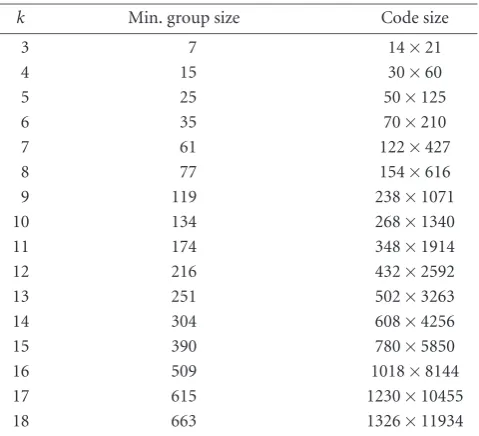
Using the proposed algorithm, girth-twelve LDPC codes could be constructed for any row-weight.Table 1shows code and row group sizes obtained using a sequential search. Ob-tained codes are about twice the size of codes derived from cage graphs in some cases.Figure 7shows row connections for two girth-twelve codes. Part (a) is a (60, 2, 4) code with a group size of 15. In part (b) a larger group size of 20 is used to construct an (80, 2, 4) code. The same amount of shifts are obtained in both cases in the second row group. From our experiments we observed that group sizes larger than those found inTable 1hold the girth. Larger codes can therefore be constructed by using larger row groups.
How-Table1: Smallest girth-twelve code sizes obtained with two groups and a sequential search.
k Min. group size Code size
3 7 14×21
4 15 30×60
5 25 50×125
6 35 70×210
7 61 122×427
8 77 154×616
9 119 238×1071
10 134 268×1340
11 174 348×1914
12 216 432×2592
13 251 502×3263
14 304 608×4256
15 390 780×5850
16 509 1018×8144
17 615 1230×10455
18 663 1326×11934
ever, we could not prove that all larger groups maintain the girth of twelve.Table 2shows code sizes obtained using a ran-dom search. Ranran-dom searches may result in smaller codes as inTable 2. However, obtaining smaller codes generally re-quires many tries to get the right combination of shifts.
4.3. Girths larger than twelve
1.16 1.17 1.19 1.23 2.17 2.18 2.2 2.24 3.18 3.19 3.21 3.25 4.19 4.2 4.22 4.26 5.2 5.21 5.23 5.27 6.21 6.22 6.24 6.28 7.22 7.23 7.25 7.29 8.23 8.24 8.26 8.3 9.24 9.25 9.27 9.16 10.25 10.26 10.28 10.17 11.26 11.27 11.29 11.18 12.27 12.28 12.3 12.19 13.28 13.29 13.16 13.2 14.29 14.3 14.17 14.21 15.3 15.16 15.18 15.22
(a)
1.21 1.22 1.24 1.28 2.22 2.23 2.25 2.29 3.23 3.24 3.26 3.3 4.24 4.25 4.27 4.31 5.25 5.26 5.28 5.32 6.26 6.27 6.29 6.33 7.27 7.28 7.3 7.34 8.28 8.29 8.31 8.35 9.29 9.3 9.32 9.36 10.3 10.31 10.33 10.37 11, 31 11.32 11.34 11.38 12.32 12.33 12.35 12.39 13.33 13.34 13.36 13.4 14.34 14.35 14.37 14.21 15.35 15.36 15.38 15.22 16.36 16.37 16.39 16.23 17.37 17.38 17.4 17.24 18.38 18.39 18.21 18.25 19.39 19.4 19.22 19.26 20.4 20.21 20.23 20.27
(b)
Figure7: Row connections for girth-twelve LDPC codes.
Table2: (N, 2,k) girth-twelve codes using two groups and a ran-dom search.
k Min. group size Code size
3 7 14×21
4 13 26×52
5 21 42×105
6 31 62×186
7 53 106×371
8 67 134×536
9 105 210×945
10 125 250×1250
4.4. Performance simulations
Bit error rate (BER) performances of constructed codes were simulated on an AWGN channel with BPSK modulation. Per-formance curves are shown inFigure 9. Simulated codes are all of size (2556, 2, 4). Four points are noted from these curves. Firstly, randomly shifted codes perform better than sequentially shifted codes. The two seq-(2556, 2, 4) and (2556, 2, 4) codes in the figure have sequential and ran-dom shifts, respectively, from two row groups. They have a girth and average girth of twelve. However, the randomly shifted code outperforms the sequentially shifted code by about 0.4 dB at 10−5 BER. Secondly, multilevel or multidi-vision codes perform better than those with two groups. The
[1 2] [1 2] [1 3] [1 3] [2 3] [2 3] 1.55 1.56 1.109 1.112 55.119 55.134 2.56 2.57 2.110 2.113 56.120 56.135 3.57 3.58 3.111 3.114 57.121 57.136 4.58 4.59 4.112 4.115 58.122 58.137
. . .
. . .
. . .
. . .
. . .
. . . 54.108 54.55 54.162 54.111 108.117 108.133 Group pairs
Row connections
Figure8: Group row connections forming girth-sixteen LDPC code with row-weight of 4.
Table3: Code sizes of girths larger than twelve using a sequential search.
k No. of groups Min. group Code size Girth
3 4 9 36×54 14
3 4 16 64×96 16
3 4 17 68×102 18
3 4 18 72×108 20
4 3 35 105×210 14
4 3 54 162×324 16
4 3 69 207×414 18
4 8 390 3120×6240 24
4 6 213 1278×2556 20
5 4 65 260×650 14
5 4 112 448×1120 16
6 6 121 726×2178 14
6 12 108 1286×3888 16
10−6
10−5
10−4
10−3
10−2
10−1
BER
0 1 2 3 4 5 6
SNR (dB) BER versus SNR
Seq-(2556, 2, 4),g=12 Ran-(2556, 2, 4),g=12 Seq-multilevel-(2556, 2, 4),g=12 Seq-(2556, 2, 4),g=20
Random code-(2556, 2, 4),g=10
Figure9: BER performance of obtained codes with 35 iterations.
outperforms girth-twelve codes by about 0.7 dB. However, quasi-cyclic codes offer the best performance and hardware complexity tradeoff.
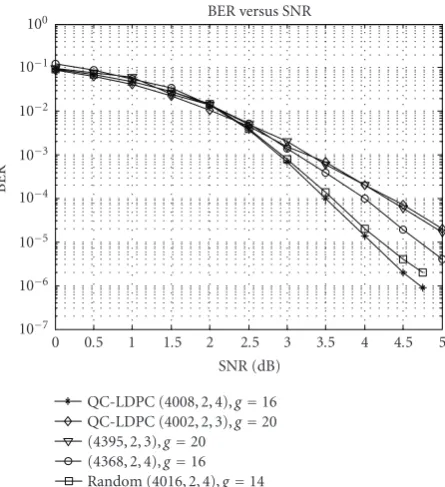
Figure 10shows larger codes compared to codes obtained using graphical models in [7] and a random code with a high girth of 14. The row-weight-three codes have the same per-formances. The obtained QC-LDPC code with row-weight of four outperforms the graphical code by about 0.6 dB at 10−5 BER and outperforms the random by about 0.1 dB at 10−5 BER.
10−7
10−6
10−5
10−4
10−2
10−3
10−1
100
BER
0 0.5 1 1.5 2 2.5 3 3.5 4 4.5 5 SNR (dB)
BER versus SNR
QC-LDPC (4008, 2, 4),g=16 QC-LDPC (4002, 2, 3),g=20 (4395, 2, 3),g=20
(4368, 2, 4),g=16 Random (4016, 2, 4),g=14
Figure10: BER performance of larger codes compared to graphical codes with 35 iterations.
4.5. Hardware implementation
Codes obtained using the original BF or PEG algorithms are not easily implementable. They have an unstructured row-column connection because of the random selection of connections. Random codes are not easily implementable in hardware since there is no general rule(s) to describe row-column connections. Connections are therefore hardwired or stored in lookup tables. Hardwired interconnections are inflexible whereas lookup tables require a large amount of memory.
Codes derived from cage graphs have some structure in that the connections can be described algebraically in most graphs [16]. However, connections may vary from vertex to vertex and from graph to graph. All connection rules need to be stored in hardware. Quasi-cyclic LDPC codes are one type of codes in which a group of rows or columns has simi-lar connections defined by shifts. These codes can be imple-mented by mapping a row or column group to one process-ing node. Addressprocess-ing of messages within processprocess-ing nodes is accomplished by memory shifts or offsets corresponding to the cyclic structure of the matrix. Examples of quasi-cyclic LDPC decoder architectures can be found in [10,17]. Vari-able and check node computations can be overlapped for quasi-cyclic LDPC codes reducing the decoding time by up to half [17]. Encoder implementations could also be simpli-fied by taking advantage of the quasi-cyclic structure as in [9].
code submatrix configuration could be optimized for BER performance or designed to map a given hardware architec-ture. For example, in [18] simulated annealing is used to find a configuration giving the best BER performance. A decoder architecture could then be designed based on that configura-tion.
5. CONCLUSIONS
A nonalgebraic search algorithm for constructing quasi-cyclic LDPC codes of column-weight two has been intro-duced. Rows of a code are divided into groups from which a distance graph is formed. Rows are connected in the graph if they are separated by a desired distance to obtained a de-sired girth. A sequential or random search could be used to find rows satisfying the distance condition. Although the al-gorithm does not guarantee girths larger than eight, larger girths were easily obtained from experiments. The algorithm obtains a wide range of codes in terms of girths, rate, and lengths. The algorithm is also efficient with a computational complexity linear in the number of rows. Randomly shifted codes perform better than sequentially shifted codes. Also more row groups result in better codes compared to codes from two row groups. Although the performance of obtained quasi-cyclic codes does not match that of random codes of the same size and girth, they are easier to implement in hard-ware.
REFERENCES
[1] R. G. Gallager, “Low-density parity-check codes,”IRE Trans-actions on Information Theory, vol. 8, no. 1, pp. 21–28, 1962. [2] H. Song, J. Liu, and B. V. K. V. Kumar, “Low
complex-ity LDPC codes for partial response channels,” in Proceed-ings of IEEE Global Telecommunications Conference (GLOBE-COM ’02), vol. 2, pp. 1294–1299, Taipei, Taiwan, November 2002.
[3] H. Song, J. Liu, and B. V. K. V. Kumar, “Large girth cycle codes for partial response channels,”IEEE Transactions on Magnetics, vol. 40, no. 4, part 2, pp. 3084–3086, 2004.
[4] M. P. C. Fossorier, “Quasi-cyclic low-density parity-check codes from circulant permutation matrices,” IEEE Transac-tions on Information Theory, vol. 50, no. 8, pp. 1788–1793, 2004.
[5] M. E. O’Sullivan, “Algebraic construction of sparse matrices with large girth,” IEEE Transactions on Information Theory, vol. 52, no. 2, pp. 718–727, 2006.
[6] Y. Mao and A. H. Banihasherni, “A heuristic search for good low-density parity-check codes at short block lengths,” in Pro-ceedings of IEEE International Conference on Communications (ICC’01), vol. 1, pp. 41–44, Helsinki, Finland, June 2001. [7] H. Zhang and J. M. Moura, “The design of structured regular
LDPC codes with large girth,” inProceedings of IEEE Global Telecommunications Conference (GLOBECOM ’03), vol. 7, pp. 4022–4027, San Francisco, Calif, USA, December 2003. [8] G. Malema and M. Liebelt, “Low-complexity LDPC codes
for magnetic recordings,” inProceedings of International En-formatika Conference (IEC ’05), vol. 5, pp. 269–271, Prague, Czech Republic, August 2005.
[9] H. Fujita and K. Sakaniwa, “Some classes of quasi-cyclic LDPC codes: properties and efficient encoding method,” IE-ICE Transactions on Fundamentals of Electronics,
Communi-cations and Computer Sciences, vol. E88-A, no. 12, pp. 3627– 3635, 2005.
[10] S. Olc¸er, “Decoder architecture for array-code-based LDPC codes,” inProceedings of IEEE Global Telecommunications Con-ference (GLOBECOM ’03), vol. 4, pp. 2046–2050, San Fran-cisco, Calif, USA, December 2003.
[11] J. Xu, L. Chen, L. Zeng, L. Lan, and S. Lin, “Construction of low-density parity-check codes by superposition,”IEEE Trans-actions on Communications, vol. 53, no. 2, pp. 243–251, 2005. [12] J. Campello, D. S. Modha, and S. Rajagopalan, “Designing
LDPC codes using bit-filling,” inProceedings of IEEE Interna-tional Conference on Communications (ICC ’01), vol. 1, pp. 55– 59, Helsinki, Finland, June 2001.
[13] X.-Y. Hu, E. Eleftheriou, and D. M. Arnold, “Regular and ir-regular progressive edge-growth tanner graphs,”IEEE Transac-tions on Information Theory, vol. 51, no. 1, pp. 386–398, 2005. [14] Y. Kou, S. Lin, and M. P. C. Fossorier, “Low-density parity-check codes based on finite geometries: a rediscovery and new results,”IEEE Transactions on Information Theory, vol. 47, no. 7, pp. 2711–2736, 2001.
[15] R. Bresnan, “Novel code construction and decoding tech-niques for LDPC codes,” M.Eng.Sc. thesis, Department of Electrical and Electronic Engineering, University College Cork, Cork, Ireland, 2004.
[16] M. Meringer, “Fast generation of regular graphs and construc-tion of cages,”Journal of Graph Theory, vol. 30, no. 2, pp. 137– 146, 1999.
[17] Y. Chen and K. K. Parhi, “Overlapped message passing for quasi-cyclic low-density parity check codes,” IEEE Transac-tions on Circuits and Systems, vol. 51, no. 6, pp. 1106–1113, 2004.
[18] J. Thorpe, K. Andrews, and S. Dolinar, “Methodologies for de-signing LDPC codes using protographs and circulants,” in Pro-ceedings of IEEE International Symposium on Information The-ory, pp. 238–242, Chicago, Ill, USA, June-July 2004.
Gabofetswe Malemaobtained the B.S. de-gree in computer engineering (1997) and the M.S. degree in electrical engineering and computer science (1999) from Val-paraiso University and The University of Illinois at Chicago, respectively. He worked as a Lecturer at Department of Computer Science, the University of Botswana, from 2000–2003. He is currently in his final year of Ph.D. study at School of Electrical and
Electronic Engineering, the University of Adelaide. His main re-search interests are LDPC construction and hardware implementa-tion and processor-in-memory architectures.
Michael Liebelt obtained B.S. degree in computer science and applied maths (1978), the B.E. degree (with honors) in electrical and electronic engineering (1979), and the M.E. degree in electrical and electronic engineering (1982) all from the University of Adelaide, Australia. His research interests are computer architec-ture, asynchronous digital systems and test methods and design for testability. He is