CHAPTER
12
Methods of proof
374 METHODS OF PROOF
12.1 Mathematical proof
A mathematical proof is a sequence of reasoning that is acceptable to everyone who understands the mathematics involved. It is not subjective as in legal 'proof' where the emphasis is on personal persuasion.
Mathematical proof begins from accepted mathematical knowledge (premises) and applies the rules of valid reasoning to reach a conclusion.
In the previous chapter, our premises were verbal statements whose truth was easy to accept. Mathematical premises often involve knowledge of definitions, conventions (e.g. -Jf6 = 4), and previously proven propositions or theorems. The combinations of mathematical information in a way that leads to a valid conclusion is often a challenging task to accomplish. It could be said that mathematical proof is an art. Before illustrating various techniques of proof, we shall review the meaning of the terms 'statement', 'converse', 'equivalence' and 'contrapositive' in a mathematical setting. Consider the following equivalence.
Two straight lines (neither vertical) are mutually perpendicular
if
and onlyif
the product of the gradients is equal to - 1.Since [ (p ---+ q) /\ ( q ---+ p)] +-+ (p +-+ q) is a tautology (see Table 11.20), we recall that the equivalence is defined by the two implications:
p ---+ q: If two straight lines (neither vertical) are mutually perpendicular, then the product of the gradients is equal to -1.
and
q ---+ p: If the product of the gradients of two straight lines is equal to - 1, then the lines are mutually perpendicular and neither is vertical.
We may regardp---+ q as a statement of a proposition (theorem) and q---+ pas its converse. Both these forms have been used in our study of coordinate geometry.
The form p ---+ q is used when we have to find the equation of a line perpendicular to a given line.
The form q ---+ p is needed when we wish to prove that two lines of known gradients are perpendicular (or not).
To prove an equivalence p +-+ q we must separately prove p ---+ q and q ---+ p. Often only one of these is proved. For example, most text books prove only the above statement, p ---+ q, when treating perpendicular lines. The converse, q ---+ p, is assumed without proof.
This works for applications because the converse is true, but we should recognise that the proof of the equivalence p +-+ q is incomplete.
In many mathematical situations the converse of a true statement is false. For example consider:
p---+ q: If a and bare positive numbers, then ab> 0. This we know to be a true statement (theorem).
q---+ p: If ab> 0 then a _a�� -posi�umbers.
This we know to be a false statement since a and b can both be negative when ab> 0. In this case we cannot write p +-+ q but are restricted to 'p ---+ q.
The tautology (p ---+ q) +-+ ( -q ---+ -p) (Table 11.20) indicates the equivalence of a statement p ---+ q and its contrapositive -q ---+ -p. This equivalence is useful because it provides us
with two methods for proving a statement of implication. (i)p ---+ q, i.e. prove the statement directly
or
(ii) - q ---+ -p, i.e. prove the contrapositive statement.
In the example from coordinate geometry, the contrapositive of p---+ q is:
METHODS OF PROOF 375
This is an obviously true statement, is equivalent top-+ q, and is often used within exercises.
12.2 Necessary and sufficient conditions
It will be recalled that there are alternative ways of expressing the implicationp -+ q, e.g. if p then q, p is a sufficient condition for q, q only if p, q is a necessary condition for p. We have seen how p +-+ q incorporates the if and only if conditions. In mathematical examples, the notions of necessary and sufficient are very frequently employed. Referring to the example p -+ q: If a and b are positive numbers then ab> 0,
we say:
(i) a, b positive is a sufficient condition for ab> 0
(ii) ab> 0 is a necessary condition for a, b to be positive. However this condition is not sufficient. Why?
When p -+ q and the converse q -+ p are both true, so that p +-+ q, we often use the expression 'necessary and sufficient' in place of 'if and only if'.
We can say, therefore, 'For two lines (neither vertical) to be perpendicular, it is necessary and sufficient that the product of their gradients is equal to - 1.'
Summary
In mathematics, the following statements have the same meaning and each is written as p tt q.
a p if and only if q b p is equivalent to q
c p is a necessary and sufficient condition of q.
12.3 Proof patterns in mathematics
We shall now demonstrate some proof techniques based upon tautologies. We shall concentrate upon those that have a wide-ranging application within mathematics.
Proof based upon [
(p -+q]
A p] -+ qIf p implies q and if p is true, then q is true.
Example 1
Prove that the lines with respective equations y = 2x + 1 and y = -
x
+ 1 intersect. p: The gradients are 2 and - 1 which are unequal.376 METHODS OF PROOF
Proof based upon transitivity [(p-+ q) A (q-+ r)]-+ (p-+ r)
This mode of reasoning is particularly common in deriving algebraic results.Example2
Prove that, if 2x
+
8 = 20, then x = 6.Statement Reason Symbol
(i) 2x
+
B= 20
given p(ii) If 2x
+
8 = 20 subtraction property p-+ qthen 2x= 12
(iii) If 2x= 12 division property q ... r
then X= 6
(Iv) If 2x
+
B= 20
tautology P ... rthen X= 6
The reasoning used in Examples l and 2 is very familiar. We do not usually set it out in such detail. The purpose here is to indicate that familiar modes of reasoning have sound logical foundations and to point out the relevant tautology that guarantees the result. We shall not be concerned with further illustrations of these familiar contexts, but will concentrate on other proof forms that are less familiar but very important within mathematics.
Proof of equivalence based on [(p -+ q) A (q-+ p)] ++ (p ++
q)
Readers may be familiar with the 'trick' for finding out whether a whole number is divisible by 3:
e.g. 3456 is divisible by 3 because 3
+
4+
5+
6 = 18 and 18 is divisible by 3. 382 is not divisible by 3 since 3+
8+
2 = 13 and 13 is not divisible by 3. The 'trick' can be justified by a theorem as follows:p B q: The sum of the digits of a whole number is divisible by 3 if and only
if
the numberis divisible by 3.
This statement of equivalence includes:
p -. q: If the sum of the digits of a whole number is divisible by 3, then the whole number is divisible by 3
and the converse:
q-. p: Ifa whole number is divisible by 3, then the sum of its digits is divisible by 3. We shall prove the equivalence for 3-digit numbers and leave the reader to extend the proof to cover larger numbers.
Proof of statement (p -+ q)
Let N denote any three-digit whole number in which a, band c take whole number values from Oto 9.
Then N = 100a
+
10b+
c (since a is hundreds, bis tens and cis units).Therefore:
C
=
3k - a - band so N
=
100a + 10b + (3k - a - b)=
99a + 9b + 3k=
3(33a + 3b + k)So Nis divisible by 3, as required.
Proof of converse (q--+ p)
In this case we assume that N is divisible by 3. Therefore:
100a + 10b + C
=
3tSo: a + b + c
=
3t - 99a - 9b= 3(t - 33a - 3b)
METHODSOFPROOF
377Since the RHS is a multiple of 3, the sum of the digits (LHS) is divisible by 3, as required. Since we have proved both p ---+ q and q ---+ p, the equivalence p +-+ q has been established
in the case of 3-digit numbers.
Try to construct a proof for four-digit numbers, then for n-digit numbers.
Proof by contrapositive (p
--+q) ++ ( - q
--+ -p)
Example3
Prove that, if n2 is even, then n is even where n is a whole number.
p ---+ q: If n2 is even, then n is even.
-q ---+ -p: If n is not even, then n2 is not even.
We now prove the contrapositive statement. Proof:
Since n is not even, we haven
= 2r
+ 1 where r is a whole number. Therefore:n2
=
(2r+
1)2 = 4r2+
4r+
1i.e. n2
=
2(2r2 + 2r) + 1= 2t + 1 where t = 2r2 + 2r
So n2 is not even.
The contrapositive form is, therefore, proved and the logical identity means that the original statement is also true.
Example4
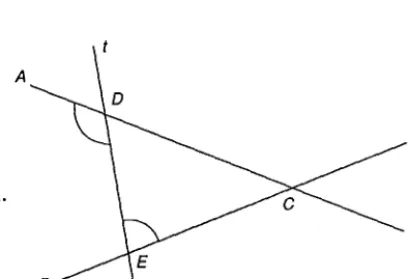
If two lines form equal alternate angles with a transversal, then they are parallel.
The contr.apositive of this statement reads as follows:
If two lines are not parallel, then the alternate angles formed with a transversal are not equal.
Figure 12-1
378 METHODS OF PROOF
Proof:
We assume the two lines AC and BC (Figure 12-1) are not parallel. t is a transversal.
Since AC and BC are not parallel, they meet at some point C (by definition of parallel lines). So DEC is a triangle (definition of triangle).
Therefore LADE> L DEC (exterior angle property).
It follows that the alternate angles, i.e. LADE and L DEC, are unequal. The contrapositive statement is therefore proved.
So, by the logical identity, the original statement is true.
12.4 Indirect proof
This mode of proof is usually called proof by contradiction. It is supported by the logical identity [p -+ (r /\ -r)] +-+ -p.
A very useful form of this equivalence is the following:
[(p /\ -q)-+ (r /\ -r)] +-+ (p-+ q).
Verify that this logical identity is a tautology.
To prove a propositionp-+ q by this method we proceed as follows: Step 1: Assume that the desired conclusion is false ( -q).
Step 2: Use any valid reasoning to prove that any statement and its negation are both true. Step 3: We have produced a contradiction so that the initial assumption (q false) is false.
So q is true.
Example 5
Prove that, if n2 is even, then
n
is even wheren
is a whole number.Proof:
(i) Assume that n2 is even but n is not even (i.e. negate the conclusion). (ii) Since n is not even then n = 2r + 1 where r is some whole number.
Therefore:
n2 = (2r
+
1)2 == 4r2+
4r+
1= 2(2r2
+
2r)+
1= 2t + 1 where t = 2r2 + 2r So n2 is odd.
(iii) However, we assumed that n2 is even and so we have produced a contradiction. So the assumption that
n
is not even is false. Thereforen
is even and the statement is proved.Example 6
Prove that, if the product of two real numbers is zero, then at least one of the numbers must be zero.
Proof:
(i) Let a, be R with ab = 0, but assume that a
*
0 and b*
0 (i.e. maintain(ii), Since a -=I= 0, .!. is defined.a Therefore:
.! a (ab) = b (inverse property)
But .! a (ab) = .!(O) = 0 (since a ab = 0)
So b
=
0.METHODSOFPROOF 379
(iii) But b = 0 contradicts the assumption b -=I= 0. Therefore, by the principle of indirect argument, the theorem is true.
Example 7
Prove that there is no largest natural number.
Proof:
(i) Assume the set of natural numbers and that this set contains a largest member k.
(ii) Since k and k + 1 are both natural numbers, their product is a natural number (property of N).
Therefore:
k(k + 1)
<
k (since k is largest number in N) i.e. k2 +k <ki.e. k2<0
But k2
<
0 is not true for any natural number and so k f/ N. (iii) Since we assumed k E N and we have proved that k f/ N we have acontradiction.
Therefore, the assumption that N contains a largest number is false and the theorem is true.
12.5 Proof by counter-example
Suppose we are considering whether p --+ q is a true statement. If we can find a single example for whichp is true and q is false, thenp--+ q is false. (Check the truth table entry.)
Example 8
Find a counter-example to disprove each of the following statements: a � = 1 for all X
x
E R.b A whole number is divisible by 6, if the sum of its digits is divisible by 6. c Ifa whole number is divisible by 6, then the sum of its digits is divisible by 6.
These statements need first to be written more precisely in a p --+ q format. a If x E R then � X
=
1.This proposition states that 'for every number x of the set of real numbers, it is true that � X
=
1 '.To disprove this claim, we must show that there exists at least one real number
380 METHODS OF PROOF
b .if the sum of the digits of a whole number is divisible by 6, then the number is divisible by 6.
This means that 'for every whole number that has the sum of its digits divisible by 6, it is true that the number itself is divisible by 6.'
To disprove this statement, we must show that there exists at least one whole number, the sum of whose digits is divisible by 6 but which itself is not divisible by 6.
The number 33 satisfies the conditions (since 3 + 3
=
6 is divisible by 6) but violates the conclusion (since 33 is not divisible by 6). So 33 serves as a counter-example to disprove the proposition.c If a whole number is divisible by 6 then the sum of its digits is divisible by 6. We can write this more precisely using a quantifier, as follows:
For every whole number which is divisible by 6, it is true that the sum of its digits
is divisible by 6.
The number 30 is divisible by 6 but the sum of its digits 3 + 0
=
3 is not. So, 30 serves as a counter-example to disprove the proposition.Example9
Prove that if a and bare non-zero real numbers, then the equation ax
=
b has one and only one solution.This reads rather like an
if
and onlyif
statement but is actually rather different. The proposition makes two claims:(i) that a solution exists
(ii) that there is only one such solution.
We should view such statements as propositions that contain two conclusions each of which must be separately proved.
For (i), we need only find a single instance that satisfies the given equation. We can regard such an instance as a counter-example to the proposition that no solution exists.
Since a
(!!.)
=
b (since! is defined) we have x=
!!. as a suitable value. Thea a a
existence of a solution has been proved.
For (ii), we assume that there are two solutions, X1 and X2, where X1
*
x2(satisfying ax
=
b). We now seek a contradiction. Since:ax1
=
b and ax2=
bwe have:
ax1
=
ax2Therefore:
and so:
! (ax1) a
=
.!(ax2)(since a a*
0)X1
= X2
We have contradicted our assumption that x1
*
x2.METHODS OF PROOF 381
12.& Famous proofs from antiquity
Deductive proof was first developed by the ancient Greeks and we conclude this section by applying their methods to two famous problems.
Example 10
Prove that -J3 is irrational.
@
iNote:
Proof:
We employ the indirect method of proof.
Assume that -J3 is rational, i.e. -J3
=
i
where a and b are positive integers without common factors.i
is, therefore, assumed to be cancelled down to its lowest terms. Since:=
-J3 a2=
3b2and so a2 is a multiple of 3.
Now., if a2 is a multiple of 3, then a is a multiple of 3. *
(*We take this as a true result for the present.)
a
=
3t for some integer tTherefore:
9t2 = 3b2
So: b2
=
3t2Therefore b 2 is a multiple of 3 and consequently, by *, we have b is a multiple of 3.
We have inferred that both a and bare multiples of 3 which means that a and b have 3 as a common factor. This contradicts our original assumption and, therefore, the assumption that -J3 is rational is false.
So -J3 is irrational.
To complete our proof, we need to assume the truth of *. This really requires separate justification. We have here a good example of proof structure, i.e. to prove some original proposition, we find it necessary to prove other results that are needed as a means to this end.
To prove *, apply the method demonstrated in Example 3 in this chapter.
Hint:
Since a is not a multiple of 3 consider the two cases:
a = 3r
+
1 and a = 3r+
2 and follow the method used in Example 3.Example 11
Prove that there are infinitely many prime numbers.
Proof (due to Euclid):
Suppose that there is a finite number of primes p 1, P2, p 3 • • • p n·
Form the number N
=
P1P2P3 .. , Pn+
1. Now N must either be prime or composite.(i) If N is prime, it is a prime number not in the list Pi, P2, .. . Pn, Why? So the
(
382 METHODS OF PROOF
Note:
(ii) If N is composite, it is a product of primes, and one of its factors must be a prime not in the assumed list. Why? Again the assumption that the list contains all primes is contradicted. So the conclusion that there is a finite number of primes must be rejected.
In the exercises that follow it may be useful to rewrite given statements in precise terms. For example, 'the sum of two odd integers is even' can be written inp � q form, as follows: If m and n are odd integers then m + n is even.
The various tautologies guarantee that the corresponding methods of proof are valid. It is not necessary to memorise the tautologies, but the methods of proof must be accurately applied.
Exercises 12a
1 Rewrite the following statements in terms of sufficient conditions, necessary conditions, or necessary and sufficient conditions, as appropriate:
a If two triangles are congruent, then their perimeters are equal.
b If two lines are parallel to the same line, then they are parallel to each other.
c A triangle is right-angled if and only if the square on one of the sides is equal to the sum of the squares on the other two sides.
d Two sides of a triangle are equal if and only if the angles opposite these sides are equal.
e For the set of natural numbers, if x
<
a then x2<
a2•2 Prove each of the following statements, justifying each step in the reasoning. (Use the previous worked examples as a guide in choosing an approach.)
a The sum of two odd integers is even.
b The sum of an odd integer and an even integer is odd.
c If n2
>
4 and n is a natural number, then n>
2.d A natural number, n, is divisible by 6 if and only if it is divisible by both 2 and 3.
e If mis odd and n is even, then the product, mn, is even. f n2 is divisible by 2 if and only if n is divisible by 2. g n3 is even if and only if n is even.
h n2 is a multiple of 3 if and only if n is a multiple of 3.
A whole number is divisible by 9 if and only if the sum of its digits is divisible by 9. j If two lines form equal corresponding angles with a transversal, then they are
parallel. k In any triangle:
(i) the greatest angle is opposite the greatest side (ii) the greatest side is opposite the greatest angle.
(Prove (i) directly, and then (ii) by contradiction.)
lfA = [�
!]
wherea ,b,c anddERthenA-1exists if and only ifad-=i:-bc.3 Prove that, within the set of integers, the equation a + x = b has one and only one solution.
METHODS OF PROOF 383
5 Find counter-examples to disprove the statements in the following examples: a The square of every odd number is even.
b A quadrilateral is a rhombus if and only if its opposite sides are parallel. c The equation sin x
=
a where a> 0 has a solution in the second quadrant. d 2x2=
8 if and only ifx
=
2.e � = xforxeR.
f If AB
=
0, then A=
0 or B=
0 where A, Band Oare square matrices, and 0 is the zero matrix.6 Prove that the equation
2x
+
3=
4x+
9 has only one solution. 7 Prove that b2- 4ac > 0 is a necessary condition for the equation ax2
+
bx+
c=
0 to have real unequal roots.8 Prove that, if ax = bx and x
*
0, then a = b.9 Prove that ax> ay if and only if a> 0 and x> y or a <0 andx<y. 10 Prove that -J2 is irrational.
11 Prove that --is is irrational.
12 Prove that
-Jp
is irrational where p is prime.13 Demonstrate how the usual proof fails when used to 'prove' -J4 is irrational. 14 Prove that log 10 2 is irrational
15 Prove that log3 2 is irrational.
16 Prove that there is no largest real number
x,
such thatx
< 1. (Use indirect proof.) 17 Prove that there is no largest real numberx,
such thatx
2<
2. (Use indirect proof.)18 Prove that there is no smallest positive real number. (Use indirect proof.)
19 Prove that two lines (neither vertical) ar"e perpendicular if and only if the product of the gradients is equal to - i.
20 Criticise the reasoning in the following 'proof' and write a correct proof. To prove: 'If a and b ER, then a2 + b2
� 2ab'. Proof:
If a2 + b2
� 2ab then a2
- 2ab + b2 � 0 i.e. (a - b)2 � 0
This is true and so a2 + b2
� 2ab.
21 Criticise the reasoning that follows and present a correct argument.
Investigate the truth of the proposition: If b is a factor of a + 1, then b is a factor of a3 - 1 where a and bare positive integers.
Let a = 2 and b = 3.
Then a+ 1
=
3 anda3 - 1=
7,so thatbis a factor ofa + 1 but not ofa3 - 1. Let a = 3 and b = 2.Then a
+
1 = 4 and a3 - 1 = 26, so that b is a factor of a+
1 and also ofa3 - 1.
384 METHODS OF PROOF
12.7 Mathematical induction
The term induction involves the deriving of a general statement or rule from one or more particular cases. A statement may be true for a few special cases. Does it follow, then, that it is true in all cases?
(i) It is true that 60 is divisible by 1, 2, 3, 4, 5 and 6. This establishes a pattern. Does it
follow that 60 is divisible by all positive integers? (No)
(ii) 1
=
121 + 3 = 22
1
+
3+
5=
321
+
3+
5+
7=
42The sum of the first two odd numbers is a perfect square; so too is the sum of the first three odd numbers, and of the first four odd numbers. Does it follow that the sum of the first n odd numbers is a perfect square? The pattern seems to indicate that it is. We shall prove shortly that it is.
(iii) It is true that, when
n
= 1, 2, 3, 4, 5, 6 or 71 n2+
n
+
11 is a prime number. Doesit follow that it is prime for all values of n? The pattern seems to indicate that this is possibly so. If n = 10, n2
+
n+
11 = 121, which is not a prime number.(iv) Consider the formulaf(n)
=
n2 - n + 41.f(l)
=
41f(4) = 53 f(2) f(5) = = 4361 f(6) j(3)
=
=
47 71These are all prime numbers, and indeed for every value of
n
from 1 to 40 we find that f(n) gives a prime number. Here is a formula which 'works' for 40 consecutive trials.However, when n = 41 we havef(41) = 412 which is not prime. Many people are
content to base a conclusion on far fewer than 40 successful trials. This example shows us that no amount of testing of individual cases can allow us to claim that a rule will work for all other cases.
Unfortunately statements such as 'this can be continued indefinitely' are too vague. In many cases we do not really know that we shall not be blocked at some stage far along the line. The tendency to overgeneralise leads to mistakes in many situations.
(v) During the 18th and 19th centuries the Mississippi River was shortened considerably by the removal of bends.
e.g. Year surveyed 1700 1720 1875
Length (miles) 1215 1179½
976
The author Mark Twain was aware of this information and wrote the following passage in his Life on the Mississippi.
'Please observe
In the space of 176 years the Lower Mississippi has shortened itself 242 miles. That is an average of a trifle over one mile and a third per year. Therefore, any calm person, who is not blind or idiotic, can see that in the Old Oolitic Silurian Period, just a million years ago next November, the Lower Mississippi River was upward of 1,300,000 miles long, and stuck out over the Gulf of Mexico like a fishing rod. And by the same token any person can see that 742 years from now the Lower Mississippi will be only a mile and three quarters long, and Cairo and New Orleans will have joined their streets together, and be plodding comfortably along under a single mayor and a mutual board of aldermen. There is something fascinating about science. One gets such wholesale returns of conjecture out of such a trifling
METHODS OF PROOF 385
We can enjoy Mark Twain's humour but yet remember that we can make similarly erroneous generalisations by jumping to mathematical conclusions without sufficient evidence.
(vi) You may have sat for a test that contained questions similar to the following: Give the next four numbers in the pattern 7, 16, 25, 34, 43, . . .
A common response would be 52, 61, 70, 79 indicating that a common difference of 9 between terms had been applied.
However, another equally valid response would be 52, 59, 61, 68. The rule being applied is that, in each successive term, the sum of the digits is a multiple of 7.
To a mathematician, the above question cannot have an answer until the rule defining the sequence is formally stated. Sometimes our past experiences in jumping to conclusions can impede our mathematical progress.
The proof technique called mathematical induction provides a method for proving propositions that are based upon the infinite set of natural numbers.
Proof by Induction
The method of proof by induction is applied to propositions, P(n), containing the natural number n.
Step 1: Verify that the statement is true for a special case, usually n
=
1, i.e. P(l) is true.Step 2: Assume that the statement is true for some integer, say n
=
k, and then prove that it must be true for n=
k+
1, i.e. prove P(k) - P(k+
1).Step 3: If it is true for n = 1, then it must be true for n = 2 and then, being true for n
=
2, it must be true for n=
3 and so on. So it is true for all natural numbers, i.e. P(n) is true for every n.We can visualise the procedure by comparison with an infinite ladder. The bottom rung is
n
=
1 while n=
k and n=
k+
1 are any two successive rungs anywhere on the ladder. Step 1 says that we can stand on the bottom rung.Step 2 says that if we can reach any one rung we can always reach the next one.
Together Steps 1 and 2 mean that we can reach every rung beginning from the bottom. This is the sense of Step 3, the conclusion.
Example 12
Prove, by induction, that the sum of the first n odd numbers in n2, that is, that:
P(n): 1
+
3+
5+
7+ ... +
(2n - 1)=
n2Proof:
Step 1: Put n
=
1 and since 1=
12, the statement P(l) is true.
Step 2: Assume that it is true for n
=
k:i.e. P(k): 1
+
3+
5+
7+ ... +
(2k - 1)=
k2and so, when n
=
k+
1, adding 2k+
1 [the (k+
1) th term] to both sides we get:1
+
3+
5+
7+ ... +
(2k - 1)+
(2k+
1)=
k2+
2k+
1i.e. 1
+
3+
5+
7+ ... +
(2k+
1)=
(k+
1)2This is P(k+ 1) since it has the same form as P(k) with k + 1 replacing k
in all places.
So, if the statement is true for n = k, then it is also true when n = k
+
1 because the sum of the first (k + 1) terms is the perfect square (k +- 1)2, i.e. P(k) -P(k+ 1).386 METHODS OF PROOF
Example 13
Prove, by induction, that 4" - 1 is divisible by 3 for all n ;;;,: 1.
Proof:
Step 1: When n
=
1, 4 - 1=
3 which is divisible by 3.Step 2: Assume that, when n = k, 4 k - 1 is divisible by 3, i.e. 4 k - 1 = 3m where m is an integer.
Whenn
=
k + 1:4k+I - 1
= 4
k+I - 4 + 3=
4(4k - 1)+
3=
4 X 3m+
3= 12m + 3
= 3(4m
+
1) which is also divisible by 3.Step 3: It is true when n
=
1 and so it is true when n=
2 and so on. Thereforeit is true for all n, a positive integer.
Example 14
Prove, by induction, that the sum of n terms of a geometric sequence whose first term is a(r" - 1)
a and common ratio r is r- 1
,;l
To prove:( " l)
� Sn = a+ ar + ar2 + ... + ar"-1 = a r -1
r-Proof:
Step]: Forn
=
l,S1=
a.It is true.
Step 2: Assume it is true for n
=
k.Sk
=
a + ar + ar2 + ... + ark -1 a(r k - 1)=--'----'-
r-
1and so, when n
=
k + 1, adding ark to both sides, we get:Sk+I =a+ ar + ar2 + . .. +ark-I+ ark = a(r
k
-11> + ark
r-ark - a
+
ark+ 1 -ark=---
r
- 1a(rk+ I - 1)
=�----
r
- 1S k + 1 has the same form as S k with k + 1 replacing k in all places.
So if it is true for
n
=
k, it is also true forn
=
k+
1 .Step 3: It is true for n
=
1, and so it is true for n=
2 and so on. Therefore itis true for all n.
Example 15
Prove, by induction, that:
1
1 . 2 + 2. 3 + 3. 4 + ... + n(n + 1)
=
3n(n + l)(n + 2)
METHODS OF PROOF 387
1
Let: Sn = 1 . 2
+
2. 3+
3 . 4+ ... +
n(n+
1 ) = 3n(n+
l)(n+
2) Proof:1
Step I: When n
=
1, S1=
1 . 2=
3.
1 . 2. 3=
2. It is true for n=
1.Step 2: Assume it is true for n
=
k.Then: Sk
=
1 . 2 + 2. 3+
3 . 4+ ... +
k(k+
1 )=
½k (k+
l)(k + 2)and so, when n
=
k+
1:Sk +I
=
1 . 2+
2. 3+
3 . 4+ ... +
k(k+
1 )+
(k+
l)(k+
2)=
½k (k+
l)(k+
2)+
(k+
l) (k+
2).= ½[k(k
+
l)(k+
2)+
3(k+
l) (k+
2)]= ½ (k
+
l)(k + 2) (k+
3 )S k + 1 has the same form as S k with k
+
1 replacing k in all places.So, if it is true for n
=
k, then it is true for n=
k+
1, i.e. Sk � Sk+ 1is true.
Step 3: It is true for n
=
1, and so it is true for n=
2 and so on. Therefore it is true for all n.Example 16
Prove, by induction, that 3n
>
1+
2n, i.e. tn=
3n - 2n - 1>
0 for n>
1.Proof:
Step 1: Put n
=
2 and, since 32 - 2. 2 - 1>
0, the statement is true for n=
2, i.e. t2>
0.Step 2: Assume that it is true for n
=
k, i.e. assume that tk=
3k - 2k - 1>
0When n = k
+
1:tk+ I = 3k+ I - 2(k
+
1 ) - 1 = 3 . 3k - 2k - 3=
3 . 3 k- 6k - 3
+
4k=
3(3k - 2k - 1 )+
4k>
0 since ,3 k - 2k - 1>
0 and 4k>
0 So, if the statement is true for n=
k, then it is also true for n=
k+
1, i.e. if tk>
0 then tk+ 1>
0.Step 3: The statement is true for n
=
2, and so it is true for n=
3 and so on. Therefore it is true for all n>
1.It will have been noted that, for application of the principle of induction, the result to be proved must be known. Consider the sequence defined by t 1
=
1, t n + 1=
2t n for all n EN;i.e. each term in the sequence is twice the preceding term. We may write successive terms as follows:
t, = 1
t2 = 2t1
=
2 X 1 = 21t 3 = 2t 2
=
2 X 2 1 = 2 2388 METHODS OF PROOF
We do not want to write the first 99 terms in order to calculate t1oo and so seek a formula (e.g. by guessing) that enables us to calculate any term directly.
The above pattern suggests that t n
=
2 n -1 and we take this as our conjecture or guess. Toprove our guess we must apply the prinpiple of induction, because we have seen that no number of individual calculations can be regarded as proving such a result.
Proof:
Step 1: When n
=
1, t1=
2°=
1. It is true when n=
1. (tiis true) Step 2: Assume it is true for n=
k.Then tk = 2k-l and so, when
n
= k+
1:tk+1=2k
t k + 1 has the same form as t k with k
+
1 replacing kin all places.So, if it is true for n = k, then it is true for n = k + 1.
Step 3: It is true for n
=
1 and so it is true for n=
2 and so on. Therefore it is true for alln.
Exercises 12b
1 Prove each of the following by induction where n is a positive integer. a 1
+
2+
3+
4+ ... +
n= �
(n+
1),i.e. the sum of the first n natural numbers is
1
(n+
1).b 1
+
2+
4+
8+ ... +
2n-l = 2n - 1c n2 - 2n
+
5>
0n d 1
+
r+
r2+ . . . +
rn -1=
!...=..L__e 5 n
+
3 is divisible by 4 1 - rf 3n � 1
+
2n, n � 1g 2
+
5+
8+ ... +
(3n - 1)= �
(3n+
1)1 1 1 1 n
h
D
+
2 . 3+
3 . 4+ · · · +
n(n+
1)=
n+
11
+
3+
32+
33+ • . • +
311-l=
3n:; 1
1 1 1 1 n
j 2 . 3
+
3 . 4+
4. 5+ · · · +
(n+
l)(n+
2)=
2(n+
2)k The sum of n terms of an arithmetic sequence whose first term is a and common
difference d is� [ 2a
+
(n - l)d](1 + x)n � 1 + nx, x > 0
m 7n - 1 is divisible by 3
n n(n
+
1) is an even numbero 2
+
4+
6+ ... +
2n=
n(n+
1)p n2 - lln
+
30 � 0 for n � 1q 2n
>
n2 for n>
4r n(n
+
l)(n+
2) is divisible by 3.12 22
n
2s D
+
D+ · · · +
(2n - 1)(2n+
1)=
t n2 -3n
+
2 � 0 for n � 1u 12n>7n
+
5nfor n � 2n(n
+
1)2(2n
+
1)METHODS OF PROOF 389
w The sum of the angles of a polygon of n sides is (2n - 4) right angles, n � 3.
x The greatest number of regions into which n straight lines can divide a circle is:
1 ( 2
2
n + n + 2),n � 12 Prove that the maximum number of points of intersection of n � 2 lines in a plane is
n(n - 2)
2
3 Prove by induction that, if $Pis invested at r!T/o per annum compound interest (and
interest is calculated on a yearly b�sis), then An = P( 1 + 1�0 y for all n where An is the
amount of money after n years of mvestment.
4 Assuming the product rule of differentiation, use induction to prove that! (xn)
=
nxn -1for all natural numbers
n.
5 Prove that the number of regions into which n straight lines divide a plane never exceeds
2n.
6 For how many successive cases does the following method for finding the positive square root of a perfect square apply?
To find '\/'64: Add 100:
Cross off last digit: Divide by 2: To find ..Jsf: Add 100:
Cross off last digit: Divide by 2:
64 + 100
=
16416,
=
16 16 + 2=
881 + 100
=
18118J = 18 18 + 2
=
97 Find where the attempted proof by induction fails for the following propositions.
a 3 + 5 + 7 + ... + (2n + 1) =
n
2 + 2 for all natural numbersn.
b 4n
>
n4 for all natural numbers � 28 In the following questions guess a formula for tn and then attempt to prove by induction
that the guess is correct for all natural numbers n.
a f1 = l,tn+1 = 2tn +l b t1 = 2,tn+1 =3tn
C l 1 = 3, ! n + 1 = t n + 4 d l 1 = 1, t n + 1 = 2!n - 1
e t1 = l,tn+1 = ln +n.n! f !1 = l,tn+1 = ln +2.3n
1 1 1 1
g tn = D + 2 . 3 + 3. 4 + · · · + n(n + 1)
h tn = 1 1 1 1
D + 4. 7 + 7. 10 + · · · + (3n - 2)(3n + 1)
1 1 1 1
tn = D + D +
s .
1 + · · · + 4n2 - 1j ln = (1 + 2 + 3 + ... + n)2
390 METHODS OF PROOF
12.8 Problem solving and investigations
Many real situations involve actions that can be counted, e.g. cutting, packaging, producing items or moving objects. In such practical contexts we often find ourselves with a result defined in terms of natural numbers and, in such cases, mathematical induction provides a means for proving results.
Example 17
What is the maximum number of pieces into which a pizza can be sliced by n straight cuts right across (i.e. from edge to edge)?
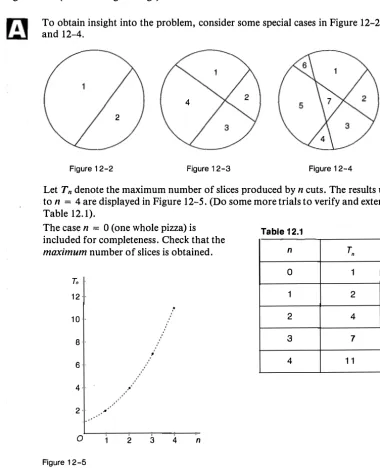
To obtain insight into the problem, consider some special cases in Figure 12-2, 12-3 and 12-4.
4 2
Figure 12-2 Figure 12-3 Figure 12-4
Let Tn denote the maximum number of slices produced by n cuts. The results up
ton = 4 are displayed in Figure 12-5. (Do some more trials to verify and extend Table 12.1).
The case n = 0 (one whole pizza) is included for completeness. Check that the
maximum
number of slices is obtained.Tn
12
.•
10
8
,
6
4 .•
2
..
0 2 3 4 n
Figure 12-5
Table 12.1
n Tn
0 1
1 2
2 4
3 7
4 11
Notes: Let: n
=
0:n
=
1: n=
2:METHODS OF PROOF 391
Tn
=
an2+
bn+
c1 = C • ••••• • •• • ••••••••••••••••••• • •••• • • •••••••••••••••••••••••• • ••••••••••••••••• (1)
2
=
a+
b+
C •••••••••••••••••••••••••••••••••••••••••••••••••••••••••••••••••• (2)4
=
4a+
2b+
C ••••••••••••••••••••••••••••••••••••••••••••••••••••••••••••••• (3) Substituting c=
1 into (2) and (3) gives a+
b=
1 and 4a+
2b=
3.These equations have solutions a
=
b = ½· So: Tn=
½n2+
½n
+
1=
.!(n2+
n
+
2) 2When n
=
4, T4=
½(16+
4+
2) = 11 so the formula checks with n = 4. Other methods of arriving at this formula may be used. For example the quadratic nature may be guessed from the way Tn increases with n. Students who know about finitedifferences will find the method very useful in checking for polynomial behaviour. Our formula remains a conjecture until we can prove that it applies for all values of n. We formulate it as a proposition to be proved by induction.
P(n): Tn
=
½<n2+
n+
2) for all natural numbers n.We must show that (i) P(l) is true and (ii) P(k)---+ P(k + 1), i.e. for all natural numbers k, if Tk
=
½ (k2+
k+
2)thenTk+ 1=
½(k+
1)2+
(k+
1)+
2.Proof:
(i) Starting the procedure with the first cut, we have T 1
=
½ (1 2+
1+
2)=
2so P(l) is true.
(ii) Assume Tk
=
½(k2+
k+
2) fork cuts and consider the effect of the (k+
l)th cut. Beginning from one edge the (k+
1) th cut intersects each of the previousk cuts (producing knew regions) and then extends from the last of the previous cuts to the far edge (producing 1 extra region).
So the (k
+
lfh cut adds (k+
1) new regions.Therefore Tk+ 1
=
Tk+
number of regions produced by the (k+
l)th cut=
½ (k2+
k+
2)+
(k+
1) (assumption)= ½ (k2
+
3k+
4)=
½ [(k+
1)2+
(k+
1)+
2]Therefore P(k) ---+ P(k
+
1 ).By the induction principle, it follows that the maximum number of slices is given by½ (n2
+
n+
2) for all natural numbers n.The value n
=
0 which also satisfies the formula has been set aside in the preceding proof.1 The induction proof was the last step in the problem solving process.
2 We can identify a number of strategies used to make progress with the problem. These strategies have wide applicability and we remind you of these strategies to provide ideas for other problem contexts.
a We represented the problem (drew diagrams of pizzas).
392 METHODS OF PROOF
c We experimented (conducted some trials).
d We introduced symbolism, n, Tn, etc. to describe the trials. e We organised the data (drew up a table).
f We searched for a principle underlying the data (graph of T n versus n).
g We generated a conjecture (formula) from patterns in the data.
h We checked the conjectured formula using another special case.
We proved that the formula was correct, using mathematical induction.
Some more problems for investigation follow. These may be attempted individually but, preferably, some at least should be group investigations.
D
12.9 Logic investigations
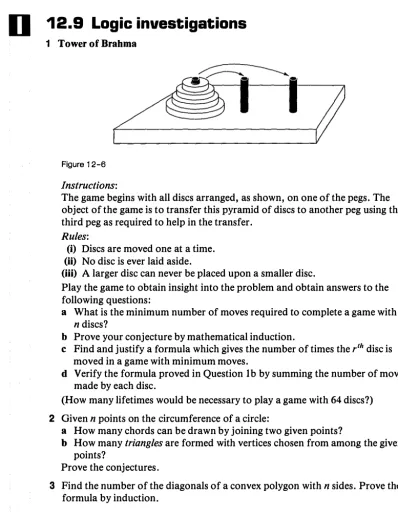
1 Tower of Brahma
Figure 12-6
Instructions:
The game begins with all discs arranged, as shown, on one of the pegs. The object of the game is to transfer this pyramid of discs to another peg using the third peg as required to help in the transfer.
Rules:
(i) Discs are moved one at a time.
(ii) No disc is ever laid aside.
(iii) A larger disc can never be placed upon a smaller disc.
Play the game to obtain insight into the problem and obtain answers to the following questions:
a What is the minimum number of moves required to complete a game with n discs?
b Prove your conjecture by mathematical induction.
c Find and justify a formula which gives the number of times the rth disc is
moved in a game with minimum moves.
d Verify the formula proved in Question 1 b by summing the number of moves made by each disc.
(How many lifetimes would be necessary to play a game with 64 discs?) 2 Given n points on the circumference of a circle:
a How many chords can be drawn by joining two given points?
b How many triangles are formed with vertices chosen from among the given
points?
Prove the conjectures.
3 Find the number of the diagonals of a convex polygon with n sides. Prove th�
METHODS OF PROOF 393
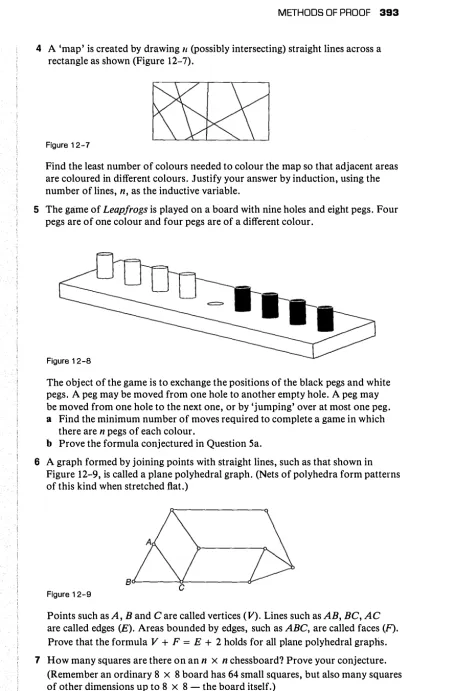
4 A 'map' is created by drawing 11 (possibly intersecting) straight lines across a rectangle as shown (Figure 12-7).
Figure 12-7
Find the least number of colours needed to colour the map so that adjacent areas are coloured in different colours. Justify your answer by induction, using the number of lines, n, as the inductive variable.
5 The game of Leapfrogs is played on a board with nine holes and eight pegs. Four pegs are of one colour and four pegs are of a different colour.
Figure 12-8
The object of the game is to exchange the positions of the black pegs and white pegs. A peg may be moved from one hole to another empty hole. A peg may be moved from one hole to the next one, or by 'jumping' over at most one peg. a Find the minimum number of moves required to complete a game in which
there are n pegs of each colour.
b Prove the formula conjectured in Question Sa.
6 A graph formed by joining points with straight lines, such as that shown in Figure 12-9, is called a plane polyhedral graph. (Nets of polyhedra form patterns of this kind when stretched flat.)
Figure 12-9
Points such as A, Band Care called vertices (V). Lines such as AB, BC, AC are called edges (E). Areas bounded by edges, such as ABC, are called faces (F). Prove that the formula V + F = E + 2 holds for all plane polyhedral graphs. 7 How many squares are there on an
n
xn
chessboard? Prove your conjecture.394 METHODS OF PROOF
[:l
12 .10 Logic projects
Tests of divisibility
A number is divisible by 3 if the sum of the digits is divisible by 3, e.g. 291 is divisible by 3 because the sum of the digits is 12, and 12 is divisible by 3. Consider any three-digit number whose digits are a, band c. It is divisible by 3 if a
+
b+
cis divisible by 3,
i.e. a
+
�
+
c = k where k is a positive integera
+
b+
C = 3k .. .. .. .. .. .. .. .. .. .. .. .. .. .. .. .. .. .. .. .. .. .. .. .. .. .. .. .. (1) The actual number=
100a+
10b+
c (e.g. 291=
2x
100 + 9x
10+
1)=
100a + 10b + 3k - a - b from (1)= 99a
+
9b+
3k=
3(33a+
3b+ k)
and, therefore, is divisible by 3.
Provide a proof for any four-digit number with digitsa, b, c and d or any five digit number with digits a, b, c, d and e.
1 Prove each of the following tests of divisibility. A number is divisible by: a 2, if the last digit is 0 or is divisible by 2
b 4, if the number formed by its last two digits is divisible by 4 c 5, if the last digit is O or 5
d 6, if it is divisible by both 2 and 3
e 8, if the number formed by the last three digits is divisible by 8 f 9, if the sum of its digits is divisible by 9
g 10, if the last digit is 0
h 11, if the sum of the digits in the odd-numbered positions is equal to the sum of the digits in the even-numbered positions or if their difference is 11. 12, if ... }
j 15, if . . . Can you think of any more tests?
Palindromes
Such numbers as 262, 1331, 88, 12421, are called palindromes. They are numbers whose digits appear in the same order whether read forwards or backwards. Write any number; now write it with its digits in reverse order and add this to the original number. Now, reverse the result of the addition and add it to the previous sum. Continue reversing and adding in this manner. Eventually (sometimes after one step) a palindrome is obtained.
Example:
2841 Reverse 1482 Add
--
4323 Reverse 3234METHODS OF PROOF 395
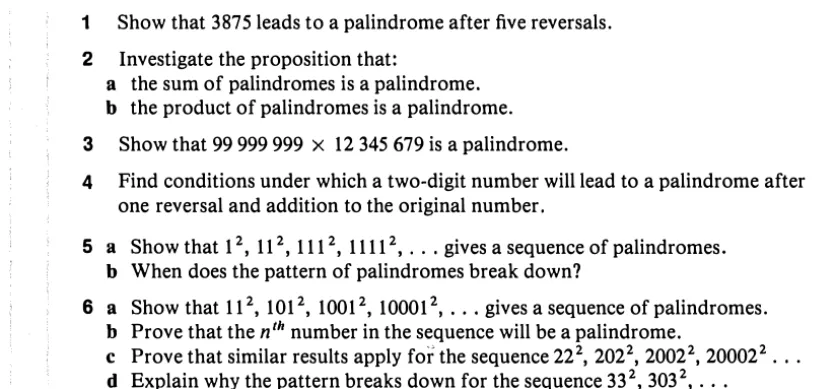
1 Show that 3875 leads to a palindrome after five reversals.
2 Investigate the proposition that:
a the sum of palindromes is a palindrome.
b the product of palindromes is a palindrome.
3 Show that 99 999 999 x 12 345 679 is a palindrome.
4 Find conditions under which a two-digit number will lead to a palindrome after
one reversal and addition to the original number.
5 a Show that 1 2, 11 2, 111 2, 1111 2, • • • gives a sequence of palindromes.
b When does the pattern of palindromes break down?
6 a Show that 11 2, 1 0 1 2, 1001 2, 10001 2
, • • • gives a sequence of palindromes.
b Prove that the nth number in the sequence will be a palindrome.
c Prove that similar results apply for the sequence 222, 2022, 20022, 200022
• • •
d Explain why the pattern breaks down for the sequence 332
, 3032, ...
12.11 Finite differences
In Example 17, we found a quadratic formula by observing the form of the graph in Figure 12-5. We now indicate a systematic method for finding the form of polynomial relationships when they exist.
Consider the quadratic formula an 2 + bn + c and list the values it takes for successive
values of n.
n 2 3 4 5
Value a + b + c 4a + 2b + c 9a + 3b + c 16a + 4b + c 25a + 5b + c
First difference
Second difference
Figure 12-1 O
�/�/�/�/
3a + b 5a + b 7 a + b 9a + b�/�/�/
2a 2a 2aFirst differences are found by subtracting each value from its right-hand neighbour. Second differences are found by applying the same process to the first differences.
Notice that the first differences form an arithmetic progression:
b + 3a, b + 5a, b + 1a, b + 9a
while the second differences (constant) are the common difference of this arithmetic progression.
Working backwards, we see that, when second differences are constant and first differences form an arithmetic progression, we have a quadratic relationship.
If we begin, instead, with the cubic an3 + bn2 + en + d and form first, second, and third
differences we find that second differences form an arithmetic progression and third differences are constant. Check this, and check that the left-hand entries in the 'value' and 'difference' columns are a + b + c + d, 1a + 3b + c, 12a + 2b, and 6a respectively. These results can be very useful in fitting formulae to tables of values.
',
396 METHODS OF PROOF
Example 18
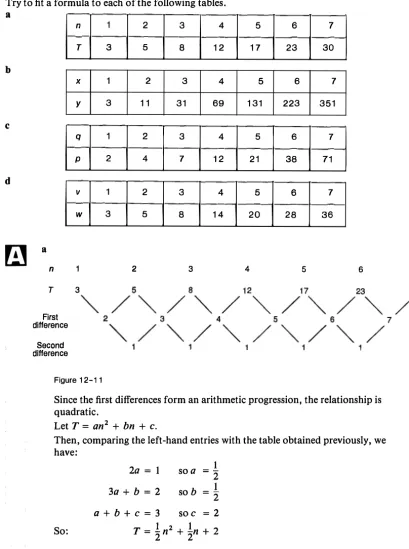
Try to fit a formula to each of the following tables. a
b
C
d
@
an
T
I : I
3I : I : I , : I , : I ,: I
3:
I
X 1 2 3 4 5 6 7
y 3 11 31 69 131 223 351
I : I : I : I : I , : I , � I
3:
I ,: I
I : I : I : I : I , : I ,: I ,: I
3:
I
2 3 4 5
3
6
First difference
Second difference
Figure 12-11
Since the first differences form an arithmetic progression, the relationship is quadratic.
Let
T
=
an
2 +bn
+c.
Then, comparing the left-hand entries with the table obtained previously, we have:
So:
1
2a
=
1 so a=
23a + b
=
2 so b=
12
a + b + C
=
3 SO C=
2T
= .!.n
2 +.!.n
+2
2
2
METHODS OF PROOF 397
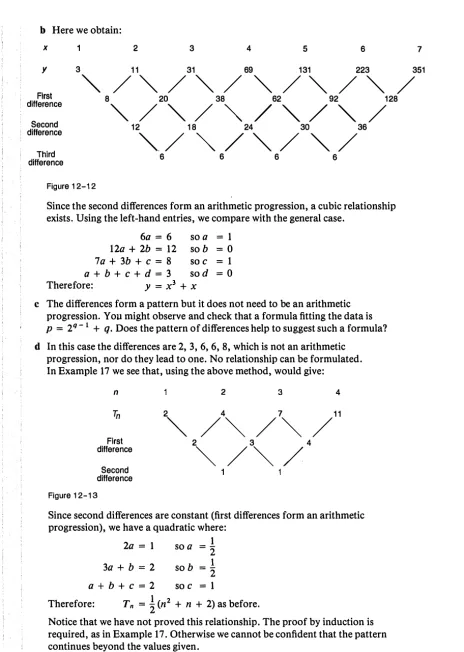
b Here we obtain:
X 2 3 4 5 6 7
y 3 11 31 69 131 223 351
First difference
Second difference
Third difference
"'/"'/"'/ "'/"'/"'
8 20 38 62 92 128/
"'/"'/"'
12 18 24/"'/"'
30 36/
"'·
6/
"'
6/ "'
6/
"'
6/
Figure 12-12Since the second differences form an arithmetic progression, a cubic relationship exists. Using the left-hand entries, we compare with the general case.
6a = 6 so a = 1
12a
+
2b=
12 sob=
0 1a+
3b+
C=
8 SOC=
1 a +b + C + d = 3 SO d = 0Therefore: y = x3 +
x
c The differences form a pattern but it does not need to be an arithmetic progression. You might observe and check that a formula fitting the data is
p
=
2q -1 + q.Does the pattern of differences help to suggest such a formula? d In this case the differences are 2, 3, 6, 6, 8, which is not an arithmeticprogression, nor do they lead to one. No relationship can be formulated. In Example 17 we see that, using the above method, would give:
n
First difference
Second difference
2 3 4
2 4 7 11
�
/�/�/
2 3 4
�/�/
Figure 1 2-13
Since second differences are constant (first differences form an arithmetic progression), we have a quadratic where:
2a = 1 soa =2 1
3a+b=2 sob
=
2 1 a+
b+
C = 2 SO C = 1Therefore: Tn
=
½(n2+
n+
2) as before.Notice that we have not proved this relationship. The proof by induction is required, as in Example 17. Otherwise we cannot be confident that the pattern continues beyond the values given.
398 METHODS OF PROOF
D
12.12 Cheese slicing
Find (and prove) the maximum number of pieces into which a block of cheese can be sliced using plane cuts from surface to surface.
D
12.13 Pizza party
You and 17 other people each bring a pizza to a pizza party. One of the party games is a guessing competition, played as follows:
The pizza brought by person 1 is regarded as whole (I piece). The pizza brought by person 2 is imagined to be divided by one single cut from rim to rim (2 pieces). The pizza brought by person 3 is imagined to be divided by two intersecting cuts from rim to rim (4 pieces). This process continues to the 18th pizza which is imagined to receive 17 cuts.
The competition is to guess the maximum number of pieces produced using all the pizzas.
1 Which of the following numbers would you choose as being the best estimate? 100,500, 1000, 1500,2000.
2 You disappear quietly for a while and come back with an entry you are sure will win (unless someone makes a very lucky guess to share the prize). What number will you choose as your entry?
3 Basking in the glow of success, you say you can even tell how many pieces would be produced if 1000 people were present. What is it?
4 Of course, you have worked out a secret formula to help you. What is the formula?
D
12.14 The twelve days of Christmas
'On the first day of Christmas my true love sent to me, A partridge in a pear tree'
So begins one of the songs so often heard at Christmas time. In examining the full text of the song we find that the 'lucky' person received the following 'new' gifts on each of the 12 days respectively.
Day 1 : 1 partridge in a pear tree Day 2 : 2 turtle doves
Day 3 : 3 french hens Day 4 : 4 calling birds Day 5 : 5 gold rings Day 6 : 6 geese a-laying Day 7 : 7 swans a-swimming Day 8 : 8 maids a-milking Day 9 : 9 ladies dancing
Day 10: 10 drummers drumming Day 11: 11 lords a-leaping Day 12: 12 pipers piping
METHODS OF PROOF 399
1 Remembering that this pattern applies for each of the 12 days, how many separate gifts did this amazing individual receive altogether?
2 Find (and check) a formula that gives the number of new gifts received on the nth day.
3 Find a formula that gives the total number of gifts received up to and including the nth day.
4 Suppose that the person receiving the gifts is still greedy and says that he/ she really would like a total of 816 separate gifts. How many extra 'days of Christmas' would be needed to achieve this? Make up some extra verses to describe the situation.
5 If the whole year (365 days) were to be made one continuous Christmas, how many gifts would the person receive?
12.15 Number patterns
Figurate numbers
The ancient Greeks liked to consider numbers that could be expressed as dots making up basic geometrical patterns. Figures 12-14, 12-15 and 12-16 respectively show the first few triangular, square, and pentagonal numbers.
Triangular numbers
•
3 6 10
Figure 12-14
Square numbers
•
D
5J
I
4 9 16
Figure 12-15
Pentagonal numbers
•
0
5 12 22
400 METHODS OF PROOF
The sequence of triangular figures, consisting of rows of one, two, three and four dots (Figure 1214), was especially revered as it symbolised the four elements -earth, air, fire and water.
1 Sketch the next two figures in each of the respective series of triangular, square, and pentagonal numbers, giving the number of dots in each.
2 Sketch the first few figures that give a sequence of hexagonal numbers.
3 Write the sequence of the first six numbers for each of the four shapes. Verify, using these numbers, that for n :;;;; 6:
a the sum of two successive triangular numbers is a square number.
b the nth pentagonal number is equal to then + 3 x (n - l)th triangular number.
c the nth square number is the arithmetic mean of the nth triangular number and
the nth pentagonal number.
4 Find a formula that gives the nth number in each of the sequences.
5 Find formulae that give the sum of the first n terms of each of the sequences.
6 Assuming that the formulae hold for all values of n, prove the following results. (Tn, Sn, P,, and H,, denote the nth terms of the triangular, square, pentagonal, and hexagonal sequences respectively).
a T n + T,, -1
=
S,,b H,, = 2S,, - n c S,, +,
=
2T,, + n + ld P11+1 = (n+l)+3T,,
7 Write short computer programs that calculate and print out the sum of the first