Reducing OCR Errors in Gothic-Script Documents
Lenz Furrer University of Zurich [email protected]
Martin Volk University of Zurich
Abstract
In order to improve OCR quality in texts originally typeset in Gothic script, we have built an automated correction system which is highly specialized for the given text. Our approach includes external dic-tionary resources as well as information derived from the text itself. The focus lies on testing and improving different meth-ods for classifying words as correct or er-roneous. Also, different techniques are ap-plied to find and rate correction candidates. In addition, we are working on a web ap-plication that enables users to read and edit the digitized text online.
1 Introduction
The State Archive of Zurich currently runs a digi-tization project, aiming to make publicly available online governmental texts in German of almost 200 years. A part of this project comprises the res-olutions by the Zurich Cantonal Government from 1887 to 1902, which are archived as printed vol-umes in the State Archive. These documents are typeset in Gothic script, also known asblackletter or Fraktur, in opposition to the antiqua fonts of modern typesetting. In a cooperation project of the State Archive and the Institute of Computational Linguistics at the University of Zurich, we digitize these texts and prepare them for public online ac-cess.
The tasks of the project are automatic image-to-text conversion (OCR) of the approximately 11,000 pages, the segmentation of the bulk of text into separate resolutions, the annotation of meta-data (such as the date or the archival signature) as well as improving the text quality by automatically correcting OCR errors.
As for OCR, the data are most challenging, since the texts contain not only Gothic type letters –
[image:1.595.310.523.438.650.2]which already lead to a lower accuracy compared to antiqua texts – but also particular words, phrases and even whole paragraphs are printed in anti-qua font (cf. figure 1). Although we are lucky to have an OCR engine capable of processing mixed Gothic and antiqua texts, the alternation of the two fonts still has an impairing effect on the text qual-ity. Since the interspersed antiqua tokens can be very short (e. g. the abbreviationDr.), their divert-ing script is sometimes not recognized by the en-gine. This leads to heavily misrecognized words due to the different shapes of the typefaces; for example antiquaLandrecht(Engl.: “citizenship”) is rendered as completely illegibleI>aii<lreclitt, which is clearly the result of using the inappropri-ate recognition algorithm for Gothic script.
Figure 1: Detail of a session header, followed by two resolutions, in German. The numbered titles as well as Roman numerals are typeset in antiqua letters.
In section 2 we present the OCR system used in the project. The focus of our work lies on section 3, which discusses our efforts in post-correcting OCR
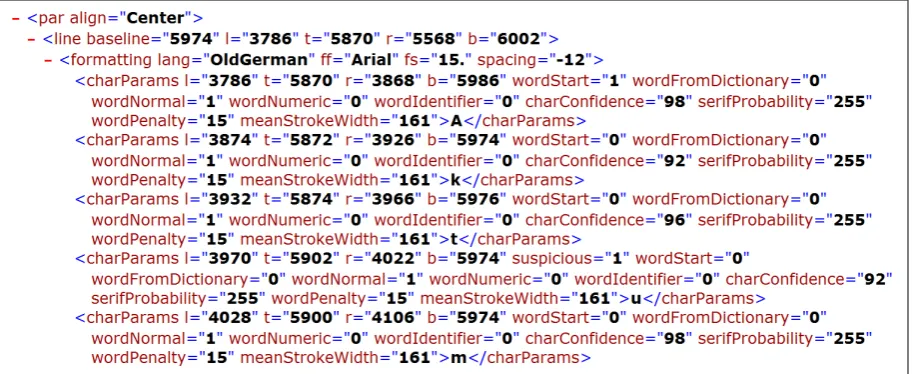
Figure 2: Output XML of Abbyy Recognition Server 3.0, representing the word “Aktum”.
errors. Section 4 is concerned with a web applica-tion.
2 OCR system
We use Abbyy’s Recognition Server 3.0 for OCR. Our main reason to decide in favour of this product was its capability of converting text with both anti-qua and Gothic script. Another great advantage in comparison to Abbyy’s FineReader and other com-mercial OCR software is its detailed XML output file, which contains a lot of information about the recognized text.
Figure 2 shows an excerpt of the XML output. The fragment contains information about the five letters of the word Aktum (here meaning “governmental session”), which corresponds to the first word in figure 1. The first two XML tags,parandline, hold the contents and further information of a paragraph and a line respectively, e. g. we can see that this paragraph’s alignment is centered. Each character is embraced by a
charParams tag that has a series of attributes. The graphical location and dimensions of a letter are described by the four pixel positions l, t, r
and b indicating the left, top, right and bottom borders. The following boolean-value attributes specifie if a character is at a left word boundaries (wordStart), if the word was found in the in-ternal dictionary (wordFromDictionary) and if it is a regular word or rather a number or a punctuation token (wordNormal, wordNumeric,
wordIdentifier). charConfidence has a value between 0 and 100 indicating the recog-nition confidence for this character, while
serifProbability rates its probability of having serifs on a scale from 0 to 255. The fourth character u shows an additional attribute
suspicious, which only appears if it is set to true. It marks characters that are likely to be misrecognized (which is not the case here).
We are pleased with the rich output of the OCR system. Still, we can think of features that could make a happy user even happier. For example, post-correction systems could gain precision if the alternative recognition hypotheses made during OCR were accessible.1 Some of the information provided is not very reliable, such as the attribute “wordFromDictionary” that indicates if a word was found in the internal dictionary: on the one hand, a lot of vocabulary is not covered, whereas on the other, there are misrecognized words that are found in the dictionary (e. g. Bandirektion, which is an OCR error for GermanBaudirektion, Engl.: “building ministry”). While the XML at-tribute “suspicious” (designating spots with low recognition confidence) can be useful, the “char-Confidence” value does not help a lot with locating erroneous word tokens.
An irritating aspect is, that we found the dehy-phenation to be done worse than in the previous engine for Gothic OCR (namely FineReader XIX). Words hyphenated at a line break (e. g.fakul- tative on the fourth line in figure 1) are often split into two halves that are no proper words, thus look-ing up the word parts in its dictionary does not help the OCR engine with deciding for the
cor-1Abbyy’s Fine Reader Software Developer Kit (SDK) is
rect conversion of the characters. Since Abbyy’s systems mark hyphenation with a special charac-ter when it is recognised, one can easily decharac-termine the recall by looking at the output. We encoun-tered the Recognition Server’s recall to be signif-icantly lower than that of FineReader XIX, which is regrettable since it goes along with a higher error rate in hyphenated words.
The Recognition Server provides dictionaries for various languages, including so-called “Old German”.2 In a series of tests the “Old Ger-man” dictionary has shown slightly better results than the Standard German dictionary for our texts. Some, but not all of the regular spelling varia-tions compared to modern orthography are cov-ered by this historical dictionary, e. g. old Ger-manUrtheil(in contrast to modern GermanUrteil, Engl.: “jugdement”) is found in Abbyy’s internal dictionary, whereasreduzirt(modern German re-duziert, Engl.: “reduced”) is not. It is also possi-ble to include a user-defined list of words to im-prove the recognition accuracy. However, when we added a list of geographical terms to the sys-tem and compared the output of before and after, there was hardly any improvement. Although the words from our list were recognized more accu-rately, the overall number of misrecognized words was almost completely compensated by new OCR errors unrelated to the words added.
All in all, Abbyy’s Recognition Server 3.0 serves our purposes of digitizing well, especially in respect of handling large amounts of data and for pipeline processing.
3 Automated Post-Correction
The main emphasis of our project is on the post-correction of recognition errors. Our evaluation of a limited number of text samples yielded a word accuracy of 96.7 %, which means that one word out of 30 contains an error (as e. g.Regieruug in-stead of correctRegierung, Engl.: “government”). We aim to significantly reduce the number of mis-recognized word tokens by identifying them in the OCR output and determining the originally in-tended word with its correct spelling.
In order to correct a maximum of errors in the corpus with the given resources, we decided for
2
The term has not to be confused with the linguistic epoch Old High German, which refers to texts from the first mille-nium A. D. Abbyy’s “Old German” seems to cover some or-thographical variation from the 19th, maybe the 18thcentury.
an automated approach to the post-correction. The great homogeneity of the texts concerning the lay-out as well as the limited variation in orthography are a good premise to achieve remarkable improve-ments. Having in mind the genre of our texts, we followed the idea of generating useful documents ready for reading and resigned from manually cor-recting or even re-keying the complete texts, as did e. g. the projectDeutsches Textarchiv3, which has a very literary, almost artistic standard in digitizing first-edition books from 1780 to 1900.
The task resembles that of a spell-checker as found in modern text processing applications, with two major differences. First, the scale of our text data – with approximately 11 million words we ex-pect more than 300,000 erroneous word forms – does not allow for an interactive approach, asking a human user for feedback on every occurrence of a suspicious word form. Therefore we need an automatic system that can account for correc-tions with high reliability. Second, dating from the late 19th century, the texts show historic or-thography, which differs in many ways from the spelling encountered in modern dictionaries (e. g. historicMittheilungvs. modernMitteilung, Engl.: “message”). This means that using modern dictio-nary resources directly cannot lead to satisfactory results.
Additionally, the governmental resolutions con-tain, typically, many toponymical references, i. e. geographical terms such asSteinach (a stream or place name) or Schwarzenburg (a place name). Many of these are not covered by general-vocabulary dictionaries. We also find regional pe-culiarities, such as pronunciation variants or words that are not common elsewhere in the German spo-ken area, e. g. Hülfstrupp vs. standard German Hilfstruppe, Engl.: “rescue team”. Of course there is also a great amount of genre-specific vocabu-lary, i. e. administrative and legal jargon. We are hence challenged to build a fully-automated cor-rection system with high precision that is aware of historic spelling and regional variants and contains geographical and governmental language.
3.1 Classification
The core task of our correction system with respect to its precision is the classification routine, that determines the correctness of every word. This part is evidently the basis for all correcting steps.
Misclassifications are detrimental, as they can lead to false corrections. At the same time it is also the hardest task, as there are no formal criteria that universally describe orthography. Reynaert (2008) suggests building a corpus-derived lexicon that is mainly based on word frequencies and the distribution of similarly spelled words. However, this is sometimes misleading. For example, saum-selig(Engl.: “dilatory”) is a rare but correct word, which is found only once in the whole corpus, whereasLiegenschast is not correct (in fact, it is misrecognized for Liegenschaft, Engl.: “real es-tate”), but it is found sixteen times in this erroneous form. This shows that the frequency of word forms alone is not a satisfactory indicator to distinguish correct words from OCR errors; other information has to be used as well.
An interesting technique for reducing OCR er-rors is comparing the output of two or more differ-ent OCR systems. The fact that differdiffer-ent systems make different errors is used to localize and cor-rect OCR errors. For example, Volk et al. (2010) achieved improvements in OCR accuracy by com-bining the output of Abbyy FineReader 7 and Om-nipage 17. However, this approach is not applica-ble to our project for the simple reason that there is to our knowledge, for the time being, only one state-of-the-art OCR system that recognizes mixed antiqua / Gothic script text.
The complex problem of correcting historical documents with erroneous tokens is addressed by Reffle (2011) with a two-channel model, which in-tegrates spelling variation and error correction into one algorithm. To cover the unpredictable num-ber of spelling variants of texts with historical or-thography (or rather, depending on their age, texts without orthography), the use of static dictionaries is not reasonable as they would require an enor-mous size. Luckily, the orthography of our corpus is comparatively modern and homogenous, which means that there is a manageable number of devi-ations in comparison to modern spelling and be-tween different parts of the corpus.
In our approach, we use a combination of vari-ous resources for this task, such as a large dictio-nary system for German that covers morphological variation and compounding (such as ging, a past form ofgehen, Engl.: “to go”, or German Nieder-druckdampfsystem, a compound of four segments meaning “low-pressure steam system”), a list of local toponyms (since our texts deal mostly with
events in the administered area) and the recogni-tion confidence values of the OCR engine. Every word is either judged as correct or erroneous ac-cording to the information we gather from the var-ious resources.
The historic and regional spelling deviations are modelled with a set of handwritten rules describ-ing the regular differences. For example, with a rule stating that the sequencethcorresponds totin modern spelling, the old formMittheilungcan be turned into the standard form Mitteilung. While the former word is not found in the dictionary, the derived one is, which allows for the assumption thatMittheilungis a correctly spelled word.
The classification method is applied to single words, which are thus considered as a correct or erroneous form separately and without their origi-nal context. This reduces the number of correction candidates significantly, as not every word is to be handled, but only the set of thedistinctword forms. However, this limits the correction to non-word er-rors, i. e. misrecognized tokens that cannot be in-terpreted as a proper word. For example,Fcueris clearly a non-sense word, which should be spelled Feuer (Engl.: “fire”). In contrast, the two word forms Absatze and Absätze (Engl.: “paragraph”) are two correct morphological variants of the same word, which are often confused during OCR. To decide which one of the two variants is correct in a particular occurrence, the word has to be judged in its original context, which is outside the scope of our project.
recognition confidence.
3.2 Correction
The set of all words recognized as correct words plus their frequency can now serve as a lexicon for correcting erroneous word tokens. This corpus-derived lexicon is by nature highly genre-specific, which is desirable. On the other hand, rare words might remain uncorrected if all of their few occur-rences happen to be misspelled, in which case there will be no correction candidate in the lexicon. Due to the repetitive character of the texts – administra-tive work involves many recurrent issues – there is also a lot of repetition in the vocabulary across the corpus. This increases the chance that a word mis-recognized in one place has a correct occurrence in another.
[image:5.595.305.513.61.225.2]The procedure of finding correction candidates is algorithmically complex, since the orthographi-cal similarity of words is not easily described in a formal way. There is no linear ordering that would group together similar words. In the simplest ap-proach to searching for similar words in a large list, every word has to be compared to every other word, which has quadratic complexity regarding the number of words. In our system we avoid this with two different approaches that are applied sub-sequently. In the first step, only a limited set of character substitutions is performed, whereas the second step allows for a broader range of devia-tions between an erroneous form and its correction.
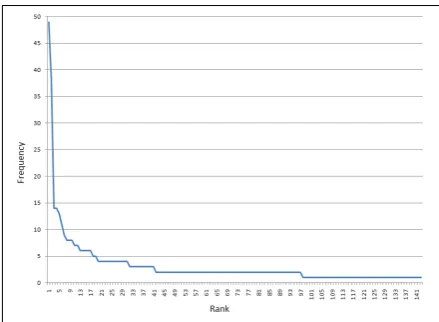
Figure 3: OCR errors ranked by their frequency, from a sample text of approx. 50,000 characters length.
3.2.1 Substitution of similar characters In this approach we attempt to undo the most com-mon OCR errors. When working with
automat-rank frequency {correct}–{recognized}
1 49 {u}–{n}
2 38 {n}–{u}
3 14 {a}–{ä}
4 14 {}–{.}
5 13 {d}–{b}
6 11 {s}–{f}
… … …
140 1 {o}–{p}
141 1 {r}–{?}
142 1 {§}–{8}
143 1 {ä}–{ö}
Table 1: Either ends of a ranked list, showing char-acter errors and their frequency.
Figure 4: Gothic characters of the Schwabacher Frakturthat are frequently confused by the OCR system. From left to right, the characters are:s(in its long form),f,u,n,uorn,B,V,R,N.
ically recognized text, one will inevitably notice that a small set of errors accounts for the majority of misrecognized characters. At character level, OCR errors can be described as substitutions of single characters. Thus, by ranking these error types by their frequency, it can be shown that al-ready a small sample of OCR errors resembles Zip-fian distribution,4 as is demonstrated in figure 3. For example, the 20 most frequent types of errors, which is less than 14 % of the 143 types encoun-tered, sum up to 50 % of all occurrences of char-acter errors. Table 1 shows the head of this error list as well as its tail. Among the top 6 we find pairs likeu andn that are also often confounded when recognizing antiqua text as well as typical Gothic-script confusions liked–bors–f. Figure 4 illustrates the optical similarity of certain charac-ters that can also challenge the human eye. For ex-ample, due to its improper printing, the fifth letter cannot be determined clearly asuorn.
For our correction system we use a manually edited substitution table that is based on these ob-servations. The substitution pairs are inverted and used as replacement operations that are applied to the misspelled word forms. The spelling
vari-4Zipf’s Law states that, given a large corpus of natural
[image:5.595.71.291.489.650.2]ants produced are then searched for correct words that can be found in our dictionary. For example, given an erroneous tokensprechcnand a substitu-tion paire, cstating that recognizedccan represent actual e, the system produces the variants spree-hcn,sprechenandspreehen. Consulting the dictio-nary finally uncoverssprechen(Engl.: “to speak”) as a correct word, suggesting it as a correction for garbledsprechcn.
3.2.2 Searching shared trigrams
In a second step, we look for similar words more generally. This is applied to the erroneous words that could not be corrected by the method de-scribed above. There are various techniques to efficiently find similar words in large mounds of data, such as Reynaert’s (2005) anagram hashing method, that treats words as multisets of words and models edit operations as arithmetic functions. Mihov and Schulz (2004) combine finite-state au-tomata with filtering methods that include a-tergo dictionaries.
In our approach, we use character n-grams to find similar correct words for each of the erroneous words. Since many of the corrections with a close editing distance have already been found in the previous step, we have to look for corrections in a wider spectrum now. In order to reduce the search space, we create an index of trigrams that points to the lexicon entries. Every word in the lexicon is split into overlapping sequences of three charac-ters, which are then stored in a hashed data struc-ture. For example, fromersten(Engl.: “first”) we get the four trigrams ers, rst, ste and ten. Each trigram is used as a key that points to a list of all words containing this three-letter sequence, soten not only leads toersten, but also towarten(Engl.: “wait”) and many other words with the substring ten.
Likewise, all trigrams are derived from each er-roneous word form. All lexicon entries that share at least one trigram with the word in question can thus be accessed by the trigram index. The lexicon entries found are now ranked by the number of tri-grams shared with the error word. To stay with the previous example, a misrecognized word form rrsten5has three trigrams (rst,ste,ten) in common
5The correction pairersten–rrstenis not found in the first
step although its editing distance is 1 and thus minimal. But since the error {e}–{r} has a low frequency, it is not con-tained in the substitution table, which makes this correction invisible for the common-error routine.
with ersten, but only one trigram (ten) is shared withwarten.
The correction candidates found with this method are further challenged, e. g. by using the Levenshtein distance as a similarity measure and by rejecting corrections that affect the ending of a word.6
3.3 Evaluation
In order to measure the effect of the correction system, we manually corrected a random sample of 100 resolutions (approximately 35,000 word to-kens). Using the ISRI OCR-Evaluation Frontiers Toolkit (Rice, 1996), we determined the recogni-tion accuracy before and after the correcrecogni-tion step. As can be seen in table 2, the text quality in terms of word accuracy could be improved from 96.72 % to 98.36 %, which means that the total number of misrecognized words was reduced by half.
4 Crowd Correction
Inspired by the Australian Newspaper Digitisation Program (Holley, 2009) and their online crowd-correction system, we are setting up an online ap-plication. We are working on a tool that allows for browsing through the corpus and reading the text in a synoptical view of both the recognized plain text and a scan image of the original printed page. Our online readers will have the possibility to immedi-ately correct errors in the recognized text by click-ing a word token for editclick-ing. The original word in the scan image is highlighted for convenience of the user, which permits fast comparison of image and text, so the intended spelling of a word can be verified quickly.
Crowd correction combines easy access of the historic documents with manual correcting. Simi-lar to the concept of publicly maintained services as Wikipedia and its followers, information is pro-vided free of charge. At the same time, the user has the possibility to give something back by
im-6
plain (errors) corrected (errors) improvement character accuracy 99.09 % (2428) 99.39 % (1622) 33.2 % word accuracy 96.72 % (1165) 98.36 % (584) 49.9 %
Table 2: Evaluation results of the automated correction system.
proving the quality of the corpus. It is important to keep the technical barrier low, so that new users can start correcting straight away without needing to learn a new formalism. With our click-and-type tool the access is easy and intuitive. However, in consequence, the scope of the editing operations is limited to word level, it does not, for example, allow for rewriting whole passages.
5 Conclusion
With this project we demonstrate how to build a highly specialized correction system for a spe-cific text collection. We are using both general and specific resources, while the approach as a whole is widely generalizable. Of course, work-ing with older texts with less standardized orthog-raphy than late 19thcentury governmental resolu-tions may lead to a lower improvement, but the techniques we applied are not bound to a cer-tain epoch. In the crowd correction approach we see the possibility to further improve OCR output in combination with online access of the historic texts.
References
Rose Holley. 2009.How Good Can It Get? Analysing
and Improving OCR Accuracy in Large Scale His-toric Newspaper Digitisation Programs. D-Lib Magazine, 15(3/4).
Stoyan Mihov and Klaus U. Schulz. 2004. Fast
Ap-proximate Search in Large Dictionaries. Computa-tional Linguistics 30(4):451–477.
Ulrich Reffle. 2011. Efficiently generating
cor-rection suggestions for garbled tokens of histor-ical language. Natural Language Engineering 17(2):265–282.
Martin Reynaert. 2005. Text-Induced Spelling
Correc-tion. Ph. D. thesis, Tilburg Universtiy, Tilburg, NL.
Martin Reynaert. 2008. Non-Interactive OCR
Post-Correction for Giga-Scale Digitization Projects. Proceedings of the Computational Linguistics and Intelligent Text Processing 9thInternational Confer-ence, CICLing 2008 Berlin, 617–630.
Stephen V. Rice. 1996. Measuring the Accuracy of
Page-Reading Systems. Ph. D. dissertation, Univer-sity of Nevada, Las Vegas, NV.
Martin Volk, Torsten Marek, and Rico Sennrich. 2010.
Reducing OCR Errors by Combining Two OCR
Sys-tems. ECAI 2010 Workshop on Language