Volume 2008, Article ID 597072,14pages doi:10.1155/2008/597072
Research Article
Feedback Reduction in Uplink MIMO OFDM Systems
by Chunk Optimization
Eduard Jorswieck,1Aydin Sezgin,2Bj ¨orn Ottersten,1and Arogyaswami Paulraj2
1ACCESS Linnaeus Center, Electrical Engineering, KTH - Royal Institute of Technology, 100 44 Stockholm, Sweden 2Information Systems Laboratory, Stanford University, CA 94305, USA
Correspondence should be addressed to Eduard Jorswieck,[email protected]
Received 12 June 2007; Revised 12 September 2007; Accepted 19 November 2007
Recommended by Ana P´erez-Neira
The performance of multiuser MIMO systems can be significantly increased by channel-aware scheduling and signal processing at the transmitters based on channel state information. In the multipleantenna uplink multicarrier scenario, the base station de-cides centrally on the optimal signal processing and spectral power allocation as well as scheduling. An interesting challenge is the reduction of the overhead in order to inform the mobiles about their transmit strategies. In this work, we propose to reduce the feedback by chunk processing and quantization. We maximize the weighted sum rate of a MIMO OFDM MAC under individual power constraints and chunk size constraints. An efficient iterative algorithm is developed and convergence is proved. The feed-back overhead as a function of the chunk size is considered in the rate computation and the optimal chunk size is determined by numerical simulations for various channel models. Finally, the issues of finite modulation and coding schemes as well as quanti-zation of the precoding matrices are addressed.
Copyright © 2008 Eduard Jorswieck et al. This is an open access article distributed under the Creative Commons Attribution License, which permits unrestricted use, distribution, and reproduction in any medium, provided the original work is properly cited.
1. INTRODUCTION
The exploitation of channel state information (CSI) at the transmitter in wireless systems has been a highly active re-search area. This transmit CSI can significantly improve the performance and reliability of multiple antenna single-user as well as multiuser systems [1–3]. Utilizing this information effectively is one of the major challenges in future mobile communication systems like, for example, WiMAX. Multi-ple input multiMulti-ple output (MIMO) multiMulti-ple access channels (MAC) and broadcast channels (BC) utilizing cyclic prefix orthogonal frequency division multiplexing (CP-OFDM) are a central part of WiMAX. Thus optimal transmit strategies that optimize the performance of such systems were pro-posed in [4–7].
Until recently, a lot of attention was given to single-user MIMO systems, which is changing nowadays. The paradigm shift from single-user MIMO to multiuser MIMO is high-lighted in [8,9]. Most recent work on multiuser sytems con-centrates on the BC, that is, the downlink. Recently, the weighted sum rate optimization is studied for flat-fading MIMO systems in [10] and the extension to MIMO OFDM
is developed in [11]. An overview of different linear precod-ing schemes for the MIMO BC is given in [12]. The ques-tion about the amount of feedback has been raised for the BC in [13]. Regarding the uplink channel, finite rate feed-back is studied in [14] for the multiple-antenna case, and the average throughput is analyzed in [15].
Depending on the system under consideration, either perfect CSI or long-term CSI is assumed to be available at the transmitter in order to derive the optimal precoding strategy. Under perfect [4,16,17] and long-term CSI [18,19], the op-timal linear precoding matrices are found at the central base station by convex optimization. Then the linear precoding matrices can be applied to up- and downlink by the duality theory [20,21]. With imperfect CSI at the transmitter, the duality theory does not hold any longer [22].
Fre
q
u
en
cy
Time Chunk
Spac e
MS
MS
MS
BS
Figure1: Multiuser OFDM MIMO MAC with chunk processing.
In MIMO OFDM systems, this control overhead and sig-nal processing complexity are quite large, leading to the def-inition of the so-called time-frequency tiles or chunks [23]. To this end, the physical channel structure divides the avail-able time-frequency resources into tiles. The tiles or chunks are considered two dimensional, and each chunk comprises a number of adjacent subcarriers in frequency domain and a number of consecutive OFDM symbols in time domain as illustrated inFigure 1. The application of chunks is wide spread and it is proposed, for example, in [23] for multi-ple antenna systems. For all subcarriers and all OFDM sym-bols within the chunk, the same spatial signal processing is applied, reducing the signal processing complexity and the feedback overhead considerably.
In the single input single output (SISO) case, the power and rate control in each chunk has to be optimized and the performance decreases as the chunk size increases. Numeri-cal evidence of this fact has been provided in [24]. Whereas in the MIMO case, the spatial signal processing, that is, the linear precoding has to be optimized per chunk. If the chan-nel is flat within one chunk, the original optimization for the single carrier case can be reused. However, it turns out that the MIMO channel matrices within one chunk vary even at small chunk sizes. This motivates the detailed analysis.
In this paper, the following contributions are made to the problem of resource allocation in OFDM-SDMAW(We call this technique OFDM-SDMA because multiple users can be allocated simultaneously to different chunks over time and frequency domains.) uplink systems under limited feedback.
(1) We formulate the weighted sum rate maximization un-der individual power constraints and unun-der the as-sumption that only one linear precoding matrix per chunk is fedback.
(2) The programming problem is solved by an efficient iterative algorithm based on an inner fix-point algo-rithm and outer iterative water filling. The conver-gence of the proposed algorithm is proved.
(3) The tradeoffbetween performance and feedback over-head is analyzed by formulating an effective transmis-sion rate that takes the amount of feedback directly into account.
(4) The effective transmission rate is illustrated for diff er-ent channel models (ideal, IEEE 802.11n [25], WIM2 [26]).
(5) Finally, the framework is extended to cope with finite modulation and coding schemes as well as finite quan-tization of the linear precoding matrices.
The first part of the paper restricts itself to the weighted sum rate maximization under chunk constraints. The sys-tem model, the limited feedback model, and the problem statements are described inSection 2. InSection 3, the opti-mization theoretic framework is developed and convergence proved. This is done first for the single-user case and then for the multiuser scenario. The implication of the results on the MIMO-OFDM MAC system design is discussed with re-spect to limited feedback, limited modulation and coding schemes (MCS), and quantized linear precoding inSection 4.
In Section 5, numerical results illustrate the performance.
The paper is concluded inSection 6and further application and open problems are discussed. The appendices contain the proofs.
1.1. Notation and symbols
Vectors are denoted by boldface small lettersa,b, and matri-ces by boldface capital lettersA,B.AT,AH, andA−1are the
transpose, the conjugate transpose, and the inverse matrix operation, respectively. The identity matrix isI, and1is the vector with all ones.A1/2is the square root matrix ofAand
[A]j,kdenotes the entry in thejth row and thekth column of
A. The expectation is denoted byE.
We will use the following symbols:Nis the number of carriers;Bis the chunk size. Therefore, there areM =N/B chunks. The transmit power constraint of userkisPk. The channel matrix of userkon carriernis given byHk,n. The transmit covariance matrix of userkon chunkmis given by
Qk,m. The inverse noise power isρ. The weight of userkto
compute the weighted sum rate is given bywk.
2. SYSTEM MODEL AND PRELIMINARIES
In this section, we introduce the MIMO MAC OFDM model. Since we operate in frequency-selective fading, there are two dimensions for resource allocation available, namely the spa-tial domain (multiple antennas) and the spectral domain (multiple carriers). To address the two dimensions, we apply linear (over space) precoders for each carrier. At the receiver, on each carrier, MMSE-successive interference cancellation (SIC) is applied.
The feedback limitation introduces blocks of carriers which are precoded with identical linear precoding matrices. We will call those blocks chunks. This additional constraint reduces the feedback overhead and signal processing com-plexity.
IDFT CP
IDFT CP
IDFT CP Q1k/,12
Q1/2 k,2
Q1/2 k,N
xk,1
xk,2
xk,N
S P
S P
S P
Linear precoding
dk,1
dk,2
dk,N
. . .
Userk
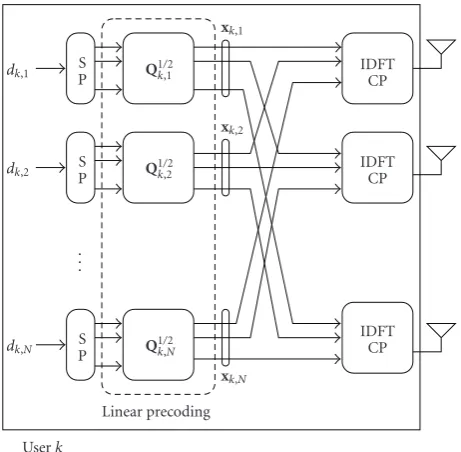
Figure2: Transmitter processing for uplink MIMO OFDM system of userk.
Q1
Q2
Q3
QN/B
N B
B
B
B
Figure3
2.1. Uplink MIMO OFDM system
Consider an ideal multiuser MIMO CP-OFDM system with Kusers,Ncarriers,Ltaps,nT transmit antennas,nRreceive antennas. Let us focus on the multiple access scenario (up-link). The transmit processing at the kth user is shown in
Figure 2.
TheNdata streamsdk,1,. . .,dk,N of userkare serial par-allel converted and linear precoded byQ1k/,12,. . .,Q1k/,N2. Note that the number of parallel data streams depend on the rank of the transmit covariance matrixQ1k/,n2. Next, theNtimesnT outputs of the linear precoder are processed in front of each transmit antenna by an IDFT and a cyclic prefix is added (CP-OFDM). Then one OFDM symbol per antenna is trans-mitted simultaneously.
The received signal on carrier 1 ≤ n ≤ N at the base station is given by
yn=
K
k=1
Hk,nxk,n+nn, (1)
whereHk,nis the flat-fading channel matrix of user 1≤k≤ Kon carriern,xk,nis the transmit vector of userkon carrier n, andnnis the white Gaussian noise with varianceσ2n=1/ρ on carriern. The individual transmit power constraint for userkisNn=1E[xk,nxHk,n]≤Pk. The base station is assumed to apply an MMSE frontend per spatial stream combined with SIC. This receiver architecture is shown to be informa-tion lossless in [27, Section 8.3.4].
2.2. Limited feedback
The control unit at the base station takes queueing infor-mation as well as physical layer inforinfor-mation into account and provides a set of linear precoding strategies for all users. Different scheduling strategies are possible ranging from throughput-oriented scheduling, which is also a subject of the current paper, to stability-based approaches [28]. Since the CSI of all users is necessary for the decision, the central-ized approach leads to a base station that informs the users about their transmit strategies by feedback. We assume that the coherence timeTin channel uses is large enough to in-form the mobiles on transmit strategies for the current chan-nel state.
In order to reduce the amount of feedback required to inform every user on every carrier about the linear precod-ing matrix, a number ofBcarriers is assigned the same lin-ear precoding matrixQb(seeFigure 3). The total number of carriersN is divided into chunks of size B. Each chunk of sizeBis processed with the same precoding matrixQb. Thus the number of precoding matrices is reduced by a factor ofB fromNtoM=N/B. Note thatBdoes not necessarily corre-spond to the coherence bandwidth of the channel.
Obviously, there is a tradeoff between the amount of feedback and the system performance. The larger B is the less feedback information is required the poorer the system performance will be. The smallerBis the more feedback in-formation is required and the better is the nominal system performance.
2.3. Problem statements
The main question that is answered in this paper is motivated in the previous section: what is the optimal transmit strat-egy and what is the optimal chunk size that maximizes the net throughput?The detailed questions about the impact of the load (number of userK, number of antennasnT), the impact of the fairness (maximum throughput scheduler, weighted sum rate), and the impact of the channel model, and the user distribution follow immediately.
[16]. ForN ≥ B > 1, even the single-user case leads to an optimization problem that cannot be solved in closed form. The following single-user single-chunk problem is the build-ing block that is needed to develop the solution for the mul-tiuser multiple-chunk optimization (In this work, the objec-tive function is always the mutual information with Gaus-sian code books, except inSection 4.3in which finite MCS are studied.),
max Q
B
b=1 cb
log detZb+HbQHHb
−log detZb
s.t.Q0, tr (Q)≤P. (2)
The coefficientsc1,. . .,cBare nonnegative real numbers and they will be defined below. The operational meaning of the positive definite matrixZbwill be the spatial noise plus in-terference covariance matrix,Hb will be identified with the MIMO channels within one chunk,Qis the transmit covari-ance matrix, andPis the sum transmit power constraint.
Next, the spectral power allocation and the multiuser weighted-sum rate problem is incorporated. Let the weights w1,. . .,wK be ordered in decreasing order, that is, w1 ≥ w2 ≥ · · · ≥ wK ≥ 0. We arrive at the following opti-mization problem: maximize the weighted-sum rate of the K-user MIMON-carrier OFDM uplink with chunk sizeB and weightsw1,. . .,wK,
max Q1,1,...,QK,M
M
m=1
B
b=1
K
k=1
wk−wk+1
ck
×log det
I+ρ
k
j=1
Hj,m,bQj,mHHj,m,b
s.t.Qk,m0, 1≤m≤M, M
m=1
tr (Qk,m)≤Pk, 1≤k≤K,
(3)
whereHj,m,bdenotes the channel matrix of user jin thebth carrier of chunkm. The optimal SIC orders were used [29, Proposition 2]. The individual power constraint of userkis Pk.ρis the inverse noise variance defined inSection 2.1. The coefficientsckin (2) are defined asck =wk−wk+1and thus
are nonnegative. We setwK+1=0.
The advantage of the optimization problem in (3) is that the objective function is jointly concave with respect to the tuple (Q1,1,. . .,QK,M), the constraint set is convex, and
there-fore the programming problem itself is convex. Due to the large number of optimization variables, the direct solution using standard convex optimization tools [30, 31] is not practically feasible. It is also not possible to solve (3) in closed form, however, we will develop an iterative algorithm that solves the problem efficiently even for high numbers of users, carriers, and antennas.
3. OPTIMIZATION THEORETIC RESULTS AND ALGORITHM DEVELOPMENT
In this section, we solve the theoretical problem statements from the last section. We will show that the multiuser prob-lem (3) can be solved by iteratively solving single-user prob-lems. Therefore, we start with the single-user problem first and develop an iterative algorithm. The convergence proof can be found in the appendix.
For the multiuser problem, the SIC decoding order is im-portant. Fortunately, the optimal order depends only on the weights of the users (as in the nonchunk single-carrier case). Based on the single-user algorithm, we develop the multiuser algorithm.
3.1. Optimal single-user chunk processing
The single-user single-chunk case is the basic element of the iterative algorithm that is developed later for the overall mul-tiuser problem solution. Therefore, we study this problem first.
Consider the following simple setup. TheBparallel data stream vectorsd1,. . .,dBof one chunk are linearly precoded by the same linear precoding matrixQ1/2and then multiplied
by different MIMO flat-fading channel matricesH1,. . .,HB to obtain
yb=HbQ1/2db+nb, for 1≤b≤B. (4)
The same positive semidefinite transmit covariance matrixQ
has to be used for all channels within one chunk.
Let the input vectors be independently zero-mean com-plex Gaussian distributed with identity covariance, that is,
dk∼CN(0,I) and the noise vectors are independently zero-mean complex Gaussian distributed with covarianceZb, that is, nb∼CN(0,Zb). The weighted mutual information be-tween input and output of the system is given by
Ψ(Q)= B
b=1 cbI
db;yb
= B
b=1
cblog det
Zb+HbQHHb
−cblog det
Zb
.
(5)
Result: Solve optimization problem (7)
Input: Channel realizationH1,1,. . .,HM,Band power constraintP >0 initialization: for all 1≤m≤M:Q0
m=0,Q1m=(P/M·nT)I, and set=1; While(Mm=1Ψ(Qm))−(
M
m=1Ψ(Qm−1))>do
=+ 1;
Q
m=Qm−1(1/2)Ψ(Qm−1)Qm−1(1/2)for all 1≤m≤M;
μ=M
m=1tr (Qm); Q
m=(P/MnTμ)Qmfor all 1≤m≤M; end
output: Optimal set of transmit covariance matricesQ1,. . .,QM
Algorithm1: Single-user optimal MIMO OFDM chunk processing.
Theorem 1. Let the start point beQ0=(P/n
T)I. The update
rule
Q+1= P
B b=1cb
I−Z−b1/2Zb+HbQHHb −1
Z−b1/2
trBb=1cb
I−Z−b1/2Zb+HbQHHb −1
Z−b1/2
(6)
converges to the optimalQ∗and solves optimization problem
(2).
The proof can be found inAppendix A. Note that the fixed point iteration in (6) has only linear convergence [35] and any Newton style algorithm has local super-linear con-vergence. However, the update rule in (6) is further refined to include spectral power allocation. If a Newton style algo-rithm is used, this extension is not directly possible.
Before the complete multiuser algorithm is developed, we consider the case in which multiple M = N/B chunks are jointly optimized under a sum power constraint M
m=1tr (Qm) ≤ P. This corresponds to the single-user
MIMO OFDM case. The optimization problem reads
max Q1,...,QM
M
m=1
B
b=1 cb
log detZm,b+Hm,bQmHHm,b
−log detZm,b
Qm0, 1≤m≤M,
M
m=1
trQm
≤P
(7)
and the spectral power allocation corresponds to water fill-ing. The naive approach is to alternate between covariance matrix optimization and spectral power allocation because the problem is jointly concave in the chunk powers and the chunk covariance matrices. However, this approach con-verges usually very slow.
For the case in whichB > 1 we develop an efficient al-gorithm that merges the spectral power allocation in the up-date rule fromTheorem 1. The algorithm was presented for c1=c2= · · · =cB=1 andZ1=Z2= · · · =ZB=σ2nIin [33]. In the following, lemma an iterative algorithm is pro-posed which solves (7).
Lemma 1. Algorithm 1solves the optimization problem(7).
The proof can be found inAppendix B. The functionΨis defined in (5). The convergence rate ofAlgorithm 1is illus-trated inFigure 4where=10−3is used. InFigure 4, it can be observed that for larger chunk sizes the convergence rate is faster because the objective function is lower and there are less optimization variables. This fast convergence is a manda-tory prerequisite to embedAlgorithm 1in the iterative water-filling algorithm for weighted sum rate optimization in the next section.
3.2. Multiuser chunk processing: weighted sum capacity
In the multiuser setting, we study the uplink scenario with SIC at the base and solve the optimization problem
max Q1,1,...,QK,M
K
k=1 wk
M
m=1 Rk,m
s.t.Qk,m0, 1≤m≤M, M
m=1
trQk,m
≤Pk, 1≤k≤K,
(8)
whereRk,mis the mutual information by userkin chunkm. The individual achievable rates depend on the SIC order. Ref-erence [29, Proposition 2] shows that the optimal decoding orderπ satisfieswπ1 ≥wπ2 ≥ · · · ≥ wπK ≥0. By
insert-ing the optimal decodinsert-ing order into (8) and collecting two succeeding terms in the sum, we obtain the programming problem in (3).
O
b
jecti
ve
functio
n
18 20 22 24 26 28 30
0 20 40 60 80 100
Iteration step
B=16
B=32
B=64
Figure4: Convergence rate of single-user MIMO OFDM chunk op-timization withnT=2,nR=2,N =1024 and different chunk sizes
for ideal iid Rayleigh fading channel model.
standard iterative water filing [16] is the single-user step and the additional spectral power allocation.
Algorithm 2 first initializes the covariance matrices to
identity matrices. Next, for all users the single-user multi-carrier chunk optimization fromAlgorithm 1is performed. Since the objective function is increasing in each step and there is a unique global optimum, the algorithm converges to the optimum. The formal proof is similar to the proof in [29, Proposition 7] and is therefore omitted. The general condi-tions for convergence and the convergence speed of the alter-nating optimization approach are given in [36, Theorems 2 and 3].
4. SYSTEM DESIGN AND OPTIMAL CHUNK SIZE
In this section, we use the developed algorithm to show how practical limitations, namely, quantization and finite mod-ulation and coding schemes (MCS) can be incorporated. Furthermore, the performance measure is introduced which takes the feedback overhead into account. Later simulations will all be based on this net throughput.
The control unit decides on transmit strategies, that is, linear precoding matrices Q1,1,. . .,QK,N, modulation, and coding for each user at each carrier. Feedback from base to mobile is required. A full rankQk hasn2T complex entries, however it can be reduced tonT + (nT −1)·nT = n2T real entries since the matrix is Hermitian. Thus, the worst case feedback (η=nT) from base to mobiles areK·N·n2Treal val-ues. By applying different chunk sizes, the feedback overhead and signal processing complexity can be decreased, reducing thereby the performance of the system.
In this section, a measure for the effective overall trans-mission rate is derived. Furthermore, several practical aspects as quantization of the linear precoding matrices and MCS are discussed.
4.1. Net throughput
Following the feedback computation above, the amount of feedback as a function of the number of transmit antennas nT, the number of usersK, the quantizationq, the coherence timeT, the number of carriersN, the chunk sizeB, and feed-back channel data rateRdis defined by
α= N·K·ζ
B·Rd·T
(9)
withζas the number of feedback bits for one transmit co-variance matrix. As an example, assume a scalar quantiza-tion and an 8-bit quantizaquantiza-tion per real value. This leads to ζ = n2
TqandK·N·n2T·8 bits feedback. Consider for exam-pleK = 10,N = 1024,nT =2. Then 320 Kbits per coher-ence time (or per frame) are necessary. Further on, the signal processing at transmitter needsN multiplications of trans-mit data block withnT×nTmatrices. Assume a feedback rate Rd=320 bits per channel use andT=500 channel uses. The resulting feedback amount in (9) is given byα=0.002N/B.
In our approach, the control overhead reduces the trans-mission rateRto the effective transmission rateRe,
Re,1=R(1−α)=R
1− N·K·ζ
B·Rd·T
. (10)
This approach considers only the uplink and the feedback reduces the transmission rate directly.
As in other communications systems, there are complex tradeoffs between design parameters and performance in multiuser MIMO OFDM MAC. In (10), there are two trade-offs. The first is with respect to the chunk sizeB. The larger B, the worse is the performance but the smaller is also the feedback overhead. The second tradeoffis with respect to the quantization level q. The largerq, the better is the perfor-mance because the linear precoding matrices are represented better, but the higher is also the feedback overhead.
4.2. Quantized linear precoding
In [37], methods and performance results of quantized feed-back approaches for multiple antenna channels are described and compared. A concrete vector quantization scheme based on Grassmannian subspace packing is proposed in [38] for single-user beamforming without power allocation. In the multiuser setting, it often happens (see multiuser illustra-tions inFigure 9) that only a small number of streams with different powers are allocated. Therefore, the Grassmannian subspace packing can be extended with a rough quantization of the power allocation to arrive at a full transmit covariance matrix. The channel optimized covariance matrix quantiza-tion is beyond the scope of this paper.
In the effective rate definition (10), q is the quantiza-tion level of every real number that is needed to parame-terize the channel covariance matrix. In the worst case,n2Tq bits are needed, that is, one transmit covariance matrixQ
is described byn2
Result: Solve optimization problem (3)
Input: Channel realizationsH1,1,1,. . .,HK,M,Band power constraintsPk>0 for
1≤k≤K
initialization: for all 1≤m≤Mand 1≤k≤K:Q0
k,m=0,Q1k,m=(Pk/M·nT)I, and set=1;
WhileM m=1
K k=1
B
b=1(wk−wk+1) log (det (I+ρ
k
j=1Hj,m,bQj,mHHj,m,b)/det (I+ρ
k
j=1Hj,m,bQj,−m1HHj,m,b))>do
=+ 1;
For 1≤k≤K, 1≤m≤MsetQ
k,m=Qk−,m1; fork=1,. . .,Kdo
{Q
k,1,. . .,Qk,B} =arg maxQ1,...,QM K
j=k(wj−wj+1)
M m=1
B
b=1log det (I+ρ
j
l=1,j =kHl,m,bQj,mHHl,m,b+ρHk,m,bQmHHk,m,b)
s.t.Qm0, 1≤m≤Mand
M
m=1tr (Qm)≤PkbyAlgorithm 1; end
end
Output: Optimal set of transmit covariance matricesQ1,1,. . .,QK,M
Algorithm2: Multiple user optimal MIMO OFDM chunk processing.
[7,39]. We use (nT−1)qbits for the power quantization and the remaining bits for beamformer quantization.
Consider, for example, the case in which the mobiles have two transmit antennas andq =8, we generate 16 777 216 random vectors for beamforming quantization. The two eigenvalues of the covariance matrix corresponding to the power allocation are uniformly quantized according to 16 levels between 0 and the maximum transmit power.
4.3. Modulation and coding schemes
In the ideal simulations, the mobiles use independent Gaus-sian code books. However, in practice finite modulation and coding schemes are employed. These limitations influence the resource allocation and limit the performance of a sin-gle stream. In order to show the impact of finite modula-tion and coding schemes (MCS), we present also results with respect to the MCS shown in Figure 5. At high SNR, the maximum achievable rate is bounded by 4.5 bit/s (64-QAM with code rate 3/4). The MCS used inFigure 5are defined in [40].
The conversion from the rates achievable with Gaussian code books to finite MCS works via the SINR values of the individual data streams. The receiver applies the optimum combining (OC) method [41]. Hence, the SINR for data stream sof userk in chunkb on carrier θ is given by(We omit the indicesbandθfor convenience.)
SINRk,s=hHk,s
t =s
hk,thHk,t+Zk −1
hk,s (11)
with effective channel after precodinghk,s=HkQ1k/,s2, where
Q1k/,s2=vk,sp1k/,s2is the beamforming vectorvk,sand power al-locationpk,sof userkand streamsand with noise plus mul-tiple access interference after SIC (For sum rate optimiza-tion the SIC order is arbitrary. For weighted-sum rate
op-A
ver
age
rat
e
(bit/s)
0 1 2 3 4 5 6 7
−5 0 5 10 15 20
SNR (dB) Gaussian code-book Finite MCS
Modulation and coding schemes (MCS)
Figure5: Average rate versus SNR for Gaussian code-book and for finite modulation and coding schemes.
timization, we assume that the users are ordered according tow1≥w2≥ · · · ≥wK≥0.),
Zk=
K
l=k+1
HlQlHHl +σ2nI. (12)
As it can be seen inFigure 5, the difference between the rates achievable with finite MCS and the Gaussian codebook is characterized by the following behavior. First the MCS curve is shifted to the right and second, that at high SNR the rate achievable with finite MCS is bounded by 4.5 bit/s/Hz. The first difference can be resolved by the SINR-gap con-cept [42,43]. For high SNR, the second difference leads to a problem because increasing the SINR from a certain point does not increase the achievable rate of finite MCS. On the one hand, this problem occurs seldom because the SINR is limited by multiple access interference. On the other hand, it occurs in sparse resource allocation scenarios where only a single user is scheduled on one chunk, this may lead to a performance loss. One remedy is to increase the finite MCS for higher SINR. Another remedy could be to include this restriction into the original optimization problem without destroying the convenient structure. This is left as an open research problem.
5. ILLUSTRATIONS
In this section, we illustrate the theoretical results as well as the practical implications. First, the rate region is completely computed for an ideal channel model without quantization and MCS constraints but with chunk constraint. These re-sults show the performance gain of the proposed algorithm compared to existing algorithms. Next, the IEEE 802.11n channel model is used to illustrate a particular chunk size optimization (again without quantization and MCS). Finally, the WIM2 channel model is used to illustrate all the practical limitations.
5.1. Rate region for ideal Rayleigh channels
InFigure 6the achievable rate region of a realization of an
identically and independently distributed (iid) Rayleigh fad-ing channel with L = 6 taps, equal power delay profile, N =32 carriers, and two users is shown for different chunk sizes. The region is computed withAlgorithm 2for 33 diff er-ent weightsw=[ω, 2−ω] withωranging from 0.01 to 1.99 in steps of 0.06. We assume nonquantized precoding matri-ces. The feedback overhead is not considered in the ratesR1
andR2shown inFigure 6.
InFigure 6it can be observed that even for a chunk size
ofB = 2 the region shrinks compared to perfect feedback withB=1 although the coherence bandwidth is larger than two carriers. The performance degradation betweenB = 1 andB=32 at the sum rate point is about 50%.
We compare the achievable rate region with the subopti-mal scheme which takes the average channel matrix within each chunk for optimization. This scheme is optimal for small SNR [44] only. The advantage of the proposed Algo-rithms1and2can be clearly observed especially for larger chunk sizes.
5.2. Sum rate in IEEE 802.11n uplink channels
In Table 1 the chunk size and the corresponding feedback
overhead in percent, the number of OFDM symbols used for
Ac
h
ie
va
b
le
ra
te
R2
(bits/c
hannel
u
se)
0 10 20 30 40 50 60 70
0 10 20 30 40 50 60 70 80
Achievable rateR1(bits/channel use)
SuboptimalB=32 SuboptimalB=16 SuboptimalB=4 SuboptimalB=8 SuboptimalB=2
ProposedB=2 ProposedB=4 ProposedB=8 ProposedB=16 ProposedB=32 Figure6: Two user rate region for different chunk sizes in ideal frequency-selective iid Rayleigh fading channel.
Table1: Feedback overhead, number of OFDM symbols for feed-back, and sum rate for different chunk sizes for 20 users in IEEE 802.11n channel model.
Chunk sizeB
Feedback overhead in %
# of OFDM symbols
Sum rate (Mbit/symb)
32 45.31 10 929
64 22.66 5 905
128 11.33 2-3 865
256 5.66 1-2 828
512 2.83 1 791
1024 1.42 <1 768
feedback, and the sum rateRare shown for a multiuser sce-nario withK = 20 users,nT = nR = 2 antennas at 15 dB SNR based on the IEEE 802.11n channel model. The precod-ing matrices are fedback without quantization.
From Table 1, we observe that the feedback overhead
can be reduced significantly with only a small penalty in the achievable sum rate. Note that if only a maximum of 4 OFDM symbols is allowed for feedback signaling (which is equivalent to 18% overhead), the chunk size has to be larger than 128.
Av
er
ag
e
e
ff
ecti
ve
sum
rat
e
(Mbit/OFDM
sy
m
bol)
400 500 600 700 800 900 1000
32 100 200 300 400 500 600 700 800 900 1000 Chunk sizeB
Approach 1 (Re,1)
Figure7: Effective average transmission rateReover chunk sizeB
for 20 users in IEEE 802.11n channel model.
generated independently by the IEEE802.11n model D and E) the easier the algorithm can allocate chunks to users who do not fluctuate too much.
In Figure 7, the average sum rates for different chunk
sizes are depicted withnT =2 andnR=2,K=20 users and an SNR of 15 dB. From the figure, it can be observed that the maximum average efficient sum rate is achieved forRe,1for B=256.
5.3. Sum rate in WINNER local area scenario
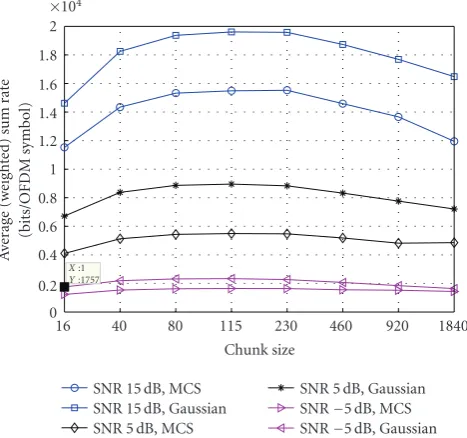
InFigure 8, the average effective sum rate of a five-user
lo-cal area scenario are shown. The system parameters are ac-cording to the definition in [40] for the local area (LA) sce-nario, that is, eight cross-polarized base station antennas and two dual cross polarized antennas. 1840 out of 2048 carriers and a signal bandwidth of 81.25 MHz out of a system band-width of 100 MHz are used. The feedback load was set to 106. No quantization of the linear precoding matrices is
as-sumed. The chunk sizes are varied between 16≤B≤1840. Three different SNR, defined as individual power constraint divided by noise power, are studied from−5 dB to 15 dB.
There are several observations inFigure 8. At first, the degradation due to finite MCS fluctuates between 20% for high SNR, 40% for medium SNR, and 30% for small SNR. The main source of rate loss is the upper bound on the rate of the finite MCS (at 4.5 bit inFigure 5). At medium and low SNR, the absolute loss due to finite MCS is decreased, for medium SNR, the average sum rate even increases with in-creasing chunk size fromB =920 toB=1840. The reason for this lies in the fact that with individual power constraints and only one large chunk, all users are scheduled simulta-neously (In the uplink scenario with individual power con-straints it can be easily shown that all users should transmit with maximum individual power to be Pareto optimal.) on
Av
er
ag
e
(w
ei
gh
te
d
)
su
m
ra
te
(bits/OFDM
sy
m
bol)
0 0.2 0.4 0.6 0.8 1 1.2 1.4 1.6 1.8 2 ×10⁴
16 40 80 115 230 460 920
Chunk size
1840
SNR 15 dB, MCS SNR 15 dB, Gaussian SNR 5 dB, MCS
SNR 5 dB, Gaussian SNR−5 dB, MCS SNR−5 dB, Gaussian X:1
Y:1757
Figure8: Effective average transmission rateReover chunk sizeB
for 5 users in WIM2 local area channel model A1.
that chunk and the individual SINRs of the data streams are clearly interference limited. No data stream is saturated with respect to the maximum data rate of the MCS.
The power allocation in the left upper subfigure in
Figure 9shows that indeed too much power is allocated to
two users on a single chunk and hence the SINR for those users is too high. However, the remaining three users dis-tributed their power over the chunks. Therefore, there is the sum rate loss of about 35% for a chunk size of 115. For larger B=230, there is much more multiple access interference (see
Figure 9right-hand side) and thus the loss due to finite MCS
is smaller, about 20%.
Second, for all SNR values, there is an optimal chunk size atB=115 which is larger than the coherence bandwidth of the channel (between 8 and 16 carriers). Another important observation is that the loss between the optimal chunk size and the minimum chunk sizeB=16 is for all SNR around 25–27%.
5.4. Resource allocation in WINNER LA
Note that the solution of the optimization problem (8) con-tains implicitly the mapping of users to chunks because mul-tiple transmit covariance matricesQk,mwill be zero and thus userkwill not be scheduled on chunkm.
Figure 9shows a typical power allocation of the users
over the chunks for one fixed channel realization of the WIM2 A1 channel model at SNR 5 dB. The channel model is for indoor small office or residential scenario with line-of-sight (LOS) with velocities between 0 and 5 km/h. Note that the sum powers of all users are identical. Two different chunk sizes are compared.
InFigure 9, it can be observed that there are two types of
Po
w
er
al
lo
ca
ti
o
n
0 0.5 1 1.5
1 2 3 4 5 User
10 20
30 40
50 60
70 80
90 100
110
Chunk
(a)
Po
w
er
al
lo
ca
ti
o
n
0 0.2 0.4 0.6 0.8 1
User
1 2
3 4
5
Chunk
1 2
34 5
6 7 8
(b)
Nu
m
b
er
o
f
ac
ti
ve
st
re
am
s
0 0.5 1
1 2 3 4 5
User
10 20
30 40
50 60
70 80
90 100
110
Chunk
(c)
Nu
m
b
er
o
f
st
re
am
s
0 0.5 1 1.5 2
User
1 2
3 4
5
Chunk
1 2
34 5 6
7 8
(d)
Figure9: Power allocation and number of active streams of users over chunks for different chunk sizes:B=16 andB=230.
In
stantaneous
sum
ra
te
(bit/OFDM)
2000 3000 4000 5000 6000 7000 8000 9000
16 230 1840
Chunk size MCS, ideal
Gaussian, ideal MCS, quantB=8
Gaussian, quantB=8 MCS, quantB=16 Gaussian, quantB=16 Figure10: Impact of transmit covariance matrix quantization on the instantaneous sum rate for 5 users in WIM2 A1 channel.
peaky power allocations lead to the rate loss for finite MCS described above. If the chunk size is increased, more and more users are scheduled on the same chunk. ForB=230, three users are loaded on one chunk on average.
For a chunk size of B = 1840 all users transmit si-multaneously on the same chunk. One interesting ques-tion is whether the users perform single-stream beamform-ing or spatial multiplexbeamform-ing. For the channel realization
fromFigure 9, only one user performs spatial multiplexing
whereas all other users perform single-stream beamforming. This observation corresponds to the results in [45,46].
5.5. Impact of quantization in WINNER LA
InFigure 10, the impact of the quantization of the transmit
covariance matrix is illustrated for one instantaneous chan-nel realization. For every transmit covariance matrix 16 bits or 8 bits are allocated. The same setting as inFigure 8is used.
InFigure 10, it can be observed that the degradation due to
Another observation from Figure 10 is that for finite MCS with quantization, the achievable rate increases mono-tonically with the chunk size. The reason for this behavior is that the gain by adapting better to the channels for small chunk sizes is lost due to the rough quantization of the trans-mit covariance matrices. In this scenario, it seems to be better to use only one roughly quantized transmit covariance ma-trix over the maximum chunk size.
6. DISCUSSIONS AND CONCLUSIONS
The work solves the weighted-sum rate optimization of the MIMO OFDM MAC under individual power constraints and under chunk constraints. In order to reduce the feedback overhead by informing the mobiles of their linear precoding matrices, the optimal chunk size is numerically found. Finite MCS and quantization of the linear precoding matrices are also addressed. The performance is illustrated by numerical simulations according to different channel models.
6.1. Further applications
In the iterative water-filling algorithm that was proposed for the weighted-sum rate optimization of flat fading MIMO channels, the update rule (6) can be directly applied to solve the inner single-user update step, that is, to solve [29, Section VII.B], first step in 6.a.] Note that this step can be also solved by a modified MAXDET [30] software. However, depending on the chunk size and the number of transmit and receive antennas, the algorithm converges slowly or does not stop at all.
Another application of the update rule and also of
Algorithm 1is in the context of code-book design for MIMO
systems with limited feedback. In [47], an iterative algorithm was proposed to find the set of covariance matrices for quan-tized feedback with statistical CSI at the transmitter. The al-gorithm is similar to Lloyd alal-gorithm which finds a local op-timum in channel optimized vector quantization [48,49]. For fixed index mapping and set of channelsH, the optimal covariance matrices are found by solving
arg max Q0
1 |H|
H∈H
log detI+HQHH
s.t. trQ≤P.
(13)
The programming problem (13) can be directly solved with the update rule (6).
6.2. Open problems
In the work, the optimization under chunk constraints is per-formed first and then the additional finite MCS and quanti-zation constraints are considered. The performance can be improved if the limitations by finite MCS and quantized pre-coding matrices are modeled as additional constraints in the programming problem (3). Thereby the constraints are to be formulated such that the properties of the constraints are conserved, especially convexity and continuity. The channel optimization quantization of the transmit covariance matri-ces in this multiuser setting is also unsolved.
In the work, it is assumed that all active users in the sys-tem have data to transmit, that is, all users have full buffers. However, the weighted sum rate optimization can be used to incorporate the queuing behavior of the system, that is, assume arrival processes at the mobiles. The interesting per-formance measure is then the system stability.
APPENDICES
A. PROOF OF THEOREM1
The optimization problem is a convex optimization problem with a feasible start point. Therefore, the duality gap is zero and we derive the KKT optimality conditions for (2) in stan-dard form (minimization of convex objective) [50]. The La-grangian is
L(Q,μ,Ξ)= −Ψ(Q) +μtr (Q)−P−tr (ΞQ). (A.1)
One of the KKT conditions is obtained by setting the first derivative ofL(Q) with respect toQto zero, that is,
∂L(Q,μ,Ξ)
∂Q = −
B
b=1 cbHHb
Zb+HbQHHb −1
Hb+μI−Ξ=0.
(A.2)
Since from the other optimality conditions followsQΞ=0, we solve (A.2) for the first summand and multiply both sides withQ1/2from the left and from the right
Q=1
μ B
b=1
cbQ1/2HHb
Zb+HbQHHb −1
HbQ1/2 (A.3)
withμchosen such that tr (Q) = P. Note that the RHS of (A.3) is positive semidefinite. The characterization in (A.3) leads directly to an iterative algorithm with the updating rule
Q+1=1
μQ
,1/2ΨQQ,1/2
=1
μ B
b=1
cbQ,1/2HHb
Zb+HbQHHb −1
HbQ,1/2
(A.4)
and the water level
μ= P
trBb=1cbQ,1/2HHb
Zb+HbQHHb −1
HbQ,1/2 .
(A.5)
Due to the convexity of the programming problem, in the op-timum the update rule will give the same covariance matrix and this is used as a stopping criteria. The representation in (6) follows with positive semidefiniteXand positive definite
Zfrom
X1/2[Z+X]−1
X1/2=I−Z−1/2[Z+X]−1
Z−1/2. (A.6)
of the proof works for any objective functionΨ(A). Con-sider the th step from A = Q to the new pointQ+1 = A1/2Ψ(A)A1/2/tr (AΨ(A)). The directional derivative of the
objective function at the pointAin the update direction
Δ= A
1/2Ψ(A)A1/2
trAΨ(A) −A (A.7) is given by
∂ ∂
=0Ψ
(A+Δ)= trΔΨ(A)
= tr
A1/2Ψ(A)A1/2Ψ(A)
trAΨ(A) −AΨ
(A).
(A.8)
Let us defineB=Ψ(A), then it holds
tr
A1/2BA1/2B
tr (AB) −AB
= 1 tr (AB)
trA1/2BA1/2B−tr (AB)2 .
(A.9)
By assumption, the matrixA=Qis trace constrained and we assume without loss of generality that tr (A)=1. The ma-trixBin (A.9) is positive semidefinite. Next, we find the ma-trixB∗which minimizes the expression in brackets in (A.9), that is, we define
g(B)= trA1/2BA1/2B− tr (AB)2 (A.10)
and solve the minimization problem
B∗=arg min
B0g(B). (A.11) The Lagrangian for (A.11) is L(B,Γ) = tr (A1/2BA1/2B)−
tr (AB)2+ tr (BΓ). Note that by construction the Lagrangian multiplierΓandBcommute. The necessary optimality con-dition is [51, Equation (15)]
2A1/2BA1/2−2 tr (AB)A=Γ. (A.12)
Multiply (A.12) from left and right withB1/2to obtain
B1/2A1/2B− tr (AB)IA1/2B1/2=0. (A.13)
From (A.13) it follows that the extreme points ofBare either
B∗ =cIforc >0 orA1/2B∗,1/2 =0. Note thatgin (A.10) is
zero for both values ofB∗, that is,g(B∗)=0.
Finally, we show that the extreme pointsB∗ are indeed minima and thereforeg(B) ≥0. Denote the eigenvalue de-compositions ofA=UΛAUHandB=VΛBVH, respectively. Define a new positive semidefinite matrix C = UHBU to writeg(C) as
g(C)= trΛA1/2CΛ1A/2C
−trΛAC2. (A.14)
Note that the functiong in (A.14) is invariant against the trace ofCand we will assume without loss of generality that the tr (C) = δ. Parameterize the unitary matrix by a skew
HermitianS = −SH as exp (−S). First, we show that the local minima are obtained for diagonalCby contradiction, that is, for the parameterized functiong(),
∂ ∂
=0g()= ∂ ∂
=0
trΛ1A/2exp (S)Bexp (−S)
×Λ1A/2exp (S)Bexp (−S)
−trΛAexp (S)Bexp (−S)2 =2 trΛABtrΛASB−trΛABS
=2 trΛAB
trΛAB−BΛA
S≥0,
(A.15)
where the last inequality follows from the choiceS=BΛA− ΛAB. Equality holds whenBandΛAcommute. Therefore, the extreme points are obtained for diagonalAand diagonal
B. Defineβ = [β1,. . .,βn]= diag(ΛB),α = [α1,. . .,αn] =
diag(ΛA), and
g(β)= n
k=1 αkβ2k−
n
k=1 αkβk
2
. (A.16)
The last step is to show thatg(β) is Schur-convex with respect toβ. This implies that the minimum is obtained forB∗=cI. We verify Schur’s condition [52, Lemma 2.1], that is, we sort β1≥β2≥ · · · ≥βnand
∂ f(β) ∂β1 −
∂ f(β)
∂β2 =2α1β1−2α2β2−2γα1β1+ 2γα2β2
≥2α1β1−2α1β1−2α2β2+ 2α2β2=0
(A.17)
with γ = n
k=1αkβk. The inequality follows because n
k=1αk=1 and we can choose n
k=1βk =δ1 arbitrary small.
Hence, the first derivative at the pointQin direction of the update in (6) is positive
∂ ∂
=0Ψ
(A+Δ)≥0. (A.18)
The remaining step is to show that the first directional derivative at the updated pointQ+1 in the direction ofQ is nonpositive. This can be shown by the same procedure as above starting from (A.8). By concavity of the objective func-tion follows that there cannot be the maximum betweenQ andQ+1. Therefore, every fix-point algorithm defined in the
way as (6) works for concave objective functions.
B. PROOF OF LEMMA1
The proof follows along the same line as the proof of
Theorem 1. The optimality conditions are given by
Qm=1
μQ 1/2
m Ψ
Qm
Q1/2
m for 1≤m≤M (B.1)
the update rule is shown by the same arguments as in the proof ofTheorem 1with the super covariance matrix
ˇ
Q=
⎛ ⎜ ⎜ ⎜ ⎜ ⎝
Q1 0 . . . 0
0 Q2 0 0
0 . .. 0 0 0 0 . . . QM
⎞ ⎟ ⎟ ⎟ ⎟
⎠ (B.2)
of sizeM×M. The update rule inAlgorithm 1can be simul-taneously expressed for all transmit covariance matrices of all chunks super channel matrix
ˇ
Hb=diag
H1,b,. . .,HM,b
(B.3)
and super noise plus interference covariance matrix
ˇ
Zb=diag
Z1,b,. . .,ZM,b
(B.4)
by
ˇ
Q+1= P
B b=1cb
I−Zˇ1/2
b
ˇ
Zb+HˇbQˇ ˇ
HHb−1Zˇ1b/2
trBb=1cb
I−Zˇ1b/2
ˇ
Zb+HˇbQˇ ˇ
HHb −1
ˇ Z1b/2
.
(B.5)
The update rule in (B.5) assures that the resultingQˇ+1is also block-diagonal and positive semidefinite and fulfills the trace constraint. Therefore, the same arguments as in the proof of
Theorem 1inAppendix Aapply.
ACKNOWLEDGMENTS
The authors would like to thank the three anonymous re-viewers who have contributed to improve this paper with their helpful comments. The first author acknowledges fruit-ful discussions with Erik G. Larsson, Per Zetterberg, Mats Bengtsson, and Patrick Svedman. This work has been per-formed partly in the framework of the IST project IST-4-027756 WINNER II, which is partly funded by the European Union. The authors would like to acknowledge the contri-butions of their colleagues. This work is supported in part by the Deutsche Forschungsgemeinschaft (DFG) and by NSF Contract NSF DMS-0354674 ONR Contract ONR N00014-02-1-0088-P00006.
REFERENCES
[1] A. J. Goldsmith, S. A. Jafar, N. Jindal, and S. Vishwanath, “Ca-pacity limits of MIMO channels,”IEEE Jourunal on Selected Areas in Communications, vol. 21, no. 5, pp. 684–702, 2003. [2] S. A. Jafar and A. Goldsmith, “Transmitter optimization and
optimality of beamforming for multiple antenna systems,”
IEEE Transactions on Wireless Communications, vol. 3, no. 4, pp. 1165–1175, 2004.
[3] W. Rhee and J. M. Cioffi, “On the capacity of multiuser wire-less systems with multiple antennas,”IEEE Transactions on In-formation Theory, vol. 49, no. 10, pp. 2580–2595, 2003. [4] A. Pascual-Iserte, A. I. P´erez-Neira, and M. A. Lagunas, “An
approach to optimum joint beamforming design in a MIMO-OFDM multiuser system,”EURASIP Journal on Wireless Com-munications and Networking, vol. 2004, no. 2, pp. 210–221, 2004.
[5] Y. J. Zhang and K. B. Letaief, “An efficient resource-allocation scheme for spatial multiuser access in MIMO/OFDM sys-tems,”IEEE Transactions on Communications, vol. 53, no. 1, pp. 107–116, 2005.
[6] Y.-C. Liang, R. Zhang, and J. M. Cioffi, “Transmit opti-mization for MIMO-OFDM with delay-constrained and no-delayconstrained traffics,”IEEE Transactions on Signal Process-ing, vol. 54, no. 8, pp. 3190–3199, 2006.
[7] N. Jindal, “MIMO broadcast channels with finite-rate feed-back,” IEEE Transactions on Information Theory, vol. 52, no. 11, pp. 5045–5060, 2006.
[8] M. Bengtsson, “From single link MIMO to multi-user MIMO,” in Proceedings of the IEEE International Conference on Acoustics, Speech and Signal Processing (ICASSP ’04), vol. 4, Montreal, Quebec, Canada, May 2004.
[9] D. Gesbert, M. Kountouris, R. Heath, C.-B. Chae, and T. Salzer, “From single user to multiuser communications: shift-ing the MIMO paradigm,”IEEE Signal Processing Magazine, vol. 24, no. 5, p. 36, 2007.
[10] M. Kobayashi and G. Caire, “An iterative water-filling algo-rithm for maximum weighted sum-rate of gaussian MIMO-BC,” IEEE Journal on Selected Areas in Communications, vol. 24, no. 8, pp. 1640–1646, 2006.
[11] M. Kobayashi and G. Caire, “Iterative waterfilling for weighted rate sum maximization in MIMO-OFDM broadcast chan-nels,” inProceedings of the IEEE International Conference on Acoustics, Speech and Signal Processing (ICASSP ’07), vol. 3, pp. 5–8, 2007.
[12] F. Boccardi, F. Tosato, and G. Caire, “Precoding schemes for the MIMO-GBC,” inProceedings of the International Zurich Seminar on Digital Communications, vol. 2006, pp. 10–13, 2006.
[13] A. Bayesteh and A. K. Khandani, “How much feedback is re-quired in MIMO broadcast channels?” inProceedings of the IEEE International Symposium on Information Theory, (ISIT ’06), pp. 1310–1314, Seattle, Wash, USA, July 2006.
[14] W. Dai, B. Rider, and Y. Lui, “Multi-access MIMO systems with finite rate channel state feedback,” inProceedings of the Allerton Conference, Monticello, Ind, USA, october 2005.
[15] T. Ratnarajah, “Limits of multi-user MIMO systems using scheduling and rate feedback,”Signal Processing, vol. 87, no. 9, pp. 2165–2176, 2007.
[16] W. Yu, W. Rhee, S. Boyd, and J. M. Cioffi, “Iterative water-filling for gaussian vector multiple-access channels,” IEEE Transactions on Information Theory, vol. 50, no. 1, pp. 145– 152, 2004.
[17] G. Wunder and T. Michel, “Optimal resource allocation for parallel gaussian broadcast channels: minimum rate con-straints and sum power minimization,”IEEE Transactions on Information Theory, vol. 53, no. 12, pp. 4817–4822, 2007. [18] A. Soysal and S. Ulukus, “Transmit directions and
optimal-ity of beamforming in MIMO-MAC with partial CSI at the transmitters,” inProceedings of the Conference on Information Sciences and Systems (CISS ’05), Baltimore, Md, USA, March 2005.
[19] E. A. Jorswieck, A. Sezgin, H. Boche, and E. Costa, “Multiuser MIMO MAC with statistical CSI and MMSE receiver: feedback strategies and transmitter optimization,” inProceedings of the International Wireless Communications and Mobile Computing Conference (IWCMC ’06), vol. 2006, pp. 455–460, 2006. [20] S. Vishwanath, N. Jindal, and A. Goldsmith, “Duality,
[21] P. Viswanath and D. N. C. Tse, “Sum capacity of the vec-tor gaussian broadcast channel and uplink-downlink duality,”
IEEE Transactions on Information Theory, vol. 49, no. 8, pp. 1912–1921, 2003.
[22] E. A. Jorswieck, “Lack of duality between SISO gaussian MAC and BC with statistical CSIT,” Electronics Letters, vol. 42, no. 25, pp. 1466–1468, 2006.
[23] M. Sternad, T. Svensson, and G. Klang, “The WINNER B3G system MAC concept,” in Proceedings of the IEEE Vehicular Technology Conference, pp. 3037–3041, 2006.
[24] S. Olonbayar and H. Rohling, “Multiuser diversity and subcar-rier allocation in OFDM-FDMA systems,” inProceedings of the OFDM Workshop, San Francisco, Calif, USA,, February 2005. [25] J. P. Kermoal, L. Schumacher, K. I. Pedersen, P. E. Mogensen,
and F. Frederiksen, “A stochastic MIMO radio channel model with experimental validation,”IEEE Journal on Selected Areas in Communications, vol. 20, no. 6, pp. 1211–1226, 2002. [26] IST-4-027756 WINNER II, “D1.1.1 WINNER II interim
chan-nel models,” 2006.
[27] D. Tse and P. Viswanath,Fundamentals of Wireless Communi-cation, Cambridge University Press, Cambridge, UK, 2005. [28] K. Seong, R. Narasimhan, and J. M. Cioffi, “Queue
pro-portional scheduling via geometric programming in fading broadcast channels,”IEEE Journal on Selected Areas in Com-munications, vol. 24, no. 8, pp. 1593–1602, 2006.
[29] H. Boche and M. Wiczanowski, “Optimization-theoretic anal-ysis of stability-optimal transmission policy for multiple-antenna multiple-access channel,”IEEE Transactions on Signal Processing, vol. 55, no. 6 I, pp. 2688–2702, 2007.
[30] S. P. Wu, L. Vandenberghe, and S. Boyd, “MAXDET: software for determinant maximization problems,”
http://www.stanford.edu/∼boyd/papers/maxdet.html, 1996. [31] Y. Labit, D. Peaucelle, and D. Henrion, “SeDuMi interface
1.02: a tool for solving LMI problems with SeDuMi,” in Pro-ceedings of the CACSD Conference, London, UK, September 2002.
[32] E. Telatar, “Capacity of multi-antenna gaussian channels,” Eu-ropean Transactions on Telecommunications, vol. 10, no. 6, pp. 585–595, 1999.
[33] E. A. Jorswieck, A. Sezgin, Y. Goa, and D. Kim, “On the trade-offbetween feedback signaling and performance for tile based MIMO-OFDMA systems,” inProceedings of the 6th Interna-tional Symposium on Wireless Personal Multimedia Communi-cations (WPMC ’06), Abano Terme, Italy, September 2006. [34] L. W. Hanlen and A. J. Grant, “Optimal transmit covariance
for MIMO channels with statistical transmitter side informa-tion,” inIEEE International Symposium on Information The-ory (ISIT 2005), pp. 1818–1822, Adelaide, South Australia, September 2005.
[35] C. T. Kelly,Iterative Methods for Linear and Nonlinear Equa-tions, SIAM, Philadelphia, Pa, USA, 1995.
[36] J. C. Bezdek and R. J. Hathaway, “Some notes on alter-nating optimization,” inProceedings of the Advances in Soft Computing—AFSS 2002: 2002 AFSS International Conference on Fuzzy Systems, vol. 2275 ofLecture Notes in Computer Sci-ence, pp. 187–195, Calcutta, India, February 2002.
[37] D. J. Love, R. W. Heath Jr., W. Santipach, and M. L. Honig, “What is the value of limited feedback for MIMO channels?”
IEEE Communications Magazine, vol. 42, no. 10, pp. 54–59, 2004.
[38] D. J. Love, R. W. Heath Jr., and T. Strohmer, “Grassman-nian beamforming for multiple-input multiple-output wire-less systems,”IEEE Transactions on Information Theory, vol. 49, no. 10, pp. 2735–2747, 2003.
[39] W. Santipach and M. Honig, “Capacity of a multi-antenna fading channel with quantized precoding matrix,” to ap-pear inIEEE Transactions on Information Theory http://arxiv .org/abs/0704.0217.
[40] IST-4-027756 WINNER II, “D6.13.7 test scenarios and cali-bration cases issue 2,” December 2006.
[41] J. H. Winters, J. Salz, and R. D. Gitlin, “The impact of antenna diversity on the capacity of wireless communication systems,”
IEEE Transactions on Communications, vol. 42, no. 2, pp. 1740– 1751, 1994.
[42] J. M. Cioffi,Digital Communication, Lecture Notes, Stanford University, Stanford, Calif, USA, 2004.
[43] J. R. Barry, E. A. Lee, and D. G. Messerschmitt,Digital Com-munication, Kluwer, Norwell, Mass, USA, 3rd edition, 2004. [44] E. A. Jorswieck, W. B. Chamekh, and M. Weckerle, “Optimal
chunk processing for multi-user MIMO OFDM wireless sys-tems,” inProceedings of the IEEE International Symposium on Personal, Indoor and Mobile Radio Communications (PIMRC ’06), Helsinki, Finland, September 2006.
[45] W. Rhee, W. Yu, and J. Cioffi, “The optimality of beam-forming in uplink multiuser wireless systems,”IEEE Trans-actions on Wireless Communications, vol. 3, no. 1, pp. 86–96, 2004.
[46] W. Yu and W. Rhee, “Degrees of freedom in wireless multiuser spatial multiplex systems with multiple antennas,”IEEE Trans-actions on Communications, vol. 54, no. 10, pp. 1747–1753, 2006.
[47] T. T. Kim, M. Bengtsson, E. G. Larsson, and M. Skoglund, “Combining long-term and low rate short-term channel state information over correlated MIMO channels,” to appear in
IEEE Transactions on Wireless Communications.
[48] G. J¨ongren and M. Skoglund, “Quantized feedback informa-tion in orthogonal space-time block coding,”IEEE Transac-tions on Information Theory, vol. 50, no. 10, pp. 2473–2482, 2004.
[49] N. Farvardin, “A study of vector quantization for noisy chan-nels,”IEEE Transactions on Information Theory, vol. 36, no. 4, pp. 199–809, 1990.
[50] S. Boyd and L. Vandenberghe, Convex Optimization, Cam-bridge University Press, CamCam-bridge, UK, 2004,http://www .stanford.edu/∼boyd/cvxbook/.
[51] T. Minka, “Old and new matrix algebra useful for statistics,”
http://research.microsoft.com/∼minka/papers/matrix/, 2000. [52] A. Jorswieck and H. Boche, “Majorization and matrix