Volume 2006, Article ID 84057, Pages1–10 DOI 10.1155/ASP/2006/84057
A Gradient-Based Optimum Block Adaptation
ICA Technique for Interference Suppression in
Highly Dynamic Communication Channels
Wasfy B. Mikhael1and Tianyu Yang2
1Department of Electrical and Computer Engineering, University of Central Florida, Orlando, FL 32816, USA 2Department of Engineering Sciences, Embry-Riddle Aeronautical University, Daytona Beach, FL 32114, USA
Received 21 February 2005; Revised 30 January 2006; Accepted 18 February 2006
The fast fixed-point independent component analysis (ICA) algorithm has been widely used in various applications because of its fast convergence and superior performance. However, in a highly dynamic environment, real-time adaptation is necessary to track the variations of the mixing matrix. In this scenario, the gradient-based online learning algorithm performs better, but its convergence is slow, and depends on a proper choice of convergence factor. This paper develops a gradient-based optimum block adaptive ICA algorithm (OBA/ICA) that combines the advantages of the two algorithms. Simulation results for telecommunication applications indicate that the resulting performance is superior under time-varying conditions, which is particularly useful in mobile communications.
Copyright © 2006 Hindawi Publishing Corporation. All rights reserved.
1. INTRODUCTION
Independent component analysis (ICA) is a powerful statis-tical technique that has a wide range of applications. It has attracted huge research efforts in areas such asfeature
extrac-tion[1],telecommunications[2–4],financial engineering[5],
brain imaging [6], andtext document analysis[7]. ICA can
extract statistically independent components from a set of observations that are linear combinations of these compo-nents.
The basic ICA model isX=AS. Here,Xis the observa-tion matrix,Ais the mixing matrix, andSis the source sig-nal matrix consisting of independent components. The ob-jective of ICA is to find a separation matrixW, such thatS
can be recovered when the observation matrixX is multi-plied byW. This is achieved by making each component in
WXas independent as possible. Many principles and corre-sponding algorithms have been reported to accomplish this task, such as maximization of nongaussianity [8,9],
maxi-mum likelihood estimation[10,11],minimization of mutual
information[12,13], andtensorial methods[14–16].
The Newton-based fixed-point ICA algorithm [8], also known as the fast-ICA, is a highly efficient algorithm. It typ-ically converges within less than ten iterations in a station-ary environment. Moreover, in most cases the choice of the learning rate is avoided. However, when the mixing matrix is highly dynamic, fast-ICA cannot successfully track the time
variation. Thus, a gradient-based algorithm is more desirable in this scenario.
The previously reported online gradient-based algorithm [17, page 177] suffers from slow convergence and difficulty in the choice of the learning rate. An improper choice of the learning rate, which is typically determined by trial and error, can result in slow convergence or divergence. In the adaptive learning and neural network area, many research efforts have been devoted to the selection of learning rate in an intelli-gent way [18–23]. In this paper, we propose a gradient-based block ICA algorithm OBA/ICA, which automatically selects the optimal learning rate.
r1(t)
× BPF
cos(ω0t+α1)
rIF,1(t)
× LPF
cos(ωIt)
rBB, 1(t)
A/D X1(n)
r2(t)
×
cos(ω0t+α2 )
BPF rIF,2 (t)
×
cos(ωIt)
LPF rBB , 2(t)
A/D X2 (n)
DSP
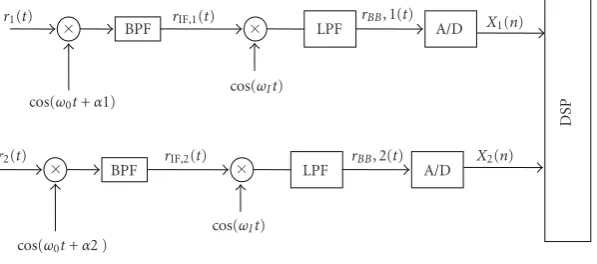
Figure1: Diversity BPSK wireless receiver structure with ICA interference suppression.
The rest of the paper is organized as follows.Section 2 presents the system model for diversity BPSK receiver struc-ture. Section 3discusses the motivation and basic strategy of OBA/ICA. Section 4formulates OBA/ICA, and it is also shown that OBA/ICA reduces to online gradient ICA in the simplest case.Section 5deals with several practical im-plementation issues regarding OBA/ICA. Section 6 applies OBA/ICA for interference suppression in mobile communi-cations assuming two different types of time-varying chan-nels, and the performance is compared with fast-ICA. Finally, conclusions are given inSection 7.
2. SIGNAL MODEL FOR DIVERSITY BPSK RECEIVERS
Figure 1shows the simplified structure of a dual-antenna di-versity BPSK receiver. We assume the image signal is the pri-mary interferer to be suppressed. The extension to the cases of multiple interferers and/or cochannel interference (CCI) is straightforward, and it is accomplished by the addition of antenna elements. For each receiver processing chain, the re-ceived signal is first downconverted from RF to IF, followed by a bandpass filter to perform adjacent channel suppression. Then, the IF signalrIF(t) is downconverted to baseband and lowpass filtered. The baseband signalrBB(t) is digitized to ob-tain the signal observationX(n), which is fed into the digital signal processor (DSP) for further processing.
In our signal analysis, frequency-flat fading is assumed. For thekth antenna (k =1, 2), the channel’s fading coeffi -cients for the desired signals(t) and the image signali(t) are defined as
fsk=αskejψsk,
fik=αikejψik,
(1)
whereαsk,αikandψsk,ψik are the channel’s amplitude and phase responses, respectively. The distributions ofαskandαik are determined by the type of fading channels the signals en-counter. Since the signals travel random paths, ψsk andψik can be modeled as uniformly distributed random phases over the interval [0, 2π).
The received signal from thekth antenna,rk(t), can be expressed as
rk(t)=2 Res(t)fskej(ω0+ωI)t+i(t)fikej(ω0−ωI)t, (2)
where Re{·}denotes the real part of a signal,ω0andωI de-note the frequency of the first and the second local oscillators (LO). The multiplication by 2 is introduced for convenience. After the RF-IF downconversion, the bandpass filtered signal is given by
rIF,k(t)=s(t)fske−jαejωIt+s∗(t)fsk∗ejαe−jωIt +i(t)fike−jωIte−jα+i∗(t)f∗
ikejωItejα, (3)
where the superscript∗denotes complex conjugate, andαis the phase difference between the received signal and the first LO signal.
The baseband signal after downconversion to baseband and lowpass filtering is expressed as
rBB,k(t)=Res(t)fske−jα+ Rei(t)fike−jα. (4)
For BPSK signals,s(t) andi(t) are real-valued, so (4) can be written as
rBB,k(t)=aks(t) +bki(t), (5)
where the coefficientsak=Re{fske−jα}, andbk=Re{fike−jα}. Thus, after A/D converter, the baseband observation is
Xk(n)=aks(n) +bki(n). (6)
Each ofs(n),i(n), andXk(n) in (6) represents a one sample signal. Since the signals are processed in frames of lengthN,
sN,iN, andXN,kare used to represent frames ofNsuccessive samples. Hence,
Therefore, the baseband signal observation matrix is ex-pressed as
X=
XN,1
XN,2
=
a1 b1
a2 b2
sN
iN
=AS. (8)
In system model (8),Xis the 2 byNobservation matrix,
Ais the unknown 2 by 2 mixing matrix, andS is the 2 by
Nsource signal matrix, which is to be recovered by ICA al-gorithm based on the assumption of statistical independence between the desired signal and the interferer. From the above derivation process, it is clear that the mixing matrix is de-termined by the wireless channel’s fading coefficients, which are often time varying. ICA requires that the mixing matrix should be nonsingular, and this is guaranteed due to the ran-domness of the wireless channel. ICA poses no requirement regarding the relative strength of the source signals, so the operating range for input signal-to-interference ratio (SIR) is quite large. However, in practice, if the interference is too strong, the front-end synchronization becomes problematic. Therefore, there are practical limitations to the application of the proposed technique.
ICA processing has the inherent order ambiguity. There-fore, reference sequences need to be inserted into source sig-nals for the receiver to identify the desired user. Fortunately, in most communication standards, such reference sequences are available.
In this paper, we are primarily concerned about the inter-ference-limited scenario. Therefore, thermal noise is not ex-plicitly included in the signal model. However, ICA algo-rithm is able to perform successfully in the presence of ther-mal noise. InSection 6, simulation results will be presented with thermal noise included.
3. BACKGROUND AND MOTIVATIONS
The fast-ICA algorithm is a block algorithm. It uses a block of data to establish statistical properties. Specifically, the “ex-pectation” operator is estimated by the average overLdata points, whereLis the block size [8]. The performance is bet-ter when the estimation is more accurate, that is,Lis larger. However, it is very important that the mixing matrix stays approximately constant within one processing block, that is, quasistationary. Thus, the problem with convergence arises when the mixing matrix is rapidly time varying, in which case a largeLviolates the assumption of quasistationarity.
On the other hand, the online gradient-based algorithm, which updates the separation matrix once for every received symbol, can better track the time variation of the mixing ma-trix. But it directly drops the “expectation” operator, which results in worse performance than a block algorithm.
Therefore, an algorithm is needed that can better accom-modate time variations by processing signals in blocks and automatically selecting the optimal convergence factor. In the following section, such a technique is developed, which is de-noted OBA/ICA.
The idea is to tailor the learning rates in a gradient-based block algorithm to each iteration and every coefficient in the
separation matrix, in order to maximize a performance func-tion that corresponds to a measure of independence. In [28], Mikhael and Wu used a similar idea to develop a fast block-LMS adaptive algorithm for FIR filters, which proved to be useful, especially when adapting to time-varying systems.
4. FORMULATION OF OBA/ICA
The algorithm developed here is used for estimating one row, w, of the demixing matrixW. The algorithm is run for all rows. The performance function adopted is the abso-lute value of kurtosis. Other ICA-related operations, such as mean centering, whitening, and orthogonalization, are iden-tical as fast-ICA. First, the following parameters are defined:
(i) j: iteration index,
(ii) M: number of observations, (iii) L: length of the processing block,
(iv) w(j) = [w1(j),w2(j),. . .,wM(j)]T: the current row of the separation matrix for the jth iteration. (i =
1, 2,. . .,M),
(v) xl,i(j): theith signal in thelth observation data vector for thejth iteration. (l=1, 2,. . .,L),
(vi) Xl(j)=[xl,1(j),xl,2(j),. . .,xl,M(j)]T:lth signal obser-vation for thejth iteration,
(vii) [G]j =[X1(j),X2(j),. . .,XL(j)]T: observation matrix for thejth iteration.
Thelth kurtosis value for the jth iteration is
kurtl(j)=EwT(j)X
l(j)4 −3, (9)
where it is assumed that the signals andw(j) both have been normalized to unit variance.
Then, the kurtosis vector for thejth iteration is
kurt(j)=kurt1(j), kurt2(j),. . ., kurtL(j)T. (10)
Now the updating formula can be written in a matrix-vector form as
w(j−1)=w(j)−[MU]j∇B(j), (11)
where
∇B(j)=∂
kurtT(j)kurt(j)
∂w(j)
=1L
∂
kurtT(j)kurt(j)
∂w1(j) · · ·
∂kurtT(j)kurt(j)
∂wM(j)
T
,
(12)
[MU]j=
⎡ ⎢ ⎣μB1
(j) · · · 0
· · · · · · ·
0 · · · μBM(j)
⎤ ⎥
Note that in (11), a “+” sign is used instead of “−” as in the steepest descent algorithm. Because our performance func-tion is the absolute value of kurtosis rather than error signal, we wish to maximize the function to achieve maximal non-Gaussianity.
To evaluate (12), we have
∂kurtT(j)kurt(j)
∂wi(j)
=
L
l=1
∂E[wT(j)x1(j)]4−32
∂wi(j)
=8 L
l=1
wT(j)X
l(j)3kurtl(j)xl,i(j).
(14)
In the derivation of (14), the expectation operator was dropped.
The block gradient vector can be written as
∇B(j)= 8L
L
l=1
wT(j)Xl(j)3
kurtl(j)xl,1(j)· · ·
L
l=1
[wT(j)Xl(j)]3kurt
l(j)xl,M(j)
T
= 8
L[G]Tj[C]3jkurt(j),
(15)
where
[C]j=
⎡ ⎢ ⎢ ⎣
wT(j)X1(j) · · · 0
· · · · · · · · ·
0 · · · wT(j)XL(j)
⎤ ⎥ ⎥
⎦ (16)
is a diagonal matrix.
From (15), the updating formula (11) becomes
w(j+ 1)=w(j) +8
L[MU]j[G]Tj[C]3jkurt(j). (17)
Now, the primary task is to identify the matrix [MU]j in an optimal sense, so that the total squared kurtosis kurtT(j)kurt(j) is maximized. In order to do that, we express thelth kurtosis value in the (j+ 1)th iteration by Taylor’s se-ries expansion:
kurtl(j+ 1)=kurtl(j)
+ M
i=1
∂kurtl(j)
∂wi(j) Δwi(j)
+ 1 2!
M
m=1 M
n=1
∂2kurt l(j)
∂wm(j)∂wn(j)Δwm(j)Δwn(j) +· · ·, l=1, 2,. . .,L,
(18)
where
Δwi(j)=wi(j+ 1)−wi(j), i=1, 2,. . .,M. (19)
In (18), the complexity of the terms increases as the order of the derivative increases. However, ifΔwi(j) is small enough, higher-order derivative terms can be omitted. In our experi-mentation, it is found that this is indeed the case.
The expectation operator in (9) is dropped. Thus,
∂kurtl(j)
∂wi(j) =4xl,i(j)
wT(j)X
l(j)3. (20)
Then, (18) becomes
kurtl(j+ 1)=kurtl(j) + 4wT(j)Xl(j)3 M
i=1
xl,i(j)Δwi(j)
=kurtl(j) + 4wT(j)Xl(j)3XlT(j)Δw(j). (21)
Writing (21) for everyl, the matrix-vector form of the Taylor expansion becomes
kurt(j+ 1)=kurt(j) + 4[C]3j[G]jΔw(j). (22)
From (17),
Δw(j)=L8[MU]j[G]Tj[C]3jkurt(j). (23)
Substituting (23) into (22), one obtains
kurt(j+ 1)=kurt(j) +32
L[C]3j[G]j[MU]j[G]Tj[C]3jkurt(j). (24)
Definingq(j) and [R]jas
q(j)=[G]Tj[C]3
jkurt(j)=q1(j),. . .,qM(j)T, (25)
[R]j=[G]Tj[C]6
j[G]j=Rmn(j), 1≤m,n≤M. (26)
The total squared kurtosis for the (j+ 1)th iteration can be written as
kurtT(j+ 1)kurt(j+ 1)=S1+S2+S3, (27a)
where
S1=kurtT(j)kurt(j), (27b)
S2=64L M
i=1
q2
i(j)μBi(j), (27c)
S3= 1024
L2 qT(j)[MU]j[R]j[MU]jq(j). (27d)
must be met:
∂kurtT(j+ 1)kurt(j+ 1)
∂μBi(j) =0, i=1, 2,. . .,M. (28)
Combining (27a) and (28) yields
∂S1
∂μBi(j)+
∂S2
∂μBi(j)+
∂S3
∂μBi(j)=0. (29)
Substituting (27b), (27c), and (27d) into (29), and using the symmetry property of the matrix [R]jgiven in (26), the fol-lowing is obtained:
M
k=1
qk(j)μ∗BK(j)rki(j)= −32Lqi(j), (30)
where∗denotes the optimal value.
Writing (30) for every i, the following matrix-vector equation is obtained:
[R]j[MU]∗jq(j)= −L
32q(j). (31)
From (31), we have
[MU]∗jq(j)= −L
32[R] −1
j q(j). (32)
From (25), (32), and (17), the OBA/ICA algorithm is ob-tained:
w(j+ 1)=w(j) +8
L(−32L)[R] −1 j q(j)
=w(j)−0.25[R]−j1q(j),
(33)
where [R]jandq(j) are given by (25) and (26).
Now we show that online gradient-based ICA can be ob-tained as a special case of the more general OBA/ICA formu-lation presented above. LetL=1 and letμB1(j)=μB2(j)=
· · · =μBM(j)=μB(j), then OBA/ICA simplifies to
w(j+ 1)=w(j)−0.25μ∗B(j)X(j)wT(j)X(j)3kurt(j), (34)
where
μ∗
B(j)= wT 1
(j)X(j)6XT(j)X(j). (35)
If we let μ = 0.25μ∗B(j)|kurt(j)|, the online gradient-based ICA is obtained [17, page 177]:
w(j+ 1)=w(j)−μsignkurt(j)X(j)wT(j)X(j)3. (36)
5. IMPLEMENTATION ISSUES
5.1. Elimination of the matrix inversion operation
OBA/ICA algorithm, (33), gives the optimal updating for-mula to extract one row of the separation matrixW. The
update equation, (33), involves the inversion of the [R] ma-trix, whose dimensionality is equal to the order of the system
M. This operation could be inefficient in the case of a high-order system. This is because the computational complexity of the matrix inversion operation isO(M3). WhenMis large, an estimate of [R] can be used. The method proposed here is to use a diagonal matrix [R]Dwhich contains only the diago-nal elements of [R]. Thus, the complexity of the inverse oper-ation becomesO(M). From extensive simulations, it is found that the adaptive system repairs itself from this approxima-tion and converges to the right soluapproxima-tion in a few addiapproxima-tional iterations.
5.2. Computational complexity
Having eliminated the inversion problem, the dominant fac-tor determining the computational complexity is the block sizeLfor most applications of ICA.Lis typically larger than the order of the systemM. It is easily seen that the number of multiplications and divisions of OBA/ICA isO(L) per itera-tion, which is equivalent to fast-ICA.
5.3. An optional scaling constant
In practice, a parameterkcan be introduced in (33) to fur-ther optimize the algorithm performance if a priori informa-tion is available regarding the speed of time variainforma-tion of the channel. Also, since the high-order derivative terms in (18) are dropped in our formulation, an additional adaptation pa-rameter can help to ensure reliable convergence. However, the value ofkis not critical, and the algorithm successfully converges over a wide range ofk, as is confirmed by our sim-ulations.
Therefore, the optimized updating formula is obtained based on (33) as
w(j+ 1)=w(j)−0.25k[R]−1
j q(j), (37)
where the choice ofkis made according to the convergence property and the speed of mixing matrix’s time variation.
5.4. Types of time variations
In our simulations two types of time variations are studied, which correspond to two scenarios that can arise in mobile communication applications.
In the first case, the change of the channel is modeled as a continuous linear time variation in the mixing matrix’s coef-ficients. In this case, the ICA algorithm seeks a compromise separation matrix that recovers the source signals with mini-mum error.
When an abrupt change occurs within a processing block, the performance for the block degrades significantly, espe-cially when the block size is large. This is because the con-verged demixing vector is a compromise between two com-pletely different channel parameters. In order to deal with this situation, we propose to locate the position of the abrupt change within the block. This technique will improve the performance if the performance degradation is due to an abrupt change within the block.
In the search procedure, the demixing matrices obtained through the previous blockW1and the subsequent blockW2
are utilized.
First, the block is evenly divided into two subblocks.W1
is used to process the first subblock, whileW2is used to pro-cess the second subblock.
If the separation performance for the second subblock is better, it is concluded that the abrupt change occurs within the first subblock. Otherwise, it is concluded that the abrupt change occurs within the second subblock.
Thus, the location of the abrupt change is narrowed down to a subblock. The search process can be continued by dividing that subblock evenly and usingW1andW2to pro-cess the two subblocks, respectively. This procedure can be repeated until the location of the abrupt change is narrowed down to a very small range.
Once the location is identified, the symbols before the abrupt change are processed by W1, and the symbols after the abrupt change are processed byW2.
6. APPLICATION IN MOBILE TELECOMMUNICATIONS
To study the performance of OBA/ICA, computer simu-lations are performed. The performance measures are the signal-to-interference ratio (SIR) and the number of itera-tions to convergenceNc. SIR represents the average ratio of the desired signal power to the power of the estimation error, defined as
SIR=10 log10
1
L
L
k=1
s(k)2
s(k)−y(k)2
, (38)
wheres(k) is thekth sample of the desired signal,y(k) is the estimate of thes(k) obtained at the output of the ICA pro-cessing unit.
For continuous linear time variation, the mixing matrix simulated is chosen as
A=
1 +lΔ 0.5 0.7 2 +lΔ
, (39)
wherel = 1, 2,. . .,L, and Δis the parameter reflecting the speed of channel variation. Here, it is assumed that the chan-nel’s transfer function is frequency-flat over the signal band. Also, the sampling interval of the receiver’s A/D converter is negligible compared with 1/Δ, which represents the rate of the channel’s time variation.
0 100 200 300 400 500 600 700 800 900 1000 Block size
0 10 20 30 40 50 60 70 80 90 100
SIR
(dB)
OBA/ICA Fast-ICA
Figure2: Signal-to-interference ratio (SIR) achieved in dB versus the processed block size employing fast-ICA and OBA/ICA (k=0.5) when channel conditions vary linearly with time:Δ=0.01 in (39).
0 100 200 300 400 500 600 700 800 900 1000 Block size
0 500 1000 1500
N
o
.o
f
it
er
at
ions
re
q
uir
ed
for
co
n
vergenc
e
OBA/ICA Fast-ICA
Figure 3: Convergence speed of fast-ICA and OBA/ICA (k=0.5) versus the processed block size when channel conditions vary lin-early with time:Δ=0.01 in (39).
0 100 200 300 400 500 600 700 800 900 1000 Block size
0 10 20 30 40 50 60 70 80 90 100
SIR
(dB)
Δ=0.01,k=0.5
Δ=0.1,k=0.5
Δ=0.5,k=1
Δ=1,k=1.2
Figure4: SIR achieved in dB versus the processed block size em-ploying OBA/ICA when channel conditions vary linearly with time.
0 2 4 6 8 10
SNR (dB) 10−3
10−2
10−1
100
Bi
t
er
ror
ra
te
AWGN bound OBA/ICA output
Figure5: Bit error rate (BER) versus SNR employing OBA/ICA.
variation within one processing block. Also, fast-ICA con-verges very slowly for long blocks, while OBA/ICA always converges within 20 iterations regardless of the block size.
For faster time variation, that is, Δ = 0.1, 0.5, 1, fast-ICA fails to converge within one thousand iterations, which makes it impractical to use. On the other hand, OBA/ICA always converges within 20 iterations. This is why only the OBA/ICA results are given. The performance for OBA/ICA is given inFigure 4. The optimalkvalues are given for every
Δ. It is observed that a largerkshould be used for faster time variation, as expected.
0 100 200 300 400 500 600 700 800 900 1000 Block size
0 5 10 15 20 25 30 35 40
SIR
(dB)
OBA/ICA Fast-ICA
Figure6: SIR achieved by OBA/ICA (k=0.5) and fast-ICA when channel conditions change abruptly.
0 100 200 300 400 500 600 700 800 900 1000 Block size
0 50 100 150 200 250 300
N
o
.o
f
it
er
at
ions
re
q
uir
ed
for
co
n
vergenc
e
OBA/ICA Fast-ICA
Figure7: Convergence of OBA/ICA (k=0.5) and fast-ICA when channel conditions change abruptly.
0 500 1000 1500 Sample index
0 10 20 30 40 50 60
SIR
(dB)
Figure8: SIR achieved by OBA/ICA for three blocks when channel conditions change abruptly in time without finding the location of the sudden change (block size=512).
iterations, compared to 7 to 10 iterations in the noiseless case. Therefore, a slight increase in the processing time may be re-quired for OBA/ICA in the presence of thermal noise.
Next, fast-ICA and OBA/ICA are compared under ab-ruptly changing channel conditions. To simulate this condi-tion, an abrupt change of the mixing matrix is introduced within the processing block. Figures6and7compare fast-ICA and OBA/fast-ICA in terms of average SIR and convergence speed without any knowledge about the abrupt change. As expected, the performance of both algorithms degrades when compared to the case of continuous time variation. However, OBA/ICA converges much faster than fast-ICA.
Following the detection of an abrupt change within a certain block, the binary search technique described in Section 5.4is simulated to detect the location of the abrupt change. As before, one hundred simulation runs are per-formed and the average performance is given. The block size is chosen to be 512 samples.Figure 8shows the perfor-mance of OBA/ICA for three consecutive blocks when a sud-den channel change is simulated at the middle of the sec-ond block. Since the adaptive algorithm tries to converge to a compromising demixing matrix for two completely diff er-ent mixing matrices, the performance for the second block degraded significantly.Figure 9describes the performance of OBA/ICA after the application of binary search for the sec-ond block. As seen, the technique successfully identified the position of the abrupt change denoted by “a,” and the re-sulting performance for the second block is substantially im-proved compared toFigure 8.
In addition to these simulation results, in Figures 10 and11the residue interference power and the SIR value are shown as a function of the iteration index. Although the whole block is processed with a converged demixing ma-trix, the two figures illustrate the convergence process of OBA/ICA algorithm.
0 500 1000 1500
Sample index a 0
10 20 30 40 50 60
SIR
(dB)
Figure9: SIR achieved by OBA/ICA for three blocks when channel conditions change abruptly in time after finding the location of the sudden change (block size=512).
0 2 4 6 8 10 12 14 16 18 20
Iteration index −45
−40 −35 −30 −25 −20 −15 −10 −5 0
P
o
w
er
o
f
the
re
sidue
int
erfer
enc
e
(dB)
Linearly varying channels withΔ=0.001 in (39) Stationary channels
Abruptly changing channels∗
Figure 10: Residue interference power averaged over a hundred simulation runs versus iteration number for OBA/ICA assuming block size = 100. ∗Without finding the location of the abrupt
change within the block.
7. CONCLUSIONS
0 2 4 6 8 10 12 14 16 18 20 Iteration index
0 10 20 30 40 50 60
Output
SIR
(dB)
Linearly varying channels withΔ=0.001 in (39) Stationary channels
Abruptly changing channels∗
Figure11: Output SIR averaged over a hundred simulation runs versus iteration number for OBA/ICA assuming block size=100.
∗Without finding the location of the abrupt change within the
block.
proposed technique is superior to the fast-ICA, especially in terms of convergence properties. This is true for changes that are linear or abrupt in nature.
ACKNOWLEDGMENT
The authors are grateful to Dr. Brent Myers, Conexant Sys-tems, Inc., for financial and technical support to the research work reported in this paper.
REFERENCES
[1] T.-W. Lee, M. S. Lewicki, and T. J. Sejnowski, “ICA mixture models for unsupervised classification of non-Gaussian classes and automatic context switching in blind signal separation,” IEEE Transactions on Pattern Analysis and Machine Intelligence, vol. 22, no. 10, pp. 1078–1089, 2000.
[2] T. Ristaniemi and J. Joutsensalo, “Advanced ICA-based re-ceivers for block fading DS-CDMA channels,”Signal Process-ing, vol. 82, no. 3, pp. 417–431, 2002.
[3] L. Castedo, C. Escudero, and A. Dapena, “A blind signal sepa-ration method for multiuser communications,”IEEE Transac-tions on Signal Processing, vol. 45, no. 5, pp. 1343–1348, 1997. [4] S. Malaroiu, K. Kiviluoto, and E. Oja, “Time series prediction
with independent component analysis,” inProceedings of Inter-national Conference on Advanced Investment Technology, Gold Coast, Australia, January 2000.
[5] M. McKeown, S. Makeig, S. Brown, et al., “Blind separation of functional magnetic resonance imaging (fMRI) data,”Human Brain Mapping, vol. 6, no. 5-6, pp. 368–372, 1998.
[6] C. L. Isbell and P. Viola, “Restructuring sparse high-dimen-sional data for effective retrieval,” inAdvances in Neural In-formation Processing Systems, vol. 11, MIT Press, Cambridge, Mass, USA, 1999.
[7] A. Hyv¨arinen and E. Oja, “A fast fixed-point algorithm for in-dependent component analysis,”Neural Computation, vol. 9, no. 7, pp. 1483–1492, 1997.
[8] A. Hyv¨arinen, “Fast and robust fixed-point algorithms for in-dependent component analysis,”IEEE Transactions on Neural Networks, vol. 10, no. 3, pp. 626–634, 1999.
[9] Z. Malouche and O. Macchi, “Adaptive unsupervised extrac-tion of one component of a linear mixture with a single neu-ron,”IEEE Transactions on Neural Networks, vol. 9, no. 1, pp. 123–138, 1998.
[10] M. Gaeta and J.-L. Lacoume, “Source separation without prior knowledge: the maximum likelihood solution,” inProceedings of the European Signal Processing Conference (EUSIPCO ’90), pp. 621–624, Barcelona, Spain, September 1990.
[11] D.-T. Pham, “Blind separation of instantaneous mixture of sources via an independent component analysis,”IEEE Trans-actions on Signal Processing, vol. 44, no. 11, pp. 2768–2779, 1996.
[12] P. Comon, “Independent component analysis, a new concept,” Signal Processing, vol. 36, no. 3, pp. 287–314, 1994.
[13] J. Principe, D. Xu, and J. W. Fisher III, “Information-theoretic learning,” inUnsupervised Adaptive Filtering, S. Haykin, Ed., vol. I, pp. 265–319, John Wiley & Sons, New York, NY, USA, 2000.
[14] P. Comon and B. Mourrain, “Decomposition of quantics in sums of powers of linear forms,” Signal Processing, vol. 53, no. 2-3, pp. 93–107, 1996.
[15] J.-F. Cardoso, “High-order contrasts for independent compo-nent analysis,”Neural Computation, vol. 11, no. 1, pp. 157– 192, 1999.
[16] A. Yeredor, “Blind source separation via the second character-istic function,”Signal Processing, vol. 80, no. 5, pp. 897–902, 2000.
[17] A. Hyvarienen, J. Karhunen, and E. Oja,Independent Compo-nent Analysis, John Wiley & Sons, New York, NY, USA, 2001. [18] R. S. Sutton, “Adapting bias by gradient descent: an
incremen-tal version of delta-bar-delta,” inProceedings of the 10th Na-tional Conference on Artificial Intelligence, pp. 171–176, San Jose, Calif, USA, July 1992.
[19] N. Murata, K.-R. M¨uller, A. Ziehe, and S. Amari, “Adaptive on-line learning in changing environments,” inAdvances in Neural Information Processing Systems (NIPS ’96), vol. 9, pp. 599–605, Denver, Colo, USA, December 1996.
[20] N. Murata, M. Kawanabe, A. Ziehe, K. M¨uller, and S. Amari, “On-line learning in changing environments with applications in supervised and unsupervised learning,”Neural Networks, vol. 15, no. 4–6, pp. 743–760, 2002.
[21] G. B. Orr,Dynamics and algorithms for stochastic search, Ph.D. thesis, Department of Computer Science and Engineering, Oregon Graduate Institute, Beaverton, Ore, USA, 1995. [22] L. Bottou, “Online algorithms and stochastic
approxima-tions,” inOnline Learning in Neural Networks, D. Saad, Ed., pp. 9–42, Cambridge University Press, Cambridge, UK, 1998. [23] G. B. Orr and T. K. Leen, “Using curvature information for fast
stochastic search,” inAdvances in Neural Information Process-ing Systems, M. Mozer, M. Jordan, and T. Petsche, Eds., vol. 9, MIT Press, Cambridge, Mass, USA, 1997.
[25] T. Yang and W. B. Mikhael, “A general approach for image and co-channel interference suppression in diversity wireless re-ceivers employing ICA,”Journal of Circuits, Systems, and Signal Processing, vol. 23, no. 4, pp. 317–327, 2004.
[26] I. Kostanic and W. B. Mikhael, “Blind source separation tech-nique for reduction of co-channel interference,” Electronics Letters, vol. 38, no. 20, pp. 1210–1211, 2002.
[27] W. Y. Leong and J. Holmer, “Implementing ICA in blind mul-tiuser detection,” inIEEE International Symposium on Com-munications and Information Technologies, vol. 2, pp. 947–952, Sapporo, Japan, October 2004.
[28] W. B. Mikhael and F. Wu, “A fast block FIR adaptive digital filtering algorithm with individual adaptation of parameters,” IEEE Transactions on Circuits and Systems, vol. 36, no. 1, pp. 1–10, 1989.
Wasfy B. Mikhaelreceived his B.S. degree (honors) in electronics and communica-tions from Assiut University, Egypt, his M.S. in electrical engineering from the Univer-sity of Calgary, Canada, and D.Eng. degree from Sir George Williams University, Mon-treal, Canada, in 1965, 1970, and 1973, re-spectively. He is a Professor in the School of Electrical Engineering and Computer Sci-ence, University of Central Florida (UCF),
Orlando. His research and teaching interests are in analog, digital, and adaptive signal processing for one and multidimensional sig-nals and systems, with applications. His present work is in wireless communications, automatic target recognition, image and speech compression, classification and recognition of speakers and facial images. He has more than 250 refereed publications and holds sev-eral patents in the field. He has received many research, teaching, and professional service awards from industry and academia. He serves on editorial boards, has chaired several international, IEEE and other, conferences, has served as VP for the IEEE Circuits and Systems Society, and so forth. He has also served on several tech-nical program committees, has organized state-of-the-art techtech-nical sessions, and is currently the Chair of the Midwest Symposium on Circuits and Systems steering committee membership.
Tianyu Yangreceived his B.S. degree in elec-trical engineering from Zhejiang Univer-sity, Hangzhou, China, and his Ph.D. degree from the University of Central Florida, Or-lando, Florida, USA, in 2001 and 2004, re-spectively. He is an Assistant Professor in the Department of Electrical and Systems Engineering, Embry-Riddle Aeronautical University, Daytona Beach, Florida. His re-search interests include adaptive/statistical