DOI 10.1155/ASP/2006/64369
Rapid Prototyping for Heterogeneous Multicomponent
Systems: An MPEG-4 Stream over a UMTS
Communication Link
M. Raulet,1, 2F. Urban,1J.-F. Nezan,1C. Moy,3O. Deforges,1and Y. Sorel4
1IETR/Image Group Lab, UMR CNRS 6164/INSA, 20, Avenue des Buttes de Co¨esmes, 35043 Rennes, France 2Mitsubishi Electric ITE, Telecommunication Lab, 1 All´ee de Beaulieu, 35 000 Rennes, France
3IETR/Automatic&Communication Lab, UMR CNRS 6164/Supelec-SCEE Team, Avenue de la Boulaie, BP 81127, 35511 Cesson-S´evign´e, France
4INRIA Rocquencourt, AOSTE, BP 105, 78153 Le Chesnay, France
Received 15 October 2004; Revised 24 May 2005; Accepted 21 June 2005
Future generations of mobile phones, including advanced video and digital communication layers, represent a great challenge in terms of real-time embedded systems. Programmable multicomponent architectures can provide suitable target solutions combin-ing flexibility and computation power. The aim of our work is to develop a fast and automatic prototypcombin-ing methodology dedicated to signal processing application implementation on parallel heterogeneous architectures, two major features required by future systems. This paper presents the whole methodology based on the SynDEx CAD tool that directly generates a distributed imple-mentation onto various platforms from a high-level application description, taking real-time aspects into account. It illustrates the methodology in the context of real-time distributed executives for multilayer applications based on an MPEG-4 video codec and a UMTS telecommunication link.
Copyright © 2006 M. Raulet et al. This is an open access article distributed under the Creative Commons Attribution License, which permits unrestricted use, distribution, and reproduction in any medium, provided the original work is properly cited.
1. INTRODUCTION
New embedded multimedia systems, such as mobile phones, require more and more computation power. They are in-creasingly complex in design and have a shorter time to market. Computation limits of critical parts of the system (i.e., video processing, telecommunication physical layer) are often overcome thanks to specific circuits [1]. Neverthe-less, this solution is not compatible with short time designs or the system’s growing need for reprogramming and fu-ture capacity improvements. An alternative can be provided by programmable software (DSP: digital signal processor, RISC: reduced instruction set computer, CISC: complex in-struction set computer) or programmable hardware (FPGA: field programmable gate arrays) components since they are more flexible. Efficiency loss can be counterbalanced by us-ing multicomponent architectures to satisfy hard real-time constraints. The parallel aspect of multicomponent architec-tures (programmable software and/or programmable hard-ware components interconnected by communication media) and possibly its heterogeneity (different component types) raise new problems in terms of application distribution.
Real-time executives developed for single-processor applica-tions can hardly take advantage of multicomponent architec-tures: handmade data transfers and synchronizations quickly become very complex and result in lost time and potential deadlocks. A suitable design-process solution consists of us-ing a rapid prototypus-ing methodology. The ultimate objective is then to go from a high-level description of the application to its real-time implementation on a target architecture [2] as automatically as possible. The aim is to avoid disruptions in the design process from a validated system at simulation level (monoprocessor) to its implementation on a heteroge-neous multicomponent target. Performances of the process can be evaluated by different aspects as follows:
(i) maximal independence with regards to the architec-ture,
(ii) possibility of handling heterogeneous multicompo-nent architectures,
(iii) maximal automation during the process (distribution/ scheduling, code generation, including data transfers and synchronizations),
(v) reduced design time,
(vi) enhanced quality and robustness of the final executive.
The methodologies generally rely on a description model, which must match the application behavior. These applica-tions are a mixture of transformation and reactive operators [3]. A transformation operator is based on the data-driven process: input data is transformed into output data. A reac-tive operator is one, which is event-driven and has to con-tinually react to stimuli. In practice, systems are a combina-tion of both. Nevertheless, an important distinccombina-tion can be made between systems with deterministic scheduling whose operators are mainly transformation-oriented, and systems with highly dynamic behavior whose operators are mostly reactive-oriented. For the first class of system (including sig-nal, image, and communication applications), DFG (data flow graphs) have proven to be an efficient representation model. They enable automatic rapid prototyping and lead to optimized scheduling [4].
This paper deals with a rapid prototyping method-ology based on the SynDEx tool, which is suitable for transformation-oriented systems and heterogeneous multi-component architectures. Major contributions concern two points as follows:
(i) method and tool, more specifically about automatic distributed code generation from SynDEx,
(ii) a complex multilayer application including video and digital communication layers, going from its high-level description to its distributed and real-time implemen-tations on heterogeneous platforms.
SynDEx automatically generates synchronized distributed executives from both application and target architecture de-scription models. These executives specify the inner compo-nent scheduling and global application scheduling, and are expressed in an intermediate generic language. These execu-tives have to be transformed to be compliant with the type of component and communication media so that they au-tomatically become compilable codes. In this article, we will focus on this mechanism based on the concept ofSynDEx kernels, and detail new developed kernels enabling automatic code generation on various multicomponent platforms.
The design and the distributed implementation of a mul-tilayer application composed of a video (MPEG-4) and a digital communication layer (UMTS) illustrate the method-ology. An MPEG-4 coding application provides the UMTS transceiver with a video coded bitstream, whereas the as-sociated MPEG-4 decoder is connected to the UMTS re-ceiver in order to display the video. The result is a com-plete demonstration application with automatic code gener-ation over several kinds of processors and communicgener-ation media.
The digital communication layer under investigation is a UMTS FDD (frequency-division duplex) uplink transceiver [5]. UMTS is the European and Japanese selected standard for 3G. It has already spread to many areas of the world, but is not yet predominant. 3G should enable us to benefit from new wireless services requiring quite a high data rate up to 2 Mbps. Typical targeted applications go from wireless
internet to video streaming, and also include high-speed pic-ture exchanging and of course voice.
MPEG-4 is the latest multimedia compression stan-dard to be adopted by the moving picture experts group (MPEG) [6]. The prototyping of MPEG-4 video codecs over multicomponent platforms and their optimizations are stud-ied in the IETR Image Group Laboratory. A part of the project has already been presented in [7]. We will therefore focus on the coupling between the UMTS and MPEG-4 sub-systems rather than describe the video codec in detail.
The paper is organized as follows:Section 2introduces the SynDEx tool and the AAA methodology. Our contribu-tion in terms of prototyping platforms and executive ker-nels is described inSection 3. The UMTS description accord-ing to the AAA methodology and its implementations are explained inSection 4. The methodology is illustrated and validated by the application (MPEG-4 + UMTS) described in Section 5 what allows to reach a new stage in the rele-vance of the method. Finally, conclusions and open issues encountered during the application development are given inSection 6.
2. SYNDEX OVERVIEW
SynDEx1 is a free academic system-level CAD (computer-aided design) tool developed in INRIA Rocquencourt, France. It supports the AAA methodology (adequation algo-rithm architecture [8,9]) for distributed real-time process-ing.
2.1. Adequation algorithm architecture
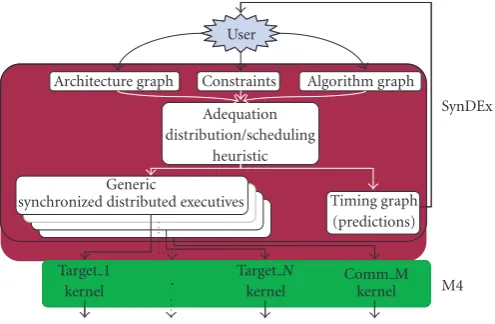
A SynDEx application (Figure 1) comprises an algorithm graph (operations that the application has to execute), which specifies the potential parallelism, and an architecture graph (multicomponent [10] target, i.e., a set of interconnected processors and specific integrated circuits), which specifies the available parallelism. “Adequation” means efficient map-ping, and consists of manually or automatically exploring the implementation solutions with optimization heuristics [9]. These heuristics aim to minimize the total execution time of the algorithm running on the multicomponent architec-ture, taking the execution time of operations and of data transfers between operations into account. These execution times are determined during the characterization process, which associates a list of characteristics, such as execution times, necessary memory, and so forth, with each (operation, processor)/(data transfer, communication medium) pair, re-spectively.
An implementation consists of both performing a distri-bution (allocating parts of the algorithm on components) and scheduling (giving a total order for the operations dis-tributed onto a component) the algorithm on the architec-ture. Formal verifications during the adequation avoid dead-locks in the communication scheme thanks to semaphores
Architecture graph Constraints Algorithm graph Adequation
distribution/scheduling heuristic Generic
synchronized distributed executives Timing graph (predictions)
Target 1 kernel
TargetN kernel
Comm M kernel
·
User
Dedicated executives for specific targets (specific compilers/loaders)
SynDEx
M4
Figure1: SynDEx utilization global view.
inserted automatically during the real-time code generation. Moreover, since the Synchronized Distributed EXecutives (SynDEx) are automatically generated and safe, part of the tests and low-level hand-coding are eliminated, decreasing the development lifecycle.
SynDEx provides a timing graph, which includes simu-lation results of the distributed application and thus enables SynDEx to be used as a virtual prototyping tool.
In the AAA methodology, an algorithm is specified as an infinitely repeated DFG. Each edge represents a data depen-dence relation between vertices, which are operations; opera-tion stands for a sequence of instrucopera-tions, which starts when all its input data is available and which produces output data at the end of the sequence. In SynDEx, there is an additional notion of reference. Each reference corresponds to the defini-tion of an algorithm. The same definidefini-tion may correspond to several references to this definition. An algorithm definition is a repeated DFG similar to those in AAA, except that ver-tices are references or ports so that hierarchical definitions of an algorithm are possible.
2.2. Automatic executive generation
The aim of SynDEx is to directly achieve an optimized im-plementation from a description of an algorithm and an architecture. SynDEx automatically generates a generic ex-ecutive, which is independent of the processor target, into several source files (Figure 1), one for each processor [11]. These generic executives are static and are composed of a list of macrocalls. The M4 macroprocessor transforms this list of macrocalls into compilable code for a specific processor target. It replaces macrocalls by their definition given in the correspondingexecutive kernel, which is dependent on a pro-cessor target and/or a communication medium. In this way, SynDEx can be seen as an off-line static operating system that is suitable for setting data-driven scheduling, such as signal processing applications [12,13].
SynDEx kernels are available for several processors, such as the TI2 TMS320C6x (C62x, C64x) and the Virtex FPGA families, and for several communication media such as links SDBs (Sundance digital buses-Sundance high-speed FIFOs), CPs (comports-Sundance FIFOs), BIFOs (BI-FIFOs-Pentek FIFOs), PCI bus, and TCP bus presented in the following sec-tion.
2.3. Design process
Our previous prototyping process integrated AVS3 (ad-vanced visual systems) as a front-end [14] for functional checking. AVS is a software designed for DFG description and simulation. The application was constructed by inserting existing modules or user modules into the AVS workspace, and by linking their inputs and outputs. The validated DFG was next converted into a new DFG by a translator to be com-pliant with SynDEx algorithm input. The main advantage was the automatic visualization of intermediate and resulting images at the input and output of each module. This charac-teristic enables the image processing designer to check and validate the functionality of the application with AVS before the step of the implementation.
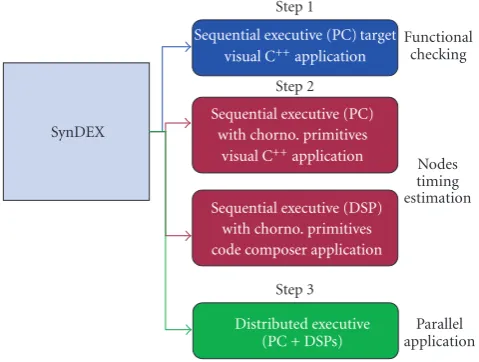
Although SynDEx is basically a CAD tool for distribu-tion/scheduling and code generation, here we demonstrate that SynDEx can also be directly used as the front-end of the process for functional checking (as it is possibly done with AVS). This is made possible thanks to our kernels pre-sented inSection 3. The design process is now based on a sin-gle tool and is therefore simpler and more efficient. SynDEx therefore enables full rapid prototyping from the application description (DFG) to final multiprocessor implementation (Figure 2) in three steps as the following:
SynDEX
Sequential executive (PC) target visual C++application
Sequential executive (PC) with chorno. primitives
visual C++application
Sequential executive (DSP) with chorno. primitives code composer application
Distributed executive (PC + DSPs)
Step 1
Step 2
Step 3
Functional checking
Nodes timing estimation
Parallel application
Figure2: SynDEx utilization global view.
Step 1. The user creates the application DFG using SynDEx. Automatic code generation provides a standard C code for a single host computer (PC) implementation (SynDEx PC ker-nel). In this way, the user can design and check each C func-tion associated with each vertex of its DFG, and can check the functionalities of the complete application with any standard compilation tools. With automatic code generation, visual-ization primitives or binary error rate computation can be used for easy functional checking of algorithms. The user can easily check his or her own DFG on a cluster of PCs intercon-nected by TCP buses. With this cluster, the user can emulate his or her embedded platform thanks to SynDEx distributed scheduling.
Step 2. The developed DFG is then used for automatic proto-typing on monoprocessor targets so that to chronometric re-ports are automatically inserted by the SynDEx code genera-tor. Each duration associated with each function (i.e., vertex) executed on each processor of the architecture graph is auto-matically estimated using dedicated temporal primitives.
Step 3. The user can easily use these durations to character-ize the algorithm graph by entering these values in SynDEx. Then, SynDEx tool executes an adequation (optimized distri-bution/scheduling) and generates a real-time distributed and optimized executive according to the target platform. Several platform configurations can be simulated (processor type, their number, and also different media connections).
The main advantage of this prototyping process is its simplicity because most of the tasks performed by the user concern the description of an application and a compiling environment. Only a limited knowledge of SynDEx and com-pilers is required. All complex tasks (adequation, synchro-nization, data transfers, and chronometric reports) are exe-cuted automatically, thus reducing the “time to market.” The user can rapidly explore several design alternatives by modi-fying the architecture graph or adding constraints.
3. SYNDEX EXECUTIVE KERNELS
As described above, the SynDEx generic executive will be translated into a compilable language. The translation of SynDEx macros into the target language is contained in li-brary files (also called kernels). The final executive for a processor is static and composed of one computation se-quence and one communication sese-quence for each medium connected to this processor. Multicomponent platform man-ufacturers must insert additional digital resources between processors to make communication possible. Thus, SynDEx kernels depend on specific platforms.
3.1. Development platforms
Different hardware providers (Sundance, Pentek) were cho-sen to validate automatic executive generation. Many com-ponent and intercomcom-ponent communication links are used in their platforms, ensuring accuracy and the generic aspect of the approach. The use of several hardware architectures guarantees generic kernel developments.
Sundance4platform: A typical Sundance device is made up of a host PC with one or more motherboards, each sup-porting one or more TIMs (Texas instrument module). A TIM is a basic building block from which you build your sys-tem. It contains one processing element, which is not nec-essarily a DSP, but an Input/Output device, or an FPGA. A TIM also provides mechanisms to transfer data from mod-ule to modmod-ule. These mechanisms, such as SDBs (200 MB/s), CPs (20 MB/s), or a global bus (to access a PCI bus up to 40 MB/s), are implemented on the TIMs using FPGAs.
The SMT320 motherboard (Figure 3) is modular, flex-ible, and scalable. Up to four different modules can be plugged into the SMT320 and connected using CP or SDB cables. The SMT361 TIM with a TMS320C6416 (400 Mhz) is very suitable for imaging processing solutions as the TMS320C64xx has special functions for handling graph-ics. The SMT319 TIM is a framegrabber, which includes a TMS320C6414 and two nonprogrammable devices: a BT829 PAL to YUV encoder, and a BT864 YUV to PAL decoder. These two devices are connected to the TMS320C6414 DSP thanks to two FIFOs, which are equivalent to SDBs with the same data rate. An SMT358 is composed of a programmable Virtex FPGA (XCV600) which integrates specific communi-cation links and specific IP blocks (computation).
Pentek5platform. The Pentek p4292 platform (Figure 4) is made up of four TMS320C6203 DSPs. Each DSP has three communication links: two bidirectional (300 Mhz) inter-DSP links and one for the Input/Output interface. The four DSPs are already connected to each other in a ring struc-ture. Some daughterboards may be added to the p4292 thanks to the VIM (velocity interface mezzanine) bus, such as analog-to-digital converters (ADC p6216), digital-to-analog converters (DAC p6229), or FPGAs (XC2V3000, XC2Vx Vir-tex2 family).
PC (pentium) PCI
Personal computer
Embedded motherboard: SMT320
DSP2 (TMS320C6416)
PCI (Bus)PCI
Bus 6 (CP)
Bus 3 (SDB) FPGA1 (Virtex)
DSPC3 (TMS320C6414) SDBa
SDBb CP0 CP1 PCI
SDBa SDBb CP0 CP1 CP2 CP3
SDBa SDBb VID in VID out Bus 1 (SDB)
In (VID in)
Out (VID out)
PAL to YUV (BT829) VID in YUV to PAL (BT864a)
VID out
SMT361
SMT358
SMT319
Figure3: Example of Sundance architecture topology.
This stand-alone Pentek platform is connected to an Eth-ernet network. This allows TCP/IP (1.5 MB/s) communica-tions between DSPs and any computer in the network in order to check a binary error rate, or to visualize a decoded image. However, this Bus’s throughputs will not authorize the transfer of uncompressed data.
3.2. Software component kernels
Most of the kernels are developed in C languageso that they can be reused for any C software programmable device. These kernels are similar for the host computer (PC) and the em-bedded processors (DSPs). The generated executive is com-posed of a sequential list of function calls (one for each DFG operation). This kind of executive and the fact that the adapted C compiler for DSPs has really improved in terms of resource use mean that the gap between an executive writ-ten in C and an executive writwrit-ten in an assembly language is narrow. The user can design each function associated with each vertex of its DFG in C or assembly language for better results [15].
SynDEx creates a macrocode made of several interleaved schedulers: one for computation and the others for commu-nications allowing parallelism of those actions. We have cho-sen to use multichannel enhanced DMA (direct memory ac-cess) transfers, thus maximizing parallelism and timing per-formance. Data transfers are executed in parallel with com-putation minimizing communication duration. DMA and CPU have their own bus to access the internal memory,
therefore bus conflicts only appear when CPU and DMA access an external memory. As all data buffers are in inter-nal memory, memory bus conflicts are null between CPU and DMA accesses. Communication overhead is only due to DMA setup which is negligible to take transfers into account (a few assembly instructions) [16].
The development of an application on TI processors can be hand-coded with TI RTOS (real-time operating sys-tem) called DSP/BIOS [17]. DSP/BIOS is well-suited for multithread monoprocessor applications. Several processors must be connected to improve computational performances and reach real-time performances. In this case, the multi-thread multiprocessor 3L diamond6 RTOS is more appro-priate for this situation than DSP/BIOS. Applications are built as a collection of intercommunicating tasks. The map-ping and scheduling of each task are chosen manually. Then data transfers and synchronizations are implemented by the RTOS using precompiled libraries. 3L enables multiproces-sor application development easier, faster, and suited to dy-namic communications between tasks. Data transfers are re-alized using DMA, but without any computation parallelism which is nearly equivalent topolling technique.
Data transfers in a signal processing application are gen-erally statically defined both in terms of data type and number so that their description with a DFG is suitable. The execution of DFG operations is also well defined so that
ADC daughterboard ADC 1 (DAC)
VIM
VIM 1 (BIFO) TCP (TCP)
Bus 1 (BIFO)
Bus 4 (BIFO) Bus 2 (BIFO)
Bus 3 (BIFO) DSP-A (TMS320C6203)
XX YY IO TCP
DSP-B (TMS320C6203) XX YY IO TCP
DSP-C (TMS320C6203) XX
YY IO TCP
DSP-D (TMS320C6203) XX YY IO TCP PC (Pentium)
TCP Personal computer
P4292 motherboard
Embedded boards
Figure4: Pentek 4292 motherboard and its daughterboard.
data transfers can be implemented with static processes. As static processes are faster than dynamic ones, SynDEx ker-nels are developed without any RTOS. That is to say that the SynDEx generic executive is not transformed into dynamic RTOS functions, but into specific static optimized functions.
3.3. Communication media kernels
With AAA methodology, two different models are possi-ble for communication media between processors: the SAM (single access memory) and RAM (random access memory, shared memory) models.
The SAM modelcorresponds to FIFOs in which data are pushed by the producer if it is not full, and then pulled by the receiver if the FIFO is not empty. Synchronizations be-tween the two processors are hardware signals (empty and full flags) and are not handled by SynDEx semaphores. The data must be received in the same order as it is sent. Most of our kernels are designed according to this model. SDBs, CPs, and BIFO DMAs enable parallelism between calculation and communications, whereas TCP and BIFO do not enable it (data polling mechanism).
The RAM modelcorresponds to an indexed shared mem-ory. A memory space is allocated, and an interprocessor syn-chronization semaphore is created for each item of data that has to be transferred. This mechanism allows the destination processor to read data in a different order to which it has been written by the source processor. Interprocessor synchroniza-tions are handled by SynDEx. The first implementation of the RAM model, through the PCI bus, is described in the fol-lowing section.
A PCI transfer kernel, for communications between a DSP on Sundance platforms and the host computer, is first
developed with the SAM model. First, the host and DSP must be synchronized. Each data transfer therefore encloses two synchronizations because the PCI bus does not have hard-ware signals like a usual FIFO (full or empty flag). The re-ceiver must first wait for the sender to write new data in the PCI memory. Then, the receiver can read data from the PCI memory and send an acknowledgement back to the sender. This “rendez-vous as soon as possible mechanism” induces idle or wait states, but is mandatory to ensure the medium is ready for the next transfer and to guarantee transfer order. PCI communications using the SAM model reach a maxi-mum transfer rate of 16 MB/s. This mechanism drastically slows down PCI transfers. In addition, a shared buffer is actu-ally allocated to the PC’s RAM by the PCI bus driver. There-fore, a new PCI kernel implementing the RAM model has been developed, and the transfer rate has been improved (up to 40 MB/s). Each item of data that has to be transferred has its own address allocation in the PCI memory and cor-responding semaphores, which allows several buffers to be written before the first one is read. This results in less wait states and more time for computation. The PCI scheduler is controlled by interrupt when using this model. Conse-quently, communications and computations can be concur-rent on the DSP, thus reducing overall execution time.
3.4. Hardware component kernel
Code generation
Generic SynDEX.m4x
Architecture-dependent Application-dependent Application name.m4x
Processor type-dependent C62x.m4x C64x.m4x Pentium.m4x FPGA.m4x
Media-type-dependent SDB.m4x (C62x, C64x, FPGA) CP.m4x (C62x, C64x, FPGA)
Bus-PCI-SAM.m4x (C62x, C64x, Pentium) Bus-PCI-RAM.m4x (C62x, C64x, Pentium) TCP.m4x (Pentium, C62x)
BIFO.m4x (C62x, C64x, FPGA) BIFO-DMA.m4x (C62x, C64x, FPGA) Figure5: SynDEx kernel organization.
Programming of a communication link depends on its type, but also on the processor. Previous works have al-ready validated these libraries [18], however, they need to evolve with processors or communication links (depending on provider’s additional logic).
3.5. Kernel organization
The libraries are classified to make developments easier and to limit modifications when necessary. As shown inFigure 5, these files are organized in a hierarchical way. An application-dependent library contains macros for the application, such as the calls of the algorithm’s different functions. A generic li-brary contains macros used regardless of the architecture tar-get (basic macros). The others are architecture-dependent: processor or communication type-dependent. Processor-dependent libraries contain macros related to the real-time kernel, such as memory allocations, interrupt handling, or the calculation sequence. Communication type-dependent libraries contain macros related to communications: send, receive, and synchronization macros, communication se-quences. As different processor types (with different pro-gramming of the link) can be connected by the same com-munication type, one part per processor type can be found in one library. The right part of the file is used during the macroprocessing.
Kernels have been developed for every component of the platforms described inSection 3.1. When SynDEx is used for a new application, only the application-dependent library needs to be modified by the user. Architecture-dependent libraries are added or modified when a new architecture is used (a processor or a medium that does not have its kernel).
4. UMTS APPLICATION
UMTS is much more challenging than previous 2G sys-tems, such as GSM. In particular, UMTS signals have a 3.84 MHz bandwidth compared with 270 kHz for GSM. Both
Table1: Legenda of UMTS FDD transmitter.
SRC Source (pseudorandom generator)
CRC Add of cyclic redundancy check bits
SEG Segmentation
COD Channel coding
EQU Equalization
INT1 First interleaving
INT2 Second interleaving
SPRdata Spreading of information bits
SPRctrl Spreading of control bits
SUM Creation of a complex signal
CST-SCR-code Generation of the scrambling code
SCR Scrambling
DPCCH Generation of control bits
PSH Pulse shaping
application and signal processing layers are very demand-ing. This partially explains the delay in the effective arrival of UMTS on the market. It presents a very interesting case study for high efficiency multiprocessing heterogeneous im-plementations. This becomes even more relevant in a soft-ware radio [19] context, which aims to implement as much radio processing as possible in the digital domain, and es-pecially onto processors and reconfigurable hardware. The advantages firstly consist of easing the system design, while privileging fast software instead of heavy low-level hardware development. Secondly, the system supports new services and features thanks to software adaptation capability during system operation [20].
4.1. General description
Transport block
SRC CRC SEG COD EQU INT1 INT2 SPR data
SPR ctrl DPCCH
SUM SCR PSH
CST SCR code Frame/frame
Slot/slot
Figure6: UMTS FDD transmitter (Tx).
Transport block
BER DCRC DSEG DCOD DEQU DINT1 DINT2 DSPR data DSCR RAKE MFL Slot/slot CST SCR code
Frame/frame
Figure7: UMTS FDD receiver (Rx).
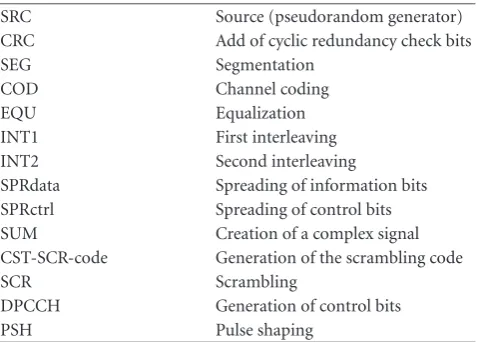
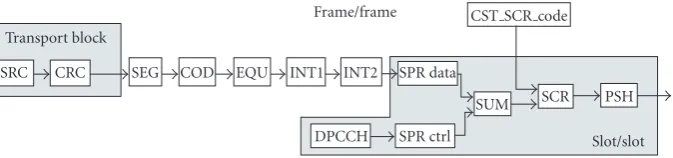
as shown in the DFG in Figure 6. This does not represent a total real UMTS since synchronization is artificial and no propagation channel is used (the link is completely digital). Data may be generated by an arbitrary source (SRCFigure 6: not in the standard) for bit-error-rate verifications or ex-tracted from a real application, such as a video stream, to make demonstrations.
Link characteristics in the measured version are as fol-lows:
(i) 1 transport channel, (ii) 1 physical channel, (iii) no channel coding, (iv) spreading factor of 4,
(v) data rate of 950 kbps.
The receiver [5] extracts the information necessary for the application using the scheme represented in Figure 7
(Table 2).
The number of operations effectively in use is much greater than the figures shown, as most of them are dupli-cated several times. The generation of a 10 ms frame (com-posed of 15 slots) requires the instantiation of approximately 140 operations for Tx and 240 for Rx in this version, which is a minimum. The granularity of the operations has the same level of complexity as a FFT, FIR, or a memory reorganiza-tion.
4.2. FIR implementation
The filter operation is of particular interest because its im-plementation complexity makes it very resource consum-ing. This is a FIR (finite impulse response) with a raised-root cosine impulse response specified by the UMTS stan-dard at both transmitter baseband output and receiver base-band input. Here, the impulse response is symmetric around its center; this characteristic can be exploited to minimize the number of memory accesses, the required memory for
storing the filter coefficients and the number of multiplica-tion operamultiplica-tions. In order to obtain a convenient rejecmultiplica-tion of contiguous bands, the filter impulse response is spread over 16 chips and consequently has 33 taps with an oversampling of 2. The same coefficients are used for Tx and Rx.
Equation (1) gives us the representation of a FIR filter with an odd number of coefficient, wherehis the real coef-ficient vector of the filter impulse response (filter taps),Kis number of coefficients (or taps),x[n] andy[n], thenth input and output complex data samples, respectively.
y[n]=hK−1
2
·xn−K−1
2
+
(K−1)/2−1
k=0
h[k]·x[n−k] +x[n−K+ 1 +k].
(1)
A real filter (i.e., filter whose coefficients are real) applied to complex data is very frequent inbaseband(BB) process-ing and consists of applyprocess-ing the same filter independently to the real and imaginary parts of the data samples. In our case we are interested in fixed point implementations, so care must be taken to avoid overflow while preserving signal qual-ity (in terms of SNR). The filter at Tx is calledpulse shap-ing (PSH), and at Rx matched filtering (MFL). At Tx PSH and oversample (which consists of inserting zero between bi-nary digits), operation can be combined in order to mini-mize computation. In this case we obtain the following: ifn is even,
y[n]=
(K−1)/4
k=0
h[2k]·
x[n−k] +x
n−
(K−1)
2 +k
,
Table2: Legenda of UMTS FDD receiver.
MFL Matched filter
RAKE Simplified RAKE (one perfectly
synchronized finger)
CST-SCR-code Generation of the scrambling code
DSCR Descrambling
DSPRdata Despreading of information bits
DINT2 Deinterleaving 2
DINT1 Deinterleaving 1
DEQU Equalization inverse operation
DCOD Channel decoding
DSEG Transport block extraction
DCRC Analysis of cyclic redundancy check bits
BER Bit error rate
ifnis odd,
y[n]=hK−1
2
·xn−K−1
2
+ (K−1)/4−1
k=1
h[2k]·
x[n−k]+x
n−(K−1)
2 +k
.
(3)
The nature of a FIR operation is particularly suited to FPGA implementations, but can also be implemented on DSP processors. A specific characteristic of the DSP is that it has a MAC (multiply accumulate) or a VLIW struc-ture to support filtering computing in one clock cycle. The TMS320C6x family, based on VLIW architecture, has six adders and two multipliers, which operate in parallel and complete execution in one clock cycle. A fixed point multiply accumulate takes two instructions: multiply on one cycle and accumulate on the next. Thanks to pipelining, it is possible to effectively compute two multiply accumulates per cycle.
The performance then directly depends on filter length and processor clock frequency as each tap is processed se-quentially. In an FPGA, it is possible to parallelize part or all of these operations, depending on the available gate sur-face. FIR implemented in the FPGA is a distributed arith-metic (DA) filter [21]. Features of this FIR are not multipli-ers, but only read only memory (ROM) and accumulators. The complexity of this filter only depends on the number of bits per sample, not on the number of taps.
In the particular case of C6x, it is possible to use a data buffer organization of the FIR as shown inFigure 8. FIR is a typical case where functional units in the microprocessor datapath can speed up processing. Data is processed in blocks. The interface consists of an input data buffer, the co-efficient buffer, and an output data buffer.
The algorithm for each input sample performs the func-tion ofy[n] in a for-loop. At the end of each block process-ing operation, the filter state is updated by copyprocess-ing the lastK input data into a state buffer (Figure 8). For the sake of pro-cessing efficiency, it is assumed that the input data buffer is stored in a memory after the state data buffer so that negative
h(0, . . . , K)
x(−K+ 1, . . . ,−1,0, . . . , N−1)
State New data
FIR (Ktaps)
y(0, . . . , N−1)
State update
Figure8: Data management for DSP implementation of an FIR.
Table3: Timing of PSH (input: 2560 samples).
Target C62x C64x XC2Vx
300 Mhz 400 Mhz 100 Mhz
Time/slot (microseconds) 576 320 338
Table4: Timing of MFL (input: 5120 samples).
Target C62x C64x XC2Vx
300 Mhz 400 Mhz 100 Mhz
Time/slot (microseconds) 1130 640 338
Table5: Tx timings and PSH ratio.
Target Sundance Pentek
Configuration 1∗C64x 1∗C62x 2∗C62x 1 ∗XC2Vx
1∗C62x
Time/frame 9.5 ms 11.8 ms 8.5 ms 9.6 ms
PSH ratio 50% 73% 53% 52%
indices of the input data buffer point to the state buffer data. In Tables3and4, the differences in timing between C62x and C64x (without taking clock rates into account) are due to the fact that compilers are not the same for each pro-cessor, and that those DSPs have different internal architec-tures. In an FPGA (XC2Vx), this FIR operation could be more parallelized giving better acceleration to the detriment of the gate surface. However, these time values are sufficient to get a Tx or Rx real-time application, that is why we use the same FIR implementation for PSH and MFL. An ele-mentary oversampling function just has to be added before PSH. On the contrary to FPGAs, we take advantage of the FIR features (cf. Section 4.2) on DSPs to optimize and di-vide by 2 the computation complexity of PSH at Tx, so that 576 microseconds versus 1130 microseconds are obtained on C62x, and 320 microseconds versus 640 microseconds on C64x.
4.3. Tx and Rx implementations
Table6: Rx timings and MFL ratio.
Target Sundance Pentek
Configuration 1∗C64x 1∗C62x 1 ∗XC2Vx
1∗C62x
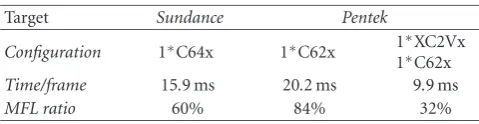
Time/frame 15.9 ms 20.2 ms 9.9 ms
MFL ratio 60% 84% 32%
Principally, due to PSH (Table 5, timing PSH ratio com-pared to a Tx implementation), the first transmitter imple-mentation onto the Pentek platform did not reach real time with one C62x DSP, however, it is possible to parallelize PSH in order to process half of the samples on two processors. Be-fore filtering, two buffers of 1296 samples (as described in
Figure 8) must be created. Each block processing operation overlaps 16 transient samples. The length of this PSH is re-duced by 1.5 when transfers are taken into account.
Furthermore, code generation and kernels can be used to quickly shift to another platform. UMTS prototyping on the Sundance platform required indeed few hours to reach to a real-time transmitter application, thanks to our previous works (UMTS algorithm description, SynDEx code genera-tion and kernels) on Pentek platform. This is a tremendous proof of the portability capabilities offered by the methodol-ogy.
UMTS Rx has been implemented according to three dif-ferent configurations (Table 6). A real-time application has been achieved on the Pentek platform with one DSP and one FPGA. MFL parallelization is also possible on several DSPs on Pentek platform, however, more than two DSPs are added compared with one FPGA in the previous configura-tion. A configuration with 4 DSPs requires many transfers in the Pentek ring structure, thus not reducing MFL computa-tion length by too much.
5. MPEG-4 OVER UMTS: A MULTILAYER SYSTEM
MPEG-4 is the latest compression standard. An MPEG-4 codec can be divided into ten main parts (e.g., system, vi-sual, and audio) with different timing requirements and exe-cution behaviors. Each part is divided into profiles and levels for the use of the tools defined in the standard. Each profile (at a given level) constitutes a subset of the standard so that MPEG-4 can be seen as a toolbox where system manufactur-ers and content creators have to select one or more profiles and levels for a given application. The application handled here is an MPEG-4 part 2 codec developed in our laboratory, which is based on the Xvid7codec. This MPEG-4 codec has also been tested on several distributed platform configura-tions [7] (multi-DSP implementation). Here, our aim is to interface UMTS with MPEG-4 to provide a bitstream to the UMTS application.
The methodology permits to merge the design of very different (heterogeneous) parts of the system in terms of hardware processing support (PC, DSP, FPGA) as well as
7www.xvid.org
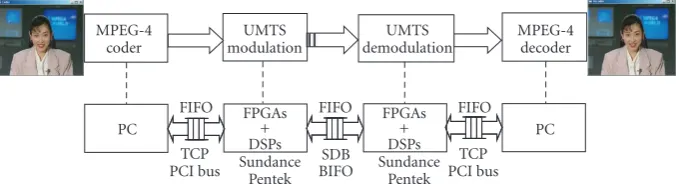
processing nature. A conventional methodology would re-quire different environments, which is a cause of bugs and in-compatibility at the integration step. This causes delays in the best case, and could even completely question the design in the worst case. Our approach permits to gather the different parts of the design very early in the design flow and anticipate integration issues. Nevertheless, MPEG-4 over UMTS arises a new difficulty: the complete application is a multilayer sys-tem (two layers MPEG-4 and UMTS) with different data pe-riodicities between layers. A consequence is that the whole application cannot be represented by a single DFG. The so-lution consists of breaking up the UMTS physical layer and the video codec layer into four algorithm subgraphs. Then these subgraphs (coder, decoder, modulation, and demodu-lation) have been implemented onto several processors con-nected each other with media (FIFO) following the topology ofFigure 9.
The MPEG-4 codec is not embedded here: firstly, TCP throughputs on the Pentek platform do not enable uncoded or uncompressed data to be transferred, and secondly, too few Sundance TIMs are available in our laboratory to em-bed a complete application with UMTS + MPEG-4. Our real-time MPEG-4 codec provides the maximum data rate sup-ported by our UMTS transceiver (950 kbps). An MPEG-4 bitstream, coded on a PC, is sent via a UMTS telecommuni-cation link to another PC to be decoded. Once the commu-nication transceiver has been implemented on a platform, it can be viewed as a communication medium equivalent to a FIFO.
So the platform integrating the MPEG-4 codec could be described as two PCs interconnected by a UMTS commu-nication medium. A FIFO is used to connect asynchronous applications (codec to UMTS communication link). Asyn-chronous means different periodicities and different data ex-change formats. A codec cycle corresponds to one image pro-cessing operation producing a variable compressed bitstream in a variable time (about 40 ms). A UMTS cycle executes one fixed size frame in 10 ms. FIFO material signals (empty and full flags) ensure the self-regulation of the global system (UMTS + MPEG-4). Two implementations of this global sys-tem have been rapidly done onto two platforms thanks to developed kernels as described inFigure 9. The global sys-tem runs in real time on Pentek platform and is not far from real time on Sundance platform (Rx is in 16 ms and must be 10 ms). The first implementation of the global application on Pentek platform takes quite a long time (two months) to find and solve the multilayer issue, but this implementation is instantaneously transposed on Sundance platform, which exactly illustrates the efficiency and the pertinence of the ap-proach.
6. CONCLUSIONS AND OPEN ISSUES
MPEG-4 coder
UMTS modulation
UMTS demodulation
MPEG-4 decoder
PC
FIFO
TCP PCI bus
FPGAs + DSPs Sundance
Pentek FIFO
SDB BIFO
FPGAs + DSPs
FIFO
TCP PCI bus
PC Sundance
Pentek Figure9: MPEG-4 over UMTS.
On the one hand, we have shown how SynDEx is capable of manually or automatically exploring several implementa-tion soluimplementa-tions using optimizaimplementa-tion heuristics, and on the other hand, how it automatically generates dedicated distributed real-time executives from kernels dependent on the proces-sors and the media. These executives are dedicated to the ap-plication because they do not use any support of RTOS, and are generated from the results of the adequation taking oper-ation and data transfer distribution and scheduling into ac-count while providing synchronizations between operations and data transfers and between consecutive repetitions of the DFG. The kernels enable recent multiprocessor platforms to be used and also enable the process to be extended to het-erogeneous platforms. It was tested on several different ar-chitectures composed of TI TMS320C6201, TMS320C6203, TMS320C6416 DSPs, Xilinx Virtex-E and Virtex-II FPGAs, and PCs.
The calculations and data transfers are executed in paral-lel. RAM and SAM communication models have been tested for PCI transfers. Higher transfer rates are reached using the RAM model enabling real-time video transfers between a PC and a DSP platform.
Several complex tasks are performed automatically, such as distribution/scheduling, code generation of data transfers and synchronizations. So the development of a new applica-tion is limited to the algorithm descripapplica-tion and to the adap-tation of kernels for platforms or components. Furthermore, as the C language is used and there is a large number of tested topologies, developed DSP kernels can easily be adapted to any other DSP and communication media.
The current MPEG-4 + UMTS application is still in progress to achieve wireless communication. A new version already integrates the channel coding (Turbo code) steps, which only slightly increases the overall complexity.
This approach ensures fast prototyping of digital sig-nal applications over heterogeneous parallel architectures in many technological fields. Other applications have already taken advantage of it. A SynDEx description of a MC-CDMA (probably planned as 4G) application has been developed by the IETR SPR laboratory [22]. LAR codec is a video codec studied in the IETR Image Group Laboratory. A sim-ilar scheme (Figure 9) has already been tested on different configurations: LAR over CDMA, MPEG-4 over MC-CDMA, and LAR over UMTS.
The complex MPEG-4 + UMTS application stresses that a multilayer system presents some specific characteristics in
terms of data flow. In the future, this case study may be cap-italized on creating in SynDEx new hierarchical models of architecture graphs in such a way the physical layer (telecom-munication link) may appear as a particular medium. An-other issue is the memory allocation in SynDEx. At each out-put of each vertex, SynDEx creates an allocation. At this time, memory allocations are reordered and reused manually to give an optimal solution. Current works deal with an auto-matic solution, based on graph coloring techniques and life memory allocation.
REFERENCES
[1] A. M. Eltawil, E. Grayver, H. Zou, J. F. Frigon, G. Poberezh-skiy, and B. Daneshrad, “Dual antenna UMTS mobile sta-tion transceiver ASIC for 2 Mb/s data rate,” inProceedings of IEEE International Solid-State Circuits Conference (ISSCC ’03), vol. 1, pp. 146–484, San Francisco, Calif, USA, February 2003. [2] K. Keutzer, S. Malik, A. R. Newton, J. M. Rabaey, and A. Sangiovanni-Vincentelli, “System-level design: orthogonaliza-tion of concerns and platform-based design,”IEEE Transac-tions on Computer-Aided Design of Integrated Circuits and Sys-tems, vol. 19, no. 12, pp. 1523–1543, 2000.
[3] T. A. Henzinger, C. M. Kirsch, M. A. A. Sanvido, and W. Pree, “From control models to real-time code using Giotto,”IEEE Control Systems Magazine, vol. 23, no. 1, pp. 50–64, 2003. [4] S. S. Bhattacharyya, P. K. Murthy, and E. A. Lee,Software
Syn-thesis from Dataflow Graphs, Kluwer Academic, Norwell, Mass, USA, 1996.
[5] 3GPP TS 25.213 v3.3.0: Spreading and Modulation FDD, re-lease 1999.
[6] F. Pereira and T. Ebrahimi,The MPEG-4 Book, Prentice-Hall PTR, Upper Saddle River, NJ, USA, 2002.
[7] N. Ventroux, J. F. Nezan, M. Raulet, and O. D´eforges, “Rapid prototyping for an optimized MPEG-4 decoder implemen-tation over a parallel heterogenous architecture,” in Proceed-ings of 28th IEEE International Conference on Acoustics, Speech, and Signal Processing (ICASSP ’03), vol. 2, pp. 433–436, Hong Kong, China, April 2003, Conference cancelled - Invited paper, ICME 2003.
[8] Y. Sorel, “Massively parallel computing systems with real time constraints: the “Algorithm Architecture Adequation” methodology,” inProceedings of 1st IEEE International Confer-ence on Massively Parallel Computing Systems (MPCS ’94), pp. 44–53, Ischia, Italy, May 1994.
[10] Y. Sorel, “Real-time embedded image processing applications using theA3 methodology,” inProceedings of IEEE Interna-tional Conference on Image Processing (ICIP ’96), vol. 2, pp. 145–148, Lausanne, Switzerland, September 1996.
[11] T. Grandpierre and Y. Sorel, “From algorithm and architec-ture specifications to automatic generation of distributed real-time executives: a seamless flow of graphs transformations,” in
Proceedings of 1st ACM and IEEE International Conference on Formal Methods and Models for Co-Design (MEMOCODE ’03), pp. 123–132, Mont Saint-Michel, France, June 2003.
[12] F. Balarin, L. Lavagno, P. Murthy, and A. Sangiovanni-Vincentelli, “Scheduling for embedded real-time systems,”
IEEE Design and Test of Computers, vol. 15, no. 1, pp. 71–82, 1998.
[13] L. A. Hall, D. B. Shmoys, and J. Wein, “Scheduling to minimize average completion time: off-line and on-line algorithms,” in
Proceedings of 7th Annual ACM-SIAM Symposium on Discrete Algorithms (SODA ’96), pp. 142–151, Atlanta, Ga, USA, Jan-uary 1996.
[14] V. Fresse, O. D´eforges, and J. F. Nezan, “AVSynDEx: a rapid prototyping process dedicated to the implementation of dig-ital image processing applications on Multi-DSP and FPGA architectures,”EURASIP Journal on Applied Signal Processing, vol. 2002, no. 9, pp. 990–1002, 2002, Special Issue on imple-mentation of DSP and communication systems.
[15] Texas Instruments, “TMS320C6000 Optimizing Compiler User’s Guide,”reference spru187l, March 2004.
[16] Y. Le M´ener, M. Raulet, J. F. Nezan, A. Kountouris, and C. Moy, “SynDEx executive kernel development for DSP TI C6x applied to real-time and embedded multiprocessors architec-tures,” inProceedings of 11th European Signal Processing Con-ference (EUSIPCO ’02), Toulouse, France, September 2002. [17] Texas Instruments, “TMS320 DSP/BIOS User’s Guide,”
refer-ence spru423b, September 2002.
[18] F. Nouvel, S. Le Nours, and I. Herman, “AAA methodology and SynDEx tool capabilities for designing on heterogeneous architecture,” inProceedings of 18th Conference on Design of Circuits and Integrated Systems (DCIS ’03), Ciudad Real, Spain, November 2003.
[19] A. Kountouris, C. Moy, and L. Rambaud, “Reconfigurability: a key property in software radio systems,” inProceedings of 1st Karlshruhe Workshop on Software Radios, Karlsruhe, Germany, March 2000.
[20] C. Moy, A. Kountouris, and A. Bisiaux, “HW and SW archi-tectures for over-the-air dynamic reconfiguration by software download,” inProceedings of Software Defined Radio workshop of IEEE Radio and Wireless Conference (RAWCON ’03), Boston, Mass, USA, August 2003.
[21] S. A. White, “Applications of distributed arithmetic to digi-tal signal processing: a tutorial review,”IEEE ASSP Magazine, vol. 6, no. 3, pp. 4–19, 1989.
[22] S. Le Nours, F. Nouvel, and J. F. Helard, “Example of a Co-Design approach for a MC-CDMA transmission system im-plementation,” inJourn´ees Francophones sur l’Ad´equation Al-gorithme Architecture (JFAAA ’02), Monastir, Tunisie, Decem-ber 2002.
M. Rauletreceived his postgraduate certifi-cate in signal, telecommunications, images, and radar sciences from Rennes University in 2002, and his Engineering degree in elec-tronic and computer engineering from Na-tional Institute of Applied Sciences (INSA), Rennes Scientific and Technical University in 2002, where he is currently working as a Ph.D. student in collaboration with Mit-subishi Electric. His interests include image
compression and telecommunication algorithms and rapid proto-typing.
F. Urbanreceived his postgraduate certifi-cate in signal, telecommunications, images, and radar sciences from Rennes Univer-sity in 2004, and his Engineering degree in electronic and computer engineering from INSA, Rennes Scientific and Technical Uni-versity in 2004. He is currently working as a Ph.D. student in collaboration with Thom-son R&D, France. His interests include im-age compression, rapid prototyping, DSP optimization, and codesign.
J.-F. Nezanis an Assistant Professor at Na-tional Institute of Applied Sciences (INSA) of Rennes and a Member of the IETR Lab-oratory in Rennes. He received his post-graduate certificate in signal, telecommu-nications, images, and radar sciences from Rennes University in 1999, and his Engi-neering degree in electronic and computer engineering from INSA, Rennes Scientific and Technical University in 1999. He
re-ceived his Ph.D. degree in electronics in 2002 from the INSA. His main research interests include image compression algorithms and multi-DSP rapid prototyping.
C. Moyhas been an Engineer at the Na-tional Institute of Applied Sciences (INSA), Rennes Scientific and Technical University, France, 1995. He received his M.S. and Ph.D. degrees in electronics in 1995 and 1999 from the INSA. He worked from 1995 to 1999 on spread-spectrum and RAKE re-ceivers for the Institute on Electronics and Telecommunications of Rennes (IETR). He then worked 6 years at Mitsubishi Electric
O. Deforges is a Professor at National Institute of Applied Sciences of Rennes (INSA). He graduated in electronic engi-neering from the ´Ecole Polytechnique, Uni-versity of Nantes, France, in 1992, where he also received a Ph.D. degree in image pro-cessing in 1995. In 1996, he joined the De-partment of Electronic Engineering at the INSA, Rennes Scientifc and Technical Uni-versity. He is a Member of the UMR CNRS
6164 IETR Laboratory in Rennes. His principal research interests are image and video lossy and lossless compressions, image under-standing, fast prototyping, and parallel architectures.
Y. Sorel is a Research Director at INRIA (National Institute for Reseach in Com-puter Science and Control) and a Scien-tific Leader of the Rocquencourt’s Team AOSTE (Analysis and Optimization for Sys-tems with Real-Time and Embedding Con-straints). His main research topics are mod-eling of distributed real-time systems with graphs and partial order, uniprocessor and multiprocesseur real-time scheduling