SIMULATION PERFORMANCE OF LOW DAMAGE BASE CONNECTION ON ABAQUS
MAHDI HATAMI
A project report submitted in partial fulfillment of the requirements for the award of the degree of
Master of Engineering (Civil-Structure)
Faculty of Civil Engineering Universiti Teknologi Malaysia
iv
v
ACKNOWLEDGEMENTS
First and foremost, I would like to express my sincerest gratitude and appreciation to my supervisor,Assoc. Prof. Dr. Suhaimi Abubakar for his worthwhile guidance throughout this project. His wide knowledge and his expert advice during the period I have been carrying out this research, has been of great value for me. His invaluable comments, kind consideration, encouragement and support have provided a good basis present this thesis.
vi
ABSTRACT
Current design codes can provide life safety performance level based on observations from recent earthquakes. However, buildings experience some damage that could be very costly to recover. Low damage control systems have been developed in recent years to minimize damage in severe earthquakes. The aim of this study is to improve the understanding of the performance of low damage steel structures especially in regard to column base connections and the friction connection with Grade 8.8 bolts. The study involves numerical analysis to assess the stress distribution, displacement, deformation and reaction forces by simulation on Abaqus Finite Element software. Outcomes include an increased understanding for low damage base connection. To reach this objective the base connection with low damage mechanism simulated using Abaqus software is compared with the results from welded base connection. It was observed that on low damage base connections, the stress distribution and yielding on main elements of structure (such as column) changed completely. This mechanism prevents any failure on column on connection with base
vii
ABSTRAK
viii
TABLE OF CONTENTS
CHAPTER TITLE PAGE
DECLARATION ii
DEDICATION iii
ACKNOWLEDGEMENTS iv
ABSTRACT v
ABSTRAK vi
TABLE OF CONTENTS vii
LIST OF FIGURES x
1 INTRODUCTION 1
1.1 Definition of Low Damage 2
1.2 Background of Study 5
1.3 Problem Statement 9
1.4 Objective of Study 10
1.5 Scope of Study 11
2 LITERATURE REVIEW 12
2.1 Low Damage Seismic Design of Buildings 12
2.1.1 Seismic Resistant Systems 13
2.1.2 Elastic Structures 16
ix
2.1.4 Passive, Active and Hybrid Systems (F. Hajjar,J. at al.,
2013) 34
2.1.5 Dampers 38
2.1.6 Elastomeric Isolators 38
2.2 Types of Devices 39
2.2.1 Metallic and Friction Dampers 39
2.2.2 Viscous and Viscoelastic Dampers 51
2.2.3 Self-Centering Dampers 52
2.2.4 Elastomeric Isolators 60
2.2.5 Sliding Devices 61
2.3 Low Damage Design of Base Connection 65
2.3.1 Base Flexibility 65
2.3.2 Behavior of Steel Moment-Resisting Frames 68 2.3.3 Theoretical Behavior of Base Plate Connection 69 2.3.4 Previous Research on Column Base Behavior and
Special 71
2.4 Modeling Details 76
3 ABAQUS SIMULATION PROCEDURE 78
3.1 Finite Element Method 83
3.2 Solution Strategy 84
3.3 Element Types 85
3.3.1 Component interaction and contact: 88
3.3.2 Analyse Procedure 89
3.4 Material Properties for the Finite Element Model 91
3.5 Define Contact 104
3.6 Applying Cyclic Load as the Displacement on Model 110
4 RESULTS AND DISCUSSION 113
5 CONCLUSION 121
x
LIST OF FIGURES
FIGURE NO. TITLE PAGE
1.1 Possible Target Performance Objective for Damage- Resistant Structures (MacRae, 2010, based on Hamburger, PEER) 7
1.2 Definition of structural performance 8
1.3 Building Performance Levels and Ranges (FEMA) 9
2.1 Post-Tensioned Beam Deformation and Hysteretic Behaviour
(MacRae, 2010) 17
2.2 Slotted bolted connections (Fitzgerald et al. (1989) 18 2.3 Components and assembling of Asymmetrical Friction Connections
(AFC) 19
2.4 Flexural AFC SHJ Connection (MacRae and Clifton, 2010) 20
2.5 Asymmetric Friction Connection 21
2.6 Simplified Lateral Force-Displacement Mechanism 23
2.7 SHJ Hysteresis with Steel (S) Shims 24
2.8 Alternative SHJ Connection (MacRae and Clifton, 2010) 26 2.9 Idealized Bolt Deformation, External Horizontal Forces and
Bearing Areas on Bolt Shank. 28
2.10 External Forces on Components. 28
xi
2.17 Elastomeric isolator 39
2.18 Mechanism of friction dampers on bracing system 41 2.19 Mechanism of multi unit friction dampers on bracing system 41 2.20 Mechanism of multi unit friction dampers on bracing system 41
2.21 Slotted-bolt friction damper 42
2.22 Slip-friction connector with (a) asymmetric mechanism, and (b),
with symmetric mechanism. 43
2.23 Sumitmo devices 46
2.24 Different types of hysteretic dampers 48
2.25 lead extrusion dampers 49
2.26 Taylor device 50
2.27 Viscoelastic damper 52
2.28 External and internal view of EDR (Nims et al., (1993)) 55
2.29 Friction spring details 56
2.30 Applications of Unbounded Post Tensioning Tendons (Walsh
et al. 2008) 57
2.31 Concept of posttension energy dissipating steel connection: a steel frame with posttension energy dissipating connections; b geometric configuration and free-body diagram of exterior posttension energy dissipating connection (Christopoulos l. , 2002 ) 58
2.32 Frictional Pendulum System 63
2.33 Exposed base plate types of behavior 74
2.34 Schematics of the three typical flexural failure modes assumed for base connections – (a) plate bending capacity on the compression side, (b) plate bending capacity on the tension side, and (c) anchor
rod tensile capacity (Gomez IR, 2010) 75
2.35 base connection detail with non-prying AFC 76
2.36 Modes of deformations 77
3.1 Parametric Modeling Script - Main Algorithm Diagram 79 3.2 Three main stage of analyse procedure on Abaqus 80
3.3 Non-prying model parts 82
3.4 Different kinds of 3D solid elements 87
3.5 Stress-strain behavior for a linear elastic material, such as steel,
xii
3.6 Nominal stress-strain behavior of an elastic-plastic material in
a tensile test. 92
3.7 Decomposition of the total strain into elastic and plastic components. 96
3.8 Material properties for steel 98
3.9 Material properties for steel 99
3.10 Material properties for steel 100
3.11 Material properties for steel 100
3.12 Material properties for steel 101
3.13 True stress-strain curve for steel plate C 102
3.14 Plate 20mm true stress-strain curve 103
3.15 Material properties for bolts 104
3.16: The master surface relationship with slave surface. 105
3.17 Contact algorithm in Abaqus/Standard. 107
3.18 Contact between column and baseplate. 108
3.19 Bolt interactions with plate’s holes 109
3.20 Cyclic loading regime according to ACI report T1.1-01 111
3.21 Bolt load to consider tightening load 112
4.1 Stress on welded and low damage connection on drift 4 % 114 4.2 Column & plates Displacements, rocking, uplift 115
4.3 Hysteresis curve of rigid connection 116
4.4 Hysteresis curve of Non-prying model 117
4.5 Strain energy of column flange down side curve on drift 4% 118 4.6 Equilibrium of energy and external work on whole model 119 4.7 Von mises stress on three part of one bolt as a example 119
CHAPTER 1
1 INTRODUCTION
Structural Steel is an important construction material it possess attributes such as strength, stiffness, toughness and absolutely high ductility of steel makes it very practical material for construct diverse structures. These characters define very efficient material for seismic resistant elements. Multy-story steel structures usually are designed with moment frame, braced frame or combination of both such as shear walls. Steel special moment-resisting frames (SMRFs) are one of the most commonly used lateral load resisting structural systems. They are considered to be most effective for this function due to their high ductility and high energy-dissipation capacity, in turn, to plastic hinge formation in the beams and the column bases, and joint panel zone shear deformation. The ability of SMRFs to resist lateral load is provided by frame action: the development of bending moments, and shear forces in the frame members and joints.
2
are seismic resistant but this is not adequate, designers make an effort to come across innovative techniques that are more reasonably priced and more effectual. For a building to resist a severe earthquake, it must exhibit dependable strength, stiffness and ductility.
From the viewpoint of life safety, a building with relatively low strength and high ductility capacity may provide the same life safety protection as a building with higher strength and lower ductility capacity. When subjected to a severe earthquake, however, the outcome in terms of structural damage sustained will be quite different. While both buildings will remain standing, the low strength/high ductility building is likely to require considerably greater structural repair than the high strength building. Such repair will at best require the building to be out of service for a period of time following the event, with associated occupant and business disruption.
1.1 Definition of Low Damage
Dr. (Clifton, 2005), has defined the concept of low damage design:
No structural repair required after ultimate limit state design level earthquake Minimal structural repair required after earthquake
Repairs easy to undertake with building in service, repairs to non structural walls
Building effectively self centers at end of shaking, residual drifts under 0.15% recommended
3
compressive, shear and bending loads. Connections are implicit completely pinned or fully rigid in the majority design of steel frames, however, the response of structures after different earthquakes proving that assumptions were wrong.
Actually, the connections behavior is something between rigid and pine which have some rotational stiffness. To explain the real actions of connections a large number of experimental and also theoretical analyses have been done. Bolted and welded beam-to-column connections rotate at an angle due to applied bending moment. Deformation of connections negatively influences the stability of structure which is occurred as the result of growing drift of frame and also declining the stiffness of members which are connected to the joints, this increase in frame drift will multiply the second order (P-Δ) effects overall stability of the frame. (Abdalla K.M., 1995) Therefore, the non-linear features of connections have significant role in structural steel design.
The efficiency of moment resisting steel frame also depends on the rotational stiffness of the column base connection. As (Aviram, 2010),carried out, a pattern of base plate connection effect significantly the property, For example, if the base plate is thin and its footing area is close to the size of the column, the base plate will present almost no impedance to rotation of the column and will behave as a pinned connection. Despite this, if the plate is thick or sufficiently stiff, the arrangement and size of the anchor bolts are adequate, and the footing area is large. The base plate will really resist rotation of the column. So the column base will approach the behavior of a fixed support. In between these two extremes are partially restrained or semi-rigid connections, which can be approximated by rotational springs of varying stiffness values.
4
In contrast, in the recent Canterbury earthquakes (September 2010, February 2011, and June 2011) there was no significant damage at the base of buildings, possibly because of the rotational flexibility at the column base”. This base flexibility was result from diverse sources, for instance column base, foundation deflection, and soil effect. Several of these buildings were constructed with rigid bases which were expected the frames yielded at the column bases similarly the height of the building due to inelastic mechanism to lateral loading. The base flexibility probably decreases the demands at the base of the structures but it may cause higher storey drift or demands on the steel frame (Borzouie, 2012).
In this report studies will conduct to understanding the performance of low damage bases. An analytical study will focus to estimate base flexibility effect on demands of the steel structure. Although some studies tried to make clear the effect of soil on the response of the structures (Moghaddasi 2012), but very little work has been carried out on the effect of base flexibility on response of the structure (MacRae et al. (2009);Aviram et al. 2010).. It is estimated that the friction connection is one of the candidates for low damage base connection (Borzouie, 2012).
5
Reduction in the column base stiffness and strength due to inadequate detailing, poor workmanship, deterioration of foundation concrete, long-term deformations, or cumulative damage from previous earthquakes also can lead to an important increase in the displacement demand of the frame. Larger drifts of the frame will cause higher structural and nonstructural damage, resulting in high repair costs after a significant earthquake. Large drifts can also lead to a soft-story mechanism and buckling instability hazard due to P-Delta effects. Observations after the 1994 Northridge and 1989 Loma Prieta, California, earthquakes suggest that the rotational stiffness of base plate assemblages significantly affected the damage suffered by structures not only directly to the base plate but also to other parts of the frame (Bertero, Anderson, and Krawinkler 1994; Youssef, Bonowitz, and Gross 1995). Investigation of this effect is one of the main goals of this report.
1.2 Background of Study
Seismic structural systems could possibly be categorized in these provisions of generations (Mackinven H., 2007):
Generation 0: when structures designed without any consideration to earthquake.
Generation 1: performance level specified and at least one performance level defined for design buildings but, that level have not been derived to verify.
6
estimation. In this generation when structure resists earthquake vibrations inelastic deformations occur as a result of yielding. Structures need some repair or replacement after earthquake because of various damages.
Generation 3: This design make an effort to post pone structural damages and prevent any inelastic/nonlinear action to reach this object for example by design the structure and foundation to be strong a sufficient amount but it is generally uneconomic in Parts of high seismicity. Other methods occupy the technique of adding energy dissipating and force limiting devices with an elastically responding skeleton. This consists of rocking structures that the structure experience uplift, yet returns to its preliminary position following the shaking (e.g. Housner) base isolation systems, friction devices, viscous dampers and other energy dissipation systems have been using in this generation of design each one of them has some privileges and troubles, which will review in next chapters. (Danner, 1995) (Christopoulos, 2002), (Ricles, 2002) and (Clifton, 2005) considered tee beam-column joint subassemblies of this type.
Generation 4: In this category structures intention is no damage to the all part of frame, in addition to contain insignificant damage under the design level occasion to the elements designed to resist the inelastic demand. “In Generation 4 moment frames, the beam end connections are designed as the primary element resisting inelastic demand. As Dr. (Clifton, 2005) considered, Moment frame connections of this type are detailed such that energy is dissipated without causing significant extension of the slab on the top of the beam, and without beam growth”.
7
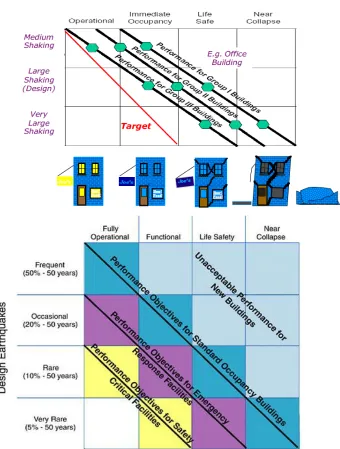
on buildings. Low damage systems have been developed in recent years to minimize damage in severe earthquakes, Figure1.1 shows the target.
Figure 1.1: Possible Target Performance Objective for Damage-Resistant Structures (MacRae, 2010, based on Hamburger, PEER)
8
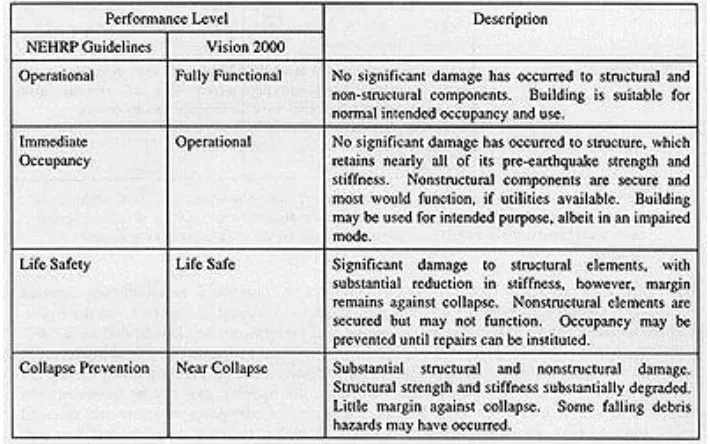
continuous scale describing the building’s expected performance, or alternatively, how much damage, economic loss, and disruption may occur. Each Building Performance Level is made up of a Structural Performance Level that describes the limiting damage state of the structural systems and a Nonstructural Performance Level that describes the limiting damage state of the nonstructural systems. Three Structural Performance Levels and four Nonstructural Performance Levels are used to form the four basic Building Performance Levels listed above.
9
Figure1.3: Building Performance Levels and Ranges (FEMA)
1.3 Problem Statement
10
important because in earthquakes such as Northridge (1994) and Kobe (1995) many brittle failures were reported at the base of the structure. In contrast, in the recent Canterbury earthquakes (September 2010, February 2011, and June 2011) there was no significant damage at the base of buildings, possibly because of the rotational flexibility at the column base. This base flexibility was resulted from different sources such as column base, foundation deflection, and soil effect. Some of these buildings were constructed with rigid bases, and it was anticipated that the frames yielded at the column bases as well as the height of the building due to inelastic mechanism to lateral loading. The base flexibility probably reduces the demands at the base of the structures but it may lead to higher storey drift or demands on the steel frame. In this thesis two different studies will be conducted to develop low damage bases. An analytical study will focuses to estimate base flexibility effect on demands of the steel structure. Although some studies tried to make clear the effect of soil on the response of the structures (Moghaddasi 2012), but very little work has been carried out on the effect of base flexibility on response of the structure (MacRae et al. 2009);Aviram et al. 2010). Secondly, low damage base connections will be developed based on experimental tests.
1.4 Objective of Study
In this study will try to improve the understanding of the performance of low damage steel structures. The aim of this study is to improve the understanding of the performance of low damage steel structures especially in regard to column base connections by simulation of one type of base connection which called Non-prying connection on finite element software Abaqus. The main topics can be categorized as:
11
1.5 Scope of Study
REFERENCES
Andriono, T., and Carr, A. J. (1990). "Seismic resistant design of base isolated multistory structures," PhD Thesis, University of Canterbury, Christchurch, New Zealand.
ADANY, S., CALADO, L. & DUNAI, L. Experimental Studies on Cyclic Behavior Modesof Base-Plate Connections. Third International Conference on the Behavior of Steel Structures in Seismic Areas ( STESSA 2000), 2000 Montreal, Canada. 97-104.
AISC 2005. Seismic Provisions for Structural Steel Buildings. American Institute of Steel Construction, Inc., Chicago, IL.
AKIYAMA, H. 1984. Strength and deformation of exposed type of steel column bases. Transactions of the Architectural Institute of Japan, 46-54.
AKIYAMA, H., YAMADA, S., YTAKAHASHI, M., KATSURA, D., KUMURA, K. & YAHATA, S. 1998. FullScale Shaking Test of the Exposed-Type Column Bases. Journal of Structural and Construction Engineering, 514, 185-192. ASTANEH-ASL, A. 2008. Seismic Behavior and Design of Base Plates in
BracedFrames. SteelTIPS Reort. Structural Steel Educational Council.
ASTANEH, A., BERGSMA, G. & H., S. J. Behavior and Design of Base Plates for Gravity, Wind and Seismic Loads. National Steel Construction Conference, 1992 AISC, Chicago, Illinois.
AVIRAM, A., STOJADINOVIC, B. & DER KIUREGHIAN, A. 2010. Performance and Reliability of Exposed Column Base Plate Connections for Steel Moment-Resisting Frames. PEER. Pacific Earthquake Engineering Research Ccenter. BACHT, T., CHASE, J. G., MACRAE, G., RODGERS, G. W., RABCZUK, T.,
125
performance of a 3 story moment frame. Journal of Constructional Steel Research, 67, 1843-1849.
BUCHANAN, A. H., BULL, D., DHAKAL, R. P., MACRAE, G. A. & PALERMO, A. 2011. Base Isolation and Damage-Resistant Technologies for Improved Seismic Performance of Buildings. Department of Civil and Natural Resources Engineering University of Canterbury.
BURDA, J. J. & ITANI, A. M. 1999. Studies of seismic behavior of steel base plates, Center for Civil Engineering Earthquake Research, University of Nevada, Reno. CHANCHÍ GOLONDRINO, J., CHASE, J. G., RODGERS, G. W., MACRAE, G. A. & CLIFTON, C. G. 2012a. Velocity dependence of HF2V devices using different shaft configurations. NZSEE Conference. New Zealand.
CHANCHÍ GOLONDRINO, J., MACRAE, G. A., CHASE, J. G., RODGERS, G. W. & CLIFTON, C. G. Methodology for quantifying seismic sustainability of steel framed structures. Steel structures workshop, 2010 University of Canterbury, Christchurch, New Zealand.
CHANCHÍ GOLONDRINO, J., MACRAE, G. A., CHASE, J. G., RODGERS, G. W. & CLIFTON, C. G. 2012b. Behaviour of Asymmetrical Friction Connections using different shim materials. NZSEE Conference.
CHANCHÍ GOLONDRINO, J., MACRAE, G. A., CHASE, J. G., RODGERS, G. W., MORA MUÑOZ, A. & CLIFTON, C. G. 2012c. Design considerations for braced frames with asymmetrical friction connections - AFC. STESSA. Santiago de Chile.
CHANCHI, J., MACRAE, G. A., CHASE, J. G., RODGERS, G. W. & CLIFTON, C. G. 2012. Clamping Force Effects on the Behaviour of Asymmetrical Friction Connections. 15WCEE. Lisbon.
CHEOK, G. S. & LEW, H. S. 1990. Seismic performance of 1/3 scale post-tensioned precast beam-column connections.
CHI, H. 2009. Development of post-tensioned column base connection for self-centering seismic resistant steel frame. Ph.D. 3378710, Purdue University. CHRISTOPOULOS, C. & FILIATRAULT, A. 2006. Principles of Passive
126
CHRISTOPOULOS, C., FILIATRAULT, A., UANG, C. & FOLZ, B. 2002. Posttensioned Energy Dissipating Connections for Moment-Resisting Steel Frames. Journal of Structural Engineering, 128, 1111-1120.
CLIFTON, C. G. 2005. Semi-Rigid Joints for Moments Resisting Steel Framed Seismic Resisting Systems. PhD, University of Auckland.
DEIERLEIN, G. G., KRAWINKLER, H., MA, X., EATHERTON, M. & HAJJAR, J. F. 2011. Earthquake Resilient Steel Braced Frames with Controlled Rocking and Energy Dissipating Fuses. Steel Construction: Design and Research, 4, 171-175. DEWOLF, J. T. 1978. Axially Loaded Column Base Plates. Journal of the Structural
Division, 104.
DEWOLF, J. T. & SARISLEY, E. F. 1980. column base plates with axial loads and moments. Journal of the Structural Division, 106, 2167-2184.
FAHMY, M. B. 1998. Seismic behavior of moment resisting steel column bases. FEMA350 2000. NEHRP Recommended Provisions for seismic Regulations for New
Buildings and Other Structures. Building Seismic Safety Council, Washington, D.C.
FILIATRAULT, A. & CHERRY, S. 1985. Performance evaluation of friction damped braced steel frames under simulated earthquake loads, Earthquake Engineering Lab , Dept. of Civil Engineering, Univ. of British Columbia, Vancouver. FISHER, J. M. 2004. Industrial Buildings Roofs to Anchor Rods. Steel design guide
7. AISC.
FISHER, J. M. & KLOIBER, L. A. 2006. Base Plate and Anchor Rod Design, AISC, AISC.
FITZGERALD, T. F., ANAGNOS, T., GOODSON, M. & ZSUTTY, T. 1989. Slotted Bolted Connections in Aseismic Design for Concentrically Braced Connections. Earthquake Spectra, 5, 383-391.
GOMEZ, I. R. 2010. Behavior and Design of Column Base Connections. DOCTOR OF PHILOSOPHY, UNIVERSITY OF CALIFORNIA DAVIS.
HON, K. K. & MELCHERS, R. E. 1988. Experimental behaviour of steel column bases. Journal of Constructional Steel Research, 9, 35-50.
127
JASPART, J. P. & VANDEGANS, D. 1998. Application of the component method to column bases. Journal of Constructional Steel Research, 48, 89-106.
MAAN, O. & OSMAN, A. 2002. THE INFLUENCE OF COLUMN BASES FLEXIBILITY ON THE SEISMIC RESPONSE OF STEEL FRAMED STRUCTURES. 4th Structural Specialty Conference of the Canadian Society for Civil Engineering. Montréal, Québec, Canada.
MACRAE, G. A. 2008a. DSFD Braces and DSFD attachments. New Zealand Heavy engineering Research Association Steel Structures Research Panel Idea. Manukua.
MACRAE, G. A. 2008b. A New Look at Some Earthquake Engineering Concepts. M. J. Nigel Priestley Symposium Proceedings. IUSS Press.
MACRAE, G. A., CLIFTON, G. C., MACKINVEN, H., MAGO, N., BUTTERWORTH, J. & PAMPANIN, S. 2010. The Sliding Hinge Joint Moment Connection. Bulletin of the New Zealand Society for Earthquake Engineering, 43, 10.
MACRAE, G. A., MACKINVEN, H., CLIFTON, C. G., PAMPANIN, S., WALPOLE, W. R. & BUTTERWORTH, J. 2007. Tests Of Sliding Hinge Joints For Steel Moment Frames. Pacific Structural Steel Conference (PSSC). Wairakei, New Zealand.
MACRAE, G. A., URMSON, C. R., WALPOLE, W. R., MOSS, P., HYDE, K. & CLIFTON, C. 2009. AXIAL SHORTENING OF STEEL COLUMNS IN BUILDINGS SUBJECTED TO EARTHQUAKES. Bulletin of the New Zealand Society for Earthquake Engineering, 42, 275-287.
MANDER, T. J., RODGERS, G. W., CHASE, J. G., MANDER, J. B. & MACRAE, G. A. 2009. Damage avoidance design steel beam-column moment connection using high-force-tovolume dissipators. Journal of Structural Engineering, 135, 1390-1397.
MIDORIKAWA, M., AZUHATA, T., ISHIHARA, T. & WADA, A. 2006. Shaking table tests on seismic response of steel braced frames with column uplift. Earthquake Engineering & Structural Dynamics, 35, 1767-1785.
128
MOGHADDASI, M. 2012. ProbabilistiProbabilistic Quantification of the Effects of Soil−Shallow Foundation−Structure Interaction on Seismic Structural Response. PhD, University of Canterbury.
MORGAN, T. A. & MAHIN, S. A. 2008. Performance-based design of seismic isolated buildings considering multiple performance objectives. Smart Structures and Systems, 4, 655-666.
MURRAY, T. M. 1983. design of lightly loaded steel column base plates. Engineering Journal, 20, 143-152. NZS3404 1997. Steel structures standard. Part1. New Zealand.
PALL, S. & MARSH, C. 1982. Response of friction damped braced frames. Journal of structural engineering, 108, 10.
RODGERS, G., SOLBERG, K., MANDER, J., CHASE, J., BRADLEY, B. & DHAKAL, R. 2012. High-Force-to-Volume Seismic Dissipators Embedded in a Jointed Precast Concrete Frame. Journal of Structural Engineering, 138, 375-386.
RODGERS, G. W., CHASE, J. G., MANDER, J. B., LEACH, N. C. & DENMEAD, C. S. 2007. Experimental Development, Tradeoff Analysis and Design Implementation of High Force-To-Volume Damping Technology. NZSEE Bulletin, 40, 35-48.
RODGERS, G. W., MANDER, J. B. & CHASE, J. G. 2011. Semi-explicit rate-dependent modeling of damage-avoidance steel connections using HF2V damping devices. Earthquake Engineering & Structural Dynamics, 40, 977-992. RODGERS, G. W., MANDER, J. B., CHASE, J. G., DHAKAL, R. P., LEACH, N. C. & DENMEAD, C. S. 2008a. Spectral analysis and design approach for high force-tovolume extrusion damper-based structural energy dissipation. Earthquake Engineering & Structural Dynamics, 37, 207-223.
RODGERS, G. W., SOLBERG, K. M., CHASE, J. G., MANDER, J. B., BRADLEY, B. A., DHAKAL, R. P. & LI, L. 2008b. Performance of a damage-protected beam-column subassembly utilizing external HF2V energy dissipation devices. Earthquake Engineering & Structural Dynamics, 37, 1549-1564.
129
TAKAMATSU, T., TAMAI, H., YAMANISHI, T. & MATSUO, A. Self-Centering Performance of Non-Slip-Type Exposed Column Base. Proceedings of the Fifth International Conference on Behaviour of Steel Structures in Seismic Areas STESSA, 2006 Yokohama, Japan.
TREMBLAY, R. 1993. Seismic Behaviour and Design of Fric-tion Concentrically Braced Frames for Steel Buildings. PhD, University of British Columbia. WONG, Y. L., PAULAY, T. & PRIESTLEY, M. J. N. 1993. Response of circular
reinforced concrete columns to multi-directional seismic attack. ACI Structural Journal, 90, 180- 191.