1
A DISLOCATION DENSITY BASED CRYSTAL PLASTICITY MODEL
FOR SIMULATION OF DEFORMATION BEHAVIOR OF NICKEL
BASED SUPER-ALLOYS
M.K. Samal1, S. Ghosh2 1
Reactor Safety Division, Bhabha Atomic Research Centre, Trombay, Mumbai-85, INDIA 2
Department of Mechanical Engineering, Johns Hopkins University, Baltimore, MD-21218, USA E-mail of corresponding author: [email protected]
ABSTRACT
Nickel-based super-alloys such as Alloy-600 find wide applications in nuclear industry as materials for steam generator tubes, through-wall nozzles and welds, due to their superior strength and corrosion resistance properties. The micro-structure of these alloys consists of the primary γ-phase; secondary and tertiary
γ′precipitates. It is computationally prohibitive to incorporate the explicit finite element model of the γ γ ′− structure in a crystal-plasticity based constitutive framework to simulate the response of the polycrystalline micro-structure of these alloys. Hence, a physically-motivated multi-scale approach has been developed in this work for simulation of response of these types of alloys. In the lower length-scale, a dislocation-density based crystal plasticity formulation has been used to simulate the responses of various types of micro-structures. A new model for simulation of the mechanism of anti-phase-boundary shearing of the γ′precipitates, by the matrix dislocations, is developed in this work. The lower-scale model is homogenized as a function of various micro-structural parameters and the homogenized model is used in the next level of crystal-plasticity based multi-scale framework. The homogenized crystal-plasticity model has been used to simulate the creep response of a single crystal nickel-based super-alloy and the results have been compared with those of experiment from literature. It was observed that the new model has been able to model the tension-compression asymmetry (due to the presence of micro-twin) as observed in single crystal experiments.
Keywords: Nickel-based super-alloy; Crystal plasticity; Finite element simulation; Creep deformation; Homogenization
INTRODUCTION
Nickel-based super-alloys such as alloy 600 have been widely used in nuclear industry as steam generator tubes, through-wall nozzles, weld material etc. due to their superior strength and corrosion resistance properties [1]. Alloy 600 provides better resistance to stress corrosion cracking compared to SS304 grade of austenitic stainless steel. Alloy 182/82 have been used as welding electrode/ filler material and these are capable of depositing defect-free weldments in alloy 600. Recently, it was observed that alloy 600 is still subject to stress-induced reheat-cracking after long exposure to high purity reactor steam and primary water. As a result, a new nickel-based super-alloy, i.e., alloy 690 along with alloy152/52 welding electrodes has been developed to replace alloy 600. Similarly, for intermediate heat exchangers of high temperature gas-cooled reactors, nickel-based super-alloys are crucial due to their superior high-temperature strength and creep resistant properties.
Superior strength and creep resistance are dependent on the mechanisms for inhibiting the motion or slowing the speed of dislocations within the crystal structure. In nickel-based super-alloys, the γ′phase [Ni3(Al, Ti)] acts as a coherent barrier to dislocation motion and is a precipitate strengthener in the primary γmatrix [2-4]. The shape and size of γ′phase can be precisely controlled by careful precipitation-hardening heat-treatments. Many of the super-alloys also contain the secondary γ′phases with a fine dispersion of tertiary γ′between these phases [5-7].
2
The aim of this work is to develop a physically motivated multi-scale approach for simulation of response of these types of alloys. At the lower scale, a dislocation-density based crystal plasticity model is developed which simulates the response of various types of micro-structures within a single crystal. The micro-structures are designed with various shapes and volume fractions of γ′precipitates. A new model for simulation of the mechanism of anti-phase boundary shearing of the precipitates (with matrix dislocations) is also developed in this work. This mechanism is activated when the stress along with the interface dislocation density are sufficient to form super-dislocations in order to enter the ordered γ′phase, thereby inducing softening in the material.
The lower scale model is homogenized as a function of various micro-structural parameters and the homogenized model is used at the next level (i.e., grain level) of multi-scale framework. In addition, a new criterion for initiation of micro-twin and a constitutive model for twin strain accumulation are also used. Micro-twin is a deformation mechanism in these alloys when the dislocations at the interface of the precipitates separate into partials and the leading partials move on adjacent planes to create a re-ordering assisted micro-twinned region. This new formulation along with the homogenized crystal plasticity model has been used to simulate the stress-strain response as well as the tension-compression assymetry as observed in single crystal experiments of these nickel based super-alloys.
DISLOCATION DENSITY BASED CRYSTAL PLASTICITY MODEL AT THE LOWER SCALE Constitutive relations for shear strain rate on slip systems
The constitutive formulation of the dislocation density based crystal plasticity model is based on the simulation of shear strain rate γαon slip system α and it can be written as
mbv
α α α
γ =ρ (1)
where m
α
ρ is the density of mobile dislocations on slip system α, bis the Burger’s vector and vα is the velocity of dislocations on slip system α. This velocity of dislocations is a function of applied shear stress τα, effective stress
eff
α
τ in the slip system and other slip system resistances and can be written mathematically as [10-12]
( Qact kB )sinh eff act sgn
( )
B
V
v e
k α α θ
α λυ τ τα
θ
− ⎛ ⎞
= ⎜ ⎟
⎝ ⎠ (2)
where λ is the distance moved by the dislocation in each step (as it is a discontinuous process which depends upon
the probability of overcoming the barriers and the presence of other mechanisms) and it is sometimes called
dislocation jump, υ is the frequency of oscillation of the dislocations, Qactis the activation energy barrier to be
overcome by the dislocations (which depends upon the mechanism of interaction of dislocations with matrix and
other barriers, e.g., precipitates or other phases), kBis Boltzmann’s constant, θ is the applied absolute temperature
in Kelvin, Vactα is the activation volume which again depends upon the mechanism of deformation being active at the
applied stress and temperature and many other parameters.
The slip system resistances are represented in terms of passing stress τpassα and the activation volumeVactα .
The effective resolved shear stress τeffα is the stress above the slip system threshold resistance (which is represented
in terms ofτpassα ) and can be expressed as
pass pass
eff
if
0 otherwise
α α α α
α τ τ τ τ
τ = ⎨⎧⎪ − >
⎪⎩ (3)
The passing stress is due to the interaction of mobile dislocations with other dislocations and dislocation networks in the same slip plane and can be expressed as
pass c Gb1 P m
α α α
τ = ρ +ρ (4)
In the above Eq. (4),
c
1is a material constant, G is the shear modulus, ρPαis the density of dislocations which areimmobilized and are in the plane of the slip system αand are also called as parallel dislocations.
3
are considered in this model. Their evolution with slip strain rate gives rise to hardening and softening in the slip system response.
Constitutive formulation for hardening/softening response due to SSDs and GNDs
The change in density of statistically stored dislocations can be thought of as net effect of some of the processes of dislocation multiplication and annihilation [10] and can be written as
lf df aa ta
SSD SSD SSD SSD SSD
α α α α α
ρ =ρ +ρ +ρ +ρ (5)
where the subscripts stands for aaÆlock formation, dfÆ dipole formation, aaÆ athermal annihilation, taÆ thermal
annihilation respectively. The constitutive equations for these dislocation generation and annihilation processes can be found in Ref. [10,11]. The rate of change of SSDs can be written in general as
(
)
SSD SSD , SSD, F, ,
α α α α α
ρ =ρ γ ρ ρ τ θ (6)
On the other hand, the increment of the density of geometrically necessary dislocations depends upon the gradient of plastic shear strain rate on slip system α[13]. It can be arbitrarily oriented with respect to the slip plane and hence, it has three components (i.e., screw, edge and normal). These components contribute to the expression for the densities of forest and parallel dislocations.
The density of mobile dislocations, i.e., m
α
ρ is computed as a function of forest ( F
α
ρ ) and parallel ( P
α ρ ) dislocation density as
m c F P
α α α
ρ = θ ρ ρ (7)
where
c
is a constant. The density of forest and parallel dislocations are evaluated as functions of density of SSDs, GNDs and interaction coefficients χαβamong different slip system as(
)
(
)
SSD GND
SSD GND
, ,
, ,
F F
P P
α α β β αβ
α α β β αβ
ρ ρ ρ ρ χ
ρ ρ ρ ρ χ
=
= (8)
The densities of forest and parallel dislocations evolve due to plastic deformation. Similarly, the densities of SSDs and GNDs also evolve due to plastic deformation and different hardening mechanisms.
CONSTITUTIVE RELATIONS FOR MICRO-TWIN IN THE HOMOGENIZED MODEL
The criterion for initiation of micro-twin is based on the state of dissociation of the leading and trailing partials on a slip systemα. Due to the stress tensor σijacting on a material point, the leading and trailing Shockley
partials will experience stresses which can be denoted as τleadandτtrailrespectively. Based on the magnitudes of the
in-plane resolved shear stress and the stress on leading and trailing Shockley partials, a criteria has been suggested in Ref. [14] as to whether the partials will remain together or get dissociated at the interface of the γ and γ′phases of the super-alloy and this has been used in this work as the micro-twin initiation condition. In addition, the 12 twin systems in the FCC alloys contribute to the shear strain rate due to movement of Shockley partials in the
γ′precipitates. The constitutive relations for shear strain rate in these twin systems can be written as
(
tp)
( )
act eff tw
tw tp tp tp
sinh
sgn
B
Q k
B
V
b
e
k
α α
θ
α α
τ
αγ
ρ
λ υ
τ
θ
−
⎛
⎞
=
⎜
⎟
⎝
⎠
(9)where the subscripts ‘tw’ and ‘tp’ refer to ‘twin’ and ‘twin partials’ respectively. The rate of change in density of twin partials is written as
4
tp tp tw
c
b
α α α
ρ
=
′
ρ γ
(10)This equation contributes to hardening in the twin systems.
FINITE ELEMENT IMPLEMENTATION OF THE MODEL
The dislocation-density based crystal-plasticity framework as described in the previous sections, has been implemented in an in-house finite element based code. The calculation of all the constitutive state variables is done at a material point except the geometrically necessary dislocation density GND
α
4
rate of change of the density of GNDs depends upon the gradient of the product F nPT
α α
γ , where FPis the plastic
part of the deformation gradientFand nαis the normal to the slip systemα . The deformation gradient is written as a product of elastic and plastic parts (i.e., FeandFP). The plastic velocity gradientLp is calculated as the summation
of contribution of each slip and twin systems to Lp (the contributions being the product of shear rate
α
γ in each slip and twin system and the Schmidt’s tensormα⊗nα), i.e.,
1
n p
L αmα nα α
γ
=
=
∑
⊗ (11)The plastic deformation gradient is updated based on the plastic shear accumulation in each slip and twin systemα as follows.
p P P
F =L F (12)
The parameter F nPT
α α
γ at each material point of integration of a finite element is extrapolated to the nodes of that element and in this way, the local variable are converted into a nodal variable so that the nonlocal parameter can be evaluated at the material integration point in the next iteration step.
For the nickel based super-alloys, the matrix γ and the secondary γ′phases are considered explicitly in the finite element model. The material properties including the elastic constants and the dislocation density coefficients are different for the matrix and the secondary phases. Moreover, the secondary γ′is an ordered phase and doesn’t contain any dislocation initially. Due to the incompatibility, the dislocations pile up at the interface of the matrix and the γ′phase. When a critical condition is reached, the dislocations cut through the precipitates and the plastic deformation starts in the secondary γ′phase.
Theγ′phase is an ordered phase (with L12 microstructure). The matrix dislocations (in the disordered FCC phase) cannot enter this ordered phase. However, the matrix dislocations can form super-dislocations at the interface of matrix and the precipitate and then enter the ordered phase through the mechanism of anti-phase boundary (APB) shearing. APB shearing of γ′phaseis assumed to take place when the resolved shear stress along the slip system α and the dislocation density at the interface exceed critical values, i.e.,
c and m c
α α
τ >τ ρ >ρ (13)
where τcis the critical resolved shear stress and ρcis the critical density at the interface for onset of APB shearing
in the γ′phase. The constitutive models for both the γ andγ′phases have been implemented in the FE code along with the criteria for onset of APB shearing in the γ′phase and has been used for simulation of constant strain rate and creep tests on single crystal experiments as discussed in the following section.
RESULTS AND DISCUSSION
The dislocation-density based crystal plasticity model as described in the previous sections has been used to simulate the deformation behavior of single crystal experiments of nickel based super-alloy CMSX-4. The experimental results have been taken from Ref. [15]. This alloy contains around 70 % of γ′precipitates and the precipitate are of primarily cubical shape. The experiment has been conducted at 800 deg. C and the loading is along the [001] direction of the crystal.
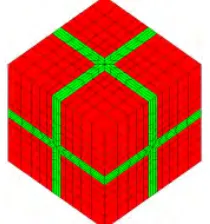
The FE mesh of the precipitate along with the matrix is shown in Fig. 1. The representative volume element (RVE) is loaded in the vertical direction with symmetric boundary conditions in x, y and z-directions. The other faces use periodic boundary conditions except the loading face. The FE mesh consists of 8-noded 3D brick elements. The results of the simulation with and without activation of APB shearing of the precipitates are shown in Fig. 2. The experiment is carried out at a strain rate of 1e-4 per second. The experimental data is also plotted in Fig. 2. As the precipitates have zero initial dislocation density and the volume fraction of the precipitates in the matrix is very high (i.e., of the order of 70%), the response is very stiff if the mechanism of APB shearing is not activated in the constitutive model.
5
accumulation of dislocation density at the interfaces of matrix and the precipitates at high stresses, the condition is satisfied so that the dislocations can form super-dislocations and enter the γ′phase. Hence, with incorporation of the criteria for APB shearing, the stress-strain response can be simulated satisfactorily as shown in Fig. 2. The material constants are also calibrated from this single crystal experimental data. Once the parameters are calibrated, these are used to simulate other micro-structures with various shapes and volume fraction of the γ′precipitates.
Fig. 1: FE mesh of the matrix along with the cubic precipitates loaded along the vertical [001] direction
0.00 0.01 0.02 0.03 0.04 0.05 0.06
0 200 400 600 800 1000 1200 1400 1600 1800
stress
(MPa)
strain
single crystal exp. (Fleury et al.) without precipitate shearing with precipitate shearing no precipitate
Fig. 2: Stress-strain response of a single crystal nickel based super-alloy CMSX-4 for loading on [001] direction at 800 deg. C
2 2.5 3 3.5 4 4.5 5
x 108 0
0.2 0.4 0.6 0.8 1 1.2 1.4 1.6 1.8
2x 10
-5
resolved shear stress (N/m2)
shea
r s
trai
n
in
cr
em
ent
vp=0.7513 n1=π/2 vp=0.125
n1=π/2
vp=0.5787 n1=π/2 vp=0.2963
n1=π/2
vp=0 ref. RVE
6
The precipitate shape is described by the parameter ‘n’ in the following equation for a generalized 3D ellipsoid.
1
n n n
x y z
a b c
⎛ ⎞ +⎛ ⎞ +⎛ ⎞ =
⎜ ⎟ ⎜ ⎟ ⎜ ⎟
⎝ ⎠ ⎝ ⎠ ⎝ ⎠ (14)
where a, b, and c are the dimensions of the precipitate in three principal directions and ‘n’ is the shape exponent. The shape exponent ‘n’ is equal to 2 for a sphere and tends to infinity for a cube. In order to parameterize the shape exponent in the homogenized model, the shape exponent has been converted to the shape factor n1 through
( )
1 1
n =tan− n (15)
The analysis has been carried out for various volume fractions of cubical precipitates (n=
∞
) with volume fractions ranging from 12.5% to 75.1%.0 0.2 0.4 0.6
0.8 1
0.5 1 1.5 2 0.9 1 1.1 1.2 1.3 1.4 1.5
volume fraction (vp) shape exponent (n1)
f(vp ,n1
)
fitted surface data points
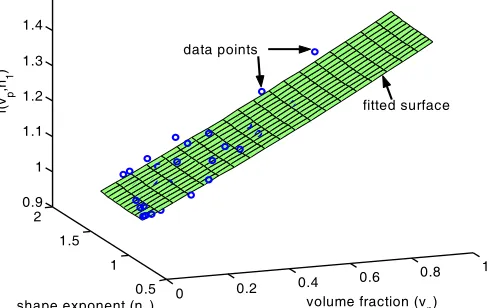
Fig. 4: Variation of the function f(vp,n1) w.r.t volume fraction and shape parameters of the precipitates
0 50 100 150 200 250 300
0 2 4 6 8 10 12 14 16
a
x
ia
l
cre
ep strai
n (%
)
time (hrs)
exp. (001 tension) FE simulation (001 tension) exp. (001 compression) FE simulation (001 compression)
Fig. 5: Prediction of tension-compression asymmetry in the creep response of the single crystal nickel based super-alloy CMSX-4 due to loading in [001] direction in tension and compression modes.
7
the homogenized variables has been expressed in suitable functional forms in the homogenized crystal plasticity framework.
The volume-averaged slip strain rate in each slip system has been evaluated and its evolution (maximum of all the slip systems) with volume-averaged resolved shear stress is presented in Fig. 3 for various values of precipitate volume fractions (v ) for a micro-structural system with cubical precipitates. Similar analyses have been p
carried out for micro-structural systems with different shapes of precipitates. The onset of plastic deformation is related to the value of the homogenized activation energy Qhomwhich is a function of the micro-structural variables
vp and n1. The ratio of Qhomto Qref(reference value of activation energy for the γphase only) has been determined from the analysis of individual micro-structures and a functional fit has been obtained, i.e.,
(
)
hom ref Q v ,np 1
Q Q = f (16)
Similar exercise has been carried out for the homogenized passing stress hom
P
τ and homogenized activation volume
hom
act
V respectively. The dependence of homogenized passing stress on vp and n1 has been determined from the values
of homogenized resolved shear stress after the APB shearing processs of the precipiates as shown in Fig. 3. Similarly, the homogenized resolved shear stress changes with continued plastic deformation and hence, the homogenized activation volume not only depends upon the parameters vp and n1, but also the the volume averaged plastic work Wp. The volume averaged plastic work density can evaluated from the FE results as
p
W
V t V
dtdV dV α α
τ γ
=
∫∫
∫
(17)Hence, we can represent the homogenized passing stress and activation volumes in the following functional forms, i.e.,
(
)
(
) ( )
hom
P P
ref P p 1
act act
hom ref V p 1 v2 p
v ,n
v ,n
f
V
V
f
f
W
τ
τ
=
=
(18)where the subscripts ‘hom’ refers to the homogenized quantity and ‘ref’ corresponds to that of γ phase only. The
variation of the function fp
(
v ,np 1)
w.r.t. vp and n1 is shown in Fig. 4. These homogenized parameters of thedislocation density based crystal plasticity model can now be used in the next level of simulations where we don’t
need to consider the explicit FE discretization of the γ γ− ′phases.
The homogenized dislocation density based crystal plasticity model has been used (along with the micro-twin nucleation and propagation laws) to simulate the creep response of single crystal nickel-based super-alloy with stress applied along different orientations of the crystal. The nickel based alloy is CMSX-4 and it contains 57.8 % volume fraction of precipitates. The experimental data has been taken from Ref. [16].
Significant tension-compression asymmetry is observed as can be seen from the experimental data presented in Fig. 5 when the single crystal specimen is loaded along [001] direction. For the loading in [001] tension, micro-twin formation is not observed as confirmed from transmission electron microscopy (TEM) observation in Ref. [16]. However, when loaded in [001] compression, significant micro-twin development is observed in the alloy and the deformation is dominant by the strain accumulation due to micro-twin.
The experimental conditions have been simulated in the model and the predictions of the model are compared with those of experiment in Fig. 5. It can be observed that the tension-compression asymmetry has been successfully modeled with the new formulation and the creep response with time as predicted by the model is very close to those of experiment both in [001] tension and [001] compression mode [Fig. 5]. It can be observed that the new model developed in this work has been very successful in satisfactorily predicting the single crystal experimental data. The micro-twin induced tension-compression asymmetry has also been satisfactorily predicted by the new model.
CONCLUSIONS
The stress-strain behavior and creep response of nickel-based super-alloys depend upon the morphology and
distribution of the γ′precipitates in the primary γ matrix. When simulating the response through the advanced
crystal-plasticity based formulations, it is not possible to incorporate the γ γ− ′morphology in the FE model
explicitly though it is possible to obtain the detailed information regarding the distribution of size, shape, spacing
8
is now possible to consider the effects of the underlying micro-structure in the homogenized crystal-plasticity based constitutive relations, which has been the focus of this work.
At the lower length scale of the multi-scale framework, a dislocation density based crystal plasticity model
has been used along with the consideration of the mechanism of APB shearing in the γ′phases. The constitutive
responses in the slip system level have been homogenized in order to develop a parametric form of the model in the higher length scale. The homogenized model as a function of the micro-structural parameters have been used along with the model for micro-twin nucleation and propagation to simulate the observed tension-compression symmetry behavior in the creep responses of single crystal specimens. The results of the new model have been compared with those of experiment and it was observed that the simulated results compare well with those of experiment. The model also predicts tension-compression asymmetry (due to presence of micro-twin) very satisfactorily.
REFERENCES
[1] Furrer D, Fecht H. Ni-based super-alloys for turbine discs. JOM Journal of the Minerals, Metals and
Materials Society 1999; 51(1): 14-17.
[2] Sugui T, Jun X, Xiaoming Z, Benjiang Q, Jianwei L, Lili Y, Wuxiang W. Microstructure and creep
behavior of FGH95 nickel-base super-alloy. Materials Science and Engineering 2011; A528 (4-5): 2076-2084.
[3] Goff SD, Couturier R, Guétaz L, Burlet H. Effect of the microstructure on the creep behavior of PM
Udimet 720 super-alloy—experiments and modeling. Materials Science and Engineering 2004; A387-389: 599-603.
[4] Hopgood AA, Martin JW. The creep behaviour of a Nickel-based single-crystal super-alloy. Materials
Science and Engineering 1986; 82: 27-36.
[5] Kovarik L, Unocic RR, Li J, Sarosi P, Shen C, Wang Y, Mills MJ. Microtwinning and other shearing
mechanisms at intermediate temperatures in Ni-based super-alloys. Progress in Materials Science 2009; 54: 839-873.
[6] Viswanathan GB, Sarosi PM, Whitis DH, Mills MJ. Deformation mechanisms at intermediate creep
temperatures in the Ni-base super-alloy Ren´e 88 DT. Materials Science and Engineering 2005; A400: 489-495.
[7] Sarosi PM, Srinivasan R, Eggeler GF, Nathal MV, Mills MJ. Observations of a<010> dislocations during
the high-temperature creep of Ni-based super-alloy single crystals deformed along the [001] orientation. Acta Materialia 2007; 55: 2509-2518.
[8] Hasija V, Ghosh S, Mills MJ, Joseph D. Modeling deformation and creep in Ti-6Al alloys with
experimental validation. Acta Materialia 2003; 51: 4533-4545
[9] Deka D, Joseph D, Ghosh S, Mills MJ. Crystal plasticity modeling of deformation and creep in
polycrystalline Ti-6242 Metallurgical and Materials Transactions 2006; A37: 1371-1388
[10]Ma A, Roters F. A constitutive model for fcc single crystals based on dislocation densities and its
application to uniaxial compression of aluminium single crystals. Acta Materialia 2004; 52(12): 3603-3612.
[11]Ma A, Roters F, Raabe D. A dislocation density based constitutive model for crystal plasticity FEM
including geometrically necessary dislocations. Acta Materialia 2006; 54: 2169–2179.
[12]Ma A, Roters F, Raabe D. On the consideration of interactions between dislocations and grain boundaries
in crystal plasticity finite element modeling-theory, experiments and simulations. Acta Materialia 2006; 54: 2181-2194.
[13]Ashby MF. The deformation of plastically non-homogeneous materials Philosophical Magazine 1970; 21:
399-424
[14]Zhou N., Wang Y. 2011. A new model for micro-twin initiation in nickel-based super-alloys. Manuscript
under preparation.
[15]Fleury G, Schubert F, Nickel H. Modelling of the thermo-mechanical behaviour of the single crystal
super-alloy CMSX-4. Computational Materials Science 1996; 7: 187-193.
[16]Kakehi K. Tension/ Compression asymmetry in creep behavior of a Ni-based super-alloy. Scripta