FROM INNOVATION TO APPLICATION
Enhancing Decision Support for Vector-Borne
Disease Control Programs
—
The Disease
Data Management System
Edward K. Thomsen, Rinki M. Deb, Sophie Dunkley, Marlize Coleman, Geraldine Foster, Miguel Orlans, Michael Coleman*
Department of Vector Biology, Liverpool School of Tropical Medicine, Liverpool, United Kingdom
Introduction
Data is at the core of any successful vector-borne disease control or elimination activity. At the early stages of control, monitoring data can help prioritize limited funding and resources to maximize impact. During the pre-elimination and elimination phases, surveillance data itself becomes the primary intervention by quickly identifying persistent transmission [1]. In addi-tion, it has been identified that spatial decision-support tools will be crucial to integrate with health information systems (HIS) as countries strive for elimination [2].
The Disease Data Management System (DDMS) is a tool designed to meet the data manage-ment and decision-support needs of vector-borne disease control programs as they transition through control to elimination. The development and functionality of the DDMS has been described elsewhere [3], and particular advantages and disadvantages are highlighted inBox 1. Here, we describe the implementation and impact of the system in disease-endemic countries, user feedback, and future challenges.
Box 1. Advantages and Disadvantages of the DDMS
Advantages
• High configurability means that the system can be adjusted for any vector-borne dis-ease control program.
• Capable of supporting decision making from control through elimination phases.
• Decision support, reporting, and spatial visualization components for multiple diseases integrated into a single tool.
• Query builders mean that the user is not limited to pre-defined reports but can easily create custom queries on demand.
Disadvantages
• High configurability means that well-trained administrators are required.
• System versatility sometimes causes untrained users to experience the DDMS as being overly complex.
• Direct mobile data capture not currently integrated. OPEN ACCESS
Citation:Thomsen EK, Deb RM, Dunkley S, Coleman M, Foster G, Orlans M, et al. (2016) Enhancing Decision Support for Vector-Borne Disease Control Programs—The Disease Data Management System. PLoS Negl Trop Dis 10(2): e0004342. doi:10.1371/journal.pntd.0004342
Editor:Michael A Johansson, Centers for Disease Control and Prevention, UNITED STATES
Published:February 18, 2016
Copyright:© 2016 Thomsen et al. This is an open access article distributed under the terms of the
Creative Commons Attribution License, which permits unrestricted use, distribution, and reproduction in any medium, provided the original author and source are credited.
Funding:Funding for the initial development of the system was provided by the Innovative Vector Control Consortium. Funding for the implementation was provided by the President’s Malaria Initiative and the Zambia Integrated Systems Strengthening Program through the United States Agency for International Development, Medical Care Development International, the Bill and Melinda Gates Foundation, and the World Health Organization through a TDR grant. The funders had no role in study design, data collection and analysis, decision to publish, or preparation of the manuscript.
System Implementation
The DDMS has been implemented in seven countries in Africa and Asia (Table 1). All coun-tries have employed a similar system architecture in which the database is accessible via the internet and there is bidirectional flow of data and outputs at all organizational levels (Fig 1).
Overall, the primary impact in most countries has been increased accessibility of data and therefore more informed decision making. This is most apparent in Zambia, where the Insecti-cide Resistance Management Technical Working Group uses DDMS outputs, in the form of maps and reports, to inform decisions related to management of insecticide resistance [4]. The implementation in Zambia, although a good example of how the DDMS can impact decision making, has not been without its challenges. Since November 2014, the DDMS has not been used, primarily because of a loss of momentum as the responsibility of maintaining the system shifted between malaria control partners. This has highlighted the need to bolster the capacity
Table 1. Description of where the DDMS is currently being implemented, for what purpose, and by what organization.
Country Disease DDMS Modules Used Implementing Organization
Benin Malaria case surveillance (passive) Ministry of Health
Ghana Malaria entomological surveillance The President’s Malaria Initiative (PMI)-funded Africa Indoor Residual Spray Project (AIRS)
Ethiopia Malaria entomological surveillance The PMI-funded AIRS project
Zambia Malaria entomological surveillance, Indoor Residual Spray (IRS) planning and monitoring
The PMI-funded AIRS project and Ministry of Health
Mali Malaria entomological surveillance The PMI-funded AIRS project
Equatorial Guinea
Malaria entomological surveillance, case surveillance (active and passive), IRS planning and monitoring, indicator surveys, long-lasting insecticidal net (LLIN) distribution, larval source management, form builder for custom forms
Bioko Island Malaria Control Project
India Visceral Leishmaniasis
entomological Surveillance, IRS monitoring Rajendra Memorial Research Institute
doi:10.1371/journal.pntd.0004342.t001
of related systems (organizational data culture, data collection procedures, IT infrastructure) to support DDMS implementations.
The prospect of increased data accessibility prompted the Africa IRS (AIRS) project, funded by the President’s Malaria Initiative, to adopt the DDMS after initial trials in Zambia and Ethi-opia [5]. This will involve the deployment of the DDMS as the entomological database in eight AIRS countries in sub-Saharan Africa. The DDMS in each country can be accessed by stake-holders nationally and internationally, which has made comparison of data at the international level more feasible.
User Feedback
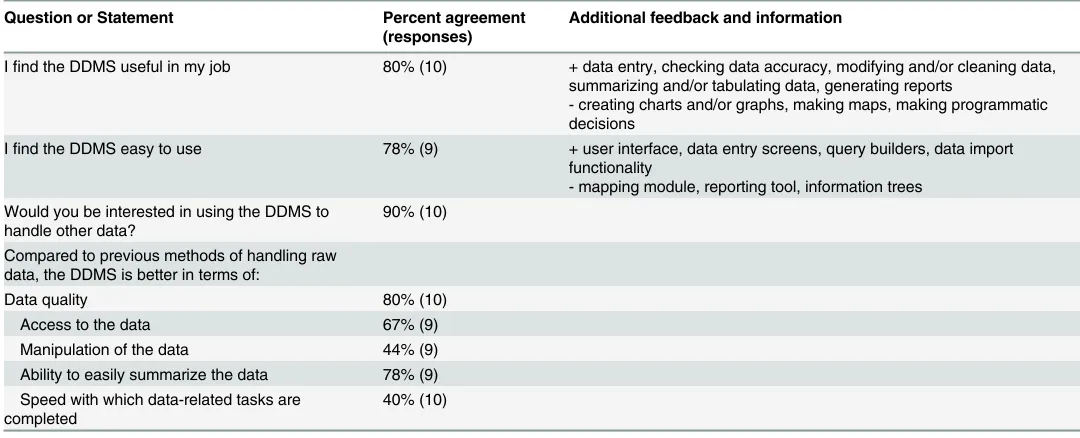
DDMS users were asked to complete an anonymous online survey to assess perceptions on use-fulness, usability, and comparison with previous data-handling methods (S1andS2 Appendi-ces). Responses were received from ten individuals in five countries. The results from this survey have highlighted the strengths of the system as well as aspects that are underutilized (Table 2). For example, nearly everyone felt that the DDMS was both useful and easy to use. However, some components, such as the mapping module and reporting tool, were consis-tently highlighted as difficult to use. In addition, job functions related to these components were highlighted as areas where the DDMS was not very useful. Some of these issues can be addressed with more rigorous training, while others can be addressed with a redesign of the user interface. Both of these aspects will be important to focus on to ensure that the system is utilized to its fullest capacity.
Eighty percent of users felt that the DDMS improved data quality compared to previous methods (usually Excel or Access databases). Processes that occur outside of the DDMS, such as data collection and entry procedures, influence some characteristics of quality data, such as timeliness and completeness. However, accuracy, accessibility, and consistency are data charac-teristics that are likely improved by using the DDMS and are primarily facilitated by ontological trees specifying which data can be entered as well as query builders that improve data accessibil-ity. A thorough evaluation of data quality is necessary to confirm users’perceptions.
Table 2. User feedback.
Question or Statement Percent agreement
(responses)
Additional feedback and information
Ifind the DDMS useful in my job 80% (10) + data entry, checking data accuracy, modifying and/or cleaning data, summarizing and/or tabulating data, generating reports
- creating charts and/or graphs, making maps, making programmatic decisions
Ifind the DDMS easy to use 78% (9) + user interface, data entry screens, query builders, data import functionality
- mapping module, reporting tool, information trees Would you be interested in using the DDMS to
handle other data?
90% (10)
Compared to previous methods of handling raw data, the DDMS is better in terms of:
Data quality 80% (10)
Access to the data 67% (9)
Manipulation of the data 44% (9)
Ability to easily summarize the data 78% (9) Speed with which data-related tasks are
completed
40% (10)
Challenges Remaining
Positive user feedback, combined with the documented impact of this tool on decision making, reinforces the need to support the adoption of decision-support tools in disease control pro-grams. However, experience with the DDMS has highlighted a primary challenge in achieving this goal: information systems do not exist in silos. They need to be underpinned by an organi-zational culture that values data use, data collection, and transfer processes that maximize reli-ability, as well as infrastructure to support their deployment.
If this challenge is addressed, the DDMS possesses several unique features that could sup-port global goals of elimination and control. First, as a multidisease system, the DDMS can facilitate integration of vector control programs, which can bolster neglected tropical disease elimination efforts [6]. Second, because of standardized data formats, the DDMS can facilitate cross-border collaboration and collective decision making. The feasibility of this has already been demonstrated through the AIRS project. Third, the DDMS has a sophisticated alert sys-tem that responds in real time as individual cases are entered. As control programs progress from the control to elimination phases, this will be a crucial feature that will allow rapid and focal response to outbreaks [7]. Lastly, the DDMS uses open-source technology that can inte-grate with other widely-used HIS, such as District Health Information Software 2 (DHIS2). The DDMS can augment current DHIS2 functionality by providing unique tools that support daily decision-making in vector-borne disease control programs. Data could therefore enter the system via the DDMS and be shuttled into a database like the DHIS2 for integration with higher-level health system data.
Moving forward, it will be necessary to rigorously assess the DDMS as any other component of an HIS to determine the technical, behavioral, and organizational determinants of its effect [8]. While user feedback is useful in determining strengths and weaknesses, future work needs to move beyond perceptions to see if the DDMS adds value to the overall HIS. In order to assure its sustainability, the DDMS user community must be able to connect with one another to seek guidance. This will decrease the reliance on a central organization to provide support. In addition, it will be necessary to secure development funding to ensure that the software con-tinues to stay up to date with current technology.
Supporting Information
S1 Appendix. DDMS User Survey—English. (PDF)
S2 Appendix. DDMS User Survey—French. (PDF)
Acknowledgments
We would like to sincerely thank Abt Associates and the PMI Africa Indoor Residual Spraying Project, the Zambia National Malaria Control Centre, the Rajendra Memorial Research Insti-tute, Medical Care Development International and the Bioko Island Malaria Control Project, and the Ministry of Health in Benin for their valuable insights and input on the use of the DDMS.
References
2. Kelly GC, Tanner M, Vallely A, Clements A. Malaria elimination: moving forward with spatial decision support systems. Trends Parasitol. 2012; 28: 297–304. doi:10.1016/j.pt.2012.04.002PMID:22607693
3. Eisen L, Coleman M, Lozano-Fuentes S, McEachen N, Orlans M, Coleman M. Multi-disease data man-agement system platform for vector-borne diseases. PLoS Negl Trop Dis. 2011; 5: e1016. doi:10. 1371/journal.pntd.0001016PMID:21468310
4. Thomsen EK, Chanda E, Musapa M, Kamuliwo M, Brogdon WG, Norris DE, et al. An operational frame-work for insecticide resistance management planning. Emerg Infect Dis. 2015;In press.
5. The PMI Africa Indoor Residual Spraying (AIRS) Project. Semi-annual report: October 1, 2014—March 31, 2015. Bethesda, MD: The PMI AIRS Project, Abt Associates, Inc.;
6. Reimer LJ, Thomsen EK, Tisch DJ, Henry-Halldin CN, Zimmerman P a, Baea ME, et al. Insecticidal bed nets and filariasis transmission in Papua New Guinea. N Engl J Med. 2013; 369: 745–53. doi:10. 1056/NEJMoa1207594PMID:23964936
7. The malERA Consultative Group on Monitoring Evaluation and Surveillance. A research agenda for malaria eradication: monitoring, evaluation, and surveillance. PLoS Med. 2011; 8: e1000400. doi:10. 1371/journal.pmed.1000400PMID:21311581