© 2013, IJCSMC All Rights Reserved 146 Available Online atwww.ijcsmc.com
International Journal of Computer Science and Mobile Computing
A Monthly Journal of Computer Science and Information Technology
ISSN 2320–088X
IJCSMC, Vol. 2, Issue. 11, November 2013, pg.146 – 154
RESEARCH ARTICLE
Managing and Configuring Network through
Software Defined Networking (SDN)
K. Venkatraman
1, Dr. V. Parthasarathy
21
Student, Department of information technology, Veltech Multitech Engineering College, India 2
Professor, Department of computer Science and engineering,Veltech Multitech Engineering College,India
[email protected],[email protected]
Abstract - This paper presents in the area of software defined networking. Our aim is to identify limitations of current networking technologies and how software-defined networks (SDN) could reduce cost, and improve competence to provide significant business value to many enterprises and campus Networks for their network management . These outcomes can lead to increased market potential for contenders which identify favorable solutions to existing networking constraints. We pursue to identify solutions in this paper to enable possible customers to assess that SDN may be preferable over Current network and also SDN introduces new possibilities or network management and configuration methods. In this article, we identify problems with the current state-of-the-art network configuration and management mechanisms and introduce mechanisms to improve various aspects of network management.
Keywords: software defined networking; open flow switch; open flow protocol; NAT; NOX
I. INTRODUCTION
© 2013, IJCSMC All Rights Reserved 147
become simple packet accelerating devices (data plane) but the “common sense ” or control logic is implemented in the controller (control plane). This exemplar shift brings several benefits compared to legacy methods. First it is much easier to introduce new ideas in the network through a software program, as it is easier to change and manipulate than using a fixed set of commands in patented network devices. Second, SDN introduces the benefits of a centralized approach to network configuration, opposed to distributed management: operators do not have to configure all network devices individually to make changes in network behavior, but instead make networkwide traffic forwarding decisions in a logically single location, the controller, with global knowledge of the network state.
In this we explore how SDN can provide better mechanisms for common network management and configuration tasks across a variety of different types of networks. While many prior studies have explored the potential benefits of applying SDN in computer networks to facilitate the evolution of network technologie RCP [9], 4D [10], and Ethane [6]), there has been little study of how SDN might make various tasks associated with managing and operating a network easier.
II. SOFTWARE DEFINED NETWORKING
Software-defined networking (SDN) is a new emerging technology for networking in which control is Decoupled a hardware and given to software part called a controller[1]. When a packet arrives at a switch in a foreseeable network rule built into the switch patented firmware tell the switch where to forward the packet. The switch sends every packet going to the same destination along the same path and treats all the packets the exact same way. In the campus network, smart switches designed with application-specific integrated circuits (ASICs) are Refined enough to recognize different types of packets and treat them differently, but such switches can be quite expensive. The aim of SDN is to allow network administrators respond quickly to changing to the requirements. In a software-defined network, a network administrator can shape traffic from a centralized control software without having to touch individual switch. The administrator can change any network switch rules when necessary ordering, de-ordering or even blocking specific types of packets with a very level gritty of control. This is especially helpful in a cloud computing multi-tenant architecture because it allows the administrator to manage traffic loads in a flexible and more efficient manner. Essentially, this allows the administrator to use less expensive, commodity switches and have more control over network traffic flow than ever before. Currently, the most popular specification for creating a software-defined network is an open standard called Open Flow. Open Flow lets network administrators remotely control routing tables.
A . Open Flow Switches
We exploit the fact that most modern Ethernet switches and routers contain flow-tables that run at line-rate to implement firewalls, NAT, QoS, and to collect statistics. [5] While each vendor’s flow-table is different, we’ve identified an interesting common set of functions that run in many switches and routers. OpenFlow exploits this common set of functions. OpenFlow provides an open protocol to program the flow table in different switches and routers. A network administrator can partition traffic into production and research fellows. Researchers can control their own flows by choosing the routes their packets follow and the processing they receive. In this way, researchers can try new routing protocols, security models, addressing schemes, and even alternatives to IP. On the same network, the production traffic is isolated and processed in the same way as today. The data path of an OpenFlow Switch consists of a Flow Table, and an action associated with each flow entry. The set of actions supported by an OpenFlow Switch is extensible, but below we describe a minimum requirement for all switches. For high-performance and low-cost the data-path must have a carefully prescribed degree of flexibility. This means forgoing the ability to specify arbitrary handling of each packet and seeking a more limited, but still useful, a range of actions.
Therefore, later in the paper, define a basic required set of actions for all Open Flow switches. An Open Flow Switch consists of at least three parts:
A Flow Table, with an action associated with each flow entry, to tell the switch how to process the flow.
A Secure Channel that connects the switch to a remote control process allowing commands and packets to be sent between a controller and the switch.
© 2013, IJCSMC All Rights Reserved 148
By specifying a standard interface the OpenFlow Protocol through which entries in the Flow Table can be defined externally, the OpenFlow Switch avoids the need for researchers to pro-gram the switch. It is useful to categorize switches into dedicated OpenFlow switches that do not support normal Layer 2 and Layer 3 processing, and OpenFlow-enabled general purpose commercial Ethernet switches and routers, to which the Open Flow Protocol and interfaces have been added as a new feature.
B. OpenFlow Controllers
The open Flow controller is a bid that manages flow mechanism in a software-defined networking (SDN) environment. The present SDN controllers are based on the Open Flow protocol where SDN controller serves as a sort of operating system (OS) for the network. Entirely communications between applications and devices have to go through the controller. The OpenFlow protocol connects controller software to network devices so that server software can tell switches where to send packets. The controller uses the OpenFlow protocol to configure network devices and choose the best path for application traffic.
Because the network control plane is implemented in software, rather than the firmware of hardware devices, network traffic can be managed more dynamically and at a much more granular level.
III NETWORK MANAGEMENT PROBLEMS
In numerous respects the large enterprise networks of today are reminiscent of the islands of automation that were common in manufacturing during the 1980s and 1990s the experiment in front of manufacturers was in linking together the islands of microprocessor-based controllers, PCs, minicomputers, and other components to allow end-to-end actions such as aggregated order entries leading to automated production runs. This optimism be located islands of automation could be joined so that the previously isolated intelligence could be leveraged to manufacture better products. Comparable difficulties harassed network operators at the beginning of the 21st century as traffic types and volumes continue to grow. In the similar with this the range of deployed NMS is also growing. Numerous NMS adds to operational expense. To hand a strong needs to reduce the cost of ownership and improve the return on investment for network equipment.
The factual not just during periods of economic downturn, but has become the norm as service level agreement are applied to both enterprise and SP networks. Network management system technology provides the network operator with some increasingly useful capabilities. Unique way from error-prone, tedious, physically intensive operations to software assisted automated end to end operations.The network operators needed to execute automated end to end management operations taking place their networks. An sample of this is Virtual local area ne management in which an NMS GUI provides a visual picture such as a cloud of MAC addresses, VLAN members ports, VLAN IDs. The network management system can also provide the ability to easily delete, modify and add virtual local area network members as well as indicate any faults as and when they happen. An additional example is enterprise WAN management in which ATM or FR virtual circuits are used to carry the traffic from branch offices into central sites. In this situation the enterprise network manager wants to be able to easily create, delete, modify, and view any faults on the virtual circuit to the remote places. Supplementary examples include storage including SANs management and video/audio conferencing equipment management.[8]
© 2013, IJCSMC All Rights Reserved 149
Automated flows through actions are required for as many network management operations as possible including the following FCAPS areas:
Provisioning
Detecting faults
Checking performance
Billing/accounting
Originating repairs or network upgrades
Maintaining the network inventory
A more and more common problem faced by network management system software developers is implementing network management support for new NE features, such as MPLS. The following four steps provide a linked overview of the management aspects of an NE feature:
A) Obtain a basic understanding of the managed technology what it does how it operates and so on. Designed for MPLS the basic purpose is to carry traffic across an MPLS core so connections LSPs and tunnels are important. These tunnels can be traffic-engineered and can also support QoS, so path and resource blocks are needed.
B) Use the energy management system to get an understanding of how the NE provides the feature for example for MPLS the user can separately create objects like paths and resource blocks. Then, these can be combined to create MPLS LSPs or tunnels. User manuals are often very useful during this process.
C) Vision the germane MIBs using a MIB browser.
D) Write simple test code to view and modify the MIB objects.
Step 4 essentially automates the actions in steps 2 and 3. The software produced in step 4 can then form the basis of Java classes that can eventually be imported into the finished NMS. The final stage in development is then adding code to the NMS to implement the overall MPLS management feature. A significant observation about the above is that it depicts NMS development as a type of reverse engineering.
The network management is provided at the end of NE development then it has a reverse engineering flavor. If the two occur in parallel then no real reverse engineering effort is required. As a result view a linked overview as the resulting knowledge emanating from following the above four steps.
Overview of network problems
At hand some serious problems affecting network management. A taking beside managed data and code together is one of the central foundations of computing and network management. Accomplishing this union of data and code in a scalable fashion is a problem that gets more difficult as networks grow. Management information base tables expand as more network resident managed objects such as virtual circuits are added. Our main Management information base note records a useful object that can help in managing additions to large Management information base tables. The grander than before size networks is matched by ever more dense devices. Ending both help and hinder operators. The originators of management systems need a rarified skill set that matches the range of technologies embedded in NEs and network supplementary emphasis is needed on solutions than on technology particularly as the components of the technology are combined in new and complex ways for instance in layer 2 and layer 3 VPNs.
© 2013, IJCSMC All Rights Reserved 150
IV LIST OF OPEN FLOW SOFTWARE’S
This paper suggest that Ns3 is the best simulation tool for making you research on implementation of SDN & too for making the perforns analysis on SDN.
Switch Software and Stand-Alone OpenFlow Stacks
A) Open vSwitch: (C/Python) Open vSwitch is a an OpenFlow stack that is used both as a vswitch in virtualized environments and has been ported to multiple hardware platforms. It is now part of the Linux kernel (as of 3.3).
B) OpenFlow Reference: (C) The OpenFlow reference implementation is a minimal OpenFlow stack that tracks the
spec.
C) Pica8: (C) An open switch software platform for hardware switching chips that includes an L2/L3 stack and support for OpenFlow.
D) Indigo: (C) Indigo is a for-hardware-switching OpenFlow implementation based on the Stanford reference implementation.
E) Pantou: (C) Pontou is an OpenFlow port to the OpenWRT wireless environment.
F) OpenFaucet: (Python) OpenFaucet is a pure Python implementation of the OpenFlow 1.0.0 protocol, based on Twisted. OpenFaucet can be used to implement both switches and controllers in Python.
G) OpenFlowJ: (Java) OpenFlow stack written in Java.
H) Oflib-node: (Javascript) Oflib-node is an OpenFlow protocol library for Node. It converts between OpenFlow wire protocol messages and Javascript objects.
I) Nettle: (Haskell) OpenFlow library written in Haskell.
Controller Platforms
A) POX: (Python) Pox as a general SDN controller that supports OpenFlow. It has a high-level SDN API including a
queriable topology graph and support for virtualization.
A) MUL: (C) MūL, is an openflow (SDN) controller. It has a C based muli-threaded infrastructure at its core. It supports a multi-level north bound interface for hooking up applications. It is designed for performance and reliability which is the need of the hour for deployment in mission-critical networks.
B) NOX: (C++/Python) NOX was the first OpenFlow controller.
C) Jaxon: (Java) Jaxon is a NOX-dependent Java-based OpenFlow Controller.
D) Trema: (C/Ruby) Trema is a full-stack framework for developing OpenFlow controllers in Ruby and C.
E) Beacon: (Java) Beacon is a Java-based controller that supports both event-based and threaded operation.
F) Floodlight: (Java) The Floodlight controller is Java-based OpenFlow Controller. It was forked from the Beacon
controller, originally developed by David Erickson at Stanford.
© 2013, IJCSMC All Rights Reserved 151
H) NDDI - OESS: OESS is an application to configure and control OpenFlow Enabled switches through a very simple and user friendly User Interface.
I) Ryu: (Python) Ryu is an open-sourced Network Operating System (NOS) that supports OpenFlow.
J) NodeFlow: (JavaScript) NodeFlow is an OpenFlow controller written in pure JavaScript for Node.JS.
K) ovs-controller: (C) Trivial reference controller packaged with Open vSwitch.
Special Purpose Controllers
A) RouteFlow RouteFlow, is an open source project to provide virtualized IP routing services over OpenFlow enabled hardware. RouteFlow is composed by an OpenFlow Controller application, an independent RouteFlow Server, and a virtual network environment that reproduces the connectivity of a physical infrastructure and runs IP routing engines (e.g. Quagga).
B) Flowvisor (Java) FlowVisor is a special purpose OpenFlow controller that acts as a transparent proxy between OpenFlow switches and multiple OpenFlow controllers.
C) SNAC (C++) SNAC is an OpenFlow controller builton NOX, which uses a web-based policy manager to manage
the network.
D) Resonance Resonance is a Network Access Control application built using NOX and OpenFlow.
E) Oflops (C) OFlops (OpenFLow Operations Per Second) is a standalone controller that benchmarks various aspects
of an OpenFlow switch.
Misc
A) STS SDN Troubleshooting Simulator.
B) FlowScale FlowScale is a project to divide and distribute traffic over multiple physical switch ports. FlowScale replicates the functionality in load balancing appliances but using a Top of Rack (ToR) switch to distribute traffic.
C) NICE-OF NICE is a tool to test OpenFlow controller application for the NOX controller platform.
D) OFTest OFTest is a Python based OpenFlow switch test framework and collection of test cases. It is based on unittest which is included in the standard Python distribution.
E) Mirage Mirage is an exokernel for constructing secure, high-performance network applications across a variety of
cloud computing and mobile platforms. Apparently, it supports OpenFlow.
F) Wakame VDC (Ruby) IaaS platform that uses OpenFlow for the networking portion.
G) ENVI ENVI is a GUI framework that was designed as an extensible platform which can provide the foundation of
many interesting OpenFlow-related networking visualizations.
H) NS3 (C++/Python) NS3 is a network simulator. It has openflow support built in to emulate an openflow environment and also it can be used for real-time simulations.
IV SDN STRUCTURE
© 2013, IJCSMC All Rights Reserved 152
on SDN Data Plane. The bit flow through the network must first get permission from the controller verifies that the communication is permissible by the network guiding principle.
A controller allows a flow the situation computes a route for the flow to proceeds and adds an entry for that flow in each of the switches along the path. By way of means all complex functions subsumed by the controller switches simply manage flow tables whose entries can be populated individual by the control and communiqué stuck between the controller and the switches uses a standardized protocol and API. Utmost commonly this interface is the OpenFlow specification conversed consequently.SDN architecture is extraordinarily flexible.
Fig.1. SDN Structure
[7] It can operate with different types of switches and at different protocol layers. Software defined networking controllers and switches can be implemented for Internet routers, Ethernet switches, transport switching, or application layer switching and direction-finding. SDN be dependent on the common functions found on networking devices which essentially involve forwarding packets based on some form of flow definition. SDN architecture, a switch performs the following functions:
Switch reduces and straight on the first packet of a flow to an SDN controller, facilitating the controller to decide whether the flow should be added to the switch flow table.
Switch forwards received packets out the suitable port based going on flow table the flow table might include importance information dictated by the controller.
Switch can drop packets on a specific flow in the short term or permanently, as dictated by the controller. Packet dipping can be used for security purposes limit Denial-of-Service attacks or traffic management necessities.
In inconspicuous terms the SDN controller manages the forwarding state of the switches in the Software Defined networking.
The controlling is done through a vendor-neutral API that allows the controller to address a wide variety of operator requirements without changing any of the lower-level aspects of the network, including topology. The decoupling of the control and data planes Software defined networking enables applications to deal with a single abstracted network device without concern for the details of how the device operates. The network solicitations see a single API to the controller.
As a result it is possible to quickly create and deploy new applications to orchestrate network traffic flow to meet specific enterprise requirements for performance or security.Motives for using Software defined networking domains include the following:
© 2013, IJCSMC All Rights Reserved 153
• Privacy: A transferor may choose to implement different privacy policies in different SDN domains. For example, an SDN domain may be dedicated to a set of customers who implement their own highly customized privacy policies, requiring that some networking information in this domain not be disclosed to an external entity.
• Incremental deployment: A transporter's network may consist of portions of traditional and newer
infrastructure. Dividing the network into multiple, individually manageable SDN domains allows for flexible incremental deployment.
V IMPLEMENTATION AND PROCESS
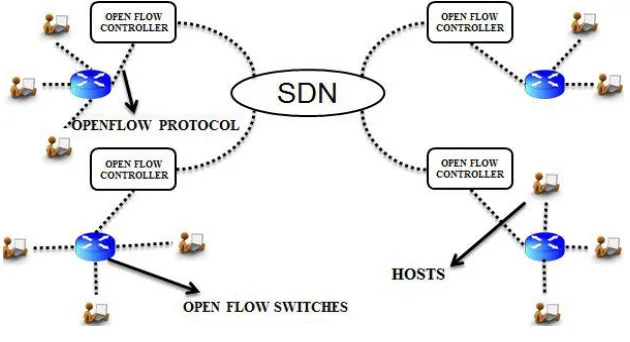
Fig. 2 depicts the SDN architecture. There is a centralized SDN block which is a software governed protocol that manages the entire network. It is connected to the OpenFlow Controller which in turn are connected to other OpenFlow switches, routers and other networking components. It uses a unique protocol known as “Open Flow Protocol” that controls and manipulates the entire network. The open flow controller controls the open flow switches. These switches monitor the networks performance and sends periodical reports to the Network Administrator as per his preference. In case of any network failures or node failures in the network this Open Flow Controller will trigger an alert message to the network administrator.
Fig. 2. SDN Design Architecture
It also has the self healing process but if the issue goes beyond the scope of the Open Flow Control protocol then an alert message is triggered to the administrator. This whole process can be manipulated by the Network administrator according to the environment of the network or according to the outcome required. This structure is applicable from a small home network to a complex commercial network.
VI CONCLUSION
© 2013, IJCSMC All Rights Reserved 154
References
[1] Controlling an SDN Via Disturbed Controller, by Europen Commission Number PIRG06-GA-2009-256326, Volkan yazici, Ozyegin University.
[2] Improving Network Management With Software Defined Networking, by Hyojoon Kim and nick feamster, 0163-6804/13/ IEEE Communication magazine 2013.
[3] Software Defined Networking Overview And Implementation, by Manal Algarni, Vinayak Nair, David Martin. George Mason University IFS 2013.
[4] Searchsdn.techtarget.com/definition/OpenFlow-controller. March 2013.
[5] OpenFlow enabling innovation in campus networks, by Tom Anderso University of Washington, hari Balakrishnan MIT, Larry Peterson Princeton university,march 2008 Openflow switch.org.
[6] http://yuba.stanford.edu/~casado/of-sw.html