Available Online at www.ijcsmc.com
International Journal of Computer Science and Mobile Computing
A Monthly Journal of Computer Science and Information Technology
ISSN 2320–088X
IMPACT FACTOR: 6.017
IJCSMC, Vol. 6, Issue. 1, January 2017, pg.167 – 177
Multipath Routing with Multiple Replica Nodes
for On Demand Video Streaming in MANETs
Rajasekhar R
1, Chennareddy P
2¹Associate Professor in CSE, JNTUACE, Anantapuramu, A.P., India
²Professor in CSE, JNTUA, Anantapuramu, A.P., India
1
[email protected]; 2 [email protected]
Abstract— Mobile Ad Hoc Networks (MANETs) have an attractive feature of rapid deployment without requiring any fixed infrastructure. Nowadays the usage of mobile devices in the network communications increased a lot. On demand video streaming is the most attractive service on the MANET but the limited capabilities of nodes like processing power, memory, energy and mobility, etc. are making it difficult to provide smooth delivery of online video streaming. This paper proposes a novel multipath routing protocol which uses multiple paths to deliver the video stream and to reduce the packet loss. The basic idea of proposed protocol, MPMR (Multipath Routing with Multiple Replica Nodes) is to maintain multiple and partial backup copies of video stream file near the destination node so that it can receive the file without any delay when a packet loss occurs in the original path. The simulation results prove that MPMR performs better over previous work.
Keywords— MANET, on demand video stream, multipath routing, node efficiency, route efficiency
I.
I
NTRODUCTIONMobile Ad Hoc Network (MANET) [1] is a wireless network that can be setup instantaneously without requiring any pre-existing infrastructure. Unlike other networks, the MANET requires no fixed topology and no planning for its deployment. Since the MANET is composed of mobile nodes that are connected together with radio links, the topology of MANET changes dynamically as the nodes move constantly from one place to another. Each node in MANET acts as a sender, receiver or a router based on the connection between the nodes. The most demanding applications in the MANET are the video stream applications. But the limited resources of nodes like processing power and memory, bandwidth limited and time varying link quality in the MANET make it difficult to transmit the video stream files through multiple wireless links. The smooth delivery of video streams through multiple wireless links in the MANET remains as a challenging research problem.
Moreover, when a packet is lost, the TCP and TFRC drop the transmission rate assuming that the network congestion is occurred. But in MANET, a packet can be lost due to several reasons like link failures, node failures, and packet collisions, etc. For the smooth delivery of video stream in MANET, a routing protocol must assist the TFRC protocol in controlling the network congestion. Frequent link failures and nodes displacements in the routing path are the major reasons of packet loss. When the routing protocol handles both the link failures and node mobility while routing the video stream packets, the TFRC is prevented from applying congestion control algorithm unnecessarily which in turn saves the time and provides smooth delivery of video stream without delay. Moreover, as mentioned in [3], multipath routing protocols provide better performance over single path routing protocols in MANET.
This paper proposes a novel routing protocol that uses multiple paths between the source and destination nodes and maintain multiple replica nodes which hold the backup video streams to provide the smooth delivery of video stream without delay. The simulation analysis of proposed routing protocol reveals the improved performance of real time online streaming applications in MANET.
The remainder of the paper is organized as follows: section 2 describes the related literature work and the design of proposed routing protocol is presented in section 3. The simulation results are discussed in section 4 and finally section 5 concludes the paper.
II.
L
ITERATURES
URVEYThe smooth delivery of video stream can be provided by the traditional transport protocol UDP in MANET. To control the network congestion, the TCP senders lower their transmission rates but the UDP senders proceed with their constant bit rate transmissions. The network congestion becomes worst with these UDP senders. An alternative version of UDP protocol, called TFRC (TCP Friendly Rate Control) transport protocol responds to the network congestion scenario as other TCP senders. To guarantee the smooth delivery of video streams in the MANET, the TFRC transport protocol requires the assistance of underlying network layer routing protocol to control the packet loss. As the link failures and nodes displacements in the routing path are the reasons of packet loss, the routing protocol must be able to control the packet loss to the extent possible. As the multipath routing protocols are most robust and stable than single path routing protocols in the MANET, this section presents the most related previous work which motivates the proposed work in this paper.
NDMP-AODV [4] is the node disjoint multipath version of AODV protocol in MANET. The source node maintains two paths to the destination. The primary path is used for the data transmission and the backup path will be used when the primary path fails. While the backup path is in usage, the source node finds alternate path to be used when the backup path fails. This protocol minimizes the transmission delay as there is always a backup path is maintained to avoid route discovery process in case of primary path fails. This routing protocol is very much helpful for the delay sensitive applications like online video streaming applications in the MANET.
In [5], ESAR (Energy Saving Ad hoc Routing) protocol is proposed which makes use of multiple energy efficient routing paths between source and destination. The highest energy efficient routing path is selected for data transmission and also backup routes are maintained. When the routing path fails, the backup path is selected immediately to prevent the delay in transmission. Highly sustainable paths are used to guarantee the smooth delivery of video streams in the MANET. Another work [6] also uses energy efficient routing protocol along with node mobility management feature. The multipath routing protocol specific to MPEG-2 video transmission is proposed in [7] which uses three different paths between source and destination nodes. The traditional DSR routing protocol is optimized with multipath and multimedia transmissions in [8,9]. Priority based multiple paths are used in [10] for the delay-sensitive applications like online video streaming.
Our previous work [11] proposes EMRP_R (Efficient Multipath Routing Protocol with Replication) for on-demand video streaming in MANETs. The source node finds the multiple paths to the destination and selects the most efficient route. The route efficiency is calculated based on the forecasting of energy, stability and traffic load. An improved version of EMRP_R is presented in [12] which addresses the replica management which lacks in EMRP_R. The group based replica relocation scheme is presented in our previous work [12].
III.
M
ULTIPATHR
OUTING WITHM
ULTIPLER
EPLICAN
ODESThe formulation of proposed routing protocol, Multipath Routing with Multiple Replica Nodes (MPMR) is inspired from our previous work [11,12] which makes use of forecasting of energy, stability and traffic load of the nodes in the route between source and destination nodes.
It is also assumed that the destination node can reply multiple route request packets within predefined threshold time. The threshold time for replying multiple non-duplicate route request messages is an important parameter which can be configured based on the network environment and application requirements.
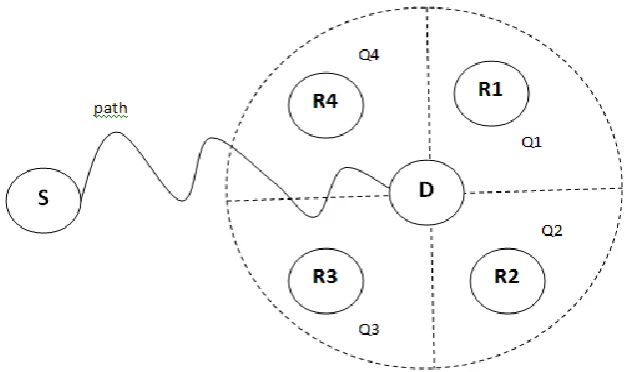
While giving the route reply message back to the source node, each node in the path including the destination node add its node-efficiency (NE) value. The route efficiency (RE) is the smallest NE value in the route. Once the source node receives multiple routes with different RE values, it selects the route with highest RE value for data transmission. Once data transmission starts, the destination node divide its transmission range into four quadrants and locates one replica node in each quadrant as shown in figure 1. The destination then sends the location information of four replica nodes to the sender so that the sender can transmit backup data to them. The source node divides the video stream file into four parts and transmits them to the four replica nodes. The first replica node in the first quadrant stores the first part of file, and so on. While receiving the video stream from the source node if any failure occurs, then the destination node approaches the corresponding replica node to continue the video stream transmission. For instance, if node or link failure occurs in the data transmission path while receiving second part, then the destination node contacts the second replica node in the second quadrant to receive the backup second part of file. Upon completing the reception of second part, remaining replica nodes transmit their backup copies to the destination node.
Figure 1 Multipath Routing with Multiple Replica Nodes Scheme
A. Node Efficiency Estimation:
The proposed method uses an important metric of node efficiency to select the best routing path for video stream transmission.
The node efficiency of node n, NE(n), is calculated by forecasting three parameter values: Energy Forecast (EF), Stability Forecast (SF) and Traffic Loa Forecast (TLF) as shown in equation 1.
)
(
*
)
(
*
)
(
*
)
(
n
a
EF
n
b
SF
n
c
TLF
n
NE
(1)where a, b and c are the weighted values of corresponding parameters. The values of a, b and c can be adjusted based on the network environment and application requirements such that the condition a + b + c = 1 holds.
The first parameter, EF(n), estimates the energy level of the node n. Each node in the path must have minimum energy level to forward the packet towards the destination. In order to prevent the link failures and node failures, the minimum energy level is set for each node. The nodes having energy levels above the minimum threshold value are selected for data transmission in the path.
1) Energy Forecasting of a Node: The energy level of a node depends on the available energy (EA) of node. The EA is calculated as shown in equation 2.
)
(
)
(
)
(
n
IE
n
CE
n
EA
(2)Where IE(n) is the initial energy level of node n and CE(n) is the consumed energy of node n. CE(n) is total amount of energy consumed on sending and receiving the packets.
)
(
)
(
)
(
n
E
n
E
n
CE
TX
RX (3)The available energy of node n, EA(n) is used to estimate the node sustainability in near future for routing process. The forecasting is done by taking the weighted moving average of node energy levels in three consecutive time slots: t, t-1 and t-2 respectively as shown in equation 4.
2 1
0
.
2
*
(
)
)
(
*
3
.
0
)
(
*
5
.
0
)
(
n
t
EA
n
t
EA
n
t
EA
n
tEF
(4) The forecasted value of energy is normalized to 1 as shown in equation 5.
otherwise
n
EF
RTT
RTT
n
EF
if
n
EF
t t)
(
*
6
6
)
(
1
)
(
(5)where RTT is the round trip time of the route in which node n is the intermediate node or destination node.
2) Node Stability Forecasting: The node mobility often causes the link failures and thus packet loss in the data transmission path. To be more stable, the routing path must include all nodes with less or no movement. In our model, we forecast the node stability by considering the node average displacement in three different consecutive time slots: t, t-1 and t-2 respectively as shown in equation 6.
)
(
*
2
.
0
)
(
*
*
3
.
0
)
(
*
5
.
0
)
(
n
D
n
D
1n
D
2n
SF
t
t
t
t(6)
Where Dt(n) is the distance covered by node n from position Pt-1(xt-1,yt-1) to the position Pt(xt,yt) which is calculated as shown in equation 7.
21 2
1
(
)
(
)
)
(
)
(
)
(
t
t
t
tt
n
x
n
x
n
y
n
y
n
D
(7)
The stability forecast value is normalized to 1 as given in equation 8.
otherwise
n
TR
n
SF
n
SF
n
TR
if
n
SF
)
(
)
(
*
6
6
)
(
)
(
1
)
(
(8) where TR(n) is the transmission range of node n.3) Traffic Load Forecasting of a Node: When the traffic load is high, the probability of packet loss is also more. Also the node spends more energy on forwarding the packets. To be reliable, the routing path must contain the nodes with minimum traffic load. The estimation of node’s traffic load is done using normalized value of routing buffer length at three different consecutive time slots: t, t-1 and t-2 respectively as shown in equation 9.
2
1
0
.
2
*
(
)
)
(
*
3
.
0
)
(
*
5
.
0
)
(
n
NTL
n
t
NTL
n
t
NTL
n
tTLF
(9) where NTL(n)t is the normalized traffic load of node n at time t and it is computed as given in equation 10.
otherwise
Q
Q
n
NTL
capacity t max,
1
)
(
(10) where Qmax is the maximum queue length at time t, and Qcapacity is the capacity of queue.B. Route Efficiency Estimation:
Once the node efficiency of all nodes n, NE(n), is estimated as in equation 1, the routing path efficiency is calculated as the smallest value of NE(n) in the path as shown in equation 11.
)}
(
....
)
1
(int
)
(
min{
)
(
p
NE
sourcenode
NE
ermediaten
ode
NE
destinatio
nnode
RE
(11) where RE(p) is the routing efficiency of path p.
The source node selects the path p only when RE(p) > ɷ , where ɷ is the threshold value.
Among the multiple routing paths, the source node selects the best routing path for the data transmission which has highest RE(p) value.
Once the data transmission starts, the destination node divides its transmission range into four quadrants and finds the four replica nodes R1(n), R2(n), R3(n) and R4(n) such that R1(n) is the replica node selected in the first quadrant and so on. If there are multiple nodes in a quadrant, the destination node selects the replica node based on NE(n) value as shown in equation 1. The destination node receives the NE(n) values from all the nodes in a quadrant, and selects the node with highest NE(n) value as the replica node to hold the backup copy of video stream file corresponding to that quadrant. The destination sends the information of all replica nodes locations (xR1,yR1), (xR2,yR2), (xR3, yR3) and (xR4, yR4) where (xR1, yR1) is the location of replica node R1 in the first quadrant. The source node then divides the video file into four parts and transmits them to the corresponding replica nodes. The replica node R1 holds the first part of file and so on. When a failure occurs during the reception of a part of file in the path, the destination node approaches the corresponding replica node to receive the file. This reduces the delay in transmission and provides smooth delivery of online video streaming on the devices of MANET.
C. MPMR Algorithm:
Step 1: Destination Node D requests online video stream transmission from the Source node S.
Step 2: Source node S discovers multiple paths to the Destination node D and selects the best path for data transmission.
Step 3: The destination node D sends the locations of four replica nodes R1, R2, R3 and R4 to the source node S. (Replica nodes are identified from the four quadrant areas of node D).
Step 4: The video file to be transmitted is divided into four segments and the source node transmits them to the corresponding replica nodes.
Step 5: When the data transmission path fails due to link failure or node failure, the destination node D receives the backup copy of the file from the replica nodes. (Based on the part of file receiving at the time of failure, the destination node D contacts the corresponding replica node).
IV.
S
IMULATIONA
NALYSISThe performance analysis of proposed routing protocol MPMR is performed using the network simulator NS2 [13]. The simulation results of MPMR protocol are compared with our previous work EMRP_R [11] and GBRR [12]. The simulation results reveal that the MPMR performs better than EMRP_R and GBRR because of maintaining multiple replica nodes to hold the backup copies of video file. The simulation topology considered for the performance analysis is shown in Figure 2. Also the simulation parameters setup is shown in the Table 1.
TABLE 1:SIMULATION PARAMETERS SETUP
Parameter Value
Simulator NS2
Simulation Time 600 sec
Terrain Dimensions 1000 X 1000 meters
Number of Nodes 30
Transport Protocol TFRC
Routing Protocol MPMR, EMRP_R and GBRR
Mobility Model Random way-point
Pause Time 0 to 250 sec
Video One segment of the India’s Biggest Motion
Picture Kabali
Video Codec H.264SVC
Number of Primary Routes 01
Figure 2 Random Distribution of 30 nodes in MANET
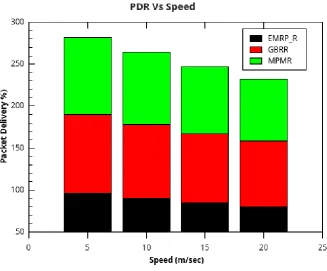
Fig 3a and Fig 3b show the impact of node speed on the packet delivery ration. It is observed that the proposed MPMR protocol performs better because it delivers more number of packets as it maintains multiple replica nodes.
Fig 3b PDR vs Pause time
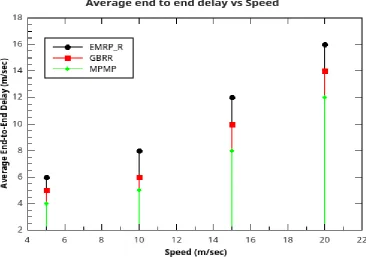
Similarly the figures 4a and 4b show the performance of proposed protocol MPMR in terms of end to end delay experienced by the destination node. Clearly, the MPMR is better in providing shortest delay compared to other methods because of multiple replica nodes. When packet loss occurs during video streaming, the destination node immediately approaches the corresponding replica node and there is no delay in relocating the replica node.
Fig 4b Transmission Delay vs Pause time
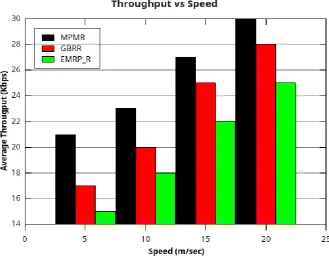
The throughput delivered is estimated and displayed in the figures 5a and 5b. It is observed that more throughput is achieved with proposed MPMR protocol.
Fig 5b Throughput vs Pause time
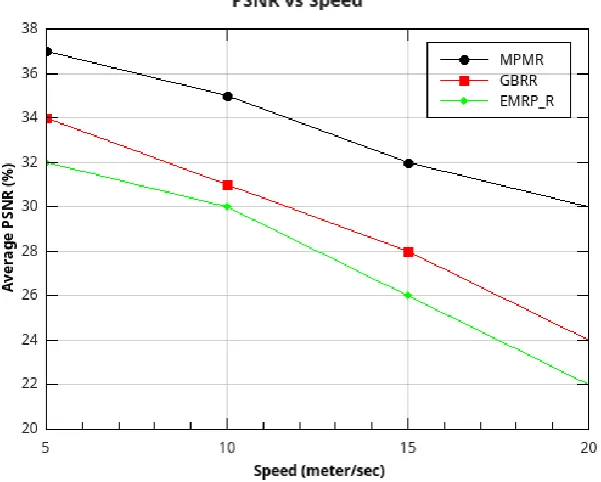
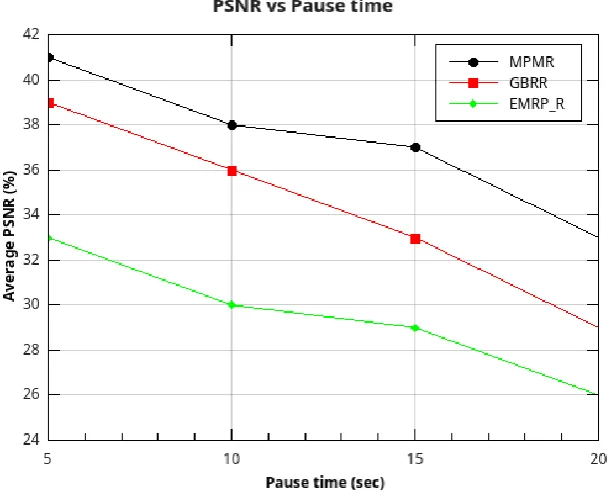
As the proposed routing protocol is designed specifically for online video streaming applications in MANET, we evaluate the average peak signal to noise ratio (PSNR) against the node mobility. The results in Fig6a and 6b show the superior performance of proposed method MPMR over other methods.
Fig 6b PSNR vs Pause time
V.
CONCLUSIONSProviding online video streaming in the MANET is a challenging task because of limitations like node processor, memory, node mobility, battery power etc. This paper proposes a novel multipath routing protocol which maintains multiple replica nodes to hold the parts of video file as backup. When the packet loss happens in the network, the destination node receives the remaining parts of video stream file from the replica nodes. As the backup copy of data is available with the destination node, the video stream can be delivered without any delay. The performance analysis of the protocol reveals the fact that it performs well over previous methods.
References
[1] Hadim, S., Al-Jaroodi, J., & Mohamed, N. (2006). Middleware issues and approaches for mobile ad hoc networks, Proceedings of 3rd IEEE Consumer Communications Networking Conference: Vol. 1 (pp.431-436).
[2] RajaSekhar R, P. Chenna Reddy, Raja Ashok Kumar and N Venkatramana, Performance comparison of
TCP, UDP and TFRC in static wireless environment, Int. J. Information and Computer Security, Vol. 8, No. 2, 2016, pp.158-180.
[3] Stephen Mueller, Rose P Tsang, and DipakGhosal, Multipath routing in mobile ad hoc networks: Issues
and challenges. In Performance Tools and Applications to Networked Systems, pp.209-234. Springer, 2004.
[4] C. Lal ,V.Laxmi, M.S.Gaur, “A Node-Disjoint Multipath Routing Method Based On Aodv Protocol For
Manets”, 26th IEEE International Conference On Advanced Information Networking And Applications, 2012.
[5] Utkarsh, Mukesh Mishra And SuchismitaChinara, ESAR: An Energy Saving Ad Hoc Routing Algorithm
For MANET, Advanced Computing (Icoac), 2012 Fourth International Conference On IEEE 2012.
[6] Smail Omar, MekkakiaZoulikha, Bernard Cousin, Energy Efficiency In Ad Hoc Wireless Networks With
Node-Disjoint Path Routing, Systems, Signal Processing And Their Applications (WOSSPA), 2011.
[7] Frias, V.C., Delgado, G.D., Igartua, M.A., Multipath routing with layered coded video to provide QoS
for video-streaming over manets, 14th IEEE International Conference on Networks, 2006. ICON ’06, vol. 1, pp. 1–6 (2006).
[8] Monica A. Igartua, Victor .C. Frias, Self configured multipath routing using path lifetime for video streaming services over Ad Hoc networks, Computer Communications , pp. 1-32, 2010.
[9] S.J. Lee and M. Gerla, Split multipath routing with maximally disjoint paths in ad hoc networks, IEEE
[10] Vaidya, B., Ko, N.Y., Jarng, S.S., Han, S Investigating voice communication over multipath wireless mobile ad hoc network, ICUIMC ’08: Proceedings of the 2nd International Conference on Ubiquitous Information Management and Communication, New York, NY, USA, pp. 528–532. ACM (2008).
[11] R.Raja Sekhar and P Chenna Reddy, An Efficient Multipath Routing Protocol with Replication for
On-demand Video Streaming in MANETs, International Journal of Computer Science and Network, Vol. 5, Issue 3, June 2016, pp: 458-466.
[12] R.Raja Sekhar and P Chenna Reddy, Group Based Replica Relocation for On Demand Video
Streaming in MANETs, International Journal of Computer Networks and Wireless Communications, Vol. 6, No. 4, July 2016, pp: 17-23.