Koblitz Curve with an FPGA Cluster
Erich Wenger and Paul Wolfger Graz University of Technology
Institute for Applied Information Processing and Communications Inffeldgasse 16a, 8010 Graz, Austria
[email protected], [email protected]
Abstract. Using FPGAs to compute the discrete logarithms of elliptic curves is a well-known method. However, until to date only CPU clus-ters succeeded in computing new elliptic curve discrete logarithm records. This work presents a high-speed FPGA implementation that was used to compute the discrete logarithm of a 113-bit Koblitz curve. The core of the design is a fully unrolled, highly pipelined, self-sufficient Pollard’s rho iteration function. An 18-core Virtex-6 FPGA cluster computed the discrete logarithm of a 113-bit Koblitz curve in extrapolated 24 days. Until to date, no attack on such a large Koblitz curve succeeded using as little resources or in such a short time frame.
Keywords: elliptic curve cryptography, discrete logarithm problem, Koblitz curve, hardware design, FPGA, discrete logarithm record.
1
Introduction
It is possible to repeatedly fold a standard letter-sized sheet of paper at the midway point about six to seven times. In 2012, some MIT students [28] were able to fold an 1.2 kilometer long toilet paper 13 times. And every time the paper was folded, the number of layers on top of each other doubled. Therefore, the MIT students ended up with 213 = 8192 layers of paper on top of each other. And poor Eve’s job was to manually count all layers one by one.
Similar principles apply in cryptography, although bigger numbers are in-volved. In Elliptic Curve Cryptography (ECC), where dlog2ne-bit private keys are used, Eve does not have to iterate through all possible nkeys. Instead, Eve would use the more efficient parallelizable Pollard’s rho algorithm that finishes in approximately √n steps. The omnipresent question is how big n has to be such that even the most powerful adversaries are not able to reconstruct a pri-vate key. Especially in embedded, cost-sensitive applications, it is important to use keys that are only as large as necessary.
necessary to practically compute discrete logarithms to check to which margin the current standards hold.
The task of computing a discrete logarithm can be split into the work done by researchers and the work done by machines. This paper presentsboth anovel hardware architecture and thediscrete logarithm of a 113-bit Koblitz curve. The highly pipelined, high-speed, and practically extensively tested ECC Breaker FPGA design was used to solve the discrete logarithm of a 113-bit Koblitz curve in extrapolated1 24 days using mere 18 FPGAs. Therefore, ECC breaker is the first FPGA design to be used to solve a large discrete logarithm. Further, based on ECC Breaker it is even possible to compute discrete logarithms of even larger binary-field elliptic curves. Substantiated by practical experimentation, this pa-per will make a notable contribution to the community’s activity of breaking larger elliptic curves and carving new standards.
This paper is structured as follows: Section 2 gives an overview on related work. Section 3 revisits some mathematical foundations and Section 4 summa-rizes the experiments with different iteration functions. The most suitable iter-ation function was implemented in hardware, which is described in Section 5. As the design is flexible enough to attack larger elliptic curves, Section 6 gives runtime and cost approximations. Section 7 summarizes the learned lessons and Section 8 concludes the paper. Appendix A gives an overview of the targeted curve parameters and pseudo-randomly chosen target points.
2
Related Work
Certicom [10] introduced ECC challenges in 1997 to increase industry accep-tance of cryptosystems based on the elliptic curve discrete logarithm problem (ECDLP). They published system parameters and point challenges for different security levels. Since then, the hardest solved Certicom challenges are ECCp-109 for prime-field based elliptic curves, done by Monicoet al.using a cluster of about 10,000 computers (mostly PCs) for 549 days, and ECC2-109 for binary-field based elliptic curves, also done by Monico et al., computing on a cluster of around 2,600 computers (mostly PCs) for around 510 days. Harleyet al.[18] solved an ECDLP over a 109-bit Koblitz-curve Certicom challenge (ECC2K-108) with public participation using up to 9,500 PCs in 126 days.
As the Certicom challenges lie far apart (ECCp-131 is 2,048 times more complex than ECCp-109), also self-generated challenges have been broken. A discrete logarithm defined over a 112-bit prime-field elliptic curve was solved by Bos et al. [9], utilizing 200 Playstation 3s for 6 months. A single playstation reached a throughput of 42·106iterations per second (IPS).This work presents the discrete logarithm of a 113-bit binary-field Koblitz curve that used 18 FPGAs for extrapolated 24 days and reached a throughput of 165·106 iterations per FPGA per second.
Further, several attempts and approximations were done in order to attack larger elliptic curves using FPGAs. Dormale et al. [24] targeted ECC2-113,
1
ECC2-131, and ECC2-163 using Xilinx Spartan 3 FPGAs performing up to 20·106 IPS. Most promising is the work of Bailey et al. [5] who attempt to break ECC2K-130 using Nvidia GTX 295 graphics cards, Intel Core 2 Extreme CPUs, Sony PlayStation 3s, and Xilinx Spartan 3 FPGAs. Their FPGA imple-mentation has a throughput of 33.7·106IPS and was later improved by Fanet al. [12] to process 111·106 IPS. Other FPGA architectures were proposed by G¨uneysu et al.[16], Judge and Schaumont [20], and Maneet al.[21]. G¨uneysu et al.’s Spartan 3 architecture performs about 173·103 IPS, Judge and Schau-mont’s Virtex 5 architecture executes 2.87·106 IPS, and Maneet al.’s Virtex 5 architecture does 660·103IPS.
So far, none of their FPGA implementations have been successful in solving ECDLPs. This work on the other hand presents apractically tested architecture which can be used to attack both Koblitz curves and binary-field Weierstrass curves.
3
Mathematical Foundations
To ensure a common vocabulary, it is important to revisit some of the basics. Hankersonet al.[17] and Cohenet al.[11] shall be consulted for further details.
3.1 Elliptic Curve Cryptography
This paper focuses on Weierstrass curves that are defined over binary extension fieldsK=F2m. The curves are defined asE/K:y2+xy=x3+ax2+b, wherea
andbare system parameters and a tuple ofxandywhich fulfills the equation is called a pointP = (x, y). Using multiple points and thechord-and-tangent rule, it is possible to derive an additive group of order n, suitable for cryptography. The number of points on an elliptic curve is denoted as #E(K) =h·n, wheren
is a large prime and the cofactorhis typically in the range of 2 to 8. The core of all ECC-based cryptographic algorithms is a scalar multiplicationQ=kP, in which the scalar k∈[0, n−1] is multiplied with a point P to deriveQ, where both points are of ordern.
As computing Q = kP can be costly, a lot of research was done on the efficient and secure computation of Q = kP. A subset of binary Weierstrass curves, known as Koblitz curves (also known as anomalous binary curves), have some properties which make them especially interesting for fast implementations. They may make use of a mapσ(x, y) = (x2, y2), σ(∞) = (∞), an automorphism of order m known as a Frobenius automorphism. This means that there exists an integer λj such that σj(P) = λjP. Another automorphism, which is not only applicable to Koblitz curves, is the negation map. The negative of a point
P = (x, y) is−P = (n−1)P = (x, x+y).
3.2 Elliptic Curve Discrete Logarithm Problem (ECDLP)
compute the scalar 0 ≤ k < n. As standardized elliptic curves are designed such that neither the Pohlig-Hellman attack [25], nor the Weil and Tate pairing attacks [13, 23], nor the Weil descent attack [15] apply, the standard algorithm to compute a discrete logarithm is Pollard’s rho algorithm [26].
The main idea behind Pollard’s rho algorithm is to define an iteration func-tionfthat defines a random cyclic walk over a graph. Using Floyd’s cycle-finding algorithm, it is possible to find a pair of colliding triples, each consisting of a point Xi and two scalars ci and di. As X1 = X2 = c1P +d1Q = c2P +d2Q and (d2 − d1)Q = (d2 − d1)kP = (c1 −c2)P, it is possible to compute
k = (c1−c2)(d2−d1)−1modn. Pollard’s rho algorithm expects to encounter such a collision afterpπn
2 steps.
In order to parallelize the attack efficiently, Van Oorschot and Wiener [30] introduced the concept of distinguished points. Distinguished points are a subset of points, which satisfy a particular condition. Such a condition can be a specific number of leading zero digits of a point’s x-coordinate or a particular range of Hamming weights in normal basis. Those distinguished points are stored in a central database, but can be computed in parallel. The number of instances running in parallel is linearly proportional to the achievable speedup. Note that each instance starts with a random starting triple and uses one of the iteration functions f which are discussed in the following section.
4
Selecting the Iteration Function
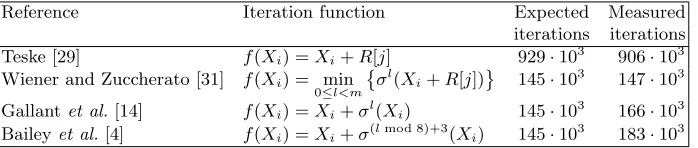
As the iteration function will be massively parallelized and synthesized in hard-ware, it is crucial to evaluate different iteration functions and select the most suitable one. In this work, the iteration functions by Teske [29], Wiener and Zuccherato [31], Gallant et al.[14], and Baileyet al. [4] were checked for their practical requirements and achievable computation rates. Table 1 summarizes the experiments done in software on a 41-bit Koblitz curve.
What all iteration functions have in common is that they update a state, henceforth referred to as triple, consisting of two scalarsci, di ∈[0..n−1] and a pointXi=ciP+diQ. An iteration functionf deterministically computesXi+1=
f(Xi) and updatesci+1 anddi+1 accordingly, such thatXi+1=ci+1P+di+1Q holds. A requirement on f is that it should be easily computable and to have the characteristics of a random function.
Teske’s r-adding walk [29] is a nearly optimal choice for an iteration func-tion. It partitions the elliptic curve group intordistinct subsets{S1, S2, ..., Sr} of roughly equal size. If a pointXi is assigned toSj, the iteration function com-putes f(Xi) = Xi +R[j], with R[] being an r-sized table consisting of linear combinations of P and Q. After approximately pπn
2 steps, Teske’s r-adding walk finds two colliding points for all types of elliptic curves.
Table 1.Implementation results of all tested iteration functions.
Reference Iteration function Expected Measured
iterations iterations
Teske [29] f(Xi) =Xi+R[j] 929·103 906·103
Wiener and Zuccherato [31] f(Xi) = min 0≤l<m
σl(X
i+R[j]) 145·103 147·103
Gallantet al.[14] f(Xi) =Xi+σl(Xi) 145·103 166·103
Baileyet al.[4] f(Xi) =Xi+σ(lmod 8)+3(Xi) 145·103 183·103
Gallantet al.[14], and Baileyet al.[4] proposed iteration functions which should achieve this√m-speedup.
Wiener and Zuccherato [31] proposed to calculatef(Xi) =σl(Xi+R[j])∀l∈ [0, m−1] and choose the point, which has the smallestx-coordinate when inter-preted as an integer. Gallantet al. [14] introduced an iteration function based on a labeling function L, which maps the equivalence classes defined by the Frobenius automorphism to some set of representatives. The iteration function is then defined asf(Xi) =Xi+σl(Xi), wherel= hashm(L(Xi)). Baileyet al.[4] suggested to compute f(Xi) =Xi+σ(lmod 8)+3(Xi) to reduce the complexity of the iteration function.
Additionally to the Frobenius automorphism, it is possible to use a negation map to improve the expected runtime by a factor of √2. The negation map comparesXi with−Xiand selects the point with the smallery-coordinate when interpreted as an integer. Although the potential speed-up seems very promising, there is an unfortunate challenge associated with the negation map; the problem of fruitless cycles which is discussed in Section 7.
In order to make sure that the potential iteration functions work as promised, a 41-bit Koblitz curve was used to evaluate the iteration functions with a C implementation on a PC (cf. Table 1). As labeling function L, the Hamming weight of the x-coordinate in normal basis was used. The hash function was disregarded. Table 1 summarizes the average number of iterations (computing 100 ECDLPs) of all tested iteration functions using four parallel threads. The experiments showed that the average number of iterations of Gallant’s and Bai-ley’s iteration functions are 13-24 % higher compared to the iteration function by Wiener and Zuccherato. Additionally, with a probability of 14-20 % some of the parallel threads produced identical sequences of distinguished points. Restarting the threads regularly or on-demand would counter this problem. Not countering the problem of fruitless threads would increase the average runtime of Gallant’s iteration function by another 29 %.
5
ECC Breaker Hardware
Before the actual hardware architecture and its most critical components are discussed, it is important to review the basic design assumptions and core ideas of the ECC Breaker design.
5.1 Basic Assumptions and Decisions
ASIC vs FPGA Design. In literature it is possible to find a lot of FPGA and ASIC designs optimized for some crucial characteristic. Some authors even dare to compare FPGA and ASIC results. However, several of the largest components in ASIC designs, e.g., registers, RAM, or integer multipliers, are for free in an FPGA design. For instance, every slice comes with several registers. Therefore, adding pipeline stages in a logic-heavy FPGA design is basically for free. For this paper, Xilinx Virtex-6 ML605 evaluation boards were chosen because of availability. Note that all following design decisions were made to maximize the performance of ECC Breaker on this particular board.
Design Goals. As Pollard’s rho algorithm is perfectly parallelizeable, the design goal clearly is to maximize the throughput per (given) area. Note that the speed (iterations per seconds) of an attack is linearly proportional to the throughput and inversely proportional to the chip area (more instances per FPGA also increase the speed). Therefore, the most basic design decision was whether to go for many small or a single large FPGA design.
Core Idea. In earlier designs, many area-efficient architectures were considered, each coming with a single F2m multiplier, F2m squarer, and F2m adder per
in-stance. The main problems of these designs were the costly multiplexers and the low utilization of the hardware. Therefore the design principle of ECC Breaker is a single, fully unrolled, fully pipelined iteration function. In order to keep all pipeline stages busy, the number of pipeline stages equals the amount of triples processed within ECC Breaker.
ECC Breaker
NextInput
Iteration Function
Point Addition
Point Automorphism
FIFO
adder
multiplier FIFO FIFO
Xi ci di
Xi+1 ci+1 di+1
Branching Table multiplier
squarer
inverter
adder
multiplier Interface
Distinguished Point Storage
Lambda Table
F2m F2m F2m
Fn Fn
Fn Fn
Fig. 1.Top-level view of ECC breaker on the left. Iteration Function on the right.
Generalization of ECC Breaker. Although the current version of ECC
Breaker is carefully optimized for a 113-bit binary-field Koblitz curve, the under-lying architecture and design approach is also suitable for larger elliptic curves, e.g, a 131-bit Koblitz curve. In Section 6, approximations of the expected run-times and potential costs to attack such a larger curve are given.
5.2 The Architecture
The basic architecture of ECC Breaker is presented in Figure 1. The core of ECC Breaker is a circular, self-sufficient, fully autonomous iteration function. A (potentially slow) interface is used to write the NextInput register. If the current stage of the pipeline is not active, the pipeline is fed with the triple from theNextInputregister. This is done until all stages of the pipeline process data. If a point is distinguished, it is automatically added to the distinguished point storage (a sufficiently large block RAM). At periodic but time-insensitive intervals the host computer can read all distinguished points that accumulated within the storage.
The iteration function itself consists of several components: a point addition module, a point automorphism module, two Fn adders, twoFn multipliers, two block-RAM based tables and several block-RAM based FIFOs to care for data-dependencies.
5.3 ECC Breaker Components
Point addition module. No matter which iteration function is selected, an affine point addition module is always necessary. In the case of binary Weierstrass curves, the formulas for a point addition (x3, y3) = (x1, y1) + (x2, y2) are x3=
µ2+µ+x
y1 y2 x2 x1
ADD ADD
FIFO
FIFO ADD
a
FIFO FIFO INV
MUL
SQU
MUL
ADD
ADD
FIFO
ADD
x3 y3
Fig. 2. Simplified point addition module. The grey shaded blocks are without regis-ters.
comparator tree
x y
rot 0 rot 1 rot 2 rot 3
C → N C → N
FIFO
BARREL ROTATE
N → C N → C
FIFO
x' y'
...
Fig. 3.Point automorphism unit with m comparator units.
Special cases of points being equivalent, inverse of each other, or the identity are not handled by the hardware as they are very unlikely to occur in practice.
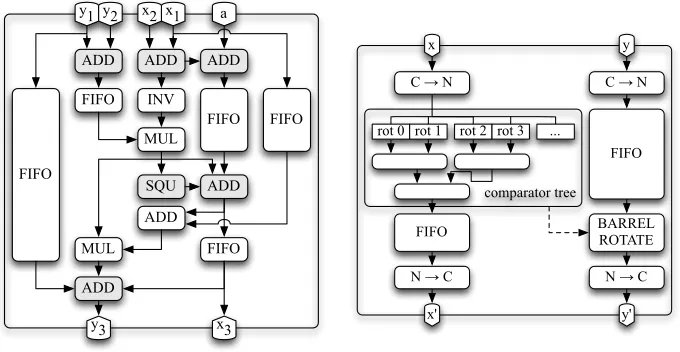
Figure 2 shows the implemented point addition module which directly maps the formulas from above. TwoF2m multiplier, oneF2m inverter, and five FIFOs
are necessary to compute a point addition in 184 cycles. Note that it is not possible to get rid of the costly inversion as the result of the point addition must be available in affine coordinates (cf. [24]).
Point automorphism module. In order to speed-up Pollard’s rho algorithm for Koblitz curves, it is necessary to uniquely map m points from the same equivalence class to a single point. As ECC Breaker follows Wiener and Zuccher-ato’s [31] approach of interpreting the field elements as integers and comparing them, it was necessary to design a module that doesmsquarings andm compar-isons as efficiently as possible. This module relies on normal basis representation and is depicted in Figure 3. It converts x and y into normal basis, finds the smallest x within the normal basis, rotatesy appropriately, and transforms x
andyback into a canonical polynomial representation. As themexponents ofx
(x(2i)
) are computed by simple rewiring (xrotated byisteps), and the smallest
xis found using a binary comparison tree, no canonicalF2m squarer is needed.
2−t. For i = pπn
2m iterations and m·i comparisons, the probability for not selecting the smaller value is only 1−(1−2−t)m·i= 0.00081 for m= 113.
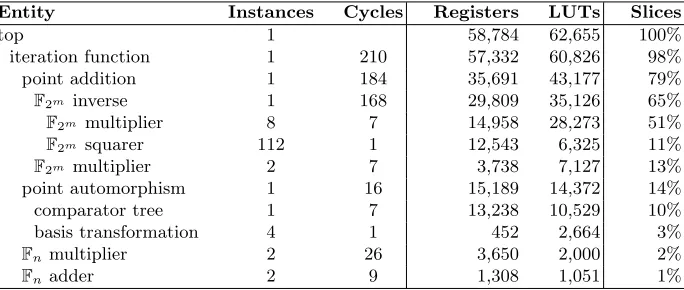
In respect to the overall design, the point automorphism module requires 14% of all slices and is about 5.6 times smaller than the point addition module (in terms of slices). The majority of the point automorphism module is the comparator tree. The basis transformations are fairly cheap and make up only 20% of the point automorphism module.
F2m inverse. An Euclidean-based inversion algorithm is not deterministic and therefore hard to compute with a pipelined hardware module. Therefore, ECC Breaker computes the inverse using Fermat’s little theorem; an inversion by exponentiation. Fortunately, an exponentiation with 2m−2can be computed very efficiently using Itoh and Tsujii’s [19] exponentiation trick, needing 112 squarers and 8 multipliers form= 113:a=a21−1
→a22−1
→a23−1
→a26−1
→a27−1 →
a214−1
→a228−1
→a256−1
→a2112−1
→a2113−2 =a−1.
F2m normal basis. The advantage of a normal basis is that a squaring is a simple rotation operation. The disadvantage of a normal basis is that a F2m
multiplication is fairly complex to compute. ECC breaker uses per default a normal, canonical polynomial representation.
Only within the point automorphism module the normal basis rendered ad-vantageous. The necessary matrix multiplication for a basis transformation can be implemented very efficiently. As the matrix is constant, on average m/2 of the input signals are xored per output signal. Based on the results from Table 2, 666 LUTs are needed per basis transformation.
Experiments show that the normal basis could also reduce the area of the consecutive squaring units within the F2m inverse. The 14, 28, and 56 squarers
currently need 1 582, 3 164, and 6 328 LUTs, respectively. Doing two basis trans-formations and a rotation within normal basis would actually save area. Also, accumulating the two transformation matrices into a single matrix would further reduce the area. However, as all squarers together only need 11% of all slices and 10% of all LUTs, the potential area improvement is rather limited. Therefore, contrary to [5, 12], ECC Breaker only uses a normal basis number representation within the point automorphism module.
F2m multiplier. As in total tenF2m multipliers are needed for the point
addi-tion module and theF2m inversion module, theF2m multipliers have the largest
effect on the area footprint of the ECC Breaker design. For ECC Breaker, the fol-lowing multiplier designs on a Virtex-6 FPGA were evaluated (post-synthesis): (i) A simple 113-bit parallel polynomial multiplier needs 5,497 LUTs. (ii) A Mas-trovito multiplier [22] interprets theF2m multiplication as matrix multiplication
Table 2.Hierarchical representation of final hardware design (post place-and-route). Entity Instances Cycles Registers LUTs Slices
top 1 58,784 62,655 100%
iteration function 1 210 57,332 60,826 98%
point addition 1 184 35,691 43,177 79%
F2m inverse 1 168 29,809 35,126 65%
F2m multiplier 8 7 14,958 28,273 51%
F2m squarer 112 1 12,543 6,325 11%
F2m multiplier 2 7 3,738 7,127 13%
point automorphism 1 16 15,189 14,372 14%
comparator tree 1 7 13,238 10,529 10%
basis transformation 4 1 452 2,664 3%
Fn multiplier 2 26 3,650 2,000 2%
Fn adder 2 9 1,308 1,051 1%
(iii) Bernstein [7] combines some refined Karatsuba and Toom recursions for his batch binary Edwards multiplier. The code from [8] for a 113-bit polynomial multiplier needs 4,409 LUTs. (iv) Finally, the best results were achieved with a slightly modified binary Karatsuba multiplier, described by Rodrıguez-Henrıquez and Ko¸c [27]. Their recursive algorithm was applied down to a 16×16-bit multi-plier level, which is synthesized as standard polynomial multimulti-plier. The formulas for the resulting multiplier structure are given in Appendix B. The design only requires 3,757 LUTs. At last the design was equipped with several pipeline stages such that it can be clocked with high frequencies.
Fn multiplier. Computing prime-field multiplications in hardware can be a
troublesome and very resource-intensive task. In the case of a Virtex-6, dedi-cated DSP slices were used for integer multiplications. As a result, the two Fn multipliers are very resource efficient, requirering only 2×145 DSP slices and 2% of all slices.
6
Results and Transferability of Results
The construction of the current ECC Breaker design was an iterative process that continuously optimized the speed, the area, and the power consumption of all components. To make maximal use of the available resources, the available block RAMs and DSP slices were used whenever possible. Table 2 gives the number of registers and LUTs needed for all components of a 113-bit Koblitz-curve ECC Breaker design. The design was synthesized and mapped with Xilinx ISE 14.6.
Table 3.ECC Breaker on different FPGAs (post synthesis).
Series Part Number LUTs of total Registers max Freq. Develop. Price
[MHz] Kit [USD]
Point Addition w/o Automorphism
Virtex-6 XC6VLX240T 57,294 38% 37,060 261 ML605 2,495
Spartan-6 XC6SLX150T 57,686 62% 37,715 147 LX150T 995
Point Addition w/ Automorphism
Virtex-6 XC6VLX240T 86,409 57% 55,881 261 ML605 2,495
Artix-7 XC7A200T 86,478 64% 55,848 264 AC701 999
Virtex-7 XC7VX485T 86,391 28% 55,704 313 VC707 3,495
Kintex-7 XC7K325T 86,391 42% 55,704 313 KC705 1,695
F2m inverse module. Although already extensively optimized, the 10F2m
mul-tipliers require about 64% of all slices. As the place-and-route tool performs optimizations across module borders, the slice counts of all components are just approximations.
6.1 ECC Breaker on Different FPGAs
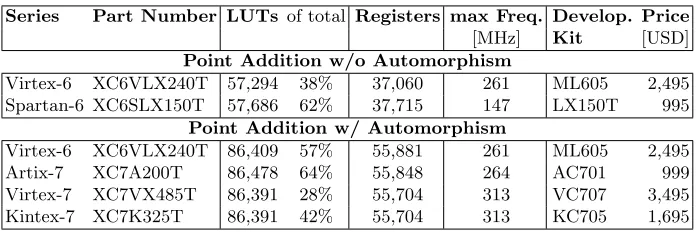
As the VHDL code is portable, the suitability of ECC Breaker was also evaluated for other Xilinx FPGAs. Although size was a secondary optimization goal, ECC Breaker has been designed for a particular Virtex-6 FPGA. So it does not come with surprise that ECC Breaker does only fit into certain FPGAs that come with certain features. For instance, the used ML605 development board incorporates a Virtex-6 FPGA that comes with 768 DSPs (of which 290 are used).
An overview of synthesis results on different FPGAs is given in Table 3. Fortunately, the ECC Breaker design is perfectly suitable for all kind of the lat-est Xilinx Virtex-7 (targets high performance designs), Kintex-7 (targets blat-est performance per cost), and Artix-7 (low cost) FPGA devices. The Virtex-7 and Kintex-7 development boards can even fit multiple ECC Breaker instances. How-ever, the Kintex-7 KC705 development board fits the most instances per cost. The prices, taken from www.avnet.com [1], do not contain taxes and do not contain potential bulk discounts.
Also smaller FPGAs were considered. Especially the Spartan-6 LX150T-series is of special interest as they are part of SciEngines RIVYERA’s S6-LX150 FPGA cluster [2]. Unfortunately, Spartan-6 FPGAs come with 180 DSPs at maximum and therefore the LX150T could be only used to attack non-Koblitz binary-field curves.
6.2 Expected Runtimes
Table 4.Approximations of best-case runtimes and costs for different targets. Series Target Freq. Inst- FPGAs Costs Iterations exp. Runt.
[MHz]ances [103 USD] [days]
Virtex-6 ECC2K-112 261 1 17 42 8.5·1015 22
Spartan-6 ECC2K-112 147 1 256 255 8.5·1015 3
Virtex-6 ECC2-112 261 2 17 42 90.3·1015 118
Spartan-6 ECC2-112 147 1 256 255 90.3·1015 28
Kintex-7 ECC2K-130 313 2 590 1,000 4,055.4·1015 127
Kintex-7 ECC2-131 313 2 5,900 10,001 46,239.1·1015 145
Kintex-7 ECC2-163 313 1 589,971 1,000,001 3,030.3·1021 189,934
at the maximum frequency, and a single FPGA contains multiple instances of ECC Breaker.
Computing a discrete logarithm of a 113-bit Koblitz curve (denoted as ECC2K-112) can be done in about 3 days, when a cluster of 256 Spartan-6 FPGAs would be available. With the same cluster, it would be possible to at-tack a 113-bit binary-field curve (denoted as ECC2-112) in 28 days.
The Certicom challenge ECC2K-130 targeted by Baileyet al.[5] and Fanet al. [12] can be computed in 127 days, assuming a budget of one million USD. The Certicom challenge ECC2-131 can be computed in 145 days, assuming a budget of ten million USD. Targeting the smallest standardized NIST curve B-163 would take 520 years, assuming a budget of one billion USD, which would be a reasonable budget of certain agencies. However, if there were one billion USD to be spent, it would be more reasonable to go for a dedicated ASIC design.
7
Lessons Learned
After spending months of research time on continuously improving the ECC Breaker design, there are some important insights that need to be discussed.
Maximum Achievable Frequency. As ECC Breaker is a fairly complex and large design, the hardware synthesizer reached its limit when it comes to max-imum frequency approximations. In most cases, it was only possible to reach a fraction of the theoretically given frequency after mapping and routing.
Multiple Instances per FPGA. It was previously mentioned that some FPGAs fit multiple ECC Breaker instances. However, it has yet to be tested whether two ECC Breaker instances per FPGA at lower clock frequency out-perform a single instance, clocked with a higher frequency. Especially under consideration of the previously discussed routing and power problems, multiple ECC Breaker instances per FPGA might not be feasible.
Fruitless Cycles. An initial implementation made use of a negation map. However, the possibility of a fruitless cycle in which Xi+1 = f(Xi) = Xi+
R[j]−R[j] = Xi rendered the hardware implementation with negation map useless. The probability that a fruitless cycle occurs is p = 2·m1·r, r being the number of branches and m the size of the automorphism. The probability to encounter a fruitless cycle afteriiterations is 1−(1−p)i. Given 1,024 branches, an automorphism of size 113, and a clock rate of 165 MHz, the iteration function was trapped in a cycle with a probability of 99% after less than one second. It is subject to future research how to efficiently get rid of the fruitless-cycle problem in a fully pipelined hardware design.
8
Conclusion
This work presents a circular, self-sufficient, highly pipelined, fully autonomous hardware design that was used to practically compute the discrete logarithm of a 113-bit Koblitz curve within extrapolated 24 days on mere 18 Virtex-6 FPGAs. However, because of the scalability and adaptability of ECC Breaker, even more complex results can be expected. This work will bring the community one step closer to solving the ECC2K-130 challenge.
Acknowledgments
The authors are really grateful to Wolfgang Kastl and J¨urgen Fuß from the Uni-versity of Applied Sciences Upper Austria who provided sixteen ML605 boards and continuously supported us and the authors would like to thank the reviewers for their helpful comments.
This work has been supported in part by the Austrian Government through the research program FIT-IT under the project number 835917 (project NewP@ss), by the European Commission through the FP7 program under project number 610436 (project MATTHEW), and the Secure Information Tech-nology Center-Austria (A-SIT).
References
1. Avnet Inc. http://www.avnet.com/, Feb 2014.
3. S. Babbage, D. Catalano, C. Cid, B. de Weger, O. Dunkelman, C. Gehrmann, L. Granboulan, T. G¨uneysu, J. Hermans, T. Lange, A. Lenstra, C. Mitchell, M. N¨aslund, P. Nguyen, C. Paar, K. Paterson, J. Pelzl, T. Pornin, B. Preneel, C. Rechberger, V. Rijmen, M. Robshaw, A. Rupp, M. Schl¨affer, S. Vaudenay, F. Vercauteren, and M. Ward. ECRYPT II Yearly Report on Algorithms and Keysizes (2011-2012). Available online athttp://www.ecrypt.eu.org/, Sep 2012. 4. D. V. Bailey, B. Baldwin, L. Batina, D. J. Bernstein, P. Birkner, J. W. Bos, G. van Damme, G. de Meulenaer, J. Fan, T. G¨uneysu, F. Gurkaynak, T. Kleinjung, T. Lange, N. Mentens, C. Paar, F. Regazzoni, P. Schwabe, and L. Uhsadel. The Certicom Challenges ECC2-X. IACR Cryptology ePrint Archive, Report 2009/466, 2009.
5. D. V. Bailey, L. Batina, D. J. Bernstein, P. Birkner, J. W. Bos, H.-C. Chen, C.-M. Cheng, G. van Damme, G. de Meulenaer, L. J. D. Perez, J. Fan, T. G¨uneysu, F. Gurkaynak, T. Kleinjung, T. Lange, N. Mentens, R. Niederhagen, C. Paar, F. Regazzoni, P. Schwabe, L. Uhsadel, A. V. Herrewege, and B.-Y. Yang. Breaking ECC2K-130. IACR Cryptology ePrint Archive, Report 2009/541, 2009.
6. E. Barker and A. Roginsky. Recommendation for Cryptographic Key Generation.
NIST Special Publication, 800:133, 2012.
7. D. J. Bernstein. Batch Binary Edwards. In Advances in Cryptology-CRYPTO 2009, pages 317–336. Springer, 2009.
8. D. J. Bernstein. Binary Batch Edwards 113-bit Multiplier. Available online at http://binary.cr.yp.to/bbe251/113.gz., May 2009.
9. J. W. Bos, M. E. Kaihara, T. Kleinjung, A. K. Lenstra, and P. L. Montgomery. Solving a 112-bit Prime Elliptic Curve Discrete Logarithm Problem on Game Consoles using Sloppy Reduction. International Journal of Applied Cryptography, 2(3):212, 2012.
10. Certicom Research. The Certicom ECC Challenge. https://www.certicom.com/ index.php/the-certicom-ecc-challenge, Nov 1997.
11. H. Cohen, G. Frey, R. Avanzi, C. Doche, T. Lange, K. Nguyen, and F. Vercauteren, editors.Handbook of Elliptic and Hyperelliptic Curve Cryptography. Discrete Math-ematics and its Applications. Chapman & Hall/CRC, Boca Raton, FL, 2006. 12. J. Fan, D. V. Bailey, L. Batina, T. G¨uneysu, C. Paar, and I. Verbauwhede.
Break-ing Elliptic Curve Cryptosystems UsBreak-ing Reconfigurable Hardware. In Field Pro-grammable Logic and Applications (FPL), pages 133–138. IEEE, 2010.
13. G. Frey and H.-G. R¨uck. A Remark Concerning m-Divisibility and the Discrete Logarithm in the Divisor Class Group of Curves. Mathematics of Computation, 62(206):865–874, 1994.
14. R. Gallant, R. Lambert, and S. Vanstone. Improving the parallelized Pollard lambda search on anomalous binary curves. Mathematics of Computation of the American Mathematical Society, 69(232):1699–1705, 2000.
15. P. Gaudry, F. Hess, and N. P. Smart. Constructive and Destructive Facets of Weil Descent on Elliptic Curves. Journal of Cryptology, 15(1):19–46, 2002.
16. T. G¨uneysu, C. Paar, and J. Pelzl. Attacking Elliptic Curve Cryptosystems with Special-Purpose Hardware. InFPGA, page 207. ACM Press, 2007.
17. D. Hankerson, S. Vanstone, and A. J. Menezes. Guide to Elliptic Curve Cryptog-raphy. Springer, 2004.
18. R. Harley. Elliptic Curve Discrete Logarithms: ECC2K-108, 2000. http:// cristal.inria.fr/~harley/ecdl7/readMe.html.
20. L. Judge and P. Schaumont. A Flexible Hardware ECDLP Engine in Bluespec. In
Special-Purpose Hardware for Attacking Cryptographic Systems (SHARCS), 2012. 21. S. Mane, L. Judge, and P. Schaumont. An Integrated Prime-Field ECDLP Hard-ware Accelerator with High-Performance Modular Arithmetic Units. In Reconfig-urable Computing and FPGAs, pages 198–203. IEEE, Nov. 2011.
22. E. D. Mastrovito. VLSI Designs for Multiplication over Finite Fields GF(2m). In
Applied Algebra, Algebraic Algorithms and Error-Correcting Codes, pages 297–309, 1988.
23. A. J. Menezes, T. Okamoto, and S. A. Vanstone. Reducing Elliptic Curve Log-arithms to LogLog-arithms in a Finite Field. Transactions on Information Theory, 39(5):1639–1646, 1993.
24. G. Meurice de Dormale, P. Bulens, and J.-J. Quisquater. Collision Search for Elliptic Curve Discrete Logarithm over GF(2m) with FPGA. In CHES, pages 378–393. Springer, 2007.
25. S. C. Pohlig and M. E. Hellman. An Improved Algorithm for Computing Loga-rithms overGF(p) and Its Cryptographic Significance. Transactions on Informa-tion Theory, 24(1):106–110, 1978.
26. J. M. Pollard. A Monte Carlo Method for Factorization. BIT Numerical Mathe-matics, 15(3):331–334, 1975.
27. F. Rodrıguez-Henrıquez and C¸ . Ko¸c. On Fully Parallel Karatsuba Multipliers for GF(2m). InComputer Science and Technology, pages 405–410, 2003.
28. C. Stier. Students break record by folding toilet paper 13 times. Available online at http://www.newscientist.com/blogs/nstv/2012/01/ paper-folding-limits-pushed.html., Jan 2012.
29. E. Teske. Speeding up Pollard’s Rho Method for Computing Discrete Logarithms. InAlgorithmic Number Theory, volume 1423, pages 541–554. Springer, 1998. 30. P. C. van Oorschot and M. J. Wiener. Parallel Collision Search with Cryptanalytic
Applications. Journal of Cryptology, 12(1):1–28, 1999.
31. M. J. Wiener and R. J. Zuccherato. Faster Attacks on Elliptic Curve Cryptosys-tems. InSelected Areas in Cryptography, pages 190–200. Springer, 1999.
A
Targeted Curve and Target Point Pair Selection
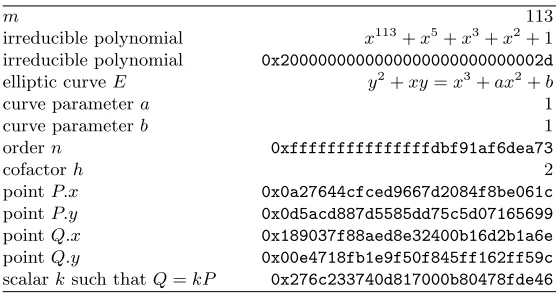
The selection of the curve parameters for a 113-bit Koblitz curve are quite straightforward. However, to proof that the discrete logarithm was actually com-puted without knowing it in advance, a point generation function was needed. The Sage code in Listing 1.1 was used to deterministically and pseudo-randomly generate two points with order n using Sage 5.12. As P and Q are gener-ated pseudo-randomly, their discrete logarithm is unknown. The Sage script also checks the point orders and the validity of the computed result. Table 5 summarizes all parameters needed for the discrete logarithm computation.
B
Binary Karatsuba
F
2113Multiplier
Table 5.Curve parameters of targeted 113-bit elliptic curve.
m 113
irreducible polynomial x113+x5+x3+x2+ 1 irreducible polynomial 0x2000000000000000000000000002d
elliptic curveE y2+xy=x3+ax2+b
curve parametera 1
curve parameterb 1
ordern 0xfffffffffffffffdbf91af6dea73
cofactorh 2
pointP.x 0x0a27644cfced9667d2084f8be061c
pointP.y 0x0d5acd887d5585dd75c5d07165699
pointQ.x 0x189037f88aed8e32400b16d2b1a6e
pointQ.y 0x00e4718fb1e9f50f845ff162ff59c
scalarksuch thatQ=kP 0x276c233740d817000b80478fde46
Algorithm 1Calculatec=a×b, witha, bbeing m-bit binary polynomials. Input: a, b
Output: c=a×b
1: mab1←(a[112..64]⊕a[63..0])×(b[112..64]⊕b[63..0]) .KS64
2: cl1←a[63..0]×b[63..0] .KS64
3: cl2←a[95..64]×b[95..64] .KS32
4: cl3←a[111..96]×b[111..96] .KS16
5: mab2←(a[95..64]⊕a[111..96])×(b[95..64]⊕b[111..96]) .KS32
6: ma3←b[112]×a[111..96]
7: mb3←a[112]×b[111..96]
8: m3←ma3⊕mb3
9: c3[32]←a[112]×b[112]
10: c3[30..0]←cl3
11: c3[31..16]←c3[31..16]⊕m3
12: m2←mab2⊕cl2⊕c3
13: c2[62..0]←cl2
14: c2[97..64]←c3
15: c2[94..32]←c2[94..32]⊕m2
16: m1←mab1⊕cl1⊕c2
17: c[126..0]←cl1
18: c[225..128]←c2
Listing 1.1.Sage code to verifyP,Q, andQ=kP.
m = 1 1 3 a =1 b =1 h =2
n =0 x f f f f f f f f f f f f f f f d b f 9 1 a f 6 d e a 7 3 k =0 x 2 7 6 c 2 3 3 7 4 0 d 8 1 7 0 0 0 b 8 0 4 7 8 f d e 4 6
FF = s a g e . r i n g s . f i n i t e _ r i n g s . f i n i t e _ f i e l d _ e x t _ p a r i .\ F i n i t e F i e l d _ e x t _ p a r i ;
K = FF ( 2 * * m , ’ x ’ ) x = K . gen ()
E = E l l i p t i c C u r v e ( K , [1 , a ,0 ,0 , b ])
def s t r _ t o _ p o l y ( str ):
I = I n t e g e r ( str , b a s e = 1 6 ) v = K (0)
for i in r a n g e (0 , K . d e g r e e ( ) ) : if ( I > > i ) & 1 > 0:
v = v + x ^ i r e t u r n v
def p o l y _ t o _ s t r ( p o l y ): vec = p o l y . _ v e c t o r _ () s t r i n g = " "
for i in r a n g e (0 , len ( vec )):
s t r i n g = s t r i n g + str ( vec [ len ( vec ) - i - 1]) r e t u r n hex ( I n t e g e r ( string , b a s e = 2 ) )
i m p o r t h a s h l i b
PX = s t r _ t o _ p o l y ( h a s h l i b . s h a 2 5 6 ( str ( 0 ) ) . h e x d i g e s t ()) PY = P o l y n o m i a l R i n g ( K , ’ PY ’ ). gen ()
P _ R O O T S = ( PY ^2+ PX * PY + PX ^3+ a * PX ^2+ b ). r o o t s () P = E ([ PX , P _ R O O T S [ 0 ] [ 0 ] ] ) ; P = P * h
QX = s t r _ t o _ p o l y ( h a s h l i b . s h a 2 5 6 ( str ( 1 ) ) . h e x d i g e s t ()) Q _ R O O T S = ( PY ^2+ QX * PY + QX ^3+ a * QX ^2+ b ). r o o t s ()
Q = E ([ QX , Q _ R O O T S [ 0 ] [ 0 ] ] ) ; Q = Q * h
p r i n t ’ P . x : ’ , p o l y _ t o _ s t r ( P [ 0 ] ) p r i n t ’ P . y : ’ , p o l y _ t o _ s t r ( P [ 1 ] ) p r i n t ’ Q . x : ’ , p o l y _ t o _ s t r ( Q [ 0 ] ) p r i n t ’ Q . y : ’ , p o l y _ t o _ s t r ( Q [ 1 ] )