COMPARATIVE STUDY OF PERFORMANCE BASED
PLASTIC DESIGN OF R.C AND COMPOSITE (CFRST)
MOMENT RESISTING FRAMES BASED ON INELASTIC
RESPONSE ANALYSIS
1
G.S.Hiremath
2Kushappa M Kabade
1
Professor,
2Post Graduate Student, Civil Engineering Department,
Basaveshwar Engineering College, Bagalkot-587102, (India)
ABSTRACT
Performance based plastic design method has emerged as a most promising and efficient seismic design method which explicitly accounts for the inelastic behavior of structural system in the design process, using the concept of energy balance applied to a pre-selected target drift and yield mechanism as design criteria based on “strong column –weak beam concept” with proper strength and ductility. In the present study comparison of a ten-storey R.C and Composite (CFRST column and Steel beam) moment resisting frames are designed by the PBPD method in terms of lateral force distribution, and the seismic performance of MRF is evaluated by non-linear static pushover analysis and non-linear dynamic time history analysis under five different ground motions using the ETABS-2013 software, with user defined hinge properties. From the above studies it is found that for nonlinear static pushover analysis shows formation of hinges in beams and at the base of the columns only for both frames leading to increased performance which clearly indicates that the PBPD method gives economical sections in terms of the optimum capacity utilization, but it is observed that the composite MRF has better yield mechanism compared to R.C MRF. From the nonlinear time history analysis it has been seen that the ground motions causes larger displacements and acceleration in the PBPD of Composite frame as compared to R.C frame. Hence it is concluded that composite moment resisting frame has performed better for high seismicity as compared to R.C moment resisting frame.
Keywords: Moment Resisting Frame, Performance Based Plastic Design (PBPD), Target Drift Yield
Mechanism, Nonlinear Static Pushover Analysis, Nonlinear Dynamic Time History Analysis,
Performance Point, Acceleration, Displacement.
I. INTRODUCTION
of doing this is through one such complete design methodology, which accounts for inelastic structural performance directly, has been developed by the senior author and his associates at the University of Michigan the Performance Based Plastic Design (PBPD) method (Lee and Goel, 2001)[1]. The methodology used here is direct design method in which uses pre-selected target drift and yield mechanisms as key performance criteria from the very start, eliminating or minimizing the need for lengthy iterations to arrive at the final design that determine the degree and distribution of expected structural damage objectives during an earthquake.
An important and economic combination of construction materials is that of steel and concrete, with applications in medium to high-rise buildings as well as bridges and steel-concrete composite systems have become quite popular in recent times because of their advantages against conventional construction. Composite construction combines the better properties of the both i.e. concrete in compression and steel in tension, results in fast construction. In India, it is comparatively new and no updated design codes are available for the same.(Anish N. Shah et al)[2]
In a concrete-filled steel tube column (RCFT, CCFT or CFST) the hollow steel tube is filled with concrete, with or without reinforcing bars. Here, the steel element contributes tensile capacity, provides confinement to concrete elements, and reduces concrete shrinkage while concrete element prevents steel from premature local buckling so that both elements contribute to the strength particularly for seismic applications. Application of the CFST concept may lead to 60% total saving of steel in comparison to a conventional structural steel system (Amir Fam, Frank S. Qie and Sami Rizkalla Journal Of Structural Engineering, ASCE, April 2004)[3].
The use of concrete-filled steel tubular columns (CFTs) in structural frames has increased in United States, Japan, China and Australia during the past the past two decades. They have been used as columns or bracings in high-rise buildings, piers for bridges, and so on. Design of CFRST column is incorporated in several codes such as ACI Building Code (ACI 318-08), Specification for Structural Steel Buildings (AISC-LRFD 360-10), EC 4, AS-5100, and CSA S16-01, CECS-28:90, AIJ(S. B. Beheshti-Aval) [4].
II. ANALYTICAL MODELLING
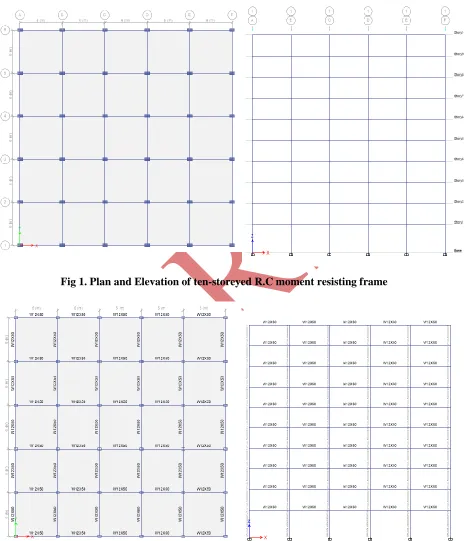
Fig 1. Plan and Elevation of ten-storeyed R.C moment resisting frame
III. METHODOLOGY OF THE STUDY
A ten-storey R.C and composite moment resisting frames are designed by the Performance based Plastic design method. Then the frames are analyzed and evaluated by the nonlinear static analysis (Push over Analysis) and nonlinear dynamic analysis (Time history analysis) under five different ground motions by using ETABS-2013.
Performance based plastic design method [Lee and Goel, 2001] [1] which is the major part of this study. In order to achieve the objectives of PBPD i.e. predictable and desired structural response. It is necessary to account for inelastic behaviour of structures directly in the design process. Figure 3 shows the target drift and yield mechanism chosen for the frame while designing it using the performance based plastic design method. The plastic hinges are to be formed at the bottom of the base column and at both ends of all floor beams only as shown in Figure 3. The beams are modeled to behave inelastically, while the columns are modeled (or „forced‟) to behave elastically. The seismic parameters considered for PBPD of R.C and Composite MRFs are, Yield drift ratio θy =1%, Target drift ratio θu=3%, Inelastic drift ratio θp= θu- θy=2%, Ductility factor μs= θu/ θy=3, Reduction Factor due to Ductility Rμ=2, Energy Modification Factor γ=1.25[5]
Fig 3. Target and Yield mechanism[Lee and Goel, 2001]
[1]Table.1 The seismic parameters of both the frames for PBPD method
Natural time Period Tn
0.985 sec
Equivalent time Period Teq
1.797 sec
Inelastic spectral acceleration Sa/g (Ce)
1.38 for R.C medium soil
0.588
Site Class D for composite
Yield drift ratio θy
1%
Target drift ratio θu
3%
Inelastic drift ratio θp= θu- θy
2%
Ductility factor μs= θu/ θy
3
Reduction Factor due to Ductility Rμ
2
3.1 User Defined Hinges
The definition of user-defined hinge properties requires moment–curvature analysis of each element. For the problem defined, building deformation is assumed to take place only due to moment under the action of laterally applied earthquake loads. Moment-curvature values calculated for R.C frame as per IS:456-2000[8] and for Composite frame as per AISC/LRFD:360-10[9]. The user-defined M3 hinge was assigned at ends of the beam member where flexural yielding is assumed to occur and P-M2-M3 for columns axial force with biaxial moments. Calculated Moment-curvature values for both MRF are entered as input in ETABS-2013.
3.2 Analysis performed in ETABS 2013
3.2.1 Pushover analysis
Pushover analysis is a nonlinear static method of analysis becoming a popular tool for seismic performance evaluation of existing and new structures. Pushover analysis can be performed as either force-controlled or displacement controlled depending on the physical nature of the load and the behaviour expected from the structure. A two or three dimensional model which includes bilinear or tri linear load-deformation diagrams of all lateral force resisting elements is first created and gravity loads are applied initially. A predefined lateral load pattern which is distributed along the building height is then applied and the entire frame is carried out up to the target drift (3%) as maximum displacement considered at roof level by using design lateral force distribution[5]. The lateral forces are increased until some members yield. The structural model is modified to account for the reduced stiffness of yielded members and lateral forces are again increased until additional members yield. The process is continued until a control displacement at the top of building reaches a certain level of deformation or structure becomes unstable. The roof displacement is plotted with base shear to get the global capacity curve. The pushover analysis is carried out as per FEMA 440[12] and a main component of Capacity Spectrum Analysis method (ATC-40)[13]. The internal forces and deformations computed at the target displacement are used as estimates of inelastic strength and deformation demands that have to be compared with available capacities for a performance check.
3.2.2 Time History Analysis
time-history analyses are required using different ground motion records. This most basic inelastic method at this time is considered overly complex and impractical for general use.
IV. RESULTS AND DISCUSSION
4.1 Inelastic response analysis of the R.C moment resisting frame designed Using performance
Based Plastic Design Approach
The R.C and Composite MRFs are designed using lateral force distribution along the height of the building for the Performance Based Plastic Design method and then nonlinear static and time history analyses were carried out. In nonlinear static pushover analysis, the entire frame is carried out up to the target drift (3% of total height of the building) by using design lateral force distribution and therefore the failure caused is shown in below Figure-4
Fig 4. Formation of Plastic hinges at step 7 and 8 in the R.C frame designed using PBPD approach
Fig 5. Earthquake ground motions records (Cape Mendocino-2, Olympia, California-2, Oakland-2,
Taft Lincoln).
Fig 7. The displacement response (Cape Mendocino-2, Olympia, California-2, Oakland-2, Taft
Lincoln) of R.C MRF designed using PBPD design approach
4.2 Inelastic response analysis of the composite moment resisting frame designed Using
performance Based Plastic Design Approach
Fig 8. Formation of Plastic hinges at step 9 and 10 in the Composite frame designed using PBPD
approach
Fig 9. The Acceleration responses (Cape Mendocino-2, Olympia, California-2, Oakland-2, Taft
Lincoln) of Composite MRF designed using PBPD approach.
Fig 10. The displacement response (Cape Mendocino-2, Olympia, California-2, Oakland-2, Taft
Lincoln) of Composite MRF designed using PBPD design approach
4.3 Acceleration and displacement
The displacement and acceleration responses of frame designed using performance based plastic design approach with respect to four different ground motion are presented in Table 2 for Non linear dynamic time history analysis.
Table.2 Acceleration and displacement values of both PBPD frames
Ground Motion
Performance Based plastic design RCC
Performance Based plastic design Composite Acceleration mm/sec2 Displacement (mm) Acceleration mm/sec2 Displacement (mm)
Olympia 3.67 105.8 4.5 138.43
California-2 4.09 78.8 4.5 105 Cape Mendocino-2 11 173.8 11.20 182.82
Oakland-2 6.92 242.5 7.20 251.20
Taft Lincoln 2.83 85.37 3.02 88.36
From above table.2 it has been also be seen that PBPD of composite frame has 23.57%, 24.95%, 5%, and 3.5%, and 3.4 % more displacement compared to R.C frame for (Olympia, California-2, Cape Mendocino-2, Oakland-2, and Taft Lincoln) earth quake ground motion respectively. Which leads to a higher hysteretic energy dissipation. The increased hysteretic energy dissipation of the frame indicates that the structure utilizes its capacity lying in the inelastic zone. The increased hysteretic energy dissipation of the frame indicates that the structure utilizes its capacity lying in the inelastic zone. The reason is that the PBPD method is based on the “strong column weak beam” concept and the beams fails first. As the structure turns into a mechanism due to formation of hinges in beams it undergoes large deformation before failure.
4.4 Performance Point
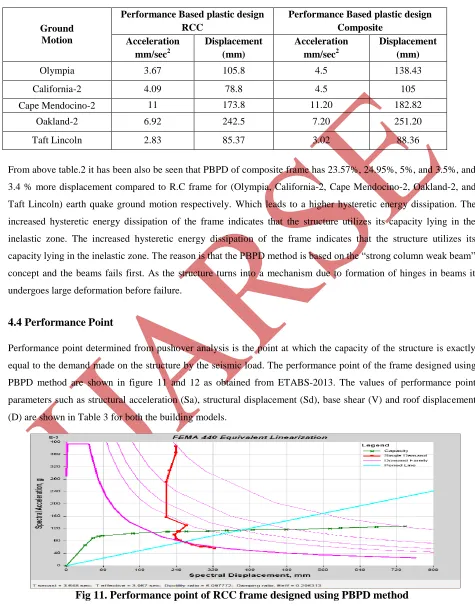
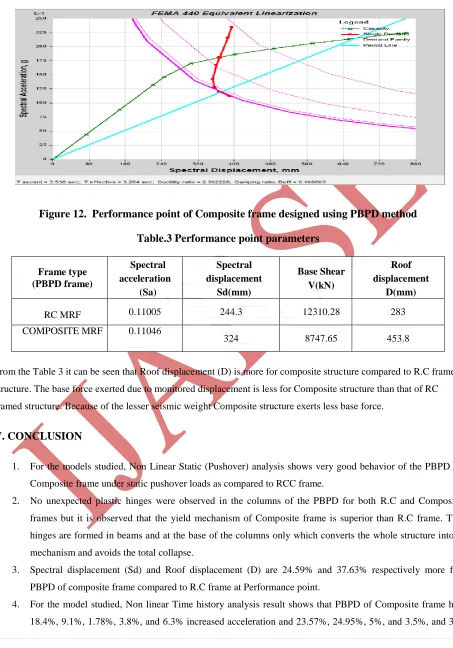
Performance point determined from pushover analysis is the point at which the capacity of the structure is exactly equal to the demand made on the structure by the seismic load. The performance point of the frame designed using PBPD method are shown in figure 11 and 12 as obtained from ETABS-2013. The values of performance point parameters such as structural acceleration (Sa), structural displacement (Sd), base shear (V) and roof displacement (D) are shown in Table 3 for both the building models.
Figure 12. Performance point of Composite frame designed using PBPD method
Table.3 Performance point parameters
Frame type (PBPD frame)
Spectral acceleration
(Sa)
Spectral displacement
Sd(mm)
Base Shear V(kN)
Roof displacement
D(mm)
RC MRF 0.11005 244.3 12310.28 283 COMPOSITE MRF 0.11046
324 8747.65 453.8
From the Table 3 it can be seen that Roof displacement (D) is more for composite structure compared to R.C framed structure. The base force exerted due to monitored displacement is less for Composite structure than that of RC framed structure. Because of the lesser seismic weight Composite structure exerts less base force.
V. CONCLUSION
1. For the models studied, Non Linear Static (Pushover) analysis shows very good behavior of the PBPD of Composite frame under static pushover loads as compared to RCC frame.
2. No unexpected plastic hinges were observed in the columns of the PBPD for both R.C and Composite frames but it is observed that the yield mechanism of Composite frame is superior than R.C frame. The hinges are formed in beams and at the base of the columns only which converts the whole structure into a mechanism and avoids the total collapse.
3. Spectral displacement (Sd) and Roof displacement (D) are 24.59% and 37.63% respectively more for PBPD of composite frame compared to R.C frame at Performance point.
% increased displacement for selected ground motion as compared to RCC frame which leads to higher hysteretic energy dissipation. The increased hysteretic energy dissipation of the frame indicates that the structure utilizes its capacity lying in the inelastic zone.
5. The PBPD method for composite frame is superior to the PBPD of R.C frame in terms of the optimum capacity utilization.
6. Composite moment resisting frame has performed better for high seismicity as compared to R.C moment resisting frame.
REFERENCES
[1] Lee, Soon-Sik, and Goel, S.C. (2001). Performance-based design of steel moment frames using target drift and yield mechanism. Research Report 20. UMCEE 01-17, Dept. of Civil and Environmental Engineering, University of Michigan, Ann Arbor, MI.
[2] Anish N. Shah, Dr. P.S. Pajgade / International Journal of Engineering Research and Applications (IJERA) ISSN: 2248-9622 www.ijera.com Vol. 3, Issue 2, March -April 2013, pp.534-539.
[3] Amir Fam; Frank S. Qie; and Sami Rizkalla.,2004, Performance-based seismic design and behavior of a composite frame, journal of structural engineering © ASCE, april 2004.
[4] S. B. Beheshti-Aval., 2012, Strength evaluation of concrete-filled steel tubes subjected to axial-flexural loading by ACI and AISC-LRFD codes along with three dimensional nonlinear analysis, International Journal of Civil Engineering, June-2012.
[5] Nayeemulla.S.I., R.G.Talasadar. and Md. Umar F.P., 2014, Comparative study of elastic design method and performance based plastic design method based on Non-linear response analysis, IOSR Journal of Mechanical and Civil Engineering (IOSR-JMCE) e-ISSN: 2278-1684, p-ISSN: 2320-334X, PP 44-50.
[6] Dr. S.B. Kharmale, Dr. V.B. Patil and V.S. Revankar., seismic performance of steel moment resisting frames designed with: displacement-based and strength-based approaches, ISET golden jubilee symposium, Indian Society of Earthquake Technology, Department of Earthquake Engineering Building, IIT Roorkee, Roorkee, October 20-21, 2012.
[7] IS-1893:2000: “criteria for earthquake resistant design of structures”.
[8] IS-456:2000: “general construction in RC Indian code of practice for plan and R.C” Bureau Indian Standards New delhi india.
[9] ANSI/AISC 360-10., AISC specification for structural steel buildings. [10] AISC-LRFD-93-2001., manual for steel construction LRFD.
[11] ASCE 7-10, minimum design loads for buildings and other structures. American Society of Civil Engineers, Reston, USA.
[13] Applied Technology Council, ATC-40. Seismic evaluation and retrofit of concrete buildings,vols. 1 &2.,Redwood City,California, 1996.
[14] Sejal P. Dalal., Sandeep .A.V.and AtulK. Desai.,2012, “ Applying performance based plastic design method to steel moment resisting frame in accordance with the Indian Standard code”,International Journal of engineering and
technology., volume 2,3- march.
[15] Sejal P. Dalal, Sandeep A. V. andAtul k. Desai., 2012, “Comparative evaluation of elastic design and performance based plastic design method for a steel moment resisting frame”,International Journal of Civil, Structural, Environmental and Infrastructure Engineering Research and Development (IJCSEIERD),ISSN 2249-6866, vol.2, issue 3, Sept 2012, pp-76-97.
![Fig 3. Target and Yield mechanism[Lee and Goel, 2001][1]](https://thumb-us.123doks.com/thumbv2/123dok_us/7753973.1271545/4.612.69.545.180.720/fig-target-and-yield-mechanism-lee-and-goel.webp)