O R I G I N A L R E S E A R C H
Pharmacokinetics of hard micronized progesterone
capsules via vaginal or oral route compared with soft
micronized capsules in healthy postmenopausal
women: a randomized open-label clinical study
This article was published in the following Dove Press journal: Drug Design, Development and Therapy
Hanbi Wang,1 Meizhi Liu,1
Qiang Fu,2 Chengyan Deng1
1Reproductive Center, Department of Obstetrics and Gynecology, Peking Union Medical College Hospital, Chinese Academy of Medical Sciences, Beijing, People’s Republic of China;2Department of Pharmacy, Peking Union Medical College Hospital, Chinese Academy of Medical Sciences, Beijing, People’s Republic of China
Video abstract
Point your SmartPhone at the code above. If you have a QR code reader the video abstract will appear. Or use:
http://www.youtube.com/watch?v=Z05OsXCUwHY
Purpose:This study aimed to evaluate the pharmacokinetics of hard micronized progester-one capsules (Yimaxin) via the vaginal or oral route compared with soft micronized progesterone capsules (Utrogestan) in a Chinese population.
Methods:A prospective single-center randomized open-label trial was conducted in 16 healthy postmenopausal women. They were randomized into two groups to receive four phases of treat-ment: vaginal Yimaxin, vaginal Utrogestan, oral Yimaxin, or oral Utrogestan, with different sequences.
Results: By the vaginal route, steady-state maximum concentration (Cmax) of Yimaxin and
Utrogestan was 29.13±8.09 and 12.30±1.60 mg/L, time to Cmax 9.72±10.50 and 11.03±9.62
hours, central compartment volume of distribution 4.26±1.86 and 10.40±2.32 L, clearance rate 0.18±0.05 and 0.38±0.10 L/h, and AUC 261.42±74.36 and 116.83±19.72 h·ng/mL, respectively.
By the oral route, Cmaxof Yimaxin and Utrogestan was 62.97±40.59 and 169.53±130.24 mg/L,
time to Cmaxwas 2.88±1.35 and 2.06±1.55 hours, central compartment volume of distribution
132.16±52.13 and 85.08±55.07 L, clearance rate 3.43±1.07 and 2.50±1.04 L/h, and AUC 274.86
±160.28 and 472.00±250.54 h·ng/mL, respectively. By the vaginal route, Cmax, minimum
concentration, AUC0–72, and AUC of Yimaxin were higher than Utrogestan, while by the oral
route the Cmax, AUC0–72, and AUC of Utrogestan were higher than Yimaxin.
Conclusion: Pharmacokinetic parameters were different between Yimaxin and Utrogestan on vaginal and oral administration. By the oral route, the metabolism and absorption of Utrogestan was superior to Yimaxin, while by the vaginal route Yimaxin was superior.
Keywords: micronized progesterone hard capsule, micronized progesterone soft capsule, pharmacokinetics, vaginal administration, oral administration
Introduction
Progesterone is a hormone secreted by ovarian corpus lutea. After the endometrium
has been affected by sufficient estrogen, progesterone converts proliferative
endo-metrium into secretory endoendo-metrium, which is conducive to embryo implantation and persistent pregnancy. Progesterone plays a very important role in endometrial
receptivity, immunosuppression, and development of decidual tissue.1,2
In women with adequate luteal function, a serum progesterone concentration of
20±5 ng/mL3 at the luteal phase can enable progesterone to act well, and serum
progesterone concentration of 25±5 ng/mL4,5at 4 weeks of pregnancy can maintain
Correspondence: Chengyan Deng Reproductive Center, Department of Obstetrics and Gynecology, Peking Union Medical College Hospital, Chinese Academy of Medical Sciences, No.1 Shuaifuyuan Wangfujing Dongcheng District, Beijing 100730, People’s Republic of China Tel +86 106 915 5898
Fax +86 106 915 5898 Email [email protected]
Drug Design, Development and Therapy
Dovepress
open access to scientific and medical research
Open Access Full Text Article
Drug Design, Development and Therapy downloaded from https://www.dovepress.com/ by 118.70.13.36 on 21-Aug-2020
easily accepted by patients due to convenience, no injec-tion-site pain and lack of dizziness or other side effects. Since the 1980s, soft micronized progesterone capsules (Utrogestan; Besins Healthcare, Paris, France) have been used widely in Europe, and can be administered orally and
vaginally.6
In 2004, a new product—hard micronized progesterone
capsule (Yimaxin; Zhejiang Xianju Pharmaceutical,
Taizhou, China) was introduced. Progesterone is
synthe-sized with diosgenin extracted from the plant Dioscorea
zingiberensis(Dioscorea nipponica). Its chemical structure is completely identical to physiological progesterone in the human body, and is a natural progesterone. Yimaxin is
prepared by solid dispersion and superfine grinding. In
theoretical analysis, Yimaxin particles are at the nanometer level. Progesterone is present in solid dispersion in a mole-cular state, which is designed to enhance the progesterone dissolution rate. Sales of Yimaxin reached 9.5 million boxes in 2018, and the drug was used by approximately 4.75 million people. Calculated by number of boxes, it accounted for about 21% of the Chinese progesterone market.
Utrogestan was introduced in China in 1992. Though Yimaxin has been used in China for 14 years, there is lack of the pharmacokinetic (PK) parameters for the Chinese
population. This study for the first time enrolled healthy
postmenopausal Chinese women to explore the PK papra-meters and tolerability of different routes of administration of Yimaxin and Utrogestan in a Chinese population.
Methods
This was a prospective, single-center, randomized, open-label study that was approved by the Ethics Committee of Peking Union Medical College Hospital (HS-1451) and registered with the Chinese Clinical Trial Register website (www.chictr.org.cn; ChiCTR1800019081). Written con-sent was obtained from each patient.
Study subjects
A total of 16 Chinese healthy menopausal women aged
45–60 years were enrolled from December 2017 to June
informed consent.
Exclusion criteria were initial physical assessment indicat-ing participant havindicat-ing abnormalities that may affect the study, any abnormal laboratory-test results prior to the study, having participated in other clinical trials in the past 3 months, receiv-ing any steroid hormone drug in the past 3 months, allergic reactions or serious adverse reactions to the test drugs, often or currently using enzyme inducers or inhibitors and other drugs that might affect drug metabolism, such as sex hormones, phenytoin, barbital, primidone, carbamazepine, rifampicin, or griseofulvin, history of thromboembolism, thrombophlebitis, or serious cardiovascular disease, history of any tumors, blood-system disorders, or severe or frequent headache, and previously or currently suffering from mental illness, depres-sion, or epilepsy.
After the subjects had signed the informed-consent form, their general information was collected and physical examination and laboratory testing performed, including evaluation of vital signs and systemic organ systems, electrocardiography, chest X-ray, breast ultrasound, basic sex-hormone examination, gynecological examination, transvaginal uterine adnexa ultrasound, blood and urine routine testing, and blood biochemical testing. Subjects were included according to the inclusion and exclusion criteria and evenly randomized into two groups (desig-nated groups A and B).
Study procedure
The study had four phases (Figure 1). In thefirst phase,
daily estradiol valerate 2 mg orally was given on days
1–20. On days 11–20, group A received Yimaxin
(vagi-nal route, 50 mg/capsule, Figure 2), 200 mg twice daily
while group B received Utrogestan (vaginal route,
100 mg/capsule, Figure 2) 200 mg twice daily. Fasting
blood was collected to measure E2 and P, and vaginal
ultrasound was performed to measure endometrial thick-ness on days 1 and 11. On day 11, blood samples were also collected before administration and 0.5, 1, 1.5, 2, 3,
4, 6, 8, and 12 hours after the first administration to
analyze PK parameters.
Drug Design, Development and Therapy downloaded from https://www.dovepress.com/ by 118.70.13.36 on 21-Aug-2020
The second administration was after all blood samples had
been collected. On days 12–19, blood samples were collected
each day before the first administration to analyze PK
para-meters. On day 20, blood samples were collected before
admin-istration and 0.5, 1, 1.5, 2, 3, 4, 6, 8 and 12 hrs after thefirst
administration to analyze the pharmacokinetics. The second administration was after all blood samples had been collected. On day 21, drugs (estrogen and progesterone) were discontin-ued, fasting blood samplescollected, and specimens of endome-trium collected and examined independently by two experienced pathologists. Fasting blood was collected every morning for PK analysis for 3 days after drug withdrawal. Washout lasted for 15 days after the last administration. Adverse events and concomitant medications were recorded. After washout, subjects entered the second period, in which group A received Utrogestan (vaginal route) 200 mg twice daily, while group B received Yimaxin (vaginal route) 200 mg twice daily. The study procedure was same as previously mentioned. In the third period, group A received Yimaxin (oral route) and group B received Utrogestan (oral route) while in the fourth round, group A received Utrogestan (oral route) and group B received Yimaxin (oral route). The study procedure was same as previously mentioned. Physical examination and laboratory testing were performed again after the study.
Blood-sample collection and processing
Blood was drawn via an indwelling needle placed onthe forearm of the subject and the initial 0.2–0.3 mL
blood was discarded before collection. About 3 mL
venous blood sample was collected each time.
Heparin was used to seal the sampling tubes. Blood
samples were centrifuged (2,000 g at 4 °C for 10
minutes) within 60 minutes after collection and the serum concentration of progesterone determined imme-diately with an electrochemical method. Serum samples
were placed at −20 °C for 2 hours for prefreezing and
then stored at −70°C. PK parameters were calculated:
maximum concentration (Cmax), time to Cmax (Tmax),
AUC0-72 half-life (t1/2), time to steady state (Tsteady),
minimum concentration (Cmin), residual area, volume
of distribution (V/F), clearance rate (Cl/F), mean resi-dence time (MRT), and AUC after reaching steady state (AUC). A case-report form was used for data collection, and data were deposited in a database after
being reviewed and verified.
Statistical methods
Statistical analysis of PK parameters was performed with a noncompartmental model in the WinNonlin standard edi-tion version 5.7 software. One-way ANOVA was used to evaluate statistical differences in geometric mean ratios of
ln-transformed Cmax, AUC0–t, and AUC0–∞ between two
groups with 95% CIs, as well as mean values oft1/2 and
CL/F between groups. The Hodges–Lehmann method was
employed to compare median Tmaxvalues between groups
with 95% CIs.
Results
Sixteen subjects successfully completed the study. Their
demographic characteristics are shown in Table 1. Blood
pressure, heart rate and body temperature showed no signifi
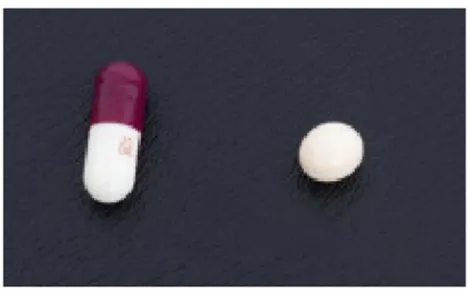
-cant changes from baseline data after the study. Mean plasma Figure 2Yimaxin (left, 50 mg) and Utrogestan (right, 100 mg) capsules. Both can
be used orally or vaginally. Figure 1Flow chart of the study.
Drug Design, Development and Therapy downloaded from https://www.dovepress.com/ by 118.70.13.36 on 21-Aug-2020
concentration–time curves of Yimaxin and Utrogestan
admin-istration via vaginal and oral routes are shown inFigures 3and
4, respectively. PK parameters of Yimaxin and Utrogestan via
vaginal and oral routes obtained by noncompartmental
analy-sis are shown inTables 2and3, respectively. PK parameters of
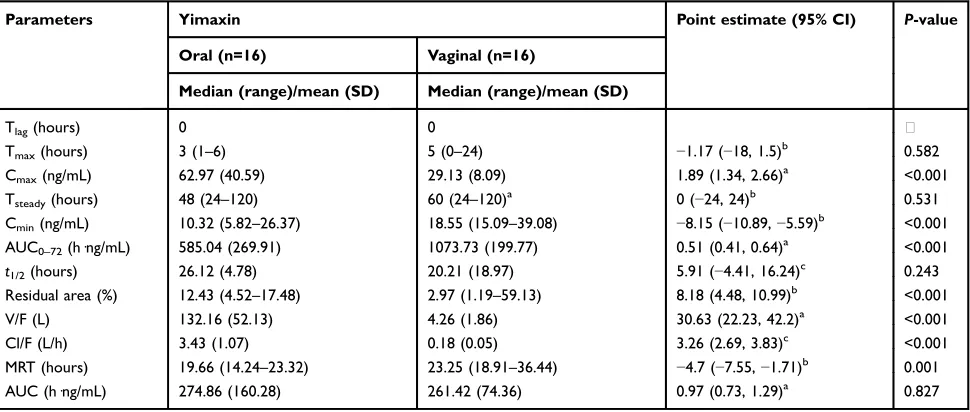
exposure from oral vs vaginal routes for Yimaxin are
com-pared inTable 4,and the corresponding mean plasma
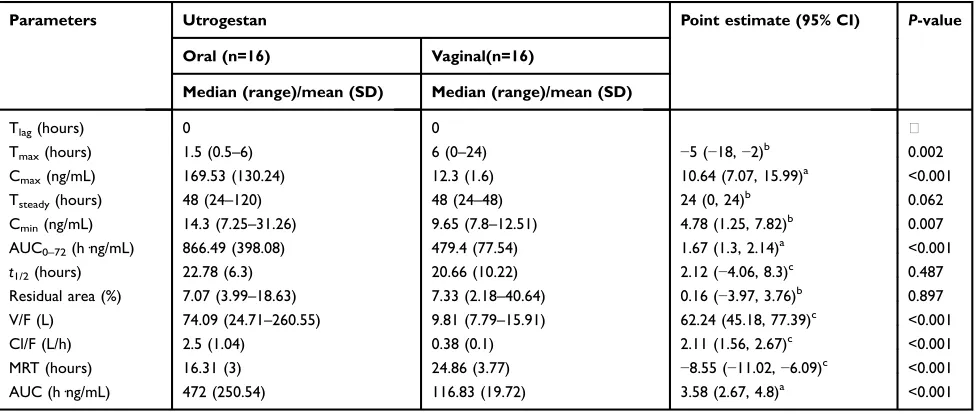
concen-tration–time curve is shown inFigure 5. Those for Utrogestan
are shown inTable 5andFigure 6.
Discussion
The main ingredient of Yimaxin is progesterone (50 mg/ capsule). After oral administration, it is metabolized by the liver, about 12% is metabolized to pregnanediol, and the metabolites are combined with glucuronic acid to be excreted
with urine. It has four metabolites, which areγ-GABA
recep-tor agonists and have sedative and hypnotic effects. Bioavailability is approximately 10% of the progesterone via
intramuscular injection.7–9 Utrogestan is progesterone 100
mg/capsule. It is a soft micronized progesterone capsule that can be administered orally or vaginally. Both routes have
good endometrial transformation.10The progesterone capsule
was initially developed for oral administration, but given its low progesterone bioavailability due to hepatic clearance, it has gained acceptance as a vaginal application. Studies have
claimed that due to thefirst-pass effect through the liver, oral
progesterone was the least effective form, contrary to
intra-muscular, which was reported to be the most efficient.11Many
studies have confirmed that vaginal administration of
micro-nized progesterone tablets and progesterone vaginal gel have similar effects on persistent pregnancy rate, but progesterone
gel is more convenient to use.12–16There have not been any
studies undertaking comparative study of the PK parameters
of Yimaxin. Since the efficacy of vaginal administration of
micronized progesterone has been well recognized, we selected the long-used Utrogestan, with good safety and stable
efficacy, as a reference drug to investigate the PK parameters
of Yimaxin, a hard micronized progesterone capsule. In this study, selection of postmenopausal women elimi-nated the effects of hormones secreted by functional ovaries. Because blood-drug concentration is low after a single dose, the general single-dose protocol is not suitable for clinical use, but twice a day is usually selected in clinical practice, which is adopted for PK study. This showed that Yimaxin and
Figure 3Serum progesterone concentration after vaginal administration of Yimaxin and Utrogestan (n=16).
Drug Design, Development and Therapy downloaded from https://www.dovepress.com/ by 118.70.13.36 on 21-Aug-2020
Utrogestan can be absorbed rapidly, regardless of route of administration, as the uptake differnce between the two
drugs via two the two routes was zero. There was no signifi
-cant difference in Tmaxbetween the two drugs via the same
route. There were no significant difference in Tmaxand Tsteady
among different drug–route combinations. Absorption of the
two drugs were different in different routes of administration.
After vaginal administration, Yimaxin had higher Cmax, lower
V/F, larger AUC, and lower Cl/F than Utrogestan. In contrast,
after oral administration, Utrogestan had a significantly higher
Cmax, lower Vc/F, larger AUC, and lower Cl/F than Yimaxin.
It is suggested that by the oral route, Utrogestan had higher plasma concentration, while by the vaginal route, Yimaxin had higher plasma concentration. There was no statistically
significant difference in MRT between the two drugs via
vaginal administration, but via oral administration the MRT of Yimaxin was longer than that of Utrogestan, suggesting Yimaxin stayed longer in the body than Utrogestan.
For exposure from oral vs vaginal Yimaxin, oral
administration had higher Cmax, residual area, V/F, and
Cl/F than those vaginal administration, but vaginal
admin-istration had higher Cmin, AUC0–72, MRT than oral
admin-istration. This suggested that the vaginal route had better absorption and more effective use than oral route. Meanwhile, comparison of exposure from oral vs vaginal Utrogestan revealed that oral administration had higher
Cmax, Cmin, AUC0–72, Vc/F, Cl/F, and AUC than vaginal
administration, but vaginal administration had higher Tmax
Figure 4Serum progesterone concentration after oral administration of Yimaxin and Utrogestan (n=16).
Table 2Pharmacokinetic parameters of Yimaxin and Utrogestan after vaginal administration
Parameters Utrogestan (n=16) Yimaxin (n=16) Point estimate (95% CI) P-value
Median (range)/mean (SD) Median (range)/mean (SD)
Tlag(hours) 0 0
Tmax(hours) 6 (0–24) 5 (0–24) 0.5 (−2 to 6)b 0.477
Cmax(ng/mL) 12.3 (1.6) 29.13 (8.09) 0.43 (0.37–0.51)a <0.001
Tsteady(hours) 48 (24–48) 60 (24–120) −24 (−24 to 0)b 0.01
Cmin(ng/mL) 9.65 (7.8–12.51) 18.55 (15.09–39.08) −9.08 (−11.19 to−7.11)b <0.001 AUC0–72(h·ng/mL) 479.4 (77.54) 1073.73 (199.77) 0.45 (0.39–0.51)a <0.001
t1/2(hours) 20.66 (10.22) 20.21 (18.97) 0.46 (−10.69 to 11.6)c 0.933
Residual area % 7.33 (2.18–40.64) 2.97 (1.19–59.13) 2.86 (0.99–6.71)b 0.017 V/F (L) 9.81 (7.79–15.91) 4.04 (1.91–8.52) 5.88 (4.77–7.53)b <0.001
Cl/F (L/h) 0.38 (0.1) 0.18 (0.05) 0.21 (0.15–0.27)c <0.001
MRT (hours) 24.86 (3.77) 24.48 (5.07) 0.38 (−2.86 to 3.62)c 0.812
AUC (h·ng/mL) 116.83 (19.72) 261.42 (74.36) 0.46 (0.39–0.54)a <0.001
Notes:a
Geometric mean ratio on one-way ANOVA;b
Hodges–Lehmann method;c
one-way ANOVA.
Abbreviations:Cmax, maximum concentration ; Cmin, minimum concentration ; Cl/F, clearance rate; MRT, mean residence time;t½, half-life; Tlag, time difference; Tmax, time to Cmax; Tsteady, time to steady state; V/F, volume of distribution.
Drug Design, Development and Therapy downloaded from https://www.dovepress.com/ by 118.70.13.36 on 21-Aug-2020
and MRT than oral administration. For Yimaxin and
Utrogestan, t½ remained the same, regardless of route.
For both drugs, MRT for the vaginal route was longer than the oral route. After achieving a constant concentra-tion of medicines, AUC in dosing intervals of vaginal administration of Yimaxin was higher than Utrogestan. However, via the oral route, Utrogestan AUC was higher than Yimaxin. For Yimaxin, there was no difference in AUC in dosing intervals after achieving constant concen-tration, regardless of administration route, but for
Utrogestan, AUC for the oral route was higher than the vaginal route.
Differences in PK parameters between Yimaxin and Utrogestan administered vaginally or orally may be related to their different pharmaceutical processes. The fact that the active progesterone concentration in blood of vaginally administered Yimaxin is higher than orally administered
Utrogestan is related to the first-pass effect through the
liver for the orally administered drug. For Yimaxin, proges-terone is dispersed in a molecular state through the solid AUC0–72(h·ng/mL) 866.49 (398.08) 585.04 (269.91) 1.46 (1.08–1.97)a 0.016
t1/2(hours) 22.78 (6.3) 26.12 (4.78) −3.34 (−7.39 to 0.71)
c
0.102 Residual area (%) 7.07 (3.99–18.63) 12.43 (4.52–17.48) −3.3 (−7.2 to 0.2)b 0.061
V/F (L) 85.08 (55.07) 132.16 (52.13) 0.61 (0.42–0.88)a 0.01
Cl/F (L/h) 2.5 (1.04) 3.43 (1.07) −0.93 (−1.7 to−0.17)c 0.018
MRT (hours) 16.31 (3) 19.21 (2.79) −2.9 (−4.99 to−0.81)c 0.008
AUC (h·ng/mL) 472 (250.54) 274.86 (160.28) 1.69 (1.17–2.43)a 0.006
Notes:a
Geometric mean ratio on one-way ANOVA;b
Hodges–Lehmann method;c
one-way ANOVA.
Abbreviations:Cm, maximum concentration; Cmin, minimum concentration ; Cl/F, clearance rate; MRT, mean residence time;t½, half-life; Tlag, time difference; Tmax, time to Cmax; Tsteady, time to steady state; V/F, volume of distribution.
Table 4Pharmacokinetic parameters of Yimaxin after oral and vaginal administration
Parameters Yimaxin Point estimate (95% CI) P-value
Oral (n=16) Vaginal (n=16)
Median (range)/mean (SD) Median (range)/mean (SD)
Tlag(hours) 0 0
Tmax(hours) 3 (1–6) 5 (0–24) −1.17 (−18, 1.5)b 0.582
Cmax(ng/mL) 62.97 (40.59) 29.13 (8.09) 1.89 (1.34, 2.66)a <0.001
Tsteady(hours) 48 (24–120) 60 (24–120)a 0 (−24, 24)b 0.531
Cmin(ng/mL) 10.32 (5.82–26.37) 18.55 (15.09–39.08) −8.15 (−10.89,−5.59)b <0.001 AUC0–72(h·ng/mL) 585.04 (269.91) 1073.73 (199.77) 0.51 (0.41, 0.64)a <0.001
t1/2(hours) 26.12 (4.78) 20.21 (18.97) 5.91 (−4.41, 16.24)c 0.243
Residual area (%) 12.43 (4.52–17.48) 2.97 (1.19–59.13) 8.18 (4.48, 10.99)b <0.001
V/F (L) 132.16 (52.13) 4.26 (1.86) 30.63 (22.23, 42.2)a <0.001
Cl/F (L/h) 3.43 (1.07) 0.18 (0.05) 3.26 (2.69, 3.83)c <0.001
MRT (hours) 19.66 (14.24–23.32) 23.25 (18.91–36.44) −4.7 (−7.55,−1.71)b 0.001
AUC (h·ng/mL) 274.86 (160.28) 261.42 (74.36) 0.97 (0.73, 1.29)a 0.827
Notes:a
Geometric mean ratio on one-way ANOVA;b
Hodges–Lehmann method;c
one-way ANOVA.
Abbreviations:Cmax, maximum concentration ; Cmin, minimum concentration ; Cl/F, clearance rate; MRT, mean residence time;t½, half-life; Tlag, time difference; Tmax, time to Cmax; Tsteady, time to steady state; V/F, volume of distribution.
Drug Design, Development and Therapy downloaded from https://www.dovepress.com/ by 118.70.13.36 on 21-Aug-2020
suspension of glyceride stearate. When administered vagin-ally, the progesterone molecules in Yimaxin can dissolve and be absorbed quickly, while for orally administered
Utrogestan, thefirst-pass effect would be applied directly to
the dissolved progesterone and thus reduce adsorption. Orally administered Yimaxin is rapidly metabolized
dur-ingfirst liver pass and then disappears from the general
circu-lation. On the other hand, vaginal-route Yimaxin reaches higher progesterone concentrations in endometrial tissue than
oral-route Yimaxin.12 Progesterone blood concentration of
vaginal-route Utrogestan is lower than oral-route Utrogestan, probably because of the fact that for Utrogestan, progesterone Figure 5Serum progesterone concentration after oral and vaginal administration of Yimaxin (n=16).
Table 5Pharmacokinetic parameters of Utrogestan after oral and vaginal administration
Parameters Utrogestan Point estimate (95% CI) P-value
Oral (n=16) Vaginal(n=16)
Median (range)/mean (SD) Median (range)/mean (SD)
Tlag(hours) 0 0
Tmax(hours) 1.5 (0.5–6) 6 (0–24) −5 (−18,−2)b 0.002
Cmax(ng/mL) 169.53 (130.24) 12.3 (1.6) 10.64 (7.07, 15.99)a <0.001
Tsteady(hours) 48 (24–120) 48 (24–48) 24 (0, 24)b 0.062
Cmin(ng/mL) 14.3 (7.25–31.26) 9.65 (7.8–12.51) 4.78 (1.25, 7.82)b 0.007 AUC0–72(h·ng/mL) 866.49 (398.08) 479.4 (77.54) 1.67 (1.3, 2.14)a <0.001
t1/2(hours) 22.78 (6.3) 20.66 (10.22) 2.12 (−4.06, 8.3)c 0.487
Residual area (%) 7.07 (3.99–18.63) 7.33 (2.18–40.64) 0.16 (−3.97, 3.76)b 0.897 V/F (L) 74.09 (24.71–260.55) 9.81 (7.79–15.91) 62.24 (45.18, 77.39)c <0.001
Cl/F (L/h) 2.5 (1.04) 0.38 (0.1) 2.11 (1.56, 2.67)c <0.001
MRT (hours) 16.31 (3) 24.86 (3.77) −8.55 (−11.02,−6.09)c <0.001
AUC (h·ng/mL) 472 (250.54) 116.83 (19.72) 3.58 (2.67, 4.8)a <0.001
Notes:a
Geometric mean ratio on one-way ANOVA;b
Hodges–Lehmann method;c
one-way ANOVA.
Abbreviations:Cmax, maximum concentration ; Cmin, minimum concentration ; Cl/F, clearance rate; MRT, mean residence time;t½, half-life; Tlag, time difference; Tmax, time to Cmax; Tsteady, time to steady state; V/F, volume of distribution.
Figure 6Serum progesterone concentration after oral and vaginal administration of Utrogestan (n=16).
Drug Design, Development and Therapy downloaded from https://www.dovepress.com/ by 118.70.13.36 on 21-Aug-2020
Conclusion
This is the first pharmacokinetic comparison between
hard progesterone hard capsule and soft (oil-based)
cap-sules. It is also the first PK comparison of the different
delivery routes of the two drugs. By the oral route, the metabolism and absorption of Utrogestan is superior to Yimaxin, while by the vaginal route Yimaxin is superior. This study provides PK data that can guide clinical medication.
Data-sharing statement
We would like to share all individual de-identified
partici-pant data related to this study in a spreadsheet format. The data will be accessible upon request and will be available for at least 5 years after publication.
Disclosure
The authors report no conflicts of interest in this work.
References
1. Lo Monte G, Piva I, Bazzan E, Marci R, Ogrin C. Luteal phase support for assisted reproductive technologies: between past, present and future.Minerva Endocrinol.2013;38:401.
2. Yanushpolsky EH. Luteal phase support inin vitrofertilization.Semin
Reprod Med.2015;33:118–127. doi:10.1055/s-0035-1545363
3. Deichert U, Hackelöer BJ, Daume E. The sonographic and endocrino-logic evaluation of the endometrium in the luteal phase.Hum Reprod. 1986;1:219. doi:10.1093/oxfordjournals.humrep.a136388
dual actions of progesterone in the nervous system: neuroprotection and myelination. Growth Horm IGF Res. 2004;14:18–33. doi:10.1016/j.ghir.2004.03.007
8. Belelli D, Lambert JJ. Neurosteroids: endogenous regulators of the GABA(A) receptor. Nat Rev Neurosci.2005;6:565–575. doi:10.1038/ nrn1703
9. Harrison NL, Majewska MD, Harrington JW, Barker JL. Structure-activity relationships for steroid interaction with the gamma-aminobu-tyric acidA receptor complex.J Pharmacol Exp Ther.1987;241:346. 10. Stute P, Neulen J, Wildt L. The impact of micronized progesterone on
the endometrium: a systematic review. Climacteric. 2016;19:316– 328. doi:10.1080/13697137.2016.1187123
11. Probst AM, Hill JA, Ginsburg ES, Hurwitz S, Politch J, Yanushpolsky EH. A randomized study comparing Crinone 8% and intramuscular progesterone supplementation in in vitro fertilization-embryo transfer cycles.Fertil Steril.2001;76:1144–1149.
12. Simunic V, Tomic V, Tomic J, Nizic D. Comparative study of the efficacy and tolerability of two vaginal progesterone formulations, Crinone 8% gel and Utrogestan capsules, used for luteal support. Fertil Steril.2007;87:83–87.
13. Bergh C, Lindenberg S, Nordic Crinone Study Group. A prospective randomized multicentre study comparing vaginal progesterone gel and vaginal micronized progesterone tablets for luteal support after in vitro fertilization/intracytoplasmic sperm injection.Hum Reprod. 2012;27:3467–3473. doi:10.1093/humrep/des341
14. Sofuoglu K, Gun I, Sahin S, Ozden O, Tosun O, Eroglu M. Vaginal micronized progesterone capsule versus vaginal progesterone gel for lutheal support in normoresponder IVF/ICSI-ET cycles.Pak J Med Sci. 2015;31:314.
15. Michnova L, Dostal J, Kudela M, Hamal P, Langova K. Vaginal use of micronized progesterone for luteal support.A randomized study comparing Utrogestan® and Crinone® 8.Biomed Pap Med Fac Univ
Palacky Olomouc Czech Repub. 2017;161:86–91. doi:10.5507/
bp.2017.007
16. Child T, Leonard SA, Evans JS, Lass A. Systematic review of the clinical efficacy of vaginal progesterone for luteal phase support in assisted reproductive technology cycles. Reprod Biomed Online. 2018;36:630–645. doi:10.1016/j.rbmo.2018.02.001
Drug Design, Development and Therapy
Dovepress
Publish your work in this journal
Drug Design, Development and Therapy is an international, peer-reviewed open-access journal that spans the spectrum of drug design and development through to clinical applications. Clinical outcomes, patient safety, and programs for the development and effective, safe, and sustained use of medicines are a feature of the journal, which has also
been accepted for indexing on PubMed Central. The manuscript management system is completely online and includes a very quick and fair peer-review system, which is all easy to use. Visit http://www. dovepress.com/testimonials.php to read real quotes from published authors.
Submit your manuscript here:https://www.dovepress.com/drug-design-development-and-therapy-journal
Drug Design, Development and Therapy downloaded from https://www.dovepress.com/ by 118.70.13.36 on 21-Aug-2020