Correctness and Fairness of Tendermint-core Blockchains
Yackolley Amoussou-Guenou‡,?, Antonella Del Pozzo‡, Maria Potop-Butucaru?, Sara Tucci-Piergiovanni‡
‡CEA LIST, PC 174, Gif-sur-Yvette, 91191, France
?Sorbonne Universit´e, CNRS, Laboratoire d’Informatique de Paris 6, LIP6, Paris, France
Abstract
Tendermint-core blockchains (e.g. Cosmos) are considered today one of the most viable alternatives for the highly energy consuming proof-of-work blockchains such as Bitcoin and Ethereum. Their particularity is that they aim at offering strong consistency (no forks) in an open system combining two ingredients (i) a set of validators that generate blocks via a variant of Practical Byzantine Fault Tolerant (PBFT) consensus protocol and (ii) a selection strategy that dynamically selects nodes to be validators for the next block via a proof-of-stake mechanism. However, the exact assumptions on the system model under which Tendermint underlying algorithms are correct and the exact properties Tendermint verifies have never been formally analyzed. The contribution of this paper is two-fold. First, while formalizing Tendermint algorithms we precisely characterize the system model and the exact problem solved by Tendermint. We prove that in eventual synchronous systems a modified version of Tendermint solves (i) under additional assumptions, a variant of one-shot consensus for the validation of one single block and (ii) a variant of the repeated consensus problem for multiple blocks. These results hold even if the set of validators is hit by Byzantine failures, provided that for each one-shot consensus instance less than one third of the validators is Byzantine. Our second contribution relates to the fairness of the rewarding mechanism. It is common knowledge that in permisionless blockchain systems the main threat is the tragedy of commons that may yield the system to collapse if the rewarding mechanism is not adequate. Ad minimum the rewarding mechanism must bef air, i.e. distributing the rewards in proportion to the merit of participants. We prove, for the first time in blockchain systems, that in repeated-consensus based blockchains there exists an (eventual) fair rewarding mechanism if and only if the system is (eventual) synchronous. We also show that the original Tendermint rewarding is not fair, however, a modification of the original protocol makes it eventually fair.
1
Introduction
distributed data structure replicated among different peers. In order to preserve the chain structure those peers need to agree on the next block to append in order to avoid forks. The most popular technique to decide which block will be appended is theproof-of-work mechanism of Dwork and Naor [18]. The block that will be appended to the blockchain is owned by the node (miner) having enough CPU power to solve first a crypto-puzzle. The only possible way to solve this puzzle is by repeated trials. The major criticisms for the proof-of-work approach are as follows: it is assumed that the honest miners hold a majority of the computational power, the generation of a block is energetically costly, which yield to the creation of mining pools and finally, multiple blockchains that coexist in the system due to accidental or intentional forks.
Recently, the non academic research developed alternative solutions to the proof-of-work technique such asproof-of-stake (the power of block building is proportional to the participant wealth), proof-of-space (similar to proof-of-work, instead of CPU power the prover has to provide the evidence of a certain amount of space) or proof-of-authority (the power of block building is proportional to the amount of authority owned in the system). These alternatives received little attention in the academic research. Among all these alternatives proof-of-stake protocols and in particular those using variants ofPractical Byzantine Fault-Tolerant consensus [10] became recently popular not only for in-chain transaction systems but also in systems that provide cross-chain transactions. Tendermint [34, 8, 32, 35] was the first in this line of research having the merit to link the Practical Byzantine Fault-Tolerant consensus to the proof-of-stake technique and to propose a blockchain where a dynamic set of validators (subset of the participants) decide on the next block to be appended to the blockchain. Although, the correctness of the original Tendermint protocol [34, 8, 32] has never been formally analyzed from the distributed computing perspective, it or slightly modified variants became recently the core of several popular systems such as Cosmos [33] for cross-chain transactions.
In this paper we analyse the correctness of the original Tendermint agreement protocol as it was described in [34, 8, 32] and discussed in [35, 28]. The code of this protocol is available in [42]. One of our fundamental results proved in this paper is as follows:
In an eventual synchronous system, a slightly modified variant of the original Tendermint protocol implements the one-shot and repeated consensus, provided that (i) the number of Byzantine validators, f, isf < n/3 where n is the number of validators participating in each single one-shot consensus instance and (ii) eventually a proposed value will be accepted by at least2n/3 + 1processes (Theorem 7 and Theorem 11).
More in detail, we prove that the original Tendermint verifies the consensus termination with a small twist in the algorithm (a refinement of the timeout) and with the additional assumption stating that there exists eventually a proposer such that its proposed value will be accepted, or voted, by more than two-third of validators.
We are further interested in the fairness of Tendermint-core blockchains because without a glimpse of fairness in the way rewards are distributed, these blockchains may collapse. Our fairness study, in line with Francez definition of fairness [23], generally defines the fairness of protocols based on voting committees (e.g. Byzcoin[31], PeerCensus[14], RedBelly [12], SBFT [25] and Hyperledger Fabric [3] etc), by the fairness of their selection mechanism and the fairness of their
result with respect to the fairness of repeated-consensus blockchains as follows:
There exists a(n) (eventual) fair reward mechanism for repeated-consensus blockchains if and only if the system is (eventual) synchronous (Theorem 16).
Moreover, we show that even in an eventual synchronous setting, the original Tendermint protocol is not eventually fair, however with a small twist in the way delays and commit messages are handled it becomes eventually fair.
Note that our work is the first to analyze the fairness of protocols based on voting committees elected by selection mechanisms asproof-of-stake.
The rest of the paper is organized as follows. Related works are discussed in Section 2. Section 3 defines the model and the formal specifications of one-shot and repeated consensus. Section 4 formalizes the original Tendermint protocol through pseudo-code and proves the correctness of the One-Shot Consensus anf the Repeated Consensus algorithms. In Section 5 we present a full descriptions of the counter-example that motivates the modification of the original algorithm and the additioinal assumptions needed for the correctness. Section 6 discusses the necessary and sufficient conditions for a protocol based on repeated consensus to achieve a fair rewarding.
2
Related Work
Interestingly, only recently distributed computing academic scholars focus their attention on the theoretical aspects of blockchains motivated mainly by the intriguing claim of popular blockchains, as Bitcoin and Ethereum, that they implement consensus in an asynchronous dynamic open system. This claim is refuted by the famous impossibility result in distributing computing [22].
In distributed systems, the theoretical studies of proof-of-work based blockchains have been pioneered by Garay et al [24]. Garay et al. decorticate the pseudo-code of Bitcoin and analyse its agreement aspects considering a synchronous round-based communication model. This study has been extended by Passet al.[38] to round based systems where messages sent in a round can be received later. In order to overcome the drawbacks of Bitcoin, [20] proposes a mix between proof-of-work blockchains and proof-of-work free blockchains referred as Bitcoin-NG. Bitcoin-NG inherits the drawbacks of Bitcoin: costly proof-of-work process, forks, no guarantee that a leader in an epoch is unique, no guarantee that the leader does not change the history at will if it is corrupted.
On another line of research Decker et al. [14] propose the PeerCensus system that targets linearizability of transactions. PeerCensus combines the proof-of-work blockchain and the classical results in Practical Byzantine Fault Tolerant agreement area. PeerCensus suffers the same drawbacks as Bitcoin and Byzcoin against dynamic adversaries.
Byzcoin [31] builds on top ofPractical Byzantine Fault-Tolerant consensus [10] enhanced with a scalable collective signing process. [31] is based on a leader-based consensus over a group of members chosen by a proof-of-membership mechanism. When a miner succeeds to mine a block, it gains a membership share, and the miners with the highest shares are part of the fixed size voting member set. In the same spirit, SBFT [25] and Hyperledger Fabric [3] build on top of [10].
In order to avoid some of the previously cited problems, Micali [36] introduced (further extended in [6, 11]) sortition based blockchains, where the proof-of-work mechanism is completely replaced by a probabilistic ingredient.
committee is elected and inside the elected committee a leader will be chosen. The leader is allowed to extend the new blockchain. The protocol is validated via simulations and only partial proofs of correctness are provided. Ouroboros [29] proposes a sortition based proof-of-stake protocol and addresses mainly the security aspects of the proposed protocol. Red Belly [12] focuses on consortium blockchains, where only a predefined subset of processes are allowed to append blocks, and proposes a Byzantine consensus protocol.
Interestingly, none of the previous academic studies made the connection between the repeated consensus specification [5, 16, 15] and the repeated agreement process in blockchain systems. Moreover, in terms of fairness of rewards, no academic study has been conducted related to blockchains based on repeated consensus.
The closest works in blockchain systems to our fairness study (however very different in its scope) study thechain-quality. In [24], Garayet al. define the notion of chain-quality as the proportion of blocks mined by honest miners in any given window and study the conditions under which the ratio of blocks in the chain mined by malicious players over the total number of blocks in a given window is bounded. Kiayias et al. in [29] propose Ouroboros [29] and also analyse the chain-quality property. Pass et al. address in [39] one of the vulnerabilities of Bitcoin studied formally in Eyal and Sirer [21]. In [21] the authors prove that if the adversary controls a coalition of miners holding even a minority of the computational power, this coalition can gain twice its share. Fruitchain [39] overcomes this problem by ensuring that no coalition controlling less than a majority of the computational power can gain more than a factor 1 + 3δ by not respecting the protocol, whereδ is a parameter of the protocol. In [19], Eyal analyses the consequences of attacks in systems where pools of miners can infiltrate each other and shows that in such systems there is an equilibrium where all pools earn less than if there were no attack. In [26], Guerraoui and Wang study the effect of message propagation delays in Bitcoin and show that, in a system of two miners, a miner can take advantage of the delays and be rewarded exponentially more than its expectation. In [27], G¨urcan et al. study the fairness from the point of view of users that do not participate to the mining. A similar work is done by Herlihy and Moir in [28] where the authors study the users fairness and consider as an example the original Tendermint [34, 8, 32]. The authors discussed how processes with malicious behaviour can violate fairness by choosing transactions, then they propose modifications to the original Tendermint to make those violations detectable and accountable.
3
System model and Problem Definition
The system is composed of an infinite set Π of asynchronous sequential processes, namely Π =
{p1, . . .}; i is called the index of pi. Asynchronous means that each process proceeds at it own
speed, which can vary with time and remains unknown to the other processes. Sequential means that a process executes one step at a time. This does not prevent it from executing several threads with an appropriate multiplexing. As local processing time are negligible with respect to message transfer delays, they are considered as being equal to zero.
Arrival model. We assume a finite arrival model [1], i.e. the system has infinitely many
processes but each run has only finitely many. The size of the set Πρ ⊂ Π of processes that
participate in each system run is not a priori-known. We also consider a finite subset V ⊆Πρ of
module included in the Cosmos project [33] that is in charge of implementing the selection ofV.
Communication network. The processes communicate by exchanging messages through an
eventually synchronous network [17]. Eventually Synchronous means that after a finite unknown timeτ there is a boundδ on the message transfer delay.
Failure model. There is no bound on processes that can exhibit a Byzantine behaviour [40] in
the system, but up tof validators can exhibit a Byzantine behaviour at each point of the execution. A Byzantine process is a process that behaves arbitrarily: it can crash, fail to send or receive messages, send arbitrary messages, start in an arbitrary state, perform arbitrary state transition, etc. Byzantine processes can control the network by modifying the order in which messages are received, but they cannot postpone forever message receptions. Moreover, Byzantine processes can collude to “pollute” the computation (e.g., by sending messages with the same content, while they should send messages with distinct content if they were non-faulty). A process (or validator) that exhibits a Byzantine behaviour is called faulty. Otherwise, it is non-faulty or correct or honest. To be able to solve the consensus problem, we assume thatf < n/3.
Communication primitives. In the following we assume the presence of a broadcast primitive.
A processpi broadcasts a message by invoking the primitive broadcast(hTAG, mi), whereTAG is
the type of the message, and m its content. To simplify the presentation, it is assumed that a process can send messages to itself. The primitive broadcast() is a best effort broadcast, which means that when a correct process broadcasts a value, eventually all the correct processes deliver it. A process pi receives a message by executing the primitivedelivery(). Messages are created with
a digital signature, and we assume that digital signatures cannot be forged. When a process pi
delivers a message, it knows the processpj that created the message.
Let us note that the assumed broadcast primitive in an open dynamic network can be implemented through gossiping, i.e. each process sends the message to current neighbors in the underlying dynamic network graph. In these settings the finite arrival model is a necessary condition for the system to show eventual synchrony. Intuitively, a finite arrival implies that message losses due to topology changes are bounded, so that the propagation delay of a message between two processes not directly connected can be bounded [4].
Problem definition. In this paper we analyze the correctness of Tendermint protocol against
two abstractions in distributed systems: consensus and repeated consensus defined formally as follows.
Definition 3.1 (One-Shot Consensus). We say that an algorithm implements One-Shot Consensus
if and only if it satisfies the following properties:
• Termination. Every correct process eventually decides some value.
• Integrity. No correct process decides twice.
• Agreement. If there is a correct process that decides a value B, then eventually all the
correct processes decideB.
• Validity[12]. A decided value is valid, it satisfies the predefined predicate denoted isValid().
correct process do not change over time. None of these specifications is appropriate for blockchain systems. In [15], Delporte-Gallet et al. defined the Repeated Consensus as an infinite sequence of One-Shot Consensus instances, where the inputs values may be completely different from one instance to another, but where all the correct processes have the same infinite sequence of decisions. We consider a variant of the repeated consensus problem as defined in [15]. The main difference is that we do not predicate on the faulty processes. Each correct process outputs an infinite sequence of decisions. We call that sequence theoutput of the process.
Definition 3.2 (Repeated Consensus). An algorithm implements a repeated consensus if and only
if it satisfies the following properties:
• Termination. Every correct process has an infinite output.
• Agreement. If theith value of the output of a correct process is B, then B is the ith value
of the output of any other correct process.
• Validity. Each value in the output of any correct process is valid, it satisfies the predefined
predicate denoted isValid().
4
Tendermint Formalization
4.1 Informal description of Tendermint and its blockchain
Tendermint protocol [34, 8] aims at building a blockchain without forks relying on a variant of PBFT consensus. When building the blockchain, a subset of fixed size n of processes called validators should agree on the next block to append to the blockchain. The set of validators is deterministically determined by the current content of the blockchain, referred as the history. We note that this subset may change once a block is appended. The mechanism to choose the validators from a given history is further referred as selection mechanism. Note that in the current Tendermint implementation, it is a separate module included in the Cosmos project [33] that is in charge of implementing the selection mechanism. Intuitively, such mechanism should be based on the proof-of-stake approach but its actual implementation is currently left open. Let us recall that Tendermint agreement protocol relies on the assumption that the selection mechanism, for each block, selects up to f
Byzantine processes from the current history.
The first block of Tendermint blockchain, called the genesis block, is atheight 0. The height of a block is the distance that separates that block to the genesis block. Each block contains: (i) a
Header which contains a pointer to the previous block and the height of the block, (ii) the Data
Although the choice of validators is managed by a separate module (see Cosmos project [33]) the rewards for the validators that contributed to the block at some specific height H are determined during the construction of the block at height H+ 1. The validators for H that get a reward forH
are the ones that validators forH+ 1 “saw” when proposing a block. This mechanism can be unfair, since some validator for H may be slow, and its messages may not reach the validators involved in
H+ 1, implying that it may not get the rewards it deserved.
4.2 Tendermint One-Shot Consensus algorithm
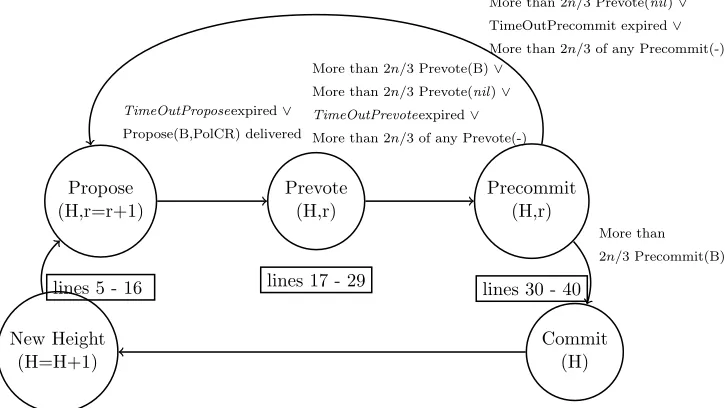
Tendermint One-Shot Consensus algorithm is a round-based algorithm used to decide on the next block for a given height H. In each round there is a different proposer that proposes a block to the validators that try to decide on that block. A round consists of three steps: (i) the Propose step, the proposer of the round broadcasts a proposal for a block; (ii) thePrevote step, validators broadcast their prevotes depending on the proposal they delivered during the previous step; and (iii) the Precommit step, validators broadcast their precommits depending on the occurrences of prevotes for the same block they delivered during the previous step. To preserve liveness, steps have a timeout associated, so that each validator moves from one step to another either if the timeout expires or if it delivers enough messages of a particular typology. Whenpi broadcasts a message
(hTAG, mi), m contains a block B along with other information. We say that pi prevotes (resp.
precommits) on B ifTAG=PREVOTE (resp. TAG=PRECOMMIT). In Figure 2 is depicted the state machine for Tendermint Consensus.
To preserve safety, when a validator delivers more than 2n/3 prevotes for B then it “locks” on such block. Informally, it means that there are at leastn/3 + 1 prevotes forB from correct processes, thenB is a possible candidate for a decision so that validators try to stick on that. More formally, a validator has aProof-of-LoCk (PoLC) for a block B (resp. for nil) at a roundr for the heightH
if it received at least 2n/3 + 1 prevotes forB (resp. for nil). In this case we say that a process is locked on such block. APoLC-Round (PoLCR) is a round such that there was a PoLC for a block at roundPoLCR. In Figure 3 the state machine concerning the process of locking and unlocking on a blockB is shown. On the edges are reported the conditions on the delivered messages that have to be met in order to lock or unlock on a block. Intuitively, when a process delivers 2n/3 of the same messageB of type prevote when in a precommit step, it locks onB. A process unlocks a block only if it delivers 2n/3 of a valueB0 or when it commits. When a process is locked on a block
B, it does not send any value different than B. This mechanism is necessary to ensure the safety of the protocol and to satisfy the Agreement property stated in Section 3.
Preamble. Note that our analysis of the original Tendermint protocol [34, 8, 32] led to the
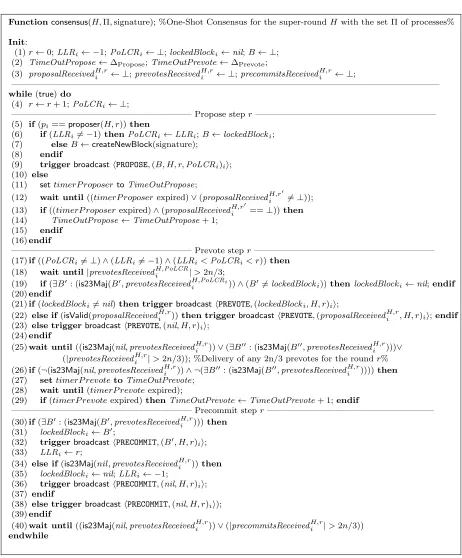
conclusion that several modifications are needed in order to implement One-Shot Consensus problem. Full description of these bugs in the original Tendermint protocol are reported in Section 5. In more details, with respect to the original Tendermint, our Tendermint One-shot Consensus algorithm (see Figure 1) has the following modifications. We added line 29 in order to catch up the communication delay during the synchronous periods. Moreover, we modified the line 19 in order to guarantee the agreement property of One-Shot Consensus (defined in Section 3). The correctness of Tendermint One-shot Consensus algorithm needs an additional assumption stating that eventually a proposal is accepted by a majority of correct processes. This assumption, stated formally in Theorem 7, is necessary to guarantee the termination.
Variables and data structures. r andPoLCRi are integers representing the current round
Functionconsensus(H,Π,signature); %One-Shot Consensus for the super-roundH with the set Π of processes%
Init:
(1)r←0;LLRi← −1;PoLCRi← ⊥;lockedBlocki←nil;B← ⊥; (2) TimeOutPropose←∆Propose;TimeOutPrevote←∆Prevote;
(3) proposalReceivedH,ri ← ⊥;prevotesReceivedH,ri ← ⊥;precommitsReceivedH,ri ← ⊥;
———————————————————————————————————————————————–
while(true)do
(4) r←r+ 1;PoLCRi← ⊥;
———————————————————— Propose stepr————————————————————
(5) if(pi==proposer(H, r))then
(6) if(LLRi6=−1)thenPoLCRi←LLRi;B←lockedBlocki; (7) elseB←createNewBlock(signature);
(8) endif
(9) triggerbroadcasthPROPOSE,(B, H, r,PoLCRi)ii; (10) else
(11) settimerP roposertoTimeOutPropose;
(12) wait until((timerP roposerexpired)∨(proposalReceivedH,ri 06=⊥)); (13) if((timerP roposerexpired)∧(proposalReceivedH,ri 0==⊥))then
(14) TimeOutPropose←TimeOutPropose+ 1; (15) endif
(16)endif
———————————————————— Prevote stepr————————————————————
(17)if((PoLCRi6=⊥)∧(LLRi6=−1)∧(LLRi<PoLCRi< r))then (18) wait until|prevotesReceivedH,i PoLCR|>2n/3;
(19) if(∃B0 : (is23Maj(B0,prevotesReceivedH,PoLCRi
i ))∧(B06=lockedBlocki))thenlockedBlocki←nil;endif (20)endif
(21)if(lockedBlocki6=nil)then triggerbroadcasthPREVOTE,(lockedBlocki, H, r)ii;
(22) else if(isValid(proposalReceivedH,ri ))then triggerbroadcasthPREVOTE,(proposalReceivedH,ri , H, r)ii;endif (23) else triggerbroadcasthPREVOTE,(nil, H, r)ii;
(24)endif
(25)wait until((is23Maj(nil,prevotesReceivedH,ri ))∨(∃B00: (is23Maj(B00,prevotesReceivedH,ri )))∨ (|prevotesReceivedH,ri |>2n/3)); %Delivery of any 2n/3 prevotes for the roundr% (26)if(¬(is23Maj(nil,prevotesReceivedH,ri ))∧ ¬(∃B00: (is23Maj(B00,prevotesReceivedH,r
i ))))then (27) settimerP revotetoTimeOutPrevote;
(28) wait until(timerP revoteexpired);
(29) if(timerP revoteexpired)thenTimeOutPrevote←TimeOutPrevote+ 1;endif
———————————————————— Precommit stepr——————————————————–
(30)if(∃B0: (is23Maj(B0,prevotesReceivedH,ri )))then
(31) lockedBlocki←B0;
(32) triggerbroadcasthPRECOMMIT,(B0, H, r)ii; (33) LLRi←r;
(34) else if(is23Maj(nil,prevotesReceivedH,ri ))then
(35) lockedBlocki←nil;LLRi← −1;
(36) triggerbroadcasthPRECOMMIT,(nil, H, r)ii; (37) endif
(38) else triggerbroadcasthPRECOMMIT,(nil, H, r)ii); (39)endif
(40)wait until((is23Maj(nil,prevotesReceivedH,ri ))∨(|precommitsReceivedH,ri |>2n/3))
endwhile
Figure 1: First part of Tendermint One-shot Consensus algorithm at correct process pi.
upon eventdeliveryhPROPOSE,(B0, H, r0,PoLCRj)ji: (41)if(proposalReceivedH,ri 0 =⊥)then
(42) proposalReceivedH,ri 0←(B0, H, r0)j;
(43) PoLCRi←PoLCRj;
(44) triggerbroadcasthPROPOSE,(B0, H, r0,PoLCR
j)ji;
(45)endif
————————————————————————————————————
upon eventdeliveryhPREVOTE,(B0, H, r0,LLR)ji: (46)if((B0, H, r0,LLR)j∈/prevotesReceivedH,r
0 i )then
(47) prevotesReceivedH,ri 0 ←prevotesReceivedH,ri 0∪(B0, H, r0,LLR)j;
(48) triggerbroadcasthPREVOTE,(B0, H, r0,LLR)ji;
(49) if((r < r0)and(|prevotesReceivedH,ri 0|>2/3))then
(50) r←r0;
(51) gotoPrevote stepr;
(52) endif
(53)endif
————————————————————————————————————
upon eventdeliveryhPRECOMMIT,(B0, H, r0)
ji: (54)if((B0, H, r0)
j∈/precommitsReceivedH,r
0 i )then
(55) precommitsReceivedH,ri 0←precommitsReceivediH,r0∪(B0, H, r0)
j;
(56) triggerbroadcasthPRECOMMIT,(B0, H, r0)ji;
(57) if((r < r0)and(|precommitsReceivedH,ri 0|>2/3))then
(58) r←r0;
(59) gotoPrecommit stepr;
(60) endif
(61)endif
————————————————————————————————————
when(∃B0:is23Maj(B0,precommitsReceivedH,ri 0)):
(62)returnB’;%Terminate the consensus for the super-roundH by decidingB0%
Figure 1: Second part of Tendermint One-shot Consensus algorithm at correct process pi.
integer representing the last round wherepi locked on a block. B is the block the process created.
Each validator manages timeouts, TimeOutPropose andTimeOutPrevote, concerning the pro-pose and prevote phases respectively. Those timeouts are set to ∆Propose and ∆Prevote and started at the beginning of the respective step. Both are incremented if they expire before the validator moves to the next step.
Each validator manages three sets for the messages delivered. In particular, the setproposalReceivedH,ri
contains the proposal thatpi delivered for the round r at height H. prevotesReceivedH,ri is the set
containing all the prevotes pi delivered for the roundr at height H. precommitsReceivedH,ri is the
set containing all the precommitspi delivered for the round r at height H.
Functions. We denote by Block the set containing all blocks, and by MemPool the structure
containing all the transactions.
• proposer:V ×Height×Round→V is a deterministic function which gives the proposer out of the validators for a given round at a given height in a round robin fashion.
New Height (H=H+1) Propose (H,r=r+1) Prevote (H,r) Precommit (H,r) Commit (H)
lines 5 - 16 lines 17 - 29 lines 30 - 40
TimeOutProposeexpired∨
Propose(B,PolCR) delivered
More than 2n/3 Prevote(B)∨
More than 2n/3 Prevote(nil)∨
TimeOutPrevoteexpired∨
More than 2n/3 of any Prevote(-)
More than 2n/3 Precommit(B) More than 2n/3 Prevote(nil)∨
TimeOutPrecommit expired∨
More than 2n/3 of any Precommit(-)
Figure 2: State Machine for Tendermint One-Shot algorithm described in Figure 1. For ease of readability, common exit conditions are represented.
∃B:
lock(B) lock(nil)
More than 2n/3 Prevote(nil)∨
(PROPOSE(B’,PolCR) delivered∧isValid(B’)∧PolCR6=⊥)∨
Commit @ B 0: More than 2 n/ 3 Prev ote(B’) ∨ ∃ B : More than 2 n/ 3 Prev o te
(B) More than 2n/3 Prevote(B)
@ B : More than 2 n/ 3 Prev ote(B)
Figure 3: State machine Lock/Unlock
• is23Maj: (Block∪nil)×(prevotesReceived ∪ precommitsReceived)→Boolis a predicate that checks if there is at least 2n/3 + 1 of prevotes or precommits on the given block ornil in the given set.
• isValid:Block →Boolis an application dependent predicate that is satisfied if the given block is valid. If there is a blockB such that isValid(B) =true, we say that B is valid. We note that for any non-block, we set isValidto false, (e.g. isValid(⊥) =false).
Detailed description of the algorithm. In Figure 1 we describe Tendermint One-Shot algorithm
to solve the One-Shot Consensus (defined in Section 3) for a given heightH. For each round r at heightH the algorithm proceeds in 3 phases:
then it creates a valid proposal and broadcasts it. Otherwise it broadcasts the block it is locked on. Ifpi is not the proposer then it waits for the proposal from the proposer. pi sets
the timer to T imeOutP roposal, if the timer expires before the delivery of the proposal then
pi increases the time-out, otherwise it stores the proposal inproposalReceivedH,ri . In any case, pi goes to the Prevote step.
2. Prevote step (lines 17 - 29): Ifpi delivers the proposal during the Propose step, then it checks
the data on the proposal. IflockedBlocki 6=nil, andpi delivers a proposal with a validPoLCR
then it unlocks. After that check, ifpiis still locked on a block, then it prevotes onlockedBlocki;
otherwise it checks if the blockB in the proposal is valid or not, ifB is valid, then it prevotes
B, otherwise it prevotes on nil. Then pi waits until|prevotesReceivedH,ri |>2n/3. If there is
no PoLC for a block or fornilfor the roundr, thenpi sets the timer toTimeOutPrevote, waits
for the timer’s expiration and increasesTimeOutPrevote. In any case, pi goes to Precommit
step.
3. Precommit step (lines 30 - 40): pi checks if there was a PolC for a particular block or nil
during the round (lines 30 and 34). There are three cases: (i) if there is a PoLC for a block B, then it locks on B, and precommits onB (lines 30 - 32); (ii) if there is a PoLC fornil, then it unlocks and precommits onnil (lines 34 - 36); (iii) otherwise, it precommits onnil (line 38); in any case,pi waits until|precommitsReceivedH,ri |>2n/3 or (is23Maj(nil,prevotesReceived
H,r i )),
and it goes to the next round.
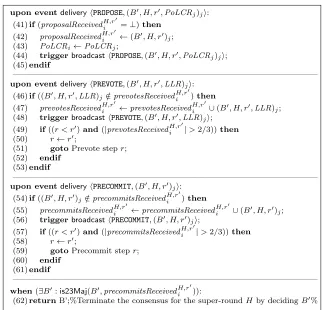
Whenever pi delivers a message, it broadcasts it (lines 44, 48 and 56). Moreover, during a round r, some conditions may be verified after a delivery of some messages and either (i)pi decides and
terminates or (ii)pi goes to the round r0 (with r0> r). The conditions are:
• For any roundr0, if for a blockB,is23Maj(B,precommitsReceivedH,ri 0) =true, thenpi decides
the blockB and terminates, or
• If pi is in the round r at height H and |prevotesReceivedH,r
0
i |>2n/3 where r
0 > r, then it
goes to the Prevote step for the round r0, or
• Ifpi is in the round r at height H and |precommitsReceivedH,r
0
i |>2n/3 wherer
0 > r, then it
goes to the Precommit step for the roundr0.
4.3 Correctness of Tendermint One-Shot Consensus
In this section we prove the correctness of Tendermint One-Shot Consensus algorithm (Fig. 1) for a height H under the assumption that during the synchronous period there exists eventually a proposer such that its proposed value will be accepted by at least 2n/3 + 1 processes.
Lemma 1 (One-Shot Integrity). In an eventual synchronous system, Tendermint One-Shot
Con-sensus Algorithm verifies the following property: No correct process decides twice.
Proof The proof follows by construction. A correct process decides when it returns (line 62).
Lemma 2(One-Shot Validity). In an eventual synchronous system, Tendermint One-Shot Consensus Algorithm verifies the following property: A decided value is valid, if it satisfies the predefined predicate denoted isValid().
Proof
Let pi be a correct process, we assume that there exists a value B, such thatpi decidesB. We
show by construction that ifpi decides on a valueB, thenB is valid.
If pi decides B, thenis23Maj(B,precommitsReceivedH,ri ) =true(line 62), since the signature of
the messages are unforgeable andf < n/3 by hypothesis, then more than n/3 of those precommits for round r are from correct processes. This means that for each of those correct processes pj,
is23Maj(B,prevotesReceivedH,rj ) =true (lines 30 - 32), and thus at least n/3 of those prevotes are from correct processes.
Let pj be one of the correct processes which prevoted on B during the roundr. pj prevotes on a
valueB during a roundr in two cases: Case a, duringr, pj is not locked on any value or Case b: pj
is already locked on B and does not checks its validity (lines 21 - 24).
• Case a: Ifpj is not locked on any value than before prevoting it checks the validity of B and
prevotes onB ifB is valid (line 22);
• Case b: Ifpj was locked on B, it did not check the validity ofB, it means that pj was locked
onB during the roundr; which means that there was a roundr0 < rsuch thatpj had a PoLC
forB for the roundr0 (lines 30 - 32), by the same argument, there is a round which happened beforer0 wherepj was locked or B is valid.
Since a process locked during a round smaller than the current one, and that there exists a first round where all correct processes are not locked (line 1), there is a roundr00< r0 where
pj was not locked onB but prevotedB, as in Case a,pj checks ifB is valid and then prevotes
on B ifB is valid (lines 22).
A value prevoted by a correct process is thus valid. Therefore a decided value by a correct process is valid since more thann/3 correct processes prevote that value. Lemma2
Lemma 3. In an eventual synchronous system, Tendermint One-Shot Consensus Algorithm verifies
the following property: Iff+ 1 correct processes locked on the same value B during a round r then no correct process can lock during round r0> r on a valueB06=B.
Proof We assume thatf+ 1 correct processes are locked on the same valueB during the roundr,
and we denote byXr the set of those processes. We first prove by induction that no process inXr
will unlock or lock on a new value. Let let pi∈Xr.
• Initialization: roundr+ 1. At the beginning of roundr+ 1, all processes in Xr are locked onB. Moreover, we have that LLRi =r, sincepi locks on round r (line 31). Let pj be the
proposer for roundr+ 1. IfLLRj =r, it means thatpj is also locked onB, since there cannot
– pj locked on a valueBj during the round LLRj ≤r. This means that during the round LLRj is23Maj(Bj,prevotesReceivedH,j LLRj) =true (line 31). pj the proposer proposes a
value Bj along with LLRj (lines 5 - 9). SinceLLRj ≤LLRi=r, pi does not unlock and
prevotesB for the roundr+ 1, and so are all the other processes inXr (lines 17 - 21). The only value that can have more than 2n/3 prevotes is thenB. Sopi is still locked on B at the end ofr+ 1.
– If pj is not locked, the value it proposes cannot unlock processes in Xr because −1 = LLRj < r, and they will prevote on B (lines 17 - 21). The only value that can have more than 2n/3 prevotes is thenB. Sopi is still locked onB at the end ofr+ 1.
– pj locked on a valueBj during the roundLLRj > r, pj the proposer proposes a valueBj
along withLLRj (lines 5 - 9). Since LLRj ≥r+ 1,pi does not unlock and prevotes B
for the round r+ 1, and so are all the other processes in Xr (lines 17 - 21). The only value that can have more than 2n/3 prevotes is thenB. So pi is still locked on B at the
end ofr+ 1.
At the end of roundr+ 1, all processes inXr are still locked on B and it may happen that other processes are locked on B for round r+ 1 at the end of the round.
• Induction: We assume that for a givena >0, the processes in Xr are still locked on B at
each round betweenr andr+a. We now prove that the processes inXr will still be locked on B at round r+a+ 1.
Let pj be the proposer for round r +a+ 1. Since the f + 1 processes in Xr were locked
on B for all the rounds between r and r +a, no new value can have more than 2n/3 of prevotes during one of those rounds, so @B0 6=B :is23Maj(B0,prevotesReceivedH,rj j) =true
where r < rj < r+a+ 1. Moreover, if pj proposed the valueB along with a LLR> r, since
the processes inXr are already locked onB, they do not unlock and prevote B (lines 17 - 21). The proof then follows as in the Initialization case.
Therefore all processes in Xr will stay locked onB at each round after roundr. Since f+ 1 pro-cesses will stay locked on the valueB on roundsr0 > r, they will only prevote onB (lines 17 - 21) for each new round. LetB0 be a value, we have that∀r0 ≥r if B0 :is23Maj(B0,prevotesReceivedH,rj 0) = true thenB0 =B.
Lemma3
Lemma 4 (One-Shot Agreement). In an eventual synchronous system, Tendermint One-Shot
Consensus Algorithm verifies the following property: If there is a correct process that decides a valueB, then eventually all the correct processes decide B.
Proof Letpibe a correct process. Without loss of generality, we assume thatpiis the first correct
pro-cess to decide, and it decidesBat roundr. IfpidecidesB, thenis23Maj(B,precommitsReceivedH,ri ) =
true (line 62), since the signature of the messages are unforgeable by hypothesis andf < n/3, then
pi delivers more thann/3 of those precommits for round r from correct processes, and those correct
process are locked onB at roundr (line 31). pi broadcasts all the precommits it delivers (line 56),
We now show that before delivering the precommits from pi, the other correct processes cannot
decide a different value thanB. f < n/3 by hypothesis, so we have that at leastf+1 correct processes are locked onB for the roundr. By Lemma 3 no correct process can lock on a value different thanB. LetB0 6=B, since correct processes lock only when they precommit (lines 30 - 32), no correct process will precommit on B0 for a round bigger than r, sois23Maj(B0,precommitsReceivedH,ri 0) =false for all r0≥r since no correct process will precommit on B0. No correct process cannot decide a value
B0 6=B (line 62) once pi decided. Eventually, all the correct processes will deliver the 2n/3 signed
precommitspi delivered and broadcasted, thanks to the best effort broadcast guarantees and then
will decide B. Lemma4
Lemma 5. In an eventual synchronous system, and under the assumption that during the
syn-chronous period eventually there is a correct proposerpksuch that|{pj :LLRk≤LLRj and pj is correct}|< n/3−f, Tendermint One-Shot Consensus Algorithm verifies the following property: Eventually a
correct process decides.
ProofLetrbe the round where the communication becomes synchronous and when all the messages
broadcasted by correct processes are delivered by the correct processes within their respective step. The round r exists, since the system is eventually synchronous and correct processes increase their time-outs when they did not deliver enough messages (lines 13 - 15, 26 - 29 and 40). If a correct process decides before r, that ends the proof. Otherwise no correct process decided yet. Let pi
be the proposer for the roundr. We assume that pi is correct. LetB be the value such that pi
proposes (B,LLRi), we have three cases:
• Case 1: No correct process is locked on a value before r. ∀pj ∈ Π such that pj is correct, LLRj =−1.
Correct processes delivered the proposal (B,LLRi) before the Prevote step (lines 12, 42 - 44). Since the proposal is valid, then all correct processes will prevote on that value (line 22), and they deliver the others’ prevotes and broadcast them before entering the Precommit step (lines 25 - 29 and 48). Then for all correct processpj, we haveis23Maj(B,precommitsReceivedH,rj ) =
true. The correct processes will lock on B, precommit on B (lines 30 - 32) and will broadcast all precommits delivered (line 56). Eventually a correct process pj will have
is23Maj(B,precommitsReceivedH,rj ) =true thenpj will decide (line 62).
• Case 2: Some correct processes are locked and ifpj is a correct process,LLRj <LLRi.
SinceLLRj <LLRi for all correct processespj, then the correct processes that are locked will
unlock (line 19) and the proof follows as in the Case 1.
• Case 3: Some correct processes are locked on a value, and there exist a correct processpj such
thatLLRi ≤LLRj.
– (i) If|{pj :LLRi≤LLRj andpj is correct}|< n/3−f (which means that even without
the correct processes that are locked in a higher round than the proposerpi, there are
more than 2n/3 other correct processes unlock or locked in a smaller round thanLLRi), then as in the case 2, a correct process will decide.
once in a round (lines 30 - 40). Eventually, thanks to the additional assumption, there exists a round r1 where the proposer pk is correct and at round r1, |{pj : LLRk ≤ LLRj and pj is correct}|< n/3−f. The proof then follows as case (3.i).
If pi is Byzantine and more than n/3 correct processes delivered the same message during the
proposal step, and the proposal is valid, the situation is likepi was correct. Otherwise, there are
not enough correct processes that delivered the proposal, or if the proposal is not valid, then there will be less than n/3 processes that will prevote that value. No value will be committed. Since the proposer is selected in a round robin fashion, a correct process will eventually be the proposer, and
a correct process will decide. Lemma5
Lemma 6 (One-Shot Termination). In an eventual synchronous system, and under the assumption
that during the synchronous period eventually there is a correct proposer pk such that |{pj : LLRk ≤LLRj and pj is correct}|< n/3−f, Tendermint One-Shot Consensus Algorithm verifies
the following property: Every correct process eventually decides some value.
Proof By construction, if a correct process does not deliver a proposal during the proposal step or
enough prevotes during the Prevote step, then that process increases its time-outs (lines 13 - 15 and 26 - 29), so eventually, during the synchrony period of the system, all the correct processes will deliver the proposal and the prevotes from correct processes respectively during the Propose and the Prevote step. By Lemma 5, a correct process decides a value, and then by the Lemma 4, every
correct process eventually decides. Lemma6
Theorem 7. In an eventual synchronous system, and under the assumption that during the
syn-chronous periods eventually there is a correct proposerpksuch that|{pj :LLRk≤LLRj and pj is correct}|< n/3−f: Tendermint One-Shot Algorithm implements the One-Shot Consensus.
Proof The proof follows directly from Lemmas 1, 2, 4 and 6. T heorem 7
4.4 Tendermint Repeated Consensus algorithm
For a given height, the set V of validators does not change. Note that each height corresponds to a block. Therefore, in the following we refer this set as the set of validators for a block.
Data structures. The integerH is the height where is called a One-Shot Consensus instance. V is
the current set of validators. B is the block to be appended. commitsReceivedHi is the set containing all the commits pi delivered for the heightH. toRewardHi is the set containing the validators from
which pi delivered commits for the heightH. TimeOutCommit represents the time a validator has
for collecting commits after an instance of consensus. TimeOutCommit is set to ∆Commit.
Functions.
• validatorSet: Π×Height →2Πis an application dependent and deterministic selection function which gives the set of validators for a given height w.r.t the blockchain history. We have
FunctionrepeatedConsensus(Π); %Repeated Consensus for the set Π of processes%
Init:
(1) H←1 %Height%;B← ⊥;V ← ⊥%Set of validators%;
(2) commitsReceivedH
i ← ∅;toRewardHi ← ∅;TimeOutCommit←∆Commit;
—————————————————————————————————————
while(true)do
(3) B← ⊥;
(4) V ←validatorSet(H); %Application and blockchain dependant% (5) if(pi∈V)then
(6) B←consensus(H, V,toRewardHi −1); %Consensus function for the heightH%
(7) triggerbroadcasthCOMMIT,(B, H)ii;
(8) else
(9) wait until(∃B0:|atLeastOneThird(B0,commitsReceivedH
i )|); (10) B←B0;
(11)endif
(12)settimerCommittoTimeOutCommit;
(13)wait until(timerCommitexpired);
(14)triggerdecide(B);
(15)H←H+ 1;
endwhile
—————————————————————————————————————
upon eventdeliveryhCOMMIT,(B0, H0)
ji: (16)if(((B0, H0)j∈/commitsReceivedH
0
i )∧(pj∈validatorSet(H0)))then
(17) commitsReceivedHi0 ←commitsReceivedH
0
i ∪(B0, H0)j;
(18) toRewardHi0 ←toRewardH
0 i ∪pj;
(19) triggerbroadcasthCOMMIT,(B0, H0)ji;
(20)endif
Figure 4: Tendermint Repeated Consensus algorithm at correct processpi.
• consensus : Height ×2Π×commitsReceived → Block is the One-Shot Consensus instance presented in 4.2.
• createNewBlock: 2Π×MemPool →Block is the application-dependent function that creates a valid block (w.r.t. the application) from the One-Shot Consensus.
• atLeastOneThird:Block ×commitsReceived →Boolis a predicate which checks if there is at leastn/3 of commits of the given block in the given set.
• isValid:Block →Boolis the same predicate as in the One-shot Consensus, which checks if a block is valid or not.
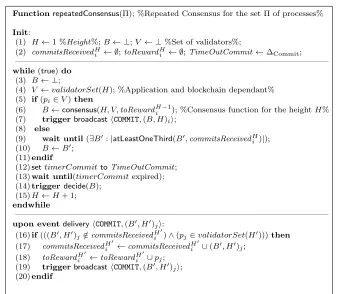
Detailed description of the algorithm. In Fig. 4 we describe the algorithm to solve the
Repeated Consensus as defined in Section 3. The algorithm proceeds as follows:
• pi computes the set of validators for the current height;
• Ifpi is a validator, then it calls the consensus function solving the consensus for the current
height, then broadcasts the decision, and sets B to that decision;
• Otherwise, ifpi is not a validator, it waits for at least n/3 commits from the same block and
• In any case, it sets the timer toTimeOutCommit for receiving more commits and lets it expire. Then pi decidesB and goes to the next height.
Whenever pi delivers a commit, it broadcasts it (lines 16 - 20). Note that the reward for the height H is given during the height H+ 1, and to a subset of validators who committed the block for H
(line 6).
4.5 Correctness of Tendermint Repeated Consensus
In this section we prove the correctness of Tendermint Repeated Consensus algorithm in Figure 4. We now show that Tendermint Repeated Algorithm (Fig. 4) implements the Repeated Consensus.
Lemma 8 (Repeated Termination). In an eventual synchronous system, and under the additional
assumption that during the synchronous period eventually there is a correct proposer pk such that |{pj : LLRk ≤ LLRj andpj is correct}| < n/3−f, Tendermint Repeated Consensus Algorithm
verifies the following property: Every correct process has an infinite output.
Proof By contradiction, letpi be a correct process, and we assume thatpi has a finite output. Two
scenarios are possible, eitherpi cannot go to a new height, or from a certain height H it outputs
only ⊥.
• Ifpi cannot progress, one of the following cases is satisfied:
– The function consensus() does not terminate (line 6), which is a contradiction due to Lemma 6; or
– pi waits an infinite time for receiving enough commits (line 9), which cannot be the case
because of the best effort broadcast guarantees and the eventual synchronous assumption, all the correct validators terminate the One-Shot Consensus and broadcast their commit.
• Ifpi decides at each height (line 14), it means that from a certain height H,pi only outputs ⊥. That means that: (i) eitherpi is a validator forH and the function consensus(H0) is only
returning⊥for all H0≥H (lines 5 and 6), or (ii) pi is not a validator forH but delivered at
leastn/3 commits for⊥ (lines 9 and 19).
– (i): Sinceconsensus() returns the value⊥, that means by Lemma 2 thatisValid(⊥) =true, which is a contradiction with the definition of the function isValid().
– (ii): Since only the validators commit, and each of them broadcasts its commit (lines 5 -7), and becausef < n/3, it means thatpi delivered a commit from at least one correct
validator (process). By Lemma 2, correct processes only decide/commit on valid value, and ⊥is not valid, which is a contradiction.
We conclude that if pi is a correct process, then it has an infinite output. Lemma8
Lemma 9 (Repeated Agreement). In an eventual synchronous system, Tendermint Repeated
Consensus Algorithm verifies the following property: If the ith value of the output of a correct process is B, thenB is theith value of the output of any other correct process.
Proof We prove this lemma by construction. Let pj andpk be two correct processes. Two cases
• pj and pk are validators for the heighti, so they call the functionconsensus() (lines 5 and 6).
By Lemma 4 pj and pk decide the same value and then output that same value (line 14).
• At least one ofpj and pk is not a validator for the height i. Without loss of generality, we
assume thatpj is not a validator for the heighti. Since all the correct validators commit the
same value, let sayB, thanks to Lemma 4, and since they broadcast their commit (line 7), eventually there will be more than 2n/3 of commits for B. So no other valueB0 6= B can be present at leastn/3 times in the setcommitReceivedH
i . So pj outputs the same value B
as all the correct validators (line 9). Ifpk is a validator, that ends the proof. If pk is not a
validator, then by the same argument as for pj,pk outputs the same valueB. Hencepj and pk both output the same value B.
Lemma9
Lemma 10 (Repeated Validity). In an eventual synchronous system, Tendermint Repeated
Con-sensus Algorithm verifies the following property: Each value in the output of any correct process is valid, it satisfies the predefined predicate denotedisValid().
Proof We prove this lemma by construction. Letpi be a correct process, and we assume that
theHth value of the output ofp
i is B. Ifpi decides a value (line 14), then that value has been set
during the execution and for that height (line 3).
• Ifpi is a validator for the heightH, then B is the value returned by the functionconsensus(),
by the Lemma 2 we have thatisValid(B) =true.
• If pj is not a validator for the height H, it means that it delivered more than n/3 signed
commits from the validators for the valueB (lines 5 - 7 and 16 - 20), hence at least one correct validator committed B, and by Lemma 2 we have that isValid(B) =true.
So each value that a correct process outputs satisfies the predicateisValid(). Lemma10
Theorem 11. In an eventual synchronous system, Tendermint Repeated Consensus algorithm
implements the Repeated Consensus. In an eventual synchronous system, and under the additional assumption that during the synchronous period eventually there is a correct proposer pk such that |{pj : LLRk ≤ LLRj and pj is correct}| < n/3−f, Tendermint Repeated Consensus algorithm
implements the repeated consensus.
Proof The proof follows directly from Lemmas 8, 9 and 10. we showed that Tendermint protocol
satisfies respectively the Termination property, the Agreement property and the Validity property.
T heorem11
5
Bugs in the original Tendermint
5.1 Addition of line 29 on Fig. 1
The line 29 allows the correct process pi to increase its time-out to catch up the communication
system becomes synchronous, the correct process may never deliver enough prevotes at time. Thus it can never precommit. To decide, a correct process needs more than 2n/3 precommits for the same value for the same round (and so more thatn/3 precommits from correct processes) to decide (line 62), no correct process ever decides, which does not satisfies the One-Shot Termination property. When a process increases its TimeOutPrevotewhenever it does not deliver enough messages, it will eventually catch-up the delay, and during the synchronous period, there will be a time from when it will deliver prevotes from all correct processes.
5.2 Modification of line 19 on Fig. 1
Originally, the line 19 was
if(∃B0 : (is23Maj(B0,prevotesReceivedH,PoLCRi
i )) then lockedBlocki ←nil;endif
In that version, it is possible that if a process pi is locked on a value B during a round r, a process
locked on the same value B during a round r0 > r makes pi unlock, but does not ensure that pi
locks again. That is a problem since it causes a violation of the Agreement property.
In the following, we exhibit a problematic scenario. Assume that there are 4 processes in the network. 3 correct processes p1, p2, p3 and a Byzantine processp4.
1. Round 1: p1 is the proposer and proposesB. All process deliver the proposal and prevote on
B from round 1.
p1 and p2 deliver all prevotes for B, and then lock and precommit onB.
p1 delivers the precommit of p1, p2 and fromp4 for Band then it decidesB. Neitherp2 andp3 delivers enough precommit to decide.
The state is: p1 decides B and left. p2 is locked on (B,1), p3 is not locked, p4 is Byzantine so we do not say anything about its state.
2. Round 2: p1 exit, and do not take part any more. p2 andp3 do not deliver the precommit for
B.
p2 is the proposer. Since p2 is locked onB, it proposes B along with 1 where it locked. p2 and p3 deliver the proposal. p2 does not unlock since it locked at round 1 and prevote onB.
p3 is not locked, but since it delivered the proposal, it prevotes onB. p4 sends a prevote on
B only to p3 such that p3 delivers all the prevotes during this step but notp2, so during the precommit step,p3 locked onB but for the round 2.
The state is: p1 already decided. p2 is locked on (B,1),p3 is locked on (B,2),p4 is Byzantine so we do not say anything about its state.
3. Round 3: p2 andp3 do not deliver the precommit for B from round 1.
p3 is the proposer. Since p3 is locked onB, it proposes B along with 2 where it locked. p2 andp3 deliver the proposal. p2 unlocks since it receives 2 but was locked at 1 and prevote the proposal B. p3 does not unlock since it locked exactly at round 1 and prevote onB. p4 sends a prevote onB such thatp3 delivers all the prevotes during its step but notp2, so during the precommit step,p3 locked onB but for the round 2.
4. Round 4: p2 andp3 do not deliver the precommit for B from round 1.
p4 is the proposer and proposes (B,3). p2 is not locked, but since it delivered the proposal, it prevotes on B. p3 unlocks since it receives 3 but was locked at 2 and prevote the proposalB.
p4 does nothing. Neither p2 nor p3 delivers enough prevotes to lock.
The state is: p1 already decidedB. p2 is not locked,p3 is not locked,p4 is Byzantine so we do not say anything about its state.
5. Round 5: p2 andp3 do not deliver the precommit for B from round 1.
p1 is the proposer but since it left, there is no proposal. p2 andp3 are not locked and did not deliver a proposal so they prevote on nil. p4 does nothing. Neitherp2 norp3 delivers enough prevotes to lock.
The state is: p1 already decidedB. p2 is not locked,p3 is not locked,p4 is Byzantine so we do not say anything about its state.
6. Round 4: p2 andp3 do not deliver the precommit for B from round 1.
p2 is the proposer. Since it is not locked, it proposes a new valueB0. p2 andp3 deliver the proposal before their respective prevote step. p2 and p3 are not locked and did deliver the proposalB0, so they prevote on B0. p4 sends prevoteB0 to both p2 andp3.
p2 andp3 deliver the 3 prevotes before entering the precommit step, and hence locked on B0 and precommit onB, andp4 also send precommit top2.
p2 delivers precommit fromp2, p3 and p4 and thus it decides B0.
The state is: p1 already decided B. p2 decidesB0,p3 is locked on B0,p4 is Byzantine so we do not say anything about its state.
At the end of the round 4, p1 and p2 decide on two different values, which does not satisfy the One-Shot Agreement property.
5.3 Counter-example for the One-Shot Termination without the additional as-sumption
We recall the additional assumption : eventually there is a correct proposer pk such that |{pj : LLRk≤LLRj and pj is correct}|< n/3−f.
In [9] the authors advocate without providing any evidence that there is a livelock problem in Tendermint description proposed in the Buchman’s manuscript [8]. Hereafter, we exhibit this evidence. We thank anonymous reviewers of the preliminary version of this work appeared as technical report [2] to point us the scenario below.
We consider a system of 4 processes,p1top4, wherep4is a Byzantine process. The round number 1 has p1 as a proposer, and we assume that it happens before the system is synchronous (before GST in DLS terminology [17]), and onlyp1 locks valuev1 in this round (lockedBlock =v1, LLR= 1 at p1, and for other processes equal to initial values. PoLCR=⊥ forp1, p2, andp3 (p4 is faulty so we don’t talk about it’s state).
guarantee on messages sent by Byzantine processes, i.e., a Byzantine process can send a message only to a subset of correct processes on time so it is delivered in the current round, and although a message is eventually delivered by all correct processes, it might not be delivered by all correct processes in the roundr in which it is sent.
1. In round 2, p2 proposes (v2,⊥), whereB =v2, andPoLCR =⊥asp2 hasn’t locked any value.
p1 rejects this proposal and Prevote v1 as it has v1 locked in round 1 (condition at line 17 evaluates to false as upon receipt of Proposal all correct processes setPoLCR to⊥). p2 and
p3 accept the proposal and prevotev2, but asp4 stay silent, no process locks a value in round 2. So at the end of round 2, we have the following state: lockedBlock = v1,LLR = 1 at p1, and for other processes equal to initial values (lockedBlock =nil andLLR =⊥) PoLCR=⊥
atp1,p2, andp3 (p4 is faulty so we don’t talk about it’s state).
2. In round 3, p3 proposes (v3,⊥) as it hasn’t locked any value. p1 rejects this proposal and prevote v1 as it has v1 locked in round 1 (condition at line 17 evaluates to false as upon receipt of Proposal all correct processes setPoLCR to⊥). p2 andp3 accept the proposal and prevotev3, but p4 sends Prevote message forv3 only top3. Furthermore, p4 sends Prevotev3 message top3 just beforetimerP revoteexpires at p3, and after timerP revoteexpired atp1 andp2, and they moved to round 4. So although Prevote messages that are received byp3 are propagated to other processes, they will be received byp1 and p2 after they moved to round 4. So in the round 3 only p3 locks v3. At the end of the round 3, lockedBlock =v1,LLR = 1 at
p1,lockedBlock =v3,LLR= 3 at p3,lockedBlock =nil,LLR=⊥atp2, andPoLCR =⊥for
p1,p2, andp3 (p4 is faulty so we don’t talk about it’s state).
3. In round 4,p4 is a proposer and as it is Byzantine process we assume it stays silent, so nothing change.
4. In round 5,p1 proposes (v1,1). p3 rejects this proposal and prevotev3 as it has v3 locked in round 3, therefore the condition at line 17 evaluates to false as LLR= 3 andPoLCR = 1 at
p3. p1 and p2 accept the proposal, and prevote v1. p4 sends Prevote message for v1 only to
p1 just beforetimerP revote expires atp1 and after timerP revoteexpires at p2 andp3. So
p2 and p3 receives Prevote fromp4 from round 5 only after they moved to round 6. So in the round 5 only p1 locksv1. At the end of the round 5, lockedBlock = v1,LLR = 5 atp1,
lockedBlock =v3,LLR = 3 at p3, lockedBlock =nil,LLR =⊥ atp2, and PoLCR = 1 forp1,
p2, and p3 (p4 is faulty so we don’t talk about it’s state).
5. In round 6, p2 proposes (v2,1) as it hasn’t locked any value. p1 rejects this proposal and prevote v1 as it has v1 locked in round 5. p3 rejects the proposal and prevote v3 as it has locked v3 in round 3, and p4 stays silent, so no process lock a value in round 2. At the end of the round 6, lockedBlock = v1,LLR = 5 at p1, lockedBlock = v3,LLR = 3 at p3,
lockedBlock =nil,LLR =⊥atp2, andPoLCR= 1 forp1,p2, andp3 (p4 is faulty so we don’t talk about it’s state).
6. In round 7,p3 proposes (v3,3). p1 rejects this proposal and prevotev1 as it has v1 locked in round 5. p2 and p3 accept the proposal and prevotev3, and p4 sends Prevote message forv3 only to p3, just beforetimerP revote expires atp3 and after timerP revoteexpires atp1 and
lockedBlock =nil,LLR =⊥atp2, andPoLCR= 3 forp1,p2, andp3 (p4 is faulty so we don’t talk about it’s state).
This scenario repeats forever, so the algorithm never terminates, which violates the One-Shot Termination property. This scenario cannot repeat forever with the additional assumption that during the synchronous period eventually there is a correct proposerpk such that |{pj :LLRk≤ LLRj and pj is correct}|< n/3−f.
Let us call that assumption assumption T.
Assumption Tvs. Symmetric Byzantine : Symmetric Byzantine processes [30] are processes
that behave arbitrarily, but their behaviour is perceived the same by all correct processes. We note that in our case; the assumption of Symmetric Byzantine is stronger than the assumption T. In fact the Symmetric Byzantine assumption restrict the Byzantine behaviour during the whole execution of the algorithm, whereas the assumptionT requires that eventually, during an interval of one round of the execution after the synchronous period, Byzantine processes behaviour do not impact at least 2n/3 correct processes.
6
Tendermint Fairness
Recently Pass and Shi defined the fairness of a Proof-of-Work based blockchain protocol for a system ofn processes as follows (please refer to [39] for the formal definition): A blockchain protocol is fair if honest process that wield φfraction of the computational resources will reap at least φfraction of the blocks in any sufficiently long window of the chain, where the computational resources represent the merit of the process. We note that in their model, a block in the blockchain was created by only one process, and that process gets a reward for the created block. We extend the definition of [39] for a system with an infinite number of processes, and where each block is produced by a subset of processes. This is the case of Tendermint for example where for each block there is a subset of processes called thevalidators that produce that block. Thecorrect validators for a block (those that followed the protocol and participated in the agreement process) are the processes that have to be rewarded for that block. Informally, we say that a blockchain protocol is fair if anycorrect process (a process that followed the protocol) that wieldφfraction of the total merit in the system will get more or lessφ fraction of the total reward that is given in the system. In order to study the fairness of a protocol in a consensus-based blockchain such as Tendermint, Redbelly, SBFT or Hyperledger Fabric, we split the protocol in two mechanisms: (i) the selection mechanism which selects for each new height the validators (the processes that will run the consensus instance) for that height taking into account the merit of each process, and (ii) thereward mechanism, which is the mechanism giving rewards to correct validators that decided on the new block. Informally, if the selection mechanism is fair, then every process will become validator proportionally to its merit parameter; and if the reward mechanism is fair then for each height only the correct validators get a reward. By combining the two mechanisms, a correct process gets rewarded at least a number proportional to its merit parameter, since the faulty processes do not get any reward.
We define the following properties for characterizing the fairness of a reward mechanism. For each height, each validator has a boolean variable which we call areward parameter.
2. For each block in the blockchain, all faulty validators and the processes that are not validators should have a reward parameter for that block equal to 0.
3. A process gets a reward for a block if and only if it has a reward parameter for that block equal to 1.
3’. There exists a heightH such that for a block in the blockchain at height H0> H a process gets a reward for that block if and only if it has a reward parameter for that block equal to 1.
Definition 6.1 (Fairness of a reward mechanism). A reward mechanism isfair if it satisfies the
conditions 1, 2 and 3.
Definition 6.2 (Eventual fairness of a reward mechanism). A reward mechanism is eventually fair
if it satisfies the conditions 1, 2 and 3’.
Definition 6.3 ((Eventual) Fairness of a blockchain protocol). A blockchain protocol is fair (resp.
eventually fair) if it has a fair selection mechanism and a fair (resp. eventually fair) reward mechanism.
6.1 Tendermint’s Reward Mechanism
The validators selection mechanism is part of a separate module of Cosmos project [33], which has Tendermint as core-blockchain. The selection mechanism is today left configurable by the application, therefore in the following we do not address this part. The rewarding mechanism, on the other hand, referred as the Tendermint’s reward mechanism is part of the original Tendermint protocol and it is reported in Figure 4 at lines 13 and 16 - 20. Tendermint’s reward mechanism works as follows:
• Once a new block is decided for height H, processes wait for TimeOutCommit time to collect the decision from the other validators forH, and put them in their settoReward (Fig. 4, lines 13 and 16 - 20).
• During the consensus at height H, let us assume that pi proposes the block that will get
decided in the consensus. pi proposes to reward processes in its settoReward (Fig. 4, line 6).
That is, only the processes from which pi delivered a commit will get a reward for the block
at heightH−1.
Lemma 12. The reward mechanism of Tendermint is not eventually fair.
Proof We assume that the system becomes synchronous, and thatTimeOutCommit <∆, where
∆ is the maximum message delay in the network. For any heightH, letpi be a validator for the
heightH−1 and pj the validator whose proposal get decided for the heightH. It may happen that pj did not receive the commit from pi before proposing its block. Hence when the block is decided, pi does not get a reward for its effort, which contradicts the condition 3’ of the reward mechanism
fairness. Tendermint’s reward mechanism is not eventually fair. Lemma12
each phase, in order to exclude from the reward a process that did not send a propose or vote message but that sends a commit because he is aware about the block produced. This scenario can be avoided, for instance, by including in thetoReward variable a processpi only iff + 1 commit
messages contain the processpi.
Lemma 13. When the commit messages are sufficient to detect a process that did not send expected
messages, Tendermint’s reward mechanism with modulable timeouts is eventually fair.
Proof We change the reward mechanism in Tendermint as follows:
• Once a new block is decided, say for height H, processes wait for at mostTimeOutCommit
to collect the decision from the other validators for that height, and put them in their set
toReward.
• If a process did not get the commits from all the validators for that height before the expiration of the time-out, it increases the time-out for the next height.
• During the consensus at height H, let us assume that pi proposes the block that will get
decided in the consensus. pi gives the reward to the processes in its toReward.
In this reward mechanism, TimeOutCommit is increased whenever a process does not have the time to deliver all the commits for the previous round. We prove that this reward mechanism is eventually fair.
There is a point in time tfrom when the system will become synchronous, and all the commits will be delivered by correct processes before the next height. From the time t, at heightH all correct processes know the exact set of validators that committed the block fromH−1, and from those commit messages, they can exclude the set of processes that did not participate to the consensus, and they give to those validators from H−1 a reward parameter greater than 0. The validators inH give the reward to the correct validators that committed and which are the only one with a reward parameter greater than 0 for H−1, which satisfy the fairness conditions 1, 2 and 3’, so the
reward mechanism presented is eventually fair. Lemma13
Theorem 14. In an eventual synchronous system, if the selection mechanism is fair, and from the
commit messages processes can differentiate correct and Byzantine behaviour, then Tendermint Repeated Consensus with the reward mechanism with modulable time-outs, is eventually fair.
Proof The proof follows by Lemma 13. T heorem14
6.2 Necessary and Sufficient Conditions for a Fair Reward Mechanism
In this section, we discuss the consequences of the synchrony on the existence of a fair reward in Repeated Consensus based blockchain protocols where the blockchain is constructed by a mechanism of repeated consensus. That is, at each height, a subset of processes called validators produce a block executing an instance of One-Shot Consensus.
Theorem 15. There exists a fair reward mechanism in a Repeated Consensus based blockchain
protocol iff the system is synchronous.