Climate Change
Mitigation and
Adaptation—
ZEMCH 2016
Edited by
Arman Hashemi
Climate
Change
Mitigation
and
Adaptation—ZEMCH
2016
Special Issue Editor
Arman Hashemi
ArmanHashemi UniversityofBrighton UK
EditorialOffice
MDPI
St.Alban-Anlage66 Basel,Switzerland
ThiseditionisareprintoftheSpecialIssuepublishedonlineintheopenaccessjournalSustainability
(ISSN2071-1050)in2017(availableat:http://www.mdpi.com/journal/sustainability/specialissues/ ZEMCH2016).
Forcitationpurposes,citeeacharticleindependentlyasindicatedonthearticlepageonlineandas indicatedbelow:
Lastname, F.M.; Lastname, F.M. Article title.Journal NameYear,Article number, page range.
FirstEditon2018
Cover photo courtesy of Dr. Arman Hashemi.
ISBN 978-3-03842-965-4 (Pbk) ISBN 978-3-03842-966-1 (PDF)
Articles in this volume are Open Access and distributed under the Creative Commons Attribution (CC BY) license, which allows users to download, copy and build upon published articles even for commercial purposes, as long as the author and publisher are properly credited, which ensures maximum dissemination and a wider impact of our publications. The book taken as a whole is
c
About the Special Issue Editor . . . v Preface to ”Climate Change Mitigation and Adaptation—ZEMCH 2016” . . . vii Daniel Efurosibina Attoye, Kheira Anissa Tabet Aoul and Ahmed Hassan
A Review on Building Integrated Photovoltaic Fac¸ade Customization Potentials
doi: 10.3390/su9122287 . . . 1 Xunmin Ou, Zhiyi Yuan, Tianduo Peng, Zhenqing Sun and Sheng Zhou
The Low-Carbon Transition toward Sustainability of Regional Coal-Dominated Energy Consumption Structure: A Case of Hebei Province in China
doi: 10.3390/su9071184 . . . 25 Khaled Galal Ahmed
Designing Sustainable Urban Social Housing in the United Arab Emirates†
doi: 10.3390/su9081413 . . . 51 Nafisa Bhikhoo, Arman Hashemi and Heather Cruickshank
Improving Thermal Comfort of Low-Income Housing in Thailand through Passive Design Strategies
doi: 10.3390/su9081440 . . . 73 Andrea Pianella, Lu Aye, Zhengdong Chen and Nicholas S. G. Williams
Substrate Depth, Vegetation and Irrigation Affect Green Roof Thermal Performance in a Mediterranean Type Climate
doi: 10.3390/su9081451 . . . 96
Bertug Ozarisoy and Hasim Altan
Adoption of Energy Design Strategies for Retrofitting Mass Housing Estates in Northern Cyprus
doi: 10.3390/su9081477 . . . .115
Bachir Nebia and Kheira Tabet Aoul
Overheating and Daylighting; Assessment Tool in Early Design of London’s High-Rise Residential Buildings
doi: 10.3390/su9091544 . . . .138
Mahmoud Haggag, Ahmed Hassan and Ghulam Qadir
Energy and Economic Performance of Plant-Shaded Building Fac¸ade in Hot Arid Climate doi: 10.3390/su9112026 . . . .161
Emad Mushtaha, Ranime Ayssar Nahl´e, Maitha Bin Saifan and Hasim Altan
The impact of Lighting on Vandalism in Hot Climates: The Case of the Abu Shagara Vandalised Corridor in Sharjah, United Arab Emirates
doi: 10.3390/su9112040 . . . .172
Nan Ma, Hing-wah Chau, Jin Zhou and Masa Noguchi
Structuring the Environmental Experience Design Research Framework through Selected Aged Care Facility Data Analyses in Victoria
Adaptation—ZEMCH
2016”
Theadverseeffects ofclimatechangeare becoming more evident andglobalwarming isnow undeniable. Efforts to mitigate the impactsof climate changehave beenprogressing slowly and adaptationisnow oneofthemajorstrategiesbeingconsideredbybothdeveloped anddeveloping countries. Thechallengingand ambitious targets ofthe Paris Agreement inDecember 2015were a milestonein such efforts; however, despitethe commitmentofmany countries,greenhouse gas emissionshavenotbeendecreasingsufficientlytoslowdowntheglobalwarming. Indeed,thereare currentlydebatesonwhetherreducingtheemissionsto40gigatonnesby2030andlimitingthe temperatureriseto“1.5 ◦C abovepre-industriallevels”arestillrealisticandachievable.Nevertheless, reducingCO2emissionsfromtheconstructionindustrywouldsignificantlycontributetoachieving theobjectivesoftheParisAgreement.
Passivedesign,low/zeroenergybuildingsandenergyefficientrefurbishmentofexistingbuildingsare someofthestrategieswhichcaneffectivelyreduceCO2emissionsintheconstructionindustry. Yet,the excessive attention to energy efficiency together with poor design/construction and short-term governmentalpoliciesinresponsetoglobalandsocialpressurestomeetambitioustargets,without muchattentiontolong-termconsequences,haveledtosomeseriousissuessuchaspoorindoorair quality,chronicoverheatingandotherassociateproblems,affectingthehealthandwellbeingofthe occupantsofenergyefficientbuildings.
Forvariousreasons,attentionisgraduallyshiftingtowardsdevelopingcountries thatarebecoming majorcontributorsto greenhousegasemissions. Unlikedevelopedcountriesthathavethe resourcesto investandrespondtoclimatechange,adaptationinpoorcountriesislefttotheindividualstomitigatethe risksofclimatechange.Low-incomepopulationslivingintheleastdevelopedcountriesarehittheworst by climate change due to their vulnerable living conditions and lack of access to an appropriate infrastructure as well as lowlevelofawareness andknowledgeto dealwith theconsequencesof climatechangeandglobalwarming.
Tothisend,thisbookexploresthecurrentissuesaroundsustainabledesignandenergyefficiency withintheconstructionindustry,inbothdevelopedanddevelopingcountries,aimingto contributeto globaleffortstowardsclimatechangemitigationandadaptation.
Arman Hashemi
Review
A Review on Building Integrated Photovoltaic Façade
Customization Potentials
Daniel Efurosibina Attoye *, Kheira Anissa Tabet Aoul and Ahmed Hassan
Department of Architectural Engineering, United Arab Emirates University, Al Ain 15551, UAE; [email protected] (K.A.T.A.); [email protected] (A.H.)
* Correspondence: [email protected]; Tel.: +971-52-971-6472
Received: 15 September 2017; Accepted: 22 November 2017; Published: 9 December 2017
Abstract:Technological advancement in Building Integrated Photovoltaics (BIPV) has converted the building façade into a renewable energy-based generator. The BIPV façade is designed to provide energy generation along with conventional design objectives such as aesthetics and environmental control. The challenge however, is that architectural design objectives sometimes conflict with energy performance, such as the provision of view and daylight versus maximum power output. In innovative cases, the characteristics of conventional BIPV façades have been modified by researchers to address such conflicts through customization as an emerging trend in BIPV façade design. Although extensive reviews exist on BIPV product types, design integration, adoption barriers and performance issues, research on BIPV customization has not been reviewed as a solution to BIPV adoption. This paper seeks to review the potential of BIPV façade customization as a means of enhancing BIPV adoption. The current paper identifies customization parameters ranging from the customization category, level, and strategies, and related architectural potential along with an assessment of their impact. The findings reflect that elemental and compositional level customization using combined customization strategies provide enhanced BIPV products. These products are well integrated for both energy generation and aesthetic applications with a power output increase of up to 80% in some cases. The paper concludes that a wide range of BIPV adoption barriers such as aesthetics, architectural integration, and performance can be overcome by appropriate BIPV customization.
Keywords: Building Integrated Photovoltaics (BIPV); façade; customization; architectural potentials; barriers
1. Introduction
BIPV reduces the damage done to the ecosystem through conventional energy sources [19] and is a promising way of relieving the increasing financial and environmental costs of fossil fuel energy generation [20]. Technological advancements have evolved BIPV into a PV application with the capability of electrical delivery at a comparatively lower cost than grid electricity for certain end users in certain peak demand niche markets [21]. As a contemporary material available to architects, BIPV serves simultaneously as a part of the building envelope and an energy source. BIPV systems can be more cost effective simply because their composition and location replaces a number of conventional components and thus provide multiple gains which are reviewed in details in this paper. These include savings in materials and electricity costs, reduced use of fossil fuels, decreasing carbon and greenhouse gases emissions and improved architectural image of the building [22,23].
However, several studies highlight various barriers which are limitations to the widespread adoption of BIPV [24–34]. They range from general product issues such as performance, aesthetics and technical complexity [26] to specific regional issues such as the need for extensive education on professional and public levels [24,25,27]. Greater attention to research and development in customization and BIPV product designs with good architectural aesthetics and integrality have been suggested by reviewers as potential solutions to these [25,26,28,32]. However, our survey of recent BIPV reviews over the last 5 years (Table 1) shows that there is only limited information on customization as potential driver for BIPV adoption. Only partial attention has been made of custom BIPV; relating to mention of strategies [35,36] and cost limitations [37]. In two other cases [38,39] a descriptive inventory of several market-ready custom BIPV product applications connecting cell technology and architectural integration is given [38]. Also, details on the possibilities, market options, and aesthetic levels of customizability were presented [39].
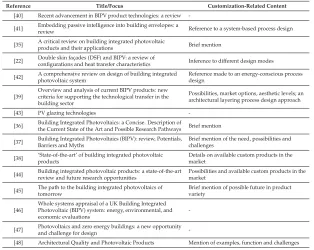
Table 1.Summary of customization content in recent Building Integrated Photovoltaics (BIPV) reviews.
Reference Title/Focus Customization-Related Content
[40] Recent advancement in BIPV product technologies: a review
-[41] Embedding passive intelligence into building envelopes: areview Reference to a system-based process design
[35] A critical review on building integrated photovoltaicproducts and their applications Brief mention
[22] Double skin façades (DSF) and BIPV: a review ofconfigurations and heat transfer characteristics Inference to different design modes
[42] A comprehensive review on design of building integratedphotovoltaic system Reference made to an energy-conscious processdesign
[39]
Overview and analysis of current BIPV products: new criteria for supporting the technological transfer in the building sector
Possibilities, market options, aesthetic levels; an architectural layering process design approach
[43] PV glazing technologies
-[36] Building Integrated Photovoltaics: a Concise. Description ofthe Current State of the Art and Possible Research Pathways Brief mention
[37] Building Integrated Photovoltaics (BIPV): review, Potentials,Barriers and Myths Brief mention of the need, possibilities andchallenges
[38] ‘State-of-the-art’ of building integrated photovoltaicproducts Details on available custom products in themarket
[44] Building integrated photovoltaic products: a state-of-the-artreview and future research opportunities Possibilities and available custom products in themarket
[45] The path to the building integrated photovoltaics oftomorrow Brief mention of possible future in productvariety
[46]
Whole systems appraisal of a UK Building Integrated Photovoltaic (BIPV) system: energy, environmental, and economic evaluations
-[47] Photovoltaics and zero energy buildings: a new opportunityand challenge for design
-[48] Architectural Quality and Photovoltaic Products Mention of examples, function and challenges
Furthermore, no information or review of experimental investigations on customization is presented to theorize its description or justify its potentiality. This review paper aims to fill this gap as identified in the literature by investigating the characteristics, strategies and potentials of BIPV customization. In addition, the study seeks to showcase the opportunities provided by customization to address the barriers of conventional BIPV.
1.1. BIPV Customisation: Working Definition
Customization is, “the action of modifying something to suit a particular individual or task” [49]. It can also be described as the configuration of products and services to meet customers’ individual needs [50]. These definitions suggest that customization is directly associated with the identification of a function, need or objective. As it relates to BIPV, several customization objectives have been investigated, such as aesthetics [51,52], architectural integration [53,54], thermal management [55–57], and shading [15,41,53]. These objectives consequently determine the added function of the designed custom BIPV façade along with energy production from the solar cells. Ref. [39,58] suggest that BIPV designs can follow a systematic design process. This infers that various levels/stages of customization are identifiable; [39] suggests a cell, module, and façade level activity while [58] presents an elemental, compositional, and integrational level of interest. In both representative cases, the idea is to first customize the cell, then the module, and finally the façade.
1.2. Research Design
Figure 1.BIPV façade customization review mind map. Source: authors.
2. Overview on BIPV Façade Applications
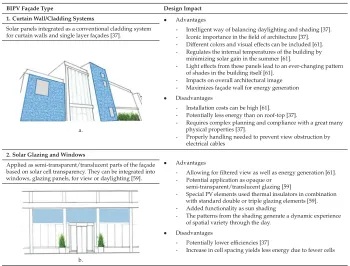
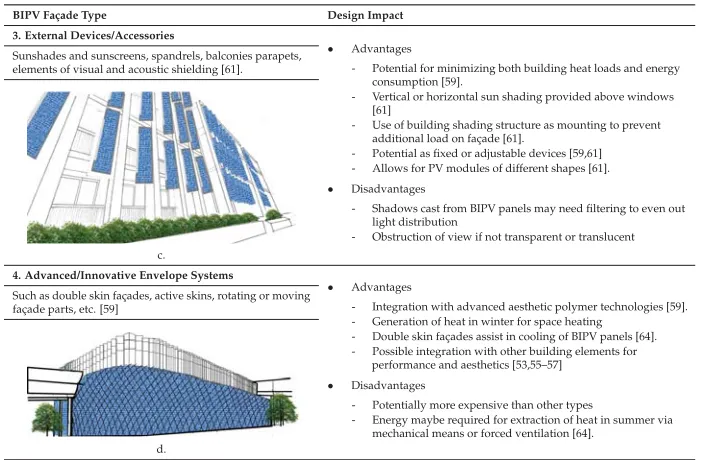
The building façade is conventionally made up of walls, glazing, cladding and fenestrations; and other structures like shading devices, parapets and balconies. Each of these building components provide opportunities for integrating PVs to the building and by extension, for façade customization [36,37,59–62]. The main BIPV façade applications extracted from literature [39,43,59,61,63] include curtain walls, glazing, external/shading devices, and innovative applications. Table 2 presents an overview of these applications using representative built examples to describe the advantages and disadvantages of each of these types.
Table 2.Design impact of BIPV façade types. Source: authors.
BIPV Façade Type Design Impact 1. Curtain Wall/Cladding Systems • Advantages
- Intelligent way of balancing daylighting and shading [37]. - Iconic importance in the field of architecture [37]. - Different colors and visual effects can be included [61]. - Regulates the internal temperatures of the building by
minimizing solar gain in the summer [61].
- Light effects from these panels lead to an ever-changing pattern of shades in the building itself [61].
- Impacts on overall architectural image - Maximizes façade wall for energy generation
• Disadvantages
- Installation costs can be high [61]. - Potentially less energy than on roof-top [37].
- Requires complex planning and compliance with a great many physical properties [37].
- Properly handling needed to prevent view obstruction by electrical cables
Solar panels integrated as a conventional cladding system for curtain walls and single layer façades [37].
a.
2. Solar Glazing and Windows
Applied as semi-transparent/translucent parts of the façade based on solar cell transparency. They can be integrated into windows, glazing panels, for view or daylighting [59].
• Advantages
- Allowing for filtered view as well as energy generation [61]. - Potential application as opaque or
semi-transparent/translucent glazing [59]
- Special PV elements used thermal insulators in combination with standard double or triple glazing elements [59]. - Added functionality as sun shading
- The patterns from the shading generate a dynamic experience of spatial variety through the day.
• Disadvantages
- Potentially lower efficiencies [37]
Table 2.Cont.
BIPV Façade Type Design Impact 3. External Devices/Accessories
Sunshades and sunscreens, spandrels, balconies parapets, elements of visual and acoustic shielding [61].
• Advantages
- Potential for minimizing both building heat loads and energy consumption [59].
- Vertical or horizontal sun shading provided above windows [61]
- Use of building shading structure as mounting to prevent additional load on façade [61].
- Potential as fixed or adjustable devices [59,61] - Allows for PV modules of different shapes [61].
• Disadvantages
- Shadows cast from BIPV panels may need filtering to even out light distribution
- Obstruction of view if not transparent or translucent c.
4. Advanced/Innovative Envelope Systems
Such as double skin façades, active skins, rotating or moving façade parts, etc. [59]
• Advantages
- Integration with advanced aesthetic polymer technologies [59]. - Generation of heat in winter for space heating
- Double skin façades assist in cooling of BIPV panels [64]. - Possible integration with other building elements for
performance and aesthetics [53,55–57]
• Disadvantages
- Potentially more expensive than other types
- Energy maybe required for extraction of heat in summer via mechanical means or forced ventilation [64].
d.
a. Curtain Wall of Hanergy Office, Guangdong, China; showing BIPV cladding; b. KTH Executive School AB, Sweden; showing glazing with wide spaced solar cells for daylighting and view; c. Shading devices on Kingsgate House London, UK; showing vertical polycrystalline panels; d. Innovative façade of Hanergy Headquarters, Beijing, China; showing innovative “dragon scale” arrangement of BIPV modules
2.1. Strategic Benefits of BIPV
BIPV is a multifunctional technology and they are therefore usually designed to serve more than one function [36,60,65]. Along with the fundamental function of producing of electricity, the multi-functionality of BIPV thus implies that it can fulfill several other tasks as a façade element such as solar protection and glare protection. Three identified classes of such added function or benefits from literature relate to the building envelope design, economic advantages and environmental impact.
• Design Benefits: relating to architectural integration and function of BIPV as a building component
• Economic Benefits: relating to financial advantages accrued as a result of BIPV application
• Environmental Benefits: relating to micro or macro environment improvements due to BIPV application
The list below contains a categorization of the multiple functions that BIPV modules can perform based on its unique characteristics.
1. Design-related benefits
a. View and daylighting—semi-transparent options allow for light transmission and contact with exterior [61,66,67].
b. Aesthetic quality—integration in buildings as a design element [36,61]
c. Sun protection/shadowing/shading modulation—used as fixed or tracking shading devices [36,37,60,61,67],
d. Replacement of conventional materials such as brickwork [37].
f. Safety—applied as safety glass [61].
g. Noise protection—reaching up to 25 dB sound dumping [36,37,61,67].
h. Heat protection/Thermal insulation (heating as well as cooling)—improving the efficiency of cells by cooling through rear ventilation [36,37,61]
i. Visual cover/refraction—one-way mirroring visual cover [60,61]. 2. Economic Benefits
a. Removal of the need for the transmittance of electricity over long distances from power generation stations [68,69].
b. Reduction in capital expenditure for infrastructure and maintenance [68,69]. c. Reduction in land use for the generation of electricity [28,70].
d. Material and labour savings as well as electrical cost reductions [36].
e. Reduction in additional assembly and mounting costs, leading to on-site electricity and lowering of total building material costs and significant savings [45]. In addition, ongoing costs of a building are reduced via operational cost savings and reduced embodied energy [71].
f. Combined with grid connection, FITs; cost savings equivalent to the rate the electricity is close to zero [28,46,72]
3. Environmental Benefits
a. Reduction of carbon emissions [28]
b. The pollution-free benefit of solar energy [45].
c. Reduces the Social Cost of Carbon (SCC) relating to the health of the public and the environment [28].
3. BIPV Façade Applications: Barriers and Strategies
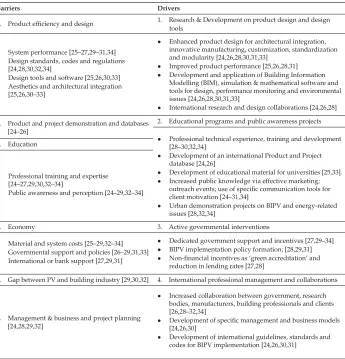
Table 3.A detailed overview of identified BIPV barriers and drivers. Source: By Authors.
Barriers Drivers
1. Product efficiency and design 1. Research & Development on product design and design
tools
• System performance [25–27,29–31,34]
• Design standards, codes and regulations
[24,28,30,32,34]
• Design tools and software [25,26,30,33]
• Aesthetics and architectural integration
[25,26,30–33]
• Enhanced product design for architectural integration,
innovative manufacturing, customization, standardization and modularity [24,26,28,30,31,33]
• Improved product performance [25,26,28,31]
• Development and application of Building Information
Modelling (BIM), simulation & mathematical software and tools for design, performance monitoring and environmental issues [24,26,28,30,31,33]
• International research and design collaborations [24,26,28]
2. Product and project demonstration and databases [24–26]
2. Educational programs and public awareness projects
• Professional technical experience, training and development
[28–30,32,34]
• Development of an international Product and Project
database [24,26]
• Development of educational material for universities [25,33].
• Increased public knowledge via effective marketing;
outreach events; use of specific communication tools for client motivation [24–31,34]
• Urban demonstration projects on BIPV and energy-related
issues [28,32,34] 3. Education
• Professional training and expertise
[24–27,29,30,32–34]
• Public awareness and perception [24–29,32–34]
4. Economy 3. Active governmental interventions
• Material and system costs [25–29,32–34]
• Governmental support and policies [26–29,31,33]
• International or bank support [27,29,31]
• Dedicated government support and incentives [27,29–34]
• BIPV implementation policy formation; [28,29,31]
• Non-financial incentives as ‘green accreditation’ and
reduction in lending rates [27,28]
5. Gap between PV and building industry [29,30,32] 4. International professional management and collaborations
6. Management & business and project planning [24,28,29,32]
• Increased collaboration between government, research
bodies, manufacturers, building professionals and clients [26,28–32,34]
• Development of specific management and business models
[24,26,30]
• Development of international guidelines, standards and
codes for BIPV implementation [24,26,30,31]
Figure 2.Simplified force field analysis of barriers and drivers of BIPV adoption. Source: By Authors.
3.1. Force Field Analysis: Comparison of Barriers and Strategies
Statistically speaking, six classes of barriers relating to the product, education, economy, and industry were identified in the referred literature with further sub-division of three of these classes. As an example, the product efficiency and design class encompasses related barriers such as system performance, design standards, codes and regulations. It also includes design tools and software, aesthetics and architectural integration issues. As observed from our investigation, the need to address public awareness and perception [24–29,32–34] and the insufficient professional training and expertise [24–27,29,30,32–34] are the most frequently identified barriers to BIPV adoption. This suggests an international agreement that the need for proper education regarding the potentials of BIPV is lacking in both public and professional domains. Comparatively, insufficient product and project demonstration and database, as well as insufficient international or bank support are ranked as the least identified barriers. It may be assumed therefore that client motivation via these latter support schemes may not be directly related to the reluctance to BIPV adoption. Another deduction from this survey is that comparatively, there are potentially more product efficiency and design related barriers, although education issues are deemed more crucial. It may be thus deduced that increase in education, training and expertise can be a tool to address issues with performance.
The analysis shows the combined weight of barriers is 400% (normalized to 40) and the combined weight of the drivers is 300% (normalized to 30). By increasing attention to the drivers, via increased research and development, raising each to a 100%, the combined weight of the drivers will rise to 400% (normalized to 40)—assuming the barriers stay constant. In this scenario, the drivers will effectively cancel out the barriers.
need to further investigate BIPV customization studies and the validation of their potential to address these barriers as mentioned.
4. BIPV Façade Customization: Critical Review of Investigations
As architects are saddled with the responsibility of building design; it is pertinent to understand fully the opportunities provided by BIPV in order to communicate them effectively to clients [75]. It has been put forward that the success of the BIPV market will in part be determined by the availability of good customizability and convincing aesthetics [39]. It terms of the need, one aspect mentioned by [76] suggests that standardized products are often not applicable when retrofitting demands flexible dimensions, and custom products have better thermal performance than conventional products [77]. Another research posits that aesthetics, dimensional requirements focused on customization capacity and functionality ought to drive the requirements for the BIPV façade [78]. Thus, this calls for innovative approaches with custom-made products as some have huge potential for energy conservation and thermal comfort [79]. Most manufacturers provide custom-made BIPV services, such as the possibility to produce modules of various power output, form, glass serigraphy/printing and colors, as well as to change the cell arrangement and the glass surface (clear glass, prism, enameled) with different properties (i.e., glare reduction) and finishing [39]. This section however, focuses on BIPV façade customization from the perspective of research investigations to identify the potentials of custom BIPV already mentioned in this review. This perspective was chosen to detail the unbiased results of research experimentation without the inhibition of market performance or worthiness.
4.1. Methodological Approach
This section focuses on the details of the investigative analysis of the 25 selected papers on BIPV customization. As earlier stated, the result of the review was used to check the applicability of BIPV façade customization to address the barriers of standard BIPV. Four (4) aspects of review were selected which are Innovation & custom category, Customisation strategy, Architectural function and Research results. These describe various aspects of BIPV façade customization and form the framework for this evaluation. Figure 3 shows these related aspects as a research guide; with further explanation briefly presented following the figure to explain the definitions and state the importance of each aspect of the review.
Figure 3.Research investigation framework. Source: By Authors.
1. Innovation and Custom Category: Product/Integration/Elemental/Compositional
• The Elemental Level: this represents the breakdown of a BIPV module into various components i.e., the solar cells, frame, glass and other protective layers; reflecting customization of cell or glass or layer type; colors or efficiencies.
• The Compositional Level: this represents the composition of the cells of the BIPV module (module-level), relating to cell spacing and the modules of the BIPV façade (façade-level), relating to tilt angle or spacing from wall for example.
2. Customization strategy: Standard/Custom/Module/Façade design manipulation
In each of the studies various strategies have been employed to customize the BIPV façade. This section helps to provide an inventory of various strategies, categorization for further analysis, possible requirements, limitations and challenges, as well as directions for possible improvements.
These groups are;
• Systematic Parametric Variation (SPV): iterative parametric changes to reach an optimum goal
• Modification of Conventional Features (MCF): modification of conventional BIPV parts
• Enhanced Design Modularization (EDM): upgrade of BIPV façade types into unique modules
• Compositional Modification and Hybridization (CMH): combination of special materials with BIPV
3. Architectural function: energy generation/aesthetics/daylighting/thermal control
This section represents the stated, implied and potential functions of the custom BIPV façade in each study. It informs the specific custom function and provides justification to debate the sustained multi-functional advantage of BIPV. It also indicates if a connection exists between the customization category and level, and the potential architectural function.
4. Results: Power Output/Cell efficiency/Heating or Cooling loads
As the focus of this review is to validate the potential of BIPV customization as a solution to standard BIPV challenges, we also extracted the specific qualitative or quantitative data from the studies as made available. In some cases data on power output of BIPV façade output was provided which was;
• A comparison with a base case (standard BIPV);
• Hot climate results as representative of intense scenarios (where multiple climatic data was presented), or
• Highest output (where optimization based on parametric variation was investigated)
T able 4. Resear ch investigations on BIPV façade customization. Reference Country of Study (BIPV Location on Façade) Deductions from Experimental Investigations Research Results Objective Custom Category/Class of Study Customization Level Investigated Strategy (Description) Architectural Potential [51] Taiwan (W all) Development and analysis of a full-colour PV module Pr oduct/Design and fabrication Elemental (Full-colour and monochr omatic coloration of module parts) Modification of conventional featur es (MCF) (Color image on backsheetglass with applied grayscale mask) Ener gy generation; Aesthetics Short Curr ent density: 0–14% reduction Cell ef ficiency : dr op to max of 10% Power: 14.2% reduction [53] Switzerland (External Device) Design, fabrication and testing of an adaptive solar façade Pr oduct & Integration/Design and fabrication;
Performance Optimisation; Ar
chitectural
Integration
Compositional @Façade-level (dynamic
façade patterns and flexible tilt angle) Enhanced design modularization (EDM) (Highly modular dynamic BIPV façade with a suitable support str uctur e, tracking and contr ol systems) Ener gy generation; Thermal Contr ol; Ener gy saving; Aesthetics Power: 36% incr ease Total ener gy savings: 31% incr ease Ener gy consumption: 8.9% decr ease CO 2 of fset: 15.3 kg CO 2 -eq per year based on the Eur opean Union grid mix. [80] Austria (Glazing) Plasmonic coloring on c-Si PV modules Pr oduct/Design and fabrication Elemental (Cell coloration) MCF; (Silver film deposition on c-Si modules with Ag thermal annealing.) Ener gy generation; Aesthetics Short cir cuit curr ent: average of 10.7% reduction Open cir cuit voltage: average of 1.1% incr ease Fill factor: average of 3.07% incr ease Maximum Power/Ef ficiency: average of 8.3% reduction [81] South Kor ea (External Shading) Application of layering ef fects to a BIPV façade Pr oduct/Design and
fabrication; Architectural Integration Compositional @Module-level (Coloration
of backsheet and Cell arrangement) EDM (Layer ed ef fects to BIPV module: unique ar chitectural finishing of glass sheets, coloration of backsheet with patterned cell arrangement.) Ener gy
generation; Daylighting; Aesthetics
Ar chitectural layering and modularization appr oach enabled application and adaptation of the described ef fects specifically developed to meet unique requests fr om clients; No performance data was available. Modular retr ofitting of a BIPV façade Integration/Ar chitectural Integration Compositional @façade-level (tilt angle) EDM (Modular retr ofit and pr ototyping based on design of conventional façades) Ener gy
generation; Daylighting; Aesthetics
T able 4. Cont . Reference Country of Study (BIPV Location on Façade) Deductions from Experimental Investigations Research Results Objective Custom Category/Class of Study Customization Level Investigated Strategy (Description) Architectural Potential [82] Kor ea (W indow) Color ed a-Si:H transpar ent solar cells employing ultrathin transpar ent multi-layer ed electr odes. Pr oduct/Performance and Optimization; Ar chitectural Integration Elemental (Electr ode and Backsheet transpar ency ,Colour variability) EDM; systematic parametric variation (SPV); MCF (T ranspar ent multi-layer ed electr odes (TMEs) with customizable coloration of optoelectr onic contr olling layer (OCL) Ener gy
generation; Aesthetics; Daylighting
Cell Ef ficiency: average of 6.36% at 23.5% average transmittance with TME @500–800 nm A ve Open cir cuit voltage: 0.8 V A ve Fill factor: 54.66% [83] China (W indow & Double Skin Façade) Comparison of ener gy performance between PV double skin façades and PV insulating glass units Pr oduct/Design and fabrication; Performance and Optimization; Ar chitectural Integration Compositional @Module-level (Module Position, Air gap) MCF; SPV ;(Regulation of air gap) Ener gy generation; Thermal contr ol; Daylighting; Ener gy saving; Aesthetics A ve. SHGCs: 0.152 (PV -DSF) and 0.238 (PV -IGU) A ve. U-value: 2.535 W/m 2K (PV -DSF)and 2.281 W/m 2K (PV -IGU) Conversion ef ficiency of PV -DSF is 1.8% better than PV -IGU Appr ox. power output: 0.01–0.3 kWh (PV -DSF); 0.01–0.32 kWh (PV -IGU) Ener gy Saving potential: 28.4% (PV -DSF) and 30% (PV -IGU) [84] China (Double Skin Façade) Overall ener gy performance of an a-si based photovoltaic double-skin façade Integration/Design and fabrication; Performance and optimization; Ar chitectural Integration; Compositional @Façade-level (V entilation mode) MCF; SPV ;(Change in ventilated modes for PV -DSF) Ener gy generation; Thermal contr ol A ve SHGC: 0.14 (Non-V entilated), 0.15 (Naturally-V entilated), 0.125 (V entilated) U-value: 3.3 (Non-V entilated), 3.7 (Naturally-V entilated), 4.65 (V entilated) [85] Switzerland (W indow & W all) Performance investigation of selected BIPV façade types. Pr oduct & Integration/Design and fabrication; Performance and optimization; Ar chitectural Integration Elemental (Cell technology ,cell transpar ency); Compositional @Module-level & Façade-level (Module Position, Air gap, T ilt angle) SPV ;V ariation of BIPV module position and ventilation mode Ener gy generation Thermal contr ol
Daylighting Shading Aesthetics
T able 4. Cont . Reference Country of Study (BIPV Location on Façade) Deductions from Experimental Investigations Research Results Objective Custom Category/Class of Study Customization Level Investigated Strategy (Description) Architectural Potential [86] China (W indow) Assessment of ener gy performance of semi-transpar ent PV insulating glass units Pr oduct & Integration/Design and fabrication; Performance and optimization; Ar chitectural Integration Elemental (Backsheet); Compositional @Façade-level (Air gap) MCF; SPV ;(V ariation of air gap and backsheet material) Ener gy generation; Thermal contr ol; Daylighting; Ener gy saving A ve. PV temp: 23–42 ◦C A ve. Daylight illuminance: 0–360 lux A ve. Heat gain: − 12.5–165 W/m 2 Power output @ air gap: 67.41 kWh @3 mm; 67.35 kWh @6 mm; 67.32 kWh @9 mm; 67.3 kWh @12 mm; 67.29 kWh @15 mm Power output @backsheet type: 67.32 kWh (Clear glass); 66.84 kWh (Low-e glass); 67.4 kWh (Low ir on glass): 67.2 kWh (T inted glass) [87] USA (W indow) Ener gy benefits fr om semi-transpar ent BIPV window and daylight-dimming systems Pr oduct & Integration/Performance and Optimization; Ar chitectural Integration Elemental (Cell transpar ency and ef ficiency);
Compositional @Façade-level (Orientation
and WWR) MCF; SPV ;(Use of a DOE-2 based calculation algorithm simulations of parameterised vaules) Ener gy generation; Thermal contr ol; Daylighting; Shading; Ener gy savings Power output range on south façade/month: 35.1–71.9 kWh @6.65 ef ficiency ,40% transpar ency ,48 W 46.4–95.4 kWh @8.82 ef ficiency ,20% transpar ency ,64 W 52.4–107.2 kWh @9.91 ef ficiency ,10% transpar ency ,72 W Appr ox. Annual Power output @WWR: 1165 kWh @10%; 3496 kWh @30%; 8157 @70% [88] Canada (Double Skin Façade) Patterns of façade system design for enhanced ener gy performance Pr oduct & Integration/Performance and Optimization; Ar chitectural Integration Compositional @Module-level (Module placement/arrangement) MCF; SPV ;EDM (Manipulation of planar geometry to induce incr ease in solar captur e) Ener gy generation; Thermal contr ol; Aesthetics Comparison with base case: Power Output: 20–80% incr ease Heating load: about 200% incr ease (worst case) Cooling load: about 52% reduction (best case) Peak electricity: peak spr ead of 4–5 h. [55] Pakistan (W all) Ener gy and Cost Saving of a Photovoltaic-Phase Change Material (PV -PCM) System Pr oduct/Design and fabrication; Performance and Optimization; Cost Elemental
(Phase-change materials); Compositional @Module-level (Module
T able 4. Cont . Reference Country of Study (BIPV Location on Façade) Deductions from Experimental Investigations Research Results Objective Custom Category/Class of Study Customization Level Investigated Strategy (Description) Architectural Potential [91] Slovakia (V entilated PV Façade) Thermal Performance of a V entilated PV Façade Coupled with PCM Pr oduct & Integration/Design, Performance and Optimization; Ar chitectural Integration Compositional @Module-level (Module design—addition of PCM) CMH; SPV (Hybridisation of BIPV with PCM layer) Thermal contr ol PV temp decr ease: up to 20 ◦C Peak temp. shift: mor e than 5 h [92] France (V entilated PV Façade) Experimental evaluation of a naturally ventilated PV double-skin building envelope in real operating conditions Pr oduct & Integration/Design and fabrication; Performance and Optimization; Ar chitectural Integration Compositional @Module-level (Module arrangement) MCF; SPV (Utilising the stack ef fect to cool a pr ototype pleated PV double façade) Ener gy generation; Thermal contr ol;
Daylighting; Shading; Aesthetics
T able 4. Cont . Reference Country of Study (BIPV Location on Façade) Deductions from Experimental Investigations Research Results Objective Custom Category/Class of Study Customization Level Investigated Strategy (Description) Architectural Potential [94] China (V entilated Double Skin Façade) Thermal performance of a photovoltaic wall mounted on a multi-layer façade Integration/Performance and Optimization; Ar chitectural Integration Compositional @Facade-level (ventilation mode) SPV (Mathematical modelling and variation of ventilation modes) Ener gy generation; Thermal contr ol A ve SHGC: 0.14 (Non-V entilated), 0.15 (Naturally-V entilated), 0.125 (V entilated) U-value: 3.3 (Non-V entilated), 3.7 (Naturally-V entilated), 4.65 (V entilated) [52] (Glazing) Aesthetic impr ovement of PV for Building integration Encapsulants Pr oduct/Design and
fabrication; Architectural Integration
Elemental (Encapsulant material) MCF (Coloration of encapsulant material using flor escence dyes) Ener gy generation; Aesthetics Power output incr ease: 2.0 % (Clear Sylgar d 184); 2.5% (Red 100 ppm Lumogen dye in Sylgar d 184) [95] Italy (Glassblocks) Evaluation of pr ototype BIPV optical performance Pr oduct/Design and
Fabrication; Performance optimization Compositional @Module-level (position
of solar cells) CMH; EDM (Pr ototyping based on conventional façade design component) Ener gy
generation; Aesthetics; Daylighting;
Thermal Contr ol Power output reductions: 19.67% (DSSC Part of Surface); 6.01% (All of Surface); 54.09% (Interior of Surface); 69.94% (Middle of Block) [96] Netherlands (W all) Aesthetics pr eservation BIPV façade using Zigzag geometry Pr oduct/Design and
Fabrication; Architectural integration
4.2. Assessment of BIPV Customization Parameters
Table 4 shows that all the studies reviewed give focus to energy generation and architectural integration; most also focus on performance and optimization of the BIPV façade; few focus on cost and environmental issues. This is reminiscent of the general fact that a BIPV façade is primarily a building element with energy producing capability. Thus, its integration and optimization of its performance are significantly important. The country of study and BIPV façade type highlight the potentiality in a variety of countries and application in building location. The variety of objective and approach in the various studies was expected, and provided a broad spectrum to carry out the review. However, in order to provide a sensible analysis, categorization was done at each stage without bias to the original intent of the researchers.
4.2.1. Innovation and Custom Category
Statistically, nine of the cases focused on design of a custom BIPV product [51,52,55,80–83,89,95], only four focused on a customization in the integration process [63,81,84,94], while 12 combined both product and integration concerns in their research [17,53,63,64,85–88,90–93]. This suggests that most custom BIPV façade products are designed with attention on the potential for proper architectural integration. Each approach is uniquely different, yet they meet the same goals of energy generation, aesthetics, and daylighting or thermal control. It is important to consolidate at this point the fact that conventional BIPV façades can provide some of these gains along with energy generation. However, these customized BIPV have the potential to out-perform standard types based on pre-design specifications and functionally-driven objectives, which emphasize these other benefits.
Regarding the customization level, four were purely elemental [51,52,80,82], eight were compositional at the module-level [64,81,83,88,89,91,92,95], and five were compositional at the façade-level [17,53,81,84,94]; eight studies combined all of the levels [55,82,85–87,90,93,96]. Comparing elemental versus compositional level, studies can be more easily carried out using conventional PV modules without the requirement of a custom-designed module. As this will require less time to fabricate the test specimens, it is probable that compositional studies are thus preferred, and were thus more numerous. However, using conventional modules for customization suggests innovative and creative applications. 4.2.2. Customization Strategy
The studies showed varying levels of complexity in the strategies used to achieve the objective of customization. It is clear from the examples that this was achieved by an interdisciplinary approach to BIPV product design. It therefore suggests that the accomplishment of custom BIPV modules requires input across several disciplines. While this may be more demanding and expensive, it creates the opportunity for greater novelty and innovative ideas. Enhanced flexibility and variety was noticed in the strategic approach applied in custom BIPV integration studies.
In the investigated cases, three were SPV [64,85,94], four were MCF [51,52,80,89], four were EDM [53,63,81], and 14 combined two or more strategies [17,55,82–84,86–88,90–93,95,96]. Clear evidence thus presents a combination of various strategies is required to achieve BIPV façade customization. In the cases of combined strategies, most of the studies addressed customization at both an elemental and compositional level, reflecting a holistic approach. Furthermore, most of the studies in this class were carried out to address aesthetic or thermal control objectives. Deductively therefore, the combined strategy approach is preferred for BIPV façade customization as it covers various multi-dimensional issues in the design.
4.2.3. Architectural Function
based on research objective or cell type selection as all a-Si applications permit some degree of light transmission [7,63,64,82,83,85–87,92,95]. Also, three addressed energy savings [53,83,87], four specifically on shading [85–87,92], and one on cladding [90] and cost [93].
The review shows that although all focused on energy generation of the custom BIPV façade, all focused also on at least one or more added function. More than half of the studies were on thermal control—in terms of added BIPV function; proving capture and reuse of PV thermal energy, as well as reduction of direct solar radiation to the interior. A sizeable number of the studies show a connection with the goal of improving the thermal control or aesthetic appeal of the product. It suggests that customization of BIPV products is in some way primarily driven by these two objectives. We observed that the architectural functions were achieved by all the classified strategies. The import of this finding is that categorization developed for this review of customization strategies for BIPV façades is justifiable, flexible and versatile in applicability.
4.2.4. Results
Performance data from the studies were varied and not reflective of comparisons with a conventional BIPV or a reference case in most cases. Were available, a 4–70% reduction related to power output was observed [51,80,90,95] and a 2–80% increase [52,53,55,96]. It is important to observe that these studies used different strategies with different reference cases. As these studies were also in different climates it is not possible to make a general conclusion on these results. They are however representative of the fact that BIPV façade customization has potentials for performance improvements or otherwise based on the design and specifications
Of the studies related to thermal control with reference cases, 3 showed improvements in relation to power output while 1 showed reductions. Of the studies related aesthetics with reference cases, 4 showed improvements in relation to power output while 2 showed reductions. This suggests the in comparative situations, the process of customization can enhance thermal control and aesthetics with satisfactory performance related to power output.
5. Challenges and Future Prospects
Several challenges exist with the concept of BIPV customization in general and specific terms and several studies have outlined these barriers [24–34,97]. Firstly, BIPV itself is still in a technological developmental phase. Its full potential is yet to be maximized and studies argue that there are still design codes and standards for application that are not full developed [24,28,30]. This review has further brought to light the vast variations in strategies and approaches with BIPV façade customization. Developing a framework for analysis is thus potentially challenging and requires certain generalizations.
Specific to BIPV façade customization objectives, thermal control and aesthetics were identified as the most frequently studied. However, the several of strategies used in both cases required special manufacturing processes which are not yet standardized on a large scale. Thus, problems with cost, machinery, and standards exist. This scenario is worsened by the identified gap between the PV and building industry [29,30,32]; as the lack of willingness to adopt new technology can be a drawback for custom applications. Further research is required to standardize the assessment of custom BIPV and develop a model for evaluation of strategies. This review intended to identify the potentiality of BIPV customization but does not answer questions related to climatic or regional applications. Customization in relation to cost issues is another area that presents further research potential to yield clear evaluative data. The cost and efficiency of a BIPV system can be lowered by reducing PV module and component manufacturing costs, improving PV and other component efficiencies, and understanding whole life cycle costs [21,98] in relation to local factors and the context when used a building skin [99].
in performance and perception. The main bottleneck discovered during a BIPV study conducted in an European research project, was in the ability to communicate this enhanced value and the new possibilities to customers and thus justify the higher cost -generally an increment around 20% [66]. Thus, custom BIPV potentials require proper communication of potentials to both the public and professionals.
6. Conclusions
This review strategically raises a theoretical background for a renewed focus on BIPV customization. It is clear that there are several experimental studies which engage in this strategy at one level or the other. Our findings indicate that BIPV façade customization can be carried out with significant advantages which include:
1. Flexibility and applicability at an elemental and compositional level
2. Versatility in development of both custom BIPV products and custom BIPV integration schemes 3. Multiple type strategies in single or combined scenarios can be used to achieve objectives 4. Increase in power output and performance is possible in a range of 2–80% based on design 5. Although, reduction in power output and performance occurs also at a range of 4–70% based
on design
In summary, we conclude that BIPV façade customization can address some of the barriers with conventional BIPV façades relating to product efficiency and aesthetic design. It can also be a driver of enhanced innovative product design for architectural integration. The extensive research and global interest in BIPV over the last one decade is not likely to abate. Areas such as daylighting, self-cleaning PV glazing, aesthetics using color, form or shapes, concentrating BIPV, perovskite-based solar cells and solar trees are some of the emerging areas [36,45,100–103]. With shifting policies, government tariffs and policy changes, it will also be interesting to investigate the possibility of using demonstration projects in certain regions as a push for BIPV-wide acceptance. Such projects will be opportunities to communicate the significant benefits of BIPV customisation and advance its adoption.
Acknowledgments: The authors gratefully acknowledge financial support from the United Arab Emirates University towards this review as part of an on-going doctoral research.
Author Contributions:Daniel Efurosibina Attoye developed the concept and framework for investigation, carried out data collection and wrote the initial manuscript. Kheira Tabet Aoul and Ahmed Hassan verified the scholastic depth of the paper, carried out a critical review of the structure and content, and also supervised the analysis and findings of this work. All authors discussed the results and contributed to the final manuscript.
Conflicts of Interest:The authors declare no conflict of interest.
References
1. Nejat, P.; Jomehzadeh, F.; Taheri, M.M.; Gohari, M.; Majid, M.Z.A. A global review of energy consumption, CO2emissions and policy in the residential sector (with an overview of the top ten CO2emitting countries).
Renew. Sustain. Energy Rev.2015,43, 843–862. [CrossRef]
2. World Energy Council (WEC).World Energy Resources 2013 Survey; World Energy Council: London, UK, 2013. 3. De la Cruz-Lovera, C.; Perea-Moreno, A.J.; de la Cruz-Fernández, J.L.; Alvarez-Bermejo, J.A.; Manzano-Agugliaro, F. Worldwide Research on Energy Efficiency and Sustainability in Public Buildings.Sustainability2017,9, 1294. [CrossRef]
4. Woodcock, J.; Edwards, P.; Tonne, C.; Armstrong, B.G.; Ashiru, O.; Banister, D.; Beevers, S.; Chalabi, Z.; Chowdhury, Z.; Cohen, A.; et al. Public health benefits of strategies to reduce greenhouse-gas emissions: Urban land transport.Lancet2009,374, 1930–1943. [CrossRef]
5. Adewuyi, A.O.; Awodumi, O.B. Renewable and non-renewable energy-growth-emissions linkages: Review of emerging trends with policy implications. Renew. Sustain. Energy Rev. 2017,69, 275–291. [CrossRef]
7. Rodhe, H. A comparison of the contribution of various gases to the greenhouse effect.Science1990,248, 1217. [CrossRef] [PubMed]
8. Lashof, D.A.; Ahuja, D.R. Relative contributions of greenhouse gas emissions to global warming.Nature 1990,344, 529–531. [CrossRef]
9. Jiang, W.; Liu, J.; Liu, X. Impact of carbon quota allocation mechanism on emissions trading: An agent-based simulation.Sustainability2016,8, 826. [CrossRef]
10. Camanzi, L.; Alikadic, A.; Compagnoni, L.; Merloni, E. The impact of greenhouse gas emissions in the EU food chain: A quantitative and economic assessment using an environmentally extended input-output approach.J. Clean. Prod.2017,157, 168–176. [CrossRef]
11. Intergovernmental Panel on Climate Change (IPCC).Climate Change 2007: Synthesis Report; Intergovernmental Panel on Climate Change: Geneva, Switzerland, 2007; pp. 45–54.
12. Liu, W.Y.; Lin, C.C.; Chiu, C.R.; Tsao, Y.S.; Wang, Q. Minimizing the carbon footprint for the time-dependent heterogeneous-fleet vehicle routing problem with alternative paths. Sustainability2014,6, 4658–4684. [CrossRef]
13. Knera, D.; Knera, D.; Heim, D.; Heim, D. Application of a BIPV to cover net energy use of the adjacent office room.Manag. Environ. Qual. Int. J.2016,27, 649–662. [CrossRef]
14. Evola, G.; Margani, G. Renovation of apartment blocks with BIPV: Energy and economic evaluation in temperate climate.Energy Build.2016,130, 794–810. [CrossRef]
15. Jayathissa, P.; Luzzatto, M.; Schmidli, J.; Hofer, J.; Nagy, Z.; Schlueter, A. Optimising building net energy demand with dynamic BIPV shading.Appl. Energy2017,202, 726–735. [CrossRef]
16. Wong, P.W.; Shimoda, Y.; Nonaka, M.; Inoue, M.; Mizuno, M. Semi-transparent PV: Thermal performance, power generation, daylight modelling and energy saving potential in a residential application.Renew. Energy 2008,33, 1024–1036. [CrossRef]
17. Peng, J.; Curcija, D.C.; Lu, L.; Selkowitz, S.E.; Yang, H.; Zhang, W. Numerical investigation of the energy saving potential of a semi-transparent photovoltaic double-skin facade in a cool-summer Mediterranean climate.Appl. Energy2016,165, 345–356. [CrossRef]
18. Bayoumi, M. Impacts of window opening grade on improving the energy efficiency of a façade in hot climates.Build. Environ.2017,119, 31–43. [CrossRef]
19. Elinwa, U.K.; Radmehr, M.; Ogbeba, J.E. Alternative Energy Solutions Using BIPV in Apartment Buildings of Developing Countries: A Case Study of North Cyprus.Sustainability2017,9, 1414. [CrossRef]
20. Song, A.; Lu, L.; Liu, Z.; Wong, M.S. A Study of Incentive Policies for Building-Integrated Photovoltaic Technology in Hong Kong.Sustainability2016,8, 769. [CrossRef]
21. Norton, B.; Eames, P.C.; Mallick, T.K.; Huang, M.J.; McCormack, S.J.; Mondol, J.D.; Yohanis, Y.G. Enhancing the performance of building integrated photovoltaics.Sol. Energy2011,85, 1629–1664. [CrossRef] 22. Agathokleous, R.A.; Kalogirou, S.A. Double skin facades (DSF) and building integrated photovoltaics (BIPV):
A review of configurations and heat transfer characteristics.Renew. Energy2016,89, 743–756. [CrossRef] 23. Zhang, W.; Lu, L.; Peng, J. Evaluation of potential benefits of solar photovoltaic shadings in Hong Kong.
Energy2017. [CrossRef]
24. Ritzen, M.; Reijenga, T.; El Gammal, A.; Warneryd, M.; Sprenger, W.; Rose-Wilson, H.; Payet, J.; Morreau, V.; Boddaert, S. IEA-PVPS Task 15: Enabling Framework for BIPV Acceleration. (IEA-PVPS). In Proceedings of the 48th IEA PVPS Executive Commitee Meeting, Vienna, Austria, 16 November 2016.
25. Tabakovic, M.; Fechner, H.; Van Sark, W.; Louwen, A.; Georghiou, G.; Makrides, G.; Loucaidou, E.; Ioannidou, M.; Weiss, I.; Arancon, S.; et al. Status and outlook for building integrated photovoltaics (BIPV) in relation to educational needs in the BIPV sector.Energy Procedia2017,111, 993–999. [CrossRef] 26. Prieto, A.; Knaack, U.; Auer, T.; Klein, T. Solar façades-Main barriers for widespread façade integration of
solar technologies.J. Façade Des. Eng.2017,5, 51–62. [CrossRef]
27. Goh, K.C.; Goh, H.H.; Yap, A.B.K.; Masrom, M.A.N.; Mohamed, S. Barriers and drivers of Malaysian BIPV application: Perspective of developers.Procedia Eng.2017,180, 1585–1595. [CrossRef]
28. Yang, R.J.; Zou, P.X. Building integrated photovoltaics (BIPV): Costs, benefits, risks, barriers and improvement strategy.Int. J. Constr. Manag.2016,16, 39–53. [CrossRef]
30. Yang, R.J. Overcoming technical barriers and risks in the application of building integrated photovoltaics (BIPV): Hardware and software strategies.Autom. Constr.2015,51, 92–102. [CrossRef]
31. Azadian, F.; Radzi, M.A.M. A general approach toward building integrated photovoltaic systems and its implementation barriers: A review.Renew. Sustain. Energy Rev.2013,22, 527–538. [CrossRef]
32. Koinegg, J.; Brudermann, T.; Posch, A.; Mrotzek, M. “It Would Be a Shame if We Did Not Take Advantage of the Spirit of the Times”. An Analysis of Prospects and Barriers of Building Integrated Photovoltaics. GAIA Ecol. Perspect. Sci. Soc.2013,22, 39–45. [CrossRef]
33. Probst, M.M.; Roecker, C. Criteria for architectural integration of active solar systems IEA Task 41, Subtask A.Energy Procedia2012,30, 1195–1204. [CrossRef]
34. Taleb, H.M.; Pitts, A.C. The potential to exploit use of building-integrated photovoltaics in countries of the Gulf Cooperation Council.Renew. Energy2009,34, 1092–1099. [CrossRef]
35. Tripathy, M.; Sadhu, P.K.; Panda, S.K. A critical review on building integrated photovoltaic products and their applications.Renew. Sustain. Energy Rev.2016,61, 451–465. [CrossRef]
36. Jelle, B.P. Building integrated photovoltaics: A concise description of the current state of the art and possible research pathways.Energies2016,9, 21. [CrossRef]
37. Heinstein, P.; Ballif, C.; Perret-Aebi, L.E. Building integrated photovoltaics (BIPV): Review, potentials, barriers and myths.Green2013,3, 125–156. [CrossRef]
38. Cerón, I.; Caamaño-Martín, E.; Neila, F.J. ‘State-of-the-art’ of building integrated photovoltaic products. Renew. Energy2013,58, 127–133. [CrossRef]
39. Bonomo, P.; Chatzipanagi, A.; Frontini, F. Overview and analysis of current BIPV products: New criteria for supporting the technological transfer in the building sector.VITRUVIO Int. J. Archit. Technol. Sustain.2015, 67–85. [CrossRef]
40. Shukla, A.K.; Sudhakar, K.; Baredar, P. Recent advancement in BIPV product technologies: A review. Energy Build.2017. [CrossRef]
41. Ibraheem, Y.; Farr, E.R.; Piroozfar, P.A. Embedding passive intelligence into building envelopes: A review of the state-of-the-art in integrated photovoltaic shading devices.Energy Procedia2017,111, 964–973. [CrossRef] 42. Shukla, A.K.; Sudhakar, K.; Baredar, P. A comprehensive review on design of building integrated photovoltaic
system.Energy Build.2016,128, 99–110. [CrossRef]
43. Skandalos, N.; Karamanis, D. PV glazing technologies. Renew. Sustain. Energy Rev. 2015,49, 306–322. [CrossRef]
44. Jelle, B.P.; Breivik, C.; Røkenes, H.D. Building integrated photovoltaic products: A state-of-the-art review and future research opportunities.Sol. Energy Mater. Sol. Cells2012,100, 69–96. [CrossRef]
45. Jelle, B.P.; Breivik, C. The path to the building integrated photovoltaics of tomorrow.Energy Procedia2012,20, 78–87. [CrossRef]
46. Hammond, G.P.; Harajli, H.A.; Jones, C.I.; Winnett, A.B. Whole systems appraisal of a UK Building Integrated Photovoltaic (BIPV) system: Energy, environmental, and economic evaluations. Energy Policy2012,40, 219–230. [CrossRef]
47. Scognamiglio, A.; Røstvik, H.N. Photovoltaics and zero energy buildings: A new opportunity and challenge for design.Prog. Photovolt. Res. Appl.2013,21, 1319–1336. [CrossRef]
48. Scognamiglio, A.; Farkas, K.; Frontini, F.; Maturi, L. Architectural quality and photovoltaic products. In Proceedings of the 27th European Photovoltaic Solar Energy Conference and Exhibition (EU PVSEC), Frankfurt, Germany, 24–28 September 2012; pp. 24–28.
49. Stevenson, A. (Ed.)Oxford dictionary of English; Oxford University Press: New York, NY, USA, 2010. 50. Pine, B.J. Mass customizing products and services.Plan. Rev.1993,21, 6–55. [CrossRef]
51. Lien, S.Y. Artist Photovoltaic Modules.Energies2016,9, 551. [CrossRef]
52. Hardy, D.; Kerrouche, A.; Roaf, S.C.; Richards, B.S. Improving the Aesthetics of Photovoltaics through Use of Coloured Encapsulants. In Proceedings of the PLEA 2013—29th Conference, Sustainable Architecture for a Renewable Future, Munich, Germany, 10–12 September 2013.
53. Nagy, Z.; Svetozarevic, B.; Jayathissa, P.; Begle, M.; Hofer, J.; Lydon, G.; Willmann, A.; Schlueter, A. The adaptive solar facade: From concept to prototypes.Front. Archit. Res.2016,5, 143–156. [CrossRef] 54. Keller, A.F. Recharging the Facade: Designing and Constructing Novel BIPV Assemblies. Ph.D. Thesis,
55. Hasan, A.; McCormack, S.J.; Huang, M.J.; Norton, B. Energy and cost saving of a photovoltaic-phase change materials (PV-PCM) system through temperature regulation and performance enhancement of photovoltaics. Energies2014,7, 1318–1331. [CrossRef]
56. Hasan, A.; McCormack, S.J.; Huang, M.J.; Sarwar, J.; Norton, B. Increased photovoltaic performance through temperature regulation by phase change materials: Materials comparison in different climates.Sol. Energy 2015,115, 264–276. [CrossRef]
57. Hasan, A.; Sarwar, J.; Alnoman, H.; Abdelbaqi, S. Yearly energy performance of a photovoltaic-phase change material (PV-PCM) system in hot climate.Sol. Energy2017,146, 417–429. [CrossRef]
58. Baum, R. Architectural integration of light-transmissive photovoltaic (LTPV). In Proceedings of the 26th European Photovoltaic Solar Energy Conference and Exhibition (EU PVSEC), Hamburg, Germany, 5–9 September 2011; pp. 5–9.
59. Munari Probst, M.C.; Roecker, C.; Frontini, F.; Scognamiglio, A.; Farkas, K.; Maturi, L.; Zanetti, I. Solar Energy Systems in Architecture-integration criteria and guidelines. InInternational Energy Agency Solar Heating and Cooling Programme; Probst, M., Cristina, M., Roecker, C., Eds.; International Energy Agency: Paris, France, 2013.
60. Farkas, K.; Frontini, F.; Maturi, L.; Munari Probst, M.C.; Roecker, C.; Scognamiglio, A.Designing Photovoltaic Systems for Architectural Integration; Farkas, K., Ed.; International Energy Agency: Paris, France, 2013. 61. Montoro, D.F.; Vanbuggenhout, P.; Ciesielska, J. Building Integrated Photovoltaics: An overview of the
existing products and their fields of application. InReport Prepared in the Framework of the European Funded Project; SUNRISE: Saskatoon, Canada, 2011.
62. Thomas, R. (Ed.)Photovoltaics and Architecture; Taylor & Francis: Didcot, UK, 2003.
63. Clua Longas, A.; Lufkin, S.; Rey, E. Towards Advanced Active Façades: Analysis of façade requirements and development of an innovative construction system. In Proceedings of the PLEA 2017, Edinburgh, UK, 3–5 July 2017; Volume 1, pp. 192–199.
64. Luo, Y.; Zhang, L.; Wang, X.; Xie, L.; Liu, Z.; Wu, J.; Zhang, Y.; He, X. A comparative study on thermal performance evaluation of a new double skin façade system integrated with photovoltaic blinds.Appl. Energy 2017,199, 281–293. [CrossRef]
65. Tabriz, S.N.; Fard, F.; Partovi, N. Review of architectural day lighting analysis of photovoltaic panels of BIPV with zero energy emission approach.Res. J. Appl. Sci.2016,11, 735–741.
66. Pagliaro, M.; Ciriminna, R.; Palmisano, G. BIPV: Merging the photovoltaic with the construction industry. Prog. Photovolt. Res. Appl.2010,18, 61–72. [CrossRef]
67. Oliver, M.; Jackson, T. Energy and economic evaluation of building-integrated photovoltaics.Energy2001, 26, 431–439. [CrossRef]
68. Bakos, G.C.; Soursos, M.; Tsagas, N.F. Technoeconomic assessment of a building-integrated PV system for electrical energy saving in residential sector.Energy Build.2003,35, 757–762. [CrossRef]
69. Sharples, S.; Radhi, H. Assessing the technical and economic performance of building integrated photovoltaics and their value to the GCC society.Renew. Energy2013,55, 150–159. [CrossRef]
70. Byrnes, L.; Brown, C.; Foster, J.; Wagner, L.D. Australian renewable energy policy: Barriers and challenges. Renew. Energy2013,60, 711–721. [CrossRef]
71. Morris, S.Improving Energy Efficient, Sustainable Building Design and Construction in Australia—Learning from Europe; ISS Institute: Carlton, Australia, 2013.
72. Abdullah, A.S.; Abdullah, M.P.; Hassan, M.Y.; Hussin, F. Renewable energy cost-benefit analysis under Malaysian feed-in-tariff. In Proceedings of the 2012 IEEE Student Conference on Research and Development (SCOReD), Pulau Pinang, Malaysia, 5–6 December 2012; pp. 160–165.
73. Sintov, N.D.; Schultz, P. Adjustable Green Defaults Can Help Make Smart Homes More Sustainable. Sustainability2017,9, 622. [CrossRef]
74. Martyn, A.S. Some problems in managing complex development projects.Long Range Plann.1975,8, 13–26. [CrossRef]
75. Attoye, D.E.; Tabet Aoul, K.A.; Hassan, A. Potentials and Benefits of Building Integrated Photovoltaics. In Proceedings of the United Arab Emirates Graduate Student Conference (UAEGSRC), Al Ain, UAE, 27–28 April 2016.