Available Online at www.ijcsmc.com
International Journal of Computer Science and Mobile Computing
A Monthly Journal of Computer Science and Information Technology
ISSN 2320–088X
IJCSMC, Vol. 4, Issue. 10, October 2015, pg.343 – 352
RESEARCH ARTICLE
DETECTION AND PREVENTION OF
UNKNOWN VULNERABILITES ON
ENTERPRISE IP NETWORKS
M.Masthan
1, Dr. R.Ravi
2Department of CSE & Manonmaniam Sundarnar University, Tirunelveli, India Professor & Head, Department of IT & Francis Xavier Engineering, Tirunelveli, India
1
[email protected]; 2 [email protected]
Abstract— Computer networks have long become backbone of the Enterprise Information System. A substantial share of the security problems we still encountered in Enterprise Network. Cyber espionage can effect Ethical, Military, Political and Economic interest anywhere. To provide secure computer networks, it is necessary to measure the relative effectiveness of security solution in the network. A network security metric enable a direct measurement and comparison of the amounts of security provided different security solutions .In this paper we propose a novel Zero Day Vulnerability Prevention Frame work consists of bunches of algorithms. The above frame work detects and prevents and unknown vulnerabilities in Enterprise IP frameworks. It also protects the behavior of the sessions performed by the user from the huge range of attacks. It helps in monitoring database requests and prevents the attacks. The proposed framework also implements worm and virus detection to evaluate malware from the data. The system also presents scoring to the vulnerabilities and finally it performs security analysis with the help of Topological Vulnerability Analysis (TVA) tool.
Keywords— Network Security, Zero day vulnerabilities prevention frame work
I.INTRODUCTION
Enterprises are faced with many challenges to achieve true network and application security because application vulnerabilities are on the rise, increasing network vulnerabilities and internal security breaches and information leaks. Common attacks on enterprises are Eavesdropping, IP Address spoofing, Password-based attacks, DOS and DDos attacks, Man-in–the–Middle attack, Sniffer attack and Application layer attack. The robust, time-tested set of efficient tools and techniques that have been developed to combat cyber-attacks on enterprise can provide cyber security for the field networks that is comparable to that of the most mission-critical enterprise networks in the world.
The main difficulties in securing computer networks is the absence of measuring the effectiveness of security solutions available in the given network. So many indirect measurements such as firewalls are obtained; but they provide very little about the effectiveness of the security solutions when it is deployed in a real- world network. In such a case, a network security metric is used because, it would provide direct
measurement of the effectiveness of the security solutions. Existing efforts provide a security metric, k zero
day safety that simply counts how many distinct zero day vulnerabilities are required to compromise a network asset. A large count will provide more secure network. It requires tight time synchronization to detect the attacks and known geographic information to identify attacks and protect the network. It is not capable to detect attacks against routing such as worm hole, sink hole attack and Sybil attacks. The attacker can easily create traffic collision with seemingly valid transmission drop or misdirect messages in routes.
To overcome these issues we proposes a Zero Vulnerabilities Prevention Framework. Instead of
providing how many vulnerabilities required to compromise a network, it provides varied algorithms to detect and prevent unknown vulnerabilities in Enterprise IP network. The framework then design algorithms for implementing a worm and virus detection to evaluate malware from the content. The above system also assign numerical scores to vulnerabilities based on known facts about vulnerabilities. Finally, the proposed framework conduct security analysis using topological vulnerability analysis tool CAULDRON.
II. Related work
Nayot Poolsappasit, R. Dewri and I.Ray in [3] proposes a risk management framework base on Bayesian networks to quantify the chances of attacks and to develop a security mitigation and management plan. It is more compact and scalable representation. This early work use Bayesian logic to evaluate identification of assets, system vulnerability and connectivity analysis. More recently, N.Idika and B.Bhargava in [5] observes that different security metrics will provide only a partial view of security and the authors then propose a framework for grouping the metrics attack graph and decision metric based on their relative importance. Attack graph for large networks can get complex and maintains an attribute template for the graph. The size of the attribute instance can be as large as the number of machines. The combination of similar type of security metric will generate more number of graphs.
The research on network security metrics has attracted much attention.In another early work, D. balzarotti, M. Monga and S. Sicari [6] proposes a Cooke’s classical method that will find previously unknown vulnerability in the software. An attack tree marked with abstract exploitability and hazard is passed to find sequences of attacks that corresponds to the easiest paths followed by potential attackers, and the amount of minimum effort needed along such paths is used as a security metric. In another similar work C.Phillips and L.Swiller [11] proposes a graph based approach that analyses network vulnerability. It requires an input database of common attacks, specific network configuration and attacker profile. The length of shortest attack paths in terms of the number of exploits, conditions or both is taken as security metric for measuring the amount of security of networks. The main limitation of those early work lies in that they generally do not consider the relative security or likelihood of vulnerabilities.
dependencies. There is no other approaches to access the risk and damage values. It specifies the effort on estimating the effort required for developing new exploits. M. Mc Queen, Boyer and M. Chaffin in[12] specifies an empirical study on the total number of zero day vulnerabilities available on a single day based on existing facts about vulnerabilities. Wang, Noel and Jajodia in [8] proposed a method that views each vulnerability as a Boolean variable and derive a logic proposition.
III.PROPOSED ALGORITHM
Here we present a zero day vulnerability prevention framework to detect and prevent vulnerabilities in
enterprise IP network. This novel framework uses varied algorithms and techniques to accomplish the goal of enterprise network. First, it finds all possible routes and selects the shortest among them based on zero day shortest Algorithm. And then we find vulnerabilities in the network using Trust Aware Detection technique. The proposed approach also implements worm and virus detection to evaluate malware from data.
Improved Advanced Techniques A. Zero day Shortest Algorithm
The Zero day Shortest Algorithm finds the shortest path from a source to all destinations in a directed graph. During this process it will also determine a spanning tree for the graph. Finding the shortest path in a network is a commonly experienced problem. For example you want to reach a target in the real world via the shortest path or in a computer network a network package should be efficiently routed through the network. A network can be modeled by a graph. Routers are represented by nodes. Physical links between routers are represented by edges. Attached computers are used. Each edge is assigned a weight representing the overall time that the request process and response given to the client. The total cost of a path is the sum of the weights of the edges. The problem is to find the least-weight path. At the first iteration, the algorithm finds the closest node from the source node which must be a neighbour of the source node. At the second iteration, the algorithm finds the second-closest node from the source node. This node must be a neighbour of either the source node or the closest node found in the first iteration. At the third iteration, the algorithm finds the third-closest node from the source node. This node must be a neighbour of either the source node or one of the first two closest nodes. The process continues. At the k-thiteration, the algorithm finds the first k closest nodes from the source node.
Procedure Zero day_shortest
Input: Source,assets
Output: Assets with a non negative real number
Method:
Let wt[source] := 0
for each node v in G
if v ≠ source
wt[v] := infinity
previous[v] := undefined
Add v to Q
while Q is not empty
u := node in Q with min wt[u]
remove u from Q
for each neighbor v of u
alt := wt[u] + leng(u, v)
if alt<wt[v]
wt[v] := alt
previous[v] := u
return wt[], previous[]
B. Zero day Frame work Encryption Algorithm
Zero day vulnerability prevention framework that uses AES for authenticating the request.AES is a symmetric block cipher. Framework use this for verifying whether the request comes from the valid client or not. The valid server connection is only possible through the abstract request. The request would be encrypted using one key and decrypted by the framework using the same key.
C. Trust Aware Detection Technique
Trusted Aware Detection Technique (TADT) encourages the framework to detect and prevent vulnerabilities in the network. Though only those legal neighboring nodes of an attacker might have correctly identified the adversary. Our design TADT proves effective against those harmful attacks developed out of identity deception. This technique can be implemented by the framework with low overhead. This TADT technique can be integrated into existing routing protocols with the least effort, thus producing secure and efficient fully-functional protocols.
It significantly reduce negative impacts from these attackers. It is also energy-efficient with acceptable overhead. It incorporates the trustworthiness of nodes into routing decisions and allows a node to circumvent an adversary misdirecting considerable traffic with a forged identity attained through replaying. It identifies such intruders that misdirect noticeable network traffic by their low trustworthiness and routes data through paths circumventing those intruders to achieve satisfactory throughput. TADT is also energy-efficient, highly scalable, and well adaptable. The above technique enables a node to keep track of the trustworthiness of its neighbors and thus to select a reliable route and put in the routing table. Not only does TADT circumvent those malicious nodes misusing other nodes’ identities to misdirect network traffic, it also accomplishes efficient energy usage.
D. Zero day Worm and Virus Detection Algorithm
most of unknown internet worm automatically. Beside antivirus, firewalls and routers can be used to detect worm. Signature and block the worm, but this occurs only after the worm already spread. The worm generates an IP address and uses that IP address to communicate to potential victim, when the IP address is unused. The proposed Worm and Virus Detection Algorithm is used to detect the malwares from the data. This algorithm used for the file that have a huge size. It performs searching based on the three attributes, file type, file size and file content. It will check the worms in the file at random locations. It is the major advantage of getting the worms from the content. The number of comparisons are performed any number of times in the specified algorithm. This will be more applicable to the user to detect the malware from the content very accurately. The rounds should be decided by one who is conducting the detection method. If there is any match in location then it will return an integer value. This will specify that file is virus affected or not. The algorithm is energy-efficient, highly scalable, well adaptable and also accomplishes time usage.
Procedure Zero day_Worm and virus Detection Input:File to Check
Output:An integer Value
Method:
Let M be the length of input file Let N be the length of original File
for i=0 to N-M
for j=0 to M if org[i+j] != inp[j] Return 0
Else if j=M Return i
E. Common Vulnerability Scoring System(CVSS)
CVSS is a vulnerability scoring system designed to provide an open and standardized method for rating IT vulnerabilities. Proposed system we are using CVSS version 2 calculator. Base score is used to calculate the Temporal score and the Temporal score is used to calculate environmental score. Base represents the intrinsic and fundamental characteristics of vulnerability that are constant over time and user environments.
Temporal represents the characteristics of vulnerability that change over time but not among user
environments. Environmental represents the characteristics of vulnerability that are relevant and unique to a
particular user's environment.
F. Vulnerability Analysis using CAULDRON
must understand not only individual system vulnerabilities but also their interdependencies. Proposed System security analysis done by Topological Vulnerability tool (TVA)-CAULDRON. CAULDRON (Cyber-attack modeling, analysis and Visualization) supports both offensive and defensive Applications. CAULDRON places Vulnerabilities and their protective measures within context of overall network security by modeling their interdependencies via attack graphs. The Analysis of attack graphs provides alternative sets of protective measures that guarantee safety of critical system. It is a Topological Vulnerability tool approach consist of Network Capture Builds a model of the network in relevant term security attributes, Vulnerability Database, Exploit specifications ,Graph engine, Interactive visual analysis of attack Graphs, and optimal counter measures.
IV.SYSTEM DESIGN
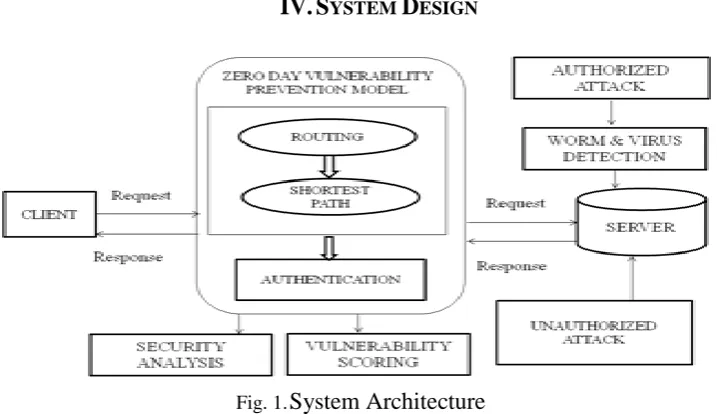
Fig. 1. System Architecture
Figure 1 demonstrates the system design. Client gives request to the server. A valid server connection is only possible through the session value. The session value is encrypted and decrypted for authentication. It will provide more security. The system defines a zero Day Vulnerability Prevention Framework that detects and prevent and vulnerabilities on Enterprise IP network. This will identify the entire possible path that client connects to the destination and put it in the routing table. From the routing table it will find the shortest path based on the weights calculate on each node. Then it provides peer connection to the appropriate sever. Thus frame work detects both authorized& unauthorized attacks. Unauthorized attack includes the client trying to connect without session or with different session .In such cases, the framework that prevents the attack by blocking particular IP and put it in a blacklist. The authorized attack will include the SQL Injection attack and prevention, File uploading attack. These attacks are detected and prevented by using Trust Aware Detection Techniques. This system mainly concentrated on the worm and virus detection by Naïve Pattern Searching Algorithm. It will detect the malware from the data. It will provide scoring to the Vulnerabilities by integrating the frame work with CVSS. Finally it will implement the security analysis with the help of CAULDRON tool and fine tune the frame work performance.
A. Route Filtering and Path Identification
B. Authentication and Unauthorized Attack
The proposed framework verifies each client whether authenticated or not. A valid server connection is only possible through the abstract session value. This session value is appended with the request to the server. Abstract session is a status value that will be encrypted. At the destination server it will be decrypted by the framework and connects to the server. This abstract session provides more security to the server connection. There will be a chance of unauthorized attack. It may be in the form request without abstract value and request having different abstract values or invalid abstract. The framework detects the unauthorized attacks based on trust aware detection technique by blocking the client from future access and put that into the blacklist.
C Authorized Attack Detection and Prevention
The biggest threats are security attacks from people within the organization. While external attacks are extremely important and critical, internal attacks should not be overlooked. The zero day has vulnerability prevention framework thus detected an authorized attack also. They may include activities like SQL injection attacks, file uploading attacks. It is possible for attackers to provide a username containing SQL meta-characters that subvert the intended function of the SQL statements. When a client wants to get the details, that when it connects to the server, weight and all details these types of attacks occur. Consider the case admin`or`1`=`1. This allows an attacker to log in to the data, since OR expression is always true. Using the same technique attackers can inject other SQL commands which could extract modify or delete data within the database. Trust aware detection technique that detects such kinds of attacks and prevents by using prepared statements that helps in defending against SQL injection and move the IP to blacklist. File uploading attacks occurred during uploading files. The attacker uploads the files that virus affected. It will go for the Google search and collects all the files that are suspected to virus with same name. It will extend the database error files by adding the new searched Google items. Trust aware detection technique that detects the attacks and prevents based on the file name and blocks that IP.
D. Worm and Virus Detection
It evaluates malware from the content. Worms and viruses are self-replicating programs. It uses network to send copies of itself to other systems invisibly without user authorization. Zero day pattern search algorithm is used to find worm and virus based on the file type, size and content. Three parameters are used for evaluating the malwares from the content. It compares the size of the file and type of the file. Then it compares the content randomly at different location. The comparison round is determined by the authenticated person. If it detects any mismatch, it will detect the file is untrusted file. If there is no change in three parameters, it will be trusted file. The untrusted file will be moved to the database black list.
E .Vulnerability Scoring
F. Security Analysis
CAULDRON, allows for the transformation of raw security data that allow users to proactively prepare for attacks, manage vulnerability risks and have real-time situational awareness. CAULDRON provides informed risk analysis, analyzes vulnerability dependencies and shows all possible attack paths into a network. In this way, it accounts for sophisticated attack strategies that may penetrate an organization’s layered defenses. CAULDRON’s intelligent analysis engine reasons through attack dependencies, producing a map of all vulnerability paths that are then organized as an attack graph that conveys the impact of combined vulnerabilities on overall security. To manage attack graph complexity, CAULDRON includes hierarchical graph visualizations with high-level overviews and detail drill down, allowing users to navigate into a selected part of the big picture to get more information. They recently installed CAULDRON in their Cyber Security Incident Response Center and it is helping them prioritize security problems, reveal unseen attack paths and protect across large numbers of attack paths. While currently being used by the FAA and defense community, the software is applicable in almost any industry or organization with a network and resources they want to keep protected, such as banking or education. Because of vulnerability interdependencies across networks, a topological attack graph approach is needed for defense against multi-step attacks. The traditional approach that treats network data and events in isolation without the context provided by attack graphs is clearly insufficient. TVA combines vulnerabilities in ways that real attackers might do, discovering all attack paths through a network. Network Capture builds a model of the network, in terms of relevant security attributes. Vulnerability Database represents a comprehensive repository of reported vulnerabilities, with each record listing the affected softw are.
V. DISCUSSIONS
The main objective is to detect and prevent unknown vulnerabilities on enterprise IP network using
zero day vulnerability prevention framework. It prevents both authorized and non authorized attacks by implementing Trust Aware Detection technique. Thus the framework will be the best to prevent these attacks in the enterprise IP network. The above framework provide an efficient peer communication in a large network. It can applied to various types of industries such as Defense, Information Technology, Research and Development which have large network.
VI.RESULTS
Fig.3 Abstract Request
Fig.4 File Decryption
Fig.5 Authorized Attack
VII. CONCLUSION
In this paper we have proposed the Zero Day Vulnerability Prevention Framework to detect the
unknown vulnerabilities which first identifies the node status whether the node is active or dead and whether it comprised with attacker’s activity. Here, it is proposed trust aware detection techniques to prevent the attack and provide secure connection from clients to server. This design also prevents attacker’s activity during data transmission. At that time it blocks the path and selects the secure path for data transmission. Next, it applied a worm and virus detection to evaluate malwares from data. Finally, the system conducted an experiment with CAULDRON tools and realized that this proposed Zero Day Vulnerability Prevention Framework and routing aware techniques together provides an efficient and secure network for data transmission.
There are several interesting areas for further research. The first is how the penetration testing can be applied to zero day vulnerability prevention framework in enterprise networks. The second is to broaden the scope by accommodating other types of attacks which requires no network connection.
REFERENCES
[1] H. Holm, M. Ekstedt, and D. Andersson, “Empirical Analysis of System-Level Vulnerability Metrics through Actual Attacks,”IEEE Trans. Dependable Secure Computing, vol. 9, no. 6, pp. 825-837, Nov. 2012
[2] T. Sommestad, H. Holm, and M. Ekstedt, “Effort Estimates for Vulnerability Discovery Projects,” Proc. 45th Hawaii Int’l Conf.System Sciences (HICSS ’12), pp. 5564-5573, 2012
[3] N. Poolsappasit, R. Dewri, and I. Ray, “Dynamic Security Risk Management Using Bayesian Attack Graphs,” IEEE Trans.Dependable Secure Computing, vol. 9, no. 1, pp. 61-74, Jan. 2012
[4] M. Shahzad, M. Shafiq, and A. Liu, “A Large Scale Exploratory Analysis of Software Vulnerability Life Cycles,” Proc. 34th Int’lConf. Software Eng. (ICSE ’12), 2012
[5] N. Idika and B. Bhargava, “Extending Attack Graph-Based Security Metrics and Aggregating Their Application,” IEEE Trans. Dependable and Secure Computing, vol. 9, no. 1, pp. 75-85, Jan./Feb. 2012.
[6] D. Balzarotti, M. Monga, and S. Sicari, “Assessing the Risk of Using Vulnerable Components,” Proc. ACM Second Workshop Quality of Protection (QoP ’05), pp. 65-78, 2005.
[7] L. Wang, S. Noel, and S. Jajodia, “Minimum-Cost Network Hardening Using Attack Graphs,” Computer Comm., vol. 29,no. 18, pp. 3812-3824, 2006
[8] J.W.P. Manadhata, “An Attack Surface Metric,” Technical Report CMU-CS-05-155, Carnegie Mellon University, 2005 [9] S. Jajodia, S. Noel, and B. O’Berry, “Topological Analysis of Network Attack Vulnerability,” Managing Cyber Threats:
Issues, Approaches and Challenges, V. Kumar, J. Srivastava, and A.Lazarevic, eds., Kluwer Academic, 2003.
[10] P. Ammann, D. Wijesekera, and S. Kaushik, “Scalable, Graph-Based Network Vulnerability Analysis,” Proc. Ninth ACM Conf.Computer Comm. Security (CCS ’02), pp. 217-224, 2002.
[11] C. Phillips and L. Swiler, “A Graph-Based System for Network- Vulnerability Analysis,” Proc. New Security Paradigms Workshop (NSPW ’98), 1998.