Available Online atwww.ijcsmc.com
International Journal of Computer Science and Mobile Computing
A Monthly Journal of Computer Science and Information Technology
ISSN 2320–088X
IMPACT FACTOR: 6.017
IJCSMC, Vol. 6, Issue. 5, May 2017, pg.127 – 136
AN EFFICIENT ANDROID AIDED
FREE FALL DETECTION AND
RESCUE SYSTEM
Rini KP
1, R.Gowthamani
2, L.Nithya
3¹P.G Student Computer Science and Engineering, Nehru Institute of Technology, Coimbatore, India ² AP (SG), Computer Science and Engineering, Nehru Institute of Technology, Coimbatore, India
³AP, Computer Science and Engineering, Nehru Institute of Technology, Coimbatore, India
1
[email protected]; 2 [email protected]; 3 [email protected]
Abstract—With increasing of aged population, elderly safety issues have more and more social significance. Elderly people living alone may be faced with accidents. In order to help them timely contact with their family members, some manufactures offer a kind of mobile phone with shortcut keys function. However, many incidents happen quick to harm the elder and their families, the consequences are serious, such as sudden fall. In this paper, we designed a new remote mobile early-warning and rescue system which set up an automatic real time emergency communication platform between the old and their family members. This system can really help and avoids the risk of serious injury because of not getting emergency treatment. At first, we analyse and make use of available data push methods in android-based mobile phones, and a model with locate function and low communication is established. Then, based on the working principle of acceleration sensor, and gyroscope using data from acceleration sensor, gyroscope sensor a fall detection analysis and assessment models is provided, in which the fall detection perception is given by the acceleration comparison algorithm. And the change in angle or body position is given by the gyroscope sensor data the location information by GPS is sending via SMS to the guardians. Also the fall data is effectively logged in to a cloud storage by using Google firebase Platform. This technology is used to monitor the fallen position and status, hence to capture real-time information about the fall as an emergency to their family members. In the real-world use, it definitely got that the system provided here is of high recognition rate for falls or accidents and timely generation of early warning. It has a high real-world significance.
Keywords— Fall detection, Accelerometer, Gyroscope, Cloud service, Smartphone
I. INTRODUCTION
independent living facilities: predict then prevent the heavy impact of a fall, or fall event detection followed by immediate notification to caretakers.
Since recent decade smartphones have gain ubiquitous popularity in numerous applications not just in developed countries, but around the world due to their extended functionality, great consumer characteristics, affordability, fast and reliable mobile communication with omnipresent coverage. Majority of modern smartphones are equipped with a number of useful and accurate integrated sensors (accelerometer, gyroscope, magnetometer, barometer, proximity, thermometer, ambient light sensor, etc.).
II. STUDYOFFALL
Fast detection of falls would not only reduce the health risks by enabling rapid medical response; but also make independent living a safe option for the elderly. The World Health Organization (WHO) reported that 28%–35% of people aged 65 years and above fall each year and the rate increases to 32%–42% for those over 70 years of age. Those who are vulnerable to falls also include those suffering from neurological diseases (e.g., epilepsy and dementia), which commonly occur in older people. In around 35 years and by 2050, it‘s estimated that more than one in each group of five people will be aged 65 or over.
General falls occur from the resting aspect like slipping from bed, or fall from a sitting. Fall event may also occur while running or walking, or fall from supports such as ladders, tables etc. Among these different falls, each may have distinct fall characteristics and different threshold parameters in order to pre find the falling event.
There are three main types of falls:
• Accidental falls: these occur when resident slip such as on water, bathrobe tie etc.
• Unexpected physiological falls: begins these occur when resident falls for physiological reason that has not be identified that is fainting, seizures, a pathological hip fractures.
• Expected physiological falls: these occur in individuals who have already been flagged as being at risk of falling. They are expected to fall again because the Fall Risk Assessment has identified being them high risk
The X, Y, and Z axes of a smartphone (see Fig. 1) are defined according to the definition of the coordinate system at the Android developer website [13]. That is, when the smartphone is placed in portrait orientation with its screen facing the user, the X axis is horizontal and points to the right, the Y axis is vertical and points up, and the Z axis points towards the outside of the front face of the screen.
When an accelerometer is in a steady and static state, the absolute value in the vertical axis is 9.8m/s2, which is equal to 1G (Gravity). For example, the vertical axis is Y in Fig. 1, and hence its accelerometer reading will be 1G.
III.FALLDETECTION
A. Needs Fall Detection Technology
Not everyone should use fall detection mechanism, as the devices may find false alarms, which can be a hassle. These devices are best for a very specific subset of people: those who regularly fall, those with early dementia or those with diabetes. To determine if fall detection is the perfect system for you, check with your primary care physician.
B. Why fall detection
While fall detection is not for everyone, it is the distinction between life and death for people who would like it Falls can result in critical injuries, like those to the head and hips, and are the leading cause of loss of independence for the elderly. These injuries can lead to hospitalization or efficient move to an assisted living facility. The longer someone remains unassisted, the less likely it becomes that he or she will make a full recovery. Whereas fall detection is a great system, keep in mind that it does not detect 100% percent of falls.
C. Fall detection work
Fall detectors use specialized technology to measure your movements and also the position of your body. These devices can tell the distinction between everyday movements and emergencies. As an example, the device will tell if you are simply laying down or if there is a sudden modification in direction as a result of a fall. Many fall detectors use accelerometers and gyroscopes to measure the changes in direction or acceleration of your movement. These monitoring tools use careful calculations that enable a sensor to tell the distinction between a fall and other movements.
D. Sensors 1) Gyroscope
A gyroscope permits a smartphone to measure and maintain orientation. Gyroscopic sensors will monitor and control device positions, orientation, direction, angular motion and rotation. Once applied to a smartphone, a gyroscopic sensor usually performs gesture recognition functions. Additionally, gyroscopes in smartphones help to determine the position and orientation of the phone.
2) Accelerometer
An accelerometer is a sensing element that measures acceleration as well as tilt, tilt angle, incline, rotation, vibration and collision. To offer functionality with a smartphone, the accelerometer software must translate the sensor output. Smartphones use several types of accelerometers, the sensing element and software representing the primary differences between the accelerometers. When applied to a smartphone, an accelerometer can automatically change the device's screen orientation vertically or horizontally.
An accelerometer is a compact device designed to measure non-gravitational acceleration. When the object it‘s integrated into goes from a standstill to any velocity, the accelerometer is designed to respond to the vibrations associated with such movement. Accelerometers are important components to devices that track fitness and other measurements in the quantified self-movement.
3) MEMS technology
These monitoring tools use careful calculations that enable a sensor to tell the distinction between a fall and other movements. Microelectromechanical systems provide the technology that makes many of a smartphone‘s features possible. This technology applies mechanical functions to small structures using dimensions in the micro meter scale. The gyroscopes and accelerometers inside of a smartphone use MEMS technology. The application of MEMS technology on smartphones also enables access for individuals with disabilities.
IV. EXISTINGSYSTEM
The existing system utilizes only the accelerometer data for detection. When a person falls, the axes of the smart phone change the directions. The movement of the smart phone is measured with help of accelerometer speeds and sampled time. This system uses simple operations to detect the falls. This existing system allows the smart phones to be placed not only on the waist but also in the pockets. This system can detect fall events effectively than simple smart phone on the waist approach without generating false alarms.
V. PROPOSEDWORK
guardians. Also the fall data is effectively logged in to a cloud storage by using Google firebase Platform. This technology is used to monitor the fallen position and status, hence to capture real-time information about the fall as an emergency to their family members. In the real-world use, it definitely got that the system provided here is of high recognition rate for falls or accidents and timely generation of early warning. It has a high real-world significance.
This system propose a low priced system that is well suited to all the requirements by using existing mainstream technologies that are reliable. Our approach is to use a worn device that billions of people already possess, a programmable cellular phone Using existing cell phone technology not only reduces the cost to the patient, it conjointly exploits a larger vary of communication capabilities and integrated hardware and software system options.
A. System Architecture
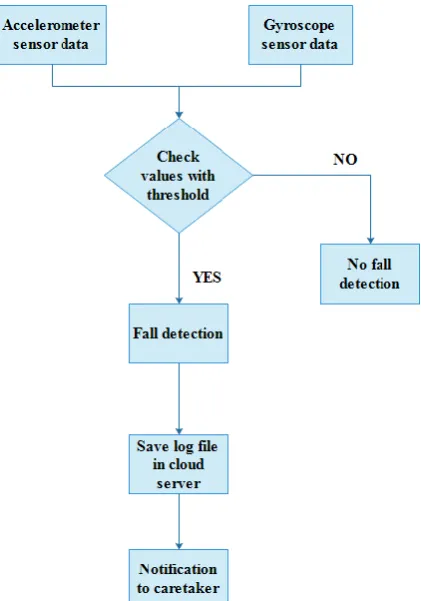
Here taken inputs are gyroscope and accelerometer sensor data. The input data checks with the threshold value. If the value cross the threshold then fall detected else no fall detection. If once fall event is detected then it is stored in cloud. By using cloud service providers, audio message and SMS which are predefined about fall event in cloud are sent to the caretaker. Touch screen response and voice recognition Cell phones are also more discrete than a dedicated monitor device to limit false positives we implement several fall detection algorithms and two stages of communication. When a fall is detected, we first communicate with the user. If the user does not respond, we then attempt to contact members in his or her social network. If both fail and the social contact confirms a fall, the system alerts an emergency service.
The main objective of this work is to collect the gyroscope and the accelerometers sensor data for fall detection. Also to share the information to care takers by messages. This paper presents an alert system for fall detection using common commercially available electronic devices to both detect the fall and alert authorities. We use a common Android-based smart phone with an integrated tri-axial accelerometer. Specifically designed focusing on elderly or people with disabilities
Figure 2. Over all system architecture
B. Module description
This system can classify mainly 4 modules. They are
1) Training module
applied to a tool on all 3 physical axes (x, y, and z), as well as the force of gravity. The rotating mechanism sensing element measures a device's rate of rotation in rad/s around every of the 3 physical axes (x, y, and z)
When a person falls, the axes of the smartphone change directions. For example, assume the Y and Z axes of the smartphone in a person‘s pocket are vertical and horizontal to the ground respectively when the person stands upright. If the person falls forward and lands with the face down, the direction of the Y axis will change from vertical to horizontal, whereas the one of the Z axis from horizontal to vertical. However, one cannot always assume the direction of the Y axis is always vertical to the ground. If a user wears trousers with big pockets and places the smartphone in landscape orientation, the axis vertical to the ground will then be the X axis rather than the Y axis.
2) Fall detection module
In this module, the fall detection is achieved by using the sensor values by comparing the values with predefined threshold. It‘s a two stage process, State 1 is to detect possible impacts and state 2 is to recognize the change of the most probable axis vertical to the ground, and to verify whether an impact has occurred.This detection system which can utilize the data which are collected from both accelerometers and gyroscope in smartphone. These data are analysed to detect falls and utilizes the cloud service to store fall status and location. These fall events are informed to pre-specified caretaker by audio message and SMS.
The main aim of the application is to enhance the testing and development capacity of fall detection devices and for analysing various patterns for different types of falls. This application can also be used readily to detect falls. The working principle of the designed application is an enhanced one for a single sensor fall detection, freely hanging fall detection pendants/devices. The logic is developed using the vector magnitude of the 3 axis of accelerometers describes the architecture of the fall detection process.
3) Notification for fall events
Notification for fall events is the part the application performs as the responsive part. Which triggers and executes the passing of information about the fall to the caregivers or paramedical authorities. When fall detected after the time expired the message/SMS will send to the caretaker one by one. If the victim fails to respond to the alert or after a real fall the care givers are notified with a voice call one by one. This module utilises modern smartphone technologies like GPS, SMS, and Voice call to inform the caregiver. Also it integrates and makes use of different API s like SMS, Voice call, and GPS.
Beep sound: it‘s like a siren fast recovery. As the victim falls a beep sound will be produced to the surroundings .Hence, any there in the surroundings can take care of the situation.
Working:
Whenever a positive fall is detected the control of the program will be transferred to notification module
It further proceeds with enabled notification with enabled notification patterns
Offloads the fall event to a remote database and helps to keep a permanent EMR over web
Electronic medical record means the patients previous treatment record by keeping that and linking it to national EMR grid in future, it will ensure that the patient receives the precise treatment.
4) Cloud logging
As future work, it can log if the victim is fallen or not as well as time of falls and also can keep a track record of falls and record can be used for precise treatment. Used to reduce operation overhead of a mobile phone with different specification. All the computation and posture analysis are done over cloud plus profile for each person can be maintained for lifelong tracking of falls. Provide the appropriate remedy specifically. Firebase Notifications is a free service that enables targeted user notifications for mobile app developers.
Firebase: Firebase projects are backed by Google Cloud Platform a. Real time database
b. Storage c. Hosting
created offered within the project within the base of operations console. Even though a developer hasn't written any check code for his or her app, check workplace will exercise the app mechanically, yearning for crashes.
VI. FALL DETECTION ALGORITHM
Input: Accelerometer and gyroscope values GPS coordinates, Emergency Numbers Output: Positive Fall Detection
.
1. Initialize Upper Threshold, Orientation // Upper threshold obtained by training
// initially the acceleration on the mobile will be 9.8 m/sec2 in the downward direction 2. Capture accelerometer values along x,y,z axis from accelerometer sensor
3. Essential calculation just uses the module (Ath ) of the aggregate acceleration of the phone 4. To compute acceleration of fallen victim
Where A x, Ay and Az are the quickening readings in headings of x, y, and z-axis measured by the accelerometer that is installed in the cell phone
5. A fall is specifically expected only if the increasing speed surpasses a choice threshold.
6. If the magnitude of acceleration reaches the threshold it saves the orientation of the person and time to a temporary variable
7. The temporary variable was compared after 400 milliseconds for further confirmation of fall occurrence.
8. Perfalld calculation all the while considers the estimations of the modules of the aggregate increasing speed (AVaba) of the device and the speeding up at unquestionably the vertical absolute acceleration (AVaba)
9. If both of the condition is fulfilled, consider as a positive fall and the notification module is started.
Fig 3: The home screen
This figure shows the home screen application should be easily operable different person with or without much smartphone usage awareness. So as to achieve that the landing page or home activity is very much simplified and contains most of the configurations. That allows effectiveness and unwanted further navigation through different menus, or settings.
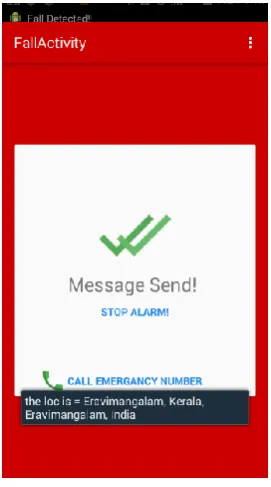
Fig 4: Fall alert message
As a positive fall is detected the alert activity is invoked and as per the given timer settings a countdown is given for the user to respond, and also in the case of negative fall. The activity allows to ‗am alright‘ button to be pressed if the victim is not injured and able to recover self. The ‗I need help‘ button allows user to respond if victim is active and needs urgent help. A special provision to call the emergency number by user self is provided.
Fig 5: Fall confirmed
Fig 6: Firebase
Selecting Service database which is used in this application will show us the real time database in which the fallen time and place will be logged From Time to Time.
VII. CLASSIFICATION USING SVM CLASSIFIER
By evaluating each feature individually by separating Healthy/DM, the highest average accuracy achieved (via SVM) was only 66.26%.a support vector machine (SVM), where the kernel function (linear) mapped the training data into kernel space. To measure the performance, average accuracy was employed
Average accuracy = (sensitivity+specificity)/2
With the average of all five repetitions recorded as the final classification rate.
Fig 7: Data flow diagram
entire system, they are fall detection module. For training module and testing module using SVM and K-NN classifier.
VIII. CONCLUSIONS
In this paper, fall detection system uses the data gathered from both accelerometer and gyroscope in smartphones. This proposed system does not employ more complex operations to detect fall events. This approach allows smartphones to be placed in waist as well as pockets. The experimental results show that the proposed method can detect fall events effectively without any false alarms. This approach provides better sensitivity and specificity to detect the falls. This experimental findings may not be generalized to all real fall situations. Fall simulation may not represent every fall situation. There are falls that are caused by dizziness, or situations when there is something to grip with during the fall. Another limitation of current study was that the accuracy and specificity of the current threshold-based method decreases when the activities involve large acceleration. Future research studies should look into the above limitations by incorporating subtle fall events, and falls during more vigorous activities such as jogging however, smartphones are widespread for applications, these devices may be limited to usability barriers for elders in addition to the limiting positions of the carriers, waist, wrist, chest, etc., intruding errors that are position-dependent. We would also like to develop more sophisticated and robust detection algorithm to deal with these more complex activities.
The present method is capable of notifying a remote party using SMS message and detecting an emergency situation when a subject remains stationary after the fall. It is therefore particularly useful for older people who live alone. It is hoped that the mobile phone would help build up the confidence of older people with fall risk, reduce the fear of falling and encourage physical activity, which will lead to an improvement in the quality of life.
R
EFERENCES
[1] Tong, L., Song, Q., Ge, Y., & Liu, M. (2016). HMM-based human fall detection and prediction methodusing tri-axial accelerometer. IEEE Sensors Journal, 13(5), 1849-1856.
[2] Wibisono, W., Arifin, D. N., Pratomo, B. A., Ahmad, T., & Ijtihadie, R. M. (2013, December). Falls detection and notification system using tri-axial accelerometer and gyroscope sensors of a smartphone. In 2013 Conference on Technologies and Applications of Artificial Intelligence (pp. 382-385). IEEE.
[3] Rakhman, A. Z., & Nugroho, L. E. (2014, November). Fall detection system using accelerometer and gyroscope based on smartphone. In Information Technology, Computer and Electrical Engineering (ICITACEE), 2014 1st International Conference on (pp. 99-104). IEEE.
[4] Madansingh, S., Thrasher, T. A., Layne, C. S., & Lee, B. C. (2015, October). Smartphone based fall detection system. In Control, Automation and Systems (ICCAS), 2015 15th International Conference on (pp. 370-374). IEEE.
[5] Colón, L. N. V., DeLaHoz, Y., & Labrador, M. (2014, November). Human fall detection with smartphones. In 2014 IEEE Latin-America Conference on Communications (LATINCOM) (pp. 1-7). IEEE.
[6] Dinah, T. A., & Chew, M. T. (2015, February). Application of a commodity smartphone for fall detection. In Automation, Robotics and Applications (ICARA), 2015 6th International Conference on (pp. 495-500). IEEEamesh Kumar B , Sivapriya V.(2015), ―
[7] Medrano, C., Igual, R., Plaza, I., Castro, M., & Fardoun, H. M. (2014, June). Personalizable smartphone application for detecting falls. In IEEE-EMBS International Conference on Biomedical and Health Informatics (BHI) (pp. 169-172). IEEE.
[8] iwari, R., Singh, A. K., & Khan, S. N. (2013, March). Using android platform to detect free fall. In Information Systems and Computer Networks (ISCON), 2013 International Conference on (pp. 161-163). IEEE.
[9] Helmy, A., & Helmy, A. (2015, December). Seizario: Novel Mobile Algorithms for Seizure and Fall Detection. In 2015 IEEE Globecom Workshops (GC Wkshps) (pp. 1-6). IEEE.
[10] Özdemir, A. T., & Orman, A. (2015, May). Developing an iPhone smartphone based fall detection algorithm. In 2015 23nd Signal Processing and Communications Applications Conference (SIU) (pp. 2561-2564). IEEE.
[11] Shen, V. R., Lai, H. Y., & Lai, A. F. (2015). The implementation of a smartphone-based fall detection system using a high-level fuzzy Petri net. Applied Soft Computing, 26, 390-400.
[12] Zhao, Z., Chen, Y., Wang, S., & Chen, Z. (2012). Fallalarm: Smart phone based fall detecting and positioning system. Procedia Computer Science, 10, 617-624.
[14] P. Mostarac, R. Malarić, M. Jurčević, H. Hegedu, A. Lay-Ekuakille, and P. Vergallo, ―System for monitoring and fall detection of patients using mobile 3-axis accelerometers sensors,‖ 2011 IEEE International Workshop on Medical Measurements and Applications, 2011.
[15] L. Tong, Q. Song, Y. Ge, and M. Liu, ―HMM-based human fall detection and prediction method using tri-axial accelerometer.‖ IEEE Sensors Journal, vol. 13, no. 5, pp. 1849-1856, 2013.
[16] Zhongtang Zhao, Yiqiang Chen, and Junfa Liu, ―Fall Detecting and Alarming Based on Mobile Phone,‖ 2010 Symposia and Workshops on Ubiquitous, Autonomic and Trusted Computing, pp. 494-497, 2010. [17] Yi He, Ye Li, and Shu-Di Bao, ―Fall detection by built-in triaccelerometer of smartphone,‖ 2012
IEEE-EMBS International Conference on Biomedical and Health Informatics (BHI), pp. 184-187, 2012. [18] Waskitho Wibisono, Dedy Nur Arifin, Baskoro Adi Pratomo, Tohari Ahmad, and Royyana M Ijtihadie,
―Falls Detection and Notification System Using Tri-Axial Accelerometer and Gyroscope Sensors of A Smartphone,‖ 2013 Conference on Technologies and Applications of Artificial Intelligence, pp. 382-385, Dec. 2013.
[19] Arkham Zahri Rakhmani, Lukito Edi Nugrohoi, and Widyawani, Kurnianingsih, ―Fall Detection System Using Accelerometer and Gyroscope Based on Smartphone,‖ (ICITACEE), pp. 99-104, Nov. 2014. [20] Stefan Madansingh, Timothy A. Thrasher, Charles S. Layne, and BeomChan Lee, ―Smartphone Based Fall
Detection System,‖ 2015 15th International Conference on Control,Automation and Systems (ICCAS 2015), pp. 370-374, Oct. 2015
[21] Luis N. Valcourt Colon, Yueng DeLaHoz and Miguel Labrador, ―Human Fall Detection with Smartphones,‖ 2014 IEEE Latin-America Conference on Communications (LATINCOM), pp. 1-7, Nov. 2014.
[22] S. Frank and T. Gary, ―Application of a Commodity Smartphone for Fall Detection,‖ The 6th International Conference on Automation, Robotics and Applications, pp. 495-500, Feb. 2015.
![Figure 1. The three axes of a smartphone [13].](https://thumb-us.123doks.com/thumbv2/123dok_us/1908779.1250138/2.595.172.434.452.718/figure-axes-smartphone.webp)