QUASI-STATIC MODELS BASED ON ARTIFICIAL NEURAL NETWORKS FOR CALCULATING THE CHARACTERISTIC PARAMETERS OF MULTILAYER CYLINDRICAL COPLANAR WAVEGUIDE AND STRIP LINE
C. Yildiz and M. Turkmen
Department of Electrical and Electronics Engineering Faculty of Engineering
Erciyes University Kayseri 38039, Turkey
Abstract—In this paper, two different neural models are proposed for calculating the quasi-static parameters of multilayer cylindrical coplanar waveguides and strip lines. These models were basically developed by training the artificial neural networks with the numerical results of quasi-static analysis. Neural models were trained with four different learning algorithms to obtain better performance and faster convergence with simpler structure. When the performances of neural models are compared with each other, the best test results are obtained from the multilayered perceptrons trained by the Levenberg-Marquardt algorithm. The results obtained from the neural models are in very good agreements with the theoretical results available in the literature.
1. INTRODUCTION
So far, the various CCPWs and CCPSs have been analyzed by many researchers. CCPW with a single dielectric substrate has been analyzed with the use of full-wave [1, 2] and quasi-static [3–5] methods. Multilayer CCPW has been analyzed by Alkan et al. [6] with the use of conformal mapping technique (CMT) which is the most often used quasi-static method. The quasi-static parameters of CCPS having a single dielectric substrate [7, 8] and multilayer dielectric substrates [9, 10] have been determined with the use of CMT.
As mentioned above, CCPW and CCPS with a single dielectric substrate or multilayer dielectric substrates have been analyzed with the use of quasi-static or full-wave methods. While full-wave methods are the most accurate tools for obtaining the characteristic parameters of transmission lines and analytically extensive, quasi-static methods are quite simple but do not threaten the dispersive nature of generic transmission lines. Consequently, the approximation of the quasi-static methods becomes worse as the transmission line becomes dispersive.
The aim of this paper is to present a new approximation based on artificial neural networks (ANNs) to determine the quasi-static parameters of multilayer CCPW and CCPS as an alternative method. As is well known, the quasi-static approximation is valid only at low frequencies. However, Bedair and Wolff [11] have shown that quasi-static approximation can be used in the design of coplanar monolithic microwave integrated circuits up to 40 GHz because of their very low dispersion. For this reason the neural models to be proposed in this work can also be used to discuss the propagation characteristics of multilayer CCPW and CCPS, at least up to millimeter-wave frequency range.
Learning and generalization ability, fast real-time operation and ease of implementation features have made ANNs popular in the last decade [12–14]. ANNs have been applied in many areas because of these features. Accurate and efficient microwave components, filters and microstrip antennas have been analyzed and designed with the use of ANNs [15–25]. In these applications, ANNs have more general functional forms and are usually better than the classical techniques, and provide simplicity in real-time operation.
algorithms to obtain better performance and faster convergence with simpler structure.
The performances of the neural models trained with different learning algorithms have been compared to each other. The inputs to the neural models are the three relative permittivities of the substrate materials and the three geometrical dimensions of multilayer CCPW and CCPS. The outputs of the neural models are the effective permittivity and characteristic impedance.
2. DETERMINATION OF THE QUASI-STATIC
PARAMETERS OF MULTILAYER CCPW AND CCPS
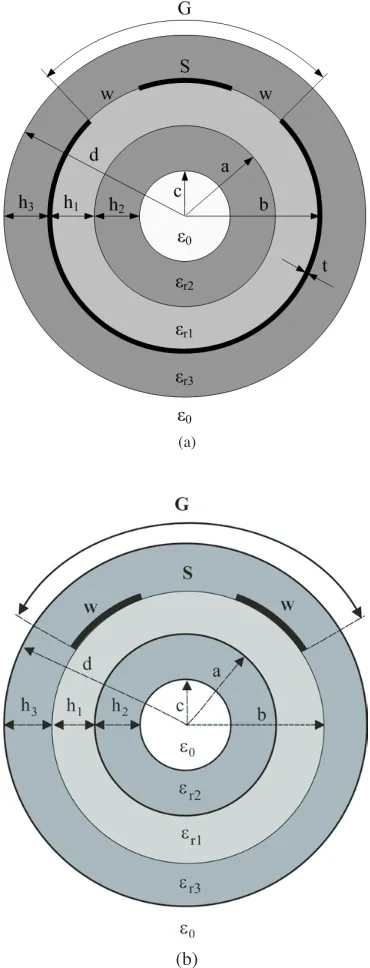
The cross-sections of multilayer CCPW and CCPS to be considered in this work are depicted in Figs. 1(a) and 1(b), respectively. In these figures, S and w represent central strip and slot width for multilayer CCPW and represent slot width and strip width for multilayer CCPS. On the other hand,h1,h2andh3indicate the thickness of the dielectric materials with the relative permittivities εr1,εr2 andεr3 respectively. In quasi-static analysis, all conductor materials are assumed to be perfectly conducting and the thickness of the conductor t is ignored. Using the quasi-static approximations, the effective permittivity εeff and the characteristic impedanceZ0 of the transmission lines are given as;
εeff = C C0
(1)
Z0 = √ε
eff
C·v0 (2)
wherev0is the speed of light in free space,Cis the total capacitance of the transmission line,C0is the air capacitance of the line corresponding with all dielectrics replaced by air. Therefore, one only has to find the air and total capacitances to obtain the quasi-static parameters of the transmission lines.
The total capacitance of multilayer CCPW and CCPS can be expressed as the sum of the air and partial capacitances as follow;
(a)
(b)
Figure 1. Cross sections of multilayer CCPW and CCPS: (a)
After a sequence of conformal mapping transformations, the air and partial capacitances for multilayer CCPW can be determined as described in [6]. Than the effective permittivity and characteristic impedance of multilayer CCPW can be obtained by using the air and total capacitances in Eqs. (1) and (2), respectively as;
εeff = 1 +q1·
εr1−εr2 2 +q2·
εr2−1 2 +q3·
εr3−1
2 (4)
Z0 = 30π √ε
eff ·
K(k0)
K(k0) (5)
where the terms q1,q2 and q3 are called the partial filling factors and they are given as
qi =
K(ki)
K(ki) · K(k0)
K(k0) i= 1,2,3. (6) where K(k) and K(k) are the complete elliptic integrals of the first kind with the modulus of k and complementary modulus k. These modules have been determined in terms of geometrical dimensions of multilayer CCPW in [6] as;
k0= S G
(2πb)2−G2
(2πb)2−S2, k
0 =
1−k2
0 (7)
and
ki =
sinh
π·S
4·b·Hi
sinh
π·G 4·b·Hi
sinh2 π2 2Hi
−sinh2
Gπ 4bHI˙
sinh2 π2 2Hi
−sinh2
Sπ 4bHI˙
,
ki =
1−k2
i, i= 1,2,3 (8)
with
H1 = ln(b/a) (9)
H2 = ln(b/c) (10)
H3 = ln(d/b) (11)
as described in [9], than the effective permittivity and characteristic impedance of multilayer CCPS are obtained by using the air and total capacitances in Eqs. (1) and (2), respectively as
εeff = 1 +
εr1−εr2 2 ·p1+
εr2−1 2 ·p2+
εr3−1
2 ·p3 (12) Z0 =
120π √ε
eff ·
K(k0) K(k0)
(13)
where the filling factorspi are given by
pi =
K(ki) K(ki) ·
K(k0)
K(k0) i= 1,2,3 (14) where K(k) and K(k) are the complete elliptic integrals of the first kind with the modulus of k and complementary modulus k. These modules have been determined in terms of geometrical dimensions of multilayer CCPS in [9] as;
k0 = S
S+ 2w k
0 =
1−k20 (15)
and
ki=
sinh
π·S 4·b·Hi
sinh
π·(S+ 2·w)
4·b·Hi
, ki =
1−k2
i, i= 1,2,3 (16)
whereHi (i= 1,2,3) were described in Eqs. (9)-(11).
Finally, the characteristic parameters of multilayer CCPW and CCPS are achieved in terms of the closed form expressions. These closed-form expressions obtained by CMT consist of complete elliptic integrals, which are difficult to calculate even by computers. For this reason, the approximate formulas were proposed for calculation of elliptic integrals [26].
3. ARTIFICIAL NEURAL NETWORKS (ANNS)
ANN learns relationships among sets of input-output data which are characteristic of the device under consideration. It is a very powerful approach for building complex and nonlinear relationship between a set of input and output data. ANNs are developed from neurophysiology by morphologically and computationally mimicking human brains [12– 14]. Although the precise operation details of ANNs are quite different from those of human brains, they are similar in three aspects: they consist of a very large number of processing elements (the neurons), each neuron connects to a large number of other neurons, and the functionality of networks is determined by modifying the strengths of connections during a learning phase.
The power of neural computations comes from weight connection in a network. Each neuron has weighted inputs, summation function, transfer function, and output. The behavior of a neural network is determined by the transfer functions of its neurons, by the learning rule, and model architecture. The weights are adjustable parameters and, in that sense, a neural network is a parameterized system. The weighted sum of the inputs constitutes the activation of the neurons. The activation signal is passed through a transfer function to produce the output of a neuron. Transfer function introduces non-linearity to the network. During training process, the inter-unit connections are optimized until the error in predictions is minimized and the network reaches the specified level of accuracy. Once the network is trained, new unseen input information is entered to the network to calculate the output for test.
In the course of developing an ANN model, the architecture of the neural network and the learning algorithm are the most important factors. ANNs have many structures and architectures [12– 14]. The class of ANN and/or architecture selected for a particular model implementation depends on the problem to be solved. After several experiments using different architectures coupled with different training algorithms, in this paper, the MLP neural network architecture [12] was used to compute the quasi-TEM parameters of multilayer CCPW and CCPS.
3.1. Multilayered Perceptrons (MLPs)
layer. Each neuron j in the hidden layer sums up its input signals xi
after weighting them with the strengths of the respective connections wji from the input layer and computes its outputyj as a functionf of
the sum, namely;
yj =f
wjixi
(17)
f can be a simple threshold function, a sigmoidal or hyperbolic tangent function. The output of neurons in the output layer is computed similarly.
Training a network consists of adjusting weights of the network by a learning algorithm. The learning algorithm gives the change ∆wji(k)
in the weight of a connection between neuronsiand j at timek. The weights are then updated according to the following formula;
wji(k+ 1) =wji(k) + ∆wji(k+ 1) (18)
MLPs can be trained using many different learning algorithms [12]. In this article, the following four learning algorithms used to train the MLPs were described briefly.
Levenberg-Marquardt (LM): This is a least-squares estima-tion method based on the maximum neighborhood idea [27, 28]. It combines the best features of the Gauss-Newton technique and the steepest-descent method, but avoids many of their limitations. In par-ticular, it generally does not suffer from the problem of slow conver-gence.
BayesianRegulation(BR): The BR algorithm updates the
weight and bias values according to the LM optimization and minimizes a linear combination of squared errors and weights, and then determines the correct combination so as to produce a well generalized network [29]. It takes place within the LM and requires more training and memory than the LM.
Conjugate Gradient of Fletcher-Powell (CGF): This
method updates weights and bias values according to the conjugate gradient with Fletcher-Reeves [30, 31]. Each variable is adjusted to minimize the performance along the search direction. The line search is used to locate the minimum point. The first search direction is the negative of the gradient. In succeeding iterations the search direction is computed from the new gradient and the previous search direction. Fletcher-Reeves version of conjugate gradient uses the norm square of previous gradient and the norm square of the current gradient to calculate the weights and biases.
The update is computed as a function of the gradient. The line search function is used to locate the minimum. The first search direction is the negative of the gradient. In succeeding iterations the search direction is computed according to the gradient.
4. NEURAL MODELS FOR MULTILAYER CCPW AND CCPS
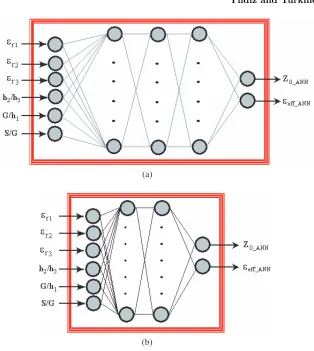
In this paper, two neural models are proposed for calculating the quasi-static parameters of multilayer CCPW and CCPS. For the neural models, the inputs are the relative permittivities of substrate materials εr1, εr2, εr3 and three geometrical dimensions h2/h3, G/h1, S/G, and the outputs are the effective permittivity (εeff) and characteristic impedance (Z0). Neural models used in calculating the effective permittivities and characteristic impedances of multilayer CCPW and CCPS are shown in Figs. 2(a) and 2(b), respectively.
ANN models are a kind of black box models, whose accuracy depends on the data presented to it during training process. A good collection of the training data, i.e., data which is well-distributed, sufficient, and accurately simulated, is the basic requirement to obtain an accurate model. For microwave applications, there are two types of data generators, namely measurement and simulation. The selection of a data generator depends on the application and the availability of the data generator.
The training data sets were obtained from CMT introduced by Alkan et al. [6], and 1296 data sets were used to train the neural model for multilayer CCPW. 576 data sets obtained from [3, 4, 6] were used to test the neural model for multilayer CCPW. The training and test data sets were obtained from CMT proposed by Gorur et al. [9] and 1008 data sets were used to train the neural model for multilayer CCPS. 448 data sets, which are completely different from training data sets, were used to test the neural model for multilayer CCPS. The ranges of the training data sets for both multilayer CCPW and CCPS are among 2 ≤ εr1 ≤ 14, 1 ≤ εr2 = εr3 ≤ 10, 0.1 ≤ S/G ≤ 0.9, 1 ≤ G/h1 ≤ 4, 100µm ≤ h1 ≤ 1500µm, 200µm ≤ h2 ≤ 1400µm, 100µm≤h3 ≤1400µm. The curvature ratio R=b/awas chosen for all structures as 0.8.
(a)
(b)
Figure 2. Neural network architectures for multilayer CCPW and CCPS: (a) neural model for multilayer CCPW; (b) neural model for multilayer CCPS.
Currently, there is no deterministic approach that can optimally determine the number of hidden layers and the number of neurons. A common practice is to take a trial and error approach which adjusts the hidden layers to strike a balance between memorization and generalization. After several trials, it was found in this paper that three hidden layered and two hidden layered networks were achieved the task in high accuracy for multilayer CCPW and CCPS, respectively.
The structures of the presented neural models in this work are given in Figs. 2(a) and 2(b). The most suitable network configuration found was 6×6×10×6×2 for multilayer CCPW. It means that the number of neurons were 6 for the input layer, 6, 10 and 6 for the first, the second and third hidden layers and 2 for the output layer. The tangent sigmoid activation functions were used in the first hidden layer, the sigmoid activation functions were used in the other two hidden layers. The network configuration found was 6×6×18×2 for multilayer CCPS, and the tangent sigmoid and logarithmic sigmoid activation functions were used in the first and second hidden layers, respectively. The linear activation function was used in the input and output layers in the neural models for both multilayer CCPW and CCPS.
5. RESULTS AND CONCLUSIONS
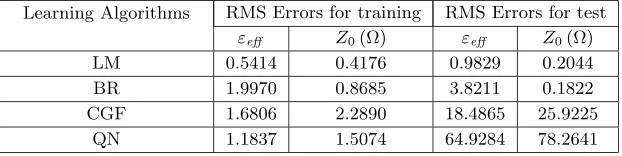
ANNs have been successfully introduced to calculate the quasi-static parameters of multilayer CCPW and CCPS. ANNs were trained with four different —the LM, the BR, the CGF and the QN —learning algorithms to obtain better performances and faster convergence with simpler structure. The performances of learning algorithms are compared with each other and obtained training and test RMS errors are given in Table 1 and Table 2 for both the effective permittivities and characteristic impedances of multilayer CCPW and CCPS, respectively. As it can be seen from these tables the best ANN results were achieved from the models trained with the LM learning algorithms for both multilayer CCPW and CCPS.
In order to show the validation of the presented neural models trained with the LM learning algorithm for the determination of the quasi-static parameters of multilayer CCPW and CCPS, comprehensive comparisons have been made and obtained results are explained briefly in the following paragraphs.
Table 1. Training and test RMS errors of the neural models for multilayer CCPW.
Learning Algorithms RMS Errors for training RMS Errors for test
εeff Z0(Ω) εeff Z0(Ω)
LM 0.1409 0.6283 0.0512 0.1103
BR 2.5326 0.5983 0.5763 0.2428
CGF 14.4429 4.2829 1.1506 7.5709
QN 20.2353 117.4026 1.1086 8.1041
Table 2. Training and test RMS errors of the neural models for multilayer CCPS.
Learning Algorithms RMS Errors for training RMS Errors for test
εeff Z0(Ω) εeff Z0(Ω)
LM 0.5414 0.4176 0.9829 0.2044
BR 1.9970 0.8685 3.8211 0.1822
CGF 1.6806 2.2890 18.4865 25.9225
QN 1.1837 1.5074 64.9284 78.2641
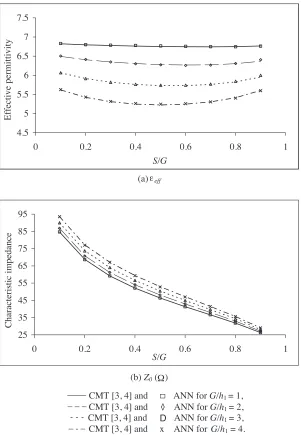
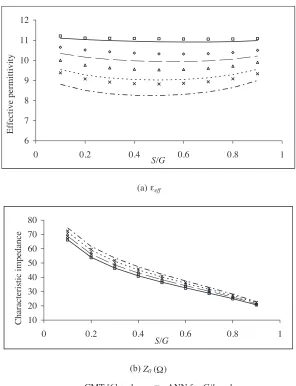
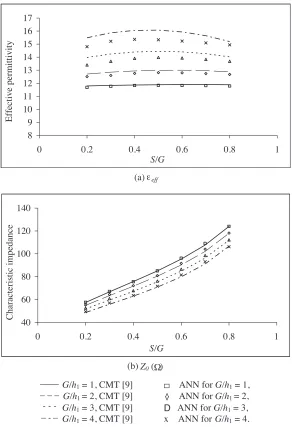
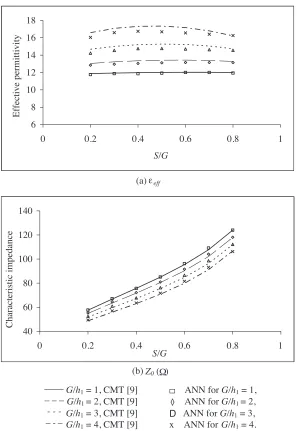
single dielectric layer are given in Figs. 3(a) and 3(b) for four different G/h1 values with respect to the shape ratio S/G, respectively. There is a perfectly good agreement between the results of the CMT [3, 4] and the presented neural model. In order to show the validation of our neural model for multilayer CCPWs having two and three dielectric layers, the obtained ANN results are compared with the quasi-static analysis results [6] for the effective permittivity and characteristic impedance in second and third comparisons. The comparison results for the quasi-static parameters of multilayer CCPW are given in Figs. 4 and 5 for four different G/h1 values with respect to the shape ratio S/G, respectively. These comparison results show that there are very good agreements among the results of the model trained by the LM learning algorithm and the quasi-static analysis [6].
4.5 5 5.5 6 6.5 7 7.5
0 0.2 0.4 0.6 0.8 1
S/G
Effective permittivity
.
(a) eff
25 35 45 55 65 75 85 95
0 0.2 0.4 0.6 0.8 1
S/G
Characteristic impedance
.
(b)Z0( ) ε
Ω
CMT [3, 4] and ANN for G/h1 = 1,
CMT [3, 4] and ANN for G/h1 = 2,
CMT [3, 4] and ANN for G/h1 = 3,
CMT [3, 4] and x ANN for G/h1 = 4.
<
<
D
- - - _ _ _
_ _
6 7 8 9 10 11 12
0 0.2 0.4 0.6 0.8 1
S/G
Ef
f
e
c
tive permittivity
(a)
20 30 40 50 60 70 80 90
0 0.2 0.4 0.6 0.8 1
S/G
Ch
aract
eri
stic impedance
(b) Z0 ( ) eff ε
Ω
CMT [6] and ANN for G/h1 = 1,
CMT [6] and ANN for G/h1 = 2,
CMT [6] and ANN for G/h1 = 3,
CMT [6] and x ANN for G/h1 = 4.
<
<
D
- - - _ _ _
_ _
6 7 8 9 10 11 12
0 0.2 0.4 0.6 0.8 1
S/G
Effec
tive
permittivity
(a)
10 20 30 40 50 60 70 80
0 0.2 0.4 0.6 0.8 1
S/G
Characteristi
c impedance
(b) Z0 ( ) Ω
CMT [6] and ANN for G/h1 = 1, CMT [6] and ANN for G/h1 = 2, CMT [6] and ANN for G/h1 = 3, CMT [6] and x ANN for G/h1 = 4.
<
<
D eff ε
- - - _ _ _
_ _
8 9 10 11 12 13 14 15 16 17
0 0.2 0.4 0.6 0.8 1
S/G
Effective
permittivity
(a)
40 60 80 100 120 140
0 0.2 0.4 0.6 0.8
S/G
Characteristic impedance
.
(b)
G/h1= 1, CMT [9] ANN for G/h1= 1, G/h1 = 2, CMT [9] ANN for G/h1 = 2, G/h1= 3, CMT [9] ANN for G/h1= 3, G/h1= 4, CMT [9] x ANN for G/h1= 4.
1
Z0 ( ) Ω eff ε
<
<
D
- - - _ _ _
_ _
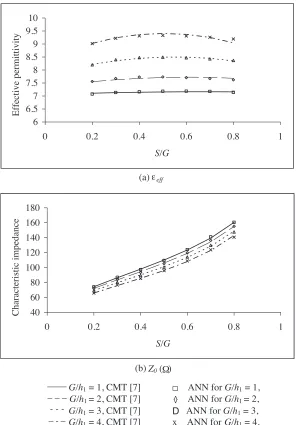
figure illustrates how the effective permittivity and characteristic impedance of multilayer CCPS varies with the shape ratio S/G for different values of G/h1. It is apparent from Fig. 6 that the results of ANN are in very good agreement with the results of CMT [9] for both effective permittivities and characteristic impedances. The second comparison is made for the quasi-static parameters of CCPS with two dielectric layers. The obtained results for the effective permittivities and characteristic impedances of multilayer CCPS are shown in Figs. 7(a) and 7(b), respectively. It can be seen from this figure there is again very good agreement between neural model results trained with LM and CMT [9] results for the quasi-static parameters of CCPS with two dielectric layers. The last comparison is made for the characteristic parameters of CCPS with a single dielectric substrate (εr2 = εr3 = 1). The comparisons for the effective permittivity and characteristic impedance of this structure are shown in Figs. 8(a) and 8(b), respectively. This figure also show that there is very good agreement between the neural results and CMT [7] results for both effective permittivity and characteristic impedances.
All these comparison results obviously show that there are very good agreements among the results of the neural models and the quasi-static analysis available in the literature for multilayer CCPW and CCPS. So the neural models presented in this work are very successful for the determination of the quasi-static parameters of CCPWs and CCPSs with a single dielectric and multilayer dielectrics. This very good agreement also shows that neural models presented in this work are not only valid for multilayer CCPW and CCPS but also a single layered CCPW and CCPS. Moreover, it should be emphasized that the proposed neural model is much simpler and more useful for the designers than the other analyzing methods with a good accuracy.
6 8 10 12 14 16 18
0 0.2 0.4 0.6 0.8 1
S/G
Effec
tive pe
rmittivity
40 60 80 100 120 140
0 0.2 0.4 0.6 0.8
S/G
Characteristic impedance
.
1 (a) εeff
(b)
G/h1= 1, CMT [9] ANN for G/h1= 1, G/h1 = 2, CMT [9] ANN for G/h1 = 2, G/h1= 3, CMT [9] ANN for G/h1= 3, G/h1= 4, CMT [9] x ANN for G/h1= 4.
Z0 ( ) Ω
<
<
D
- - - _ _ _
_ _
6 6.5 7 7.5 8 8.5 9 9.5 10
0 0.2 0.4 0.6 0.8 1
S/G
Effe
ctive pe
rmittiv
ity
40 60 80 100 120 140 160 180
0 0.2 0.4 0.6 0.8 1
S/G
Characteri
stic impedance
(a) εeff
(b)
G/h1= 1, CMT [7] ANN for G/h1= 1, G/h1 = 2, CMT [7] ANN for G/h1 = 2, G/h1= 3, CMT [7] ANN for G/h1= 3, G/h1= 4, CMT [7] x ANN for G/h1= 4.
Z0 ( ) Ω
<
<
D
- - - _ _ _
_ _
REFERENCES
1. Su, H. C. and K. L. Wong, “Dispersion characteristics of coplanar waveguide,” IEEE Transactions on Microwave Theory and Techniques, Vol. 44, 2120–2122, 1996.
2. Dib, N., T. Weller, M. Scardeletti, and M. Imparato, “Analysis of cylindrical transmission lines with finite difference time domain method,” IEEE Transactions on Microwave Theory and Techniques, Vol. 47, 509–512, 1999.
3. Su, H. C. and K. L. Wong, “Quasi-static solutions of cylindrical coplanar waveguides,” Microwave Optical Technology Letters, Vol. 14, 347–351, 1997.
4. Dib, N. and A. Al-Zoubi, “Quasi-static analysis of asymmetric cylindrical coplanar waveguides with finite-extent ground,”
International Jour. Electronics, Vol. 87, 185–198, 2000.
5. Karpuz, C., M. Duyar, and A. Gorur, “Analysis of cylindrical conductor-backed coplanar waveguides,”Microwave Optical Tech-nology Letters, Vol. 27, 144–146, 2000.
6. Alkan, M., A. Gorur, and C. Karpuz, “Quasi-static analysis of cylindrical coplanar waveguide with multilayer dielectrics,”
International Jour. of RFand Microwave CAE, Vol. 8, 303–314, 1998.
7. Karpuz, C., A. Gorur, and M. Alkan, “Quasistatic analysis of cylindrical coplanar strip lines,” Microwave and Optical Technology Letters, Vol. 17, 148–151, 1998.
8. Du, Z., K. Gong, J. S. Fu, Z. Feng, and B. Gao, “CAD models for asymmetrical, elliptical, cylindrical, and elliptical cone coplanar strip lines,” IEEE Trans. Microwave Theory Tech., Vol. 48, 312– 316, 2000.
9. Gorur, A., M. Duyar, and C. Karpuz, “Analytic formulas for calculating the quasistatic parameters of a multilayer cylindrical coplanar strip line,” Microwave and Optical Technology Letters, Vol. 22, 432–436, 1999.
10. Akan, V. and E. Yazgan, “Quasi-static solutions of multilayer elliptical, cylindrical coplanar striplines and multilayer coplanar striplines with finite dielectric dimensions-asymmetrical case,”
IEEE Trans. Microwave Theory Tech., Vol. 53, 3681–3686, 2005. 11. Bedair, S. S. and I. Wolff, “Fast and accurate analytic formulas for
12. Haykin, S., Neural Networks: A Comprehensive Foundation, Macmillan College Publishing Comp., New York, USA, 1994. 13. Christodoulou, C. G. and M. Georgiopoulos,Application of Neural
Networks in Electromagnetics, Artech House, MA, 2001.
14. Zhang, Q. J. and K. C. Gupta, Neural Networks for RFand Microwave Design, Artech House, 2000.
15. Watson, P. M. and K. C. Gupta, “Design and optimization of CPW circuits using EM-ANN models for CPW components,”
IEEE Transaction Microwave Theory Techniques, Vol. 45, 2515– 2523, 1997.
16. Devabhaktuni, V. K., M. C. E. Yagoub, Y. Fang, J. Xu, and Q. J. Zhang, “Neural networks for microwave modeling: model development issues and nonlinear modeling techniques,”
International J. of RFand Microwave CAE, Vol. 11, 4–21, 2001. 17. Yildiz, C., S. Sagiroglu, and M. Turkmen, “Neural model for coplanar waveguide sandwiched between two dielectric substrates,” IEE Proceedings - Microwaves, Antennas and Propagation, Vol. 151, 7–12. 2004.
18. Guney, K., C. Yildiz, S. Kaya, and M. Turkmen, “Artificial neural networks for calculating the characteristic impedance of airsuspended trapezoidal and rectangular-shaped microshield lines,”Journal of Electromagnetic Wave and Applications, Vol. 20, 1161–1174, 2006.
19. Jin, L. C., L. Ruan, and L. Y. Chun, “Design E-plane bandpass filter based on EM-ANN model,” Journal of Electromagnetic Wave and Applications, Vol. 20, 1061–1069, 2006.
20. Mohamed, M. D. A., E. A. Soliman, and M. A. El-Gamal, “Optimization and characterization of electromagnetically coupled patch antennas using RBF neural networks,” Journal of Electromagnetic Wave and Applications, Vol. 20, 1101–1114, 2006. 21. Yildiz, C., K. Guney, M. Turkmen, and S. Kaya, “Neural models for coplanar stripline synthesis,” Progress in Electromagnetics Research, PIER 69, 127–144, 2007.
22. Ganatsos, T., K. Siakavara, and J. N. Sahalos, “Neural network-based design of EBG surfaces for effective polarization diversity of wireless communications antenna systems,”PIERS Online, Vol. 3, 1165–1169, 2007.
24. Kabir, H., Y. Wang, M. Yu, and Q. Zhang, “Applications of artificial neural network techniques in microwave filter modeling, optimization and design,”PIERS Online, Vol. 3, 1131–1135, 2007. 25. Cengiz, Y., F. Gunes, and U. Kilic, “Optimization of a microwave amplifier using neural performance data sheets with a memetic algorithm,”PIERS Proceedings, 227–231, Prague, Czech Repulic, August 27–30, 2007.
26. Hilberg, W., “From approximations to exact relations for characteristics impedances,” IEEE Trans. Microwave Theory Tech., Vol. 17, 259–265, 1969.
27. Levenberg, K., “A method for the solution of certain nonlinear problems in least squares,” Quart. Appl. Math., Vol. 2, 164–168, 1944.
28. Marquardt, D. W., “An algorithm for least-squares estimation of nonlinear parameters,”J. Soc. Ind. Appl. Math., Vol. 11, 431–441, 1963.
29. MacKay, D. J. C., “Bayesian interpolation,”Neural Computation, Vol. 4, 415–447, 1992.
30. Fletcher, R. and C. M. Reeves, “Function minimization by conjugate gradients,”Comput. J., Vol. 7, 149–154, 1964.
31. Scales, E., Introduction to Non-linear Optimization, Springer-Verlag, New York, 1985.