Improved Meet-in-the-Middle Cryptanalysis of KTANTAN
Lei Wei1, Christian Rechberger2, Jian Guo3, Hongjun Wu1, Huaxiong Wang1, and San Ling1
1
Division of Mathematical Sciences, School of Physical and Mathematical Sciences
Nanyang Technological University, Singapore {weil0005,wuhj,hxwang,lingsan}@ntu.edu.sg
2
Katholieke Universiteit Leuven, ESAT/COSIC and IBBT, Belgium
3
Institute for Infocomm Research, A∗STAR, Singapore. [email protected]
Abstract. We revisit meet-in-the-middle attacks on block ciphers and recent developments in meet-in-the-middle preimage attacks on hash functions. Despite the presence of a secret key in the block cipher case, we identify techniques that can also be mounted on block ciphers, thus allowing us to improve the cryptanalysis of the block cipher KTANTAN family. The first and major contribution is that we spot errors in previous cryptanalysis, secondly we improve upon the corrected results. Especially, the technique indirect-partial-matching can be used to increase the number of matched bits significantly, as exemplified by our attacks. To the best of our knowledge, this is the first time that a splice-and-cut meet-in-the-middle attack is applied to block ciphers. When the splitting point is close to the start or the end of the cipher, the attack remains to be at very low data complexity. The secret key of the full cipher can be recovered faster than exhaustive search for all three block sizes in the KTANTAN family. The attack on KTANTAN32 works with a time complexity 272.9
in terms of full round encryptions. The attack has a time complexity of 273.8 and 274.4
on KTANTAN48 and KTANTAN64, respectively. Moreover, all the three attacks work with 4 chosen ciphertexts only. These results compare favourably with the factor 2 speed-up over brute force obtained in earlier work4
, and hence these attacks are the best cryptanalysis results so far.
Keywords: block cipher, hash function, meet-in-the-middle attack, KTANTAN, indirect-partial-matching, splice-and-cut
1 Introduction
Low-end computing devices such as RFID tags are usually characterized by extremely tight cost and power consumption requirements. The needs of cryptography on such devices have been increasing with the growing pervasiveness and mass deployment of these devices. There are sev-eral block cipher primitives proposed in recent years, targeting very small footprint and reduced power consumption, in particular DESL [22], PRESENT [4], HIGHT [19], mCrypton [23], the KATAN/KTANTAN family [7] and PRINTcipher [21] which is proposed as a cryptography
solution for IC-printing.
In this paper, we examine several techniques developed on meet-in-the-middle preimage attacks of hash functions and find that they are still effective when applied to block ciphers. With a circular configuration, we arrive at a more general framework compared to [6]. As an example we apply the attack to the KTANTAN family, the key of the full cipher can be found in time complexity faster than exhaustive search by an order of 27.1, 26.2 and 25.6 for block size 32, 48 and 64. Moreover, these attacks require only 4 chosen ciphertexts.
Organization. In Section 2, we review the results and techniques developed in meet-in-the-middle attacks on both block ciphers and hash functions. In Section 3, we briefly introduce the
4
design of the KTANTAN family. In Section 4, we introduce earlier cryptanalysis in [6] followed by our observations and experiment results. In Section 5 we extend the meet-in-the-middle attack with the hash techniques in Section 2 to achieve the best cryptanalysis results. Section 6 concludes the paper with discussions and possible open problems.
2 Developments in MITM Attacks
Meet-in-the-middle (MITM) is a generic cryptanalytic approach originally developed from crypt-analysis of block ciphers. Early development starts with cryptcrypt-analysis of DES, which dates back to 1977. Similar ideas have been applied to round-reduced variants of AES in last 12 years. More recently, these techniques are found to be quite useful in preimages attacks of hash functions. We will review these results and techniques developed on DES, AES and hash functions in the following Section 2.1, 2.2 and 2.4, respectively.
2.1 Basic MITM Attacks on DES
DES is a block cipher standardized as FIPS 46 in 1976. It has a block size of 64 and key size 56. In an early cryptanalysis by Diffie and Hellman [13] in 1977, a meet-in-the-middle attack was proposed to examine the security of a cascade of the encryption functionEK(·) with two independent 56-bit keys K1 and K2. A ciphertext C is computed as EK2(EK1(P)) from
plaintext P. Given text pair (P, C), an intermediate valueM can be computed as bothEK1(P)
andEK−12(C), with parallel guesses ofK1 andK2. By first storing values ofM computed fromP with all values of K1, computeM′ with guesses ofK2 to find match with the storedM values, the correct (K1, K2) pair certainly gives a match and is expected to be revealed by excluding the false positives with additional text pairs. The attack is able to recover 112-bit key in at most 257 rather than 2113 in number of full DES encryptions.
In practice it is rare that key materials are completely separated into two halves of the cipher, as in the case of doubly cascaded DES. Meet-in-the-middle remains effective even in less desirable scenarios. In 1985, Chaum and Evertse published several meet-in-the-middle attacks against reduced DES [8]. The idea is to find “bits in the middle” that are independent of certain key bits when computed from both ends. For anR-round case with encryption functionEK(·), let the GK(·) be the first S rounds and HK(·) be the rest R−S rounds, we have EK(·) = HK◦GK(·). Given text pair (P, C), we can compute the intermediate values M :=GK(P) and M′ :=HK−1(C) for a key guessK. The attack is effective if there is ˜K(K and for some nonzero maskbsuch that b·GK˜(P) =b·HK−˜1(C) for all (P, C) pairs, where·is the bit-wise logic AND. Thewt(b)-bit match can be used to filter 2−wt(b) ratio of wrong keys during the MITM attack, wt(·) computes the weight of the binary vector b. The attack covers at most 7 rounds (round 2-8) of DES faster than exhaustive search. Further work due to [15] on DES reduced to 4,5,6 rounds has involed novel methods to reduce the time complexity.
2.2 MITM Attacks on AES and Other Block Ciphers
2.3 More Recent MITM Attacks
In [6] the framework is made clearer with different notions as compared with the basic idea in [8]. Some key bits ofK are not used in the firstS1 rounds,i.e.,GK =GK1 withK1 (K being the
key bits essentially used in the first S1 rounds. Similarly,HK =HK2 withK2 (K for the last
S2 rounds. In addition, the matching is done in a separate partial matching phase of the middle R−S1−S2 rounds transformation I(·) from two fully determined states M := GK1(P) and
M′:=H−1(K2),i.e.,EK(·) =HK2◦I◦GK1(·). The formalization allows better understanding
of the attack and may breed powerful extensions. We will discuss the attack details in Section 4, which is the first attack that applies to the full KTANTAN32. Similar MITM attacks have been applied to block ciphers including reduced GOST [26] and XTEA [27] recently.
2.4 Developments of MITM Preimage Attacks on Hash Functions
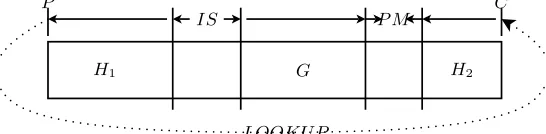
In 2008, Aoki and Sasaki noticed that the MITM attacks could be applied to hash functions, to find (second) preimages faster than brute-force. The attacks have successfully broken the one-wayness of several designs in the MD4 hash family including MD5 [25], round-reduced SHA-0 and SHA-1 [2], round-reduced SHA-2 [1], and also some other Davies-Meyer hash constructions, e.g., Tiger [17], reduced HAS-160 [18] and HAVAL [24]5. Besides the basic techniques, several new techniques have been developed in these hash attacks, namely,splice-and-cut,initial struc-ture(IS),partial-matching (PM), andindirect-partial-matching. We describe them here in detail as in Fig. 1, and later in the paper apply to KTANTAN family to obtain the best cryptanalytic results. A detailed review of MITM preimage attacks on hash functions can also be found in [17].
LOOKU P
P C
IS P M
H1 G H2
Fig. 1.A general setup for MITM attacks
Splice-and-Cut To prevent (second) preimage attacks for narrow-pipe (i.e., the state size equals to digest size) hash designs, feedforward is usually required. Davies-Meyer is among the most popular ways to construct a compression function from a block cipher,i.e.,h′ =Em(h)⊕h, where⊕h is called feedforward andE is a block cipher keyed by message m. In contrast to the MITM attacks against block ciphers,splice-and-cut makes use of the feedforward, and split the block cipherE(·) into three sub-ciphers,e.g.,E(h) =H2◦G◦H1(h). Lethinter =H1(h), we can refine the expression to H2−1(H1−1(hinter)⊕h′) =G(hinter). With the information ofh and h′, one can compute the output h⊕h′ of the block cipher, this is called splice, which connects the input and output of E. The attack starts with the intermediate point hinter of the E, andcut the compression function into two parts:G(·) andH2−1(H1−1(·)⊕h′), then carry out the MITM attacks (note in a preimage attack against hash functions, h′ is given as the target, hence can
be treated as a constant and values ofhinter can be chosen freely). This enables the attacker to choose the splitting point (position of hinter) wherever he wants. Hence it allows to search for globally better set of neutral bits which might lead to a lower attack complexity.
5
In case of block ciphers, such feedforward does not exist. However, one can still build a virtual feedforward by making use of a lookup table between plaintext and ciphertext. Instead of usingH1−1(hinter)⊕h′ as the output ofE, we useLOOKU P(H1−1(hinter)), whereLOOKU P outputs a ciphertext given the plaintext H1−1(hinter) under the correct key. Hence the MITM attack can be carried out from the two sides of the equation H2−1(LOOKU P(H1−1(·))) =G(·). The original MITM attacks can be viewed as a special case in this generalized setting withH1 being the identity, i.e.,H1 covers 0 round withhinter being the plaintext.
The tableLOOKU P can be constructed by computing from a randomly chosenhinter. The set of possible H1−1(hinter) for varying keys are the chosen plaintexts to index the ciphertexts accordingly. The entire codebook is necessary when H1 involves more secret key bits than the block size. If much less entries are used in the table, it can be further compressed to a dense table to reduce memory requirement. The data complexity of the attack is the number of entries in this table. More details are in Section 5.
Initial Structure In a hash attack, one can choose the value of hinter freely. It is noted that, under certain conditions, some neighbouring key bits can be swapped, and yet leave the computation result unchanged. With help of this, some steps near hinter can be skipped as demonstrated in Fig. 1, and smaller size ofK1andK2 can be found for the forward computation GK1 and backward HK2, hence a reduced time complexity is possible.
Partial-Matching LetKc := K1∩K2,i.e., the key bits used in both computing forward for M and backward for M′ from the same hinter. It is noted that it is not necessary to match M and M′ fully at the early stage of the attacks. For 2|K1|−|Kc| candidates of M, and 2|K2|−|Kc|
candidates of M′, it is expected to have 2|K1|+|K2|−2|Kc|−m pairs left if onlym bits are checked
and matched. Then one can further check the candidates left if the rest of bits inM and M′ are also matched. This additional step takes about 2|K1|+|K2|−2|Kc|−m full encryptions. Actually it
is much less due to the fact that the re-check needs only to repeat the portion of PM as shown in Fig. 1. Letα denotes the percentage of steps covered by PM over that of the full cipher. The re-check will not dominate the overall complexity when
(|K1|+|K2| −2|Kc| −m) + log2(α)<max(|K1| − |Kc|,|K2| − |Kc|).
Indirect-Partial-Matching The indirect partial matching is a way to extend the partial matching for more steps. Usually partial matching starts only when key bits in K2\Kc appear after the end of G (otherwise, one can extend G for more steps). Similarly for the other side, i.e., key bits in K1\Kc appear just before H2. If one can find several bits in the IS portion such that it can be expressed as GK1 +φK2 from one direction, and HK2+µK1 from the other
direction. Instead of computing the actual values and doing the match directly, one can compute GK1 −µK1 and HK2−φK2 independently from two directions to check for match. The power
of this technique will be demonstrated in our results in Section 5.
There are more techniques such as partial-fixing, precomputed-initial-structure, probabilistic-partial-matching developed in these hash attacks, however they are not much related to our results.
3 The KTANTAN Family of Block Ciphers
tags hence the cipher is targeting low gate count and reduced power consumption, besides an 80-bit security level supported by a large security margin on differential cryptanalysis, linear cryptanalysis and other attacks.
Both KATAN and KTANTAN have three variants with block sizes of 32-bit, 48-bit and 64-bit and each of them takes 80-bit user key. In addition, KATAN and KTANTAN share the same data path specification, including the round transformation and round constants. The data path is best illustrated with Fig. 2 cited from [7]. The round transformation is repeated for 254 rounds with a sequence of values of IRi fori= 1. . .254.
Fig. 2.Illustration of KATAN/KTANTAN round transformation
The cipher state consists two partsL1 andL2 with different lengths. During the encryption, the plaintext is loaded into the two registers for L1 and L2 in little-endian. In each round of KTANTAN32, L1 and L2 are shifted to the left by 1 position with their least significant bits filled by results offb,r(·) andfa,r(·), respectively.fa,r and fb,rare the only non-linear functions in the round transformation, defined as
fa,r(L1) =L1[x1]⊕L1[x2]⊕(L1[x3]·L1[x4])⊕(L1[x5]·IRr)⊕ka,r (1)
fb,r(L2) =L2[y1]⊕L2[y2]⊕(L2[y3]·L2[y4])⊕(L2[y5]·L2[y6])⊕kb,r (2) where ka,r and kb,r are 2 bits subkey of round r and IRr is the round r constant. For the case of KTANTAN48 and KTANTAN64, the round transformation is repeated 2 and 3 times, respectively. The specification of version specific constants can be found in Table 1 and IR in Table 2.
Table 1.Parameters defined for the KATAN/KTANTAN family of ciphers
Blocksize |L1| |L2| x1 x2 x3 x4 x5 y1 y2 y3 y4 y5 y6
32 13 19 12 7 8 5 3 18 7 12 10 8 3
48 19 29 18 12 15 7 6 28 19 21 13 15 6
64 25 39 24 15 20 11 9 38 25 33 21 14 9
Table 2.Round constant: the irregular update sequence
1111111000 1101010101 1110110011 0010100100 0100011000 1111000010 0001010000 0111110011 1111010100 0101010011 0000110011 1011111011 1010010101 1010011100 1101100010 1110110111 1001011011 0101110010 0100110100 0111000100 1111010000 1110101100 0001011001 0000001101 1100000001 0010
feedback polynomialx8+x7+x5+x3+ 1. With an initial value 0xFF, it is clocked 254 times. In each round the state of the LFSR is used to select two bits fromK.
First divide K into five 16-bit words, let K = w4||w3||w2||w1||w0, where the LSB of w0 is the LSB of K and the MSB ofw4 is the MSB of K. LetT7T6· · ·T1T0 be the state of LFSR at a particular roundr, then let ai= MUX16to1(wi, T7T6T5T4) where MUX16to1 is a multiplexer that outputs the value of a bit inwi with position specified byT7T6T5T4. After that, the subkey bits ka,r and kb,r are selected as
ka,r = ¯T3·T¯2·(a0)⊕(T3∨T2)·MUX4to1(a4a3a2a1, T1T0)
kb,r= ¯T3·T2·(a4)⊕(T3∨T¯2)·MUX4to1(a3a2a1a0,T¯1T¯0)
where MUX4to1 is a multiplexer that selects 1 bit from 4, similar as MUX16to1. In fact, when the LFSR is clocked each round, the MSB is taken to form the irregular update sequence. The reference IR may be useful to verify the implementation of the key schedule. It is noted that the reference implementation has been updated several times, we list the entire key schedule in Appendix A to avoid ambiguity, in accord with implementation [3].
4 The Previous Meet-in-the-Middle Attack
Here we briefly describe the attack in [6]. The attack manages to recover the secret key with very low data complexity, as required by the unicity distance in the known plaintext setting. The attack to KTANTAN32 runs at a time complexity of 279, although arguably marginal, is the first key-recovery attack applicable to the full 254 rounds faster than brute force. For block size b of 48 and 64, the attack manages to break 251 and 248 rounds respectively.
The main idea of this attack is to cut theR-round KTANTAN-b cipher into three parts for someα, β < R,i.e.,the firstα rounds as the forward phase, the lastβ rounds as the backward phase and the middleR−α−β rounds as the partial matching (MITM) phase. Let xi be the state after round i, for 0 ≤ i ≤ 254. Let ϕi,j be the transformation from round i to round j (inclusive) of the R-round KTANTAN-b, under an unknown fixed key K :=k79k78. . . k1k0. It is found that the key bits inA1 :={k15, k79} are neutral to H :=ϕ254−β+1,254 (i.e.,the last β rounds) for 1≤β ≤118, andA2 :={k5, k37, k69} neutral toG:=ϕ1,α (i.e.,the firstα rounds) for 1≤ α ≤105. The rest of the bits A0 := {k0, k1, . . . , k78, k79} \(A1SA2) are used in both the forward and the backward phases. The attack to KTANTAN32 proceeds as described in Section 2 with a text pair (P, C).
For each guess of key bits inA0:
1. For each guess ofA1, computeM :=G(P) =ϕ1,105(P). Then, 3-bit ofx128can be computed from M and used as an index to store value ofA1 in a table.
Key testing: Test whether M′ = ϕ
106,136(M) for K, i.e., current guessed values for bits in A0, A1andA2. IfKpasses, try additional pairs one by one. Continue the search ifK is rejected. If K manages to survive all pairs, we conclude that it is the correct key with probability close to 1.
Data Complexity: Roughly ⌈80/b⌉ text pairs are necessary to identify the correct key for block size b. (i.e.,each pair has a filtering power of 2−b). Each time the key passes the test of one pair, an additional pair is used, until the key is rejected or all text pairs exhausted - we conclude that K is the correct guess.
Time Complexity:The claimed complexity is at around 2|A0|(2|A1|+ 2|A2|)+ 280−3 = 279basic
operations. Considering that a more accurate calculation will better reflect the attack at the marginal value, the number of full block encryptions that the attack works at is
2|A0|
(2|A1|
·α/R+ 2|A2|
·β/R+ 2|A1|+|A2|−m
(R−α−β)/R)= 2. 77.6.
4.1 New Experimental Observations on the Attack
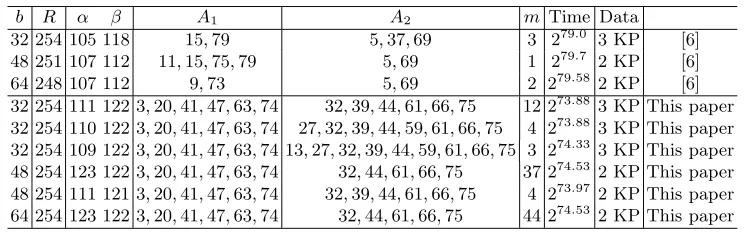
We have implemented the family of KTANTAN and examined the attack by Bogdanov and Rechberger in [6], with respect to both the cipher design paper [7] and its reference imple-mentation [3]. We managed to find different sets of neutral key bits for the KTANTAN key schedule, these neutral key bits lead to the first non-marginal attack of the cipher family for the full rounds of all the three block sizes. The new set of neutral key bits are presented in Table 3. The first example of the comparison to the B-R attack on KTANTAN32 would be that the set of key bits A2 neutral to ϕ1,105 is {13,27,32,39,44,59,61,66,75}, and A1 ={3,20,41,47,63,74} neutral toϕ137,254 while at most 3 bits can be matched in the middle6. We compare the attacks in Table 3.
Table 3.The B-R attack and our results
b R α β A1 A2 m Time Data
32 254 105 118 15,79 5,37,69 3 279.0
3 KP [6] 48 251 107 112 11,15,75,79 5,69 1 279.7
2 KP [6] 64 248 107 112 9,73 5,69 2 279.58
2 KP [6] 32 254 111 122 3,20,41,47,63,74 32,39,44,61,66,75 12 273.88
3 KP This paper 32 254 110 122 3,20,41,47,63,74 27,32,39,44,59,61,66,75 4 273.88
3 KP This paper 32 254 109 122 3,20,41,47,63,74 13,27,32,39,44,59,61,66,75 3 274.33
3 KP This paper 48 254 123 122 3,20,41,47,63,74 32,44,61,66,75 37 274.53
2 KP This paper 48 254 111 121 3,20,41,47,63,74 32,39,44,61,66,75 4 273.97
2 KP This paper 64 254 123 122 3,20,41,47,63,74 32,44,61,66,75 44 274.53
2 KP This paper
For an attack with m-bit matching value and b-bit block size we follow a more detailed calculation of the time complexity in number of full block encryptions (form >|A1|+|A2|the last term can be dropped):
2|A0|
(2|A1|
·α/R+ 2|A2|
·β/R) + 280−m·(R−α−β)/R.
6
4.2 Low Complexity Implementation of the Attack
The attack works at time complexity above 270which is still out of reach for nowadays computing power. Nevertheless, due to the very low data complexity at merely the unicity distance, it is feasible to launch the attack with just a handful of text pairs (e.g., by eavesdropping a small amount of ciphertexts that correspond to known protocol headers). Moreover, in the cases that the secret keys are not derived with full 80-bit entropy, such an attack may become a real threat when time complexity becomes 26 to 27 times less due to the attack of this paper.
We implement such an attack scenario as a cryptanalytic game, one of the authors as the attacker tries recovering the complete secret key when a few plaintexts and their ciphertexts are given by another author, who then verifies whether the attack is successful as only he knows the real key. We assume that the attacker has already gained knowledge of part of the key bits in A0. The attack works on the full 254-round KTANTAN32, with α = 111, β = 122, A1 =
{3,20,41,47,63,74}, A2 ={32,39,44,61,66,75}. By computing forward up to the end of round 126 and backward before round 127, there are 12 bits match. The details of the matching are given in the same notations used in [6].e.g., k1 = 1 means the key bit is active (unknown) and k2 = 0 means the key bit is inactive (known). An 1 in the state means the bit is affected by an active key bit, and 0 means it is not affected (i.e.,this state bit can be fully determined from previous state).
forward part: Neutral bits: 32 39 44 61 66 75
forward R=112: k1=1, k2=1, 0 0 0 0 0 0 0 0 0 0 0 0 1 0 0 0 0 0 0 0 0 0 0 0 0 0 0 0 0 0 0 1 forward R=113: k1=0, k2=0, 0 0 0 0 0 0 0 0 0 0 0 1 0 0 0 0 0 0 0 0 0 0 0 0 0 0 0 0 0 0 1 0 forward R=114: k1=0, k2=0, 0 0 0 0 0 0 0 0 0 0 1 0 0 0 0 0 0 0 0 0 0 0 0 0 0 0 0 0 0 1 0 0 forward R=115: k1=0, k2=0, 0 0 0 0 0 0 0 0 0 1 0 0 0 0 0 0 0 0 0 0 0 0 0 0 0 0 0 0 1 0 0 0 forward R=116: k1=0, k2=0, 0 0 0 0 0 0 0 0 1 0 0 0 1 0 0 0 0 0 0 0 0 0 0 0 0 0 0 1 0 0 0 1 forward R=117: k1=0, k2=0, 0 0 0 0 0 0 0 1 0 0 0 1 0 0 0 0 0 0 0 0 0 0 0 0 0 0 1 0 0 0 1 0 forward R=118: k1=0, k2=0, 0 0 0 0 0 0 1 0 0 0 1 0 0 0 0 0 0 0 0 0 0 0 0 0 0 1 0 0 0 1 0 1 forward R=119: k1=0, k2=0, 0 0 0 0 0 1 0 0 0 1 0 0 0 0 0 0 0 0 0 0 0 0 0 0 1 0 0 0 1 0 1 0 forward R=120: k1=0, k2=0, 0 0 0 0 1 0 0 0 1 0 0 0 1 0 0 0 0 0 0 0 0 0 0 1 0 0 0 1 0 1 0 1 forward R=121: k1=0, k2=0, 0 0 0 1 0 0 0 1 0 0 0 1 1 0 0 0 0 0 0 0 0 0 1 0 0 0 1 0 1 0 1 1 forward R=122: k1=0, k2=0, 0 0 1 0 0 0 1 0 0 0 1 1 1 0 0 0 0 0 0 0 0 1 0 0 0 1 0 1 0 1 1 1 forward R=123: k1=0, k2=0, 0 1 0 0 0 1 0 0 0 1 1 1 1 0 0 0 0 0 0 0 1 0 0 0 1 0 1 0 1 1 1 0 forward R=124: k1=1, k2=0, 1 0 0 0 1 0 0 0 1 1 1 1 1 0 0 0 0 0 0 1 0 0 0 1 0 1 0 1 1 1 0 1 forward R=125: k1=0, k2=0, 0 0 0 1 0 0 0 1 1 1 1 1 1 0 0 0 0 0 1 0 0 0 1 0 1 0 1 1 1 0 1 1 forward R=126: k1=0, k2=0, 0 0 1 0 0 0 1 1 1 1 1 1 1 0 0 0 0 1 0 0 0 1 0 1 0 1 1 1 0 1 1 1
backward part: Neutral bits: 3 20 41 47 63 74
backward R=132: k1=0, k2=1, 0 0 0 0 0 0 0 0 0 0 0 0 0 1 0 0 0 0 0 0 0 0 0 0 0 0 0 0 0 0 0 0 backward R=131: k1=1, k2=1, 1 0 0 0 0 0 0 0 0 0 0 0 0 1 1 0 0 0 0 0 0 0 0 0 0 0 0 0 0 0 0 0 backward R=130: k1=0, k2=0, 0 1 0 0 0 0 0 0 0 0 0 0 0 0 1 1 0 0 0 0 0 0 0 0 0 0 0 0 0 0 0 0 backward R=129: k1=0, k2=0, 0 0 1 0 0 0 0 0 0 0 0 0 0 0 0 1 1 0 0 0 0 0 0 0 0 0 0 0 0 0 0 0 backward R=128: k1=0, k2=0, 0 0 0 1 0 0 0 0 0 0 0 0 0 0 0 0 1 1 0 0 0 0 0 0 0 0 0 0 0 0 0 0 backward R=127: k1=0, k2=0, 1 0 0 0 1 0 0 0 0 0 0 0 0 0 0 0 0 1 1 0 0 0 0 0 0 0 0 0 0 0 0 0
Bit map of 12 matched bits: 1 0 1 0 1 0 1 1 1 1 1 1 1 0 0 0 0 1 1 0 0 1 0 1 0 1 1 1 0 1 1 1
The game works as follows:
1. First, player A chooses an 80-bit secret key and generates 3 text pairs. Then he sends the lower 40 bits of A0 together with the text pairs to Player B. The 80-bit secret key in bit stream order looks as:
where ∗ denotes unknown bit and 0/1 the known bit. The text pairs are (0x1314B499, 0xE995A2BE), (0x39AF5959,0xA7B2C77C), and (0xF5128319,0x1A54138F).
2. Second, player B recovers the bits under ∗ with the following results: A1 : 111110, A2 : 010100 and A0 :1001100111001011011100001000, where each bit from low to high order
corresponds to the masked bits in A1, A2 and A0.
3. Lastly, player A acknowledges that the recovered bits are correct.
Note:The attack in Step 2 successfully recovers the 40-bits in 5 hours 34 seconds on a Quad-core HP xw4600 workstation of 2.40GHz. The implementation makes use of the reference bit-slice code which fits well in this attack as 26instances of partial transformations are required on both the forward and backward phase,i.e.,forϕ1,111andϕ−1331,254 respectively. On each direction, the 64 bit-sliced instances are loaded with 64 guesses ofA1andA2respectively. With 40 bits known, the estimated complexity 274is reduced to around 234full encryptions. The estimation matches the experiment well since the bit-sliced reference implementation encrypts 226 text blocks in roughly 45 seconds on this workstation. As a comparison, recovering 40 bits by exhaustive search will take roughly half a month using the same computational resources.
5 More General MITM Attacks on KTANTAN Family
The attacks described in Section 4 are due to a weakness in the key schedule of the KTANTAN family, especially, the efficiency of the attacks depends crucially on how many neutral key bits can be found on the forward phase and the backward phase. Hence a natural question is, is there an optimal partitioning if we are allowed to relax some requirements? We employ the splice-and-cut technique described in Section 2.4, start by randomly choosing a value for the state at a middle round and compute both forward and backward to check how many bits can be matched by the indirect-partial-matching technique. The core idea of this setup is almost identical with the basic form, i.e., the B-R attack. For m-bit match, under the correct key guess, the match and re-check followed will all pass while for a random wrong guess, the match will hold with probability 2−m,i.e.,a ratio of 2−m of the overall guesses will be filtered in the partial matching phase. This effectively reduces the amount of key testing below brute-force.
5.1 Indirect Partial Matching
We employ this technique due to an important observation on the mixing of key bits. In each round the transformation with fr,a and fr,b are repeated 1, 2 and 3 times for respective block size 32, 48 and 64. For each of the evaluations of (1) and (2), a single round key bit is mixed XOR-linearly into the LSB of L1 or L2, hence affecting the lowest 1 to 3 bits considering the shift(s). In the round that follows, very few bits of the state get involved in the nonlinear terms of (1) and (2) when computing fr,a and fr,b. This means after the round key bits are mixed into the state, they will remain linear for quite a number of rounds. With this observation, the indirect-partial-matching technique is considered to try tracing more state bits during the partial matching. These additional state bits are those affected by active key bits, but just linearly affected.
5.2 Splice-and-Cut
computation, andf0andf1be that of the forward computation. The rounds between (exclusive) b0 andf0 are used for theinitial structure. However in the case of KTANTAN, the search result shows that this technique is not particularly relevant to a better attack, therefore we are setting f0 to b0+ 1 to allow no initial structure. The indirect partial matching is performed between two fully determined statesM :=xf1 (after round f1) and M
′ :=x
b1−1 (before roundb1). The
search is done with the fact in mind, that a huge LOOKU P table may be necessary to splice the two ends of cipher together as described in Section 2.4. Nevertheless, the block sizes of all three versions are less than the key size, in the worst case, the key recovery attack will have to use the entire codebook. Note that the attack is still strictly better than owning the codebook since it is able to recover the secret key.
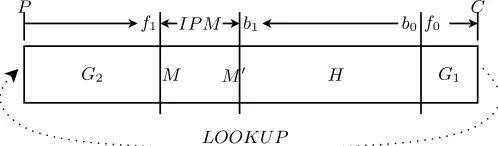
From the search result shown in Table 4, in the optimal partition of KTANTAN32 and KTANTAN64 as well as a near-optimal partition of KTANTAN48, the backward phase and the forward phase are split before round 254. In total only 4 ciphertexts have to be computed from the chosen statex253asϕ254,254(x253) with all possible values of the round keyk71k7. Hence the data complexity is at 4 chosen ciphertexts. For each iteration of the attack, we refer the active entry of the LOOKU P table theactive pair, and other entries in the table asnon-active pairs. During the key testing, besides the reuse of the active pair, one or two additional non-active pairs can be used to reject false positives. In the optimal partition of KTANTAN48 that gives the least time complexity, the entire codebook is necessary since the chosen statex107 is in the middle of the cipher. In Fig. 3 below we illustrate the cases in which the splitting point is at the end of the cipher. With notations of previous sections,G:=ϕ1,f1◦LOOKU P◦ϕf0,254 and
H:=ϕb1,b0.
LOOKU P
P C
f0 b0 b1
IP M f1
H G1
G2 M M′
Fig. 3.Illustration of MITM attack with splice-and-cut
5.3 The Attack with Splice-and-Cut and Indirect-Partial-Matching
The first step is to construct the table LOOKU P as to splice the two ends of cipher. It is done with the chosen ciphertext (C, P) pairs, or the entire codebook. For the attack illustrated by Fig. 3, the splitting point is at the end, we select a random value for xb0 and compute
C := G1(xb0) for all the possible values of key bits involved in G1 := ϕf0,254. For each C
find the corresponding plaintext P and add (C, P) to the table LOOKU P with C as the in-dex and P as the value. If the splitting point is in a middle round and we need the entire codebook, LOOKU P is constructed by adding all the (C, P) pairs when f1 < f0 or all the (P, C) pairs when b0 < b1. We do not discuss this scenario since it is almost identical to the algorithm for the illustrated attack. Following the notations we use A1 for the key bits neu-tral to the backward transformation H−1 :=ϕ−1
b1,b0 and A2 for the key bits neutral to forward
G:=G2◦LOOKU P◦G1=ϕ1,f1 ◦LOOKU P◦ϕf0,254.
Attack Algorithm: For each guess of key bits inA0:
1. For each guess ofA1, compute M :=G(xb0). Then,m-bitpartial matching signature can be
2. For each guess of A2, compute M′ := H−1(xb0). Then compute the same m-bit partial
matching signature fromM′. If the value is the index to some storedA1, do thekey testing.
Indirect Partial Matching: The m-bit partial matching signature are m bits values at the position of the matched bits, computed as described in Section 2.4 on indirect partial match-ing. Searching of such signature requires to find state bits either independent of the active key bits in the IPM phase or dependent but only linearly affected. The technique significantly im-proved the number of bits that can be matched. This allows us to have more rounds for partial matching hence possibly more neutral bits. The detailed matching of the current optimal attack to KTANTAN32 can be found in Appendix B. To compute the matching signature, we take KTANTAN32 for example, the matching point in the optimal attack shown above is after round 115. To simplify the notations, let x := x115 and x[i] be the i-th bit of x, for 0≤i ≤31. For the forward part of the indirect partial matching, it is not hard to find the following key bits appear only as linear terms in corresponding state bits, k27 in x[0],k13 inx[1],k39 inx[3], k59 inx[4] andk39 in x[22]. For the backward part, similarly we have linear terms of k74 in x[26], k74 in x[21], k74 in x[3] and k20 in x[2]. Hence the matching signature is (x[26]−k74, x[22]− k39, x[21]−k74, x[7], x[6], x[5], x[4]−k59, x[3]−k39−k74, x[2]−k20, x[1]−k13, x[0]−k27) which can be computed from both sides without knowing the value for the active key bits from that side.
Key testing: Test whether M′ = ϕ
f1+1,b1−1(M) for K, i.e., current guessed values for bits
inA0, A1 and A2. If K passes, try non-active pairs. Continue the search if K is rejected. If K manages to survive a number of pairs at the unicity distance, we conclude that it is the correct key with probability close to 1.
Table 4 shows the result of search that leads to better complexities.
Table 4.MITM attack with splice-and-cut and indirect-partial-matching techniques
b R b1 b0 f0 f1 A1 A2 m Time Data
32 254 148 253 254 109 13,27,32,39,44,59,61,66,75 3,20,41,47,63,74 11 272.93
4 CC This paper 48 254 246 107 108 208 0,3,32,47,60,63,64 13,27,39,44,59,61 9 273.43
248
KP This paper 48 254 150 253 254 111 32,39,44,61,66,75 3,20,41,47,63,74 15 273.77
4 CC This paper 64 254 151 253 254 112 32,44,61,66,75 3,20,41,47,63,74 54 274.38
4 CC This paper
6 Conclusions
MITM attacks in general on block cipher cryptanalysis if more powerful enhancements can be discovered. More dedicated matching techniques might be possible for particular block ciphers.
References
1. Kazumaro Aoki, Jian Guo, Krystian Matusiewicz, Yu Sasaki, and Lei Wang. Preimages for Step-Reduced SHA-2. In Mitsuru Matsui, editor,ASIACRYPT, volume 5912 ofLNCS, pages 578–597. Springer, 2009. 2. Kazumaro Aoki and Yu Sasaki. Meet-in-the-Middle Preimage Attacks Against Reduced SHA-0 and SHA-1.
In Shai Halevi, editor,CRYPTO, volume 5677 ofLNCS, pages 70–89. Springer, 2009.
3. Jean-Phillipe Aumasson, Miroslav Knezevic, and Orr Dunkelman. Bit-sliced Reference Implementation of KATAN/KTANTAN Family. http://www.cs.technion.ac.il/~orrd/KATAN/katan.c, 2010. Accessed on 6 August 2010.
4. Andrey Bogdanov, Lars R. Knudsen, Gregor Leander, Christof Paar, Axel Poschmann, Matthew J. B. Rob-shaw, Yannick Seurin, and C. Vikkelsoe. PRESENT: An Ultra-Lightweight Block Cipher. In Pascal Paillier and Ingrid Verbauwhede, editors,CHES, volume 4727 ofLNCS, pages 450–466. Springer, 2007.
5. Andrey Bogdanov and Christian Rechberger. A 3-Subset Meet-in-the-Middle Attack: Cryptanalysis of the Lightweight Block Cipher KTANTAN. InSelected Areas in Cryptography, pages 229–240, 2010.
6. Andrey Bogdanov and Christian Rechberger. Generalized Meet-in-the-Middle Attacks: Cryptanalysis of the Lightweight Block Cipher KTANTAN. 2010. In preproceedings of SAC,http://homes.esat.kuleuven.be/ ~abogdano/talks/ktantan_sac10.pdf.
7. Christophe De Canni`ere, Orr Dunkelman, and Miroslav Knezevic. KATAN and KTANTAN - A Family of Small and Efficient Hardware-Oriented Block Ciphers. In Christophe Clavier and Kris Gaj, editors,CHES, volume 5747 ofLNCS, pages 272–288. Springer, 2009.
8. David Chaum and Jan-Hendrik Evertse. Crytanalysis of DES with a Reduced Number of Rounds: Sequences of Linear Factors in Block Ciphers. In Hugh C. Williams, editor, CRYPTO, volume 218 of LNCS, pages 192–211. Springer, 1985.
9. Joan Daemen and Vincent Rijmen. AES Proposal: Rijndael. NIST AES proposal, 1998.
10. H¨useyin Demirci and Ali Aydin Sel¸cuk. A Meet-in-the-Middle Attack on 8-Round AES. In Kaisa Nyberg, editor,FSE, volume 5086 ofLNCS, pages 116–126. Springer, 2008.
11. H¨useyin Demirci, Ali Aydin Sel¸cuk, and Erkan T¨ure. A New Meet-in-the-Middle Attack on the IDEA Block Cipher. In Mitsuru Matsui and Robert J. Zuccherato, editors,Selected Areas in Cryptography, volume 3006 ofLNCS, pages 117–129. Springer, 2003.
12. H¨useyin Demirci, Ihsan Taskin, Mustafa C¸ oban, and Adnan Baysal. Improved Meet-in-the-Middle Attacks on AES. In Bimal K. Roy and Nicolas Sendrier, editors,INDOCRYPT, volume 5922 ofLNCS, pages 144–156. Springer, 2009.
13. W. Diffie and M. E. Hellman. Exhaustive Cryptanalysis of the NBS Data Encryption Standard. Computer, 10(6):74–84, 1977.
14. Orr Dunkelman, Nathan Keller, and Adi Shamir. Improved Single-Key Attacks on 8-round AES. In Masayuki ABE, editor,ASIACRYPT, volume 6477 ofLNCS, Singapore, December 2010. Springer. To appear, available
http://eprint.iacr.org/2010/322.pdf.
15. Orr Dunkelman, Gautham Sekar, and Bart Preneel. Improved Meet-in-the-Middle Attacks on Reduced-Round DES. In K. Srinathan, C. Pandu Rangan, and Moti Yung, editors,INDOCRYPT, volume 4859 of
LNCS, pages 86–100. Springer, 2007.
16. Niels Ferguson, John Kelsey, Stefan Lucks, Bruce Schneier, Michael Stay, David Wagner, and Doug Whiting. Improved Cryptanalysis of Rijndael. In Bruce Schneier, editor,FSE, volume 1978 ofLNCS, pages 213–230. Springer, 2000.
17. Jian Guo, San Ling, Christian Rechberger, and Huaxiong Wang. Advanced Meet-in-the-Middle Preimage Attacks: First Results on Full Tiger, and Improved Results on MD4 and SHA-2. In Masayuki Abe, editor,
ASIACRYPT, volume 6477 ofLNCS, Singapore, December 2010. Springer.
18. Deukjo Hong, Bonwook Koo, and Yu Sasaki. Improved Preimage Attack for 68-Step HAS-160. In Donghoon Lee and Seokhie Hong, editors,ICISC, volume 5984 ofLNCS, pages 332–348. Springer, 2009.
19. Deukjo Hong, Jaechul Sung, Seokhie Hong, Jongin Lim, Sangjin Lee, Bonseok Koo, Changhoon Lee, Donghoon Chang, Jaesang Lee, Kitae Jeong, Hyun Kim, Jongsung Kim, and Seongtaek Chee. HIGHT: A New Block Cipher Suitable for Low-Resource Device. In Louis Goubin and Mitsuru Matsui, editors,
CHES, volume 4249 ofLNCS, pages 46–59. Springer, 2006.
20. Sebastiaan Indesteege, Nathan Keller, Orr Dunkelman, Eli Biham, and Bart Preneel. A Practical Attack on KeeLoq. In Nigel P. Smart, editor,EUROCRYPT, volume 4965 ofLNCS, pages 1–18. Springer, 2008. 21. Lars R. Knudsen, Gregor Leander, Axel Poschmann, and Matthew J. B. Robshaw. Printcipher: A block
cipher for ic-printing. In Stefan Mangard and Fran¸cois-Xavier Standaert, editors, CHES, volume 6225 of
22. Gregor Leander, Christof Paar, Axel Poschmann, and Kai Schramm. New Lightweight DES Variants. In Alex Biryukov, editor,FSE, volume 4593 ofLNCS, pages 196–210. Springer, 2007.
23. Chae Hoon Lim and Tymur Korkishko. mCrypton - A Lightweight Block Cipher for Security of Low-Cost RFID Tags and Sensors. In JooSeok Song, Taekyoung Kwon, and Moti Yung, editors,WISA, volume 3786 ofLNCS, pages 243–258. Springer, 2005.
24. Yu Sasaki and Kazumaro Aoki. Preimage Attacks on 3, 4, and 5-Pass HAVAL. In Josef Pieprzyk, editor,
ASIACRYPT, volume 5350 ofLNCS, pages 253–271. Springer, 2008.
25. Yu Sasaki and Kazumaro Aoki. Finding Preimages in Full MD5 Faster Than Exhaustive Search. In Antoine Joux, editor,EUROCRYPT, volume 5479 of LNCS, pages 134–152. Springer, 2009.
26. Gautham Sekar, Nicky Mouha, and Bart Preneel. Meet-in-the-Middle Attacks on Reduced-Round GOST.
Information Processing Letters. Submitted.
27. Gautham Sekar, Nicky Mouha, Vesselin Velichkov, and Bart Preneel. Meet-in-the-Middle Attacks on Reduced-Round XTEA. In Aggelos Kiayias, editor,CT-RSA, Lecture Notes in Computer Science. Springer, 2011. To appear, availablehttp://www.cosic.esat.kuleuven.be/publications/article-1505.pdf.
Appendix AThe key schedule of the KTANTAN family
rounds (ka,r,kb,r)
1 - 10 63 , 31 31 , 63 31 , 63 15 , 47 14 , 14 60 , 76 40 , 40 49 , 17 35 , 67 54 , 22 11 - 20 45 , 77 58 , 26 37 , 69 74 , 10 69 , 69 74 , 10 53 , 21 43 , 43 71 , 7 63 , 79 21 - 30 30 , 62 45 , 45 11 , 11 54 , 70 28 , 60 41 , 41 3 , 19 38 , 70 60 , 28 25 , 73 31 - 40 34 , 34 5 , 21 26 , 74 20 , 52 9 , 41 2 , 18 20 , 68 24 , 56 1 , 33 2 , 2 41 - 50 52 , 68 24 , 56 17 , 49 3 , 35 6 , 6 76 , 76 72 , 8 49 , 17 19 , 51 23 , 55 51 - 60 15 , 63 14 , 46 12 , 28 24 , 72 16 , 48 1 , 49 2 , 34 4 , 20 40 , 72 48 , 16 61 - 70 17 , 65 18 , 50 5 , 53 10 , 58 4 , 36 8 , 8 64 , 64 64 , 0 65 , 1 51 , 19 71 - 80 23 , 55 47 , 47 15 , 15 78 , 78 76 , 12 73 , 9 67 , 3 55 , 23 47 , 47 63 , 31 81 - 90 47 , 79 62 , 30 29 , 77 26 , 58 5 , 37 10 , 26 36 , 68 56 , 24 33 , 65 50 , 18 91 - 100 21 , 69 42 , 42 5 , 5 58 , 74 20 , 52 25 , 57 3 , 51 6 , 38 12 , 12 56 , 72 101 - 110 16 , 48 33 , 33 3 , 3 70 , 70 60 , 28 41 , 41 67 , 3 71 , 71 78 , 14 77 , 13 111 - 120 59 , 27 39 , 39 79 , 15 79 , 79 62 , 30 45 , 45 59 , 27 23 , 71 46 , 46 13 , 29 121 - 130 42 , 74 52 , 20 41 , 73 66 , 2 53 , 69 42 , 42 53 , 21 27 , 75 38 , 38 13 , 13 131 - 140 74 , 74 52 , 20 25 , 57 35 , 35 7 , 7 62 , 78 44 , 44 73 , 9 51 , 67 22 , 54 141 - 150 29 , 61 11 , 43 6 , 22 44 , 76 72 , 8 65 , 65 50 , 18 37 , 37 75 , 11 55 , 71 151 - 160 46 , 46 77 , 13 75 , 75 70 , 6 61 , 29 27 , 59 39 , 39 15 , 31 46 , 78 76 , 12 161 - 170 57 , 73 34 , 34 69 , 5 59 , 75 38 , 38 61 , 29 43 , 75 70 , 6 77 , 77 58 , 26 171 - 180 21 , 53 43 , 43 7 , 23 30 , 78 44 , 44 9 , 25 18 , 66 36 , 36 9 , 9 50 , 66 181 - 190 36 , 36 57 , 25 19 , 67 22 , 54 13 , 45 10 , 10 68 , 68 56 , 24 17 , 49 19 , 51 191 - 200 7 , 39 14 , 30 28 , 76 40 , 40 1 , 1 66 , 66 68 , 4 57 , 25 35 , 35 55 , 23 201 - 210 31 , 79 30 , 62 13 , 61 10 , 42 4 , 4 72 , 72 48 , 16 33 , 33 51 , 19 39 , 71 211 - 220 78 , 14 61 , 77 26 , 58 21 , 53 11 , 59 6 , 54 12 , 44 8 , 24 32 , 64 64 , 0 221 - 230 49 , 65 18 , 50 37 , 37 11 , 27 22 , 70 28 , 60 9 , 57 2 , 50 4 , 52 8 , 40 231 - 240 0 , 0 48 , 64 32 , 32 65 , 1 67 , 67 54 , 22 29 , 61 27 , 59 7 , 55 14 , 62 241 - 250 12 , 60 8 , 56 0 , 32 0 , 16 16 , 64 32 , 32 1 , 17 34 , 66 68 , 4 73 , 73 251 - 254 66 , 2 69 , 5 75 , 11 71 , 7
Appendix B
Here we show the indirect partial matching of the optimal attack to KTANTAN32. When a state bit is affected by an active key bit, it is denoted + if linearly affected and 1 if nonlinearly affected. In the match, those bits with + can be matched with the indirect matching technique. It can be seen that the indirect matching technique gives 8 more bits match than the original 3 using direct partial matching.
forward R=110: k1=0, k2=1, 0 0 0 0 0 0 0 0 0 0 0 0 + 0 0 0 0 0 0 0 0 0 0 0 0 0 0 0 0 0 0 0 forward R=111: k1=1, k2=1, 0 0 0 0 0 0 0 0 0 0 0 + + 0 0 0 0 0 0 0 0 0 0 0 0 0 0 0 0 0 0 + forward R=112: k1=1, k2=1, 0 0 0 0 0 0 0 0 0 0 + + + 0 0 0 0 0 0 0 0 0 0 0 0 0 0 0 0 0 + + forward R=113: k1=0, k2=0, 0 0 0 0 0 0 0 0 0 + + + 0 0 0 0 0 0 0 0 0 0 0 0 0 0 0 0 0 + + 0 forward R=114: k1=0, k2=0, 0 0 0 0 0 0 0 0 + + + 0 0 0 0 0 0 0 0 0 0 0 0 0 0 0 0 0 + + 0 + forward R=115: k1=0, k2=0, 0 0 0 0 0 0 0 + + + 0 0 1 0 0 0 0 0 0 0 0 0 0 0 0 0 0 + + 0 + +
backward part: 6 Neutral bits: 3 20 41 47 63 74
backward R=147: k1=0, k2=0, 0 0 0 0 0 0 0 0 0 0 0 0 0 0 0 0 0 0 0 0 0 0 0 0 0 0 0 0 0 0 0 0 backward R=146: k1=0, k2=0, 0 0 0 0 0 0 0 0 0 0 0 0 0 0 0 0 0 0 0 0 0 0 0 0 0 0 0 0 0 0 0 0 backward R=145: k1=0, k2=0, 0 0 0 0 0 0 0 0 0 0 0 0 0 0 0 0 0 0 0 0 0 0 0 0 0 0 0 0 0 0 0 0 backward R=144: k1=0, k2=0, 0 0 0 0 0 0 0 0 0 0 0 0 0 0 0 0 0 0 0 0 0 0 0 0 0 0 0 0 0 0 0 0 backward R=143: k1=0, k2=0, 0 0 0 0 0 0 0 0 0 0 0 0 0 0 0 0 0 0 0 0 0 0 0 0 0 0 0 0 0 0 0 0 backward R=142: k1=0, k2=0, 0 0 0 0 0 0 0 0 0 0 0 0 0 0 0 0 0 0 0 0 0 0 0 0 0 0 0 0 0 0 0 0 backward R=141: k1=0, k2=0, 0 0 0 0 0 0 0 0 0 0 0 0 0 0 0 0 0 0 0 0 0 0 0 0 0 0 0 0 0 0 0 0 backward R=140: k1=0, k2=0, 0 0 0 0 0 0 0 0 0 0 0 0 0 0 0 0 0 0 0 0 0 0 0 0 0 0 0 0 0 0 0 0 backward R=139: k1=0, k2=0, 0 0 0 0 0 0 0 0 0 0 0 0 0 0 0 0 0 0 0 0 0 0 0 0 0 0 0 0 0 0 0 0 backward R=138: k1=0, k2=0, 0 0 0 0 0 0 0 0 0 0 0 0 0 0 0 0 0 0 0 0 0 0 0 0 0 0 0 0 0 0 0 0 backward R=137: k1=0, k2=0, 0 0 0 0 0 0 0 0 0 0 0 0 0 0 0 0 0 0 0 0 0 0 0 0 0 0 0 0 0 0 0 0 backward R=136: k1=0, k2=0, 0 0 0 0 0 0 0 0 0 0 0 0 0 0 0 0 0 0 0 0 0 0 0 0 0 0 0 0 0 0 0 0 backward R=135: k1=0, k2=0, 0 0 0 0 0 0 0 0 0 0 0 0 0 0 0 0 0 0 0 0 0 0 0 0 0 0 0 0 0 0 0 0 backward R=134: k1=0, k2=0, 0 0 0 0 0 0 0 0 0 0 0 0 0 0 0 0 0 0 0 0 0 0 0 0 0 0 0 0 0 0 0 0 backward R=133: k1=0, k2=0, 0 0 0 0 0 0 0 0 0 0 0 0 0 0 0 0 0 0 0 0 0 0 0 0 0 0 0 0 0 0 0 0 backward R=132: k1=0, k2=1, 0 0 0 0 0 0 0 0 0 0 0 0 0 + 0 0 0 0 0 0 0 0 0 0 0 0 0 0 0 0 0 0 backward R=131: k1=1, k2=1, + 0 0 0 0 0 0 0 0 0 0 0 0 + + 0 0 0 0 0 0 0 0 0 0 0 0 0 0 0 0 0 backward R=130: k1=0, k2=0, 0 + 0 0 0 0 0 0 0 0 0 0 0 0 + + 0 0 0 0 0 0 0 0 0 0 0 0 0 0 0 0 backward R=129: k1=0, k2=0, 0 0 + 0 0 0 0 0 0 0 0 0 0 0 0 + + 0 0 0 0 0 0 0 0 0 0 0 0 0 0 0 backward R=128: k1=0, k2=0, 0 0 0 + 0 0 0 0 0 0 0 0 0 0 0 0 + + 0 0 0 0 0 0 0 0 0 0 0 0 0 0 backward R=127: k1=0, k2=0, 1 0 0 0 + 0 0 0 0 0 0 0 0 0 0 0 0 + + 0 0 0 0 0 0 0 0 0 0 0 0 0 backward R=126: k1=0, k2=0, + 1 0 0 0 + 0 0 0 0 0 0 0 1 0 0 0 0 + + 0 0 0 0 0 0 0 0 0 0 0 0 backward R=125: k1=0, k2=0, 0 + 1 0 0 0 + 0 0 0 0 0 0 1 1 0 0 0 0 + + 0 0 0 0 0 0 0 0 0 0 0 backward R=124: k1=0, k2=0, 1 0 + 1 0 0 0 + 0 0 0 0 0 1 1 1 0 0 0 0 + + 0 0 0 0 0 0 0 0 0 0 backward R=123: k1=1, k2=0, 1 1 0 + 1 0 0 0 + 0 0 0 0 1 1 1 1 0 0 0 0 + + 0 0 0 0 0 0 0 0 0 backward R=122: k1=0, k2=1, 1 1 1 0 + 1 0 0 0 + 0 0 0 1 1 1 1 1 0 0 0 0 + + 0 0 0 0 0 0 0 0 backward R=121: k1=0, k2=1, + 1 1 1 0 + 1 0 0 0 + 0 0 1 1 1 1 1 1 0 0 0 0 + + 0 0 0 0 0 0 0 backward R=120: k1=0, k2=0, 1 + 1 1 1 0 + 1 0 0 0 + 0 1 1 1 1 1 1 1 0 0 0 0 + + 0 0 0 0 0 0 backward R=119: k1=0, k2=0, 1 1 + 1 1 1 0 + 1 0 0 0 + 1 1 1 1 1 1 1 1 0 0 0 0 + + 0 0 0 0 0 backward R=118: k1=0, k2=0, 1 1 1 + 1 1 1 0 + 1 0 0 0 1 1 1 1 1 1 1 1 1 0 0 0 0 + + 0 0 0 0 backward R=117: k1=0, k2=0, 1 1 1 1 + 1 1 1 0 + 1 0 0 1 1 1 1 1 1 1 1 1 1 0 0 0 0 + + 0 0 0 backward R=116: k1=0, k2=0, 1 1 1 1 1 + 1 1 1 0 + 1 0 1 1 1 1 1 1 1 1 1 1 1 0 0 0 0 + + 0 0