Cryptanalysis of GOST
Nicolas T. CourtoisUniversity College London, Gower Street, London, UK Abstract. GOST 28147-89 is a well-known Russian government encryp-tion standard. Its large key size of 256 bits at a particularly low imple-mentation cost [83] make that it is widely implemented and used [70, 105, 66, 83, 88]. In 2010 GOST was submitted to ISO to become an inter-national standard. GOST was analysed by Schneier, Biham, Biryukov, Dunkelman, Wagner, various Australian, Japanese, and Russian scien-tists, and all researchers seemed to agree that it looks quite secure. Though the internal structure of GOST seems quite weak compared to DES, and in particular the diffusion is not quite as good, it is always stip-ulated that this should be compensated by a large number of 32 rounds cf. [63, 101, 100, 8] and by the additional non-linearity and diffusion pro-vided by modular additions [63, 84]. At Crypto 2008 the hash function based on this cipher was broken. Yet as far as traditional encryption ap-plications with keys generated at random are concerned, until 2011 no cryptographically significant attack on GOST was found.
In this paper we present several new attacks on full 32-rounds GOST. Our methodology is derived from the idea of conditional algebraic attacks on block ciphers [25, 20] which can be defined as attacks in which the prob-lem of key recovery is written as a probprob-lem of solving a large system of algebraic equations, and where the attacker makes some “clever” as-sumptions on the cipher which lead to an important simplification in the algebraic description of the problem, which makes it solvable in practice if the assumptions hold. Our methods work by black box reduction and allow to literally break the cipher apart into smaller pieces and reduce breaking GOST to a low data complexity software/algebraic/MITM at-tack on 8 or less rounds. We obtain some 50 distinct atat-tacks faster than brute force on the full 32-round GOST and we provide five nearly prac-tical attackson two major 128-bit variants of GOST (cf. Table 6). Recent updates:Our latest attacks combine all of [higher-order] trun-cated differentials, complexity reduction, [approximate] fixed points, re-flections, MITM and software/algebraic attacks. Single key attacks are summarized in Table 3 p. 53 and Table 7 p. 153 and the fastest of these is a differential attack in 2179 by Courtois [40, 39]. In the multiple random
key scenario the cost of recovering one full 256-bit GOST key decreases in a spectacular way at the expense of further growing data requirements. In Table 4 page 128 we summarize all our attacks in this space. Our fastest attack achievesa nearly feasible T= 2101(cf. Section 28.6 and [34]).
1
Publication Info and Development History
This paper describes a general methodology for block cipher cryptanalysis through a reduction to a low-data complexity key recovery attack and some 50 different attacks on GOST obtained with this methodology. Most of these attacks were developed in 2010/2011 when an original 28-pages version of this paper with five distinct attacks which break GOST faster than brute force was submitted to Crypto 2011. Just a few days earlier Isobe have made public his first attack on full GOST [74] with time complexity of 2225. Each single attack in our sub-mission was already faster than this attack, and our fastest attack had time complexity of 2216. It also contained several weak-key attacks and a practical attack on one 128-bit key variant. With our complexity reduction methodology we reduce the complexity of GOST to a number of well-defined cryptanalysis questions with less rounds and less data, which can be studied separately. In May 2011 an abridged version of this paper was submitted to Asiacrypt 2011 and it containedtwodistinct attacks with time complexity of 2216. An alternative final step for one of these attacks was presented by Shamir et al at FSE 2012 with complexity of about 2192, see [50]. In the meantime a better single-key attack on GOST was found by Courtois withT = 2179, cf. [39, 40]. Principal single key attacks on GOST are summarized in Table 3 page 53 and Table 7 page 153.
In 2012 there were many major updates of this paper which greatlyreduced
the time or/and data complexity. We have also seen a major paradigm shift in understanding the security of GOST. Ciphers are NOT used with single keys. On the contrary. We have discovered that the multiple key scenario is stronger more practical and much more versatile than the single key scenario. Many of our earlier “weak” key attacks can now be transformed into “real” attacks which are able to recover ordinary GOST encryption keys generated at random. These attacks are very competitive and faster than any other known attack from the pragmatic perspective of the total price paid per each 256-bit key recovered. Our recent attacks combine all of differential, complexity reduction, reflections, fixed points, MITM and software/algebraic approaches. In Section 26 we introduce a new concept of approximate fixed point biclique which is a higher-order differential property and allows to propose new attacks with only about 2101per key for breaking some keys in a population of 256-bit keys generated at random, this at the expense of further growing data requirements (over many keys). The data quantity per key is frequently just 232. All these are not single key attacks yet many are vastly more realistic attacks on GOST than 2192 from [50] and 2179 of [39, 40]. Our best attacks are summarized in Table 4 page 128.
2
Impact and Significance of This Research
This paper has some serious significance both scientific and historical.
It is very rare to see a cipher submitted to ISO being broken during its stan-dardization process, while nobody in the scientific community have expressed a slightest suspicion about its security. Over two decades less than 10 block ciphers were judged “good enough” to become a serious candidate for ISO standardisa-tion, as GOST has become in 2010, cf. [83]. The fact that GOST was believed to be secure until 2011, and now can be broken in so many different ways including several arguably nearly practical attacks is quite remarkable.
Similarly it is safe to say that nobody in the cryptographic community have ever thought that there will ever be an attack following the broad idea of software algebraic attacks [12, 19] which can break a real-life government/military/Internet standard block cipher faster than by brute force. Likewise until recently no-body would consider that low-data complexity attacks on reduced rounds of block ciphers such as in [19, 15, 48] are very important. However our paradigm of “Complexity Reduction” provides us with a large number of ways to reduce the complexity of breaking a cipher precisely to a low-data complexity attack. Some of these exploit already known fixed point, sliding, reflection and involution properties, other are totally new and non-trivial self-similarity attacks. We called it “Algebraic Complexity Reduction” because very few low-data complexity at-tacks are known, and a software “algebraic attack” was the initial motivation to find all these attacks, and remains one of the very few plausible last steps (can also be a meet in the middle attack, see Section 15.1 and [50]). To summarize our work brings powerful and disruptive new techniques in cryptanalysis lead-ing to great many new attacks: new methods to achieve reduction to low-data complexity attacks, and efficient methods to deal with these low-data attacks.
It is also very rare to be able to break a real government standard cipher, used to protect classified and secret information, apparently without any limitations, cf. [65], unlike United States DES which could only be used to protect unclassified information. Though some of our attacks are becoming remotely feasible, it is still too expensive in order to actually be able to decrypt GOST communications in practice. It is however wrong to believe that this is only academic research. It is believed that actual versions of GOST used in practice may have additional properties which could make them much weaker than most versions studied in this paper. Some weaker versions o GOST we can already break and the attacks tend to be practical: for example for Family B of 128-bit GOST keys, given 235 chosen plaintexts, we can recover keys in time 281, see Fact 101 on page 145.
3
Dark Side of Research: Peer Review
A first version of this paper was submitted to Crypto 2011. It was already an original 28-pages pages with five distinct single-key attacks which break GOST faster than brute force and much more.
Being a referee in a scientific conference is a difficult and challenging task. One referee of this paper have written:“The paper is decently written, and the attack is easy to follow. However, there is a big, big, big problem : this attack, which is the main contribution of the paper has already been published at FSE’11 (it was even the best paper), just a few days before the CRYPTO submission deadline”.
There are two major problems with this statement.
First the referee claims that this attack is THE SAME as the Isobe attack from FSE 2011. This is totally incorrect. Moreover the precise attack which referee wrote about was very clearly presented as an example of “bad” attack, something which is maybe not even an attack given its very large memory re-quirements. Interestingly it is not obvious at all to see why an attack such as Isobe attack is interesting and should be published cf. [74]. Arguably only im-proved versions of Isobe attacks with less memory are really interesting, cf. [50]. In comparison our “bad” attack was just a much simpler and faster alter-native in the same category, even though we never tried to promote it, as it is clearly not excessively good compared to just any other of our attacks. Interest-ingly absolutely all the attacks in our submission without exception (including the “bad” attack) were actually both simpler and strictly faster (!) than the Isobe attack published at FSE 2011. Our paper already contained in early 2011 several other non-trivial single-key attacks with various parameters, three weak-key attacks the best of which had time complexity of 2120and a practical attack on one 128-bit key variant with complexity below 270. It has also introduced a highly innovative and powerful methodology for block cipher cryptanalysis which have later produced some 50 distinct attacks on GOST. How can all this be the same as Isobe attack?
Moreover and secondly, how can the referee claim that “the main contri-bution” of this paper is this attack? We are talking about a totally inessential MITM attack in the paper, strictly the worst attack in the paper, which takes a few lines to describe and which does not illustrate the methodology of the paper, on the contrary. Our paper has specifically explained that this attack needs to be discarded due to excessively large memory requirements. In the submitted version we read:“Important: If we consider that [...] the cost of2128 of memory at some moment in the future may be as high as to be equivalent to2256 in com-puting power [...] it is possible to believe that we do not yet have a valid attack on GOST. Happily, we are going now to present a more convincing attack, and later also attacks which are strictly faster attacks and yet with very low storage requirements”. To summarize the referee did not do very good work.
now it containedtwodistinct attacks with time complexity of 2216which again were excessively good for the attacks known at this moment. In this submission the “inessential” attack we moved to the appendix. It was again refereed with extremely little care and one referee have again complained about why the ex-planation of this same “bad” attack was moved Appendix. Moreover he claimed that this attack (which was clearly an accessory result or not a result at all) was “the core of this paper”.
The same referee at Asiacrypt 2011 wrote: “I think that the audiences of Asiacrypt will not feel it is interesting”. This is the biggest insult to cryptogra-phy research we have ever seen. The fact is that half of papers accepted at this Asiacrypt are about things about which nobody ever heard about, not even pro-fessional cryptologists (say JH42, Armadillo,theory, incremental research, etc. ), not to say it would interest anybody in the industry or government circles.
In contrast, we can wonder how many times it ever happened at Asiacrypt that a military-grade cipher, and an official government standard of a major country, used by large banks, implemented in SSL, was broken, while being in the process of being standardized by ISO to become a global industrial stan-dard? This because – on the face value – it clearly appeared to be better and more competitive than any “Western” cipher (on the development of which tens millions of euros were spent?) Impacting potentially all of: national critical in-frastructures, key financial systems and even ordinary computer software. Not many times: it seems that an event as described has very rarely happened in some 20 years of Asiacrypt. Interestingly AES got broken at the same Asiacrypt by an academic attack only very slightly faster than brute force. However this has happened after it was standardized by ISO. GOST was broken at the right moment. It could be worth billions of dollars to fix problems due to GOST.
Moreover while most modern cryptography research is about fiction, GOST has some serious historical significance. It is maybe THE ONLY cipher which would be worth cryptanalysing. Maybe the only cipher on the cryptanalysis of which billions of dollars could be and should be spent. One might suspect that GOST has been used for decades by some if not all of the most dangerous regimes on this planet (Soviet Union, Russia and regimes traditionally supplied by Russia such as Iran, North Korea, Syria, etc). Arguably it would be in the broad public interest to be able to uncover the content of such communications even if this is possible 30 years after the facts.
4
Structure and Organization of This Paper
In Section 5 we describe what was known about GOST until now. In Section 6 we explain brute force attacks on a block cipher with small blocks such as GOST. In later Section 20.3 we comment on the data complexity of the attacks. In Section 7 we work basic low-level algebraic and logical optimizations in view of developing software low-data complexity attacks.
In Section 8 we explain the concept of conditional algebraic attacks on ciphers with guess-then-determine and amplification, and in Section 8.1 we introduce the general concept of Algebraic Complexity Reduction which will be further developed starting just before and in Section 14.
In Section 9 through Section 12 we study various Guess-Then-Algebraic/Software attacks on up to 8 rounds of GOST. which are summarized in Table 1 on page 25. Additional variants are studied in Appendix J.
In Section 13 we go back to study of high-level properties of GOST and de-scribe GOST cipher algebraically as a composition of permutations implied by the key scheduling. At his moment we view GOST as a composition of black boxed with for example 8 rounds each. We discuss the crucial Reflection and In-volution properties inside GOST. In Sections 13.8 through Section 13.7 we relate these properties to well-known historical results on composition of permutations known since the 1930s. We emphasize the fact that these properties allow one to deduce values inside a composition of permutations, which is one of the key guiding principles in this paper. This is what allows black-box reductions where the attacker can obtain a number of Plaintext/Ciphertext pairs for a reduced round cipher. An early historical example of such a reduction from the 1930s is shown in Section 13.8.
Approximate reflections will be later studied in Appendix F and approximate fixed points in Section 26.
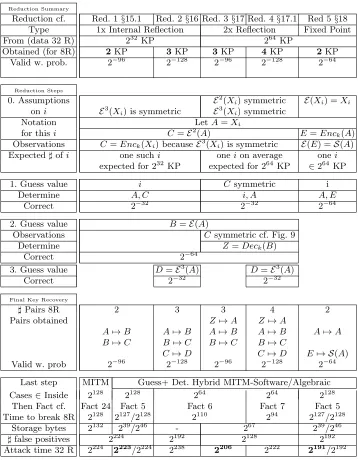
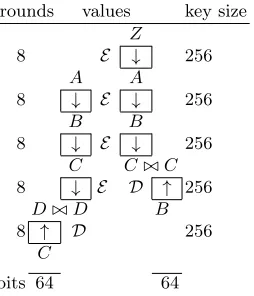
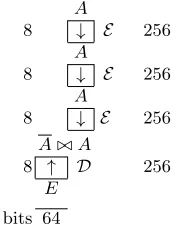
In Section 14 we study the concept of Black Box Algebraic Complexity Re-ductions in detail and summarize all single key reRe-ductions and attacks in this paper.
Most reduction results in this paper are reductions from 32 to 8 rounds of GOST. However in Appendix D we study reductions for 32 to 16 rounds of GOST, in Appendices C, G and H.2 we study self-similarity attacks focusing on a subset of 16 consecutive rounds inside GOST, in Appendix E we study chosen-data reductions, and in Section 30 we study reductions from 32 to 4 rounds for 128-bit GOST variants.
In Sections 15-16 we study single key attacks with 232of data and in Sections 17-18 we study single key attacks with 264 of data. In Appendix A and B we provide additional non-trivial single key attacks. In Section 19 we discuss what makes GOST vulnerable against our attacks and explain what are the ingredients for even more powerful attacks.
further weak key attacks which are particularly efficient or where the weak keys are somewhat “visible” to the attacker from the data. The attacker can detect which keys are weak and break GOST efficiently.
In Section 25 we introduce attacks which mix complexity reduction and dif-ferential cryptanalysis approaches. In Section 26 we introduce a major new con-cept of an approximate fixed point biclique which is a multiple approximate fixed point concept provoked by higher-order differential properties and in Sec-tion 26.3 and in Appendix I we apply it to GOST. In SecSec-tions 27-28 we develop a large number of new attacks. In Section 29 we summarize all our attacks on GOST single key and multiple key attacks.
An alternative point of view on cryptanalysis of GOST which focuses on ob-taining values inside the cipher and encompasses all of our self-similarity attacks such as black-box reductions but also differential cryptanalysis and many other attacks is discussed in Appendix K.
In Section 30 we provide nearly-practical attacks on two well-known 128-bit variants of GOST which results are summarized in Table 6 page 147.
In Section 32 we look at ISO standardization of GOST. In Section 33 we summarize our results and provide some concluding remarks. Single key attacks are summarized in Table 3 page 53 and Table 7 page 153. Selected best attacks with single and multiple keys are summarized in Table 4 page 128.
5
Background
GOST is a block cipher with a simple Feistel structure, 64-bit block size, 256-bit keys and 32 rounds. Each round contains a key addition modulo 232, a set of 8 bijective S-boxes on 4 bits, and a simple rotation by 11 positions. A particu-larity of GOST is that its S-boxes can be secret. One set of S-boxes has been published in 1994 as a part of the Russian standard hash function specification GOST R 34.11-94 [67, 68, 101]. and according to Schneier [101] this set is used by the Central Bank of the Russian Federation. They also appear in more recent RFC4357 [69] as being part of the so called ”id-GostR3411-94-TestParamSet”. A source code was included in [101] however this code specifies apparently a wrong (reversed) ordering of the S-boxes compared to later code contained in Crypto++ library [105] which is also faster and contains a set of test vectors. This precise version of GOST 28147-89 block cipher is the most popular one, and it is commonly called just “the GOST cipher” in the cryptographic literature.
Schneier reports that some Russian system manufacturers would use S-boxes generated at random [101]. Variable S-boxes could however be more costly to implement and also require more effort in key distribution and management. Consequently in practice S-boxes are likely to be fixed. There exists a Russian reference implementation of GOST which is a part of OpenSSL library and contains eight sets of S-boxes [70] which can be used for encryption or for the GOST hash function. Overall, it is because of the small size of the GOST S-boxes (see [16, 19, 25, 12, 13]) that the cipher is vulnerable to “software algebraic attacks” [12, 16, 19, 25, 97, 98, 20, 107, 109]. Therefore our attacks are expected to work with a similar complexity for any choice of S-boxes, see also [42, 44]. In all our attacks we assume however that the S-boxes are known. In 1998 Saarinen proposed a method which allows to efficiently recover secret S-boxes from an encryption chip through a chosen-key attack [99, 57].
It is widely known that the structure of GOST is in itself quite weak, an in particular the diffusion is quite poor, however, this is expected to be compensated by a large number of rounds [101]. Thus, so far there was no significant attack on this algorithm from the point of view of communications confidentiality: an attack which would allow decryption or key recovery in a realistic scenario where GOST is used for encryption with various random keys. In contrast, there are already many many papers on weak keys in GOST [75, 8], attacks for some well-chosen number of rounds [75, 6, 100], attacks with modular additions removed [8], related-key attacks [78, 56, 94], reverse engineering attacks on S-boxes [99, 57], and attacks on the hash function based on this cipher [72, 73, 47, 81]. GOST is also, likely to be very badly broken by side channel attacks [80]. In all these attacks the attacker has much more freedom than we will allow ourselves. In this paper we limit ourselves to the questions which pertain to the security of GOST used in encryption, with keys chosen at random and we look mostly at high-level structural attacks on GOST when it is used in encryption.
and slightly faster. According to Biryukov and Wagner, the structure of GOST, and in particular the reversed order of keys in the last 8 rounds, makes it secure against sliding attacks [58, 7, 8]. However the cipher still has a lot of self-similarity and this exact inversion of keys allows other attacks in which fixed points are combined with a so called “Reflection” property [73, 75]. The latter attack breaks GOST only for certain keys, which are weak keys. For these keys it is possible to break GOST with a complexity of 2192 and with 232 chosen plaintexts.
6
Preliminary Remarks on GOST
In this paper we calla P/C paira pair of knownPlaintext andCiphertext for full GOST, or for a reduced-round version of GOST.
GOST has 64-bit block size and the key size of 256-bit keys. Accordingly:
Fact 1. 4 P/C pairs are necessary to determine the GOST key. With 4 P/C pairs we expect to get on average about one key. We get the correct key together with a list of, sometimes a few, but on average less than 1 wrong keys.
With 5 P/C pairs we are able to discard all these wrong keys in practice: the probability that just one more key works for this extra P/C pair is 2−64. This is unlikely to ever happen in a single key recovery attack.
Fact 2. A brute force attack on GOST takes 2255GOST encryptions on average. Justification: We proceed as follows: we use one P/C pair and check all the possible keys. On average half way through the right key will be found. Only for an expected number of 2191 keys which are confirmed with the first pair, we do further comparisons. Most of these 2191 arefalse positives. This notion plays an important role in this paper. Here, and elsewhere, the key remark is that the total number of these false positives is small and the complexity of rejecting all the incorrect keys with additional P/C pairs is actually negligible. Indeed we have at most 2192cases to be checked with another P/C pair. Then at most 2128 keys remain to be checked against the third P/C pair etc. Overall we need to do about 2255+ 2191+ 2127+ 263+ 1 GOST encryptions on average. This number is very close to 2255GOST encryptions.
Part I
Low-Level Study Of
Individual Components,
Local Optimization and
Early Software/Algebraic
7
Algebraic Cryptanalysis and Low Data Complexity
Attacks on Reduced-Round Block Ciphers
Algebraic attacks, on block and stream ciphers, can be defined as attacks in which the problem of key recovery is written as a problem of solving a large system of Boolean algebraic equations which follows the geometry and struc-ture of a particular cryptographic circuit [12, 13, 16, 19, 107, 109]. The main idea was explicitly proposed by Shannon in 1949, see [102]. For DES the idea was articulated as a method of Formal Coding [71]. The best currently known at-tack on DES can be found in [19]: it allows to break only 6 rounds of DES given only 1 known plaintext. The most efficient attacks nowadays are based on writing ciphers as systems of multivariate polynomial equations and manipulat-ing these equations usmanipulat-ing either algebraic tools (elimination algorithms such as XL, Gr¨obner Bases [53] and ElimLin cf. [25, 26]) or constraint satisfaction soft-ware such as SAT solvers which solve algebraic problems after conversion [17]. Many other methods have been proposed recently [97, 98, 106, 107, 109] and for one problem instance many different attack techniques do usually work to some extent, see [19] and though SAT solvers do frequently solve many practical prob-lems where Gr¨obner bases run out of memory, see [17], it was also shown in [17] that in a few cases where both methods worked, Gr¨obner bases methods were actually faster. We summarize all these methods which use “solver software” to determine unknown variables inside a complex circuit of Boolean equations under the general term of Algebraic Cryptanalysis (AC). This is just a name: not all these attacks are very algebraic (however they have been invented as a result of attempts to break GOST by an algebraic attack and they use algebraic equations in the form of sparse multivariate polynomial equations over small finite fields.)
7.1 Application to GOST
GOST is a Feistel cipher with 32 rounds. In each round we have a round function fki(X) with a 32-bit sub-key ki. Each round function contains a key addition
modulo 232, a set of 8 bijective S-boxes on 4 bits, and a simple rotation by 11 positions. We need to to find a way to represent the cipher as an algebraic system of equations in such a way that it can efficiently be solved. It can be seen as encoding the problem of key recovery as an instance of an NP-hard problem. Both methods for encoding ciphers as such problems, and advanced heuristic algorithms for solving such problems are in constant evolution and are constantly improved. We have developed several efficient methods for formal encoding of GOST block cipher in the spirit of [19] and a lot of complex encoding, conversion and solver software for algebraic cryptanalysis.
Justification: The method is in spirit very similar to the attacks on DES de-scribed in [19]. On method studied in [19] is to encode the S-boxes as an algebraic system of I/O relations (equations which relate Inputs and Outputs of these S-boxes). However, already for DES, the fastest attacks of this type described in [19] use a different method, with some 20 additional variables per S-box, which allow equations to be more compact and more sparse. For GOST S-boxes, im-portant specific optimizations based on the idea of reducing their multiplicative complexity and are described in [46, 81]. In order to encode the addition modulo 232 we follow the first method described in [25]. The concatenation of all these equations describing the whole cipher or a large chunk of it can solved by various conversion and solver software [53, 17, 103, 104].
Remark.As recently as in July 2012, Russian researchers have written that this attack cannot work and is a fiction. This was presented at a major Russian cryptography conference [95] held in English with post-proceedings in prepara-tion. This is a very curious statement. Some or our attacks are highly technical and it is not obvious that they will work. However the attack of Fact 3 above is particularly easy, we have only 4 rounds!
7.2 Attacks on 6 Rounds of GOST
In the similar way, we obtain the following result for 6 rounds which is not needed in our later work but may give the reader an idea of what kind of complexity one may expect for 8 rounds, which will our main concern in Section 9 through Section 11 and at other places.
Fact 4 (Key Recovery for 6 Rounds). Given 3 P/C pairs for 6 rounds of GOST the 192-bit key can be recovered in time equivalent to 256 GOST encryptions on the same software platform.
This attack also works for arbitrary GOST S-boxes.
Justification: This is another experimental attack with guessing of a few bits and the timing is obtained by a computer simulations.
Part II
8
On Conditional Algebraic Attacks on Ciphers
Algebraic attacks allow to break many stream ciphers [16, 13, 14] but for block ciphers they only work for a limited number of rounds [16, 12, 19, 20]. Additional tricks are needed to reduce the complexity of an algebraic attack.
Conditional algebraic attacks, which could also be called Guess-Then-Algebraic attacks, make some, more or less clever assumptions on the internal variables of the cipher of key bits, and determine all the other variables. The goal is to sim-plify the system of equations in such a way that it becomes solvable in practice. There are many methods to achieve that, some work locally, some with larger pieces of the cipher computation circuit, see [25, 20] for some examples.
In many cases, for example for DES [19], it turns out that the best way is to just fix say the first 20 key variables, and determine the other. This is due to the fact that in DES key variables repeat quite uniformly at random inside the algorithm. They repeat many times, and guessing a number of these variables leads to very important simplifications. In contrast other variables do not repeat. in the algebraic description, and in absence of additional properties which could be exploited, there is no particularly clever method to choose variables which would work even comparably as well as guessing these key variables.
In other ciphers, there are other highly non-trivial ways of making assump-tions. In [25] the authors study the concept of (Probabilistic) Conditional De-scribing Degree of addition modulo 2n. The main idea is that certain linear equations can be added as assumptions about the internal state of the cryp-tosystem, and they may produce a larger number of additional linear equations
simultaneously true with high probability. The key question is the question of “gain” oramplification. Which set ofk linear equations can be added to a system of equations in order to generate a extra αk linear equations by some given algebraic elimination algorithm such as ElimLin [25, 26] or a Gr¨obner bases algorithm [53] at a given degree. The question is highly non-trivial and extends to larger subcomponents of the cipher. For example in [25], the authors show a clever method for achieving as much 4nlinear equations from n well-chosen linear assumptions done on the internal state variables for 9 consecutive steps of Snow 2.0. which givesα= 4. This results in an algebraic attack on the keystream generation component of Snow 2.0. and the value ofα= 4 seems very hard to improve.
The attacks we present in this paper inherit the ideas of all the attacks we mention above: they take a quite non-trivial method for algebraic description of S-boxes [19], a particular method for algebraic description of addition modulo 2n [25], and some clever tricks at the high-level description of the cipher as in [58, 7, 8, 6, 57, 20]. Our attacks on GOST bear some resemblance to certain known attacks on KeeLoq: both GOST and KeeLoq are ciphers relatively small block size compared to key size, imperfect periodicity (cf. [7, 8, 6, 20]) and weak internal structure which is expected to be compensated by a larger number of rounds. But it isn’t and we are able to break GOST a lot faster than brute force.
8.1 Reductions and Black-Box Reductions
The main idea is as follows. In order to reduce the attack complexity, we exploit the self-similarity of the cipher (due for example to a weak key schedule) and add some well-chosen assumptions which produce interesting and sometimes quite non-trivial consequences due to the high-level structural properties of the cipher, which makes cryptanalysis problems smaller, simpler and easier to solve. In this process we need to minimise the costs (in terms of probability that our assumptions hold) and to maximise the benefits (in terms of the number and the complexity of interesting relations which hold under these assumptions).
This process is called Algebraic Complexity Reduction. In most cases what we get is to compute (guess or determine) many internal values inside one or several decryptions, and literally break the cipher apart into smaller pieces. The notion of Algebraic Complexity Reduction creates new important optimi-sation problemsin symmetric cryptanalysis: which deals with the fundamental question of how we can reduce the complexity of a cipher in cryptanalysis to a simpler problem, with a limited quantity of data, and with greatly reduced com-plexity, and this in the best possible (optimal) way while many interesting and non-trivial solutions will exist.
One example of a Black-Box Algebraic Complexity Reduction from 264 KP for 32 rounds of GOST, to 4 KP for 8 rounds of GOST, can be found in [27] and a lot more such examples are found in the present paper. An early historical example of an attack from the 1930s which falls exactly within this Black-Box Algebraic Complexity Reduction methodology is discussed in Section 13.8.
8.2 Optimizing The Reductions: Amplification
Reductions can be compared in terms of the number of pairs obtained, the resulting reduced number of rounds, success probability, and in terms of plaintext complexity, see for example Table 3.
A key property of these reductions is the process of so calledAmplification
which is inspired by earlier work such as Section 6.3 of [25].
of keys. Then the attacker can in constant time determine many other internal bits inside the cipher to the total ofY bits.
We are only interested in cases in which the values X and Z are judged realistic for a given attack, for exampleZ <32 andX <128.
We call amplification the ratioA=Y /X.
The amplification is an important question in algebraic cryptanalysis which was previously discussed in [25]. We should note that there are some difficulties in defining this ratio formally:
1. We claim that we need specific definitions for each individual cipher and for each specific attack method. For exampleY can be the total number of linear equations obtained with the ElimLin algorithm [25, 19, 26] after adding a well-chosen set ofX linear equations on the internal bits inside the cipher. 2. Intuitively, the higher, this amplification coefficient A is, while X and Z remain below a certain threshold, the stronger and more surprising is the attack obtained.
3. With higher values of X, the amplification can also be higher, however the attacker must limit the size of X for the whole the attack to remain fast enough overall.
4. It is very difficult to know if an attack with given parameters may exist. In Section 13 we are going to start our study ofhigh-levelamplification: how some relations on larger blocks of GOST can induce some other very interesting relations. Before that, on Section 11.1 and in [35, 32] we study how the best possible amplification attacks can be achieved at the low and medium-level
Part III
Low-Level Attacks On Up
To 8 rounds Of GOST With
Well-Chosen Subsets of Key
9
Best Known Key Recovery Attacks on 8 Rounds of
GOST with I/O Pairs
The key question in this section is given a very small number of I/O pairs for he 8 rounds of GOST, what is the best attack? We (and other researchers) have developed a number of such attacks with 2,3,4,6 and more pairs. We start by describing basic key results which are useful in this paper and only later and in Appendix J we will describe many other attacks of this type with variants and necessary background facts and methodology.
9.1 Key Results on 8 Rounds
In this Section and in Table 1 below we summarize the most important known low-data complexity attacks on 8 rounds of GOST.
Rounds 4 8 8 8 8 8
Key size 128 256
Data 2 KP 2 KP 3 KP 4 KP 6 KP ≈600 KP
See Fact 3 [50] Fact 5 [35] Fact 6 [35] Fact 7 Fact 127 Fact 10 cf. page 13 Fact 15 page 40 page 26 page 26 page 205 page 35
cf. also [95] Fact 16 Fact 13
Memory bytes small 243 246 268 small 269 small small Time 224 2128 2127 2107 2110 294 294 283 250
Table 1.Principal attacks on 8 rounds of GOST with 2,3,4 and more KP We start with 2 pairs.
Fact 5 (Key Recovery for 8 Rounds and 2 KP). Given 2 P/C pairs for 8 rounds of GOST we can enumerate 2128 candidates for the full 256-bit key in total time equivalent to 2127 GOST encryptions on the same software platform and about 246 bytes of memory.
With a similar methodology we will also obtain in Section 12.5 some very good results for 3 KP which case is very important in this paper. We have:
Fact 6 (Key Recovery for 8 Rounds and 3 KP). Given 3 P/C pairs for 8 rounds of GOST we can produce 264 candidates for the 256-bit key in time equivalent to 2110 GOST encryptions. The storage requirements are negligible and all the 264 candidates can be produced in an uniform way, each of them is produced in time of 246 GOST encryptions on average.
Justification: This is obtained by another MITM-Inversion attack, described in Section 12.1. Another attack with 2107GOST encryptions but at the expense of MUCH larger memory of 268 bytes is given in [35]. Finally, we also established that:
Fact 7 (Key Recovery for 8 Rounds and 4 KP). Given 4 P/C pairs for 8 rounds of GOST we can recover the full 256-bit key in time equivalent to 294 GOST encryptions with negligible memory.
Justification: In [35] we describe two attacks with complexity of 294 for 4 KP. One is an excessively technical MITM attack with large memory, another is a super simple software attack with same running time and negligible memory. This attack and additional useful variants of this attack are subsequently studied in Section 12.1 and in Appendix J.
10
Low-Level Structural Properties of GOST
In order to study guess-then-determine attacks, we need to analyse the low-level structural properties of GOST such as how S-boxes in one round influence the S-boxes in another round, and how to predict bits inside the cipher with incomplete information about the key.
10.1 Connections Inside One Round Of GOST
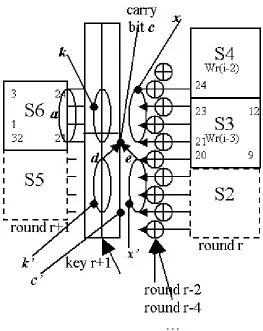
GOST has 32 identical rounds such as the one described in Fig. 1 below. They differ only by the subsets of 32 key bits which they use. GOST is somewhat a structurally weak cipher: only 32 bits, a fairly small proportion, are used in each round.
We number the inputs of the S-box Si fori = 1,2, . . . ,8 by integers from 4i+ 1 to 4i+ 4 out of 1..32 and its outputs are numbered according to their final positions after the rotation by 11 positions: for example the inputs of S6 are 20,21,22,23 and the outputs are 32,1,2,3.
Fig. 1.One Round of GOST And Connections in The Following Round
10.2 Predicting Carry Bits in GOST
In this subsection we show certain basic facts studied in more details in [40] concerning the prediction of carry bits inside GOST which we need in this paper. The key remark is that in many cases the carry bits and output bits in subsequent rounds of GOST can be computed with incomplete knowledge of all the key bits and data bits, on which this bit depends, in this and previous round. In other cases we will simply consider both the case when the carry bit is 0 and when the carry bit is 1.
We have the following basic fact:
Fact 8 (Following [40]). The input a on 4 bits of any particular S-box in GOST (for example the input of S6 in Fig. 2 below) can be computed as:a= x+k+c mod 16 wherekare the 4 key bits at this S-box,cis a single carry bit withc= 1⇔x0+k0+c0 ≥16 wherex0 andk0 are the data and the key at the previous S-box, andc0 is the previous carry bit.
Assume that the attacker knows only the outputs of only the two appropriate S-boxes at the previous roundr, andx0 (4 bits of the state 2 rounds earlier are also needed to obtain x0). Letd, ebe respectively the most significant bits ofk0 andx0. Then we have:
11
Guess-Then-Determine And Software Attacks With
SAT Solvers
Initially we have just used various algebraic and logical software solvers to find low data complexity attacks we needed in order to break full 32-round GOST. However very quickly we realized that the crucial question in this type of at-tacks is a combinatorial optimization question which is also an essential struc-tural cryptographic question. It is about which bits can be guessed and which bits should be determined, or in other words what is the optimal guess-then-determine strategy, and how to implement such a strategy. Our key results are summarized in Table 1 on page 25 and many other results are found in the following sections, in Appendix J and in [35].
11.1 Amplification At The Low Level
Amplification is a key concept in cryptanalysis. The amplification is maybe easier to define when as in many initial steps in many of the attacks on GOST in this paper, we deal with black boxes, cf. Definition 8.2.1 page 20 and we obtain I/O relations for 8 rounds of GOST. In this section we work at the low level, when we look at a complete functional description of a cipher. The concept of amplification is equally important at this scale, though it seems actually trickier to define formally as we will see in this section.
The question is what is the best possible software attack with tools such as the ElimLin algorithm [25, 19, 26] SAT solvers [46, 17], Gr¨obner bases [53] and other [97]. In all these algorithms we observe the phenomenon of Amplification in various forms. For example we can study and count linearly independent linear equations and try to amplify their number by the ElimLin algorithm, see [25, 19, 26]. When the ElimLin algorithm is itself the last step of the attack, or if the SAT solver is the last step of the attack, this amplification phenomenon becomes very important. We observe an avalanche-like phenomenon where more and more new linear equations are generated in the ElimLin algorithm, until the system is solved. Similarly, with SAT solver there is a point of phase transition where the problem becomes really easy to solve.
11.2 SAT Solvers in Cryptanalysis
There are two main approaches in SAT cryptanalysis or two main algorithms to break a cipher with a SAT solver:
1. The SAT Method:Guess X bits and run a SAT solver which, if the as-sumption onXbits is correct takes timeT. Abort all the other computations at timeT. The total time complexity is about 2X·T.
2. The UNSAT Method:Guess X bits and run a SAT solver which, if the assumption onX bits is incorrect finds a contradiction in timeT with large probability 1−P say 99 %.
With a small probability ofP >0, we can guess more key bits and either find additional contradictions or find the solution.
The idea is that ifP is small enough the complexity of these additional steps can be less then the 2X·T spent in the initial UNSAT step.
11.3 Contradiction Immunity and SAT Immunity
If we want to qualify the resistance of a cipher against the two attacks described above, it is natural to define the two following quantities which are introduced in [32]:
Definition 11.3.1 (Contradiction Immunity or UNSAT Immunity cf. [32]). We define the Contradiction Immunity of a given cipher and forM = 1 plaintext/ciphertext pairs of the cipher as being the smallest possible number of key bits which can be fixed so that givenM = 1 KP we can obtain a contradiction with probability at least 50 % by just examining the logical consequences of these key bits. We require this contradiction to be found in a very short time, less than 1 second for the best SAT solver available.
Similarly we define:
Definition 11.3.2 (SAT Immunity or Satisfaction Immunity, cf. [32]).
We define the SAT Immunity of a given cipher and for M plaintext/ciphertext pairs of the cipher as being the smallest possible number of key bits which can be fixed so that givenM KP we can compute the secret key by the best available SAT solver in a relatively short time, say less than 1000 seconds.
Discussion: These notions are as precise as they can be. They depend on software used, but not excessively. Because we can only hope to provide upper bounds for this quantity by concrete “attacks” with concrete software, it makes sense to use (each time) the best available software, and improve these bounds slightly as the software improves. Importantly, we should consider that the first notion is much more robust and more fundamental: it expected to depend only on the connections between the components with the “optimal” subset of key bits, we do not expect that the contradiction will be found be examining too many other bits, but just by simple step-by-step local analysis. We also expect that the time to finding a contradiction will be essentially zero and will not depend too much on the software used. In contrast, the SAT Immunity can only be determined by somewhat “solving” the whole cipher, with the avalanche effect. Unless we are able to determine all the bits in the whole cipher, we do NOT know if the cipher is really solvable. It is safe to say that nobody really understands the complexity of SAT solvers in practice. Our experience shows that the results for the second notion will depend a lot on the SAT solver software used and where some software works well, some other does not seem to work at all(!).
11.4 Main Applications of UNSAT/SAT Immunities
Applications in Cryptanalysis. The main idea is that these two numbers will allow to evaluate the security of the cipher against cryptanalytic attacks with a SAT solver. Upper bounds we obtain do translate, more or less, as we will see, into concrete attacks with complexity of about 2X. The two figures will also indicate which of the three strategies: SAT/UNSAT/Mixed is more likely to work.
For a particularly simple and elegant example of simultaneous application of SAT and UNSAT Immunities in cryptanalysis we refer to Section 11.3.
Applications to Design of Block Ciphers. It is easy to see that the designer of a cipher can very effectively lower-bound these quantities. This will be achieved by making sure that each S-box in each round influences as many S-boxes as possible in the next round. This is not all very different than design-ing a cipher which is provably resistant to linear and differential cryptanalysis. Interestingly, Schneier once claimed that “Against differential and linear crypt-analysis, GOST is probably stronger than DES” [101]. Therefore we should also expect that Contradiction Immunity of DES and GOST are comparable. Hap-pily, similar attacks with SAT solvers have been developed for both DES [19] and GOST [46]. In fact, it is obvious that the diffusion in DES is much better than in GOST and so is the Contradiction Immunity in DES. However we need to be careful about drawing any conclusions and direct comparisons do not mean much. If the contradiction immunity is 78 for 8 out of 32 rounds of GOST with 3 KP and 256-bit keys, is it better or less good, than contradiction immunity being 20 for 6 rounds out of 16 of DES with 1 KP and 56-bit keys? It is very hard to say.
11.5 Application to DES
11.6 Application to GOST
Some basic results on the Contradiction Immunity and SAT Immunity of GOST are given in [32]. These results are constructive upper bounds. We reproduce the basic facts here and include additional facts and analysis.
For a long time we thought that the Contradiction Immunity of 8 rounds of GOST was about 128. The reason for that can be found in Fig. 4 in [40]: it is possible to see that GOST splits very neatly into two nearly independent ciphers with 128-bit key each, which are only loosely connected. With this idea it is easy to understand why a software/algebraic attack on 8 rounds of GOST with complexity of 2120seems plausible and natural. However recently we found that it is much lower than 128, much closer to 64, see [32].
The goal of the attack is to find a set of bits such that if these bits are know, and given 1 pair for 8 rounds of GOST, it is possible to find a contradiction on this set of bits.
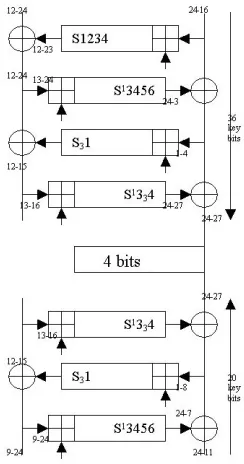
Notation, cf. Fig. 3 and Fig. 4below: We denote by S13 just 1 higher ranking bit at S-box 1 in a given round. Similarly we denote byS33 the 3 lower ranking bits of S3.
With this set we see that there are many incertitudes in computing the middle 4 bits, in many rounds we have at least 1 bit missing to determine the result. Therefore frequently we do not obtain a contradiction. However we are close and we obtain that:
Fact 9. For the set of 56 bits depicted in Fig. 3 a contradiction with 1 KP can be found with probability about 2−4.1 over GOST keys chosen at random. Justification: This was obtained experimentally with CryptoMiniSat. We can also observe that in many cases the contradictions are obtained for specific weaker keys, those which contain some bits at zeros or some bit at one which make the carries generated in modular additions easier to predict and decrease the number of cases in the middle. It is not correct to believe that for any key, by looking at many different encryptions we are bound to find a contradiction with certainty. This would lead to a single key attack on 8 round of GOST with time of essentially 256, as every wrong key could be rejected. Unhappily it is not as simple as that. We can however claim that:
Fact 10. For a proportion of at least about 2−4.0GOST keys chosen at random given about 600 KP for 8 rounds of GOST the full 256-bit key can be determined in time of very roughly about 250 GOST encryptions.
Justification: We sketch the attack. The data complexity is obtain by a calcula-tion of type (1−2−4.1)600≈2−51. Thus we can eliminate most keys on 56 bits in the first step of the attack. Then we need to work with larger sets, and there is little doubt that with such a large quantity of data, most extensions of keys on 56 bits can also be eliminated. This attack requires further research.
11.7 Contradiction Immunity of GOST
We obtain the following result which also appears in [32]:
Fig. 4.Our best set of 78 bits for UNSAT
Fact 11 (Following [32]).The Contradiction Immunity for 8 rounds of GOST is at most 78.
Justification: We have constructed and tried many different sets aiming at a contradiction in the middle. Our best set is as follows (cf. Fig. 4): 0-15,47-58,64-70,111-114,128-130,175-182,192-202,239-255. The contradictions can be found in time of 0.06 s with CryptoMiniSat 2.92 software [104] with probability of about 50 %. It is easy to see that they could be obtained in essentially constant time by a dedicated algorithm with some small precomputed tables.
11.8 SAT Immunity of GOST
Unhappily, it turns out that a set which is good for UNSAT is typically NOT good at SAT. No SAT solver software we dispose of is able to find the missing bits if the 78 bits of Fig. 4 are fixed. Happily we have found sets which are very good at SAT and they are in fact smaller than 78. Our best result is as follows:
Fact 12 (Following [32]). The SAT Immunity for 8 rounds of GOST and 4 KP is at most 68.
Justification: We use the following set of bits depicted in Fig 5 0-15,51-55,64-66,128-130,179-183,192-207,224-231,244-255 which is also used in [35]. All the remaining 256-68 bits can be determined in time of about 400 seconds using GOST encodings described in [46] and with CryptoMiniSat 2.92 [104].
12
New Low-Level MITM-Inversion Attacks on 8 Rounds
In this paper we use many low-data complexity key recovery results for 8 rounds of GOST such as Fact 5. Without such attacks it is not clear at all if GOST can be broken faster than brute force and an overwhelming majority of attacks on GOST relies on these attacks. Interestingly even today some researchers still claim that they do not exist, see [95].Early attacks we have discovered were pure software attacks, and then Dinur Dunkelman and Shamir have proposed an advanced MITM attack at FSE 2012, for the case of 2 KP and 8 rounds [50]. Subsequently we have developed many attacks of this type with 2,3,4 and more KP and for 4,6,8 rounds including some faster alternatives to Dinur-Dunkelman-Shamir attack [50]. Three attacks for 3 and 4 KP are described in [35]. In this paper we describe many more such attacks. Many of these results rely on experimental results with software and best results have been obtained with SAT solver software used at several places inside the attack.
Some of these attacks are quite complex and technical and they mix the idea of [multi-dimensional] Meet-In-The-Middle and software algebraic inversion attacks. Some are particularly simple and easy to understand. In Section 12.1 we are going to present one such result on 4 KP to start with, which illustrates the methodology perfectly take only a few lines to describe, is easy to understand, and can also be seen as a very nice example of application of the notion of SAT and UNSAT Immunities of Section 11.3.
Unhappily all known very efficient attacks on 2 and 3 KP are much more technical. They will be described below. Key results are shown in Table 1, and many additional results are given this section and in Appendix J.
12.1 A Mixed MITM-Algebraic Inversion Attack For 4 KP
For 4 KP our best attack is MUCH simpler and it was already published in [35]. Later in Section J.2 we are going to develop additional important variants of this attack.
12.2 A Mixed Attack with 4 KP from [35]
Fact 13. Given 4 KP for 8 rounds of GOST the full 256-bit key can be found in time of about 294 GOST computations and negligible memory.
Justification: As in [35] we proceed as follows. 1. We use our set of 68 bits as in Fig 5.
2. We run the software 268times for all possible assignments of the 68 bits. 3. Computer simulations with the timeout of 7 seconds, a proportion of 1−2−5
of cases on 68 bits terminates with UNSAT within 2 s on average.
4. Overall, we only need to run a proportion of 2−5 of all the 268 cases for as many as 400 seconds, in other cases it simply terminates automatically within 2 s which is 223GOST encryptions on the same CPU.
12.3 Mixed MITM-Algebraic Inversion Attacks - Basic Fact
These attack was inspired by our previous more or less successful attempts to design an ”algebraic” key recovery attack on 8 rounds of GOST [27, 46] which is needed as a last step for some 40 attacks described in this paper, and by other attacks on GOST in particular various MITM attacks [35, 32, 50]. In [32, 35, 50] we see that there exist interesting sets of bits which allow one to design a ”good” attack of type guess-then-determine: guess certain bits and determine the remaining bits by software. We would like to be able to do something different that a classical MITM attack. We would still guess some bits in the middle, but then instead of using the classical approach with large memory, use a SAT solver to determine the same key bits with negligible memory. What we will show here is in fact a very general approach which can be used to transform many MITM attacks into low-memory versions with a software solver. It is a mixed MITM-Algebraic/Inversion attack in which we will guess data bits and determine key bits, and not vice-versa, like it was in traditional MITM attacks.
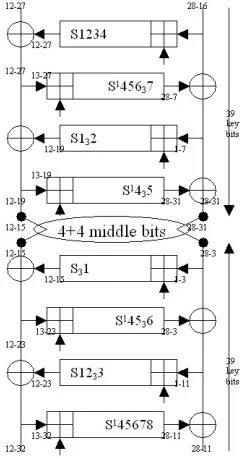
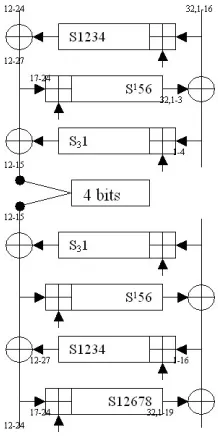
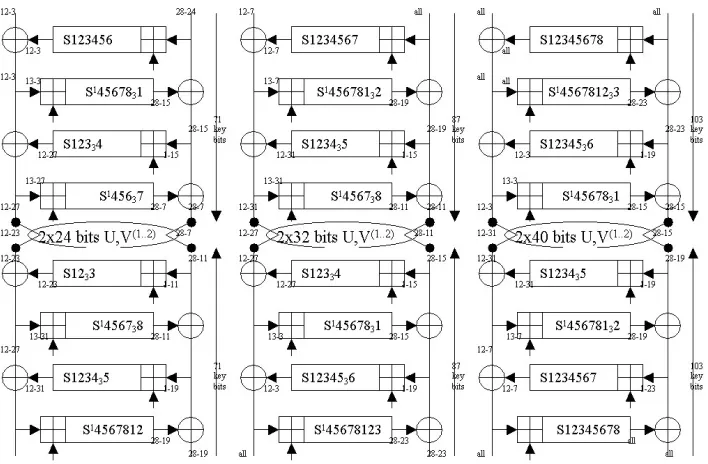
First we establish again a basic preliminary fact about the middle bits. We assume that we know the 71/87/103 key bits in the first 4 rounds (or in the last 4 rounds) as shown in one of the three cases depicted in Fig. 6. We want to be able to compute these 24/32/40 bits or produce a short list of possible values on 24/32/40 bits. Then it is easy to see that:
Fact 14. Given the 71/87/103 key bits in one half of and in any of the three cases depicted in Fig. 6 and the plaintext or ciphertext for one sigle encryption, there are on average about 23.6possibilities to determine the 24/32/40 bitsmiddle bitsU, V, except for the last lower 103 bits where we obtain only 22.3possibilities. Justification: The justification is nearly exactly the same in all the six cases. In roder to understand this attack better we may to look at Fig. 1 on page 27. We will first look at the first case with 71 bits in the upper 4 rounds.
1. In R2 we know all data bits 13-3 but not the bit 4 for S1. Following Fact 8 we will have about 21.3 possibilities for the joint state of S56781 in R2. 2. In R3 we know 15 out of 16 bits for S1234 and there is no carry entering.
This gives only 21possibilities for state of S1234 in R3.
3. In R4 we know the lower 15 out of 16 input bits of S4567 with the higher bit of S7 missing, and want only to determine the state of S567 not of S4, and we know one data bit 12 at S4. We have 21.3possibilities.
4. Similarly in the backwards direction and knowing 71 key bits in the lower 4 rounds we get 20.3+1+1.3+1 possibilities for the same middle U, V.
5. By extending our argument by exactly 1 S-box in each round we obtain the same result for 87 bits.
6. We obtain the same result for 103 bits in the upper half.
12.4 A Mixed MITM-Algebraic Inversion Attack For 2 KP
Now we present a hybrid MITM-Algebraic attack which can be applied poten-tially to 8 rounds of GOST and 2,3,4 and more KP. However for 4 and 5 KP our preliminary results show it is not as good as other attacks known to us. Therefore we will just apply it to 2 and 3 KP. We proceed as follows.
Fact 15. Given 2 KP for 8 rounds of GOST we can enumerate 2128 possible keys on 256 bits in total time of about 2124 GOST computations and with 246 bytes of memory.
In order to check these 2128possible solutions with some data for 32 rounds, and assuming that only one key is correct, we need 2127full GOST encryptions on average.
Fig. 6.Mixed MITM-Algebraic Attacks On 8 Rounds of GOST
Justification:
We proceed as follows:
1. We work with the right pane of Fig. 6 with 103+103 key bits. 2. We have 2·40 = 80 middle bits.
All the steps which follow are executed 280 times which will be taken into account directly in all the figures below.
3. Following Fact 14, given a fixed set of 80 middle bits there are 2103+2·3.6−80= 230.2 possibilities for the 103 key bits in the upper 4 rounds.
5. Now we present a method to recover these key bits without enumerating all the 2103cases, saving both running time and memory. Each half separately. We use the same encoding of GOST as in [46] and a SAT solver [103, 104]. 6. We consider fixing 24 key bits out of 103 which are used in the first two
rounds (cf. right pane of Fig. 6). We use only 16 key bits 0-15 in round 1 and 8 key bits 47-54 in round 2. Then we run a SAT solver to determine the missing 103-24 bits with a time-out of 27 seconds. There may be one, or several solutions (see later), or a contradiction.
This takes 0.05 s on average with CryptoMiniSat 2.92 [104]. This is about 218 GOST encryptions on the same CPU.
7. If the system is UNSAT, it means that the 24 bits can be rejected.
8. It may seems strange that we enumerate 230.2 solutions by examining 224 cases. The explanation is that solutions are NOT random but correlated, they are organized in clusters with several solutions sharing identical 24 bits, and due to limited diffusion and that Fact 8 deal with averages however in practice we have 0, 1 or several cases. For the first 4 rounds of GOST fixing the 80 middle bits for two GOST encryptions will already lead to frequent contradictions on 24 key bits. This happens also at a later stages of this attack: larger subsets of key bits for GOST will be excluded, while the cases which are not excluded will lead to several solutions which need to be enumerated.
9. With 24 bits fixed, our system of equations is SAT with probability exper-imentally only about 2−2.35, which is much lower than expected due to the clustering of solutions highlighted above. If it is SAT we will complete these 24 bits by successively 2, 4, 6, 8, 10, 12, 14 and 16 more bits and run the SAT solver again and output one solution. This is needed to make sure to fragment the space sufficiently and to output all multiple solutions, because our current SAT solver software outputs only one solution.
The time to do this additional enumeration of solutions can be neglected compared to the current step because only with frequency of 2−2.35we have SAT and expect on average not 1 but 330.2−24 ≈ 26.2 solutions. Then we guess additional 2,4,6 and more bits if it is SAT, which will fragment the space of solutions already. Solutions will be still be clustered and most choices examined will be shown contradictory in time in 0.2 s. The average propor-tion of choices which still survive is decreasing quickly. Other choices which give SAT again, will require further fragmentation of the space,
We stop at an arbitrary threshold of 24+16 even if it is SAT. At this stage the probability that a given solution obtained with a SAT solver is still not unique is going to be very small, at most 2−10, and we can afford to ignore some solutions (with probability 1−2−10the whole attack might fail because of cases which were ignored and lost in this enumeration). , which loss can be afforded).
Thus we can enumerate all the 230.2 solutions in total time spent being roughly about 280+24+18= 2122 GOST encryptions.
11. We can further extend each of these cases by further 12 key bits in rounds 234, by extending the set by 1 S-box in each round except in the first round which is completely known now.
Then given 103+12 key bits it is very fast to compute the resulting 16=2·8 new middle bits, and we estimate it requires only about 1/32 = 2−5GOST encryptions and doing it 212 times requires about 2110.2+12−5≈2117GOST encryptions.
12. At this stage we enumerate 2110.2+12= 2122.2 cases with 103+12 key bits in the upper half and 80+16 data bits.
13. In the same way, for the same 80 middle bits, we can enumerate all the 227.6 possibilities for the 103 key bits in the lower 4 rounds which is expected to be even slightly easier, and take less than 2122 GOST encryptions.
14. At this stage we enumerate 280+27.6 = 2107.6 cases with 103 key bits + 80 data bits for the lower half.
15. Again we can also further extend each of these cases by further 12 key bits in rounds 567 and efficiently compute the same 16 additional middle bits, which requires slightly less than 2117GOST encryptions obtained above. 16. At this stage we enumerate 2107.6+12= 2119.6 cases with 103+12 key bits in
the lower half and same 80+16 data bits.
17. These two enumerations require only about 246 bytes of memory to store. In all these cases, 80 middle bits are fixed, and 16 additional data bits are variable. We can assume that the data are sorted or hashed according to the 16 new middle bits.
18. Now for each current set of 80 middle bits, and the sets stored in memory with keys on 115 bits and 16 more middle bits, we are going to fix the 16 middle bits.
This is done 296 times and then due to sorting of our data by the new 16 middle bits, we read the section of 230.6−16= 214.6 cases with keys on 115 bits from the upper list, and a section with 227.6−16= 211.6cases with keys on 115 bits from the lower list.
Thus we can now enumerate 280+16+14.6+11.6 = 2122.2 possible cases with keys on 230 bits and 96 middle data bits.
19. It remains to be seen how can we efficiently extend these to 2128 solutions to 256 bits. This should be very easy because very few bits are missing. We expect that on average there will be 2128−122.2= 25.8ways of extending each solution with 26 additional bits.
In order to see that this is going to be very easy we observe that the unknown 26 key bits are in the middle 4 rounds and only 10 are in rounds 3 and 6, and further 16 are in rounds 4,5. All the other bits inside GOST are known from 230 key bits known in each case. This is like breaking a 26-bit cipher with 3 rounds and can be implemented with precomputed optimizations. Overall we expect that this enumeration requires only about 25.8·2/32 GOST computations. It needs to be done 2122.2 times with an overall cost of about 2122.2+5.8−4= 2124 GOST computations.
data for 32 rounds, and assuming that only one key is correct we will really need about 2127full GOST encryptions on average, and we will be able to output the correct key half way on average.
A similar result with 24times higher running time and 25times less memory is obtained in [50]. In fact our result can very easily be transformed into a slower attack with less memory. For example just be fixing 4 key bits in the first 4 rounds all the way through we can reduce the size of the upper list 24times and make some stages of the attack 24times slower. Therefore we can also achieve a result very close to the result in [50] as well as many other variants.
12.5 A Mixed MITM-Algebraic Inversion Attack For 3 KP
Now for 3 KP we have the following attack:
Fact 16. Given 3 KP for 8 rounds of GOST we can enumerate 264possible keys on 256-bit in total time of about 2110 GOST computations and small memory. Justification:
We proceed as follows:
1. We work with the left pane in Fig. 6 with 71+71 key bits. 2. We have 3·24 = 72 middle bits.
3. Following Fact 14, given a fixed set of 72 middle bits we expect to get 271+3·3.6−72= 29.8 possibilities for 71 bits of the key in the upper 4 rounds. 4. In the same way, for the same 72 middle bits, there is 29.8 possibilities for
the 71 key bits in the lower 4 rounds.
5. We fix 16 key bits out of 71: first 16 bits in the first round. Then we run a SAT solver to determine the missing 71-16 bits. This takes 0.5 s on average with CryptoMiniSat 2.92 [104]. This is about 220GOST encryptions on the same CPU.
6. If the system is UNSAT, it means that the 16 bits can be rejected.
7. Total time spent in this step is about 272+16+20= 2108GOST encryptions. 8. If the system is SAT which happens with probability experimentally about
2−5we extend these 16 bits by up to 12 more bits, one bit at a time, checking for UNSAT, which also takes less 0.5 s in each case, is done for one more bits only for 2−6 of cases, for two more bits only for 2−7 of cases, etc... Overall we expect that the number of cases is divided by two each time and all this enumerates all the solutions for these 16 bits (on average less than one but sometimes a few) in total time of about 272+16−5+20+1 = 2104 GOST encryptions which overall is smaller than the initial step above.
9. In the same way, for the same 72 middle bits, we enumerate all the 29.8 possibilities for the 71 key bits in the lower 4 rounds in the same total time spent of another 2108GOST encryptions.
10. We need a negligible quantity of memory to store these two sets of 29.8 half-keys on 71 bits.
12. The solution is expected to be unique, this is because there are only 264 solutions on 142 bits.
13. If the set of 72 middle bits + 142 key bits is correct, this takes 17 seconds or 226 GOST encryptions with CryptoMiniSat 2.92 [104].
14. If we run this in each case, the total time spent in this last step would be about 272+9.8+9.8+25= 2117 GOST encryptions. However we do NOT need to do it.
15. There are at least 72 middle bits which are fully random inputs, plus the 9.8 bits of entropy in the choice of the other bits in the above procedure. Therefore we estimate that a correct choice of 72+142 bits for which we have to recover the key in 17 seconds as above happens only with probability about 264−72−9.8 ≈ 2−18. Most of the time we expect that the same SAT solver execution as above, will in fact terminate much earlier, within about 0.1 s with UNSAT, which will be an early abort in all but 2−18 of cases.
16. Thus the time spent in the last step of our attack is only about 272+9.8+9.8+18+ 272+9.8+9.8+25−18= 2110 GOST encryptions which dominates the whole at-tack. The storage required is negligible.
Related Research:Another faster attack with only 2107GOST encryptions BUT at the expense of MUCH larger memory of 268 bytes is given in [35].
Research Challenges:One might think that the result could be less than 2110. For example consider the following well chosen set of just 39+39 bits which is obtained using the same pattern as in Fig. 6. The exact bits used are: 0-15,47-58,64-70,111-114,128-130,175-182,192-202,239-255. We can run a SAT solver 278 times for all possible assignments of the 78 bits.
Even for 78 bits, a very substantial proportion of 1−2−3.5 of cases on 78 bits already terminates with UNSAT within 0.3 s on average. Time spent in this step is ONLY about 278+19 ≈297 GOST computations. Then we can fix more bits, a superset of 78 bits, one new bit at a time and continue only if the result is not already shown UNSAT which is expected to happen with a non-negligible probability. At the end we will obtain a system which will be solved with a SAT solver which however will need to run only for a very small proportion of cases not yet filtered out. The only question is purely combinatorial one: what is the best trajectory extending the 78 bits with further bits? We leave it for future research. It is an optimisation problem for our already known attack in 2110 GOST encryptions which could potentially be improved down to maybe even 298GOST encryptions.