Diet Selection by Cattle under High-
Intensity Low-Frequency, Short Duration,
and Merrill Grazing Systems
CHARLES A. TAYLOR, M.M. KOTHMANN, L.B. MERRILL, AND DOAK ELLEDGE
Abstract
A study was conducted to evaluate standing crop of forage and cattle diets for a ‘I-pasture high-intensity low-frequency (HILF) grazing system, and a ‘I-pasture short-duration grazing (SDG) system on the same area. A epasture, 3-herd (Merrill) deferred rotation grazing system was sampled as a standard for comparison. Standing crop of forage was highest for the HILF grazing system compared to the SDG and Merrill grazing systems. The Merrill system with brush control (Pasture 10) had a greater standing crop than the Merrill system without brush control (Pasture 16) or the SDG system. Standing crop in Pasture 16 was comparable to the SDG system. Cattle diets from the HILF system varied signifi- cantly between collections at the beginning and end of each grazing period. A significantly higher percentage of forbs were consumed at the beginning of each grazing period (Period A) compared to the end (Period B). Cattle selected the greatest amounts of pricklypear at the end of each collection period during fall and spring, but not during the winter. Greater amounts of pricklypear were selected when mature grasses and oak and juniper browse were the primary alternatives. Crude protein (CP) levels of diets from the HILF system decreased with shifts in forage selection from Texas winter- grass and forbs (Period A) to pricklypear and dry grass (Period B). Diets from the SDG system were characterized by higher percen- tages of grass and less forbs and pricklypear compared to the HILF grazing system. Also, there were no major shifts in forage selection between collection period A and B for the SDG system. This resulted in a non-significant difference in CP values for diets collected in period A compared to period B. However, a significant decline was recorded for digestibility of diets between the two collection periods. CP and digestibility were higher for diets from the SDG system compared to the HILF grazing system. Botanical composition and diet quality were comparable for the SDG and Merrill grazing systems. Competition between different kinds of animals may be reduced by changing management from a HILF to a SDG system. This would be important where combinations of animals such as cattle, sheep, goats, and deer utilize a common range. Based on diet quality, livestock production from a SDG system should be equivalent to a Merrill system.
Most rangelands on the Edwards Plateau have been grazed yearlong and too intensively for almost 100 years, resulting in a significant decline of their productivity. By using proper kinds of animals, stocking rate, and system of grazing, Merrill (1959) found that declining productivity of these rangelands could be reversed. Acocks (1966) described non-selective grazing as an effective scheme for range improvement but indicated that it might reduce nutrient intake.
At the time of the research authors were research scientist, professor, professor in
charge, and research assistant, Texas Agricultural Experiment Station.
This report is Technical Article No. 15258 from the Texas Agricultural Experiment Station.
C.T. Taylor’s and LB. Merrill’s present address is P.O. Box 918, Sonora, Texas; M.M. Kothmann’s is Dept. of Range Science, Texas A&M Univ., College Station, Texas; and D. Elledge’s is 110 N. Elm, Perryton, Texas.
Manuscript received July 11, 1979.
During the past two decades, new grazing schemes have evolved utilizing several pastures and fewer herds of live- stock (Booysen and Tainton 1978). They described two types of intensive rotational grazing systems. High utiliza- tion grazing is comparable to high-intensity low-frequency (HILF) grazing used in Texas and highperformance grazing is comparable to short duration grazing (SDG). Howell’s (1978) experience with the systems led to a shortening of the grazing and rest periods with subsequent improvement in animal performance. Savory (1979) reported new concepts in ranch fencing designs to facilitate frequent movement of animals under short duration grazing systems.
Corbett (1978) found that steers on a HILF grazing sys- tem needed supplements during the latter part of the grazing periods throughout the year. HILF grazing systems using grazing periods longer than 2 weeks have resulted in reduced animal performance (Robbins 1975; Kothmann et al. 1975). The cause of reduced animal performance must be identified to improve the design of intensive rotational grazing systems.
The objectives of this study were to determine the stand- ing crop of forage in seven pastures grazed first under a HILF system and then under SDG and in two pastures grazed under a 4-pasture, 3-herd (Merrill) deferred rotation system. The botanical and nutrient compositions of diets selected by cattle under these grazing systems were also determined.
Methods and Materials
Botanical and nutritive compositions of cattle diets were deter- mined on the Texas A&M University Agricultural Research Sta- tion at Sonora, Texas. Two studies were conducted, the first during 197 l-72 and the second during 1978-79.
Experiment I
The study site was a 7-pasture, high intensity low-frequency grazing system using cattle, sheep, and goats. All livestock were in one herd and were moved every 3 weeks, giving each pasture 21 days of grazing followed by an 18-week deferment. The stocking rate was equivalent to 4.8 ha/auy (54 animal units per section) yearlong. The stocking ratio was 60% cattle, 20% sheep, and 20% goats.
Standing crop of available forage was determined immediately prior to grazing in each of the seven pastures, using 100 plots measuring 0.3 X 0.6 M (1 X 2 ft) by the method described by Edlefsen et al. (1960). Data were summarized by species and forage classes within pastures. Data were averaged across all seven pas- tures to give mean composition of available forage during the study. Species composition was based on standing crop prior to grazing. These data were not analyzed statistically.
period. Diets collected during period A were representative of light utilization and period B a higher degree of use. Animals were rotated between morning and afternoon collections, but were not used for both on the same day. A subsample was removed from each diet collection and dried at room temperature for determina- tion of botanical and chemical composition.
Diet samples were analyzed microscopically to determine the relative proportion of plant fragments of each species as described by Kothmann (1968). Percent composition of diets based on plant fragment counts was corrected to percent composition by weight. Known weights of single species diet samples were mixed together and analyzed botanically to determine the percent frag- ments of each forage class. The following equations were deve- loped to determine the relative weight of fragments of forbs (X21, browse Xi) and pricklypear (X4’) as compared to grass (Xl’).
Xl = % grass by fragments YI = % grass by weight X2 = % forbs by fragments
X3 = % browse by fragments
Y2 = % forbs by weight Ys = % browse by weight X4 = % pricklypear by fragmentsY4 = 9% pricklypear by weight
xi= 1 xz’ = YPXlXl x; =YBXIXi xi Y4XlXi
x2 (I-Y2) X3( 1 -Y3) X4( 1 -Y4)
The relative weight per plant fragment of each forage class based on grass as equal to one Xi = 1, Xi = 3.15, Xi = 2.62, and Xl = 19.24.
Once relative weight had been determined for all forage classes, the following formula was used to correct the species composition from percent fragments to percent by weight(Y). Computations of actual percent by weight are made by the appropriate adjustment of the numerator (XX’) over the common denominator.
Y1 = x1x
XIX1 + x2xi + x3x3) + x4x4
Preference ratings for forage classes were developed as described by Durham and Kothmann (1977). Mean forage standing crop was used with the mean diet composition to calculate a preference value for collection periods A and B in each season. A preference rating of i- 10 indicates the highest possible preference while a -10 indi- cates it was not consumed and 0 represents selection in proportion to availability.
Diet samples were analyzed for crude protein (CP) and total dry ash by procedures given in A.O. A.C. (1960). In vitro digestible organic matter (IVDOM) was determined using the procedure of Tilly and Terry (1963), and cell walls were determined by the procedure of Van Soest and Wine (1967).
Experiment II
The chemical and botanical composition of diets selected by cattle were compared under SDG and Merrill systems. The SDG system consisted of the same seven pastures used for the HILF grazing system in Experiment I. The grazing period was 7 days per pasture except during August 1978 when it was 3 days. The Merrill system consists of four pastures with three herds rotated to provide 12 months grazing followed by 4 months rest for each pasture. Two pastures grazed with the Merrill system were used in this study. Pasture 10, of one Merrill system, had been rootplowed and seeded in 1969 and was stocked at 60 animal units per section while pasture 16 from another Merrill system had no brush control and was stocked at 36 animal units per section. The short duration system was stocked at 50 animal units per section. Both the Merrill and SDG systems had a 45:27.5:27.5 animal unit ratio of cattle, sheep and goats, respectively.
Herbaceous standing crop estimates were made prior to collec- tion of diet samples by hand-clipping 30 randomly selected plots (0.25 m2) per pasture. The samples were separated into grass and forb, dried at 60°C, and weighed. Standing crop was estimated
prior to moving the animals into a pasture. All clipped forage samples from summer and fall of 1978 were lost in a fire at the Texas A&M University Range Science Field Laboratory.
In addition to the clipped plot technique, a two-stage technique was used during the summer of 1979 to estimate total above- ground standing crop by species. Species composition of the stand- ing crop was determined by a technique similar to that described by Edlefsen et al. (1960) as modified by Anderson (1977). Confidence intervals were calculated for each forage category at the .05 proba- bility level.
Six esophageally fistulated steers were used to collect diet sam- ples. Diet collections in the SDG system were made for the first 2 days a new pasture was grazed and the last 2 days prior to leaving the pasture. When the grazing periods on the short duration system were 3 days, collections were made for 1 day at entering and 1 day at leaving the pasture. Collections were made in the Merrill system on dates corresponding with collections in the SDG system.
With the exception of lyophilizing the diet samples in Experi- ment II, the same procedures were used in diet collection and sample analysis (chemical and botanical) as were used in Experi- ment I.
Results and Discussion
Experiment I
Available Forage
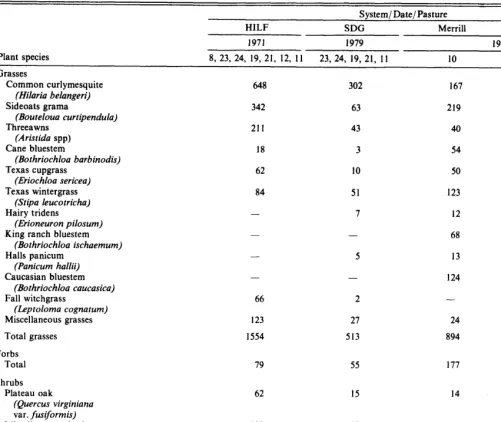
Grasses were the most abundant component of standing crop (Table 1). Grass availability varied among pastures from 1,213 kg/ ha to 2,286 kg/ ha; however, there were con- sistently more grasses than forbs or browse available. Com- mon curlymesquite (Hilaria belangeri) was the dominant grass species in five pastures, while sideoats grama (Boute- Zoua curtipendula) was the dominant grass in two pastures. Threeawns (Aristida spp.) were the third most abundant grasses. Texas wintergrass (Stipa leucotricha) and rescue- grass (Bromus unioloides) were the only cool season grasses recorded.
Total forb availability remained relatively constant across pastures although differences occurred in availability of individual species. Texas bluebonnet (Lupinus texensis) occurred in only two pastures and contributed 21 and 29 kg/ ha. Likewise common horehound (Marrubium vulgare) was available in measurable quantities in only two pastures furnishing 2 and 12 kg/ha. Winter forb production is dependent upon autumn and winter precipitation. Late summer and early fall rainfall was above average, but winter rainfall was below average during this study.
Plateau oak (Quercus virginiana var. fusiformis), Vasey shin oak (Quercus pungens var. vaseyana) and juniper (Juniperus spp) were the most abundant woody species (Table 1). Since Vasey shin oak and juniper were not found in the cattle diets during the study, they were included with miscellaneous species. Pricklypear (Opuntia macrorhiza) standing crop varied from 50 to 100 kg/ ha in six pastures, but was over 400 kg/ ha in one pasture. Sacahuista (Nolina texana) standing crop was estimated to be near 600 kg/ ha in two pastures, with very little in the other five pastures. Plateau oak was distributed rather uniformly among the pastures.
Botanical Composition of Diets
The botanical composition of diets selected by cattle over the 9 month period varied seasonally (Table 2). Grasses were the dominant forage class selected while browse contributed very little. This fits the general concept that cattle are graz- ers, not browsers. Surprisingly, pricklypear contributed a mean of 25% to the diets during the study. Even though
Table 1. Standing crop (kg/ha) by species of vegetation on seven pastures grazed under a high-intensity low-frequency (HILF) and short duration (SDG) grazing systems and two pastures (10 and 16) grazed under the Merrill system on the Edward’s Plateau near Sonora, Texas, during 1971 and 1979.
Plant species
Grasses
Common curlymesquite
(Hilaria belangeri)
Sideoats grama
(Bouteloua curtipendula)
Threeawns
(Aristida spp) Cane bluestem
(Bothriochloa barbinodis)
Texas cupgrass
(Eriochloa sericea)
Texas wintergrass
(St&a leucotricha)
Hairy tridens
(Erioneuron pilosum)
King ranch bluestem
(Bothriochloa ischaemum)
Halls panicum
(Panicum hallii)
Caucasian bluestem
(Bothriochloa caucasica)
Fall witchgrass
(Leptoloma cognatum)
Miscellaneous grasses
Total grasses
Forbs Total
Shrubs Plateau oak
(Quercus virginiana
var. fusiformis)
Miscellaneous shrubs
Grassland pricklypear
(Opuntia macrorhiza)
System/ Date/ Pasture
HILF SDG Merrill
1971 1979 1979
8, 23, 24, 19, 21, 12, 11 23, 24, 19, 21, 11 10 16
648 302 167 346
342 63 219 66
211 43 40 55
18 3 54 -
62 10 50 23
84 51 123 51
- 7 12 24
- - 68 -
- 5 13 -
- - 124 -
66 2 - -
123 27 24 31
1554 513 894 596
79 55 177 60
62 15 14 74
322 153 26 235
127 37 - 55
Browse Total
Total
511 205 40 364
2143 744 1111 1020
forbs comprised only 10% of the diets, they were an impor- tant component.
Total grass consumption decreased between periods A and B during the fall and spring but increased during winter (Table 2). However, in every pasture cattle diets contained a higher percentage of Texas wintergrass during period A than period B. The percentage of common curlymesquite in the diets increased from period A to B during fall, winter, and spring indicating that it was not a highly preferred species, even though it was the most abundant species in the diets. Cattle were able to graze more selectively during period A than period B. As the more palatable vegetation was removed, they were forced to consume vegetation of lower preference. Through this study, from September to April, Texas wintergrass was green. It will flower in late April and May and is generally dormant during the summer. The lowest preference for common curlymesquite was dur- ing the winter when it was dormant.
cantly to the diets, probably because of its coarseness due to advanced maturity. The first study did not include that period of the year when sideoats grama was actively growing.
Forbs were the third most abundant class of forage in the diets and were highly selected throughout the study. Cattle tended to prefer forbs as long as they were available regard- less of the season (Table 2).
Fall witchgrass was the most preferred warm-season grass during 1971-72 based on amount in the diets relative to the amount available. Sideoats grama did not contribute signifi-
Table 2. Species composition ($) of diets of cattle grazing a ‘I-pasture high- Table 3. Preference values1 for forage classes selected by cattle grazing on a intensity low-frequency grazing system from September 24,1971, until 7-pasture high intensity low frequency grazing system from September
May 11,1972, on the Edwards Plateau near Sonora, Texas. 24,1971, to May 11,1972, on the Edwards Plateau near Sonora, Texas.
Season’ Period2
Fall Winter Spring
A B A B A B
Grasses Curlymesquite Sideoats grama Threeawns Fall witchgrass Cane bluestem Texas cupgrass Texas wintergrass Rescuegrass
Miscellaneous grasses
Total
Forbs
Total 23.5 3.8 15.9 0.5 13.5 1.5
Shrubs Plateau oak Honey mesquite Sacahuista
Miscellaneous shrubs
0.0 0.0 0.1 0.0 3.8 4.2 0.0 0.0 0.0 0.0 0.6 8.4 0.5 2.9 0.2 0.0 1.1 1.8 0.0 0.0 0.0 0.0 T 2.2
Total 0.5 2.9 0.3 0.0 5.5 16.6
Pricklypear 0.3 33.8 43.8 41.7 16.5 21.2
33.7 44.4 19.1 44.2 35.6 46.5
4.9 0.3 T T 0.5 0.4
T 0.5 0.0 1.9 0.4 1.9 5.4 8.9 6.8 11.3 16.6 8.9 1.9 0.2 0.1 0.0 0.8 0.1 1.5 0.5 0.0 0.0 0.0 0.1 22.6 4.5 13.5 0.3 9.4 2.5 2.3 0.0 0.0 0.0 0.8 0.2 2.4 0.2 0.5 0.1 0.1 0.1
74.7 59.5 40.0 57.8 64.5 60.7
‘Fall represents grazing periods from September 24 to January 6, winter from January 7 to March 9, and spring was from March 10 to May 11.
2Period A is mean of diets collected during the first three days of each 2 l-day grazing period and Period B is a mean of the last three days.
T = Trace (<. 1%)
selected during fall, winter, and spring, comprising 5, 5, 36, 8, 10, and 4% of the diets from individual pastures during collection period A. Horehound was found in diets collected during the last 3 days of grazing in only one pasture where it represented only 2% of the diet.
Cattle selected significantly (K.05) less browse in their diets during the first 3-day collection periods (2%) compared to the last 3day collection periods (6%) indicating that browse was not a preferred forage. Honey mesquite (Proso- pis glandulosa var. glandulosa) comprised 25% of the diets
for collection period B in one pasture during spring. A late freeze killed the honey mesquite foliage and consumption of regrowth accounted for its significant increase in the diets. Plateau oak contributed higher percentages to the cattle diets during the spring than any other time (Table 2). Saca- huista was selected by the animals during the fall and spring, with greater amounts consumed during collection period B than A.
Pricklypear, the second most abundant class of forage in the diets was selected most during the winter (Table 2). Larger amounts were consumed in collection period B than in period A during the fall and spring, but not during the winter. The long grazing period (21 days) coupled with the long rest period (126 days) allowed a high proportion of the vegetation to mature between grazing periods; thus the animals had little change to utilize regrowth vegetation. Cattle selected the greatest amounts of pricklypear when mature grasses and browse were the primary alternatives. Taylor and Merrill (1975) reported that pricklypear con- sumption by cattle was greater under HILF than under continuous grazing, resulting in increased pricklypear den- sity under the HILF system.
Season1 Period3
Fall Winter Spring
A B A B A B
Grasses 0.1 -1.0 -2.9 -1.1 -0.6 -1.0
Forbs 7.3 0.1 6.2 -7.6 5.7 -4.2
Shrubs -9.5 -7.2 -9.6 -10.0 -5.3 -0.3 PricklvDear -9.0 7.0 7.6 7.5 4.7 5.6
‘Preference values were calculated using means for diets and available forage as follows: % diet - % available x lo.
y0 diet + 70 available
2Fall represents grazing periods from September 24 to January 6, winter was from January 7 to March 9, and spring was from March 10 to May I I.
-‘Period A is for diets collected during the first three days of a 21-day grazing period and period B is for the last three days.
Grasses were consumed in proportion to availability dur- ing fall and spring (Table 3). However, negative preference ratings during winter indicated selection against grasses in general, although Texas wintergrass was a preferred species throughout the study. Preference values for browse were low except for period B in spring. Pricklypear had negative preference values for fall but was highly preferred during the winter. Preference values for forbs were consistently high during collection period A; however, low values for collec- tion period B were biased since forage availability was not reevaluated at the end of the grazing periods. Observation indicated that all forbs available to cattle had been utilized by the end of the grazing periods.
Nutrient Composition of Diets
During the fall and winter months when most forage was mature, CP levels were higher during period A than period B (Table 4). Differences in CP levels corresponded to shifts in forage selection from Texas wintergrass and forbs to prick- lypear and dry grasses. Texas wintergrass and forbs were very important during the study with respect to providing adequate levels of CP. During the spring, CP levels were higher in period B than period A. The increased CP in period B could be attributed to increased consumption of threeawn, honey mesquite and other browse species which had new growth available. CP content of diets was below the level recommended (NRC 1976) for a lactating cow in eight of the 22 collection periods.
Compared to other grazing systems, HILF grazing sys- tems have promoted more rapid range improvement and greater carrying capacity (Merrill and Taylor 1975). How- ever, individual animal performance has been reduced. This
Table 4. Chemical composition (%) of diets selected by cattle grazing on a 7-pasture high-intensity low-frequency grazing system from September 24,1971, to May 11,1972, on the Edwards Plateau near Sonora, Texas.
Season’ Fall Winter Spring
Period2 A B A B A B
Crude protein 11.3 6.8 10.1 7.3 10.3 11.4 In vitro digestibility 42.8 47.2 47.5 41.0 46.8 47.0 Cell walls 73.8 72.0 56.3 67.3 68.5 68.5 Total ash3 15.3 17.8 20.7 20.0 14.5 13.1
‘Fall represents grazing periods from September 24 to January 6, winter was from January 7 to March 9, and spring was from March 10 to May I I.
2Period A is a mean of diets collected during the first three days of each 2 l-day grazing period and perid B is a mean of the last three days.
‘Total ash content of forage collected from esophageally-fistulated animals, not corrected for salivary ash contamination.
reduced individual animal performance can be attributed in part to the mature condition of vegetation. Also, the oppor- tunity for selective grazing is reduced soon after animals enter a pasture, forcing them to consume plant species of lower quality. Theoretically, this nutritional problem could be minimized by either feeding a supplement during stress periods or shortening the grazing period. Shorter grazing and rest periods would probably be the most practical solution.
The highest ash contents were associated with high levels of pricklypear in the diet (Table 4). Pricklypear contains 20 to 25% ash compared to about 10% for many of the warm season grasses (Fraps and Cory 1940).
Highest percentages of cell-walls in the diets occurred in the fall, while the lowest percentage occurred in winter. High percentages of cell-walls were associated with high levels of mature warm-season grasses in the diets. Low levels of cell-walls were associated with higher amounts of forbs and pricklypear in the diets. Malecheck (1970) also reported that goat diets, which contained more cell-walls, also contained greater percentages of grasses.
In vitro digestibility of the diet tended to be low through- out the study reflecting the maturity of the vegetation. Botanical composition of diet samples with the highest IVDOM (55%) was 66% grasses and 34% forbs in the spring and 3 1% grasses and 69% pricklypear in the winter. Diets which contained higher percentages of mature grass teneded to be less digestible. Although CP content of diets increased significantly during spring, IVDOM was still relatively low, indicating that significant amounts of mature grasses were still being consumed along with the early spring growth.
Experiment II
Available Vegetation
The SDG study pastures were sampled in June 1979 and mid-December 1978 to mid-March 1979 by the clip plot technique. Grasses were the most abundant component of standing crop (Table 5). However, grass standing crop was less compared to the standing crop under HILF grazing in Experiment I. Implementation of a SDG system combined with the previous summer’s drought may have caused a lower standing crop. The range of availability of grass from SDG pastures varied from 433 kg/ha to 290 kg/ha.
Table 5. Mean standing crop (kg/ha) of forage determined by clipped plot technique in pastures of short-duration and Merrill grazing systems from December 1978 to June 1979.
Standing crop
Short duration
Grass 513
Forbs 55
Browse’ 205
Merrill2 (pasture 16)
Grass 596
Forbs 60
Browse’ 364
Merrill3 (pasture 10)
Grass 894
Forbs 177
Browse’ 40
‘Browse was measured in short duration and Merrill grazing systems in June 1979. *Vegetation was measured in pasture 16 for Merrill system on January 5,1979, March
13, 1979, and June 16, 1979.
Wegetation was measured in pasture 10 for Merrill grazing system on June 12, 1979.
During June 1979, five of the seven pastures in the short duration grazing system and two pastures (10 and 16) grazed under the Merrill system were sampled for standing crop (Table 1). The grass standng crop for the short duration system varied from 420 kg/ ha to 621 kg/ha. Pasture 10 (Merrill system), which was deferred from March 15 to June
15, had the highest total standing crop (1,111 kg/ ha). The greatest variety of grasses and forbs were found in pasture 10, while pasture 16 (Merrill system) had the greatest variety of browse. There was consistently more grass than browse or forbs during the month of June.
Grass availability in pasture 10 was 894 kg/ ha (Table 1). Previous treatment on this pasture including use of goats, root plowing, and reseeding had significantly affected both quantity and composition of available forage compared to the other pastures. Sideoats grama was the major grass species in pasture 10 with 219 kg/ ha. Common curlymes- quite, Caucasian bluestem (Bothriochloa caucasica var. songarica), Texas cupgrass, and threeawn also contributed significantly to grass standing crop. In the SDG pastures and pasture 16 common curlymesquite, sideoats grama, and threeawn were the dominant grasses (Table 1).
Pasture 10 had the greatest forb availability (177 kg/ ha). Western bitterweed (Hymenoxys odorata), spreading sida (Sida filicaulis), and dozedaisy (Aphanostephus ramossissi- mus) were the most abundant species. With the exception of pasture 10, most of the forb growth was heavily utilized and only low growing or non-palatable species were present in significant amounts.
Pasture 16 (Merrill) and pasture 23 (SDG) had the highest total browse availability, while pasture 10 had the lowest availability with 364,354, and 40 kg/ ha, respectively. Saca- huista and pricklypear accounted for most of the variability of browse among pastures. Plateau oak, juniper, and vasey shin oak were the most common browse species in the pastures sampled.
Botanical Analysis of Diets
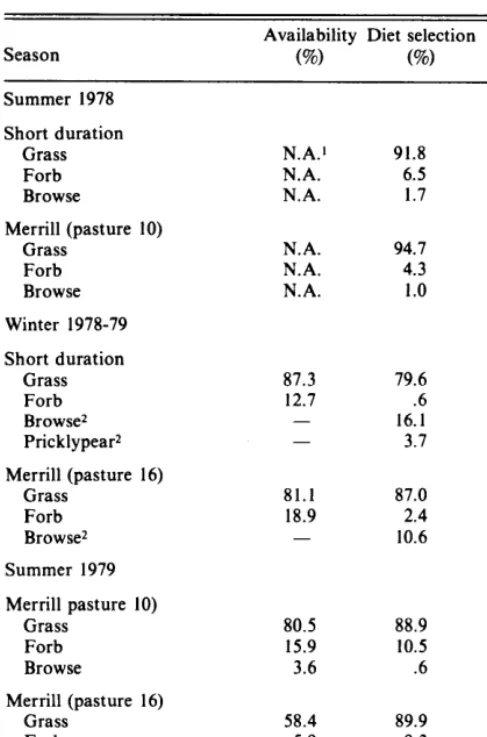
Grass was the major component of the diets selected by the steers, while forbs and browse were minor components (Table 6). Grass selection, averaged across treatments, was lowest during the winter (197879). The percentages of forbs and browse in the diets were similar for the summer of 1978 and 1979, but differed during the winter collection period. Measurable amounts of pricklypear fragments occurred in only five diet collections out of the total 146. This repres- * ented an interesting contrast to pricklypear consumption in experiment I. Shortening the grazing and rest periods resulted in cattle selecting a higher percentage of their diet from grasses, with less forbs and pricklypear being con- sumed under SDG in experiment II than under HILF in experiment I.
Diets did not differ significantly between SDG and Mer- rill grazing systems. Animal diets from the SDG systems closely parallelled diets from the Merrill system. This is an important observation since pasture 10 (Merrill system) has a higher range condition classification.
Table 6. Composition (%) of available vegetation and diets of cattle, and preference values (P.V.) for forage classes selected by cattle grazing on ‘I-pasture short-duration and Merrill grazing systems on the Edwards Plateau near Sonora, Texas.
Table 7. Percent crude protein (CP) and percent in vitro digestibility (IVDOM) of diets selected by cattle grazing on short-duration and Merrill grazing systems on the Edwards Plateau near Sonora, Texas.
Season
Availability Diet selection
(%) (%) P.V.
Summer 1978
Short duration Grass Forb Browse
Merrill (pasture 10) Grass
Forb Browse
Winter 1978-79
Short duration Grass Forb Browse2 Pricklypear
Merrill (pasture 16) Grass
Forb Browse2
Summer 1979
Merrill pasture 10) Grass
Forb Browse
Merrill (pasture 16) Grass
Forb Browse
Short duration Gras Forb Browse
N.A.’ 91.8 -
N.A. 6.5 -
N.A. 1.7 -
N.A. N.A. N.A.
94.7 4.3 1.0
- - -
87.3 79.6
12.7 .6
- 16.1
- 3.7
- .5 -5.8 -
81.1 87.0 .4
18.9 2.4 -7.5
- 10.6 -
80.5 88.9 + .5
15.9 10.5 -2.2
3.6 .6 -6.9
58.4 89.9 2.1
5.9 9.3 2.2
35.7 .8 -9.6
66.9 93.9 1.8
7.2 3.5 -3.5
25.9 2.4 -8.3
‘Clipped samples were lost in an accidental fire.
2Only herbaceous vegetation was clipped on these sampling dates.
the summer months with a 7-day grazing period for the SDG system compared to fall, winter, and spring for the HILF system. At other seasons the SDG had a 3-day grazing period and no difference was found between period A and B.
Chemical Analysis of Diets
Diets of steers contained 10.6% CP and 57.14% IVDOM averaged across both treatments for the study. The IVDOM and CP values decreased significantly from summer to win- ter (Table 7). Vegetation maturity and weathering of forage were the major factors causing these decreases in CP and digestibility of the diets. Both CP and IVDOM increased with spring growth of forage starting in March. Differences in diet quality between grazing systems were not significant. This is an interesting observation since animal performance from the HILF system (over an 8 year period) has consist- ently been significantly lower compared to animal perfor- mance from the Merrill grazing systems. Shortening the length of the rest periods of the HILF system from 126 days in experiment I to 42 days in experiment II has prevented the development of mature forage. This enables the livestock to utilize higher quality vegetation throughout the year. Also, reducing the length of the grazing period from 21 days to 7
Season CP IVDOM
Short-duration grazing
Winter 1978-79 8.5 45.21
Summer 1978 11.3 59.29
Summer 1979 10.9 59.45
Merrill (pasture 16)
Winter 1979 9.32 48.0
Merrill (pasture 10)
Summer 1978 10.83 59.89
Summer 1979 10.75 58.83
days from experiment I to II allowed the animals to select the more preferred forage species without being forced to consume poor quality vegetation. Forage quality data from experiment II indicated that animal performance should be similiar for SDG system compared to Merrill grazing system.
Crude protein values did not differ significantly between periods A and B in SDG system (Table 9). However, a significant difference was recorded for digestibility values. This would indicate that a 7-day graze period was long enough to slightly reduce nutrient intake of animals. A more rapid rotation with more pastures might give further improvement in nutrient intake.
Conclusions
For experiment I the 21day grazing periods were long enough to drastically affect diet selection by the cows. This was reflected by major shifts in species composition of diets and a reduction in CP content of the diets from collection period A to B. Selection of plant species such as bluebonnet, horehound, pricklypear, and honey mesquite, which gener- ally receive little or no use by cattle, indicated that the HILF grazing system may have altered forage preferences. Another factor which may have affected diet selection was the 126-day rest periods, which allowed forage to mature between grazing periods. The relatively low IVDOM of diets throughout the study was a reflection of the maturity of the forage.
Crude protein levels of diets collected at the end of the grazing periods during fall and winter were usually below levels required by lactating cows. However, diets collected at the beginning of the grazing periods were generally adequate in CP. Reducing the length of the grazing and rest periods in
Table 8. Composition (o/o) of diets of cattle grazing a 7-pasture short- duration grazing system on the Edwards Plateau near Sonora, Texas.
Season’ Summer 1978 Summer 1979
Period2 A B A B
Grasses 92.7 90.2 93.2 91.4
Forbs 6.1 7.3 4.3 2.8
Browse 0.8 2.2 1.7 5.4
Miscellaneous 0.4 0.3 0.8 0.4
Pricklypear 0.0 0.0 0.0 0.0
Table 9. Chemical composition (%) of diets selected by cattle grazing on a ‘I-pasture short-duration grazing system on the Edwards Plateau near Sonora, Texas.
Season’ Summer 1978 Summer 1979
Period* A B A B
Crude Protein 9.4 10.0 11.3 10.4
In vitro digestibility 60.1 55.9 62.8 56.1
‘Summer 1978 represents grazing from June 30 to August 4. Summer 1979 represents grazing from June I1 to June 24.
ZPeriod A is a mean of diets collected during the first or second day of each 7-day
grazing period and period is a mean of diets collected the last day.
experiment II significantly improved diet quality. Also, diet selection by the animals was changed significantly coti- pared to experiment I and closely paralled diets selected by cattle from the Merrill system. With the shorter graze and rest periods in experiment II, the vegetation was maintained in higher nutritional growth stage. This resulted in a greater utilization of the grass and prevented heavy use on poor quality vegetation such as pricklypear.
Crude protein levels of diets collected from the SDG system did not differ between collection A and B. However, a significant difference was measured for digestibility of diets from the two collection periods. This would indicate a grazing period of less than 7 days would probably increase diet quality.
The implications from experiments I and II are very important: Forbs represented a much lower percentage oj the cattle diets from the SDG system compared to the HILF system. This would indicate that competition between dif- ferent kinds of animals may be reduced by changing man- agement from a HILF to a SDG system. This would be extremely important where combinations of animals such as cattle, sheep, goats, and deer utilize a common range. Also, based on diet quality, livestock production from a SDG system should be equivalent to a Merrill system. Since heav- ier stocking rates can be maintained on the SDG system compared to the Merrill system, without brush control, an increase in the efficiency of transfer of nutrients from a basic resource, range vegetation, to useable products, meat and fiber, has been accomplished. -
Literature Cited
Acocks, A.P.H. 1966. Non-selective grazing as a means of veld reclama- tion. Proc. Grassld. Sot. S. Afr. 1: 33-39.
Anderson, D.M. 1977. Standing crop, diets, travel and weight changes under short-duration and continuous grazing. Ph.D. Dissertation. Texas A&M Univ. 181 p.
A.O.A.C. 1960. Official Methods of Analysis (9th ed.). Ass. Off, Agr. Chem. Washington, D.C.
Booysen, Peter De V., and Neil M. Tainton. 1978. Grassland management: Principles and practice in South Africa. Proc. First Int. Rangeland Cong. Denver, Colo. p. 551-554.
Corbett, Quincy, Jr. 1978. Short duration grazing with steers-Texas style. Rangeman’s J. 5: 20 l-203.
Durham, Albert J., Jr., and M.M. Kothmann. 1977. Forage availability and cattle diets on the Texas Coastal Prairie. J. Range Manage. 30: 103-106.
Edlefsen, J.L., C.W. Cook, and J.T. Blake. 1960. Nutrient content of the diet as determined by hand plucked and esophageal fistula samples. J. Anim. Sci. 19: 560-567.
Fraps, G.S., and V.L. Cory. 1940. Composition and Utilization of range vegetation of Sutton and Edwards Counties. Tex. Agr. Exp. Sta. Bull. 586
Howell, L.N. 1978. Development of multicamp grazing systems in the Southern Orange Free State, Republic of South Africa. J. Range Man- age. 31: 459-465.
Kothmann, M.M. 1968. The botanical composition and nutrient compo- sition of the diet of sheep grazing on poor condition pasture compared to good condition pasture. Ph.D. Diss., Texas A&M Univ. 60 p.
Kothmann, M.M., W.S. Rawlins, and Jim Bluntzer. 1975. Vegetation and livestock responses to grazing management on the Texas Experimental Ranch. Tex. Agr. Exp. Sta. PR-3310. 4 p.
Malechek, J.C. 1970. The botanical and nutritive composition of goat diets on lightly and heavily grazed ranges in the Edwards Plateau of Texas. Ph.D. Diss. Texas A&M Univ. 61 p.
Merrill, Leo B. 1959. Heavy grazing lowers carrying capacity. Tex. Agr. Exp. Sta., Tex. Agr. Prog. Vol. 5 (March).
Merrill, L.B., and C.A. Taylor. 1975. Advantages and disadvantages of intensive grazing management systems near Sonora and Barnhart. Tex. Agr. Exp. Sta. PR-3341.
NRC. 1976. Nutrient requirements of domestic animals. No. 4. Nutrient requirements of beef cattle. 5th ed. Nat. Acad. Sci. Washington, D.C. p. 55.
Robbins, J. Phillip. 1975. Pasture management. Proc. 1975 Univ. Tex. Coop. Field Day and Tour. p. 36.
Savory, Allan. 1979. Range fencing designs for short duration grazing. Beef Cattle Sci. Handbk. 16: 380-383. Agri-services Found., Clovis, Calif.
Taylor, CA., and Leo B. Merrill. 1975. Influence of a short-duration grazing system on pricklypear. Tex. Agr. Exp. Sta. PR-3341.
Tilley, J.M.A., and R.A. Terry. 1963. A two-stage technique for the in vitro digestion of forage crops. J. Brit. Grassland Sot. 18: 104.
Van Soest, P.M., and R.H. Wine. 1967. Use of detergents in the analysis of fibrous feeds. IV. The determination of plant cell-wall constituents. J. Ass. Off. Anal. Chem. 50: 314.