
Practical Near-Collisions and Collisions on
Round-Reduced
ECHO
-256 Compression Function
J´er´emy Jean and Pierre-Alain Fouque
Ecole Normale Sup´erieure
45 rue d’Ulm – 75230 Paris Cedex 05 – France
{Jeremy.Jean, Pierre-Alain.Fouque}@ens.fr
Abstract. In this paper, we present new results on the second-round SHA-3 candidateECHO. We describe a method to construct a collision in the compression function of ECHO-256 reduced to four rounds in 252operations on AES-columns without significant memory requirements. Our attack uses the most recent analyses onECHO, in particular theSuperSBoxandSuperMixColumnslayers to utilize efficiently the available freedom degrees. We also show why some of these results are flawed and we propose a solution to fix them. Our work improve the time and memory complexity of previous known techniques by using available freedom degrees more precisely. Finally, we validate our work by an implementation leading to near-collisions in 236operations.
Keywords: Cryptanalysis, Hash Functions, SHA-3,ECHO-256, Collision attack
1 Introduction
Recently, the National Institute of Standards and Technology (NIST) initiated an international public competition aiming at selecting a new hash function design [12]. Indeed, the current cryptanalysis of hash functions like SHA-1 and MD5 show serious weaknesses [17,18,19,20]. To study hash functions, one of the most powerful strategy is the differential cryptanalysis, which was introduced in [2] by Biham and Shamir to study the security of block ciphers. It consists in following the evolution of a message pair in the cipher by looking at the differences between the messages while they propagate through the encryption process. This type of analysis is particularly useful for studying hash functions where no secret-key is involved: in this known-key model [6], the attacker can thus follow the message pair at each step of the process. Knudsen generalized the idea in [5] with the concept of truncated differentials, aiming at following the
presence of differences in a word, rather than their actual values. Initiated by the work of Peyrin on Grindhal [13], this kind of analysis leads to many other successful attacks against block ciphers and hash functions, in particular those based on the AES [7,10]. For the AES, since all differences are equivalent, only their presence matters.
Thanks to the SHA-3 contest, new kinds of attacks for AES-based permutations have been suggested in the past few years, in particular the rebound attack [10] and the start-from-the-middle attack [9]. In both cases, the novelty is to start searching for a message pair conforming a given differential path in the middle of the trail. Doing so, we have the freedom of choosing values and differences where they can reduce greatly the overall cost of the trail.
The rebound technique uses these degrees of freedom to fulfill the most expensive part of the trail at very low average complexity whereas the remaining of the path is verified probabilistically. The number of controlled rounds in that case can not exceed two rounds. The start-from-the-middle technique improves the rebound attack in the sense that it uses the independence in the search process as much as possible. Consequently, it extends the number of controlled rounds to three, without any extra time.
on the SHA-3 proposal LANE [21]. In comparison to the rebound or the start-from-the-middle techniques, we are not limited to a controlled part located in the middle of the path. In the end, the partial message pairs are merged using remaining degrees of freedom. Schl¨affer’s beautiful
attacks permute some linear transformations to introduce theSuperMixColumnslayer, which
relies on a large matrix lacking of optimal diffusion properties. It thus allows to build sparser truncated differential. In this paper, we show that the latest analyses of ECHOmade by Schl¨affer fail with high probability at some point of the merging process: the attacks actually succeed with probability 2−128. Nevertheless, we suggest an attack using degrees of freedom slightly differently to construct collisions and near-collisions in the compression function of ECHO-256.
Our new techniques improve the rebound attack by using freedom degrees more precisely to get and solve systems of linear equations in order to reduce the overall time and memory complexity. We also describe a new method to efficiently find a message pair conforming a
truncated differential through the SuperSBox when not all input or output bytes are active.
Both new techniques allow to repair some of the Schl¨affer’s results to construct collisions in the compression function of ECHO-256. To check the validity of our work, we implement the attack to get a semi-free-start near-collisions in 236 (Appendix B). That is, a chaining value h and a
message pair (m, m0) colliding on 384 bits out of 512 in the compression functionf reduced to four rounds: f(h, m) =384 f(h, m0).
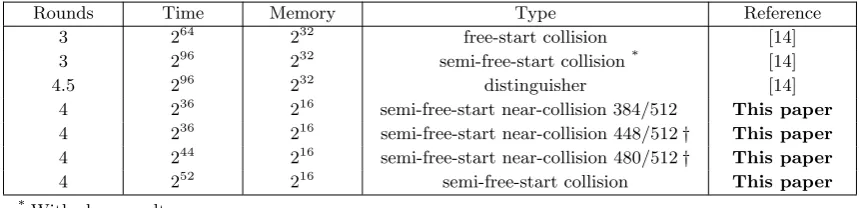
We summarize our results in Table 1.
Table 1.Summary of results detailed in this paper and previous analyses of ECHO-256 compression function. We measure the time complexity of our results in terms of operations on AES-columns. The notationn/512 describe the numbernof bits where the message pair collides in the near-collisions.
Rounds Time Memory Type Reference
3 264 232 free-start collision [14]
3 296 232 semi-free-start collision* [14]
4.5 296 232 distinguisher [14]
4 236 216 semi-free-start near-collision 384/512 This paper
4 236 216 semi-free-start near-collision 448/512† This paper 4 244 216 semi-free-start near-collision 480/512† This paper 4 252 216 semi-free-start collision This paper
*
With chosen salt
†
These results are examples of other near-collisions that can be derived from the attack of this paper.
The paper is organized as follows. In Section 2, we quickly recall the specifications of the
ECHO hash function and the permutation used in the AES. In Section 3, we describe the
dif-ferential path we use and present an overview of the difdif-ferential attack to find a message pair conforming this path. Then, in Section 4, we present the collision attack of ECHO-256 compres-sion function reduced to four rounds. Finally, we conclude in Section 5. We validate our results by implementing the near-collision attack and present a message pair conforming the path in Appendix B.
2 Description of ECHO
The hash function ECHO updates an internal state described by a 16×16 matrix of GF 28
elements, which can also be viewed as a 4×4 matrix of 16 AES states. Transformations on this large 2048-bit state are very similar to the one of the AES, the main difference being the
equiv-alent S-Box calledBigSubBytes, which consists in two AES rounds. The diffusion of the AES
states in ECHO is ensured by two big transformations: BigShiftRows and BigMixColumns
BigSB
0 1 2 3
BigSR
0
1 2 3
BigMC 2 rounds AES AES MixColumns
Fig. 1.One round of theECHOpermutation. Each of the 16 cells is an AES state (128 bits).
At the end of the 8 rounds of the permutation in the case ofECHO-256, theBigFinaloperation adds the current state to the initial one (feed-forward) and adds its four columns together to
produce the new chaining value. In this paper, we only focus on ECHO-256 and refer to the
original publication [1] for more details on both ECHO-256 andECHO-512 versions. Note that the keys used in the two AES rounds are an internal counter and the salt, respectively: they are mainly introduced to break the existing symmetries of the AES unkeyed permutation [8]. Since we are not using any property relying on symmetry and that adding constants does not change differences, we omit these steps.
Two versions of the hash functionECHOhave been submitted to the SHA-3 contest:ECHO-256 and ECHO-512, which share the same state size, but inject messages of size 1536 or 1024 bits respectively in the compression function. Focusing on ECHO-256 and denotingf its compression function, Hi the i-th output chaining value, Mi = Mi0 ||Mi1 || Mi2 the i-th message block
composed of three chunks of 512 bits each Mij and S = [C0C1C2C3] the four 512-bit ECHO
-columns constituting state S, we have (H0=IV):
C0 ←Hi−1 C1 ←Mi0 C2←Mi1 C3 ←Mi2
AES. We recall briefly one AES round on Figure 2 and refer as well to original publication [11]
for further details. TheMixColumnslayer implements a Maximum Distance Separable (MDS)
SB 0 1 2 3
SR 0
1 2 3
MC AK
AES S-Box mul. by a MDS matrix
Fig. 2.One round of the AES permutation is the succession of four transformations: SubBytes (SB), ShiftRows (SR), MixColumns (MC) and AddKey (AK). Each of the 16 cells is an element of GF 28
(8 bits).
code that ensures a complete diffusion after two rounds. It has good diffusion properties since its branch number, i.e. the sum of input and output active bytes, is always 0 or greater than 5. As for the AES S-Box, it satisfies an interesting differential property: namely, a random differ-ential transition exists with probability approximately 1/2. By enumerating each input/output difference pair, this result can be computed and stored in 216in the difference distribution table
∆. At the position (δi, δo), this table contains a boolean value whether the differential transition
δi → δo exists. That is, if the equality S(λ) +S(λ+δi) = δo holds for at least one element
λ∈GF 28
,S being the AES S-Box. We note that this table can be slightly enlarged to 219 to store one solution when possible.
Notations. Throughout this paper, we name each state of the ECHO permutation after each
the AES-state at rowiand columnjby Sn[i, j]. Additionally, we introducecolumn-slice orslice
to refer to a thin column of size 16×1 of theECHOstate. We useECHO-column or simplycolumn
to designate a column of ECHO, that is a column of four AES states. Similarly,ECHO-row orrow
refer to a row of the ECHO state; that is, four AES states.
3 Differential attack for hash functions
To mount a differential attack on a hash function, we proceed in two steps. First, we need to find a good differential path, in the sense that, being probabilistic, it should hold with a probability as high as possible. In the particular case of AES-based hash functions, this generally means a path with a minimum number of active S-Boxes. In comparison with the differential attacks where fixed differences chosen for their high probability go along with the differential path, for this particular design, all differences behave equivalently. Thus, the path is actually a truncated path, precising only whether a difference exists or not.
Second, we have to find a pair of messages following that differential path, which fixes values and differences. In the sequel, we present an equivalent description of theECHO-permutation and then detail our choice of differential path, using the new round description. The part of the attack that finds a valid message pair for this path using the equivalent description is detailed in Section 3.3.
3.1 Reordering of transformations in the ECHO permutation
SuperSBox. Rijmen and Daemen introduced in [3] the concept of SuperSBoxto study two
AES rounds. By bringing the two non-linear layers together, this concept is useful to find a message pair conforming a given differential path and leads to a new kind of cryptanalysis [4].
The design of one AES round describes the sequenceSB-SR-MCof transformations1, but we
can use the independence of bytes to reorder this sequence. Namely, dealing with the non-linear
BigSubBytes layer of ECHO, we can permute the first ShiftRows with the first SubBytes
without affecting the final result of the computation. We then glue the two non-linear layers into
a uniqueSB-MC-SBnon-linear transformation of the permutation. The so-calledSuperSBox
transformation is then viewed as a single non-linear layer operating in parallel on 32-bit AES-columns.
SuperMixColumns. In a similar way, by permuting theBigShiftRowstransformation with
the parallel MixColumns transformations of the second AES round, a newsuper linear
oper-ation has been introduced by Schl¨affer in [16], which works on column-slices of size 16×1.
This super transformation called SuperMixColumns results of 16 parallel applications
of MixColumns followed by the equivalent in ECHO, that is BigMixColumns. This super
transformation is useful for building particular sparse truncated differential. The matrix of the
SuperMixColumns transformation is defined as the Kronecker product (or tensor product) of
Mwith itself,Mbeing the matrix of theMixColumnsoperation in the AES:MSM C =M⊗M.
Schl¨affer noted in [16] (in Section 3.3) thatMSM C is not a MDS matrix and its branch number
is only 8, and not 17.
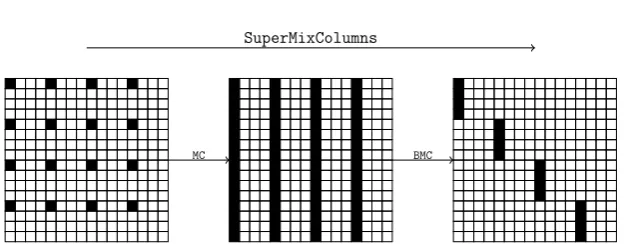
From this observation, it is possible to build sparse truncated differentials (Figure 3) where there are only 4 active bytes in both input and output slices of the transformation. The path 4 →16 →4 holds with probability 2−24, which reduces to 28 the number of valid differentials, among the 232 existing ones. For a given position of output active bytes, valid differentials are
actually in a subspace of dimension one. In particular, for slice s,s∈ {0,4,8,12}, to follow the
1
truncated differential 4 → 16 → 4 of Figure 3, we need to pick each slice of differences in the one-dimensional subspace generated by the vector vs, where:
v0 = [E000 9000 D000 B000]T v4= [B000 E000 9000 D000]T
v8 = [D000 B000 E000 9000]T v12= [9000 D000 B000 E000]T
MC BMC
SuperMixColumns
Fig. 3.TheSuperMixColumnslayer in the particular case of the truncated differential 4→16→4.
This new approach of the combined linear layers allows to build sparser truncated differentials but caused erroneous conclusions when it was used in [16] (in Section 4.1). Namely, at the end of the attack, where two partial solutions need to be merged to get a solution for the whole differential path, everything relies on this critical transformation: we need to solve 16 linear systems. We detail more precisely the problem in Section 3.4, where we study the merge process.
3.2 Truncated differential path
As in the more recent analyses of ECHO [15,16], we consider the path at the byte-level: this
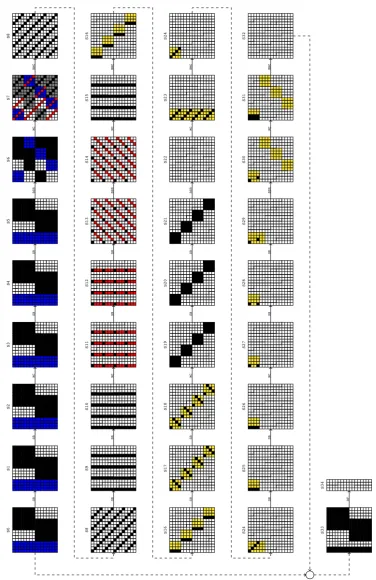
allows to build paths sparser than the ones we could obtain by considering only the AES-state level [1,4,9]. Our path is mostly borrowed from [16] and counts 418 active S-Boxes for theECHO -permutation reduced to four rounds. The only difference lies in the first round, where we increase significantly the number of active S-Boxes to decrease the time complexity of the attack. We note that the number of active S-Boxes is not directly correlated with the complexity of the attack. Moreover, in that case of an AES-based permutation, we can consider a truncated differential path because the actual differences are not really important since they are all equivalent: only theirpresence matters.
Figure 4 presents the truncated differential path used in this attack on the compression function reduced to four rounds. The attack being quite technical, colors have been used in order to improve the reader’s understanding of the attack.
3.3 Finding a message pair conforming the differential path
Strategy. To find a message pair that follows the differential path of Figure 4, our attack
S0
SR
S1
SB
S2
MC
S3
SB
S4
SR
S5
BSR
S6
MC
S7
BMC
S8
S8
SR
S9
SB
S10
MC
S11
SB
S12
SR
S13
BSR
S14
MC
S15
BMC
S16
S16
SR
S17
SB
S18
MC
S19
SB
S20
SR
S21
BSR
S22
MC
S23
BMC
S24
S24
SR
S25
SB
S26
MC
S27
SB
S28
SR
S29
BSR
S30
MC
S31
BMC
S32
⊕
S33
BF
S34
SuperSBox. In the differential path described on Figure 4, there are many differential
tran-sitions through the SuperSBox of the third round where input differences are reduced to one
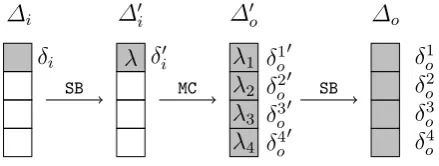
active byte. We are then interested in differential transitions such as the one described in
Fig-ure 5. For this kind of transition, the distribution difference table of the SuperSBox would
work but requires 264 to be computed and stored2. We show that we can compute a pair of
columns satisfying this path in 211 operations on one AES-column.
∆i
δi SB
λ ∆0i
δi0
MC
λ1
λ2
λ3
λ4
∆0o δ1
o
0
δ2
o
0
δo30 δo40
SB
∆o
δ1
o
δ2
o
δo3 δo4
Fig. 5.ASuperSBoxdifferential transition with only one active input byte.
Let us consider the input difference to be∆i = [δi, 0, 0, 0]Treduced to one active byteδiand
the output difference ∆o =
δo1, δo2, δ3o, δ4oT
: we aim at finding a pair of AES-columns (c1, c2)
conforming those differences; that is:c1+c2 =∆iandSuperSBox(c1) +SuperSBox(c2) =∆o.
In a precomputation phase of 216, we compute and store the differential distribution table of the AES S-Box.
The differential properties of the AES S-Box restrict the number of output differences of the firstSubByteslayer to 27−1 and for each one, the underlying values are set. Denotingδi0one of the output differences of this layer andλthe associated value such thatS−1(λ)+S−1(λ+δi0) =δi,
we can propagate this difference ∆0i = [δi0, 0, 0, 0]T linearly to learn the four differences at the
input of the second SubBytes layer. We note ∆0o = MC(∆0i) = [δo10, δo20, δo30, δ4o0]T those differences. Here, both the input and the output differences are known and the four differential transitions δi
o
0
→δi
o exist with probability approximately 2−4. Since we can restart with 27−1
differentδ0i, we get approximately 23 valid differential transitions. Each of these transitions fixes the underlying values, noted λ1, λ2, λ3, λ4. At this point, all intermediate differences conform
to the path, but in terms of values, we need to ensure that λ is consistent with λ1, λ2, λ3, λ4.
To check this, we exhaust the 24 valid vectors of values we can build by interchanging λi and
λi+δoi
0
.
All in all, among the 23+4vectors of values we can build, only a fraction 2−8 will satisfy the 8-bit condition onλ. This means that the considered differential transition∆i→∆othrough the SuperSBox occurs with probability 2−1 and if the transition exists, we can recover an actual AES-column pair in 2724 = 211 operations.
Remark. We can generalize this method to construct input values with probability 2−1 for differential transitions 2→ 4 and 3 → 4 and even 4→ 4: time complexity are 218, 225 and 232
respectively. This method applies as well on invSuperSBox.
3.4 Overview of the attack
In this subsection, we describe the main steps used to find a message pair conforming the differential path. We begin by the sensitive part of the attack, which caused erroneous statements in [16]: the merging phase of the two partial solutions.
2
Merging step. Assume for a moment that we solved both subparts of the path, i.e. the red bytes between S7 and S14 are fixed as well as the yellow ones between S16 and S31: we have two partial solutions for the complete differential path. The truncated differential of Figure 4 is then partially verified but to merge the two parts, we need to set the white bytes so that the
SuperMixColumns transition from S14 to S16 is possible.
Due to the particular construction ofMSM C, some algebra considerations show that for the
already-known values in S14 (red) and S16 (yellow), the SuperMixColumns transition will
not be possible unless a 128-bit constraint is satisfied: the remaining degrees of freedom can not be used to satisfy this relation. Since all of the 16 column-slices of the considered matrices are independent, this leads to 16 constraints on 8 bits.
The flaw in [16] is to assume these relations are true, which holds only with probability 2−128, whatever the value of unset bytes are. These equalities need to be true so that the 16 linear systems have solutions. The first system associated to the first slice is given by:
MSMC
h
a0 x0 x1 x2 a1 x3 x4 x5 a2 x6 x7 x8 a3 x9 x10 x11
iT
=
h
b0 b1 b2 b3 ∗ ∗ ∗ ∗ ∗ ∗ ∗ ∗ ∗ ∗ ∗ ∗
iT (1)
where ai and bi are known values,xi are unknowns and ∗ is any value in GF 28
. This system has solutions if a particular linear combination of [a0, a1, a2, a3]Tand [b0, b1, b2, b3]T lies in the
image of some matrices: this constraints the already-known values to verify an 8-bit relation. The
constraint comes from the fact that MSM C is the Kronecker productM⊕M. For example, in
the following, we denote byai, 0≤i≤3, the four known values of slice 0 of S14 coming from the
first subpart (red) and bi the known values for the same slice in S16, from the second subpart
(yellow). With this notation, the first system will have solutions if and only if the following condition is satisfied:
2a0+ 3a1+a2+a3 = 14b0+ 11b1+ 13b2+ 9b3. (2)
See Appendix A for the detailed proof. These constraints for each slice of the
SuperMix-Columnstransition can also be viewed in a different way: consider all thebiknown for all slices,
thus we can only pick 3 out of 4ai per slice in S14 and determine the last one deterministically.
Alternatively, due to the ShiftRowsandBigShiftRowstransitions, we can independently
de-termine slices 0, 4 and 8 in S12 so that slice 12 of S12 would be totally dede-termined. This transfers the problem into the first subpart of the path.
Step 1. We begin by finding a pair of ECHO-columns satisfying the truncated path reduced
to the first ECHO-column between S7 and S12. This is done with a randomized AES-state of
the column, used to get and solve linear equations giving all differences between S7 and S9. Indeed, differences between S7 and S9 for the first column only depend on the four differences in S7[2,0]3. Then, we search for valid differential transitions through the AES S-Box between S9 and S10 to finally deduce a good pair of ECHO-columns. This step can be done in 212operations on AES-columns (Section 4.1).
Step 2. Once we solved the first ECHO-column, we can deduce all differences between S12
and S16: indeed, the wanted SuperMixColumnstransition imposes them as discussed in
Sec-tion 3.1. This step is done in constant time (SecSec-tion 4.2).
3
Step 3. Now that we have the differences in S16, we have a starting point to find a message pair for the second subpart of the whole truncated path: namely, states between S16 and S31 (yellow bytes). To do so, the idea is similar as in Step 1: since all differences between S20 and S24 only depend on the four differences of S244, we can use a randomized AES-columncin S18 to get four independent linear equations in S20 and thus deduce all differences between S20 and
S24. Then, we search for input values for the 15 remaining SuperSBoxes, which have only one
active byte at their input (Section 3.3). This succeeds with probability 2−15 so that we need
to retry approximately 215 new random c. The whole step can be done in 226 operations on
AES-columns (Section 4.2).
Being done, the truncated path is followed until the end of the four rounds in S32. Note that
we can filter the MixColumns transition between S26 and S27 in a probabilistic way so that
less slices would be active in S32.
Step 4. Getting back to the first subpart of the truncated path, we now find a valid pair of
ECHO-columns satisfying the truncated path between S7 and S12 reduced to the second ECHO
-column. This is basically the same idea as in Step 1. This can be done in 212 operations on
AES-columns as well (Section 4.3). Note that this step could be switched with Step 3.
Step 5. To construct a valid pair of ECHO-columns satisfying the truncated path between S7
and S12 reduced to the third ECHO-column, we proceed as before (steps 1 and 4), but we start by randomizing three AES states instead of one: indeed, differences between S7 and S9 at the input of the non-linear layer now depend on 12 differences, the ones in S7[0,2], S7[1,2] and S7[3,2]. Getting 12 linear systems then allow to learn those differences and we can finally search for four valid differential transitions through the AES S-Box in 24 operations on AES-columns (Section 4.3).
Step 6. The merging step in [16] fails with high probability, but we know how to get into the valid cases: since the three firstECHO-columns of the first subpart are now known, we can deduce
the whole last ECHO-column allowing the 16 needed equations mentioned before. There is no
freedom for that column, so we are left with a probabilistic behavior to check if it follows the column-reduced truncated differential. We then propagate the pair of deduced values backwards
until S8 and check if the invBigMixColumns transition behave as wanted: namely, four
si-multaneous 4→3 active bytes, which occurs with probability (2−8)4. Hence, we need to restart
approximately 232 times the previous Step 5 to find a valid pair of ECHO-columns satisfying both the path between S7 and 12 and the 128-bit condition imposed by the merging step. This step can be performed in 236 operations on AES-columns (Section 4.3).
Step 7. To get a collision in the compression function, we then need to take care of the compres-sion phase in the BigFinaloperation: the feed-forward and the xor of the four ECHO-columns. The collision is reached when the sum of the two active AES-states per row in S0 equals the active one in S32. We have enough degrees of freedom to determine values in associated states of S7 (gray) to make this happens. Together with the probabilistic filter of Step 3, this step may impose the global time complexity of the attack; so, weakening the final objective (to get a near-collision, for instance) can make the whole attack practical (Section 4.4).
Step 8. The last step consists in filling all the remaining bytes by solving the 16 linear systems
mentioned in Step 6, while taking care at the same time that theinvBigMixColumnsbetween
4
S8 and S7 reaches the values determined by Step 7. Due to the particular structure of the solution sets, the systems can be solved in parallel in 232 operations on AES-columns (Section 4.5).
4 Collision on the 4-round compression function
4.1 Partial message pair for the first subpart
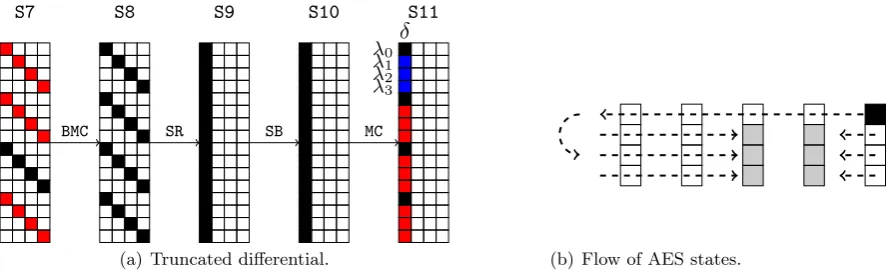
This step aims at finding a pair of ECHO-columns satisfying the truncated differential of Figure 6. We consider the first column separately from the others in order to reach a situation where the merging process will be possible. Indeed, once we fix a slice, we can determine the differences at the beginning of the second subpart in S16.
BMC SR SB MC
δ λ0
λ1
λ2
λ3
S7 S8 S9 S10 S11
(a) Truncated differential. (b) Flow of AES states.
Fig. 6.Truncated differential path (a) used for the first subpart of the attack for oneECHO-column. We represent on (b) the order in which AES states are randomized (black) or deduced by a small rebound attack (gray).
The previous method suggested in [16] (in Section 4.1) to find paired values following this truncated differential is a rebound attack working in time 232 and using the differential
distri-bution table of the SuperSBox of size 264. We show how we can find an ECHO-column pair
conforming this reduced path in 212 operations on AES-columns without significant memory
usage.
Rather than considering the whole column at once, we start by working on the top AES state in S11, that is S11[0,0]. We begin by choosing random values (λ0, λ1, λ2, λ3) for the first AES-column of S11[0,0] (blue bytes), such that the active byte is set to difference δ, also chosen at
random in GF 28
\{0}. Starting from S11[0,0] and going backwards, those values and differences are propagated deterministically until S8[0,0]. Since there is only one active byte per slice in the considered ECHO-column of S7, each of the associated four slices of S8 lies in a subspace of dimension one. Therefore, solving four simple linear systems leads to the determination of the 12 other differences of S8.
Therefore, in the active slice of S9 of Figure 6 at the input of the SubBytes layer, the
four first paired bytes have values and differences known, whereas in the 12 other positions, only differences are set. Our goal now is to find good values for these byte pairs, which can be achieved by a small rebound attack on the AES S-Box where the output differences are propagated from S11 by choosing random differences. Thus, we iterate on the (28)3 possible unset differences of S11 and propagate them linearly to S10. When both input and output differences of the 12 AES S-Boxes are known, we just need to ensure that these 12 differential transitions are possible. This is verified by the precomputed table5 ∆. It ensures that the 12 transitions will occur
5
simultaneously with probability 2−12. Since we can try approximately (28)3 output differences, we will have about (28)3 2−12 (24)3 ≈ 224 different vectors of values by trying them all. The factor (24)3 comes from the possibility of interchanging the two solutions of the equations 12 times to get more vectors of values6.
All in all, for anyλ0, λ1, λ2, λ3, δ picked at random in GF 28(with non-null difference), we can find 224ECHO-column pairs in S12 in 212such that the associated truncated differential from S12 to S7 is verified. We could thus build approximately 224+8×5 = 264 pairs of ECHO-columns following the column-reduced truncated differential.
4.2 Finding a message pair for the second subpart
We now get a partial message pair conforming the first subpart of the truncated path reduced to a single ECHO-column. Rather that completing this partial message pair for the three other active slices in S12, we now find a message pair conforming the second subpart of the truncated path, located in the third round from S16 to S24 (yellow bytes).
Indeed, the mere knowledge of a single active slice pair of S12 in the first subpart is sufficient to get a starting point to find a message pair for the second subpart, i.e. yellow bytes. This
is due to the desired transition through the SuperMixColumns transition: as explained in
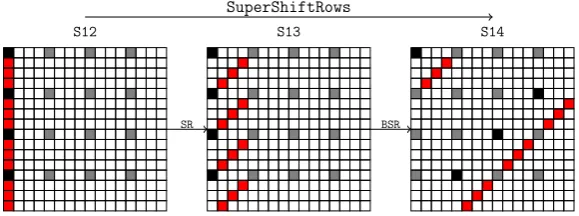
Section 3.1, differences in S14 lie in one-dimensional subspaces. Once a slice pair for the first slice of S12 is known and computed forwards to S14 (black and red bytes on Figure 7), there is no more choice for the other differences in S14. Finally, all differences between S12 and S17 have been determined by linearity of involved transformations.
S12
SR
S13
BSR
S14
SuperShiftRows
Fig. 7.TheSuperShiftRowslayer where only the values and differences of the first slice of S12 are known (black and red bytes).
At this point, only input differences of SuperSBoxesof the third round are known. We note that all operations between S20 and S24 are linear, so that all differences in those states only depend on the four differences of S24. We denote bykithe non-null difference of column slicei∈
{0,1,2,3} in state S24. By linearly propagating differences in S24 backwards to S20, we obtain constraints on the 64 output differences of theSuperSBoxin S20. To find the actual differences, we need to find the four ki and thus determine four independent linear equations. Considering
arbitrarily the first AES-column of S20[0,0] (Figure 8), differences are: [84k0,70k3,84k2,70k1]T (black bytes).
Starting from S18, let δ a random difference among the 27 −1 possible ones imposed by
S17 for the considered columns (Figure 8). Any choice imposes the value associated to the differential transition as well: we denote it λ0. At this step, we introduce more freedom by picking random values for the three remaining bytes of the column: (λ1, λ2, λ3). Note that we
6
δ λ0
λ1
λ2
λ3
MC S18[0,0]
SB
S19[0,0] S20[0,0]
Fig. 8.TheMixColumnsandSubBytestransitions on the first AES-column between S18[0,0] and S20[0,0].
can choose (28)3 = 224 of them and thus 231 starting points in total. After this randomization the AES-column in S18, the same AES-columns in S19 and S20 are fully determined. We then need to link the four bytes with the differences provided by the right part of the path from S24 to S20: this is done by simple algebra by solving four linear equations in four variables, which are ki, 0≤i≤3.
After solving, we have the four differenceskiof state S24: we propagate them backwards from
S24 to S20 and learn all the differences between S20 and S24. Only one pair of AES-columns out of the 16 was used in S18 to deduce differences ki in S24, so we now try to find values for
the 15 left (Figure 9).
S17
SB
S18
MC
S19
SB
S20
SuperSBox
Fig. 9.Last step to get a message pair conforming the second subpart of the path: finding the 15 remaining AES-columns using theSuperSBoxproperties. Black bytes are active and yellow bytes have already been defined in the previous step, as well as differences of the first AES-column of the first AES-state. Gray bytes are inactive and the target of this step.
Each of the remaining AES-columns, can be viewed as a differential transition through a
SuperSBox between S17 and S20 where all differences have been previously set. As described
in 3.3, we have 15 differential transitions through the SuperSBox with only one input active
byte in each. The 15 transitions occur simultaneously with probability 2−15 and if so, we can recover the 15 AES-column pairs in parallel in 211 using the technique previously described.
Since there are 15 AES-columns to find in S17, we need to generate approximately 215 new
(δ, λ0), λ1, λ2, λ3 and restart the randomization in S18[0,0].
Considering one message pair conforming a single ECHO-column of the first subpart of the
truncated path as starting point, the number of pairs we can build which follow the truncated path for this second subpart is: 27 28×3 2−15 ≈216. We note that we get one in 226 operations in parallel.
In the collision attack on the compression function, we further extend this step by
probabilis-tically filtering the active bytes in the MixColumns transition between S26 and S27. Among
the 216 message pairs we can build that follow the truncated path between S16 and S26, only
one in average will verify the 4 → 2 transition through MixColumns. If such a pair is found
and not one or three because this is a best compromise we can make to lower the overall time complexity of the collision attack.
4.3 Completing the partial message pair of the first subpart
As discussed in Section 3.4, to solve the merging step, slice 12 of S12 is constrained by slices 0, 4 and 8 of S12. All values of slice pair 0 have been determined (Section 4.1) and used to fix yellow bytes and thus get a message pair conforming the second subpart of the truncated path (Section 4.2).
Consequently, we only have freedom on the slice pairs 4 and 8 in S12. We determine values of slice pair 4 in the same way as slice 0 by considering the first subpart of the truncated path from S7 to S14 reduced to the secondECHO-column. There is a single active byte per slice in this
ECHO-column of S7, so that we can build approximately 260 valid columns7 in that position in 212 operations on AES-columns for a single one.
As soon as we have one, we use the remaining freedom of slice 8 to generate simultaneously slice pairs 8 and 12 of S12. We note that in the two last ECHO-columns of S7, there are three active bytes per slice (Figure 4). The method we suggest starts by finding a slice pair for slice 8 conforming the truncated differential reduced to the third ECHO-column between S7 and S12. We proceed in the same way as we did for slices 0 and 4 and then, we deduce deterministically the slice pair 12 from the constraints imposed by the merge. Finally, we check whether that slice pair conforms the truncated differential reduced to the last ECHO-column until S7, namely the
four simultaneous transitions 4→3 throughinvMixColumns between S8 and S7.
The cost of 24 to construct a slice pair for slice 8 allows to repeat it 232 times to pass the
probability 2−84 of finding a valid slice pair for slice 12 conforming both the linear constraints
of the merge and the truncated differential through invBigMixColumns. Note that we have
enough degrees of freedom to do so since we can find approximately (27)4(28)3×3 = 2100 valid
slice pairs for slice 8. However, only 232 are needed, which completes this step in 236operations on AES-columns and fixes all the red bytes between S7 and S14.
4.4 Compression phase in the feed forward
After four rounds, the round-reduced compression function applies the feed forward (S33 ←
S0+S32) and XORs the four columns together (BigFinal). This operation allows to build the
differential path such that differences would cancel out each other. As shown in the global path (Figure 4), states S0 and S32 XORed together lead to state S33 where there are three active AES-states in each row. In terms of differences, if each row sums up to zero, then we get a collision for the compression function in S34 after the BigFinal.
As we constructed the path until now, in both S0 and S32, we still have freedom on the values: only differences in S32 located in the two first slices are known from the message pair conforming the second subpart of the truncated path. These differences thus impose constraints
on the two other active pair states per row in S0. Namely, for each row r of S0 where active
AES states are located in columns cr and c0r, we have S0[r, cr] + S0[r, c0r] = S32. Additionally,
differences in S4 are known by linearly propagating the known differences from S7.
After the feed-forward, we cancel differences of each row independently: we describe the reasoning for an arbitrary row. We want to find paired values in the two active states of the considered row of S0, say (A, A0) and (B, B0), such that they propagate with correct differences in S4, which are known, and with correct diagonal values (red bytes) in S7 after theMixColumns.
7
In the sequel (Figure 10), we subscript the AES-stateAbyjto indicate thatAj is the AES-state
A propagated untilECHO-state Sj with relevant transformations according to Figure 4.
SR S-SB SR MC
A0 B0 A1 B1 A4 B4 A6 B6 A7 B7
A00 B00 A01 B10 A04 B04 A06 B60 A07 B70
Fig. 10.Propagation of the pairs of AES-states (Ai, A0i) and (Bi, Bi0) in a singleECHO-row in the first round. Non-white bytes represent active bytes; those in S7 (in red) are the known values and differences from the message pair conforming the first subpart of the truncated path.
The known differences of S4 actually sets the output differences of the SuperSBox layer:
namely, A4 +A04 = ∆4 and B4 +B40 = ∆04, where ∆4 and ∆04 are the known differences in
the considered row of S4. The constraint on the known diagonal values in A7 and B7 restricts
the available freedom in the choice of the AES-columns of A6 and B6 (and linearly, to their
equivalent A06 and B60 with diagonal values in A07 and B70) to reach the already-known diagonal values in S7 (red bytes). An alternative way of stating this is: we can construct freely the three first columns of (A4, A04) and (B4, B40) and deduce deterministically the fourth ones with the
nextMixColumnstransition, since 4 out of 8 input or output bytes of MixColumnsfix the 4
others. Furthermore, this means that if the three first columns ofA1,A01,B1 and B10 are known, then we can learn the values of the remaining columns of S1 (bytes in gray).
We thus search valid input values for the three first SuperSBoxes of S1: to do so, we
randomize the two differences per AES-column in this state and get valid paired values with probability 2−1 in 218 with respect to output differences∆4 (Section 3.3). Consequently, we can deduce the differences of the same AES-columns inB1+B10 to get a zero sum with S32 after the
BigFinal. This holds with the same 2−1probability, with respect to∆04. Once we have the three differential transitions for the three first AES-columns of both AES-states, all the corresponding values are then known and we propagate them inA6,A06,B6 and B60 (black bytes). Since in S7,
diagonal values are known, we deduce the remaining byte of each column inA6,A06,B6 andB06
(gray) and propagate them backwards until S1.
The final step defines the nature of the attack: to get a collision, we check if those constrained values cancel out in the feed-forward, which holds with probability 2−32. Restarting with new random values in S1 and in parallel on the four rows, we find a collision in 21822232 = 252 operations on AES-columns. Indeed, we need to repeat 232times the search of valid paired input values for the SuperSBox, which is done in time 218 and succeeds with probability 2−2.
4.5 Final merging phase
After we have found message pairs following both subparts of the truncated path so that the merge is possible, we need to finalize the attack by merging the two partial solutions.
In practice, this means finding values for each white bytes in the truncated path and in
particular, at the secondSuperMixColumns transition between S14 and S16. For each of the
For example, in the first slice, we have:
L0(x0, x3, x6, x9) =c0 (3)
L1(x1, x4, x7, x10) =c1 (4)
L2(x2, x5, x8, x11) =c2 (5)
where L0, L1, L2 are linear functions and c0, c1, c2 constants linearly deduced from the 8 known-values ai and bi, 0≤i≤3, of the considered system.
In this phase of the merging process, we also need to set white bytes accordingly to the known values in S7 stemming from the feed-forward. We pick random values for unset bytes in S7[1,3] and S7[2,2] (Figure 11), such that all values in the two last ECHO-columns of S7 are set. Consequently, by indirectly choosing values for gray bytes in S14, we set the values of half of
S7
BMC
S8
SR
S9
SB-MC-SB
S12
SR-BSR
S14 Blue, red and yellow bytes
Green bytes
Fig. 11.After randomization of states S7[1,3] and S7[2,2], all values of gray bytes are known. Colors show the flow of values in one step of the merging process.
the unknowns per slice. For example, the system for the first slice becomes:
L00(x0, x3) =c00 (6) L01(x1, x4) =c01 (7) L02(x2, x5) =c02 (8)
where L00, L01, L02 are linear functions andc00,c01,c02 some constants.
The three equations (6), (7), (8) are independent, which allows to do the merge in three steps: one on each pair of slices (1,5), (2,6) and (3,7) of S12. Figure 11 represents in color only the first step, on the slice pair (1,5) of S12. We show that each of the three steps can be done in 232and detail only the first step.
Because of the dependencies between bytes within a slice in S14, any choice of blue bytes in S12[0,0] determines blue bytes on S12[1,0] (and the same for yellow and red bytes, Figure 11). In total, we can choose 28×43
= 296 different values for the blue, yellow and red AES-columns of state S12. Since we are dealing with values, we propagate them backwards until S8. The
BigMixColumns transition from S7 to S8 for these two slices imposes the 8 green values in
S8[2,0] and S8[3,1]. Going forwards through the SuperSBox, we deduce green values in S14
and check whether the four pairs of green bytes satisfy the linear constraints in S14, which occur with probability 2−84 = 2−32. We then have to restart with approximately 232new blue bytes and random yellow and red ones before satisfying the four constraints simultaneously.
5 Conclusion
In this article, we introduce new results on ECHO-256 compression function reduced to four
rounds by describing a collision attack. Our result is the first one which does not need to store
the large difference distribution table of the SuperSBox, which contributes in making the
attack practical. We also prove that the latest results by Schl¨affer on ECHO are flawed and we suggest a way to correct it in some ways. We also improve the time and space complexity of the attack by taking into account more precisely the available degrees of freedom. We describe as well an efficient way to find paired input values conforming particular truncated differentials through theSuperSBoxwhere not all input bytes are active. Finally, we validate our claims by implementing a practical variant of the described attack. We believe this work can lead to new attacks: in particular, the collision attack by Schl¨affer onECHO-256 might be corrected using our new techniques.
References
1. Benadjila, R., Billet, O., Gilbert, H., Macario-Rat, G., Peyrin, T., Robshaw, M., Seurin, Y.: SHA-3 proposal: ECHO. Submission to NIST (updated) (2009)
2. Biham, E., Shamir, A.: Differential Cryptanalysis of DES-like Cryptosystems. In: CRYPTO’91. (1991) 3. Daemen, J., Rijmen, V.: Two-Round AES Differentials (2006)
4. Gilbert, H., Peyrin, T.: Super-Sbox Cryptanalysis: Improved Attacks for AES-Like Permutations. In Hong, S., Iwata, T., eds.: FSE. Volume 6147 of Lecture Notes in Computer Science., Springer (2010) 365–383 5. Knudsen, L.R.: Truncated and higher order differentials. In: Fast Software Encryption - Second International
Workshop, Leuven, Belgium, LNCS 1008, Springer-Verlag (1995) 196–211
6. Knudsen, L.R., Rijmen, V.: Known-Key Distinguishers for Some Block Ciphers. In Kurosawa, K., ed.: ASIACRYPT. Volume 4833 of Lecture Notes in Computer Science., Springer (2007) 315–324
7. Lamberger, M., Mendel, F., Rechberger, C., Rijmen, V., Schl¨affer, M.: Rebound Distinguishers: Results on the Full Whirlpool Compression Function. In Matsui, M., ed.: Advances in Cryptology – ASIACRYPT 2009, Proceedings. Volume 5912 of Lecture Notes in Computer Science., Springer (2009) 126–143
8. Le, T.V., Sparr, R., Wernsdorf, R., Desmedt, Y.: Complementation-Like and Cyclic Properties of AES Round Functions. In Dobbertin, H., Rijmen, V., Sowa, A., eds.: AES Conference. Volume 3373 of Lecture Notes in Computer Science., Springer (2004) 128–141
9. Mendel, F., Peyrin, T., Rechberger, C., Schl¨affer, M.: Improved Cryptanalysis of the Reduced Grøstl Compres-sion Function, ECHO Permutation and AES Block Cipher. In Jacobson Jr., M.J., Rijmen, V., Safavi-Naini, R., eds.: SAC 2009, Proceedings. Volume 5867 of Lecture Notes in Computer Science., Springer (2009) 16–35 10. Mendel, F., Rechberger, C., Schl¨affer, M., Thomsen, S.S.: The Rebound Attack: Cryptanalysis of Reduced Whirlpool andGrøstl. In Dunkelman, O., ed.: Fast Software Encryption 2009, Proceedings. Volume 5665 of Lecture Notes in Computer Science., Springer (2009) 260–276
11. National Institute for Science, Technology (NIST): Advanced E.D.F.-G.D.F.ncryption Standard (FIPS PUB 197) (November 2001)http://www.csrc.nist.gov/publications/fips/fips197/fips-197.pdf.
12. National Institute of Standards, Technology: Announcing Request for Candidate Algorithm Nominations for a New Cryptographic Hash Algorithm (SHA-3) Family. Technical report, DEPARTMENT OF COMMERCE (November 2007)
13. Peyrin, T.: Cryptanalysis of Grindahl. In Kurosawa, K., ed.: Advances in Cryptology – ASIACRYPT 2007, Proceedings. Volume 4833 of Lecture Notes in Computer Science., Springer (2007) 551–567
14. Peyrin, T.: Improved Differential Attacks for ECHO and Grøstl. In Rabin, T., ed.: CRYPTO. Volume 6223 of Lecture Notes in Computer Science., Springer (2010) 370–392
15. Peyrin, T.: Improved Differential Attacks forECHO and Grøstl. In Rabin, T., ed.: Advances in Cryptology – CRYPTO 2010. Volume 6223 of Lecture Notes in Computer Science. Springer Berlin / Heidelberg (2010) 370–392
16. Schl¨affer, M.: Subspace Distinguisher for 5/8 Rounds of theECHO-256 Hash Function. (2010) To appear in Selected Areas in Cryptography 2010, Proceedings.
17. Wang, X., Lai, X., Feng, D., Chen, H., Yu, X.: Cryptanalysis of the Hash Functions MD4 and RIPEMD. In Cramer, R., ed.: Advances in Cryptology – EUROCRYPT 2005, Proceedings. Volume 3494 of Lecture Notes in Computer Science., Springer (2005) 1–18
19. Wang, X., Yu, H.: How to Break MD5 and Other Hash Functions. In Cramer, R., ed.: Advances in Cryptology – EUROCRYPT 2005, Proceedings. Volume 3494 of Lecture Notes in Computer Science., Springer (2005) 19– 35
20. Wang, X., Yu, H., Yin, Y.L.: Efficient Collision Search Attacks on SHA-0. In Shoup, V., ed.: Advances in Cryptology – CRYPTO 2005, Proceedings. Volume 3621 of Lecture Notes in Computer Science., Springer (2005) 1–16
21. Wu, S., Feng, D., Wu, W.: Cryptanalysis of the LANE Hash Function. In Jacobson Jr., M.J., Rijmen, V., Safavi-Naini, R., eds.: Selected Areas in Cryptography 2009, Proceedings. Volume 5867 of Lecture Notes in Computer Science., Springer (2009) 126–140
A Merging process in detail
An instance of the problem to solve is the following: givena0,a1,a2,a3,b0,b1,b2,b3 ∈GF 28
, find x0,x1,x2,x3,x4,x5,x6,x7,x8,x9,x10,x11∈GF 28
such that:
MSMC
h
a0 x0 x1 x2 a1 x3 x4 x5 a2 x6 x7 x8 a3 x9 x10 x11
iT
= (9)
h
b0 b1 b2 b3 ∗ ∗ ∗ ∗ ∗ ∗ ∗ ∗ ∗ ∗ ∗ ∗iT
where∗is any value in GF 28. Since we are only interested in the four first output values (the problem is similar for others slices), we do not take into consideration the lines other than the four first ones. LetMSMC|0,1,2,3 be that matrix.
MSMC|0,1,2,3=
4 6 2 2 6 5 3 3 2 3 1 1 2 3 1 1 2 4 6 2 3 6 5 3 1 2 3 1 1 2 3 1 2 2 4 6 3 3 6 5 1 1 2 3 1 1 2 3 6 2 2 4 5 3 3 6 3 1 1 2 3 1 1 2
(10)
The system to be solved can be rewritten as (MSMC|j0,1,2,3 is the matrix composed of rows
0,1,2,3 and columnj from MSMC):
MSMC|10,,21,,32,,35,6,7,9,10,11,13,14,15
h
x0 x1 x2 x3 x4 x5 x6 x7 x8 x9 x10 x11
iT
=
MSMC|00,,41,,28,,123
a0 a1 a2 a3 + b0 b1 b2 b3 (11)
Now, we make the assumption that at least a solution to the problem exists. This means that the right-hand side of (11) lies in the image of the matrixMSMC|01,,12,,32,,53,6,7,9,10,11,13,14,15from the
left-hand side. Because the matrix MSMC is a Kronecker product of M with itself, matrices
MSMC|10,,12,,32,,53,6,7,9,10,11,13,14,15, MSMC|90,,110,2,,113,13,14,15 and MSMC|01,,21,,32,,53,6,7 share the same image,
described by:
S0 = [t0, t1, t2, L(t0, t1, t2)], t0, t1, t2 ∈GF 28 (12)
where L(t0, t1, t2) = 247t0+ 159t1+ 38t2. Finally, if a solution exists, this means that:
4 6 2 2 2 3 1 1 2 3 1 1 6 5 3 3
| {z }
MSMC|00,,41,,28,,123
a0 a1 a2 a3 + b0 b1 b2 b3
In other words, this means that the following equality is true:
14b0+ 11b1+ 13b2+ 9b3 = 2a0+ 3a1+a2+a3. (14)
The given parameters a0, a1, a2, a3, b0, b1, b2, b3 are then constrained on an 8-bit condition. The converse is then: if this relation is not satisfied, then the problem has no solution.
We took the example of the very first slice, but the problem is similar for the 16 different slices in S14/S16. Namely, per slice, parameters need to satisfy the following equalities:
Slice Condition
0 14b0+ 11b1+ 13b2+ 9b3 = 2a0+ 3a1+a2+a3
1 11b0+ 13b1+ 9b2+ 14b3 = 2a0+ 3a1+a2+a3
2 13b0+ 9b1+ 14b2+ 11b3 = 2a0+ 3a1+a2+a3
3 9b0+ 14b1+ 11b2+ 13b3 = 2a0+ 3a1+a2+a3
4 14b0+ 11b1+ 13b2+ 9b3 =a0+ 2a1+ 3a2+a3
5 11b0+ 13b1+ 9b2+ 14b3 =a0+ 2a1+ 3a2+a3
6 13b0+ 9b1+ 14b2+ 11b3 =a0+ 2a1+ 3a2+a3
7 9b0+ 14b1+ 11b2+ 13b3 =a0+ 2a1+ 3a2+a3
8 14b0+ 11b1+ 13b2+ 9b3 =a0+a1+ 2a2+ 3a3
9 11b0+ 13b1+ 9b2+ 14b3 =a0+a1+ 2a2+ 3a3
10 13b0+ 9b1+ 14b2+ 11b3 =a0+a1+ 2a2+ 3a3
11 9b0+ 14b1+ 11b2+ 13b3 =a0+a1+ 2a2+ 3a3
12 14b0+ 11b1+ 13b2+ 9b3 = 3a0+a1+a2+ 2a3
13 11b0+ 13b1+ 9b2+ 14b3 = 3a0+a1+a2+ 2a3
14 13b0+ 9b1+ 14b2+ 11b3 = 3a0+a1+a2+ 2a3
15 9b0+ 14b1+ 11b2+ 13b3 = 3a0+a1+a2+ 2a3
The main problem in the reasoning of [16] is to assume that a solution exists, while for some parameters, there is no solution. Let us consider the following example: a0= 66, a1= 23, a2 = 133, a3 = 135, b0= 17, b1 = 34,b2 = 51, b3= 68. In that case,
MSMC|00,,41,,28,,123
a0 a1 a2 a3 + b0 b1 b2 b3 = 116 157 140 158 /
∈S0 (15)
The augmented matrix of the system and its equivalent reduced row-echelon form are:
6 2 2 5 3 3 3 1 1 3 1 1 116 4 6 2 6 5 3 2 3 1 2 3 1 157 2 4 6 3 6 5 1 2 3 1 2 3 140 2 2 4 3 3 6 1 1 2 1 1 2 158
∼
1 0 0 140 0 0 141 0 0 141 0 0 0
0 1 0 0 140 0 0 141 0 0 141 0 0
0 0 1 0 0 140 0 0 141 0 0 141 0
0 0 0 0 0 0 0 0 0 0 0 0 1
(16)
The last row indicates that the system has no solution. We now take another example, where the linear relation is satisfied: all parameters remain unchanged, except b3 = 70. Here, the system becomes:
6 2 2 5 3 3 3 1 1 3 1 1 116 4 6 2 6 5 3 2 3 1 2 3 1 157 2 4 6 3 6 5 1 2 3 1 2 3 140 2 2 4 3 3 6 1 1 2 1 1 2 156
∼
1 0 0 140 0 0 141 0 0 141 0 0 232
0 1 0 0 140 0 0 141 0 0 141 0 133
0 0 1 0 0 140 0 0 141 0 0 141 156
0 0 0 0 0 0 0 0 0 0 0 0 0
so that we can choosex0,x1,x2,x3,x4,x5,x6,x7,x8freely and determinex9,x10,x11afterwards. If a solution exists, there are 289 = 272 solutions to the problem. Taking any other slice leads to a very similar description of the set of solutions, with the same kind of dependencies between the variables.
B Semi-free-start near-collision example on four rounds
Below is a message pair leading to a near-collision on 384 out of 512 bits in the compression function reduced to four rounds, when we omit the counter and salt.
Table 2. Result of the semi-free-start near-collision attack on the compression f of ECHO-256 reduced to four rounds. Inputs are the paired chaining values (hn, h0n) with no difference and the message pair (m, m0), leading to
hn+1=f(hn, m) andh0n+1=f(h 0
n, m
0
) which collide on 384 bits out of the 512 of the resulting chaining values.
S[i, j] hn h0n hn⊕h0n
S0[0,0] DEDF73AC E834ABF3 1DA654E7 8B80E057 DEDF73AC E834ABF3 1DA654E7 8B80E057 00000000 00000000 00000000 00000000 S0[1,0] 8C82AF64 E938032D EA498F65 4F3FA168 8C82AF64 E938032D EA498F65 4F3FA168 00000000 00000000 00000000 00000000 S0[2,0] A3DEC6EE BDD97F9C 69425DE7 B88FAE55 A3DEC6EE BDD97F9C 69425DE7 B88FAE55 00000000 00000000 00000000 00000000 S0[3,0] E0276510 531114BA 8EA8ADD3 9037426B E0276510 531114BA 8EA8ADD3 9037426B 00000000 00000000 00000000 00000000
S[i, j] m m0 m⊕m0
S0[0,1] B1B7D769 8B7AD57A 7B57FF05 472BECEF B1B7D769 8B7AD57A 7B57FF05 472BECEF 00000000 00000000 00000000 00000000 S0[1,1] D9E41EF0 FB869029 29B437B2 CC398919 D9E41EF0 FB869029 29B437B2 CC398919 00000000 00000000 00000000 00000000 S0[2,1] CAAAC63A E8B4F522 DCA83BB4 52227A82 B6477E77 581C4385 A0035D3E 8C061217 7CEDB84D B0A8B6A7 7CAB668A DE246895 S0[3,1] 9142CAB0 D8421346 E35702E9 477A5AAB 6104E89C 8E995FCC 2AF9D466 B2C3D16C F046222C 56DB4C8A C9AED68F F5B98BC7 S0[0,2] F097871F B8733C73 3BD02C4C F7004240 A1E83191 315E7268 04D6F3D6 BF87220C 517FB68E 892D4E1B 3F06DF9A 4887604C S0[1,2] A765E039 EB6C558F B444631F DD4BC1AB 6993F70F 5F87B6BF 6402FB87 CA7859C6 CEF61736 B4EBE330 D0469898 1733986D S0[2,2] BCEAEFAA 8304B57E F2C6732D D396D8F8 2507A8FD 67F83C71 9B523FBF 3534F32E 99ED4757 E4FC890F 69944C92 E6A22BD6 S0[3,2] C406CB83 EA157529 E008A7CB 11675D1A 005DF381 40322440 16E70F34 454F1318 C45B3802 AA275169 F6EFA8FF 54284E02 S0[0,3] 84258159 7A87E98E B750B21D 31D0F510 0429D2E3 5B02D7DE A22839AA 174013DA 800C53BA 21853E50 15788BB7 2690E6CA S0[1,3] A5808F25 DBDE4281 ECAFEF87 3607ACBB 8EEC6709 3B61D819 29D65D83 09B27795 2B6CE82C E0BF9A98 C579B204 3FB5DB2E S0[2,3] E9B4133F F7C776FC E9F2C741 754EBC6B E9B4133F F7C776FC E9F2C741 754EBC6B 00000000 00000000 00000000 00000000 S0[3,3] 8C219844 7E17C475 7AED625F 3B685665 8C219844 7E17C475 7AED625F 3B685665 00000000 00000000 00000000 00000000
S[i, j] hn+1 hn0+1 hn+1⊕h0n+1

![Fig. 8. The MixColumns and SubBytes transitions on the first AES-column between S18[0,0] and S20[0,0].](https://thumb-us.123doks.com/thumbv2/123dok_us/1869983.1243292/12.595.122.475.348.446/fig-mixcolumns-subbytes-transitions-rst-aes-column-s.webp)

![Fig. 11. After randomization of states S7[1,3] and S7[2,2], all values of gray bytes are known](https://thumb-us.123doks.com/thumbv2/123dok_us/1869983.1243292/15.595.75.527.286.385/fig-randomization-states-s-values-gray-bytes-known.webp)
